The first truck arrived at the gate just after eight on a morning so cold that the frost still held the tire marks in the county road. By nine, eleven trucks had formed a line beside forty-two acres of eastern Washington soil that had defeated three generations of men. Their trailers carried eighty tons of apples, bruised and fermented and far beyond anything a grocery store would accept. The young man directing the drivers was twenty-seven years old, wore gloves patched with electrical tape, and had less than eighteen thousand dollars left after buying the land. Across the fence, a neighbor who farmed almost twenty-seven hundred acres watched the procession with the expression of someone attending a funeral he had predicted.
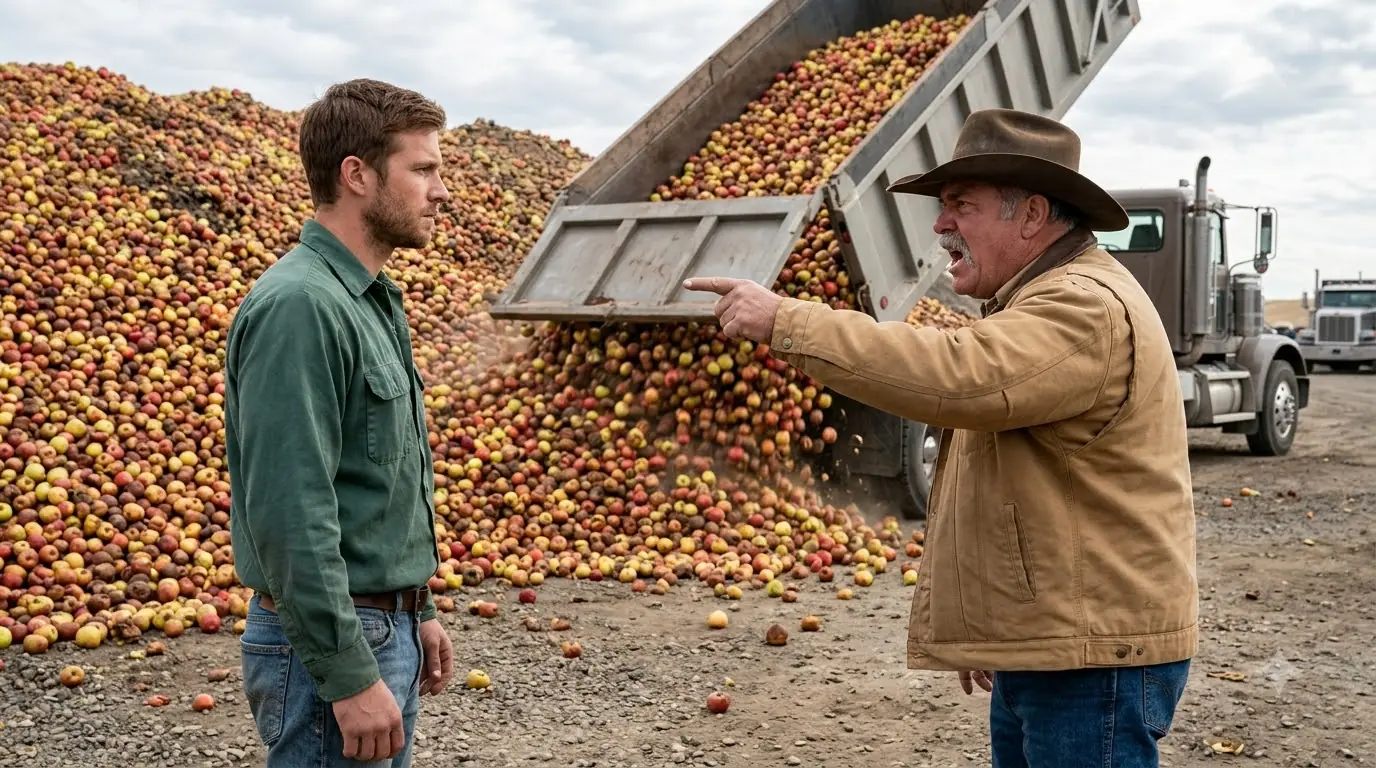
"How much of that mess are you putting here?" the neighbor called. "Every last pound," the young man answered, pointing a driver toward the prepared unloading pad. "Eighty tons?" The older farmer laughed and drew two nearby workers into his amusement. "Your grandfather fought to keep this place producing, and you finally finished it off with garbage." The young man waited until the truck had stopped before answering, "If I'm wrong, you'll know by the smell long before you know by the harvest."
His name was Caleb Rowan, and the place everyone still called the Rowan farm had not belonged to his family for eleven years. His grandfather, Ellis Rowan, had managed neighboring orchards for decades before buying a small wheat operation near the foothills, convinced that a family ought to own something it could repair with its own hands. Caleb's father had lost the property after a succession of dry years, medical bills, and an equipment loan he had never understood until the payments fell behind. The land passed to an investment company, then to a storage contractor who used a corner for machinery and left the rest bare. When Caleb finally scraped together enough money to buy it back, the realtor walked him through the purchase agreement twice to make sure he understood he was buying a problem rather than a farm.
At the closing table, Caleb signed his name with a pen that kept skipping. He had spent six years as a mechanic for an irrigation contractor, two more driving delivery trucks, and every season in between doing whatever work paid enough to keep his savings moving. He wasn't married, and his friends joked that his old pickup had been his longest relationship. He had no wealthy relatives, no inherited equipment fleet, and no mysterious investor waiting for his call. What he did have was his grandfather's battered notebook, a tractor purchased from a county surplus sale, and a conviction that the land's worst feature might also explain how to repair it.
The topsoil had gone thin before Caleb was born. Decades of aggressive cultivation had exposed it to wind, while compacted traffic lanes carried heavy rainfall away faster than roots could use it. A soil report from the extension service measured organic matter at well under one percent in several samples and found infiltration