The first truck arrived before sunrise.
It came down the narrow dirt road beside the Dela Cruz farm with its headlights cutting through the mist, carrying a load of pale brown rice husks piled higher than the cab.
Twelve-year-old Daniel heard the engine from the room he shared with his younger brother.
He slipped out of bed, crossed the kitchen, and opened the back door.
The truck stopped near the eastern boundary of the farm.
Its bed lifted.
Thousands of dry husks rushed out with a hollow whisper, forming a fresh mound beside the irrigation ditch.
The driver lowered the bed and left without looking toward the farmhouse.
By breakfast, the wind had already carried the lighter pieces across the field.
They collected against fences.
Filled shallow furrows.
Caught in the roots of the few surviving vegetable plants.
Daniel’s father stood beside the kitchen window with his coffee untouched.
“Another load,” he said.
His wife, Rosa, looked outside.
“Can we stop them?”
Miguel Dela Cruz shook his head.
“The road belongs to the mill. That strip beyond the ditch belongs to Mr. Valdez.”
“But it blows onto us.”
“I know.”
Daniel sat at the table listening.
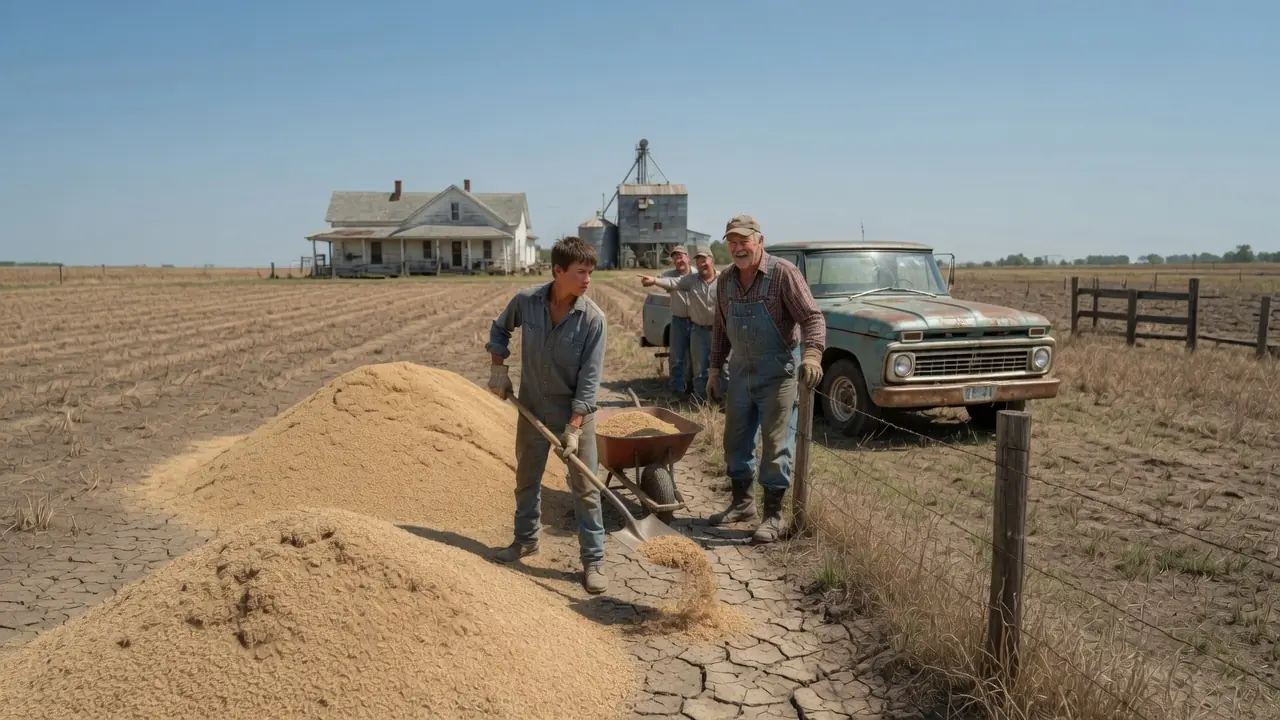
For three years, the San Marcos Rice Mill had dumped husks on the unused land bordering the family’s twenty-two-acre farm in central Arkansas.
The mill called it temporary storage.
Everyone else called it the husk mountain.
By summer, the piles rose higher than the fence.
When the wind came from the east, husks covered the Dela Cruz fields like dry snow. During rain, they clogged the drainage channels. In hot weather, they trapped against machinery and fences.
Neighbors complained about dust.
Children threw themselves down the slopes for fun.
The mill continued dumping.
To most people, the husks were worthless.
To Miguel, they were another reminder that his farm was failing.
The soil had once been dark and loose enough to crumble in his hand.
By 2008, years of drought, repeated tillage, and declining organic matter had turned much of it into hard gray-brown ground.
Rain struck the surface and ran away.
During summer, cracks opened wide enough for Daniel to push his fingers into them.
The farm still produced soybeans, sweet corn, and a few acres of vegetables, but yields fell each season.
Miguel borrowed more money to apply fertilizer.
The fertilizer produced short bursts of green growth.
Then the plants weakened again.
The soil no longer seemed capable of holding water or nutrients.
When Daniel was ten, he heard his father tell Rosa they might have to sell the eastern field.
At twelve, he heard him discuss selling the entire farm.
The Dela Cruzes had owned the land for only eleven years, but Miguel had worked toward it for most of his life.
He arrived in the United States from the Philippines at twenty-one and spent years repairing irrigation pumps, driving grain trucks, and working seasonal harvest jobs.
He saved everything he could.
The twenty-two acres outside San Marcos were not considered especially good land, but they were his.
He built the small farmhouse with help from friends.
Rosa planted fruit trees beside the kitchen.
Daniel learned to walk between rows of young corn.
His younger brother, Mateo, was born in the back bedroom during an ice storm when the ambulance could not reach them.
The farm was not simply where they lived.
It was evidence that sacrifice could become something solid.
Now that evidence was drying out beneath their feet.
Daniel attended San Marcos Middle School, where his science teacher, Mrs. Evelyn Hart, assigned the class a soil project.
Each student had to collect samples from three places and compare their color, texture, drainage, and organic content.
Daniel collected one sample from the garden near the house.
One from the eastern field.
And one from beneath the oldest rice-husk pile.
The first two behaved as expected.
The garden soil contained some dark material from compost Rosa added each spring.
The eastern field was pale, compacted, and slow to absorb water.
The soil beneath the husks was different.
Daniel pushed his hand several inches into it without needing a shovel.
The ground was cool and dark.
Earthworms twisted beneath the surface.
When he poured water onto the sample at school, it absorbed slowly and evenly.
Mrs. Hart noticed.
“Where did this come from?”
“Beside our farm.”
“What grows there?”
“Nothing. The rice mill dumps husks on it.”
She crumbled the soil between her fingers.
“How long have they been there?”
“Three years.”
“And the soil beneath them looks like this?”
Daniel nodded.
Mrs. Hart looked at the other samples.
“Burns some. Pushes the rest back.”
“Why?”
“They’re waste.”
Mrs. Hart smiled slightly.
“Are you sure?”
That question followed Daniel home.
He walked to the husk mound after school.
The pile smelled dry and faintly sweet.
He dug into it with both hands.
The outer layer was loose and sharp.
Several inches down, the husks had darkened.
Deeper still, they were damp and partly broken apart.
Fungi formed white threads between them.
Beneath the oldest section, the soil felt like the sample from class.
Daniel filled a bucket.
Miguel saw him carrying it toward the garden.
“What are you doing?”
“Testing something.”
“With that?”
Daniel nodded.
“Throw it back.”
“Why?”
“It brings rats.”
“I didn’t see rats.”
“It can carry mold.”
“Some mold helps soil.”
Miguel looked at him.
“Since when are you an agronomist?”
Daniel recognized the warning in his father’s voice.
He lowered the bucket.
“Mrs. Hart said the ground under the pile is better.”
Miguel glanced toward the husk mountain.
“That ground has not grown a crop in twenty years.”
“Maybe the husks changed it.”
“Maybe your teacher does not depend on that ground to pay a bank.”
Daniel said nothing.
Miguel took the bucket and emptied it beside the ditch.
“We need less of that waste on our farm, not more.”
For the next week, Daniel observed instead of arguing.
He measured soil temperature beneath the husks and in the open field.
The husk-covered ground was cooler by eleven degrees in the afternoon.
He poured equal cups of water onto bare soil and husk-covered soil.
Water ran off the bare ground.
The husks slowed it long enough to soak in.
He placed husks in jars with different materials.
One jar contained only husks.
Another contained husks and soil.
A third contained husks, soil, and chicken manure from Rosa’s coop.
The third jar warmed within two days.
Mrs. Hart explained decomposition.
Rice husks contained silica and broke down slowly. They could improve aeration and protect soil, but if mixed directly into the ground in large amounts, they might temporarily tie up nitrogen.
Used incorrectly, they could harm a crop.
Used as surface mulch or composted with nitrogen-rich material, they could become valuable.
Daniel wrote every detail in a spiral notebook.
He called the county extension office.
A soil specialist named Dr. Marcus Reed answered.
Daniel expected the man to dismiss him because of his age.
Instead, Marcus listened.
“Do you have access to large quantities?” he asked.
“More than we want.”
Marcus laughed.
“Rice husks can be useful. But you need to know what was done to them.”
“They come straight from the mill.”
“Any chemicals?”
“I don’t know.”
“Find out.”
“How?”
“Ask the mill.”
The San Marcos Rice Mill occupied six acres beside the railroad tracks.
Daniel rode there on his bicycle after school.
The security guard stopped him at the gate.
“You can’t ride through here.”
“I need to talk to someone about the husks.”
The guard looked at the boy, then toward the mound visible beyond the silos.
“Everyone wants to complain about the husks.”
“I don’t.”
That answer earned him a longer look.
The guard called the office.
Ten minutes later, plant manager Frank Tolland stepped outside.
Frank was fifty-four, square-faced, and wore a white shirt that never seemed to collect dust despite the mill operating around him.
“You’re Miguel’s boy.”
“Yes, sir.”
“What happened now?”
“Nothing.”
Frank crossed his arms.
“Then why are you here?”
“I want to know if the husks are treated with anything.”
Frank frowned.
“Treated?”
“Chemicals. Preservatives. Pesticides.”
“They’re hulls from milled rice.”
“So nothing added?”
“Not after milling.”
“What about before?”
“Rice may carry field residues, but the husks are screened. Why?”
Daniel held up his notebook.
“I want to use them on our soil.”
Frank stared at him.
“Your father sent you?”
“No.”
“That sounds more likely.”
“Can I take some?”
Frank looked toward the mountain.
“You want us to give you our waste?”
“Yes.”
“How much?”
Daniel had not considered the question.
“A pickup load.”
Frank laughed.
“You bring a truck, you can take ten.”
“Free?”
“You’d be saving us hauling.”
Daniel rode home faster than usual.
Miguel was repairing a cultivator tine in the machine shed.
“The mill said we can take the husks for free.”
Miguel did not look up.
“We don’t want them.”
“We could use them as mulch.”
“No.”
“Dr. Reed at the extension office said—”
“You called the extension office?”
“Yes.”
“Without asking me?”
“I asked about soil.”
Miguel put down the wrench.
“Daniel, this farm is not a school experiment.”
“The eastern field is dying.”
“I know.”
“The husks hold water.”
“They also blow everywhere.”
“We can wet them.”
“They can pull nitrogen from the ground.”
“If we leave them on top, they won’t pull as much.”
Miguel’s expression changed slightly.
The boy had done more than guess.
Daniel opened his notebook.
“I tested them. Mrs. Hart helped. The county man said to compost some with chicken manure and use the rest as mulch.”
Miguel looked at the pages but did not take them.
“We need crops this year.”
“I know.”
“If you are wrong, we lose more.”
“Then give me one acre.”
Miguel laughed once.
“One acre?”
“The worst acre near the ditch.”
“That ground barely produces anything.”
“Then we don’t risk much.”
Miguel turned back to the cultivator.
“No.”
Daniel stood there.
His father continued working.
“What would make you say yes?”
Miguel tightened the nut until the metal squealed.
“Nothing.”
Daniel left.
He did not stop experimenting.
Behind the chicken coop, Rosa allowed him to build a compost pile.
She did not ask Miguel.
Daniel layered wet rice husks with chicken manure, grass clippings, vegetable scraps, and small amounts of soil.
He checked the temperature daily.
The pile reached 132 degrees.
He turned it with a fork.
Steam rose into the morning air.
After several weeks, the harsh edges of the husks softened.
The material darkened.
Earthworms appeared near the bottom.
Rosa watched him sift it through wire mesh.
“It smells better than your father’s fertilizer.”
“It is better than fertilizer.”
“Do not say that where he can hear you.”
Daniel spread the finished compost across three rows of tomatoes.
He mulched one row with fresh husks.
A second with straw.
He left the third bare.
The summer turned dry.
By late June, the bare row required water every day.
The straw row lasted two.
The husk-covered row remained moist for nearly four.
Tomatoes in the composted section grew taller, with thicker stems and darker leaves.
Miguel noticed.
He said nothing.
In July, the farm received only half an inch of rain.
The eastern field hardened.
Soybean leaves curled during the hottest part of each afternoon.
Miguel ran the irrigation pump until the well level dropped dangerously low.
One evening, he walked through Daniel’s tomato rows.
He lifted the husk mulch with his boot.
The soil beneath was damp.
He crouched and pushed two fingers into it.
They sank easily.
Daniel watched from the porch.
Miguel stood.
“How much does the mill have?”
Daniel tried not to smile.
“Thousands of tons.”
“How would you spread it?”
“With the manure spreader.”
“It will bridge in the box.”
“We can mix it with wet compost.”
“Too light.”
“We can spray it with water.”
Miguel looked toward the eastern field.
“One acre.”
Daniel nodded quickly.
“One acre.”
“You do the work.”
“Yes.”
“You keep records.”
“I already do.”
“And if the crop turns yellow, we stop.”
“Yes.”
The first truckload arrived the following Monday.
Frank Tolland sent it at no charge.
The driver tipped the husks beside the barn.
Neighbors saw.
By evening, three people had called Miguel.
Paul Sutter, who farmed north of them, drove over personally.
“You letting the mill dump on your yard now?”
“We’re testing mulch.”
Paul looked at the pile.
“You know rice hulls don’t feed corn.”
“They’re not supposed to.”
“They’ll blow into the next county.”
Daniel stood beside his father.
“We’re wetting them.”
Paul smiled at him.
“You planning to farm or make breakfast cereal?”
Miguel’s jaw tightened.
Daniel answered before he could.
“We’re trying one acre.”
Paul looked toward the failed eastern ground.
“That acre needs lime and nitrogen, not trash.”
“We tested the pH,” Daniel said. “It’s fine.”
Paul laughed.
“You have all the answers.”
“No.”
Daniel looked at the pile.
“That’s why we’re testing it.”
They spread the husks between rows of late sweet corn and pumpkins.
First, Daniel applied a thin layer of compost.
Then he added three inches of damp husks on the surface.
The manure spreader clogged repeatedly.
He climbed inside with a fork and broke the bridges apart while the machine was shut down.
It took two days to cover the acre.
Wind lifted portions of the dry top layer.
Daniel sprayed them again.
Neighbors continued laughing.
Someone placed a hand-painted sign beside the road:
DANIEL’S GIANT CHICKEN BED.
Miguel removed it before sunrise.
The first season did not produce a miracle.
The sweet corn grew slightly better than the previous year.
The pumpkins spread farther than expected.
Weeds decreased beneath the mulch.
Water use dropped by nearly forty percent.
But yields were not extraordinary.
Paul Sutter stopped beside the field after harvest.
“Where’s the miracle?”
Daniel looked at the remaining husks.
“I didn’t promise one.”
Paul kicked at the mulch.
“You spent all summer hauling waste to grow average corn.”
“The bare field grew almost nothing.”
“Almost nothing is cheaper.”
Daniel wrote the comment in his notebook.
Not because he agreed.
Because it revealed the question people were asking.
Was the improvement worth the labor?
That winter, Daniel collected more data.
Soil beneath the husks remained less compacted.
Earthworm counts tripled.
Rain infiltrated faster.
Organic matter rose slightly.
The changes were small.
But they moved in the right direction.
Dr. Reed visited in February.
He took cores from the treated and untreated ground.
“The top six inches are improving,” he said.
Miguel watched him crumble the soil.
“How long before it becomes good?”
Marcus smiled.
“Good soil is not a product you install.”
“How long?”
“Three years for obvious changes. Longer for deep ones.”
Miguel looked disappointed.
Daniel did not.
Three years sounded possible.
They expanded to four acres.
The mill delivered thirty loads.
Frank Tolland was pleased to reduce disposal costs. He told other farmers they could take husks too.
No one did.
The second year, Daniel changed the process.
Fresh husks were spread only as surface mulch.
Composted husks went into planting rows.
He added cattle manure from a neighboring dairy and green material from the town’s yard-waste collection.
He also made biochar from some of the husks.
Dr. Reed warned him not to burn them carelessly.
Rice husk ash could be extremely fine, and uncontrolled burning wasted much of the carbon.
Daniel built a small low-oxygen kiln from an old steel drum.
The first batch failed.
It turned mostly to ash.
The second remained half raw.
By the fourth attempt, he produced black, brittle char.
He soaked it in manure tea before applying it.
“Why soak charcoal?” Mateo asked.
“Empty char can hold nutrients, but it needs to be charged first.”
Mateo stared at him.
“You sound like Mrs. Hart.”
Daniel threw a husk at him.
The second growing season brought heavy spring rain followed by six dry weeks.
Untreated sections crusted after the rain.
Seedlings struggled to emerge.
The husk-covered ground absorbed water without sealing.
Later, during the drought, it remained moist longer.
The sweet corn on Daniel’s acres grew nearly a foot taller.
Pumpkins produced twice the weight.
Soybean roots extended deeper and carried more nodules.
Miguel began taking visitors to the field.
He still described it as his son’s experiment, but the words no longer sounded dismissive.
He purchased a used compost turner at auction for $600.
Rosa noticed.
“You said this was not a school project.”
“It isn’t.”
“What is it now?”
Miguel looked toward Daniel loading husks.
“Work.”
The third year changed everything.
Spring arrived wet.
Water stood across much of the county.
Fields north of San Marcos remained too soft for planting.
The Dela Cruz husk-treated acres drained faster because the improved surface structure allowed water to move downward instead of collecting above compacted soil.
Miguel planted four days earlier than most neighbors.
Then summer turned brutally dry.
Temperatures remained above ninety-five degrees for twelve consecutive days.
Paul Sutter’s corn fired from the bottom leaves upward.
The Dela Cruz plants curled at midday but recovered each evening.
Beneath the husk mulch, soil temperature remained lower.
Moisture stayed available near the root zone.
When harvest came, the treated ground produced more than anyone expected.
Sweet corn yields nearly doubled compared with the untreated field.
Pumpkins averaged twenty-eight pounds.
The soybean section produced fifty-four bushels per acre.
The untreated eastern ground produced twenty-nine.
People stopped laughing.
They began stopping at the road.
First one truck.
Then three.
Then entire groups.
Farmers walked the rows and lifted husks with their boots.
They pushed fingers into the soil.
They asked about nitrogen.
Application depth.
Wind.
Rats.
Fire risk.
Decomposition.
Daniel answered what he knew.
When he did not know, he said so.
Paul Sutter visited after dark, when fewer people would see his truck.
“How much did you spread?”
“Three inches the first year. Added about one inch after that.”
“How much nitrogen?”
Daniel gave him the records.
Paul looked through the notebook.
“You wrote down every rain?”
“Yes.”
“Every irrigation?”
“Yes.”
“Why?”
“So I’d know if it worked.”
Paul returned the notebook.
“Can I try ten acres?”
Daniel smiled.
“The mill will be happy.”
By the time Daniel graduated from high school, twelve farms around San Marcos used rice husks.
The mill stopped dumping beside the Dela Cruz property.
Instead, farmers lined up to collect them.
Frank Tolland began charging a small loading fee.
Daniel objected.
“You used to pay to get rid of them.”
Frank shrugged.
“They have value now.”
“They always had value.”
“Not until someone wanted them.”
That statement stayed with Daniel.
Value did not begin when a material became useful.
Sometimes usefulness existed long before anyone understood it.
He enrolled at Arkansas State University to study soil science.
Miguel wanted him to remain on the farm.
Rosa insisted he leave.
“You discovered one thing,” she told him. “Go learn the names of the rest.”
Daniel returned every weekend.
At university, he learned the chemistry behind what he had observed.
Rice husks contained lignin and silica, making them resistant to rapid decomposition.
Their structure improved porosity.
As surface mulch, they reduced evaporation, moderated temperature, suppressed weeds, and protected soil from raindrop impact.
Composted properly with nitrogen-rich material, they added stable organic matter.
Converted into biochar, they could improve nutrient retention and microbial habitat in certain soils.
But they were not magic.
Applied too thickly, they could repel water while dry.
Mixed fresh into soil, they could temporarily immobilize nitrogen.
Burned carelessly, they created smoke and dangerous fine ash.
In wet climates, they could create drainage issues.
Every use depended on conditions.
Daniel returned home with more caution than confidence.
He changed the farm’s system again.
They tested application rates.
Measured soil carbon.
Monitored nutrient levels.
Compared husks with straw, wood chips, and cover crops.
The best results came not from husks alone, but from combining them with reduced tillage, compost, cover crops, and careful irrigation.
The husks had opened the door.
They were not the entire room.
In 2016, a severe drought struck the region.
Several farms lost nearly half their yields.
The Dela Cruz farm suffered too.
But its restored soils held enough moisture to produce a viable crop.
The family made every loan payment.
For the first time since Daniel was a child, Miguel ended the year with money left after expenses.
He sat at the kitchen table reviewing accounts.
“You saved the farm,” he said.
Daniel shook his head.
“The husks helped.”
“You found them.”
“They were already there.”
Miguel looked toward the eastern field.
“You saw something I didn’t.”
Daniel closed the ledger.
“I was looking because I didn’t know what I was supposed to ignore.”
Miguel smiled.
“That sounds like an insult.”
“It might be.”
The farm expanded to forty acres after they purchased adjoining land from Mr. Valdez.
The same strip where the mill once dumped its waste became the center of a soil-restoration demonstration field.
Daniel planted vegetables, grains, and fruit trees.
He experimented with no-till planting through husk mulch.
The peach trees beside the former dump grew faster than those near the house.
Earthworm counts reached levels Daniel had never recorded anywhere on the original farm.
Birds returned to the hedges.
Rainwater that once rushed into the ditch soaked slowly into the ground.
The sleeping soil had not been dead.
It had been starved of protection and organic matter.
Daniel finished his degree and returned home full-time.
He founded a small company called Delta Soil Works.
At first, it consisted of one truck, two compost turners, and a borrowed loader.
The company collected rice husks from mills and blended them with manure, food-processing waste, and plant material.
They sold compost and charged farmers for custom application.
Frank Tolland became one of Daniel’s first contracts.
The conversation took place in the same mill office Daniel entered on his bicycle years earlier.
Frank slid an agreement across the desk.
“You’ll remove all our husks?”
“Most of them.”
“And pay us?”
Daniel shook his head.
“You pay us to manage them.”
Frank laughed.
“You expect me to pay you for something farmers want?”
“You’re not paying for the husks. You’re paying for guaranteed removal, storage compliance, dust control, and recordkeeping.”
Frank leaned back.
“You learned business at college.”
“I learned what disposal costs you.”
Frank studied the numbers.
Then signed.
Within five years, Delta Soil Works served three counties.
Daniel employed eighteen people.
He never described rice husks as free fertilizer.
They were not fertilizer.
He described them as a resource that required correct handling.
That distinction saved customers from the mistakes early imitators made.
One farmer tilled fresh husks deeply into a cornfield and created severe nitrogen deficiency.
Another piled dry husks near a shed, where a spark from a welder started a fire that smoldered for days.
Daniel used both failures in workshops.
“Waste does not become harmless because we call it useful,” he told farmers. “It becomes a responsibility.”
The most important test came during the flood of 2021.
The Red River rose after days of heavy rain.
Water crossed low roads and entered fields throughout the county.
The Dela Cruz farm stood on slightly higher ground, but the eastern acres received more than eight inches of rain in four days.
Miguel, now sixty-seven, watched from the porch.
“When you were twelve, this field would have stayed underwater for a week.”
Water moved through the cover crop and husk-rich surface without cutting deep channels.
The soil absorbed more than it once could.
Excess drained gradually toward the restored ditch.
By the third day, the field was walkable.
Across the road, conventional bare ground carried visible sheets of topsoil into the drainage canal.
Paul Sutter stood beside Daniel watching brown water leave his untreated back field.
“I should have listened sooner.”
“You did listen.”
“After I laughed for three years.”
Daniel smiled.
“You were early compared with some.”
Paul looked toward the Dela Cruz land.
“You know what bothers me?”
“What?”
“I spent forty years buying things in bags because I thought improvement had to arrive with a label.”
Daniel picked up a handful of husk-rich soil.
“Labels make instructions easier.”
“They also make invoices.”
“Yes.”
Paul laughed.
When Miguel retired, he did not leave the farm.
He continued repairing machinery and complaining about Daniel’s management decisions.
“You use too many cover crops.”
“They protect the soil.”
“They look like weeds.”
“They are planted in rows.”
“Organized weeds.”
Rosa kept chickens and maintained the orchard.
Mateo became an electrician and installed solar panels on the compost facility.
Mrs. Hart visited the farm with each new group of sixth-grade students.
She always brought three jars.
Bare soil.
Husk-covered soil.
Compost.
Students poured water into them and watched the differences.
One year, a girl asked Daniel when he knew the idea would work.
“I didn’t.”
“But you used acres of your farm.”
“One acre first.”
“Weren’t you afraid?”
“Yes.”
“What if it failed?”
“Then I wanted it to fail small enough that I could learn from it.”
Mrs. Hart smiled.
She had heard him give the answer many times.
At the end of the tour, Daniel showed students his first spiral notebook.
The pages were stained with soil and rain.
Temperatures.
Rainfall.
Water tests.
Compost recipes.
In one margin, he had copied Paul Sutter’s comment:
Almost nothing is cheaper.
Beneath it, years later, Daniel added:
Until the cost of losing the soil arrives.
The San Marcos Rice Mill changed ownership in 2024.
The new corporation planned to install a furnace that would burn husks for energy.
The announcement was presented as a sustainability project.
The furnace would reduce waste and generate heat for the milling process.
Daniel supported the idea in principle.
Then he read the plans.
The company intended to burn nearly all available husks.
Farmers who had built soil programs around the material would lose access.
The combustion ash would still contain silica, but most of the carbon would be gone.
At a public meeting, Daniel asked the new plant director, Kevin Ross, whether the company had evaluated agricultural demand.
Kevin smiled in the same patient way Charles Voss had once smiled at a child asking too many questions in another town.
“Our energy system is the highest-value use.”
“Highest value to whom?”
“To the facility and the environment.”
“Farmers are using those husks to reduce irrigation and erosion.”
“We are aware of limited agricultural use.”
“Limited?”
Daniel listed the acreage.
More than six thousand acres received some form of husk mulch, compost, or biochar blend.
Kevin’s expression changed.
“We cannot build industrial strategy around informal local practices.”
Daniel looked at the farmers beside him.
“The practices are documented.”
“By your company.”
“By the extension service and university too.”
The conflict divided the county.
Some supported the energy furnace.
It promised jobs and lower emissions from fossil fuel.
Others feared losing a resource they now depended on.
Daniel refused to frame it as energy versus soil.
“The question is not whether husks should be burned,” he said. “It is how much should be burned after agricultural needs are measured.”
The university conducted a life-cycle analysis.
The result surprised both sides.
Burning a portion of the husks for energy reduced natural-gas use.
Returning a portion to soil as compost or biochar stored carbon, improved water efficiency, and reduced fertilizer losses.
The best environmental outcome came from dividing the supply.
Kevin resisted.
The furnace contract depended on full capacity.
Internal emails later revealed the company had overstated waste availability to secure financing.
Once again, something called worthless had already been promised twice.
Daniel proposed a compromise.
The mill would reserve thirty-five percent of husks for agriculture.
The furnace would use the rest.
Ash from combustion would be tested and, where safe, incorporated into construction materials or carefully managed soil amendments.
The company rejected the proposal.
Farmers organized.
Not with threats.
With records.
Water-use reductions.
Yield comparisons.
Soil-carbon data.
Erosion measurements.
Photographs covering fifteen years.
The same notebooks people had once laughed at became evidence in state hearings.
A regulator asked Daniel why rice husks deserved special protection.
“They don’t,” he answered.
“The soil does.”
The commission required the mill to complete a resource-allocation study before operating at full capacity.
The final agreement reserved forty percent of the husks for agricultural use.
The furnace opened a year later at reduced design load.
Both systems survived.
Kevin Ross resigned before construction ended.
Frank Tolland, long retired, attended the opening ceremony.
He stood beside Daniel watching conveyors carry husks in two directions.
One toward the energy plant.
One toward the compost loading area.
“You know,” Frank said, “when you came to my office, I thought you wanted a pickup load.”
“I did.”
“You took the whole waste stream.”
Daniel shook his head.
“No. I changed where people thought the stream ended.”
At forty-two, Daniel still farmed the original Dela Cruz acres.
The eastern field had become the most productive ground on the property.
Soil organic matter rose from less than one percent to more than four in the best areas.
The ground held more water.
Needed less irrigation.
Resisted crusting.
Produced reliable crops through both dry and wet seasons.
The transformation did not come from husks alone.
It came from eighteen years of mulch, compost, cover crops, reduced tillage, manure, careful fertilizer use, and constant observation.
But the husks began it.
They were the material close enough to use.
Cheap enough to risk.
Strange enough to make a boy curious.
When Miguel died at seventy-four, hundreds attended the funeral.
Farmers.
Mill workers.
Students.
Employees.
People whose land had improved because the Dela Cruz family shared what they learned.
After the service, Daniel walked to the old eastern field.
He carried his father’s work gloves.
Miguel had worn them until the leather hardened around the fingers.
Daniel placed them on a fence post.
For years, he believed his father had resisted the husks because he lacked imagination.
Age taught him something more generous.
Miguel was not afraid of rice husks.
He was afraid of losing the little he had.
A child could afford curiosity because failure remained someone else’s burden.
A father with loans, crops, and children saw every experiment as a possible missing payment.
Miguel had still given him one acre.
That acre became forty.
Then six thousand across the county.
Daniel kept the original one-acre plot separate from the commercial fields.
He never leveled its uneven rows.
A small sign stood beside it:
FIRST HUSK TRIAL — 2009
Visitors expected dramatic plants.
Most years, it looked ordinary.
That was the point.
Healthy soil rarely looked heroic.
It held water.
Accepted roots.
Fed microorganisms.
Allowed crops to grow without calling attention to itself.
One afternoon, a boy from a nearby farm stood beside the sign holding a bag of cotton-gin waste.
“My father says this stuff is useless,” he told Daniel.
“It might be.”
The boy looked disappointed.
Daniel crouched and examined the material.
“Or it might be useful in a specific way.”
“How do I know?”
“You test it.”
“My father won’t let me use a field.”
“Ask for a garden row.”
“What if he says no?”
“Use a bucket.”
The boy looked toward the restored fields.
“Did everyone laugh at you?”
“Not everyone.”
“Who believed you?”
Daniel thought of Mrs. Hart.
Dr. Reed.
His mother quietly giving him space behind the chicken coop.
His father finally allowing one acre.
“Enough people.”
The boy lifted the bag.
“What should I write down?”
“Everything that changes.”
As the child walked away, wind moved across the farm.
A few rice husks lifted from a compost pile and drifted toward the eastern field.
Years earlier, the same sight made Miguel angry.
The husks represented disrespect.
Waste dumped beside struggling ground.
A problem delivered by the truckload.
Daniel watched them settle between rows of a winter cover crop.
Nothing about the material had changed.
It remained light.
Sharp.
Slow to decay.
Difficult to handle.
What changed was the understanding around it.
People had stopped asking how to get rid of it.
They began asking what work it could do before it was gone.
The mill once dumped mountains of rice husks because no one believed they had value.
A twelve-year-old boy collected them because he noticed the soil underneath.
He did not revive the farm with a secret.
He did it with one acre, repeated measurements, small failures, and the patience to let soil recover at the speed living things require.
By the time the neighbors understood what the husks could do, the dry eastern field had become the darkest ground on the farm.
And the waste everyone wanted gone had taught an entire county how to stop throwing away its soil.