The first thing Nia Davenport noticed about the retired police dog was that he did not care about her.
That mattered because his owner seemed convinced she was the most suspicious person who had ever moved onto Magnolia Crest Drive.
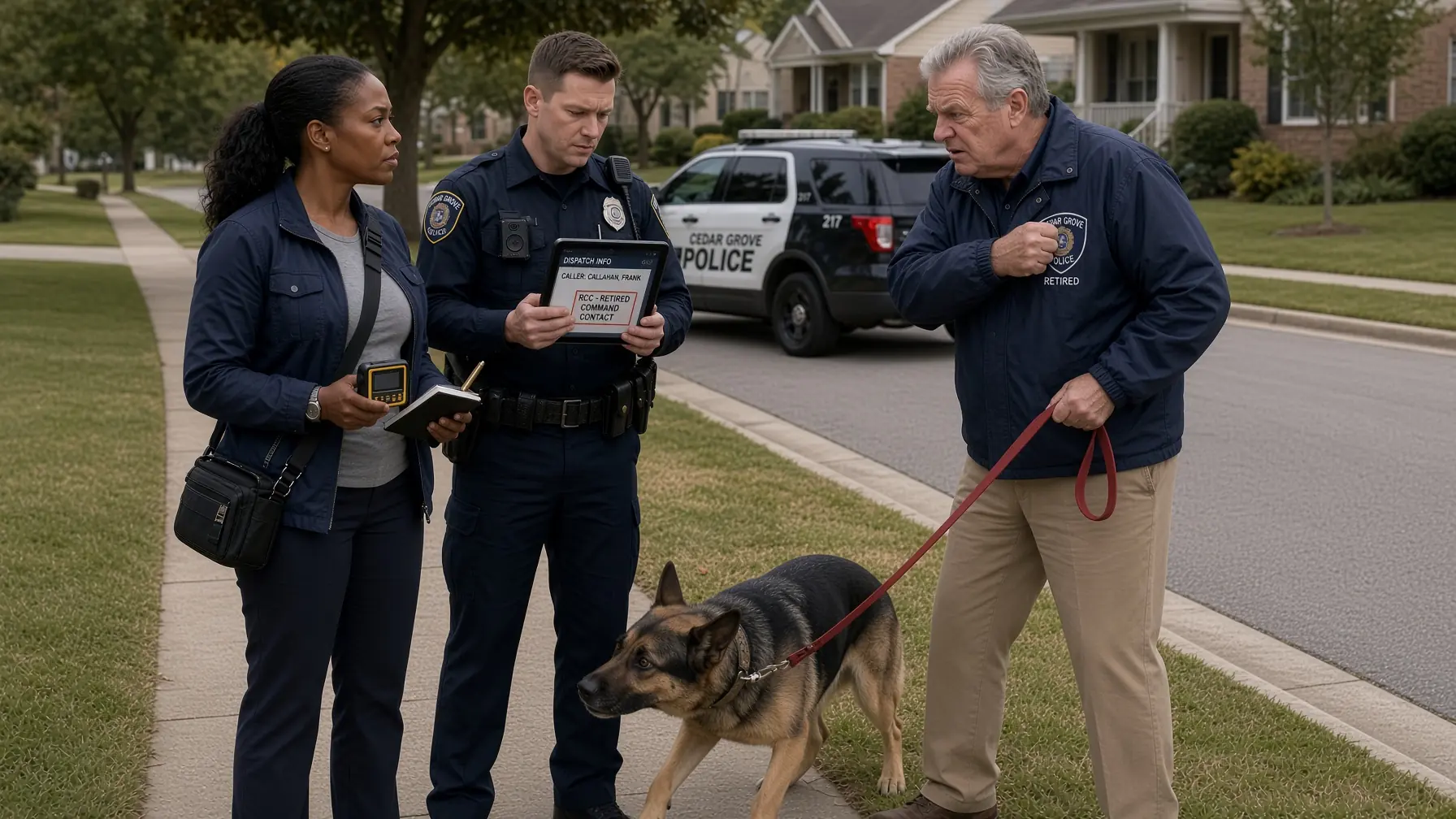
Ranger was an eleven-year-old German Shepherd with gray around his muzzle and stiffness in his hips. According to the brass tag on his red collar, he had once worked with the Cedar Grove Police Department.
His owner, Gordon Pike, had too.
Captain Gordon Pike.
Retired four years.
He made sure everyone knew the title.
On Nia’s sixth morning in Pinebrook Heights, Ranger stood at the edge of Gordon’s yard, ignored Nia completely, lowered his nose, and pulled toward a circular utility cover embedded beside the eastern sidewalk.
Again.
Nia had seen him do it three times already.
The grass around the cover had turned yellow despite recent rain.
A shallow depression had formed in the pavement.
And when the neighborhood sprinklers ran, Ranger became restless enough that Gordon had to shorten the leash.
Nia crouched several feet away on the public sidewalk and lifted a small air-quality monitor.
She did not touch the cover.
Did not open it.
Did not cross into anyone’s yard.
She held the sensor above the pavement, checked the reading, and took a photograph.
Behind her, Gordon said:
“There you go again.”
Nia stood.
Gordon was sixty-six, tall, square-shouldered, silver-haired, still carrying himself like a man who expected rooms to quiet when he entered them.
He wore an old Cedar Grove Police Department windbreaker.
The patch had faded.
The authority had not, at least in his own mind.
“You’ve been here less than a week,” he said, “and you keep photographing utilities.”
Nia slipped the monitor into her shoulder bag.
“I’ve been here six days.”
“That’s what I said.”
“And this is the third time you’ve confronted me for standing on a public sidewalk.”
“I’m watching out for my neighborhood.”
Nia looked at Ranger.
The dog was still staring toward the utility cover.
“Your dog appears to be watching out for something else.”
Gordon tightened the leash.
“Leave Ranger out of it.”
A marked police SUV turned onto Magnolia Crest Drive.
Nia looked at the time.
8:14 a.m.
She opened the small notebook in her hand and wrote it down.
Gordon noticed.
“You documenting me?”
“I document events.”
“That usually means you’re planning something.”
“It usually means people remember events differently.”
The patrol SUV stopped.
Officer Jordan Ruiz stepped out.
He saw Gordon and immediately said:
“Morning, Captain.”
Nia looked up.
Gordon had not been a captain for four years.
Yet the title arrived before any question about what had happened.
Ruiz approached him first.
“Dispatch said possible interference with a gas utility.”
Gordon pointed toward Nia.
“She’s been photographing covers and using electronic equipment around the line.”
Ruiz turned.
“Ma’am?”
“Nia Davenport.”
“What’s the device?”
“Air-quality monitor.”
“You open the cover?”
“No.”
“Touch it?”
“No.”
“Put anything inside?”
“No.”
Ruiz looked toward Gordon.
“Did you see her do any of those things?”
Gordon crossed his arms.
“I saw suspicious behavior.”
Nia said:
“That wasn’t the question.”
Gordon’s jaw tightened.
Ruiz looked tired already.
“What exactly are you doing, Ms. Davenport?”
“Observing visible conditions.”
She pointed.
“Discolored grass.”
“Pavement settlement.”
“Possible odor under certain wind conditions.”
“And his dog repeatedly alerts to the same location.”
Gordon scoffed.
“He reacts because she keeps coming out here with equipment.”
Nia looked toward Ranger.
The dog was not looking at her.
Ruiz followed her gaze.
For several seconds, nobody spoke.
Then he said:
“There’s no violation here.”
Gordon stared at him.
“You’re taking her word over mine?”
“I’m looking at what happened.”
Nia wrote the response time into her notebook.
Seven minutes.
That was almost as interesting as the utility cover.
Almost.
Six days earlier, Nia had arrived at 1842 Magnolia Crest Drive in a gray Volvo with Washington, D.C., plates.
Gordon lived next door.
He had been sitting on his porch when she unloaded two locked equipment cases.
Before the delivery driver left, Gordon crossed the lawn.
“You the new owner?”
“Yes.”
“Nia Davenport.”
“Gordon Pike.”
He waited.
Then added:
“Retired captain, Cedar Grove Police Department.”
Nia offered her hand.
“Nice to meet you.”
He seemed disappointed by the normality of her response.
“You live here alone?”
“Yes.”
“What kind of work?”
“Public-safety compliance.”
“For the city?”
“I consult on regulatory and integrity reviews.”
His eyes moved toward the equipment cases.
“What’s in those?”
“Work equipment.”
“Pinebrook has strict HOA rules.”
“I read them before closing.”
“People here value order.”
“So do I.”
Gordon smiled.
“Then we’ll get along.”
Nia smiled back.
“I also value boundaries.”
That smile disappeared.
An hour later, a delivery van brought two boxes labeled with the name of an environmental-monitoring supplier.
Gordon called police before the driver finished unloading.
Officer Ruiz arrived in seven minutes.
He asked Nia to confirm she owned the property.
She showed her driver’s license and closing documents.
Gordon then suggested Ruiz inspect the boxes.
Ruiz refused.
No warrant.
No reported crime.
No emergency.
After the patrol car left, Nia entered her kitchen, opened a black notebook, and wrote three observations with the old brass mechanical pencil that had belonged to her father.
One:
Gordon Pike made a non-emergency complaint.
Two:
Police arrived in seven minutes.
Three:
The responding officer interviewed the retired captain before approaching the homeowner.
Nia drew no conclusion.
One incident was not a pattern.
Her father had been a building inspector for thirty-eight years.
He used to tell her:
“Write what you know.”
“Write what you think separately.”
“And never confuse the columns.”
She still followed that rule.
That evening, Nia reviewed the Pinebrook Heights HOA packet.
The association had rules for everything.
Mailbox colors.
Fence heights.
Overnight parking.
Exterior paint.
Garage-door replacements.
Satellite dishes.
Holiday lighting.
But the section covering shared gas and water infrastructure referenced annual inspections that were not included.
Nia logged into the resident portal.
The inspection records were not there either.
That alone proved nothing.
Associations were often disorganized.
Then Ranger began whining outside.
Nia looked through the kitchen window.
Gordon had taken him for an evening walk.
Ranger passed three houses without interest.
Then reached the eastern utility cover and stopped.
Nose down.
Body tense.
Gordon tugged.
“Come on.”
Ranger refused.
Nia checked the wind.
East to west.
Toward Gordon’s house.
She wrote that down too.
By Sunday, there were enough small details to justify questions.
Yellowing grass.
Pavement settlement.
The dog’s repeated behavior.
Missing maintenance records.
Two unusually rapid police responses to Gordon’s complaints.
Nia emailed the HOA president.
His name was Wesley Trammell.
She requested the most recent gas-line inspection, contractor invoice, and pressure-test certification.
Wesley responded twenty-three minutes later.
Welcome to Pinebrook Heights. Most neighborhood concerns can be resolved privately without unnecessary alarm. Please contact me directly before involving city agencies.
No inspection attached.
No invoice.
No certification.
Nia read the email twice.
Then forwarded it to a separate secure archive.
Her friend Tara Kim arrived later with coffee, bagels, and a small camera system.
Tara had known Nia since graduate school.
She entered the kitchen, saw the utility maps covering the table, and sighed.
“You’ve been here less than a week.”
“Yes.”
“And already need cameras.”
“They’re for documentation.”
“That is never reassuring when you say it.”
They installed cameras covering Nia’s porch, driveway, front yard, and public approach.
Nothing pointed into Gordon’s windows or private yard.
Within fifteen minutes of Gordon noticing the installation, another patrol car arrived.
Again Ruiz.
He inspected the camera angles.
All lawful.
Gordon pointed at one.
“She can move it after you leave.”
Ruiz looked exhausted.
“Captain, I can only document what exists now.”
Nia stepped forward.
“Please include the camera direction in the report.”
Gordon stared at her.
“You’re creating a paper trail.”
Nia closed her notebook.
“Paper trails usually create themselves.”
The next morning, Nia tried something simple.
Three appointment notices.
Each described a licensed indoor air-quality technician visiting her home.
One copy went to Gordon.
Arrival time: 9:00 a.m.
One went to Wesley.
Arrival time: 11:00.
One went to the HOA office.
Arrival time: 2:00.
The actual technician was scheduled for eleven.
At 10:55, a white service van arrived.
At 10:58, a police cruiser turned onto Magnolia Crest.
Ruiz stepped out.
“We received a suspicious-contractor report.”
The technician held up his work order.
“I’m scheduled inside.”
Nia asked:
“What arrival time did the caller provide?”
Ruiz checked his notes.
“Around eleven.”
Nia looked across the street.
Wesley Trammell stood beside his mailbox pretending to examine letters.
Only Wesley had received eleven.
Nia wrote the event number down.
Later, Tara asked:
“That proves he called.”
“It proves the information traveled through him.”
“You know he called.”
“I know what the evidence supports.”
Tara smiled.
“You haven’t changed.”
“No.”
“That was not a compliment.”
The technician found no unsafe reading inside Nia’s house.
But near the eastern exterior wall, he stopped.
“Do you smell that?”
Nia did.
Faint.
Sulfur-like.
Gone when the wind changed.
“Could be landscaping chemicals,” he said.
“Could be drainage.”
“I’d keep monitoring.”
Gordon heard the comment from his driveway.
Within minutes, he went inside and called someone.
That afternoon, Wesley appeared at Nia’s front door carrying an apple pie.
He wore a navy sport coat and carried himself like a banker attending a funeral.
“I thought we should start over.”
Nia looked at the pie.
“Coffee?”
“Black.”
They sat in her kitchen.
Wesley’s attention moved toward the locked equipment cases in the hallway.
“I understand you have concerns about utility records.”
“I requested them.”
“Older HOA documents are not always organized.”
“The maintenance report that appeared yesterday was removed from the resident portal overnight.”
Wesley’s expression did not change.
“You monitor the portal closely.”
“I monitor documents tied to public safety.”
He folded his hands.
“Residents are becoming nervous.”
“They see sensors.”
“Police vehicles.”
“Questions about underground gas.”
“The police vehicles arrived because Gordon keeps calling them.”
“He’s protective.”
“He’s using old relationships to turn suspicion into police responses.”
Wesley picked up his coffee.
“Thirty years of service earns respect.”
“Yes.”
“It does not convert guesses into evidence.”
Nia leaned forward.
“When was the eastern line last pressure-tested?”
“Late spring.”
“Which contractor?”
“Carolina Municipal Inspection Services.”
“Who was the engineer?”
“I don’t remember.”
“You signed the certification.”
“I sign many documents.”
“Then send me the invoice, test record, and engineer verification.”
Wesley set the cup down.
“Most residents don’t interrogate volunteer board members over routine maintenance.”
“Most board members don’t ask residents to remove safety monitors while refusing to produce safety records.”
He stared at her.
Then:
“I hope we can settle this privately.”
“So do I.”
She looked at the unopened pie.
“Send the records.”
Wesley left without taking it.
By the following morning, Nia had the report.
It created more questions than it answered.
The company named on the inspection had allowed its state registration to lapse more than a year earlier.
The engineer whose signature appeared on the document had retired six months before the alleged inspection.
And the signature itself looked suspiciously clean.
Nia sent it to Tara.
“Public sources only.”
“No private databases.”
“No intrusion.”
“Visible document properties and licensing records.”
Tara called an hour later.
“The signature image matches one used on a public report from three years ago.”
Nia stopped writing.
“Same image?”
“Same imperfections.”
“And the contractor?”
“Dissolved.”
“Engineer?”
“Retired before the inspection date.”
Nia looked toward the eastern sidewalk.
The false document changed everything.
A missing record was disorganization.
A document created to make a safety problem look resolved was something else.
Then the gas company responded to Nia’s public-record request.
The eastern branch had experienced pressure irregularities ten months earlier.
Replacement had been recommended.
The work order was marked completed.
There was no matching service record showing the replacement had actually occurred.
Nia printed the letter.
Placed it beside the HOA report.
And wrote:
Evidence now supports unresolved infrastructure risk and falsified maintenance documentation.
Then another line:
Unknown who created false report. Unknown financial motive. Unknown level of police involvement.
Separate columns.
Always.
Gordon’s calls continued.
A contractor carrying storage drives.
Suspicious.
Tara visiting.
Suspicious.
A licensed technician parked near Nia’s driveway.
Suspicious.
Nia using an air monitor on her own flower bed.
Suspicious.
Each call generated an event number.
Each produced an officer.
Some arrived within ten minutes.
Others even faster.
Nia began comparing response times using public dispatch information.
A vehicle break-in several streets away waited nearly an hour.
A damaged stop sign remained unattended while two units checked a service van at her house.
One welfare check was delayed while Ruiz responded to another complaint from Gordon.
The pattern no longer affected only Nia.
Police resources were being diverted.
When Ruiz returned for the fifth time, Nia gave him a bottle of water.
He accepted.
Then said quietly:
“For what it’s worth, I told dispatch there wasn’t a reason to send me.”
“Then why are you here?”
“Your address has an RCC notation.”
Nia opened her notebook.
“What does RCC mean?”
Ruiz hesitated.
“Retired command contact.”
“Written policy?”
“No.”
“Who authorizes it?”
“I don’t know.”
“What effect?”
“Calls from certain retired command staff get treated as trained-observer reports.”
“Higher priority?”
“Sometimes.”
Nia nodded.
“How many complaints from Mr. Pike have resulted in violations?”
Ruiz knew the answer.
“None.”
“How many complaints become wrong before reputation stops functioning as evidence?”
Ruiz looked toward Gordon’s house.
“He trained half the department.”
“That explains the respect.”
“It does not explain the priority.”
Ruiz handed back the water bottle.
“I’m going to document the concern.”
“Through the normal review channel?”
“Yes.”
“Good.”
He looked at her carefully.
“You know a lot about police administration.”
“I know what shortcuts look like after people forget they’re shortcuts.”
Gordon himself did not believe he was abusing anything.
That was part of the problem.
Once, he had been a good officer.
Reverend Evelyn Shaw, who lived three houses down, told Nia that.
Gordon had organized storm checks.
Found missing children.
Visited elderly residents during blackouts.
He had trained young officers patiently.
Then his wife died.
Then retirement.
One by one, the phone calls stopped.
The department moved on.
New captains sat in his office.
New supervisors made decisions without asking him.
Wesley Trammell still called him Captain.
Dispatchers still recognized his voice.
Officers still arrived quickly.
Those small courtesies gave Gordon something retirement had taken.
Relevance.
“He used to check on people because he thought they needed help,” Evelyn said.
“Now?”
“Now I think he checks because he needs to feel necessary.”
Nia looked toward Gordon’s house.
“That explains the behavior.”
“It doesn’t excuse it.”
“No.”
Evelyn smiled.
“You sound like a judge.”
“My father was an inspector.”
“Worse.”
Wesley understood Gordon’s weakness better than Gordon did.
He rarely ordered him to do anything.
Instead:
“Someone with your experience should probably keep an eye on this.”
Or:
“I would never tell a former captain how to respond to a safety concern.”
Or:
“Residents trust your judgment.”
Then Wesley supplied details.
Nia’s contractors.
Her appointments.
Her letters.
Her equipment.
Gordon turned the details into police complaints.
Wesley kept his own hands clean.
At least he thought he did.
Nia confirmed the information chain using harmless details.
A strange technical phrase placed into an HOA email appeared in Gordon’s complaint two hours later.
A deliberately uncommon description given only to Wesley was repeated to Officer Ruiz.
One file provided through a lawful document service was later opened from a city network.
Nia did not know by whom.
So she wrote:
City network access confirmed. User unknown.
Tara complained.
“You know exactly what this is.”
“I know what it probably is.”
“There’s a difference?”
“It is the entire difference.”
The gas readings worsened.
Only briefly.
Usually after irrigation.
Or when wind moved west from the eastern corridor.
The pattern matched Ranger.
Nia installed three monitors on her own property.
One visible beside the porch.
One inside a large planter.
One near the mailbox.
The following morning, the visible unit had been switched off.
The planter unit was gone.
The mailbox unit remained.
It had recorded a sharp overnight increase.
Camera footage showed a person in a dark rain jacket.
Face outside the frame.
A gloved hand reached toward the visible sensor.
Then toward the planter.
Tara watched twice.
“That could be Gordon.”
“Could.”
“Could be Wesley.”
“Yes.”
“Can I hate the way you answer questions?”
“You already do.”
Nia preserved the footage.
Made no accusation.
That afternoon, the gas company sent updated information.
Pressure loss was increasing.
The eastern line should be professionally inspected without further delay.
Nia forwarded the warning to Wesley.
His response:
No confirmed emergency exists. Please avoid unnecessarily alarming homeowners.
Nia printed it.
The neighborhood meeting happened Friday night.
Nearly forty residents filled the Pinebrook community hall.
Gordon stood at the front.
No police jacket this time.
Just a pressed shirt.
He thanked everyone for coming.
Then described Nia’s behavior.
Photographs.
Sensors.
Contractors.
Requests for dispatch records.
Missing utility paperwork.
Possible property-value effects.
He did not call her a criminal.
That would have been easier to challenge.
He called her a concern.
Wesley sat beside the wall with a clipboard.
When residents asked whether the gas line was safe, he said:
“The current records indicate it passed inspection.”
Nia entered with Evelyn.
The room changed.
Gordon frowned.
“You weren’t invited.”
Nia took an empty chair.
“The meeting concerns my property, my equipment, and police calls made about me.”
“I’d like to hear the full concern.”
Gordon said:
“You’ve brought tension into a neighborhood that was peaceful before you arrived.”
Nia stood.
“I bought a house.”
“I accepted legal deliveries.”
“I installed cameras on my own property.”
“I requested maintenance records.”
“The tension came from the response to those actions.”
Gordon stepped away from the lectern.
“You don’t understand this community.”
“I understand many people here spent decades paying for their homes.”
“That is exactly why accurate gas-line records matter.”
Then she faced Wesley.
“Who performed the last pressure test?”
Wesley did not answer directly.
Nia held up the report.
“Why does this inspection contain the signature of an engineer who retired six months before the inspection date?”
Murmurs.
Wesley said:
“Administrative corrections happen.”
“Was the engineer present?”
“I’d need to review the file.”
“You signed it.”
“I sign documents based on professional recommendations.”
“Which professional?”
Silence.
A retired accountant in the second row raised his hand.
“I’d like the contractor invoice.”
Another resident:
“I want the original pressure report.”
A woman near the aisle said:
“I’ve smelled something near my driveway after the sprinklers run.”
Wesley stood.
“Everyone needs to remain calm.”
“If we order unnecessary excavation, every homeowner could face a large assessment.”
That worked.
Immediately.
People who had been asking about safety began asking about money.
How much?
Would insurance cover it?
Could dues increase?
Nia watched the shift.
Fear had changed targets.
Wesley no longer needed them to believe the gas line was safe.
He needed them to fear the cost of finding out it wasn’t.
Gordon said:
“We should protect what we’ve built.”
Nia looked around the room.
“Protection starts with facts.”
“Not familiarity.”
Gordon stared at her.
Perhaps because he had taught younger officers the same principle years earlier.
The meeting ended without answers.
When Nia returned home, one monitor had been disconnected.
A new HOA violation notice was taped to her door.
UNAPPROVED EXTERIOR DEVICE
Signed by Wesley.
Silver ink.
Nia photographed it.
Saved the camera recording.
Updated the evidence log.
No anger.
No confrontation.
Every attempt to stop the documentation simply produced more documentation.
The real break came the following night.
A licensed gas technician was scheduled to access the central valve room.
Nia sent three location notices.
Gordon received a notice naming the north service gate.
Wesley received east.
The official HOA office received central.
Only the central valve room appeared on the real utility work order.
At 11:18 p.m., Nia’s camera activated.
Wesley walked toward the community hall carrying a flashlight.
He entered the correct code for the central utility area.
Inside, through the glass panel, the camera captured him opening a maintenance cabinet.
He removed an old tag attached to a pipeline diagram.
Photographed it.
Put it in his coat.
Then looked toward the camera.
Nia saved the recording to two separate drives.
Sent one copy through a protected evidence channel.
She did not go outside.
The next morning, the official utility access code no longer worked.
The technician arrived carrying the work order.
The gate rejected the code.
Nia called Wesley.
“The utility company needs access.”
“The HOA withdrew permission.”
“You cannot privately withdraw access from the gas company without notification.”
“We received information that the inspection wasn’t authorized.”
“I am standing beside the technician whose company issued the work order.”
Wesley hung up.
Within minutes, Gordon appeared.
Then police.
Captain Melissa Grant arrived with Ruiz.
Wesley brought a cancellation notice.
Same work-order number.
City logo.
But wrong contact number.
Slightly distorted formatting.
The technician read it.
“My office did not issue this.”
Wesley reached for the paper.
Captain Grant held it.
“You submitted this as proof that access had been revoked.”
“It needs to remain with the report.”
Gordon stepped forward.
“Melissa, we handled property disputes together for years.”
Grant turned.
“Mr. Pike.”
His expression changed.
Not Captain.
Mr. Pike.
“You are not part of this response in an official capacity.”
Gordon took one step backward.
It was the first time Nia saw him understand that retirement had a legal meaning.
The inspection was rescheduled for the next morning under direct utility coordination.
Before leaving, the technician spoke quietly to Nia.
“Pressure loss worsened overnight.”
“How much?”
“Enough that I would not wait through the weekend.”
“Put that in writing.”
He did.
That evening, the community’s fall social preparations continued.
Tables.
String lights.
Food warmers.
And a portable generator positioned beside the community hall.
Near the eastern gas corridor.
Nia looked at the generator for a long time.
Then at Ranger.
The dog stood rigid near Gordon’s fence.
Again facing the utility cover.
At 4:17 the following afternoon, Nia’s monitor climbed sharply.
Pavement near the eastern marker had settled farther.
Ranger began barking.
When Gordon opened the gate, the dog pulled free of his grip and moved straight toward the utility cover.
Then something unexpected happened.
Ranger left the cover.
Walked across the street.
And stopped at Nia’s porch.
The dog looked at her.
Then back toward the utility corridor.
Nia stepped outside holding the detector.
Ranger immediately returned to the cover.
Gordon followed.
“Ranger.”
The dog ignored him.
Nia lowered the monitor toward the pavement.
The reading rose.
Gordon stared at the screen.
“That could be wrong.”
“I verified it against two other units.”
“One of those disappeared.”
“Yes.”
“You can’t prove who took it.”
“I haven’t accused anyone.”
Wesley’s Lexus pulled beside the community hall.
“What’s happening?”
Nia said:
“Gas readings are elevated.”
“Again?”
“The line needs emergency inspection.”
Wesley shook his head.
“I spoke to someone at the utility this morning.”
“No emergency.”
“Name?”
“I don’t remember.”
“Office?”
“I am not required to report every conversation to you.”
Nia looked at Gordon.
“Have you verified any part of what he just told you?”
Gordon’s answer came automatically.
“I know Wesley.”
“He wouldn’t endanger his own neighborhood.”
Nia looked at Ranger.
“That is not verification.”
Nia called 911.
She reported elevated gas readings.
Visible ground movement.
Prior pressure-loss warnings.
False inspection documentation.
Potential underground gas failure.
She requested fire response and gas utility emergency coordination.
Ten minutes later, no fire truck arrived.
Nia checked the public call portal.
Her report had been classified as:
Routine utility concern associated with ongoing neighborhood dispute.
She stared at the screen.
That was the moment her role changed.
Not because she wanted a reveal.
Because the local system had now downgraded a credible emergency due to the reputation surrounding her address.
For more than two weeks, Nia had been conducting a limited integrity review authorized through the state’s law-enforcement oversight bureau.
She had moved into Pinebrook because complaints had already surfaced about preferential dispatch treatment for former command staff.
She had been instructed to observe.
Document.
Avoid interfering with local operations unless immediate danger required it.
The gas line had not been part of the original assignment.
That had been real.
And now the two problems had collided.
A compromised emergency-response shortcut was protecting a falsified safety record.
Nia entered her house.
Opened the second locked equipment case.
Removed her credential wallet.
Then called the state duty officer.
“Davenport.”
“Authorization?”
She gave it.
The voice changed.
“Identity confirmed.”
Nia looked through the kitchen window toward residents setting up tables near the hall.
“I need emergency escalation and record preservation.”
“Basis?”
“Credible natural-gas leak.”
“Local dispatch downgraded the call after associating the address with repeated unfounded complaints from a retired police official.”
“I also have evidence of falsified HOA inspection records and possible obstruction of utility access.”
“What do you need?”
“State-assisted fire dispatch.”
“Utility emergency coordinator.”
“Preservation of local dispatch logs.”
“And notification to Cedar Grove command that this is now a verified public-safety response.”
The duty officer asked:
“Do you want arrests?”
“No.”
“I want the neighborhood evacuated safely.”
“Everything else waits.”
That was the difference between authority and theater.
Captain Melissa Grant received the state notification four minutes later.
She called Nia.
“I just received an authenticated directive identifying you as a state public-integrity investigator.”
“Yes.”
“You could have told me.”
“Until twenty minutes ago, I had no reason to interfere with your command.”
Grant paused.
“What do you need?”
“Quiet evacuation.”
“No sirens near the eastern corridor.”
“No residents starting vehicles.”
“No garage-door motors.”
“Fire and utility units entering from the west.”
“Ruiz should clear the homes closest to the community hall.”
“I’ll handle it.”
Five minutes later, Cedar Grove returned.
This time differently.
Three patrol vehicles.
Fire command.
Utility emergency truck.
Gordon approached Grant.
“Melissa, this is being exaggerated.”
Grant did not look at him.
“Mr. Pike, move west.”
He stopped.
“You know my experience.”
“Yes.”
“And right now, my responsibility is to current information.”
Nia crossed the street wearing a plain navy jacket.
She opened the credential wallet for Grant, Ruiz, and the fire chief.
Gordon saw the state seal.
His expression changed.
“You said you were a consultant.”
“I said I worked in public-safety compliance.”
“You let me think you were an ordinary homeowner.”
Nia looked at him.
“I am an ordinary homeowner.”
“You decided that living beside me entitled you to everything else.”
That silenced him.
Not the title.
The sentence.
Evacuation began.
Evelyn Shaw brought her handwritten neighborhood phone list.
She knew which residents lived alone.
Who needed medications.
Who had mobility issues.
Ruiz knocked door to door.
No vehicle ignition.
No electrical switches.
Walk west.
Bring essentials only if immediately accessible.
Wesley approached the community hall.
“I need to secure HOA records.”
Nia stopped him.
“Leave them.”
“I have a fiduciary responsibility.”
“You also have written notice that records related to the utility issue are subject to preservation.”
He stared at her.
Then at the state investigators arriving at the western entrance.
For the first time, his calm began to fracture.
The gas company could not open the central gate.
The access code had been changed.
Emergency override failed.
A technician manually released the mechanical latch with police assistance.
Nobody touched the gate until it was checked for electrical safety.
Inside the valve room, the crew found another problem.
Two diagrams.
One current HOA map.
One older municipal installation record Nia had obtained from public archives.
They did not match.
The branch labels had been reversed.
The maintenance tag identifying the eastern control was missing.
Captain Grant said:
“We have video of Wesley removing one.”
The technician studied the maps.
Outside the gate, Ranger began pulling toward the community hall.
Gordon said quietly:
“He was trained for odor work early in his career.”
The technician looked at the dog.
Then at Nia’s sensor logs.
“The highest readings match this branch.”
He contacted regional control.
Valve number verified.
Original installation record confirmed.
Authorization given.
The technician turned the manual control.
For several seconds, pressure remained high.
Nia watched the monitor.
Then the number dropped.
The technician exhaled.
“Eastern branch isolated.”
No one cheered.
Residual gas remained in the soil.
Homes still had to be checked.
But the active supply was cut.
A generator volunteer appeared carrying the ignition key.
Ruiz stopped him.
“Do not start that.”
“I was only testing it.”
“One spark could have been enough.”
The man went pale.
He put the key back into his pocket.
Wesley tried to leave thirty minutes later.
His Lexus reached the western gate.
State vehicles blocked the road.
Boxes sat in the back seat.
Laptop bag.
External drives.
Paper files.
Wesley lowered his window.
“I’m moving association records out of the hazard area.”
Nia approached with two state investigators.
“The records were under preservation notice.”
“I’m protecting association property.”
“You were instructed not to remove them.”
“You cannot search my vehicle.”
“That’s correct.”
Nia held up a document.
“We’re not relying on your consent.”
The warrant was not based on Nia moving into the neighborhood.
Or on Gordon’s suspicions.
Or on a secret title.
It was based on weeks of records.
False certifications.
Deleted maintenance files.
Utility warnings.
Financial documents.
Dispatch logs.
And video showing Wesley removing the maintenance tag from the valve room after receiving information only the HOA office possessed.
Investigators inventoried the vehicle.
Inside the boxes were old gas-company warnings.
Contractor invoices.
Insurance correspondence.
HOA ledgers.
And the missing maintenance tag.
Wesley asked for a lawyer.
Nia nodded.
“That is your right.”
No speech.
No humiliation.
No dramatic confession.
The evidence did not need one.
The financial investigation took months.
The result was uglier than the neighborhood expected and less theatrical than gossip wanted.
Wesley had received three written warnings about the deteriorating eastern gas line.
The recommended replacement was expensive.
The HOA maintenance reserve could have covered most of it.
But a large portion of that fund had been transferred to a consulting company controlled by Wesley’s brother-in-law.
Some work performed by that company was legitimate.
Other invoices were inflated.
Several could not be verified.
To keep residents from asking why the gas-line replacement had not happened, a false inspection report was created using the expired contractor’s name and an old image of a retired engineer’s signature.
The line was then marked safe in HOA records.
Gordon had not created the fraud.
He had not received the money.
But his role mattered.
Wesley had discovered that Gordon’s old police reputation could make uncomfortable questions look suspicious.
Give Gordon enough information.
Tell him someone might threaten property values.
Mention unfamiliar equipment.
Suggest a new resident had hidden motives.
Gordon did the rest.
Police cars arrived.
Neighbors watched.
Nia appeared controversial.
And once a person becomes “the one who always has police at her house,” even a real warning can sound like another chapter in an old dispute.
That almost happened with the gas leak.
The Cedar Grove Police Department conducted its own review.
The RCC code was real.
Not officially.
That was the problem.
Retired senior officers had been given informal courtesy flags in dispatch.
A handful of dispatchers treated their calls as trained-observer reports.
Supervisors were often notified earlier.
Responses sometimes moved faster.
Nobody had formally approved the practice.
Nobody had formally prohibited it either.
It simply grew.
A favor.
Then habit.
Then expectation.
Then something powerful enough to distort emergency priorities.
A senior dispatcher named Paul Henley had applied the code automatically to Gordon’s calls.
He had also shared nonpublic details with him after some incidents.
The department found that Paul had downgraded Nia’s legitimate gas warning after seeing the long history of complaints attached to her address.
Paul later said:
“I thought I was filtering another neighborhood argument.”
Captain Grant answered:
“That is what the system trained you to see.”
That did not absolve him.
But it explained how a small privilege became a safety failure.
The RCC designation was eliminated.
Honorary retired-officer access cards were canceled.
Any change in emergency priority now required a written reason tied to current policy.
Repeated unfounded complaints about the same person or address triggered supervisory review rather than automatic escalation.
Not because retired officers were no longer allowed to call.
They were.
As citizens.
Their past careers remained worthy of respect.
Their voices simply stopped carrying undocumented legal weight.
Gordon returned his honorary access card.
He stopped wearing the police windbreaker.
That surprised Nia more than anything.
For three months, they barely spoke.
He lived at 1844.
She lived at 1842.
Ranger remained the only creature moving comfortably between the emotional boundaries.
Once the gas line was replaced, the dog stopped alerting near the eastern sidewalk.
He would sniff the new cover.
Then move on.
Normal.
The neighborhood had nearly needed a retired K9 to convince people of something the paperwork should have revealed ten months earlier.
Three months after the evacuation, Pinebrook residents gathered in the high-school auditorium because the community hall was still undergoing repairs.
The temporary HOA board opened the meeting.
Utility records were displayed publicly.
Financial review.
Police findings.
New contractor-verification procedures.
Nia spoke for fifteen minutes.
No classified details.
No dramatic reveal.
She explained the sequence.
Missing inspections.
Pressure warnings.
False certification.
Repeated police calls.
Informal dispatch privilege.
Emergency downgrade.
Then evacuation.
She ended with:
“My job title did not make the conduct against me improper.”
“It was improper when I was simply the woman living next door.”
“Fair treatment cannot depend on whether someone answering the phone recognizes your name.”
Captain Grant spoke next.
“Our department allowed professional respect to become unwritten privilege.”
“We are responsible for that.”
Ruiz admitted he had taken longer than he should have to question Gordon’s repeated complaints.
“I thought loyalty meant protecting the reputation of someone I respected.”
“I understand now that loyalty to the public means checking facts even when the person speaking is someone you admire.”
Evelyn Shaw stood.
“Public trust is usually lost one favor at a time.”
“Maybe that is how it has to be rebuilt too.”
Then Gordon raised his hand.
People turned.
He walked to the microphone.
For once, nobody called him Captain.
“My name is Gordon Pike.”
He stopped there.
No title.
No years of service.
“My wife died two years before I retired.”
“The department gave me somewhere to be every morning for thirty years.”
“Then one day it didn’t.”
He looked down.
“I thought experience meant I could see danger before other people did.”
“Sometimes I could.”
“Then I started believing that if I felt suspicious, something must exist to justify it.”
His eyes moved toward Nia.
“When she wouldn’t answer every question I asked, I treated privacy as evidence.”
“When she challenged my judgment, I treated disagreement as disrespect.”
“When Wesley gave me information, I believed him because he made me feel useful.”
He swallowed.
“My dog recognized the danger under the street before I did.”
A few people looked toward Ranger, lying beside Evelyn’s chair.
Gordon continued:
“My calls helped make a real emergency look unreliable.”
“Wesley manipulated me.”
“But manipulation only works when it has something to use.”
“My pride gave him that.”
He turned toward Nia.
“I’m sorry.”
Nia did not rush to rescue him from the discomfort.
After several seconds, she said:
“An apology opens a door.”
Gordon waited.
“Responsibility is what walks through it.”
He nodded.
“That’s fair.”
Six months later, Pinebrook held the fall social it had postponed.
Not at the repaired hall.
In the western park.
People brought chili.
Cornbread.
Chicken and dumplings.
Three kinds of pie.
No generator sat beside a gas line.
Inspection documents were posted on the resident portal.
Contractor licenses could be checked.
Utility spending required recorded votes.
Maintenance reserves were separated from discretionary spending.
Gordon helped carry folding chairs.
When someone asked where the tables should go, he pointed toward the event coordinator.
“Ask her.”
That small act impressed Nia more than an apology had.
Change was repetition.
Not declaration.
Ranger spent most of the evening beneath the magnolia tree in Nia’s yard.
Near sunset, Gordon walked over.
He stopped beside her.
“Quiet night.”
Nia looked around.
Neighbors talking.
Children playing.
People disagreeing about barbecue sauce.
No one controlling the conversation.
“No.”
Gordon raised an eyebrow.
Nia smiled.
“A trustworthy one.”
Ranger sniffed the evening air.
Then lay down.
No pulling.
No barking.
No warning.
Beneath the eastern sidewalk, the replacement gas line held steady.
And for the first time since Nia Davenport moved into Pinebrook Heights, nobody needed a former captain, a state investigator, or an old police dog to tell them whether the neighborhood was safe.
The records were open.
The inspections were real.
The emergency system followed written rules.
No resident’s voice gained more authority because of an old title.
That was the part Nia cared about most.
Not Wesley’s prosecution.
Not the financial recovery.
Not the reveal of her state credentials.
Systems that depend on discovering the “important person” in the room are not fair systems.
If Nia had truly been nothing more than a woman who had moved into 1842 Magnolia Crest Drive six days earlier, Gordon’s repeated harassment would still have been wrong.
The missing gas inspection would still have mattered.
The police courtesy would still have been dangerous.
The leaking line would still have threatened thirty-eight families.
Her title did not make the facts true.
It only gave her a clearer path to force people to look at them.
Years later, when new inspectors joined Nia’s division, she sometimes told them about Pinebrook.
They always expected the dramatic part to be when she opened her credential wallet.
She corrected them.
“The important moment happened before that.”
“What moment?”
“When Gordon’s dog kept pulling toward the same utility cover.”
They usually laughed.
Nia didn’t.
“Everyone had a story.”
“Gordon thought the dog was reacting to me.”
“Wesley said the gas line was safe.”
“Residents thought police cars meant I was probably causing trouble.”
“Dispatchers thought repeated calls meant my address was the problem.”
“The only participant who didn’t care about anyone’s reputation was the dog.”
“What did he care about?”
Nia smiled.
“What was actually there.”
Then she would tap her father’s brass pencil against the desk.
“Your job is to be more like that.”
“Observe.”
“Verify.”
“Write down what you know.”
“And never let the person with the strongest reputation replace the evidence in front of you.”
Because Pinebrook had nearly learned that lesson the hard way.
A retired captain thought his experience entitled him to permanent influence.
An HOA president learned to use that influence as cover.
A dispatcher turned professional courtesy into operational priority.
Neighbors mistook police attention for proof.
And beneath all of them, under a quiet suburban street, a gas line continued deteriorating.
The danger had never been the woman taking photographs.
It was what everyone stopped looking at because they were too busy looking at her.