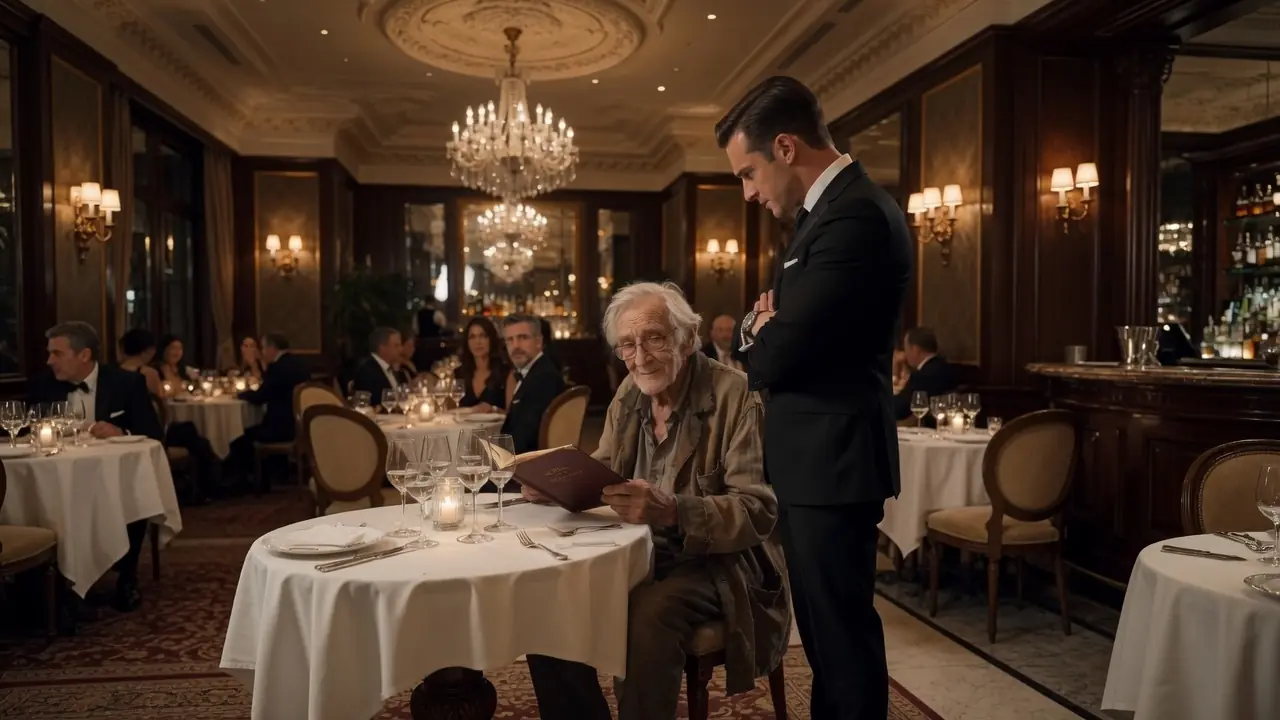
The first thing Victor Lang noticed was the old man’s coat.
Not his eyes. Not the careful way his hands held the menu. Not the quiet dignity in the way he sat at Table Twelve as if he had every right to be there. Victor looked first at the faded brown coat, the frayed cuff, the soft collapse of old fabric at the shoulders. Then he looked at the man’s worn shoes and decided the rest of the story without asking a single question.
Le Ciel was not built for people who looked like Walter Hayes.
At least, that was what Victor believed. The restaurant sat on Madison Avenue behind tall glass doors and brass handles polished until they reflected the city lights. Inside, crystal chandeliers hung over white tablecloths, marble floors, dark wood panels, and wine glasses so thin they seemed made from frozen air. Every detail had been trained to whisper wealth without ever raising its voice.
Walter Hayes had entered just after eight o’clock.
He came alone, moving slowly with the kind of careful steps that belonged to a man whose body had outlived most of his plans. His white hair was loose and uneven, his glasses slightly crooked, and his coat looked as though it had survived more winters than most people in that dining room had survived disappointments. The hostess had hesitated when she saw him. Walter had only smiled gently and asked for a table.
“Do you have a reservation, sir?” she had asked.
“No,” Walter said. “But I’d like to sit at Table Twelve, if it’s available.”
The hostess looked confused. Table Twelve was not an ordinary table. It sat near the center of the dining room, beneath the largest chandelier, visible from every corner, reserved only for VIP guests, critics, investors, and the kind of customers whose names appeared in business magazines. Before the hostess could answer, Walter had moved toward it with surprising certainty and lowered himself into the chair.
That was when Victor Lang saw him.
Victor had been standing near the bar, reviewing the reservation list with one of the assistant managers. He was thirty-eight, handsome in a polished way, with black hair combed back, a perfect tuxedo jacket, and the clipped voice of someone who had spent years teaching himself to sound superior. He had only been general manager of Le Ciel for seven months, but he already behaved as if the building, the staff, and the reputation had risen from his own hands. Nothing irritated him more than disorder in a room he believed he controlled.
He walked toward Table Twelve with a smile that never touched his eyes.
“Good evening,” Victor said. “May I help you?”
Walter looked up from the menu.
“I hope so,” he replied. “I’d like to order dinner.”
Victor’s gaze slid over the old coat again.
“This table is reserved.”
Walter looked around at the empty place settings.
“For whom?”
“For private guests.”
“I see.”
“May I ask how you entered?”
Walter blinked slowly.
“Through the door.”
A couple at the nearest table heard that and laughed softly. Victor’s jaw tightened, not because the answer was rude, but because it had made him look foolish. He leaned closer, lowering his voice in the way people do when they want cruelty to seem professional. The dining room had begun to notice, and Victor hated being watched unless he was winning.
“Sir, this is a three-Michelin-star restaurant,” Victor said.
“I know.”
“Our tasting menu begins at six hundred dollars per person.”
“I saw the menu.”
“And we do not allow walk-ins to occupy VIP seating.”
Walter folded the menu gently.
“Then move me to another table.”
Victor paused.
That answer should have ended the matter, but by then Victor had already made the mistake of feeling challenged. He looked around and saw several customers watching. He imagined what they saw: their polished manager being questioned by an old man in a poor coat. The thought burned him.
“No,” Victor said. “I think it would be best if you left.”
Walter’s face changed only slightly.
“I have not eaten.”
“You will not be eating here.”
A silence fell over the nearby tables.
The pianist at the bar kept playing, but his fingers slowed. Chloe, one of the younger waiters, stood near the wine station with a decanter in her hand, watching Victor with growing unease. She had seen him dismiss people before, usually delivery workers, applicants, and staff he disliked. She had never seen him speak this way to a guest seated under the chandelier.
Walter placed both hands on the tablecloth.
“I only came for dinner,” he said.
That quiet sentence should have softened the room.
A few guests nodded.
One man at the window lifted his glass. A woman in a black silk dress covered a smile with her napkin. Across the room, two young men in expensive watches exchanged amused glances, treating the old man as a small disruption in their evening entertainment. Walter noticed all of it and remained still.
Victor leaned down again.
“You need to leave.”
Walter looked at him through the thin lenses of his old glasses.
“What is your name?”
Victor blinked.
“My name?”
“Yes.”
“You don’t get to question me.”
“I asked because a man should know the name of the person shaming him.”
The words were soft, but they reached farther than shouting.
Chloe felt them in her chest. The pianist finally stopped playing. The dining room seemed to wait, caught between embarrassment and curiosity. Victor’s face flushed, and something ugly moved behind his eyes. He had expected apology. He had expected retreat. Instead, the old man had refused to shrink.
“I’m Victor Lang,” he said. “General manager of Le Ciel.”
Walter nodded.
“Then you are responsible for what happens in this room.”
Victor laughed once, sharp and mean.
“There it is. That little act like you’re someone important.”
Walter said nothing.
Victor pointed toward the entrance.
“People like you walk in here hoping confidence will carry you past the bill. You sit at a table you cannot afford, ask for water, pretend dignity is payment, and wait for someone to feel sorry for you.”
Walter’s fingers tightened slightly near the edge of the linen.
“There is no shame in being hungry,” he said.
Victor’s smile turned colder.
“No. But there is shame in pretending you belong where you don’t.”
That was when he slapped him.
It happened so quickly that even Victor seemed surprised by his own hand. The sound cracked through the dining room, sharp and sudden, bouncing off marble, crystal, and polished wood. Walter’s glasses flew from his face, spun across the floor, and slid beneath the polished shoe of a wealthy real estate developer seated near the aisle. Walter remained seated, one cheek reddening under the chandelier light.
For one frozen second, no one inside Le Ciel moved.
Then a few guests laughed.
Not loudly at first. Just small, careful laughs from people who wanted to remain on the winning side of the room. The woman with the silk dress pressed her napkin harder against her mouth. The real estate developer looked down at the cracked glasses and nudged them lightly with the tip of his shoe.
Chloe’s face went pale.
“Mr. Lang,” she whispered.
Victor turned on her.
“What?”
“Maybe we should stop.”
“Go back to your station.”
Her mouth closed.
Walter looked toward her for half a second.
Not pleading. Not asking for rescue. Just noticing that she had tried. That small look made Chloe feel ashamed in a way Victor’s anger never could. She lowered the decanter and stepped back, but her eyes stayed on Walter.
Victor adjusted his jacket as if the slap had wrinkled him.
“I said,” he repeated, louder now, “we don’t serve people like you.”
Walter did not touch his cheek.
He did not reach for his glasses. He simply looked up through blurred eyes, calm in a way that made the room feel colder. “I heard you,” he said. “Everyone heard you.”
Victor’s jaw tightened.
“Then stand up and leave.”
Walter breathed in slowly.
Outside, New York glittered beyond the windows, black cars slipping along Madison Avenue and headlights sliding across the glass. Inside, guests sat under crystal light with forks suspended above plates they suddenly could not taste. The restaurant had been built to hide discomfort beneath elegance. But some moments break through every layer of polish.
Walter looked toward the kitchen doors.
They were tall, dark, and carved into the rear wall, with brass handles dulled by years of service. Through the round glass windows, white jackets moved quickly beneath bright stainless-steel light. The kitchen had its own heartbeat, fast and disciplined, unaware that the dining room had turned into a trial. Walter stared at those doors as if looking at an old friend.
Victor followed his gaze.
“What are you looking at?”
“The kitchen.”
“You will not step inside it.”
“I wasn’t planning to.”
“You wouldn’t last two minutes.”
For the first time, Walter’s mouth moved faintly.
It was not quite a smile. It was closer to pain recognizing irony. Victor saw it and hated it. “What is funny?” he demanded.
“Nothing,” Walter said. “Just an old memory.”
Victor placed one hand on the back of Walter’s chair.
“Get up.”
Walter looked at the hand.
“Take your hand off my chair.”
A murmur moved through the dining room.
Victor bent closer, voice low and venomous.
“Old man, you are one second away from being dragged out.”
Walter lifted his eyes.
“By whom?”
Victor turned toward the security host near the entrance.
“Call security.”
Before the host could move, the kitchen doors opened.
The sound was not loud, but everyone turned toward it.
A tall man in a white chef’s uniform stepped into the dining room, his chef’s hat rising above the line of servers behind him. He was in his sixties, broad-shouldered, stern-faced, and moving with the authority of someone who did not ask permission inside his own kitchen. Behind him came four chefs, then two line cooks, then a pastry chef with flour still dusting one sleeve. They stopped at the doorway like a silent wall of witnesses.
The head chef’s name was Antoine Moreau.
He had worked at Le Ciel for twenty-six years. He had trained under the restaurant’s original founder, fought through the hard years, rebuilt the menu after two disasters, and carried the kitchen through changes in ownership, critics, trends, and managers who thought a dining room mattered more than a stove. The staff feared him, respected him, and loved him in the way cooks love a man who can still work the line when everyone else is breaking. He had heard the slap from the kitchen.
At first, Antoine’s eyes went to Victor.
Then they moved to Walter.
The color drained from his face.
He took one step forward.
Then another.
The room watched the chef cross the marble floor, his expression changing with every step. The anger that had brought him from the kitchen cracked into disbelief. His mouth parted slightly. His eyes fixed on Walter’s red cheek, then on the cracked glasses lying beneath the real estate developer’s shoe.
“Move your foot,” Antoine said.
The developer blinked.
“I’m sorry?”
Antoine did not raise his voice.
“Move your foot.”
The man moved it.
Chloe rushed forward at last, bending to pick up the glasses before Victor could stop her. Her hands trembled as she lifted them from the floor. One lens was cracked, the frame bent at one corner. She held them like a confession.
Victor tried to recover control.
“Chef, stay out of this. I’m removing this man now.”
Antoine turned to him slowly.
“Removing him?”
Victor pointed toward Walter.
“He caused a disturbance.”
Antoine stared at him.
“Did he strike someone?”
Victor said nothing.
“Did he shout?”
Nothing.
“Did he threaten staff?”
Victor swallowed.
“He sat at a restricted table without authorization.”
Antoine looked at Table Twelve.
Then he looked at Walter.
His voice changed.
“Mr. Hayes.”
The name moved through the room like a match dropped into dry paper.
Walter Hayes.
Several older guests looked up sharply. One woman whispered the name to her husband, and his eyes widened. The staff near the kitchen went rigid. Chloe turned toward Walter with the broken glasses still in her hands. Victor frowned, confused, but trying not to look confused.
Walter looked at Antoine.
“Hello, Tony.”
The head chef’s face broke.
Not into tears, but into something close. He stepped forward and bent slightly, not as a servant, not as an employee, but as a student greeting the man who had first taught him where fire belonged. “I thought you were in Vermont,” Antoine said.
“I was.”
“You should have called.”
“I wanted to see the restaurant without my name arriving first.”
The dining room was completely silent now.
Victor looked from the chef to Walter.
“What is this?” he asked.
Antoine turned toward him.
“You don’t know who this is?”
Victor’s confidence faltered.
“He claimed he helped build places like this.”
Antoine’s eyes hardened.
“No. He built this place.”
A gasp spread across the dining room.
Victor took one step back.
“That’s impossible.”
Antoine pointed toward the old man, his voice carrying to every table.
“This is Walter Hayes, founder of Le Ciel. His recipes built the first menu. His savings opened the first kitchen. His name is still on the original deed.”
The room changed instantly.
The laughter died as if someone had cut a wire. The woman with the napkin lowered it, her face suddenly stiff. The developer who had nudged Walter’s glasses stared at his plate. The young men who had raised their phones lowered them, realizing too late they had recorded the wrong side of the story.
Victor’s face turned pale.
“No,” he said. “The founder sold years ago.”
Walter accepted the cracked glasses from Chloe.
“I sold the operating company,” he said. “Not the building. Not the recipes. Not the legacy trust that licenses the name.”
Victor’s mouth opened.
Nothing came out.
Antoine stepped closer to him.
“You slapped the man whose hands taught this kitchen how to cook.”
Victor looked at Walter, panic flashing across his face.
“Mr. Hayes, I didn’t know.”
Walter placed the bent glasses carefully on the table.
“No,” he said. “You didn’t ask.”
Victor tried again.
“This was a misunderstanding.”
Walter looked at him.
“A misunderstanding does not leave a handprint.”
Those words settled over the room.
Victor’s eyes darted toward the guests, then the staff, then the phones pointed in his direction. He understood now that the power had moved. The room he had controlled minutes earlier had turned against him with the clean cruelty of wealthy people trying to distance themselves from a mistake they had enjoyed. Suddenly no one wanted to laugh.
Antoine’s voice shook with anger.
“Why did you strike him?”
Victor’s throat worked.
“He refused to leave.”
“Because he asked for dinner.”
“He was at a VIP table.”
Antoine turned toward Table Twelve.
“This table is his.”
Victor blinked.
Antoine looked back at him.
“It has always been his. Table Twelve was reserved by Mr. Hayes for family, staff, and anyone he chose to seat there. Every manager before you knew that.”
Walter’s eyes moved across the dining room.
“Apparently not every manager.”
Victor’s pride finally cracked into fear.
“Mr. Hayes, please, I was only trying to protect the restaurant.”
Walter’s expression remained calm, but his voice was colder than before.
“From what?”
Victor did not answer.
Walter leaned forward slightly.
“From an old coat? From worn shoes? From a man you thought could not afford a plate you never served him?”
Victor lowered his eyes.
“From someone who made your guests uncomfortable?” Walter continued. “Or from someone whose poverty, real or imagined, disturbed the picture you wanted to sell?”
No one moved.
Chloe stood beside the table with tears in her eyes, ashamed she had not stepped forward sooner. Antoine stared at Victor with open fury. The kitchen staff behind him looked as though they were restraining themselves by discipline alone. The guests sat frozen inside the elegance they had trusted to protect them from this kind of truth.
Walter slowly picked up the menu.
“I chose the first version of this menu on a folding table in a rented kitchen,” he said. “We had six burners, three cracked pans, and one waiter who quit before dessert service.” His fingers brushed the leather cover. “We were not perfect. But no one left hungry because they looked poor.”
Antoine looked down.
He remembered those years.
He had been twenty-seven when Walter hired him, a young cook with anger in his hands and talent he did not know how to control. Walter had taught him patience, not by lecture, but by standing beside him until the sauce stopped splitting. He had taught him that food carried the dignity of the person who made it and the person who ate it. Hearing Victor insult that legacy had pulled something old and fierce out of him.
Walter turned to Chloe.
“What is your name?”
“Chloe Bennett,” she whispered.
“Thank you for trying, Chloe Bennett.”
Her face crumpled slightly.
“I should have done more.”
“Yes,” Walter said gently. “But you did something.”
That kindness wounded her more than anger would have.
Victor wiped his palms against his trousers.
“Mr. Hayes, I will personally arrange your dinner. On the house, of course. Chef Moreau can prepare whatever you like. We can move you to the private room, away from this disruption.”
Walter looked at him for a long moment.
“You are still trying to manage appearances.”
Victor froze.
Walter placed the menu down.
“I do not want the private room. I do not want a free meal. I do not want a manager who slapped me to pretend service is apology.”
Antoine nodded once.
Victor’s face tightened.
“What do you want?”
Walter looked toward the cracked glasses.
“Pick them up.”
Victor stared.
Chloe had already retrieved them.
Walter’s voice stayed even.
“From her hands. Bring them to me. Then explain to every person here why you believed I deserved the floor.”
Victor’s face flushed.
“Mr. Hayes, please.”
Walter did not move.
“Do it.”
The dining room watched Victor Lang walk toward Chloe.
His steps were stiff. His hands trembled slightly when Chloe held out the broken glasses. He took them, unable to meet her eyes, and turned back toward Walter. The distance from Chloe to Table Twelve could not have been more than twelve feet, but it seemed to take him longer than his entire career.
He placed the glasses on the table.
Walter looked up at him.
“Now speak.”
Victor’s mouth worked.
“I was wrong.”
Walter waited.
Victor looked around the room, humiliation crawling up his neck.
“I judged Mr. Hayes by his appearance,” he said. “I denied him service. I insulted him. I struck him.” His voice broke slightly. “There was no justification.”
Walter studied him.
“Was it policy?”
Victor swallowed.
“No.”
“Was it protecting the guests?”
“No.”
“Was it protecting Le Ciel?”
Victor’s eyes shone with panic.
“No.”
Walter leaned back.
“Then what was it?”
Victor’s voice dropped.
“Prejudice.”
The word was not loud, but it filled the room.
Walter closed his eyes for a moment.
Not in satisfaction.
In sorrow.
Because victory over ugliness never felt clean when ugliness had already done its harm.
Antoine turned toward the assistant manager near the bar.
“Call the ownership counsel.”
Victor looked at him sharply.
“Chef, wait.”
Antoine ignored him.
“Tell them Mr. Hayes is present. Tell them there has been a physical assault by the general manager. Tell them to send documentation for immediate suspension.”
Victor stumbled backward.
“Suspension?”
Walter opened his eyes.
“You are fortunate if that is where it begins.”
A waiter near the entrance whispered something into a phone.
The restaurant, once full of controlled elegance, had become a courtroom without a judge. Guests who had laughed now stared down at their plates. A few had the decency to look ashamed. Others only looked worried that their faces might appear in the videos now spreading across the internet.
Grant Ellis, the developer who had nudged the glasses, cleared his throat.
“Mr. Hayes,” he said, “I want to apologize. I didn’t realize who you were.”
Walter turned his blurred gaze toward him.
“That is not an apology.”
Grant blinked.
“I’m sorry?”
“You are apologizing because you realized who I was. Try again, and apologize for what you did when you thought I was nobody.”
Grant’s face went red.
The entire dining room watched him fail to answer.
Walter did not wait.
He looked toward the kitchen.
“Chef Moreau.”
Antoine straightened.
“Yes, sir.”
“Is the soup still on the menu?”
Antoine’s eyes softened.
“The onion soup?”
Walter nodded.
“The one we served the first winter.”
A faint smile moved across Antoine’s face.
“It is not on the printed menu.”
“No?”
“No, sir. But I can make it.”
Walter looked toward the kitchen staff.
“Then make enough for the staff first.”
Antoine’s throat tightened.
“For the staff?”
“Yes. They have been standing all night while people like him decide who matters.”
Chloe pressed a hand to her mouth.
Antoine nodded.
“Yes, sir.”
Walter looked around the dining room.
“And after that, serve whoever remains.”
The words struck the guests harder than any insult.
Whoever remains.
Several people shifted uncomfortably. A few placed napkins on the table and stood quietly, ashamed or offended or unwilling to sit under the weight of what had happened. Others stayed, but not with the same posture they had worn before. The room was no longer a place where wealth protected them from being seen.
Victor stood beside the table, ruined and silent.
Walter looked at him one last time.
“You thought this room belonged to people who could pay for it,” he said. “That was never the heart of Le Ciel.”
Victor whispered, “I’m sorry.”
Walter’s eyes did not soften.
“I believe you are sorry now.”
The difference was clear.
Two security staff arrived, but not for Walter. Antoine spoke to them quietly, and they positioned themselves near Victor. The general manager looked around, realizing the command he had tried to use against an old man now hovered over him. His face collapsed.
“You can’t remove me like this,” Victor said.
Walter looked at him.
“I can.”
Victor looked at Antoine.
Antoine’s voice was final.
“You will wait in the office until counsel arrives.”
Victor’s eyes filled with helpless rage.
Then he turned and walked toward the private hallway, no longer the polished master of the room, but a man escorted out of the illusion he had built around himself. No one clapped. No one laughed. The silence that followed him was colder than punishment.
When he was gone, Walter sat alone at Table Twelve.
Chloe approached with a glass of water.
Her hands still trembled.
“I’m sorry, Mr. Hayes,” she said.
Walter accepted the glass.
“Do you like working here?”
She hesitated.
“I used to.”
He nodded.
“That is an honest answer.”
She looked toward the kitchen.
“Chef Moreau is the reason most of us stayed.”
“I know.”
“He protects the kitchen. But the dining room...” She stopped, afraid she had said too much.
Walter finished for her.
“The dining room forgot itself.”
Chloe nodded, eyes wet.
Walter looked down at the cracked glasses on the table.
“Rooms can forget. People remind them.”
Twenty minutes later, bowls of onion soup came from the kitchen.
Not first to the VIP tables.
First to the waiters, hosts, runners, dishwashers, cooks, and bussers. The staff ate standing near the kitchen entrance, holding bowls carefully, unsure whether they were allowed to accept such a reversal of order. Antoine stood among them, his chef’s jacket still clean but his eyes red. Walter watched quietly.
Then one bowl was placed in front of him.
The smell rose slowly.
Caramelized onions. Broth dark with time. Bread softened under melted cheese. It was not the most expensive dish Le Ciel had ever served. But it was the first dish that had made people come back in the early years, when reviews were scarce and the future of the restaurant rested on whether strangers could taste honesty in a bowl.
Walter lifted the spoon.
His hand shook.
Antoine noticed and stepped closer, but Walter gave him a look that said not yet. He tasted the soup, closed his eyes, and sat still for a long moment. The dining room seemed to wait for a verdict more important than any critic’s star.
Finally, Walter opened his eyes.
“Too much salt,” he said.
Antoine let out a broken laugh.
Several staff members laughed with him, softly at first, then with relief that felt almost like grief leaving the body. Walter’s mouth curved. Not much. Just enough to prove that the old heart inside the old coat had not been destroyed by one man’s hand.
The next morning, every major food page in New York carried the story.
Some headlines focused on the slap. Others focused on Victor Lang’s suspension. A few used the phrase “founder returns,” as if Walter had staged a dramatic comeback instead of simply asking for dinner. The video of Antoine stepping out of the kitchen and saying Walter’s name spread faster than anyone expected.
But the part people repeated most was quieter.
“You are apologizing because you realized who I was. Try again, and apologize for what you did when you thought I was nobody.”
That sentence reached farther than Le Ciel ever had.
Three days later, Victor Lang was formally terminated.
Le Ciel issued a public statement acknowledging failure, not disruption. It confirmed Walter Hayes’s ongoing ownership interest in the building, his role as founder, and the immediate review of management, guest treatment, and staff reporting procedures. The statement was careful, but Walter insisted on one line before he approved it. Hospitality without dignity is performance, not service.
A week later, Walter returned to Le Ciel.
This time, he came through the front door wearing the same faded coat.
The hostess saw him and stood straighter, but not in fear. Chloe greeted him by name. Antoine came from the kitchen without being called. No one blocked his path to Table Twelve.
Walter sat down slowly.
His new glasses rested on his nose, the old cracked pair folded in a small box inside his coat pocket. He had kept them. Not because he wanted to remember the pain, but because objects sometimes make better witnesses than people. The broken frame would sit one day in the staff training room, beneath a plaque with the words: Before service, remember who you are serving.
Chloe brought water.
Antoine brought soup.
Walter looked around the dining room, where the lighting still glittered, the marble still shone, and the silver still waited beside perfect plates. Luxury had not disappeared. But something beneath it had shifted. The room had been forced to remember that elegance without humanity is only decoration.
Later that evening, a young dishwasher named Miguel passed near Table Twelve carrying a tray of clean glasses.
Walter stopped him.
“You work in the kitchen?”
Miguel nodded quickly.
“Yes, sir.”
“Do they feed you before service?”
Miguel looked surprised.
“Sometimes.”
Walter looked toward Antoine.
Antoine heard the question from across the room and nodded immediately.
“From now on, always.”
Miguel smiled before he could hide it.
Walter picked up his spoon.
“Good.”
That was how the new rule began.
Staff meal first. Every day. No exceptions. Not leftovers scraped together after the rich were satisfied, but real food prepared with care. Walter called it the first test of any restaurant that claimed to understand hospitality. If the people serving the meal were treated like furniture, the dining room had already failed before the first guest arrived.
Months later, people still came to Le Ciel for the tasting menu.
They came for the wine cellar, the chandeliers, the famous soup, and the story of the old founder who had returned in a faded coat. Some hoped to see him at Table Twelve. Sometimes they did. Sometimes they only saw the empty chair and lowered their voices when passing it.
Walter did not visit every night.
He was ninety-one, and his body no longer obeyed all his wishes. But when he did come, he sat quietly, watched the staff, and ordered simply. He never demanded special treatment. He only demanded that no one else be denied basic respect because they did not arrive wrapped in proof of their importance.
And that became the true legacy of his return.
Not the viral video.
Not the manager’s fall.
Not even the revelation that the old man in the worn coat still had power hidden beneath his silence.
The real legacy was the question Walter left behind for every person who worked under the name Le Ciel: how do you treat someone when you believe they have nothing to give you?
Victor Lang had answered that question with contempt.
Walter Hayes answered it with soup.
And in the end, the restaurant survived not because of its chandeliers, its prices, or its stars, but because the man who built it came back just in time to remind everyone that a table is not sacred because rich people sit there.
A table is sacred because someone hungry is welcomed to it.