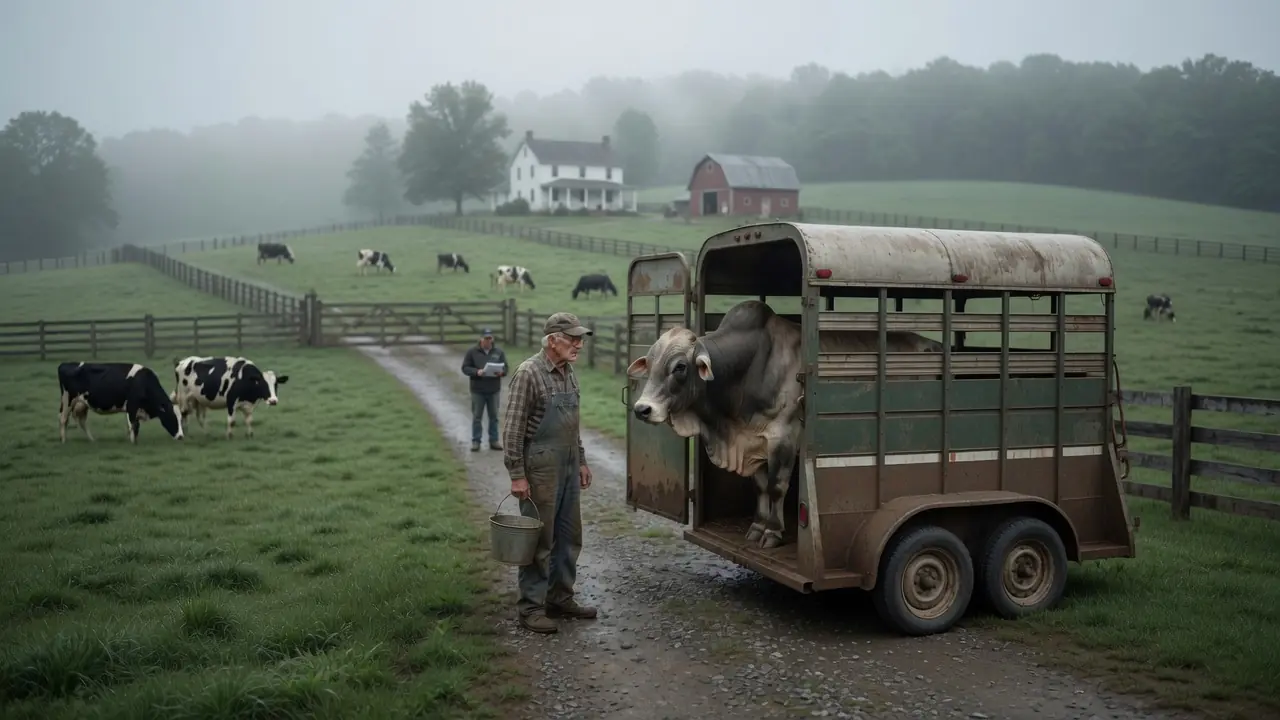
The morning fog was still thick over Willowbrook Farm when the livestock trailer turned onto the wrong gravel driveway. Ezra Hawthorne was standing beside the feed trough with a metal bucket in one hand, his wire-rimmed glasses low on his nose and his old work cap pulled down against the damp Kentucky air. His small herd of dairy cows lifted their heads as the truck rumbled closer, its tires crunching over gravel that rarely saw anything larger than a milk delivery. At sixty-seven, Ezra had lived long enough to know when something did not belong, and that trailer did not belong on his modest forty-acre farm.
Willowbrook was not the kind of place that received expensive livestock from across the country. It was a quiet dairy operation in Bourbon County, with a white farmhouse, a small red barn, patched wooden fences, and pastureland that Martha, Ezra’s late wife, had once called “enough for a humble life.” Since her passing two years earlier, the farm had grown quieter than Ezra liked to admit. He still rose before daylight, still fed the cows, still repaired what needed repairing, but some mornings felt less like living and more like following old instructions left behind by a woman he missed.
The trailer stopped near the barn, and the driver climbed down with a clipboard in his hand. He was a burly man named Clint, wearing a baseball cap and the tired expression of someone who had been driving too long. Ezra wiped his hands on his overalls and walked toward him slowly. “Clint, this can’t be right,” Ezra said after glancing at the paperwork. “I run a small dairy farm, not a bull operation.”
Clint frowned at the delivery envelope and scratched his head. “Paperwork says Willowbrook Farm, Bourbon County,” he replied. “Delivery for one bull named Thunder Strike.” Ezra stared at him as if he had announced that a circus elephant was waiting inside the trailer. “I haven’t ordered any bull,” he said. “And I surely haven’t ordered one with a name like that.”
Clint looked toward the trailer with the defeated shrug of a man who only hauled what others paid him to haul. “Mister, I just drive the truck. The GPS brought me here, and this is the address on the papers.” Before Ezra could argue further, Clint walked to the back of the trailer and unlatched the door. The metal creaked open, and a heavy silence seemed to fall over the farm.
What stepped down from the trailer made Ezra forget every complaint in his mouth. Thunder Strike was enormous, a gray Brahman bull with a massive shoulder hump, thick neck, heavy muscles, and horns that curved with quiet authority. He must have weighed nearly twenty-eight hundred pounds, but he moved with a strange, controlled slowness, as if every step had been learned through caution. His gray coat caught the morning light through the fog, and for one breath, he looked less like livestock and more like some ancient creature delivered by mistake from another world.
“Hold on,” Ezra called. “You can’t just leave him here.” But Clint was already climbing back into the cab. “I have another run waiting, and the paperwork says delivered,” he said through the open window. The truck pulled away before Ezra could stop him, leaving the old farmer standing alone with a bull worth more than anything else on his farm.
Ezra opened the envelope with stiff fingers. The documents told a story that made his stomach tighten. Thunder Strike had been rejected by three breeding facilities in Colorado for difficult behavior, refusing handlers, damaging equipment, and failing in the role everyone had assigned him. Words like dangerous, unpredictable, and unsuitable appeared in official language that tried to sound calm. Ezra looked from the papers to the bull and felt a strange sadness settle over him.
Thunder Strike stood in the temporary pen near the barn, still as a stone. He was not snorting, charging, or scraping at the ground. He was only watching the farm with dark intelligent eyes that looked tired in a way Ezra understood too well. “They called you rejected, didn’t they, big fella?” Ezra said softly.
The bull turned his massive head toward Ezra’s voice. Something in that movement was gentle, almost careful, and it pulled a memory from Ezra so sharply that he had to blink. Martha had always rescued animals no one else wanted: a three-legged barn cat, a blind old mare, a dog too nervous to be touched. She used to say that the creatures with the worst reputations often had the deepest wounds.
Ezra stood by the fence, studying the bull from a safe distance. “Maybe you and I both know what it feels like to be left behind,” he murmured. Thunder Strike breathed out slowly, warm mist rising from his nostrils into the fog. The sound was not threatening. It was weary.
An hour later, Delilah Riversong drove up in her battered blue pickup, drawn by the sight of the trailer tracks and the gossip that traveled faster than weather in Bourbon County. Delilah was fifty-two, sharp-eyed, strong-shouldered, and known for taking in horses with bad legs, bad tempers, or bad histories. She had known Ezra since they were children, and she had known Martha well enough to understand the empty space her death had left behind. She climbed the fence before Ezra could warn her not to.
“Ezra Hawthorne,” she called, staring at Thunder Strike, “what in creation is that monster doing in your pasture?” Ezra held up the papers. “Apparently, getting delivered to the wrong Willowbrook.” Delilah took the envelope, read quickly, and then grew quiet. Her expression changed from amusement to concern, then to something softer.
“This bull has a bloodline people would pay serious money for,” she said. “His sire alone was famous in breeding circles.” Ezra frowned. “Then why did three facilities send him away?” Delilah did not answer at once. She moved closer to the fence and looked carefully at Thunder Strike’s neck, flanks, and posture.
Up close, the story became clearer than the paperwork. There were old rope marks near the neck, faint scars on his hide, and a stiffness in the way he stood when anyone came too close. Delilah’s face softened. “Oh, you poor thing,” she whispered. “They tried to break you, didn’t they?”
Thunder Strike lowered his head until his nose nearly touched her outstretched hand. Ezra stiffened, ready to pull her back, but the bull did not lunge or snort. He only stood there, breathing softly, allowing the first kindness of the morning to reach him. Delilah’s eyes filled with tears.
“I don’t think this was just a delivery mistake,” she said quietly. Ezra gave her a tired look. “You sound like Martha.” Delilah smiled faintly. “Good. Martha was usually right about animals and almost always right about you.”
By afternoon, half the county seemed to know about the rejected bull at Willowbrook Farm. Virgil Ashworth stopped by with coffee and a warning. A feed salesman slowed down twice on the road. Two neighbors leaned over the fence pretending to ask about fencing supplies while clearly staring at Thunder Strike. Ezra answered questions politely until his patience ran thin.
Three days later, Thunder Strike did something that changed the way people talked about him. Ezra was fixing a section of fence when Buttercup, one of his oldest Holstein cows, got her leg caught in loose wire near the pasture edge. The cow bawled in distress, jerking against the wire and making the tangle worse. Ezra dropped his tools and started toward her, but Thunder Strike reached her first.
Ezra froze, afraid the massive bull would panic or hurt her by accident. Instead, Thunder Strike lowered his enormous head and nudged the wire away with careful precision. He shifted his hooves slowly, waited when Buttercup pulled back, then nudged again until the wire loosened. Within seconds, the old cow stepped free.
“Well, I’ll be,” Ezra muttered, watching Thunder Strike back away to give Buttercup space. The bull did not demand attention or act triumphant. He simply stood nearby until Buttercup steadied herself, then walked calmly back toward the shade. Ezra felt the hair rise along his arms.
When Delilah heard what had happened, she brought Dr. Magnolia Clearwater the next morning. Dr. Clearwater was the county’s most experienced large-animal veterinarian, a practical woman who believed in evidence before sentiment. She reviewed the papers, then observed Thunder Strike from outside the fence for nearly an hour. By the end of it, she looked puzzled.
“These records describe a completely different animal,” she said. “The bull I see is cautious, responsive, and socially aware.” Ezra looked toward Thunder Strike, who was grazing peacefully among the dairy cows. “So maybe the records are wrong.” Dr. Clearwater adjusted her hat. “Or maybe the environment was wrong.”
That evening, Ezra fed Thunder Strike hay from his hand for the first time. The bull took it with such delicate control that his lips barely touched Ezra’s palm. Ezra felt a tremor move through him, not of fear, but of recognition. “Martha would have loved you,” he whispered.
The peaceful rhythm did not last. The next morning, Ezra received a call from Brutus Ironclad, the Colorado rancher who owned Thunder Strike on paper. Brutus spoke with the clipped impatience of a man used to giving orders. He explained that the bull had been meant for another Willowbrook facility, a breeding operation farther east, and that another truck would arrive that afternoon to take him to auction.
Ezra looked through the kitchen window at Thunder Strike standing beneath the old oak tree. The bull seemed calmer each day, as if Willowbrook had loosened some invisible rope around him. “Auction?” Ezra repeated. Brutus snorted into the phone. “That animal has caused enough trouble. I want him gone.”
After the call, Ezra walked slowly to the fence. Thunder Strike came to him without being called, lowering his head near the top rail. Ezra placed one hand against the bull’s thick neck. “Looks like your vacation is over, big fella,” he said, and his voice betrayed him.
The bull pressed his forehead gently against Ezra’s shoulder. The gesture was so trusting, so plainly dependent, that Ezra felt something inside him decide before his mind had finished calculating. He returned to the house, picked up the phone, and called Brutus Ironclad back. “Mr. Ironclad,” he said, “I would like to make you an offer.”
The negotiation was ugly, loud, and full of warnings. Brutus said Thunder Strike was a liability. Ezra offered ten thousand dollars cash, which was more than he could comfortably spare but less than the bull’s bloodline was worth. Brutus laughed at him, then cursed the bull, then finally agreed because he wanted the problem removed from his books. By the end of the call, Ezra owned Thunder Strike.
Delilah helped him with the paperwork, but she kept looking at him as if he had done something brave and foolish at the same time. “Martha would have kissed you for this,” she said. Ezra signed the final line. “Martha would have told me to do it before breakfast.”
Not everyone saw it that way. Ezra’s daughter, Luna, called from California that evening with panic in her voice. She had found old videos online, read stories about Thunder Strike’s past, and decided her father had lost his mind. “Daddy, you are sixty-seven and living alone,” she said. “You cannot buy a dangerous bull because you feel sorry for him.”
Ezra listened from the porch while Thunder Strike stood quietly near the fence. Luna’s fear was not cruel, but it was heavy. Since Martha’s death, she and her brother had been trying to convince him to sell the farm and move closer to family. To them, Willowbrook was isolation. To Ezra, it was the last place on earth where his life still sounded like his own.
“I understand you worry,” Ezra said. “But Thunder Strike is not what those reports say.” Luna sighed in frustration. “You cannot know that after a few days.” Ezra looked at the bull’s calm eyes. “Sometimes a few days of kindness tell more truth than years of bad handling.”
Luna flew in the following week, prepared to argue. She arrived in designer jeans and city boots, carrying the determined expression she had inherited from both parents. Delilah met her near the barn with Dr. Clearwater and a visiting agriculture professor named Dr. Sterling Blackwood, who had driven from Lexington after hearing about Thunder Strike’s bloodline and behavior. Luna barely greeted them before demanding to see the bull.
They walked toward the main pasture together. Thunder Strike stood among the dairy cows, his massive gray body making the Holsteins look delicate beside him. Just then, a neighbor’s border collie slipped under the fence chasing a tennis ball. The dog ran directly in front of Thunder Strike’s hooves, and everyone stopped breathing.
Thunder Strike froze. Slowly, with astonishing control, he lifted one enormous hoof and held it suspended until the little dog darted clear. Only after the collie was safely away did the bull lower his foot and resume grazing as if nothing remarkable had happened. Luna put a hand over her mouth.
“That is not normal,” Dr. Blackwood whispered. His professional composure had cracked completely. He began speaking about spatial awareness, emotional intelligence, and rare genetic markers in Thunder Strike’s bloodline. Luna barely heard him. She was watching her father watch the bull, and for the first time she understood that Ezra was not clinging to danger, but responding to trust.
The discovery spread faster than anyone expected. Within days, researchers, reporters, cattle investors, and curious locals began calling Willowbrook. A Texas billionaire offered two million dollars for Thunder Strike, then three. The numbers were large enough to make Ezra sit down at the kitchen table and stare at them written on a napkin. Three million dollars could change everything.
It could repair the farmhouse, secure his future, help Luna and her brother, and give his grandchildren opportunities Ezra never had. Yet when he looked outside, he saw Thunder Strike pressed against the far fence, frightened by the attention and strangers. The bull who had begun to trust him was shutting down beneath the weight of everyone wanting something from him. Ezra crumpled the napkin in his hand.
When Dr. Blackwood arrived with a team of students and equipment, Thunder Strike backed away with visible distress. Delilah was the first to say what everyone should have seen. “You are all about to turn him back into what they called him,” she warned. Ezra looked at the bull trembling near the fence, and his voice came out stronger than it had in years.
“Everyone leave,” he said. Dr. Blackwood tried to protest about research value, but Ezra raised one hand. “He is not a machine, not a prize, and not a circus act. This is private property, and my answer is no.” It took an hour, but the vehicles finally rolled down the driveway.
When the farm grew quiet again, Thunder Strike returned to the fence. Ezra reached through and stroked the bull’s neck, feeling the tremble slowly leave his muscles. Luna stood behind him, watching with tears in her eyes. “Daddy,” she said softly, “that investor called again.”
“Tell him Thunder Strike is not for sale,” Ezra replied. “Not for three million, not for any number he can say.” Luna studied her father, and something in her softened. “You really mean that.” Ezra nodded. “This bull trusted me when nobody else would. I will not betray that trust now.”
Six months later, Willowbrook Farm had changed, but not in the way the world had tried to force. Dr. Clearwater helped Ezra create a small animal intelligence program that allowed observation only in natural, calm conditions. Students came quietly, one or two at a time, with strict rules and no shouting, no crowds, no pressure. Thunder Strike participated only when he wanted to, and Ezra always watched his mood before anyone else’s ambition.
Luna stayed longer than planned. Then she stayed again. Eventually, she began working remotely from Martha’s old craft room, helping Ezra manage calls, paperwork, and visitors who came to learn rather than exploit. One evening, she stood beside Delilah and watched Thunder Strike gently arrange colored blocks with his nose while Ezra praised him like an old friend.
“I thought Daddy was fading out here,” Luna said. Delilah smiled. “He was.” Luna looked toward the pasture. “And then a rejected bull got delivered to the wrong farm.” Delilah nodded. “Sometimes wrong turns know more than maps do.”
Ezra changed too. He learned to use a computer to record Thunder Strike’s behavior. He spoke at local agricultural meetings about patience, stress, and the danger of labeling animals before understanding them. People who once came to stare now came to listen. The lonely widower who had been moving through routine found himself needed again, not as a curiosity, but as a voice for creatures who could not explain their own pain.
One quiet evening beneath the old oak tree, Ezra sat with Thunder Strike while the dairy cows grazed nearby. The bull lowered his massive head into Ezra’s lap, breathing slowly in the fading Kentucky light. Ezra rested one hand on the gray forehead and thought of Martha, of rescue cats and blind horses, of all the unwanted lives she had made room for. “You found the wrong farm,” he whispered. “And somehow, it was the only right one.”
Thunder Strike closed his eyes. In that peaceful moment, Ezra understood that saving the bull had never been one-sided. Thunder Strike had given him purpose after grief had nearly hollowed him out. He had brought Luna home, brought neighbors closer, and turned Willowbrook from a quiet place of mourning into a farm alive with meaning again.
People would tell the story many ways. Some would focus on the money Ezra refused, others on the scientific mystery, others on the delivery mistake that started everything. But Ezra knew the real story was simpler and deeper. A rejected bull had been sent where he was not supposed to go, and a lonely farmer had looked past the label everyone else believed.
That was all love required sometimes. Not wealth, not fame, not proof written in documents. Only one living soul willing to look at another and say, “I see what they missed.” At Willowbrook Farm, that was enough to change two lives forever.