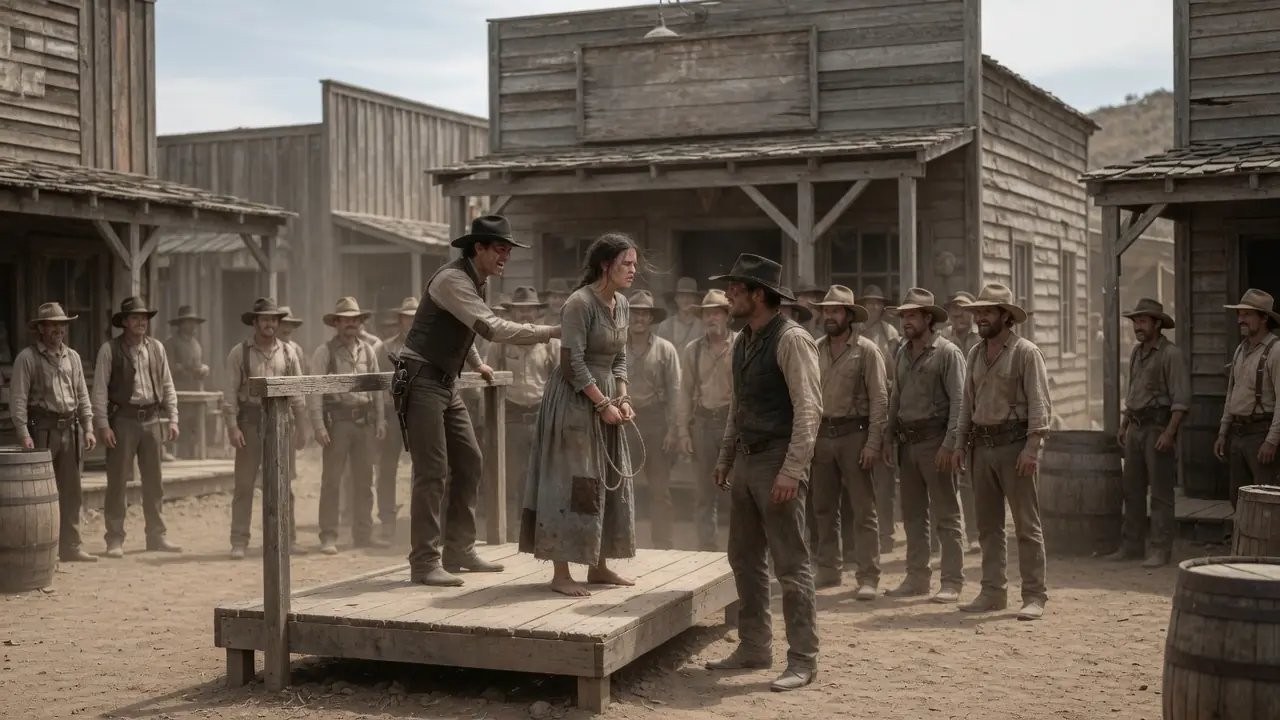
The merchant’s voice cut across the Dry Hollow cattle market like a dirty blade. “Fifty dollars for the girl,” Travis Boone shouted, lifting one hand toward the wooden auction platform. “Same price as a mule, and quieter than most.” A wave of laughter rolled through the crowd of cowboys, ranch hands, and dusty townsmen, but the young woman on the platform did not lower her head.
She stood barefoot on the rough boards, her faded gray-blue dress patched at the hem, her wrists loosely bound with rope in front of her. Dust clung to her skirt and ankles, and the afternoon sun turned the whole town into a yellow haze. Behind her, the old sign above the storefront read Dry Hollow, half-swallowed by weather and dirt. Her name was Lydia Hart, though Boone said it as if a name was only another thing he owned.
Mason Callahan had not come to Dry Hollow to save anyone. He had ridden in from his ranch to buy a horse, nothing more, because his old stallion had gone lame before the autumn drive. He stood near the edge of the market in a battered black hat, dark vest, and dust-stained shirt, silent as always, watching men inspect cattle with the bored cruelty of people used to choosing value by muscle and price. But when Boone pushed Lydia forward and the crowd laughed again, Mason’s jaw tightened.
“She cooks, sweeps, hauls water, and won’t argue,” Boone called out, grinning through tobacco-stained teeth. “Only trouble is, she does not hear a word and does not speak one either.” A man near the pen chuckled and said, “Sounds like the perfect wife for a quiet rancher.” More laughter followed, but Lydia’s eyes rose at that exact moment. They met Mason’s through the dust, and what he saw there stopped him from turning away.
There was no pleading in her face. No tears. No helplessness. Her eyes were dark, steady, and full of a fierce silence that looked less like surrender than waiting. Mason had seen wounded soldiers with that look, men who had lost everything except the decision not to break.
Boone began lowering the price when no one answered. “Forty-five, then. Surely one of you has room for a mute girl who works.” The crowd shifted, amused and curious, but no man stepped forward for any reason that sounded clean. Mason felt the old scar in his shoulder tighten, the one he carried from his cavalry years. The world had taught him to mind his own troubles, but it had never taught him to enjoy watching someone be reduced to a price.
“I’ll take her,” Mason said. The words came out before he knew he had chosen them. The laughter died at once, and every face in the market turned toward him. Boone blinked, then smiled slowly. “Well now, Callahan. Didn’t figure you for a charity man.”
Lydia did not flinch when Mason reached for the rope. He cut it with one clean motion, letting it fall between them. Boone laughed under his breath. “She is yours now.” Mason turned slowly and looked at him with a coldness that silenced even the men nearest the platform. “No,” he said. “She is free now.”
For the first time, Lydia looked uncertain. Not afraid exactly, but surprised, as if freedom was a word people had used around her but never given to her. Mason stepped off the platform and moved aside, leaving space between them. “You can go where you like,” he said, knowing she could not hear him, but needing to say it anyway. She watched his mouth carefully, then looked at the open street, the crowd, and the empty road beyond town.
No one else offered her shelter. No one offered her shoes, water, food, or a safe way out of Dry Hollow. The men who had laughed now looked away, suddenly eager to return to cattle and prices. Lydia rubbed her wrists once, then climbed down from the platform and followed Mason without a word. He did not tell her to come. She simply chose the only man who had treated her like a person.
His wagon waited beneath a mesquite tree at the edge of town. Two geldings stamped in the dust, nervous from the noise of the market. Mason pointed toward the wagon bed, where sacks of flour, coffee, beans, and tools lay packed for the ranch. Lydia understood instantly and climbed up with quiet grace, settling between the supplies like someone used to taking little space in the world.
As Mason guided the wagon out of Dry Hollow, the town watched them leave. Boone counted his money in the doorway of the auction yard, still smiling, but Mason noticed the smile had lost its pleasure. Lydia sat behind him, her back straight, her eyes moving across the prairie with sharp attention. She looked less like a rescued girl than a prisoner studying the road out of a cage.
For nearly an hour, they traveled in silence. Mason was used to silence, but this one felt different because it belonged to two people who did not yet know how to share it. He glanced back once and found Lydia watching the horizon, her hair whipping loose around her face. “My ranch is west of Silent Valley,” he said, speaking slowly so she might read his lips if she chose. “It is not much, but it is safe.”
Lydia tilted her head, studying his mouth. Then she gave one short nod. Mason did not know whether she understood every word, but she understood enough. He turned back to the reins, feeling strangely relieved. Behind them, Dry Hollow shrank into a blur of storefronts and dust.
By late afternoon, the sky began to change. The blue faded behind a low brown wall rising in the west. Mason felt the hair on the back of his neck lift before the horses reacted. Ranger snorted first, then Dakota tossed his head, both animals sensing trouble before the storm had fully shown itself. Mason narrowed his eyes at the horizon and cursed under his breath.
A sandstorm was coming fast. The kind that swallowed wagons, blinded horses, and turned open prairie into a living grave. Mason snapped the reins, urging the team forward, but the land ahead offered no shelter. No trees, no washout, no rocks high enough to break the wind. Only the wide merciless plain and the storm charging across it.
Then Lydia climbed onto the wagon seat beside him and gripped his sleeve. Mason looked over, startled. She pointed south with fierce urgency. He shook his head. “There is nothing south.” She pressed her hand to her chest, then pointed again, harder this time, her eyes locked on his as if the storm itself had spoken to her through the ground.
Mason hesitated only a second. Every instinct told him to push toward the ridge ahead, but Lydia’s face held a certainty he could not explain. He turned the team south. The wagon lurched over rough earth, the horses straining as the first hard gust slammed dust against them. Lydia kept pointing, her hair whipping wildly, her body braced against the wind.
The storm hit like a wall. Red dust swallowed the sky and rattled against the wagon boards. Mason could barely see the horses’ heads, but Lydia leaned forward beside him, one hand gripping the seat, the other pointing through the choking air. Suddenly the ground dropped beneath the wagon wheels, and Mason shouted as they plunged down a narrow slope.
The wagon rolled into a hidden canyon tucked inside the folds of the prairie. Stone walls rose on both sides, cutting the wind almost in half. Mason hauled back the reins and brought the team under a rocky overhang just as the full storm roared overhead. Dust poured across the canyon rim like a red waterfall, but below, they were alive.
Mason sat breathing hard, then looked at Lydia. She was covered in dust, but her eyes were calm. “You knew,” he whispered. She watched his mouth, then placed one hand on the wagon plank, feeling the faint tremor of the earth beneath them. Slowly, Mason understood. She had not heard the storm; she had felt the land.
They spent the night in that canyon. Mason built a small fire from dry brush tucked under the rock, then gave Lydia his coat when the air turned cold. She tried to refuse, shaking her head, but he placed it around her shoulders and stepped away before she could argue. The gesture seemed to confuse her more than kindness should have.
By the firelight, Mason pointed to himself. “Mason.” Lydia watched his lips, then touched her own chest. Her mouth shaped one word, nearly soundless. Lydia. Then she touched her ear, shook her head, touched her throat, and shook her head again. Mason nodded slowly. “You don’t hear. You don’t speak.”
Lydia held his gaze, then pressed her palm to the dirt near the fire. Her eyes closed. After a moment, she raised two fingers and pointed toward the horses. Ranger shifted before Mason heard anything, scraping a hoof against stone. Lydia opened her eyes, and Mason felt something like awe move through him. She heard the world in a way no one in Dry Hollow had been willing to understand.
The next morning, the prairie looked washed clean. They climbed from the canyon and reached Mason’s ranch by noon, a lonely place of adobe walls, cedar pens, a weathered barn, and land stretching far beneath the Texas sky. Mason had built most of it himself after leaving the cavalry, board by board, post by post, loneliness by loneliness. Until Lydia rode into the yard, he had never realized how quiet it was.
The horses noticed her first. Liberty, his gray mare, crossed the pen and lowered her head to Lydia’s hand without hesitation. Mason frowned because Liberty trusted almost no one. Lydia touched the mare’s neck, closed her eyes, then pointed at the front leg. Mason checked it and found heat above the hoof, the beginning of swelling he had not seen.
Lydia found his liniment, clean cloth, and water before he finished asking what she needed. She wrapped the leg with gentle confidence, and Liberty stood still beneath her hands. Mason leaned in the barn doorway, watching the girl Boone had called useless save his best mare from days of pain. “They lied about you,” he said quietly.
Lydia did not answer, but she did look at him. There was sadness in her eyes, as if lies were nothing new. From that day, she slept in the barn by choice, close to the animals, where the rhythm of hooves and breath must have felt safer than a house. Mason did not force her otherwise. He had learned enough already to know that safety could not be ordered.
Weeks passed, and Lydia became part of the ranch without asking permission. She soothed nervous horses, found small injuries before they worsened, and taught Mason signs with patient hands. Water. Food. Horse. Danger. Thank you. Slowly, Mason learned the language of her silence and discovered it was not empty at all.
One night, he heard humming from the barn. It was low and broken, more vibration than song, but it wrapped around the horses like a blanket. Mason stopped in the doorway and saw Lydia brushing Liberty while the mare stood with her eyes half closed. “I thought you could not make sound,” he said softly.
The brush fell from Lydia’s hand. Fear flashed across her face so sharply Mason raised both hands and stepped back. She touched her throat, shaking her head again and again. He understood then that someone had punished her for even that small sound. “Not here,” he said, keeping his voice gentle. “No one hurts you here.”
She stared at him for a long time. Then she took his hand and placed it against her throat. A rough whisper came out, broken and painful, not quite a word. Mason’s jaw clenched, not at the sound, but at the cruelty that had made her afraid of it. Lydia pulled away, ashamed, but Mason only nodded. “Still yours,” he said. “Voice or no voice.”
Trouble came on a Sunday in Dry Hollow. Mason had taken Lydia into town for supplies, thinking enough time had passed since the auction for people to mind their business. He was wrong. When he came out of the mercantile, a crowd had gathered near the church fence, and Lydia stood in the middle of it with her hands raised, trying to explain herself through signs no one wanted to understand.
Mrs. Dalton, the pastor’s wife, pointed at Lydia with a trembling finger. “She does strange things,” the woman said. “Animals follow her. Children stop crying when she touches them. Miller’s lame dog stood after she laid hands on it.” The crowd muttered, fear rising faster than reason. “She is cursed,” someone whispered.
Mason pushed through the men and stood beside Lydia. “Since when is mercy a curse?” he asked. Mrs. Dalton recoiled as if he had spoken blasphemy. Lydia tried to sign again, peaceful and careful, but the unfamiliar movement made the crowd panic. A man shouted that she was casting a spell.
Then every horse tied along the street reared at once. Wagons rattled, men jumped back, and the crowd scattered in alarm. Mason seized Lydia’s hand and pulled her toward the wagon. He did not know if the horses had reacted to the people’s fear, Lydia’s distress, or something deeper. He only knew Dry Hollow had just found a new reason to hate what it did not understand.
At the ranch, Lydia went straight to Liberty’s stall and buried her face against the mare’s neck. Mason found her there, shoulders trembling. He did not ask questions. After a long moment, she turned and signed with shaking hands. They are afraid of me.
“They are afraid of what they cannot name,” Mason said. Lydia touched her own chest, then pointed toward the road. I should leave. Mason stepped closer, his voice low and firm. “No.” She looked at him desperately. I bring danger. He shook his head. “Danger was already in men who call kindness evil.”
That night she told him the truth in signs and broken whispers. Her mother had carried the same gift, the ability to calm animals, sense pain, and feel trouble moving through the earth before others could see it. People had called her strange, then cursed, then worse. When fear turned cruel, Lydia’s mother died protecting her, and her father blamed the child who survived.
Mason listened until his hands curled into fists. Lydia touched the faint mark at her throat and looked away. Her father had tried to silence what frightened him, then sold her when even that did not erase who she was. Mason wanted to ride to Dry Hollow and drag every guilty man into the street, but Lydia laid a hand over his heart. Her touch stopped him because it asked for something harder than anger.
The first riders appeared three days later. Six men stopped on the ridge above the ranch and watched for nearly an hour before turning away. A week later, twelve came. They did not speak, but their silence carried warning enough. Mason began sleeping with his rifle near the bed, and Lydia began staying inside the house at night.
Then came the fire. Mason woke to smoke and Lydia’s desperate cry, a raw sound forced through her damaged throat. They ran outside and found flames climbing the barn wall. Lydia rushed for the stalls while Mason hauled water, and together they got the horses out before the roof caught fully.
By dawn, half the barn was gone. Hay had burned, tools had blackened, and smoke drifted over the yard like a funeral veil. On one surviving beam, three words had been carved and scorched deep into the wood: Drive out the witch. Lydia stared at the message, then signed the words Mason already feared. I have to leave.
Mason stepped between her and the road. “This is your home.” She pointed to the burned barn, tears in her eyes. They will destroy you. Mason looked at the smoke, the ruined hay, the frightened horses, and then back at her. “Let them learn I am harder to scare than an old barn.”
Before Lydia could answer, more riders appeared. Mason lifted his rifle, but these were not the men from the ridge. Dr. Samuel Whitaker rode first, followed by Miguel Alvarez, Sarah Whitman, and others whose animals or children Lydia had helped. They stopped before the burned barn, and Dr. Whitaker removed his hat. “What happened here was wrong,” he said. “We came to help.”
For the next two weeks, the ranch filled with hammering, sawing, voices, and footsteps. Neighbors brought boards, hay, nails, food, and horses strong enough to haul beams. Some came because they loved Lydia. Some came because shame had finally overcome fear. By the time the new barn frame stood against the sky, Dry Hollow had split in two: those who still whispered curse, and those who had seen too much healing to believe it.
During the rebuilding, Mason noticed Lydia often resting a hand over her stomach. At first he thought it was weariness, then worry, then something he was almost afraid to hope. One evening, as sunset burned copper across the new barn beams, Lydia took his hand and placed it gently beneath hers. Her eyes filled with both joy and fear. Baby, she signed.
Mason stopped breathing. “Our baby?” he asked. Lydia nodded, tears slipping down her face. The word our seemed to change the whole valley around them. Mason knelt before her in the dust, pressing his forehead against her hand. “No one will harm you,” he said. “No one will harm this child.”
They married three days later in Dr. Whitaker’s office with two witnesses and a silver ring Mason had purchased with money meant for lumber. Lydia signed her vows while Dr. Whitaker spoke them aloud, and Mason answered every word with a steadiness that surprised even himself. When he placed the ring on her finger, Lydia made a soft broken sound that might have been laughter. It was the most beautiful thing Mason had ever heard.
The pregnancy changed how people saw her, though not always gently. Some women came with blankets and advice. Others crossed themselves in secret when Lydia passed. Mrs. Dalton, who had once called her cursed, arrived one afternoon with a basket of baby clothes and eyes full of shame. “A child ought not pay for grown folks’ fear,” she said.
Spring brought rain, green grass, and one last test. On a stormy night, Lydia suddenly stiffened at the supper table, both hands pressed to her stomach. Mason rushed to her, terrified the baby was coming too soon, but she shook her head and pointed toward the valley. Fire. Pain. Men coming.
Mason looked through the rain and saw, far off, flames rising from the Roosevelt place. Riders were already moving toward his ranch, likely planning to blame Lydia for whatever had happened. He grabbed his rifle, but Lydia took his arm and shook her head. Then she pointed to the road, the barn, and the horses. They needed witnesses, not war.
By the time the riders reached the ranch, half of Dry Hollow was behind them. Mason had sent Miguel’s boy galloping for Dr. Whitaker and the sheriff, and Lydia stood beside the porch in the rain, pale but unafraid. The Roosevelt family’s wagon carried a badly burned lantern, an overturned oil can, and a frightened boy who confessed through tears that his father had set the fire himself to stir the town against Lydia. The lie collapsed in the mud before it could stand.
After that, fear lost its sharpest teeth. Not all at once, but enough. Farmers brought injured horses without hiding their faces. Mothers came with sick children. Travelers stopped at the ranch to ask for the quiet woman who could sense pain through a hoof, a hand, or the tremor of the ground. Lydia never called it a miracle. She only called it listening.
When her labor came in April, the whole valley seemed to hold its breath. Mason paced outside the bedroom while Sarah Whitman and Dr. Whitaker worked inside. Lydia’s broken cries rose and fell with her humming, the same deep sound that had calmed horses and steadied frightened hearts. Hours later, a baby’s cry filled the house.
Dr. Whitaker came out with tears in his eyes. “A girl,” he said. Mason entered the room and found Lydia exhausted but shining, holding a tiny child with dark hair and wide eyes flecked gold in the lamplight. The baby was not afraid. She only stared at the room as if she had arrived already listening.
Lydia looked up at Mason and signed slowly. She hears the world like me. Then, with a trembling smile, she whispered one fragile word. “Hope.” Mason touched the baby’s tiny hand, and she curled her fingers around his as if she had known him forever. For the first time in his life, Mason Callahan wept without shame.
Years later, people would say the Double C Ranch became a refuge because of Lydia Hart Callahan. They would speak of the woman once sold in a cattle market, the rancher who paid fifty dollars to free her, and the child named Hope who grew up hearing the world in ways no one could explain. Some called Lydia gifted, some called her blessed, and some simply called her the heart of Silent Valley.
Mason knew the truth was simpler. The miracle had not begun when Hope was born, or when the barn was rebuilt, or when Dry Hollow finally learned to listen. It began the moment Lydia stood barefoot on an auction platform and refused to let cruelty own her spirit. It began when a rancher looked into her eyes and saw not property, not weakness, not silence, but a woman the world had failed to understand.
On quiet evenings, Mason would stand on the porch with Lydia beside him while Hope ran through the pasture and the horses followed her like loyal shadows. He would take Lydia’s hand, feel the strength in her fingers, and remember the fifty dollars that had changed his life. “I thought I was saving you,” he would say softly. Lydia would lean against him and smile.
Then, in her fragile whisper, she would answer the same way every time. “You opened the gate.” And Mason would look out across the valley, full of animals, children, wind, and second chances, knowing she had done the rest.