The dust came before the sound did.
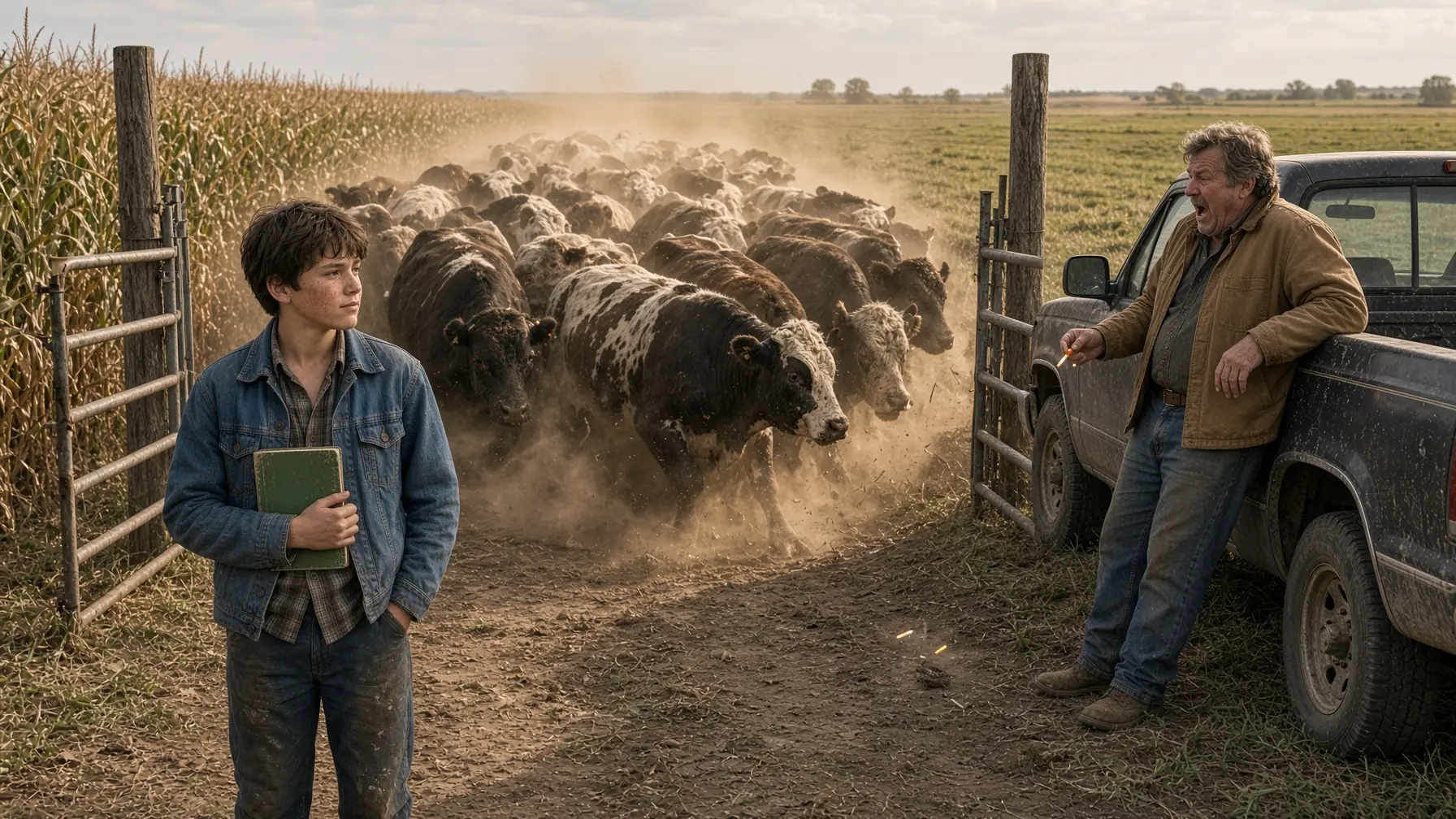
Eli Tannahill was fourteen years old, standing at the edge of forty acres of late corn, when he saw the gate on the north fence swing open.
For half a second, he thought the latch had failed.
Then he saw Reeve Callaway standing behind it.
One hand still rested on the gate.
The other hung loose at his side.
Beyond him, sixty-one bulls surged through the opening.
The animals came forward in a dark, heavy wave, hooves tearing at the dry October ground as they headed directly toward the Tannahill corn.
Reeve did not chase them.
He did not shout.
He simply walked back to his truck, leaned against the tailgate, lit a cigarette, and watched.
Then he smiled.
Eli did not move.
Not yet.
He stood beside the first row of corn and listened as the ground began to tremble.
Reeve thought he was watching a fourteen-year-old boy lose the crop that would decide whether his family kept the farm.
He had no idea Eli had spent the previous seven weeks digging something into the earth.
Something Reeve could not see from his truck.
Something Eli’s grandfather had first drawn in a green canvas notebook thirty years earlier.
And in less than a minute, sixty-one bulls were going to find it.
Nobody in Vane County, Missouri, expected Eli Tannahill to keep the farm past one growing season.
His father, Samuel Tannahill, died in March of 1991 after a truck crossed the center line on Highway 28 during a freezing rain.
Samuel was forty-two.
Eli was fourteen.
One morning Eli had a father who complained about diesel prices, sharpened mower blades at the kitchen table, and could diagnose most tractor problems by listening for ten seconds.
By evening, he did not.
Samuel left behind sixty acres outside Marsh Hollow, an aging farmhouse, several pieces of equipment held together by welding rods and patience, and a 1978 International tractor that coughed blue smoke on cold mornings.
He also left bills.
Some expected.
Some not.
The worst arrived in June.
An envelope from the county agricultural extension credit program showed an outstanding balance connected to seed, fertilizer, and equipment assistance Samuel had arranged before his death.
$4,127.63.
Payment due before the end of the year.
Eli’s mother, Martha, read the letter twice at the kitchen table.
Then she folded it.
“We’ll work it out.”
Eli knew that tone.
It was the same tone she had used at his father’s funeral when relatives asked if she needed anything.
It meant she had no idea how.
The Tannahill place had sixty acres, but only about forty were planted in corn that year.
The rest included the farmhouse, barn, a garden, low wet ground, a narrow stand of timber, and several acres too poorly drained to plant reliably.
Their corn was not beautiful.
But it was alive.
If the weather held and prices did not collapse, it might be enough.
That summer, practically everyone offered advice.
Some useful.
Some disguised as predictions.
At Dutch Olman’s feed store on Route 9, Eli once walked in just in time to hear Dutch speaking to a customer.
“That boy will sell out by Christmas.”
Dutch was sixty-three, thick around the middle, with a white mustache stained yellow near the corners from cigarettes.
The customer glanced toward Eli.
Dutch saw him.
He did not apologize.
“Ground like that needs a grown man on it.”
Eli carried a sack of mineral salt to the counter.
“I need two of these.”
Dutch rang him up.
Nothing more was said.
That was the thing about Marsh Hollow.
People rarely thought they were insulting you.
They believed they were simply describing reality.
Fourteen-year-old boys did not run farms.
Widows did not beat debt.
Old tractors did not become younger.
And small farms surrounded by larger operations eventually became part of those larger operations.
That was simply how things went.
Reeve Callaway believed it more strongly than most.
Callaway owned eighty acres immediately north of the Tannahill property.
He raised cattle and cut hay.
He was forty-eight, heavy through the shoulders, with thick brown hair beginning to gray near the ears and the habit of speaking as though every conversation were a negotiation he had already won.
He had wanted the Tannahill bottomland for years.
Samuel never sold.
Three weeks after Samuel’s funeral, Reeve came to the farmhouse.
Martha opened the door.
Eli sat at the kitchen table pretending not to listen.
Reeve removed his hat.
“I know this isn’t an easy time.”
Martha said nothing.
“I've been thinking maybe I can take one problem off your hands.”
“What problem?”
“The land.”
He offered $38,000 for all sixty acres.
Martha stared at him.
“You offered Samuel fifty-two last year.”
Reeve shifted.
“That was before.”
“Before what?”
He did not answer directly.
“Corn prices change. Equipment condition changes. And you've got debt.”
Martha’s face hardened.
“How do you know about our debt?”
“Small town.”
Eli looked up.
That was the first moment he truly disliked Reeve Callaway.
Martha handed him his hat.
“The farm isn’t for sale.”
Reeve smiled patiently.
“You should think about it.”
“I just did.”
He left.
Two weeks later, twelve of his cattle appeared in the Tannahill west field.
They trampled several rows of young corn before Eli and Martha pushed them back through a sagging section of fence.
Reeve apologized.
“Animals get out.”
In June, it happened again.
This time they got into Martha’s vegetable plot.
Tomato plants flattened.
Beans broken.
Reeve stood at the boundary afterward and shrugged.
“Old fence.”
“It’s your cattle,” Martha said.
“And half the fence is technically yours.”
That became his answer.
Every time.
Fence issue.
Neighbor issue.
Accident.
Civil matter.
Eli started writing things down.
Not because anyone told him to.
Because his grandfather had.
He carried a cheap spiral notebook in his coat pocket.
May 14 — cattle west forty. Eight rows corn damaged.
June 30 — twelve head in garden. Tomatoes, beans, squash.
July 22 — Deputy Cal Riggs visited. Photographs taken. No charge.
The deputy had been polite.
That almost made it worse.
Cal Riggs drove out, looked at the damage, then at the fence.
“Without evidence somebody intentionally let them through, there isn’t much criminal here.”
Martha crossed her arms.
“This is the third time.”
“I understand.”
“Do you?”
Cal looked uncomfortable.
“Fence disputes are usually civil matters.”
There it was again.
The phrase everyone used when they wanted a problem to belong to somebody else.
Eli wrote it down too.
His grandfather’s notebook had been sitting in the kitchen drawer for twelve years.