Boon Carter had counted everything in his house twice that night.
He counted the eight cattle left in the lower pasture, the two feed sacks stacked near the west wall of the barn, and the jars in the root cellar one by one. Beans, potatoes, flour, coffee, salt, and a little dried beef wrapped in cloth. Every number looked smaller after he wrote it down in the ledger. Under the ledger sat the county tax notice, folded once, but heavy enough to feel like a stone on the kitchen table.
The Carter ranch had once stretched proud across the dry ridge outside Abilene, with cattle moving like a dark river beneath the morning sun. But three hard years had changed that. Drought had burned the grass, sickness had taken half the herd, and the bank had started sending letters that looked polite until a man read them slowly. Boon had learned that trouble did not always arrive kicking the door open. Sometimes it came folded in an envelope.
He had been doing math by lamplight long after the house went quiet.
The oil lamp smoked low beside his elbow, staining the kitchen air with a bitter smell. Outside, October dragged across the ranch with dry leaves, fence-wire moans, and the sharp breath of an early cold front. Boon rubbed his thumb against the edge of the tax notice and tried to make the numbers obey him. They did not.
That was when he heard the barn.
At first, it was only a board creaking. Boon froze, listening through the walls of the old house. Then straw shifted softly, followed by a tiny uneven breath, the kind made by someone trying very hard not to be heard. His hand moved from the ledger to the lantern before his mind had fully decided what his body already knew. Past midnight, a barn did not whisper unless hunger had found it.
He stood slowly.
The kitchen chair scraped beneath him, sounding too loud in the sleeping house. Boon lifted the lantern, lit it from the lamp, and pulled his coat from the peg by the door. His rifle rested above the shelf, but he did not reach for it right away. If the sound belonged to a thief, the cattle would have bawled. If it belonged to a stray dog, the horses would have stomped restless against the stall boards.
This quiet was different.
This quiet was human.
The yard was hard under Boon’s boots as he crossed toward the barn. Dust lifted around each step, and the wind cut through his coat like it knew where the cloth had worn thin. The ridge behind the ranch stood black beneath a moonless sky. Even the cattle seemed to hold their breath.
Boon stopped outside the barn door.
He could hear it now. Not one breath. Several. Small, careful, uneven breaths buried beneath the hay. His fingers tightened around the lantern handle until the metal bit into his palm. He did not want trouble. More than that, he could not afford kindness that turned into trouble.
He slid the barn door open with his shoulder.
The old hinge gave one long complaint.
Boon raised the lantern high, and the light climbed the rough beams, touched the hanging rope, shone across the tack hooks, and spilled over the hay where no one should have been. For one second, his mind tried to make the scene smaller than it was. A bundle. A shadow. One trespasser.
Then the patchwork shawl moved.
Boon saw the faces.
Four children lay curled around a woman in the hay. The smallest boy was pressed against her shoulder, trembling even in sleep, his thumb near his mouth. Two children were folded at her legs like puppies trying to disappear inside straw and cloth. The oldest girl lay closest to the woman’s sleeve, hands tucked under her chin, taking up so little room it looked practiced.
The woman had made her body into a door.
Her shawl was hardly a shawl anymore. It was three colors of old cloth, repairs over repairs, frayed so thin that lantern glow passed through the seams. She had pulled it over every child before keeping any warmth for herself. Her dress was dusty, torn at the hem, and damp near the knees from walking through cold grass after dark.
Boon’s first feeling was not kindness.
It was fear wearing a practical voice.
He needed that hay. He needed those feed sacks. He needed strangers gone before morning brought questions to his gate and trouble to his name. A man with a tax notice on his kitchen table could not become a shelter for every broken soul wandering through the county.
Then her eyes opened.
She did not scream.
She did not scramble backward.
She tightened one arm around the smallest boy and looked directly into Boon’s face as if she had already measured the worst he might do. Her eyes were red from sleeplessness, but steady. Her mouth trembled once before she forced it still.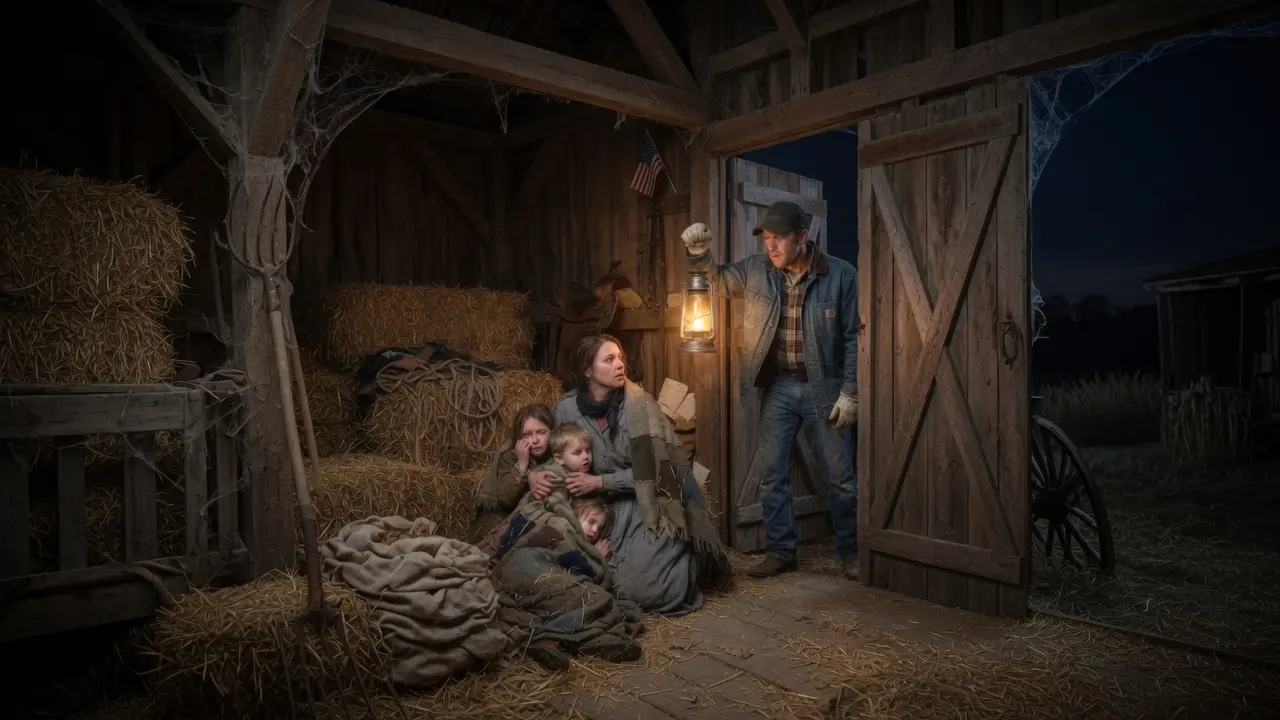
“They were cold,” she whispered.
Not hungry.
Not lost.
Not sorry.
Cold.
The word stripped the barn down to what mattered. Four little bodies under one torn shawl, a woman awake enough to be afraid, and a rancher holding a lantern like a judge who had never asked to be one. Boon’s jaw tightened as he looked from the children to the feed sacks, from the feed sacks to the open door behind him. Outside, the wind had teeth.
For one ugly breath, he imagined stepping backward.
He imagined closing the barn door and returning to the ledger where numbers never looked at him with tired eyes. He could tell himself they would leave by morning. He could tell himself he had done no harm. The lie was already forming when the oldest girl stirred.
“Mama,” she breathed.
The woman’s face broke for less than a second.
It was quick, almost too quick to notice. Pain moved through her eyes, then vanished behind control. She swallowed hard and lowered her gaze before grief could wake the children. Boon understood then.
The cold in the barn changed.
“Please don’t wake them,” the woman said. Her voice stayed soft, but it had an edge sharpened by three nights without rest. “They haven’t slept right in three days.” She pulled the smallest boy closer and shielded his face from the lantern. “We’ll be gone by morning.”
Boon’s eyes moved over the children again.
The oldest girl could not have been more than ten. The boy under the woman’s arm looked six, maybe seven, though hunger made children hard to age. A little girl with pale hair slept against the woman’s lap, one hand twisted into the torn shawl. The smallest child, half hidden beneath hay and blanket scraps, breathed with a faint whistle that made Boon’s chest tighten against his will.
“How long have you been here?” he asked.
“Since dark,” she said. “I saw your barn from the ridge.” She paused, then forced the rest out. “We only needed someplace warm for one night.”
“You got names?”
The woman hesitated.
Not long enough to lie.
Long enough to decide how much truth might cost.
“My name is Clara Whitcomb,” she said. “The children are Ruth, Eli, Maisie, and little Samuel.”
Boon watched her hand move gently over each child as she named them. Not possessive, not uncertain. Protective. Her fingers trembled only after the names were spoken.
“Where are their people?” Boon asked.
Clara’s throat worked.
“Buried outside Mercer Crossing.”
The lantern flame shifted in the draft.
Boon looked away first.
Mercer Crossing had taken fever badly that summer. He had heard talk of wagons leaving houses with sheets nailed over windows, of children sleeping beside graves because no one left could carry them farther. But stories heard at the mercantile were different from children breathing in a man’s hay. Distance made suffering sound smaller.
“These yours by blood?” he asked.
“No.”
“Then why are they with you?”
Clara lifted her chin slightly. “Because no one else took them.”
That answer settled between them heavier than any plea.
The smallest boy woke at the sound of Boon’s voice. His eyes found the lantern first, then Boon’s boots, then Boon’s face. The child began to shake so hard the straw around his knees whispered. Clara pulled him against her chest immediately, her own body stiffening like she expected Boon to drag them out by force.
“If you must throw someone out,” she said, her voice low but fierce, “throw me out first.”
Boon stared at her.
“You brought four children into my barn and expected mercy from a stranger?”
“No,” Clara said. “I expected nothing.” Her eyes shone, but she refused to let tears fall. “But they were freezing.”
Boon stood there with the lantern raised, feeling the weight of his own house behind him and the hunger of winter ahead. He thought of the two feed sacks. He thought of the tax notice. He thought of his wife’s grave on the hill, though Mary had been gone six years and he still hated when memory chose moments without asking.
Mary would have opened the door.
That thought angered him because it made the choice clearer.
He lowered the lantern.
“Nobody leaves this barn tonight,” Boon said.
Clara blinked as if she had not understood.
Boon turned toward the stall wall where old horse blankets hung from wooden pegs. He pulled two down and tossed them near the hay. Then he lifted the lantern higher and pointed toward the tack room. “There’s a draft through the north wall. Move them closer in.” He paused, jaw tight. “I’ll bring something hot.”
Clara did not thank him.
Not yet.
She only stared at him with suspicion still guarding her face, because desperate people learn not to trust kindness until it survives the next minute. Boon understood that better than he wanted to. He stepped back through the barn door, shut it halfway against the wind, and walked toward the house with his chest feeling heavier than when he had left.
Inside the kitchen, the ledger waited.
The tax notice waited.
The numbers waited.
Boon ignored them.
He opened the stove door, stirred the embers, and built the fire back to life. Then he took the last pot of beans from the shelf, added water, salt, and a strip of dried beef he had been saving for morning. He cut bread into slices thin enough to stretch, then stared at them and cut two more. After a moment, he pulled down the coffee tin, hesitated, and shut it again.
Children did not need coffee.
He filled a jar with milk instead.
When he returned to the barn, Clara was sitting closer to the inner wall with all four children wrapped in the horse blankets. Ruth, the oldest, was awake now and watching him with guarded eyes too old for her face. Eli hid his mouth against Clara’s sleeve. Maisie blinked in and out of sleep, pale hair stuck to her cheek. Little Samuel had not opened his eyes, but his breathing still sounded rough.
Boon set the pot on an overturned crate.
“Eat slow,” he said.
No one moved.
Clara looked at the food, then at him.
“You eat first,” she said.
Boon frowned.
“What?”
“You eat first.”
He nearly snapped at her, but then he saw her hand resting over the children like a warning. She had seen enough poison in the world that even beans could look dangerous in a stranger’s barn. Boon picked up the spoon, took one bite, and swallowed. Then he set it down.
“Now feed them before I change my mind.”
The boy Eli moved first.
Clara held him back just long enough to make sure Boon did not step closer. Then she gave him the spoon. The child ate like hunger had rules and he was afraid of breaking them. Ruth watched her siblings before taking any for herself. Maisie cried silently when the bread touched her hand.
Boon looked away.
He busied himself checking the barn door, the stall latch, the rope on the east beam, anything that did not require watching children eat like rescued animals. After a while, Clara stood slowly and brought the empty bowl back to him. Her face had softened, but her spine remained rigid.
“Thank you,” she said.
The words sounded painful, as if gratitude cost her pride she had very little left to spend.
Boon nodded once.
“What happened at Mercer Crossing?”
Clara’s fingers tightened around the bowl.
“The fever came through after harvest work started,” she said. “Their mother died first. Their father two days later.” She glanced toward Ruth. “The town took them in for a week, maybe less. Then people started arguing about who could feed them.”
“And you were what?”
“A seamstress.”
“You kin?”
“No.”
“Then why take four children?”
Clara looked back at the hay where they slept.
“Because Ruth heard two men talking about sending them to the county poorhouse.” Her voice lowered. “She asked if I knew whether they separated brothers and sisters there.”
Boon’s hand stilled.
“What did you tell her?”
Clara swallowed.
“I told her to pack what she could carry.”
Outside, the wind pressed against the barn walls.
Boon wanted to say that was foolish. He wanted to say one woman had no business dragging four children across open country with winter coming. He wanted to say the poorhouse might have at least fed them. But Ruth’s face, too watchful and too thin, made every practical argument sound like cowardice.
“Where were you headed?” he asked.
“West.”
“That ain’t a place.”
“It was all I had.”
Boon let out a slow breath through his nose.
“You can stay till morning,” he said.
Clara’s eyes sharpened.
“And then?”
“Then we see daylight.”
She looked as if she wanted a better promise.
Boon did not give one.
That was all he had.
The next morning came gray and cold.
Boon woke before dawn in his chair by the kitchen stove, having slept less than an hour. The house felt different, though no one else had entered it. He could feel the barn behind the walls like a question waiting to be answered.
He carried more food out before sunrise.
When he opened the barn door, Ruth was already awake with a pitchfork in her hands.
It was too heavy for her.
She held it anyway.
Boon stopped in the doorway, not angry, not amused. Clara woke instantly beside the children and sat up, fear flashing across her face until she saw the food in his hands. Ruth lowered the pitchfork only when Clara touched her wrist.
“Girl’s got sense,” Boon said.
Ruth stared at him.
“She’s got fear,” Clara replied.
Boon set the food down.
“Fear keeps folks alive sometimes.”
Clara’s face hardened slightly. “Only if it doesn’t swallow them whole.”
That was the first time Boon saw something besides exhaustion in her. There was anger under it. Not reckless anger, but a steady fire banked low because survival left no room for flames. He respected it before he meant to.
After breakfast, Boon told Clara he needed the children out of the hay so he could feed the cattle.
She rose immediately.
“We’ll leave.”
“I didn’t say leave.”
She froze.
Boon looked at the children, then toward the empty stall closest to the house. “They can sit in there while I work. It’s warmer than the yard.” He hesitated. “There’s water in the trough. Wash up if you need.”
Clara watched him closely.
“You change your mind often?”
“Only when I slept badly.”
For the first time, something almost like a smile touched her mouth.
It vanished quickly.
But Boon saw it.
The children spent that morning sitting in the empty stall while Boon worked. Ruth helped Maisie wash her face. Eli followed every movement Boon made, still fearful but curious. Little Samuel coughed until Clara rubbed his back and whispered into his hair.
By noon, Boon knew the boy needed more than warmth.
He rode into town before Clara could argue.
The town of Abilene had a way of turning news into weather. Before Boon reached the mercantile counter, three people had already seen the extra flour, molasses, and medicine he picked up. Mrs. Bell from the church stopped near the fabric shelf and narrowed her eyes at the children’s stockings folded in his basket. The barber leaned halfway out his door as Boon loaded the supplies.
By sunset, half the town knew something had happened at the Carter ranch.
By the next morning, they thought they knew what.
The first visitor was Deputy Harlan Pike.
He arrived with his horse lathered and his eyes already suspicious. Harlan had never liked unanswered questions. He stepped into Boon’s yard with one thumb tucked into his gun belt and looked toward the barn. Boon came out of the house before the deputy could knock.
“Heard you got strangers staying,” Pike said.
“News travels faster than decency.”
Pike’s mouth tightened.
“Woman and children?”
Boon did not answer.
Pike took one step toward the barn.
Boon moved into his path.
That was the first real line drawn.
Pike looked down at Boon’s boots, then back at his face. “You hiding runaways, Carter?”
“I’m keeping children warm.”
“Not what I asked.”
“It’s the answer you’re getting.”
The barn door opened behind them.
Clara stepped out with Ruth close beside her, one hand resting on the girl’s shoulder. She looked cleaner now, though still worn to the bone. The sight of Pike made Ruth go stiff. Clara felt it and shifted slightly in front of her.
Pike noticed.
“What’s your name?” he asked.
“Clara Whitcomb.”
“These your children?”
Clara’s lips parted.
Boon saw the split second of danger.
If she said yes, Pike could accuse her of lying later. If she said no, he could use the law to take them. Clara knew it too, and for one second, the whole yard balanced on the answer.
“They’re under my care,” she said.
Pike smiled without warmth.
“That ain’t the same thing.”
“No,” Boon said. “It’s better than what they had.”
Pike turned back to him.
“You want legal trouble on top of tax trouble?”
The words landed exactly where Pike meant them to land.
Boon’s face did not change, but Clara looked sharply at him. Now she knew. The ranch was not safe because Boon had plenty. It was only safe because he had chosen to make room inside his own lack.
Pike leaned closer.
“County can place them.”
Clara’s fingers tightened around Ruth’s shoulder.
Ruth whispered, “No.”
It was one word, but it carried a graveyard inside it.
Boon heard it.
So did Pike.
For once, the deputy looked uncomfortable.
Boon stepped closer, lowering his voice. “You ride back to town and tell whoever sent you that those children are fed, warm, and not bothering a soul.”
“And if the county asks official?”
“Then I’ll come official.”
Pike studied him.
“You’re a fool, Carter.”
“Wouldn’t be the first man to think so.”
The deputy finally mounted and rode off, but his visit changed the air around the ranch. Clara knew now that Boon was standing between them and more than the cold. Boon knew it too. That realization settled into the house like another debt.
That night, Clara tried to leave.
Boon found her in the barn wrapping food into cloth while the children slept. She froze when the lantern light touched her hands. For one second, shame crossed her face, but she did not apologize. She only tied the bundle tighter.
“You stealing from me now?” Boon asked.
“No,” she said. “Leaving before you lose more because of us.”
He stepped into the barn.
“The road’s colder than last night.”
“We’ve survived cold.”
“Samuel hasn’t.”
Her hands stopped.
Boon’s voice softened despite himself. “Boy needs a doctor if that cough gets worse.”
Clara turned away, shoulders tight.
“We can’t pay one.”
“I didn’t ask if you could.”
She spun back toward him.
“That is exactly what everyone asks, even when they don’t say it.”
The anger in her voice echoed against the beams.
Boon stood still.
Clara pressed a shaking hand against her mouth, then lowered it. “I have asked at doors until my knuckles bled. I have watched people count children before counting mercy. I know what charity looks like when it is already tired of you.”
Boon looked at the bundle in her hands.
“Put the food back.”
Her eyes flashed.
“Don’t order me like I’m some—”
“Put it back,” he said again, “because you ain’t leaving.”
The words struck her silent.
Boon took one breath and forced the rest out.
“I got a tax notice on my table and winter breathing down my neck. I won’t lie to you. I don’t know how to carry this.” His jaw tightened. “But I know I won’t sleep if I send four children into the dark.”
Clara’s face crumpled for one second before she turned away.
Her hand gripped the barn post hard enough for her knuckles to pale. She did not sob loudly. She made one small broken sound, then swallowed it like she was ashamed of being human. Boon looked away and gave her the dignity of not being watched.
The next morning, he moved them into the house.
Not proudly.
Not easily.
He did it with the stiff movements of a man rearranging his life before his heart could argue. Ruth and Maisie slept in the small side room where Mary used to sew. Eli and Samuel slept near the stove. Clara took the chair by the door and refused the bed until Boon told her stubbornness was not a blanket.
For the first few days, the house felt crowded in all the wrong ways.
Children moved quietly, too quietly, as if every floorboard might revoke their shelter. Ruth washed dishes without being asked. Eli stacked firewood until his hands blistered. Maisie saved crusts in her pocket. Samuel coughed through the nights, and Clara woke every time his breath changed.
Boon watched them all.
He had forgotten how much noise hope made when it was afraid to return.
By the end of the week, Ruth had learned where Boon kept the flour. Eli had started following him to the barn, staying five steps behind. Maisie sat under the kitchen table with a rag doll Clara made from torn cloth. Samuel slept better near the stove, one hand always curled around Clara’s sleeve.
The ranch began changing around them.
Not softer.
Alive.
One morning, Boon found Eli in the barn trying to lift a feed scoop nearly as big as his chest.
“You trying to feed cattle or bury yourself?” Boon asked.
Eli dropped the scoop and stepped back, terrified.
“I was helping.”
Boon looked at the boy’s thin arms, then at the scoop.
“Helping starts smaller.”
He handed Eli a tin cup.
“Fill this.”
Eli stared at the cup like it was a badge.
From that day on, he followed Boon during morning chores. He learned which cow kicked, which gate stuck, and how to carry water without spilling half of it. He still flinched at sudden sounds, but less often. Boon noticed and pretended not to.
Clara noticed too.
One afternoon, she stood in the barn doorway watching Eli laugh for the first time after a calf licked his coat sleeve. The sound startled everyone, including Eli himself. Clara pressed one hand against her chest, eyes bright and wounded. Boon saw the look and understood that joy could hurt when a person thought they had lost the right to expect it.
“You all right?” he asked.
She wiped quickly at her cheek.
“Yes.”
“You lie poorly.”
“So do you.”
Boon almost smiled.
Then winter came early.
The first snow fell before the last hay had been fully secured. Wind pushed drifts against the barn doors, and the cattle needed more feed than Boon had planned. The house became a place of constant work—boiling water, mending clothes, drying socks, stretching meals, patching cracks in walls. Clara worked as hard as any hired hand and harder than most.
Still, the tax deadline moved closer.
Boon said nothing about it until Clara found the notice beneath the ledger.
She stood in the kitchen holding the paper while Boon came in from the cold, snow melting on his shoulders. Their eyes met, and for once he saw no fear in hers. Only understanding. That was somehow worse.
“You should have told me,” she said.
“Ain’t your burden.”
“We are in your house.”
“That don’t make my debts yours.”
Her jaw tightened.
“You think I don’t know what it means to owe more than you can carry?”
Boon removed his gloves slowly.
“I think you’ve carried enough.”
Clara looked down at the paper again.
“If we leave, does it help?”
“No.”
“Truth.”
“No,” Boon said, firmer this time. “It doesn’t.”
She studied him, then folded the notice carefully and placed it back on the table.
“Then we don’t leave.”
The word we stayed in the room after she said it.
Boon did not correct her.
The next week, Clara began sewing for town families from scraps and old cloth. Mrs. Bell from the church brought torn shirts first, pretending she only wanted to “test the woman’s stitches.” Clara repaired them so cleanly that Mrs. Bell returned with three dresses, then church linens, then quiet apologies wrapped in baskets of food. Some people in town still whispered. But whispers lost strength when faced with useful hands and hungry children.
Boon sold two calves to buy time.
It was not enough.
Then the storm hit.
It came down from the north with no mercy, turning the ridge white and sealing the roads before sundown. By midnight, the cattle were restless, the barn door had iced along the bottom, and one of the pregnant cows went down near the far fence. Boon saw the lantern light catch her body through the snow and reached for his coat.
Clara grabbed his arm.
“You can’t go alone.”
“I have to.”
“Then I’m coming.”
“You’ll freeze.”
“So will you if you fall.”
There was no time to argue.
They went into the storm together, Boon carrying rope and Clara holding the lantern low against the wind. Snow struck their faces like thrown sand. Twice Clara slipped, and twice Boon caught her by the elbow. By the time they reached the cow, both were breathing hard, their clothes stiff with ice.
The animal was tangled near broken wire, exhausted and frightened.
Boon worked the rope around her while Clara held the lantern and spoke softly, not to him, but to the cow. Her voice had the same tone she used with Samuel when his cough woke him at night. Calm. Firm. Refusing panic.
It took nearly an hour.
When the cow finally rose, staggering but alive, Boon nearly dropped to one knee from exhaustion. Clara grabbed his coat and held him upright. In the wild lantern light, their faces were close enough for him to see snow melting on her lashes.
“You still think mercy is bad ranch business?” she asked, breath shaking.
Boon stared at her.
Then he let out a tired laugh.
“Depends who’s keeping the books.”
By spring, the ranch had survived.
Barely, but barely was still alive.
The children changed with the season. Ruth stopped hiding food. Eli grew louder around the barn. Maisie sang to the chickens in a voice so soft Boon had to stand still to hear it. Samuel’s cough faded, and one morning he ran across the yard without stopping.
Clara watched him from the porch.
Boon stood beside her.
Neither spoke for a while.
Then she said, “I used to think if I kept them alive long enough, someone better would come.”
Boon looked at the children playing near the fence.
“Someone better?”
“Someone with money. A family. A safer place.”
He rested both hands on the porch rail.
“You still waiting?”
Clara turned toward him.
Her eyes no longer looked like the eyes of a woman bracing for the next door to close.
“No,” she said.
The county tax man arrived in June.
He came with papers, two witnesses, and the careful expression of a man used to delivering bad news without accepting responsibility for it. Boon stood in the yard while Clara kept the children on the porch behind him. The tax man explained the amount due, the deadline missed, the legal process that could begin if payment was not made.
Boon listened without interrupting.
Then Ruth stepped down from the porch.
She held a cloth pouch in both hands.
Clara moved as if to stop her, but Ruth kept walking.
“This is from sewing money,” Ruth said, placing the pouch on the ledger Boon had brought outside. “And egg money. And what Mr. Bell paid Eli for stacking wood. It’s not enough.”
The tax man looked uncomfortable.
Boon stared at the pouch.
Then Eli came down with another small bundle. Maisie followed with coins wrapped in a handkerchief. Even little Samuel carried one button, thinking it mattered because everyone else was giving something.
Boon’s throat tightened.
“Children,” he said softly, “this ain’t your debt.”
Ruth lifted her chin.
“It’s our home too.”
The words broke something open in him.
Not pain.
Not grief.
Something locked for years.
Before Boon could answer, a wagon rolled into the yard. Then another. Then three more. Mrs. Bell came first, followed by the blacksmith, the mercantile owner, Deputy Pike, and farmers Boon had helped through years of hard weather without ever asking for much back. They came with envelopes, goods, hay notes, and quiet faces.
Deputy Pike stepped down last.
He would not meet Boon’s eyes at first.
“Town heard you were short,” he said gruffly.
Boon looked across the crowd.
“I didn’t ask.”
“No,” Pike said. “That’s probably why they came.”
The tax man counted the money twice.
Then he signed the extension and rode away without saying much.
When the yard emptied, Boon stood beside the porch holding the cloth pouch Ruth had given him. Clara came down slowly. The children stayed close behind her, watching him like the world depended on what he might say next.
Boon looked at them all.
The woman who had walked through hunger for children not her own.
The girl who had learned to protect before she learned to rest.
The boy who now carried feed like responsibility was something sacred.
The little ones who had turned his silent house into a place where morning mattered again.
He cleared his throat.
“I got something to ask.”
Clara went still.
Boon reached into his coat and pulled out folded papers.
“I spoke to Judge Mallory.”
Her eyes widened.
“He says if no kin come forward, and if the children agree, this ranch can petition for guardianship.”
Ruth’s hand flew to her mouth.
Eli stared at Boon as if he did not understand the word but understood the hope inside it.
Clara’s voice shook.
“This ranch?”
Boon looked at her.
“This family.”
For a moment, nobody moved.
Then Samuel ran first.
He hit Boon around the legs with enough force to make him stagger. Maisie followed, then Eli, then Ruth, who tried not to cry and failed completely. Boon stood stiffly at first, overwhelmed by small arms and loud breathing and the terrifying weight of being needed. Then his hand came down gently on Samuel’s back.
Clara watched from the porch step, crying silently now.
Boon looked at her over the children’s heads.
“You too,” he said.
Her face changed.
Not with surprise.
With the slow, painful release of someone who had been standing guard for too long and had finally been told she could come inside.
Years later, folks in Abilene would still tell the story of the night Boon Carter found a woman and four orphans sleeping in his hay barn. They would say he had been a hard man then, half-buried under debt, grief, and the kind of loneliness ranchers learn to call peace. They would say Clara Whitcomb had no claim to those children except love, and somehow that turned out to be the strongest claim of all.
The barn remained standing long after the debt was paid.
Boon never replaced the old door, even when Eli offered to hang a better one after he grew tall enough to lift it himself. The hinge still complained every time it opened. Clara said it sounded like the night their lives changed.
On cold evenings, Samuel liked to sit under the hayloft and ask Boon to tell the story again.
Boon always grumbled that the boy had heard it enough.
Then he told it anyway.
He told how he raised the lantern and saw four children curled under one torn shawl. He told how Clara looked him straight in the eye, exhausted and fierce, and gave him no excuse except the truth. He told how he nearly chose fear because fear was easier to defend than mercy.
But he always ended the same way.
“She said, ‘They were cold.’”
Then Boon would look across the barn at Clara, older now, softer in the face but still with that steady fire behind her eyes.
“And I found out,” he would say, “that sometimes God sends a man a family dressed up like trouble.”
The children would laugh.
Clara would shake her head.
And outside, the wind would move across the ridge, no longer sounding empty.