Nobody planned to save Clara Whitmore that day. Not the ranchers who came to the dusty auction yard looking for horses. Not the farmers who leaned against the fence with their hats low over their eyes. Not the men laughing near the cattle pens, counting coins and making cruel jokes beneath the brutal Texas sun. To them, it was supposed to be just another monthly auction in Dry Hollow, the kind of place where people came to buy mules, cattle, wagons, tools, and anything else a hard life on the frontier demanded.
But by noon, the crowd had gathered around something that did not belong on any auction block. A young woman. She stood barefoot on the rough wooden platform, her wrists bound with rope, her dress torn at the hem and stained with dust. Her face was streaked with dirt, and exhaustion clung to her thin shoulders as if it had become part of her body. The trader beside her yanked the rope hard enough to make her stumble forward.
“Same price as a mule!” he shouted. “Who’s bidding?” Laughter rolled through the crowd. Some men looked her over as if she were livestock. Others joked about whether she could cook, scrub floors, haul water, or survive the winter.
No one asked her name. No one asked where she had come from. No one asked what had been done to her before she ended up standing there under that merciless sky. She did not speak. She only kept her head lowered.
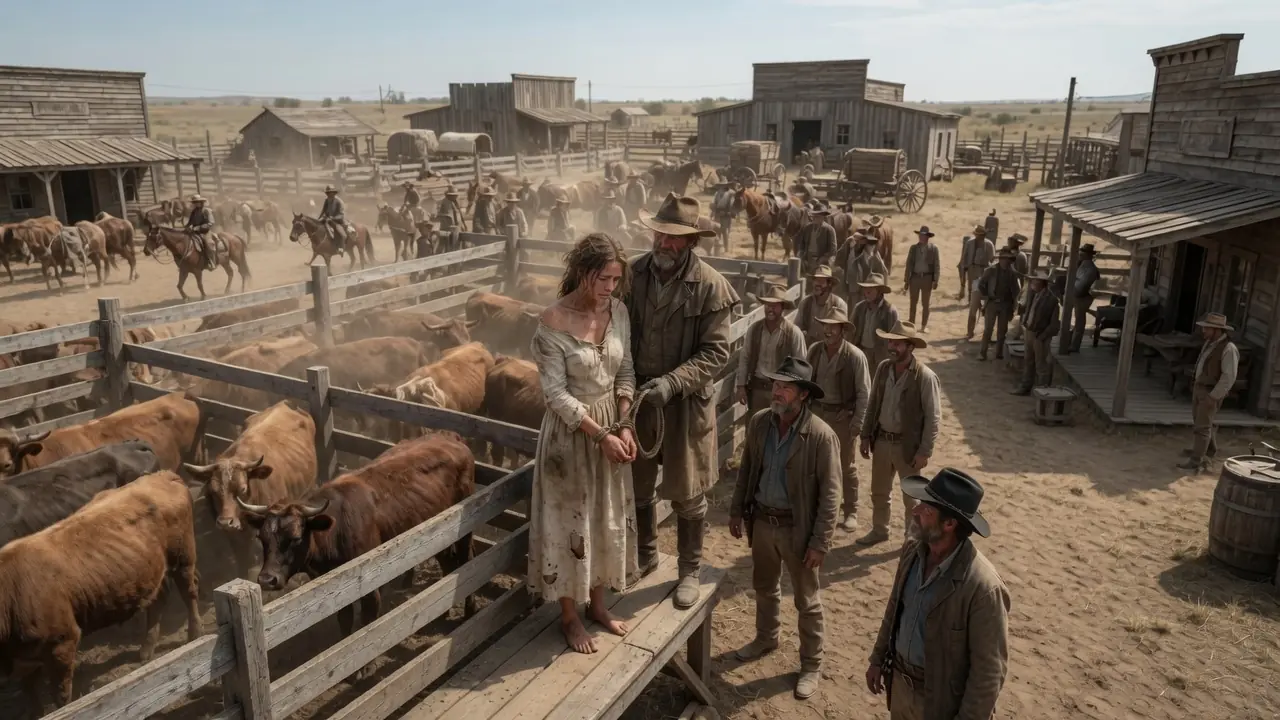
Until, for one brief moment, she lifted her eyes. That was when Mason Callaghan stopped walking. Mason had not come to Dry Hollow to become part of anyone’s tragedy. He was forty-six years old, a widower, and the owner of a ranch several miles outside town. He had come that morning to buy two strong horses, maybe a wagon wheel if the price was fair, and then ride home before evening.
He was not a man who searched for trouble. Life had already given him enough of it. Years earlier, he had buried his wife, Eleanor, beneath a cottonwood tree behind their ranch house. Since then, the place had become too quiet. The kitchen table had one chair pulled out instead of two.
The evenings stretched long. The wind seemed louder than it used to. He still worked from sunrise to sundown because work was the only thing that kept grief from swallowing him whole. But when he saw the young woman on that auction block, something in him went still. It was not only her fear that caught him.
It was what lived behind it. Her eyes were tired, yes. Frightened, yes. But they were not empty. They were not broken. Somewhere beneath all that dust and humiliation, there was still a fierce little flame refusing to die.Mason had seen that look once before. He had seen it in his own mirror after Eleanor passed, when every breath felt like a burden and yet some stubborn part of him kept rising before dawn. The trader jerked the rope again. “Healthy enough,” he barked. “Strong arms. Knows how to work. Doesn’t complain.”
The words fell across the auction yard like a hammer striking stone. The laughter died. The trader squinted at him. “You serious, Callaghan?” Mason’s jaw tightened.
“I said I’ll take her.” Someone in the crowd sneered. “Didn’t know you were buying trouble today.” Mason did not turn around. He counted out the money with steady hands, though inside him something burned hotter than the Texas sun.
The trader snatched the bills, sliced through the ropes around Clara’s wrists, and shoved her forward as if he were unloading broken equipment. She stumbled. Mason caught her before she hit the dirt. The moment his hands touched her arms, she flinched so sharply it made his chest ache. He let go at once.
“I won’t hurt you,” he said quietly. She looked at him for a long moment, searching his face as if kindness were a language she no longer trusted. Then she gave the smallest nod. Mason removed the blanket from his wagon and wrapped it around her shoulders. He handed her his canteen, but she only stared at it.
“It’s water,” he said gently. “You don’t have to ask.” Her fingers trembled as she took it. The crowd began to drift away, disappointed now that the cruelty had ended too soon to entertain them. Mason helped her into the wagon, climbed up beside her, and took the reins.
For miles, neither of them spoke. The town disappeared behind them. The road stretched ahead through dry grass, mesquite, and red dust. The sun slowly lowered, turning the horizon pale orange. Mason did not ask questions.
He had learned that wounded people rarely needed questions first. They needed quiet. They needed safety. They needed time. Only when the ranch came into view, with its weathered fence line and small white house beneath the cottonwood trees, did she finally whisper a single word.
“Clara.” Mason looked over gently. “Clara,” he repeated, as if making sure the world heard her name properly for the first time that day. “I’m Mason.” She nodded once, then looked away toward the open land.
Neither of them knew it yet, but both of their lives had already changed. The first days were careful. Mason gave Clara the small room at the back of the house, the one that had once belonged to visitors who no longer came. He placed clean clothes outside the door, left warm food on the kitchen table, and never entered her space without knocking. Clara moved through the house like someone afraid every floorboard might punish her for making a sound.
If Mason reached too quickly for a cup, she stiffened. If a door slammed in the wind, she nearly jumped out of her skin. At supper, she ate slowly, as though expecting someone to take the plate away before she finished. Mason pretended not to notice, because he sensed that being watched was its own kind of pain.
On the third morning, he found her in the yard before sunrise, already carrying a bucket toward the well. “You don’t have to earn your place here,” he said from the porch. She froze. The bucket hung from her hand. “I can work,” she answered softly.
“I didn’t say you couldn’t.” “I don’t want to be useless.” Mason stepped down from the porch, keeping plenty of distance between them. “There’s work enough for both of us. But nobody on this ranch has to bleed for a bed or a meal.” Clara lowered her eyes.
“I don’t know how to live like that.” The honesty of it silenced him. After a moment, Mason said, “Then we’ll learn slow.” And they did. Slowly.
At first, Clara worked because fear told her she had to. She swept floors that were already clean. She folded laundry twice. She fed chickens before Mason even woke. But as the days passed, something in her began to soften.
She learned that Mason did not shout. He did not raise a hand. He did not demand stories she was not ready to tell. When rain came, he sat on the porch and listened to it like music. When supper burned, he laughed and ate it anyway.
When she dropped a plate and it shattered across the floor, she backed into the wall with terror in her eyes. Mason only reached for the broom. “Plates break,” he said. “People matter more.” That was the first time Clara cried in his house.
Not loud. Not dramatically. Just one hand over her mouth, shoulders shaking as if her body did not know what to do with gentleness. By autumn, Clara had begun to smile. By winter, she laughed.
It happened one cold morning when Mason tried to fix a loose barn door and dropped the hammer into a water trough. He stood there, soaked to the sleeve, looking so offended by his own mistake that Clara burst into laughter before she could stop herself. The sound filled the barn. Mason looked up. For one breath, he forgot how lonely the ranch had been.
“Well,” he said, trying to appear serious, “I’m glad my suffering brings joy to this household.” Clara laughed harder. After that, the ranch changed. Not all at once. But enough.
There was coffee warming in the morning. There were curtains opened to let sunlight in. There was a second voice at the supper table. Clara began humming old songs while kneading bread. Mason found himself telling stories he had not spoken aloud in years.
He told her about Eleanor. How she had loved wildflowers. How she used to scold him for tracking mud into the kitchen. How she could calm a frightened horse with nothing but her voice. Clara listened with care.
One evening, while they sat near the stove, she said, “You loved her very much.” Mason looked into the fire. “I still do.” Clara nodded. “I think love stays, even when people don’t.”
Mason turned toward her. There was a sadness in her voice too old for her years. He wanted to ask who had taught her that. But he did not. Not yet.
But something else worried him. Some mornings, she woke pale. Sometimes she pressed one hand against her stomach when she thought he was not looking. At supper, she would take two bites and then push the food around her plate. Once, while hanging sheets on the line, she swayed so badly Mason had to catch her by the elbow.
“You’re sick,” he said. “I’m fine.” “You nearly fell.” “It was just the heat.” “It’s February.”
She looked away. Fear had returned to her face. Not fear of Mason. Fear of the truth. That frightened him more.
He offered to take her to the doctor in town, but she refused so quickly that he did not press. Still, the worry sat heavy in him. Then came the evening in the barn. The sky had turned violet beyond the hills, and Mason was closing the stall doors when he heard something fall. He turned sharply.
Clara was on one knee near the hay bales, one hand gripping the post, her face drained of color. Mason rushed to her side. “Clara.” “I’m sorry,” she whispered. “For what?”
Her breathing shook. Tears gathered in her eyes, and this time she did not try to hide them. “I have to tell you something.” Mason lowered himself beside her. “Then tell me.”
She placed both hands over her stomach. The gesture was so protective, so instinctive, that Mason understood before she said another word. His heart stopped. Clara looked at him with terror and shame tangled together. “I’m carrying a child.”
The barn went silent except for the soft shifting of horses in their stalls. Mason did not move. Clara began speaking quickly, as though she expected kindness to disappear if she did not explain fast enough. “I didn’t tell you because I was afraid. I thought if you knew, you’d send me away. I thought you’d think I tricked you, or that I brought trouble here, or that I was—”
“Clara.” His voice was quiet, but firm enough to stop her. She looked at him. Mason swallowed hard. “Did someone hurt you?”
Her face crumpled. That was answer enough. For a moment, Mason felt a rage so deep it frightened even him. It rose from the place where grief had lived for years, hot and sharp and almost blinding. But Clara was watching him, and he knew his anger could not become another thing she had to fear.
So he breathed. Slowly. Then he took off his hat and set it on the barn floor. “You listen to me,” he said. “You and that child are safe here.”
Clara stared at him as if she had not understood. “I don’t have anywhere else.” “You don’t need anywhere else.” “I don’t know how to be a mother.” “Nobody does at first.”
“I’m scared.” “I know.” The tears spilled freely now. Mason’s own eyes burned. He had imagined many futures after Eleanor died, most of them quiet and lonely. He had never imagined a frightened young woman would arrive at his ranch carrying a child beneath her heart and grief behind her eyes.
But life had a strange way of bringing people to the same doorway. Some came needing rescue. Some came needing purpose. And sometimes, without planning it, they gave those things to each other. Clara whispered, “You don’t hate me?”
Mason looked almost wounded by the question. “No, Clara. I hate what was done to you. I hate every person who made you believe this was your shame to carry. But I do not hate you.” She covered her face and sobbed. Mason sat beside her on the barn floor until the worst of it passed.
He did not touch her until she leaned toward him first. Then he wrapped one arm around her shoulders, careful and steady, like a man holding something fragile that had survived more than it should have. The next morning, Mason hitched the wagon. Clara stood on the porch, pale but determined. “Where are we going?”
“To see Doc Harlan.” Fear flashed across her face. Mason softened his voice. “Only to make sure you’re healthy. Both of you.” She hesitated. Then nodded.
In town, people stared. They always stared. Dry Hollow was the kind of place where gossip traveled faster than horses. By noon, half the town had seen Mason Callaghan escorting Clara Whitmore into the doctor’s office. By evening, whispers had begun.
Some said Mason was a fool. Some said Clara had trapped him. Some said no decent man would bring a woman like that into his home. Mason heard the talk two days later outside the general store. He stopped, turned, and looked directly at the three men speaking.
The oldest cleared his throat. “No offense meant, Mason.” Mason stepped closer. “Then you should have no trouble keeping quiet.” No one laughed.
From that day on, people learned that Mason Callaghan’s patience had limits, and Clara Whitmore stood on the other side of them. Spring came slowly. Clara’s belly began to show. Mason built a cradle from cedar wood, sanding every edge until it was smooth. He painted the small back room a soft cream color because Clara said yellow made her think of morning light.
At night, she sewed tiny blankets from scraps of old fabric Eleanor had once saved. “Are you sure?” Clara asked when Mason gave her the box. Mason nodded. “She would have wanted something beautiful to come from it.” Clara ran her fingers over the cloth.
For a long time, she said nothing. Then she whispered, “I wish I could have known her.” Mason smiled sadly. “She would have liked you.” “No, she wouldn’t.”
“She would.” Clara shook her head. “I’m not the kind of woman people like.” Mason leaned back in his chair. “Clara, the people who made you believe that were not people worth measuring yourself by.”
She looked down at the blanket in her lap. “I’m trying to believe you.” “That’s enough for now.” As her time drew near, Clara’s fear changed shape. It was no longer the old fear of being hurt.
It was the new fear of loving someone she had not met yet. “What if I look at the baby and remember everything?” she asked one night. Mason did not pretend the answer was simple. “Maybe you will,” he said gently. “At first.”
Her eyes filled. “But maybe one day you’ll look at that child and see something else.” “What?” “Your courage.”
Clara pressed a hand to her stomach. The baby moved. For the first time, she smiled through her tears. The storm came in late May. Rain hammered the roof. Thunder rolled over the land. The wind bent the trees until their branches scraped against the windows.
Clara went into labor just after midnight. Mason rode through the rain to fetch Doc Harlan, pushing his horse harder than he had in years. By the time they returned, Clara was gripping the bedframe, her hair damp with sweat, her face tight with pain. Mason stood outside the bedroom door, helpless in a way he had never felt before. He had faced droughts, wild horses, sickness, debt, and death.
But waiting there, listening to Clara cry out, nearly broke him. Hours passed. The storm raged. Then, just before dawn, a new sound rose inside the house. A baby’s cry.
Small. Sharp. Alive. Mason closed his eyes. Doc Harlan opened the door, tired but smiling.
“It’s a girl.” Mason stepped inside slowly. Clara lay against the pillows, exhausted, pale, and trembling. In her arms was a tiny baby wrapped in one of Eleanor’s old blankets.
The child’s face was red and wrinkled, her fists curled tightly, her cry fading into soft little breaths. Clara looked down at her. Mason waited. He saw the fear in Clara’s eyes. He saw the memories come close.
Then Clara touched the baby’s cheek with one shaking finger. The baby turned toward her. Something in Clara’s face changed. Not all the pain disappeared. Life did not work that cleanly.
But something new entered beside it. Love. Fierce, frightened, overwhelming love. “She’s so small,” Clara whispered. Mason smiled.
“She’s got time.” Clara looked up at him. “What should I name her?” He shook his head. “That’s for you to choose.”
She looked back at the baby. Outside, the storm began to quiet. “Hope,” she whispered. Mason’s throat tightened. Clara held the baby closer.
“Her name is Hope.” Years later, people in Dry Hollow would tell different versions of the story. Some would say Mason Callaghan rescued Clara Whitmore from an auction block. Some would say Clara brought life back into a house that had been grieving too long. Some would say baby Hope changed the ranch forever.
All of those things were true. But none of them were the whole truth. The truth was quieter. Mason had not planned to save anyone that day. Clara had not planned to trust anyone again.
And Hope had entered the world carrying no blame for the darkness that came before her. Together, they became something the town had not expected. A family. Not perfect. Not untouched by pain.
But real. There were still hard days. There were mornings when Clara woke from nightmares and had to remind herself she was safe. There were evenings when Mason sat beneath the cottonwood tree and missed Eleanor so deeply he could hardly breathe. There were moments when Hope cried through the night, and both of them felt too tired to stand.
But there was also laughter. There was bread cooling on the windowsill. There was a baby learning to crawl across the kitchen floor. There was Clara singing while rocking her daughter beside the stove. There was Mason carrying Hope on his shoulders through the pasture, pointing out horses, clouds, and wildflowers.
And one afternoon, when Hope was almost three, she ran barefoot across the yard toward Clara with a fistful of yellow blooms. “For you, Mama.” Clara knelt and gathered her daughter into her arms. Mason watched from the porch. The same woman who had once stood barefoot on an auction block, treated like she was worth less than an animal, now held a child who looked at her as if she were the safest place in the world.
Clara looked over Hope’s shoulder and met Mason’s eyes. Neither of them spoke. They did not need to. Some stories do not end with revenge. Some do not end with grand speeches or the whole world admitting it was wrong.
Some stories end with a woman learning to breathe again. With an old house becoming warm. With a child named Hope growing up in a place where no one ever had to earn love by suffering for it. And maybe that was the greatest victory of all. Because on a dusty Texas afternoon in 1887, the crowd had looked at Clara Whitmore and seen nothing but weakness.
But Mason Callaghan had seen the flame still burning in her eyes. And years later, that flame had become a home.