Sometimes the most fragile sound in the world can change everything. That morning it was the sound of a child crying in the vastness of the Arizona desert, a sound so small it could have been mistaken for the wind. Except the wind doesn't weep with such desperation. The sun had barely cracked the horizon when I heard it. I was riding the eastern fence line of my ranch, doing what I did every morning since my wife Sarah passed three years ago, checking cattle, mending wire, filling my days with work so I wouldn't have to fill them with memories.
The desert was painted in shades of gold and purple, that brief moment when the world holds its breath between night and day. My horse, a reliable buckskin mare named Dancer, suddenly stopped and turned her ears forward. She heard it before I did. At first, I thought it might be a wounded animal. We get coyotes out here sometimes, or a mountain lion, and the sounds they make when they're hurt can fool you into thinking they're almost human.
But this was different. This was human. This was a child. I touched my heels to Dancer's flanks, and we moved toward the sound. The land out here can trick you; what looks like a hundred yards might be a quarter mile, and the morning light plays games with shadows and distance. But Dancer knew, animals always know.
She picked her way carefully down a shallow wash, her hooves clicking on loose stones, and that's when I saw her. A little girl, no more than seven years old, sitting at the base of a scrub mesquite tree. Her dress was torn, her feet were bare and bleeding, and her dark hair hung in tangled braids down her back. She had her arms wrapped around herself, rocking slowly back and forth, and the sound coming from her throat was the kind of sound that breaks a man's heart clean in two.
I dismounted slowly, keeping my movements easy and predictable. I've worked with frightened horses my whole life, and children aren't so different when they're scared. You don't rush them, you don't crowd them, you let them see you're not a threat. She looked up at me with eyes so dark they were almost black, eyes that had seen things no child should ever see. There was dirt streaked across her face, and when she saw me, she didn't run.
She was too exhausted to run. She just stared at me like I might be another nightmare in a long line of nightmares she'd already survived. I knelt down about ten feet from her, making myself smaller, less threatening. I kept my hands visible, my voice soft. "Easy there, little one. I'm not going to hurt you."
She didn't answer. She clutched something to her chest, a small beaded pouch that looked handmade, and she watched me the way a cornered rabbit watches a wolf. I reached for my canteen, opened it slowly, and held it out toward her. The sound of water sloshing inside seemed to break through whatever fear was holding her frozen. Her eyes fixed on that canteen like it was the most precious thing in the world.
I set it down on the ground between us and backed up a step. "Take your time. It's all yours." She moved like a shadow, quick and cautious, grabbing the canteen and bringing it to her lips. She drank too fast, water spilling down her chin, and I had to reach out gently to slow her down. "Easy now. Too much too fast will make you sick."
She let me take the canteen back, and that's when I saw her feet, raw and blistered, some of the blisters broken and bleeding. She'd walked a long way, probably days, across some of the harshest country in the territory. Whatever had happened to her, wherever she'd come from, she'd survived it through sheer determination and a kind of courage that made me ashamed I'd ever felt sorry for myself. I took off my jacket, a worn leather duster that had seen better days, and draped it around her shoulders.
She was so small it swallowed her whole. Then I lifted her gently, expecting her to fight or scream, but she didn't. She was too tired. She just laid her head against my shoulder, still clutching that beaded pouch, and let out a breath that sounded like she'd been holding it for years. "You're safe now," I told her, though I wasn't entirely sure what safe meant anymore.
I turned Dancer toward home and started the ride back. The girl didn't make a sound. She just held on, and I could feel her small body trembling against mine, whether from cold or fear or exhaustion, I couldn't tell. Probably all three. The ride back to the ranch took twenty minutes that felt like hours.
Every time I looked down at her, I thought about my own daughter, the one Sarah and I never got to have. We tried for years, hoped and prayed, and waited, but it never happened. Sarah used to say, "Maybe God had different plans for us, that maybe we were meant to help other people's children instead." I didn't put much stock in divine plans back then. I figured the world was what it was, and you made the best of what you got.
But holding this little girl, feeling her breath steady as she finally fell asleep against my chest, I wondered if maybe Sarah had been right after all. The ranch came into view just as the sun fully cleared the eastern mountains. It wasn't much, just a small main house, a barn, a corral, and a few outbuildings. But it was mine, paid for with ten years of hard work and sweat. Smoke was already rising from the kitchen chimney.
Rosa Martinez, my cook and housekeeper, was up and working. Rosa had been with me for five years, ever since her husband died and left her with nothing. She was a round, warm woman in her mid-fifties, with hands that could make the toughest beef tender and a heart that matched. She came out onto the porch when she heard Dancer's hooves in the yard. She was wiping her hands on her apron, probably expecting me to want breakfast early, but when she saw what I was carrying, her whole face changed.
"Dios mío, Boss, what you got there?" "Found her out by the East Wash. She's Apache, I think. Been walking for days." Rosa came down the steps and reached out to touch the girl's forehead, checking for fever, the way mothers do. The girl stirred, but didn't wake.
"Pobrecita, she burning up a little. Bring her inside. I get water, food, clean clothes." I carried her into the house, into the small room I'd always meant to turn into something useful, but never had. It had a bed, a dresser, and a window that looked out over the eastern hills. Rosa was already pulling back the covers, fluffing the pillow, moving with the efficiency of a woman who'd raised six children of her own.
I laid the girl down gently. She didn't let go of that beaded pouch, not even in sleep. Rosa covered her with a blanket and immediately started pulling off the girl's torn moccasins to examine her feet. "Ay, Boss, look at this. She walked through hell to get here."
"Can you fix her up, Rosa?" "I clean, put medicine, wrap good. But Boss..." Rosa looked up at me with those knowing eyes of hers, eyes that had seen too much of life's cruelty. "You know, people in town not going to like this." "Then they don't have to come to my ranch."
Rosa smiled at that, the kind of smile that said she'd expected nothing less, but appreciated hearing it anyway. She shooed me out of the room so she could work, and I went to the kitchen, where the coffee pot was already hot on the stove. I poured myself a cup and stood at the window, watching the sun climb higher, turning the desert from purple to gold to the hard white of midday. I'd kept to myself for three years, speaking only to Rosa and the occasional ranch hand who needed work.
I'd gotten used to the silence, the empty spaces, the way a house feels when there's no one in it but you. But somehow, in the span of one morning, that silence felt different. There was life in my house again, fragile, wounded life, but life nonetheless. I heard Rosa moving around in the back room, heard water splashing, heard her voice speaking soft Spanish words I couldn't quite make out. After about half an hour, she came into the kitchen wiping her hands on a towel.
"She sleep now. I give her water, little bit of broth, clean her wounds. She wake up soon, I think." "Did she say anything?" "One word only. She keeps saying, 'Na, na, na.' I don't know what it mean. Maybe her name, maybe someone she looking for."
I nodded, sipping my coffee, thinking about that word. Na. It sounded like a name or maybe a title. My knowledge of Apache language was limited to a few trading words and phrases. I'd always tried to treat the Apache people fairly, had even done business with a few of their traders over the years, but I'd never learned their language properly.
Now I wished I had. Rosa poured herself coffee and sat down across from me at the kitchen table. She had flour on her dress from making biscuits and her hair was starting to come loose from the bun she always wore. "What you going to do, Boss?" "Find out where she belongs. Get her back to her people."
"And if her people all dead, then I guess we'll figure that out when we get there." Rosa nodded, but her eyes were worried. She knew as well as I did that a white rancher taking in an Apache child was the kind of thing that started talk, bad talk. The kind that could turn neighbors into enemies and make a man's life difficult in ways that went beyond words. But I'd made my choice the moment I picked her up.
You don't leave a child in the desert to die. You don't turn your back on someone who needs help just because it might make your life harder. Sarah had taught me that; she'd always been the better person, the kinder heart. And even though she was gone, I tried to live by the principles she'd believed in. The girl slept most of the day.
I went about my work, checking on the cattle, mending a section of fence that had come down in last week's windstorm. But my mind kept drifting back to the house, wondering if she'd woken up, wondering what I'd say to her when she did. Rosa came out to the barn around noon with a sandwich and more coffee. "She awake. She ate three biscuits and drink milk. She scared still, but better."
"Did she say anything else?" "She asked for Na again. She cry when I tell her I don't know where Na is. I think maybe Na is her mother." That made sense. A child that young, lost and alone, would be crying for her mother.
The question was, where was the mother? Was she dead? Was she somewhere out there searching? Had the same thing that happened to this little girl happened to her entire family? I finished my sandwich and headed back to the house. Rosa met me at the door with a warning look.
"She very scared of men right now, Boss. You go slow." "I will." The girl was sitting up in bed when I entered the room. She had the blanket pulled up to her chin, and her eyes tracked me the moment I appeared in the doorway. I stayed near the door, keeping my distance, and I spoke as gently as I knew how.
"Hello there. My name is Luke. Luke Dawson. This is my ranch. You're safe here." She stared at me, silent. "Can you tell me your name?" Nothing, just those dark eyes watching every move I made. I held up my hands, showing her they were empty.
"I'm not going to hurt you. I promise you're safe." She looked at Rosa, who had followed me into the room, and Rosa gave her an encouraging nod. "Okay, miha, he good man, he help you." The girl's grip on the blanket loosened slightly. Then, in a voice so small I almost didn't hear it, she whispered, "Na."
"That's your name? Na?" She shook her head quickly, tears welling up in her eyes. She pointed toward the window, toward the world outside. "Na. Na." "Your mother?"
She nodded and a tear spilled down her cheek. I knelt down near the bed, still keeping enough distance that she wouldn't feel cornered. "We'll find her. I promise you, we'll try to find your mother." She looked at me with such hope in her eyes that it nearly broke me. How do you make a promise like that to a child when you have no idea if you can keep it?
But what else could I do? I couldn't tell her that her mother was probably dead, that whatever had driven her out into the desert alone had likely killed everyone she loved. I couldn't take that hope away from her, not yet. Rosa brought in a bowl of soup and some bread. She ate slowly, still weary, but hunger won over fear.
When she finished, she curled up under the blanket without a word. "I'll need to ride into town tomorrow," I told Rosa quietly. "Talk to the sheriff, see if anyone's reported Apache troubles in the area." "You want me to stay with her?" "Please, I don't want her waking up alone and thinking we've abandoned her."
That night, I sat on the porch with a glass of whiskey and watched the stars come out. The desert night was cool and clear, the way it gets in early fall, and the sky was so thick with stars it looked like someone had spilled diamonds across black velvet. Sarah used to love nights like this. She'd sit right here next to me, her hand in mine, and we'd talk about everything and nothing, the way married people do when they've been together long enough that silence is just as comfortable as conversation.
I missed her. God, how I missed her. Three years wasn't long enough to forget the sound of her laugh, the way she smelled like lavender and bread, the way she could look at me and know exactly what I was thinking. She would have known what to do with this little girl. She would have had the right words, the right touch, the right way to make her feel safe.
All I had was good intentions and a promise I wasn't sure I could keep. The next morning, the girl was sitting at the kitchen table when I came in for breakfast. Rosa had found some old clothes somewhere, probably something left over from her own grandchildren's visits, and the girl looked almost normal, except for the fear still living in her eyes. She watched me come in, watched me pour coffee, watched me sit down across from her. "Morning," I said.
She didn't answer, but she didn't look away either. Rosa set a plate of eggs and bacon in front of me, then one in front of the girl. We ate in silence, and I was careful not to stare, not to make her more uncomfortable than she already was. When she finished, she pushed her plate away and looked at Rosa, then at me. "Na," she said again, but this time it wasn't a cry or a plea.
It was a statement, a reminder, a demand almost. Find Na. "I will. I promised. We'll start looking today." After breakfast, I was heading out to saddle Dancer for the ride into town when Rosa called me back.
"Boss, Boss, come quick!" I turned and saw her standing on the porch, pointing toward the eastern hills. I followed her gaze and felt my heart kick hard against my ribs. There was someone there, a figure standing on the ridgeline about two00 yards out. Even at that distance, I could tell it was a woman.
She stood perfectly still, silhouetted against the morning sky, and she was watching my house. The girl appeared in the doorway next to Rosa. She looked where we were looking, and suddenly her whole body went rigid. Her mouth opened and she screamed one word at the top of her lungs, "Na!" Then she was running, running barefoot across the yard, running toward that distant figure with every ounce of strength in her small body.
The woman on the ridge didn't move at first, like she couldn't believe what she was seeing. Then she started running too, down the hill, stumbling over rocks and scrub brush, her arms outstretched. They met in the middle of my yard like two forces of nature colliding. The woman dropped to her knees and caught the girl in her arms, and the sound that came out of both of them was something primal, something beyond words.
It was relief and grief and joy all mixed together, the sound of a mother who thought her child was dead and a child who thought she'd never see her mother again. I stood on the porch next to Rosa, and neither of us moved. Some moments are too sacred to interrupt, and this was one of them. The woman held the girl for what must have been five minutes, just held her and rocked her and spoke to her in rapid Apache words, tumbling over words, checking her all over for injuries, touching her face, her arms, her hands as if she couldn't quite believe she was real.
Finally, she stood up, still holding the girl on her hip, and turned to face me. She was tall for a woman, probably in her early thirties, with long black hair that fell past her shoulders and eyes that were sharp and intelligent and full of a weariness that came from hard experience. Her clothes were torn and dusty, and she had bruises on her arms and a cut above her left eyebrow, but she stood straight and proud, meeting my gaze without flinching. Rosa moved first, coming down the steps with her hands spread wide in a gesture of peace.
"It's okay, miha, we help your daughter. We keep her safe." The woman's eyes flicked to Rosa, then back to me. She said something in Apache that I didn't understand, then she switched to English, broken and halting, but clear enough. "You... You find her?" I nodded. "Yes, ma'am. Found her out by the East Wash yesterday morning. She was alone and hurt. I brought her here, got her fed and cleaned up."
The woman's eyes filled with tears, but she didn't let them fall. "You save her life." "Just did what anyone would do." She shook her head firmly. "No, not anyone. You good man."
She said it with such certainty that I almost believed it myself. Rosa came forward slowly, speaking in her gentle way. "You hungry, miha? Thirsty? You look like you've been walking long time." The woman hesitated, clearly torn between her instinct to run and her desperate need for help. Finally, she nodded.
She set the girl down, but kept hold of her hand, as if afraid that letting go meant losing her again. "Come inside," I said. "We'll get you both fed, and you can tell us what happened." She followed us into the house, moving like a wild animal in a trap, ready to bolt at the first sign of danger. But once she saw the kitchen, saw Rosa moving around with her comfortable maternal efficiency, saw the food on the table and the warm fire in the stove, some of the tension left her shoulders.
Rosa set out bread and cold chicken and fresh milk, and the woman ate with the same desperate hunger her daughter had shown the day before. Between bites, she kept glancing at the girl, touching her hair, her cheek, as if reassuring herself that this was real. When she'd eaten enough to take the edge off her hunger, I poured her coffee and sat down across the table. Rosa had taken the girl into the other room to check her bandages, giving us space to talk.
"My name is Luke Dawson. This is my ranch. You and your daughter are safe here for as long as you need." The woman wrapped her hands around the coffee cup, absorbing its warmth. She spoke slowly, choosing her words carefully. "My name, Na." She paused, searching for words. "My daughter, she called Tun. My English not good. Sorry."
"Your English is fine. Can you tell me what happened? Where you came from?" Na's face darkened, and for a moment I thought she wouldn't answer. Then she took a deep breath and began to speak, her words halting, but her meaning clear. "Three days ago, maybe four. I..." She paused, searching for the word. "...lose count. Men come to village nighttime. They say they want trade. We give food, make welcome, but they lie."
She stopped, her hands gripping the coffee cup so hard I thought it might shatter. "They wait until sleep. Then they come with guns, with fire. They burn homes. They take things. They kill." Her voice broke on that last word, but she forced herself to continue. "My husband, he died two winters ago. But my brother, my father, they there. They fight. The men, they shoot. I take Tun. We hide in a rocks. Morning come, I go back. Everyone..." She closed her eyes. "...everyone dead."
I felt something cold settle in my chest. A raid, a massacre, the kind of thing that happened out here more often than people wanted to admit, where the line between outlaws and upstanding citizens got blurry and violence was just another tool for getting what you wanted. "These men who attacked, did you see their leader? Did he say what he wanted?" Na nodded slowly. "One man, he have..." She touched her own face, drawing a line down her cheek. "...scar here. Big scar. He asked for gold. Old gold. Spanish gold. He think we know where it is."
"Do you?" Na shook her head. "My husband, before he die, he find old map. He go look, never come back. I think he die looking. No gold, just dream. But this man with the scar, he thinks the gold is real." "Yes. He asked me, 'Where is gold?' I say, 'I don't know.'" She swallowed hard. "He hurt people to make me tell. But I don't know. So I take Tun. We run. We run for three days. Tun, she get tired, scared. I look for water and she wander off. When I come back, she gone. I look everywhere. Everywhere. I think..." She stopped, unable to continue.
"You thought she was dead." Na nodded, tears finally spilling down her cheeks. "I think I lose everything. My people, my home, my daughter, everything." I reached across the table and put my hand over hers, a gesture I wouldn't normally make with a stranger, but that felt necessary in that moment. "You didn't lose her. She's alive and she's safe. You both are."
Na looked up at me with eyes that held a mixture of gratitude and something else, something that might have been the faintest flicker of hope. "Why you help us? We Apache. Your people and my people, we..." She struggled for words. "...not friends." I pulled my hand back and leaned back in my chair. "She's a human being who needs help. That's all the reason I need. Sarah believed we're supposed to help each other when we can."
"Your wife, where is she gone?" "Three years now. Fever took her." "I am sorry." We sat in silence for a moment, two people who'd lost too much sitting across a kitchen table in the middle of nowhere. Rosa came back in with Tun, who immediately ran to her mother and climbed into her lap.
Na held her close, whispering to her in Apache, and the girl smiled for the first time since I'd found her. Rosa looked at me and gave me a small nod. She had cleaned and rebandaged the girl's feet and given her a cloth doll that had probably belonged to one of her granddaughters. Tun clutched it now like it was the most precious thing in the world. "You both need rest," I said to Na. "Take the back room. Stay as long as you need."
"We can't stay. That man, the one with scar, he looked for us. If he find us here, he kill you too." "Let me worry about that right now. You need to rest and recover. We'll figure out what comes next tomorrow." Na looked like she wanted to argue, but exhaustion was written all over her face. Finally, she nodded. "One night, then we go."
I didn't argue with her, but I also didn't believe her. One night in a warm house with food and safety wasn't going to be enough to send her back out into the desert, not with a wounded child. She needed time, and whether she admitted it or not, I was going to make sure she got it. Rosa showed them to the back room again, and I heard her speaking softly in Spanish, probably telling Na where things were, making her feel welcome. I went back out to the porch and stood in the morning sun, thinking about what Na had told me.
A man with a scar looking for Spanish gold, willing to kill an entire village to find it. That kind of evil wasn't new out here, but it never got easier to stomach. And if he was looking for Na and her daughter, he wasn't going to stop just because they'd managed to escape once. I thought about riding into town right then, talking to Sheriff Bradley, getting some kind of protection organized. But I knew how that would go.
Bradley was a decent man, but he was practical, and practical men didn't risk their lives or their deputies' lives for an Apache woman and child. He'd tell me to turn them over to the Indian agent, which was as good as signing their death warrant, given how corrupt most of those agents were. No, if Na and Tun were going to be safe, it was going to have to be here on my land under my protection. I went to the barn and checked my rifles.
I had two good Winchesters and an old Henry that had belonged to my father. I cleaned them, loaded them, and put them where I could reach them quickly. Then I walked the perimeter of the property, looking for good defensive positions, thinking about lines of sight and where attackers might come from. I wasn't a soldier. I'd never fought in the war, being too young when it started and too essential to the family ranch when it was over.
But I'd grown up on the frontier, and frontier life teaches you how to defend what's yours. You learn to shoot straight, think ahead, and never let your guard down completely. By the time I came back to the house, it was late afternoon. Rosa met me at the door with worry in her eyes. "Boss," she said quietly, "that woman, Na, she'd been crying all day. Quiet, so the little one don't hear, but crying. Her heart is broken, Boss. Broken into a million pieces."
"Keep an eye on her," I said. "Make sure she eats. Make sure she rests. Time heals most things, even broken hearts." But even as I said it, I wondered if it was true. Some things don't heal. Some losses are too big, some wounds too deep.
All you can do is learn to carry them and hope they don't drag you under. That evening we all sat down to dinner together. Rosa had made a pot roast with potatoes and carrots, and the smell filled the whole house with warmth and comfort. Tun sat between her mother and Rosa, eating slowly but steadily, and occasionally she'd look up at me with those dark eyes and something that might have been trust. Na ate, too, though I could tell her mind was elsewhere.
After dinner, Rosa cleared the dishes, and I suggested we sit on the porch for a bit. The evening was cool and pleasant, and I thought the fresh air might do Na good. She came out with Tun, and the three of us sat on the porch steps while Rosa hummed in the kitchen washing up. The sky was turning that deep purple it gets just before the stars come out, and the desert was settling into its night rhythms, all the small sounds of creatures going about their business.
Tun pointed up at the sky and said something in Apache. Na smiled, the first real smile I'd seen from her, and translated. "She say stars are our ancestors. They watch us, keep us safe." "That's a nice thought," I said. "My wife used to say something similar. She believed the people we loved never really left us, that they stayed close somehow, watching over us."
"Your wife sound like good woman." "The best woman I ever knew." Na was quiet for a moment, watching Tun chase fireflies. Then she said softly, "My husband never meet Tun. He die in mountains before she born. Sometimes I wonder what he would think of her, of all this."
"He'd be proud," I said. "Any man would be proud of a daughter like that and a wife as strong as you." She smiled, but there were tears in her eyes. "Thank you for saying that." She was right, of course. The grief didn't get smaller, you just got bigger around it, built your life around the empty space where someone used to be.
We sat in comfortable silence for a while, watching Tun chase fireflies in the yard. The girl's laughter was like music, pure and untainted, the kind of sound that reminded you what joy was supposed to feel like. Then, from behind us, Rosa's voice cut through the peace. "Boss, Boss, you better come see this."
I turned to find her standing in the doorway, her face pale, pointing toward the eastern road. I stood up and looked where she was pointing, and my blood went cold. There were riders coming, five of them, maybe six, still a ways off, but clearly heading toward my property. In the fading light, I couldn't make out details, but I didn't need to. I knew who they were.
I knew why they were coming. The man with the scar had found them. Time has a way of slowing down when danger approaches. Those riders were still half a mile out, maybe more, but every second felt like it lasted an hour. I could hear my own heartbeat, loud and insistent in my ears, and I could feel Na's presence behind me, tense and ready to run.
"Rosa," I said quietly, keeping my voice steady. "Take Tun inside. Put her in the root cellar and stay with her. Don't come out until I tell you it's safe." "But Boss..." Rosa started, but I cut her off. "Now, Rosa, please." She understood the tone.
She'd heard it before, the voice of a man who wasn't asking anymore. She reached for Tun, but the girl had already sensed the change in the air. Children always know when adults are afraid, no matter how well you try to hide it. She clung to her mother's leg, looking up at Na with wide, frightened eyes. Na knelt down and spoke rapidly in Apache, her hands on Tun's shoulders.
The girl shook her head, tears starting to form, but Na was firm. She kissed her daughter's forehead, said something else, and then gently pushed her toward Rosa. Tun went reluctantly, looking back over her shoulder as Rosa hurried her into the house. I turned to Na. "You should go with them. Get in the cellar where it's safe."
She looked at me like I'd suggested she sprout wings and fly. "No," she said simply. "They come for me. I stay." "Na, this isn't your fight anymore. Let me handle it." She moved past me and walked into the house, her back straight, her movements purposeful.
I followed her, confused, and found her in my study, looking at the gun rack on the wall. She pointed to one of the rifles. "You teach me use this?" I stared at her for a moment, trying to understand what she was asking. "You want to fight?"
She turned to face me, and there was steel in her eyes, hard and unforgiving. "They kill my family. They burn my home. They hunt my daughter like animal. Yes, I will fight." I could have argued with her. I could have told her it was too dangerous, that she needed to stay with Tun, that I could handle this on my own. But the look in her eyes told me I'd be wasting my breath.
This woman had already lost everything; she wasn't about to hide in a cellar while someone else defended her. I took down one of the Winchesters and showed her how to load it, how to aim, how to work the lever action. She learned quickly, her hands steady and sure. When I was satisfied she wouldn't shoot herself by accident, I handed her a box of ammunition.
"Stay in the house, second floor front window. You'll have a clear line of sight to the yard. Don't shoot unless I give the signal or unless they shoot first." She nodded, already moving toward the stairs. "And Na..." She paused, looking back at me. "If things go bad, if I go down, you take Tun and you run. Don't stop. Don't look back. Just run."
She held my gaze for a long moment, and I saw something pass across her face, some emotion I couldn't quite name. Then she nodded once and disappeared up the stairs. I grabbed the other Winchester and my gun belt, strapped on my Colt revolver, and walked out onto the porch. The riders were closer now, close enough that I could count them. Six men, all armed, all riding with the kind of confidence that comes from knowing you have the numbers and the firepower.
They weren't trying to be subtle; they wanted me to see them coming. I stood at the edge of the porch, rifle held loosely in both hands, and waited. They slowed as they approached the gate, spreading out in a line like they'd done this before. And maybe they had. Maybe they'd ridden up to a dozen ranches, a dozen homes, and done whatever they pleased because no one had the courage or the firepower to stop them.
The man in the center was the one I focused on. Even from a distance, even in the fading light, I could see the scar running down the left side of his face, a jagged white line that started at his temple and ended at his jaw. He was a big man, broad-shouldered and thick through the chest, probably in his mid-fifties. He wore a black hat, black coat, and had two pistols on his hips. His horse was a big roan stallion that looked mean enough to bite.
The riders stopped about twenty yards from my porch, just outside comfortable shooting range. The scarred man looked at my house, at the barn, at the corral, taking inventory. Then his eyes settled on me, and he smiled. It wasn't a pleasant smile. It was the smile of a man who enjoyed what he was about to do.
"Evening, friend," he called out. His voice was deep and rough, like gravel scraping against wood. "Beautiful place you got here. Be a shame if something happened to it." I didn't answer. I just stood there, watching him, waiting.
He seemed amused by my silence. "Name's Caleb Morrison. Maybe you heard of me." "I've heard the name." "Then you know I'm not a man to trifle with. I'm looking for something, an Apache woman and her brat. Word is somebody matching that description was seen heading this way. You wouldn't happen to know anything about that, would you?"
"Can't say that I do." Morrison's smile widened. "See, I think you're lying. I think that Apache woman and her kid are in your house right now, probably shaking in their boots, and I think you're going to be smart and hand them over before this conversation turns unpleasant." I shifted my grip on the rifle just slightly, just enough to let him know I was ready to use it.
"There is nothing on my property that belongs to you, Morrison. I suggest you ride on out of here before someone gets hurt." One of the other riders, a thin man with a nervous laugh, spoke up. "Boss, you want, we should just rush him. Six of us, one of him. Odds are pretty good." Morrison held up a hand, silencing him.
He was still looking at me, measuring, calculating. "He's got nerve, I'll give him that. But nerve don't stop bullets. Neither does stupid." I said, "You might get me, but I guarantee I'll take at least three of you with me. Maybe more. Question is, which three of you want to die today?"
That got their attention. I saw the nervous one shift in his saddle, glancing at the men beside him. Nobody likes being reminded they're mortal. Morrison's expression darkened. "You're making a big mistake, friend. I got twenty men. You got what? A rifle and a bad attitude. I can burn this place to the ground and everything in it."
"You could try." He studied me for another long moment, and I could see him doing the math in his head. Was it worth the cost? Even if his men took me down, I'd hurt them badly in the process. And if there were others in the house, if they were armed, the cost could be even higher.
Finally, he turned his horse, preparing to leave. But before he did, he looked back at me one last time. "You got twenty-four hours," he said. "Hand over the woman and the kid or I come back with every man I got. And when I do, I won't be asking polite. I'll take what I want and burn the rest."
Then he spurred his horse and rode off, his men following. I watched them until they disappeared into the gathering darkness, and only then did I allow myself to breathe. Na appeared beside me so quietly I almost didn't hear her. She was still holding the rifle, her knuckles white on the stock. "He come back," she said.
It wasn't a question. "Yeah, he'll come back." "Then we have one day." I looked at her, this Apache woman who'd lost everything and still had the courage to stand and fight. "One day to figure out how to survive an army. One day," I agreed. "We better make it count."
We went inside and I bolted the door behind us. Rosa came up from the cellar with Tun, who ran immediately to her mother. Na picked her up and held her close, murmuring reassurances in Apache. Rosa looked at me with frightened eyes. "Boss, what we going to do?"
"I need to ride into town. Tonight, before Morrison comes back at dawn. We need allies, and organizing that takes time we don't have come morning." But Boss, Rosa said, "What if he come tonight while you gone?" Na spoke up, her voice quiet but firm. "Then I defend. I learn to shoot. Rosa knows how to shoot. We put Tun in cellar, hide her good."
"Morrison, he want me alive. He need me to tell him where gold is. He not burn ranch until he get me. That give us time." She was right, and I hated that she was right. Morrison wanted information, which meant he'd try to take Na alive first. It was a small advantage, but it was something. I looked at Na.
"You're sure about this?" She met my eyes steadily. "You need help. I stay, protect. You go bring back fighters. That is only way we survive tomorrow." Rosa crossed herself but nodded. "I have rifle, Boss, and that old shotgun of my husband's. We make them think twice about coming for us."
"All right," I said, "but I'm not going alone." Na nodded. "I come with you. You need someone who knows Morrison and how he thinks. Rosa can protect Tun better than I can right now. She knows this house, knows the hiding places." Rosa nodded, but I could see she didn't think much of that plan.
Neither did I. Truth be told, Sheriff Tom Bradley was a decent man, but he was also practical. He had two deputies and a town to protect. Riding out to defend one ranch against twenty outlaws wasn't the kind of odds he'd be excited about, but I had to try. "I'll take Dancer. Should be back before dawn. Keep the doors locked and the rifles loaded. If anyone comes before I get back, don't open the door. Just shoot through the windows if you have to."
Rosa crossed herself. "Dios nos proteja." I saddled Dancer in the barn, working by lantern light, my hands moving through the familiar motions while my mind raced ahead. The ride to town would take two hours, maybe less if I pushed hard. That would put me there around nine or ten o'clock.
I could find Bradley, make my case, and be back before the sun came up. As I was tightening the cinch, I heard footsteps behind me. I turned to find Na standing in the barn doorway, silhouetted against the light from the house. "I come with you," she said. I shook my head. "You need to stay with Tun. She needs her mother."
"Tun safe with Rosa. I come. I know Morrison. I know how he think. I help." There was logic to what she said. She'd survived Morrison's attack, escaped from him, evaded him for days. She knew his patterns, his methods, but bringing her to town was risky in a different way.
Tensions between the white settlers and the Apache were high. Walking into town with an Apache woman in tow might cause more problems than it solved. But when I looked at her face, saw the determination there, I knew arguing was pointless. She'd already made up her mind. "All right, but you stay close to me, and if there's trouble, you let me handle it."
She nodded and swung up onto Dancer with a grace that suggested she'd spent plenty of time on horseback. I climbed up behind her and we rode out into the night. The desert at night is a different world. The heat of the day gives way to a chill that seeps into your bones, and the darkness is so complete it feels like you're riding through ink.
But the moon was up, nearly full, and it cast enough light to see the trail. Dancer knew the way anyway; she'd made this trip a hundred times. We rode in silence for the first hour. Na sat stiff and straight in front of me, her body tense, always alert. I could feel her breathing, steady and controlled, and I found myself wondering what she was thinking.
Was she afraid, angry, planning her next move? With Na, it was hard to tell. She kept her emotions locked down tight, showing only what she wanted you to see. Finally, she spoke. "Your wife, she die of fever." "Yes." "Was you with her at the end?"
"I was." "That is good. My husband, he go into mountains looking for gold. He never come back. I never get to say goodbye, never get to tell him..." She paused. "...that I carry his child." I felt something tighten in my chest. "Tun?"
She nodded. "He never know he have daughter. Die before she born." "I'm sorry." She was quiet for a moment. Then she said, "You lose wife, I lose husband. We both know what it feel like. Empty." "Yeah. Empty."
We rode on, two people bound by grief and circumstance, heading into an uncertain night. The town of Copper Springs sat in a shallow valley surrounded by low hills. It wasn't much, just a main street with maybe twenty buildings, a church, a school, and about three hundred souls trying to scratch out a living in hard country. Most of the buildings were dark when we rode in, but there was light coming from the saloon and the sheriff's office.
I steered Dancer toward the sheriff's office and dismounted. Na slid down beside me, pulling her shawl up to cover her head and face. It wouldn't fool anyone who looked closely, but in the dim light, it might be enough to avoid immediate trouble. The sheriff's office was a small adobe building with bars on the windows and a single lamp burning inside. Through the window, I could see Sheriff Tom Bradley sitting at his desk, working on some paperwork.
He was a man in his early fifties, gray-haired and weathered, with a thick mustache and tired eyes. He'd been sheriff for ten years, and the job had worn him down in the way it wears down all honest lawmen who try to keep order in places where order is hard to come by. I pushed open the door and he looked up, his hand instinctively going to the gun on his hip before he recognized me. "Dawson? A little late for a social call, isn't it?"
"This isn't social, Tom. We need to talk." His eyes shifted past me to Na, and I saw his expression change. He stood up slowly, his hand still near his gun. "That's an Apache woman." "Her name is Na. She and her daughter are staying at my place. They're in trouble."
Bradley's jaw tightened. "What kind of trouble?" "The kind that's going to get them killed if we don't do something about it." I spent the next ten minutes telling him everything: the massacre at Na's village, Morrison and his men, the threat he'd made. Bradley listened without interrupting, his face growing grimmer with each detail.
When I finished, he sat back down and rubbed his face with both hands. "Damn it, Dawson. Why'd you have to go and make this my problem?" "Because it's the right thing to do. You know Morrison, you know what he's capable of. If I don't stop him at my place, he'll just move on to the next ranch, the next family. He needs to be stopped."
Bradley shook his head. "I got two deputies. Morrison's got twenty men, maybe more. Even if I wanted to help, which I do, we'd be slaughtered." "So, you're saying no?" "I'm saying it's suicide." Bradley looked at Na, his expression softening slightly.
"Ma'am, I'm sorry for what happened to you and yours, I truly am. But I can't sacrifice my men for a fight we can't win." Na stepped forward, her English clear despite the accent. "My people die because no one help. Now you say you no help again. When does someone finally help?" Bradley had the decency to look ashamed, but he didn't change his answer.
"I'll send word to the territorial marshal. Maybe he can bring in some men." "That'll take weeks. We've got hours." "Then I suggest you leave, Dawson. Take the woman and her kid, head east to New Mexico territory. Start over somewhere Morrison can't find you."
I'd already considered that option and rejected it. Morrison would just keep hunting. He'd track us down eventually, and when he did, we'd be alone and vulnerable. Better to make a stand on ground I knew, with walls around me and a few friends at my back. I stood up to leave. "Thanks for nothing, Tom."
"Dawson, wait." I stopped at the door. Bradley sighed. "There's a man a couple miles north of town, calls himself Reverend Samuel Webb. He's got some pull with the community, been organizing folks to help each other out. If anyone might be willing to stand with you, it would be him."
"Where can I find him?" "Little white church on the hill. Can't miss it." I nodded and walked out, Na following close behind. As we mounted Dancer again, I heard Bradley call out one more time. "Dawson, for what it's worth, I hope you make it."
It wasn't much, but it was something. At least he was honest about his limitations. We rode north out of town, following Bradley's directions. The church sat on a small rise overlooking a creek, a simple white building with a cross on top and a small house next to it. Light was burning in the windows of the house, and I could hear someone playing a piano, the notes carrying clear and sweet through the night air.
I knocked on the door, and the music stopped. A moment later, the door opened to reveal a man in his sixties, tall and thin with white hair and the kind eyes of someone who'd spent a lifetime trying to see the good in people. "Help you, friend?" he asked. "Are you Reverend Webb?" "I am."
"My name is Luke Dawson. I need your help." He looked past me to Na, took in her Apache features, and his expression didn't change. He just opened the door wider. "Come in, both of you." His house was small but clean, filled with books and simple furniture.
A Bible sat open on a table next to the piano. He gestured for us to sit, poured us both coffee without asking if we wanted it, and then settled into a chair across from us. "Now then," he said, "tell me what's troubling you." I told him the same story I'd told Bradley, and he listened with the same quiet attention. But unlike Bradley, when I finished, he didn't hesitate.
"This Morrison sounds like a man who's given himself over to evil, and evil must be opposed no matter the cost." "You'll help us?" "The good book says we're to shelter the widow and the orphan, to stand against injustice, to be a voice for those who have none." Reverend Webb smiled. "Seems pretty clear to me what I'm supposed to do."
"It could get you killed." "We're all going to die someday, Mr. Dawson. The question is whether we die having stood for something or having run from everything." Na leaned forward, her eyes intense. "You have others? People who fight with us?"
Webb nodded slowly. "There are some good people who've been hurt by men like Morrison, who understand that standing together is the only way to survive out here. I can rally maybe eight or ten by sunrise." "It's not much against twenty." "No, but it's more than you had an hour ago. And sometimes, Mr. Dawson, faith and courage can make up for numbers."
I wanted to believe him. I wanted to believe that right would triumph over might, that good people standing together could defeat evil, but I'd lived on the frontier long enough to know that bullets didn't care about righteousness. Still, it was more help than I'd expected to get. "We'll take it," I said. "How soon can you get them to my ranch?"
"I shall start spreading the word tonight. We'll be there by first light." We shook hands, and as Na and I turned to leave, Webb called out, "Mr. Dawson, there's one more person you should talk to. An old Apache man lives about five miles east of here near Dead Horse Canyon. Calls himself Red Sky Walker. He's a bridge between our worlds."
"If anyone can help you understand what you're up against and how to fight it, it's him." "I'll find him." We rode out into the night again, heading east this time. The moon was starting to sink toward the western horizon, and I knew dawn wasn't far off. We needed to find this Red Sky Walker and get back to the ranch before Morrison made good on his threat.
Dead Horse Canyon was a narrow cleft in the rocks where, according to legend, an entire cavalry unit had lost their horses to some disease back in the sixties. Whether the story was true or not, the name had stuck. We found the canyon easily enough, and near its entrance, tucked against the rock face, was a small dwelling made of wood and stone. Smoke was rising from a hole in the roof, and I could see firelight flickering inside.
I dismounted and helped Na down. She looked nervous, which surprised me. I'd seen her face down Morrison without flinching, but the prospect of meeting Red Sky Walker seemed to unsettle her. "You know him?" I asked. "I know of him. He is..." She searched for the word. "...holy man, keeper of old ways, very powerful."
I knocked on the doorframe. There wasn't actually a door, just a blanket hanging in the opening. A voice from inside called out in Apache, and Na responded. There was a moment of silence, then the blanket was pushed aside and an old man stepped out. He was ancient, his face so lined and weathered it looked like carved wood.
His hair was pure white and hung in two long braids down his chest, but his eyes were sharp and clear, missing nothing. He looked at Na, then at me, and then he smiled. "Welcome," he said in perfect English. "I have been expecting you." Red Sky Walker's home was exactly what you'd expect from a man who'd lived most of his life according to the old ways.
The walls were hung with dried herbs, animal skins, and objects whose purposes I could only guess at. A fire burned in the center of the room, the smoke rising up through the hole in the roof. The smell was pungent, but not unpleasant, a mixture of sage and cedar, and something else I couldn't identify. He gestured for us to sit on blankets arranged around the fire.
When we were settled, he produced a clay pipe, filled it with tobacco, lit it from the fire, and took a long draw before passing it to Na. She accepted it with both hands, took her own draw, and passed it to me. I did the same, though I'd never been much for smoking. When the ritual was complete, Red Sky Walker spoke. "You come because of the scarred one, the man who brings death and seeks gold that does not exist."
"How did you know?" I asked. He smiled. "The wind tells me many things. And also, I heard the shooting three nights ago, heard the screams. I am old, but I am not deaf." Na leaned forward. "My village... You heard?"
"I heard. And I am sorry. Your father was a good man. Your brother was brave. They died as warriors." Tears spilled down Na's cheeks, but she didn't make a sound. Red Sky Walker reached out and touched her hand gently. "You survived because you were meant to survive. Your daughter lives because there is still work for both of you to do in this world."
"The scarred man is coming to my ranch," I said, "tomorrow, with twenty men. He wants Na and her daughter. I need help stopping him." Red Sky Walker puffed on his pipe thoughtfully. "Twenty is many. You have how many?" "Maybe twelve, if everyone Reverend Webb promised shows up."
The old man nodded. "Twelve against twenty. Not good odds, but not impossible. The question is not numbers. The question is will." "Will?" He looked at me with those ancient eyes. "Do you have the will to kill? Because that is what it will take. Not just to defend, but to kill, to end lives, to carry that weight forever."
I'd thought about that on the ride over. I'd killed men before, twice, both times in self-defense when I'd been younger and more hotheaded. I still remembered their faces, still saw them sometimes in dreams. Killing changes you, leaves a mark on your soul that never quite washes off. "If it's them or us," I said finally, "then yes, I have the will."
He turned to Na. "And you, daughter? Can you kill the men who destroyed your people?" She didn't hesitate. "Yes." Red Sky Walker smiled sadly. "Then you both have what you need. But you will need more than will, you will need strategy. You will need to think like the scarred one thinks."
"Help us," I said. "Tell us how to fight him." He stood up, moving with surprising grace for someone his age, and walked to the far wall. He took down what looked like a rolled-up piece of hide and brought it back to the fire. When he unrolled it, I saw it was a map, hand-drawn, showing the area around my ranch in surprising detail.
"Your ranch is here," he said, pointing. "The scarred one will come from the east, where his camp is. He will come at dawn, when the light is in your eyes and his men are fresh. He will not sneak. He will ride in hard, trying to overwhelm you with speed and numbers." "Can we stop that?"
"Not directly, but you can slow it. Make him change his plan. Make him think." "How?" Red Sky Walker's finger traced a line on the map. "Here, where the trail narrows between these two hills. Set an ambush. Not to kill, but to wound. Hurt them enough that they become cautious. Caution makes men slow. Slow gives you time."
"We don't have enough people for an ambush and to defend the ranch." "You do if you use the land." He looked at Na. "Your people know this. The land is your ally. Make them fight where you want them to fight, not where they want to fight."
Na nodded slowly, understanding. "We draw them in. Make them come to us on our terms." "Exactly." Red Sky Walker rolled up the map. "But there is something else you must know. The scarred one is not just cruel, he is smart. He will expect defenses, he will expect resistance. What he will not expect is for you to have allies, to have people willing to stand with you. That is your advantage."
He turned to me. "At dawn, I will bring two of my warriors, young men, good fighters. They will help." I felt something loosen in my chest, something I hadn't realized was so tight. "Thank you." "Do not thank me yet. We may all die tomorrow. But if we must die, we die standing, not running. That is the Apache way."
He looked at Na. "And it is the way of any person with honor." We left shortly after, riding hard for home. The eastern sky was starting to show the first hints of gray when we finally saw the ranch buildings. What Luke and Na didn't know was that Reverend Webb hadn't gone home after they left.
He'd ridden straight back to Copper Springs, his mind working through what needed to be done. He'd knocked on Sheriff Bradley's door just before midnight. Bradley had answered in his nightshirt, gun in hand. "Webb? What in blazes?" "Tom, we need to talk. Now."
Inside, Webb had laid it out plain. "Luke Dawson is making a stand tomorrow. He's got maybe ten people facing twenty of Morrison's men. He's going to die out there, Tom. They all are, unless we help." Bradley had poured himself a whiskey. "I told Dawson I couldn't spare the men."
"I know what you told him, and I know why. But Tom, think about what you're really saying. You're saying that keeping the peace in town is more important than stopping a man who massacred an entire Apache village. You're saying that your comfort matters more than justice." "That's not fair, Samuel." "Isn't it?" Webb had leaned forward.
"Morrison isn't just going after Dawson, he's testing all of us. If we let him win tomorrow, what's to stop him from coming after any of us next time? What's to stop every outlaw in the territory from thinking they can do whatever they please?" Bradley had been quiet for a long time, then he'd reached for his gun belt. "How many men do you think will come?"
"As many as I can wake up between now and dawn," Webb had said. "Gather whoever will ride. I'll meet you at the edge of town at first light." Bradley had nodded slowly. "You're either the bravest man I know, Reverend, or the craziest." "Maybe both," Webb had said with a slight smile. "But I'd rather be crazy and alive than sensible and dead."
By the time Luke and Na returned to the ranch, Sheriff Bradley was already riding through Copper Springs, knocking on doors, calling in favors, assembling men who owed him or who simply couldn't stand by and watch good people die. The sun rose over the desert, painting the sky in shades of gold and crimson. Smoke was rising from the chimney, which meant Rosa was up and had the coffee going. That woman never slept, I swear.
I'd barely dismounted when the front door opened and Rosa came rushing out, her face a mixture of relief and anger. "Dios mío, Boss, I've been worried sick! You say you'll be back before dawn." "It's not dawn yet," I pointed out. "Close enough."
She grabbed my arm and pulled me toward the house. "Come, come. You both need food, rest." Inside, Tun was sleeping on the sofa, curled up under a blanket. Na went to her immediately, brushing the hair from her face, checking her breathing. The girl stirred, but didn't wake.
Rosa had laid out bread, cheese, and cold beef along with a pot of coffee strong enough to stand a spoon in. Na and I ate quickly, neither of us realizing how hungry we'd been. "Did you get help?" Rosa asked quietly. "Some. Maybe enough."
She made the sign of the cross. "I pray it is enough, Boss. I pray to every saint I know." As we ate, I told them what Red Sky Walker had said about the ambush, about using the land, about making Morrison fight on our terms. Na listened intently, and I could see her mind working, putting pieces together.
When I finished, she said, "I know that place, the narrow trail. Good place for ambush, but we need shooters. Good shooters." "Reverend Webb said he'd bring people. We'll have to see who shows up and what they can do." "I can shoot," Rosa said suddenly. We both looked at her.
"You think I live out here forty years and never learn to shoot? My husband, he teach me. I may be old, but my eyes still good." "Rosa, I..." I started, but she cut me off. "Don't you 'Rosa' me. This is my home, too. Those men come here, they come for all of us. I fight."
Looking at her standing there with her jaw set and her eyes fierce, I believed her. "All right, you're in." We spent the next hour going over the plan. Na drew a rough map in the dirt of the yard, showing where the ambush should be set up, where the defenders at the ranch should position themselves, and where we'd fall back if things went bad. She had a tactical mind that impressed me.
She didn't just think about shooting; she thought about sightlines, cover, escape routes—all the things that separated people who survived battles from people who died in them. Just before a true dawn, we heard horses. My hand went to my gun, but then I saw the riders coming from the west, not the east. Reverend Webb was leading a group of people.
I counted quickly: nine, including Webb himself. Not as many as I'd hoped for, but more than we'd had. They dismounted in the yard, and I went out to meet them. Webb made introductions. Most of the men I recognized from town, though I didn't know them well.
There was Doc Miller, the town physician, a thin man in his fifties who'd served as a surgeon in the war. There was Jake Thompson, who ran the general store, looking nervous but determined. A few ranch hands I'd seen around, men who'd probably worked for every outfit in the territory at one time or another. And there was one woman besides Rosa, her name was Margaret Henley, a widow who ran a small horse ranch south of town.
She was maybe forty, weathered and tough, with a rifle slung over her shoulder and the look of someone who'd seen trouble before and wasn't afraid to see it again. Webb approached me, his hand extended. "We came as quickly as we could. Heard you had a visit from Morrison last night." "Word travels fast." "In a small town, everything travels fast." He looked around the ranch, assessing. "What's your plan?"
I explained about the ambush, about the defense of the ranch, and about the help coming from Red Sky Walker. Webb listened, nodding occasionally, asking questions that showed he was thinking tactically. When I finished, he said, "We'll need someone at the ambush site who can coordinate, who can signal when to fire and when to fall back. Someone the shooters trust."
"That should be me," Doc Miller said. "I've done battlefield triage. I can read a situation quickly." Webb nodded. "Good. You'll take Jake, Margaret, and two others, set up in those rocks overlooking the trail. Your job isn't to stop them. Your job is to hurt them enough that they slow down, think twice."
"What about the rest of us?" Thompson asked. "You'll be here at the ranch. Defensive positions inside and around the buildings. We turn this place into a fortress." As the sun rose fully, turning the desert from gray to gold, we worked. We moved furniture to block windows, created firing positions on the second floor, and stacked hay bales for cover in the yard.
Na directed much of this with quiet authority, and to their credit, none of the town's people questioned her. They saw she knew what she was doing, and that was enough. Red Sky Walker arrived with his two warriors just as we were finishing. The young men were maybe twenty years old, lean and hard, with a kind of quiet confidence that comes from growing up in a culture where survival is a daily challenge.
They carried bows and had knives at their belts, but Red Sky Walker also gave them rifles he'd apparently acquired over the years. The old man surveyed our preparations and nodded approvingly. "You have done well. Now comes the hard part: the waiting." He was right. The next two hours were the longest of my life.
We drank coffee, checked and rechecked our weapons, and tried to make small talk that felt hollow in the shadow of what was coming. Tun woke up and Na took her aside, speaking to her softly in Apache. I didn't know what she was telling her daughter, but I could guess: be brave, stay hidden, no matter what happens, survive. Around mid-morning, one of Red Sky Walker's warriors perched on the roof as a lookout called out.
"Riders coming from the east. Many riders." "This was it. Everyone to positions!" I called out. "Na, you take the second floor front window like we planned. Rosa, you're in the kitchen, cover the back approach. Webb, you're with me on the porch." The others scattered to their assigned positions.
Tun was already in the root cellar, hidden behind barrels and sacks of grain. If things went completely to hell, Rosa had instructions to get to her and run for the canyon. I loaded my Winchester, checked my Colt, and stepped out onto the porch. Webb stood beside me, his own rifle ready. In the distance, I could see dust rising, getting closer.
"Mr. Dawson," Webb said quietly, "whatever happens today, I want you to know it's been an honor." "Honor is going to get us killed, Reverend." He smiled. "Perhaps, but at least we'll die with clean consciences." Morrison and his men appeared on the horizon, riding hard like Red Sky Walker had predicted.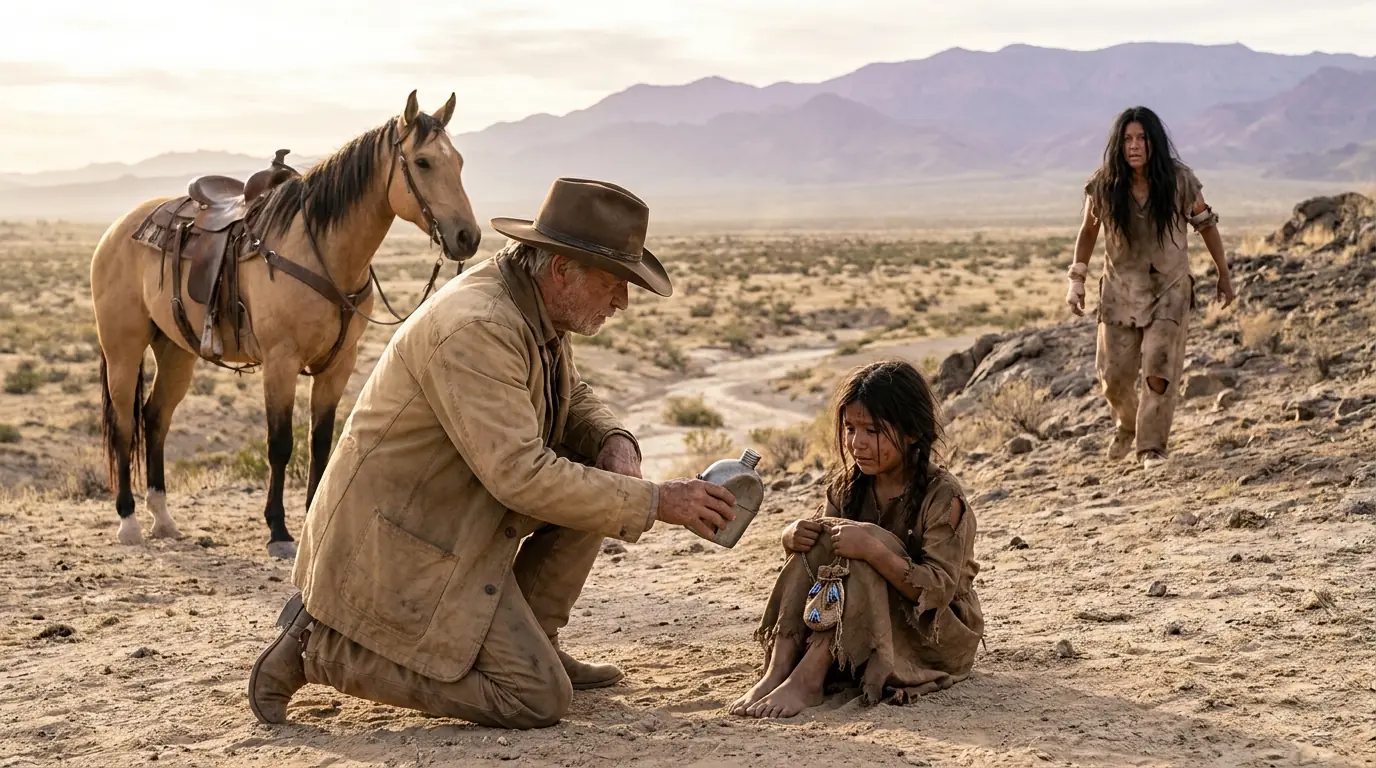
I counted them: twenty men, just as he'd said. They were spread out in a loose line, moving fast, clearly intending to overwhelm us with a single crushing charge. They were about half a mile out when I heard the first shots from the ambush site, sharp cracks echoing across the morning air. Morrison's line immediately broke apart, men scattering, horses rearing, more shots.
I saw one man fall from his saddle, saw another grab his arm. The charge faltered. Morrison was screaming orders, trying to regroup his men, but the damage was done. They'd lost their momentum, lost their confidence. They pulled back, taking cover behind rocks and scrub brush, and the ambush team ceased fire.
Phase one complete: they were hurt, they were cautious, and they were exactly where we wanted them—committed to the fight, but not close enough to overwhelm us yet. "Morrison!" I called out, my voice carrying across the distance. "You're on my land. Last chance to ride away." His response was a bullet that kicked up dirt three feet to my left.
I guess that answered that question. Webb fired back a measured shot that came close enough to make Morrison duck. All around me, I heard our defenders opening up controlled fire from good positions. Morrison's men returned fire, but they were in the open and we were behind cover. The math was in our favor for now.
The battle settled into a rhythm. They'd shoot, we'd shoot back, neither side able to gain an advantage. This was exactly what Red Sky Walker had warned us about. A stalemate could last hours, and time favored Morrison. He had more men, more ammunition, more options. All he had to do was wait us out or flank us, and we were finished.
"I need to change the dynamic," I thought. "Need to make him commit or retreat." "Boss!" Rosa called from inside. "They trying to circle around the back!" One of Red Sky Walker's warriors was already moving, running low across the yard to a position where he could cover the rear approach. He called out something in Apache and Na responded from the window above me.
"She says three men trying to sneak up through the wash," Webb translated. "How do you know Apache?" "Spent time on a reservation years ago trying to bring the gospel, learned it enough to get by." The warrior in back opened fire, his shots precise and deadly. I heard a scream, heard someone yelling for help.
The flanking attempt was stopped, but Morrison wasn't done. He'd split his force now, half pressuring the front, half trying to work around the sides. We had enough people to cover all the approaches, but just barely. If he found a weak spot, if we lost even one defensive position, the whole thing could collapse. Hours passed.
The sun climbed higher, turning the day hot and bright. We were running through ammunition faster than I'd like, and I knew Morrison had to be having the same problem. But he had more to start with, and he could afford to waste it. Around noon, there was a lull. Morrison's men pulled back slightly, regrouping, probably trying to figure out their next move.
I used the opportunity to check on everyone. Na was still at her window, her face streaked with sweat and gunpowder residue, but her eyes were clear and focused. She'd been shooting steadily, carefully, making every bullet count. "You holding up?" I asked. "I am here. I fight. That is enough. Tun, she sleeps. Rosa checks on her. She is safe."
I moved through the house, finding Rosa reloading her rifle with shaking hands but a determined expression. The others were tired but holding. We'd lost no one, though Jake Thompson had taken a graze across his shoulder and Margaret Henley had a cut on her forearm from broken glass. Na was already moving among the wounded.
I watched as she knelt beside Jake, examining his shoulder with gentle but expert hands. "This need to be cleaned good, or infection come," she said. She pulled out her beaded pouch, the one Tun had been clutching when I found her. Inside were dried herbs carefully wrapped. "What's that?" Jake asked nervously.
"Medicine. My father teach me." She crushed some of the dried leaves between her fingers, the sharp scent of sage filling the air. "This stop bleeding, keep wound clean." Doc Miller appeared, his medical kit in hand. He watched as Na mixed the crushed herbs with a little water to make a paste, then applied it to Jake's wound with a clean cloth.
"May I?" Doc asked, gesturing to the pouch. Na handed it to him. Doc examined the contents, smelling each herb carefully. "Yes, sage... What's this, osha root?" Na nodded. "For pain and healing. My father was healer in our village. He teach me since I was small. Plants are medicine if you know how to use them."
Doc Miller looked at her with new respect. "Your father was a wise man. I learned medicine from books in Philadelphia. He learned from the land itself. I think his way might be better." He handed back the pouch. "Would you teach me sometime? There's much I don't know about these desert plants." "Yes," Na said simply. "I teach."
She moved to Margaret next, cleaning and binding her cut with the same careful attention. By the time she'd finished, the bleeding had stopped and Margaret was flexing her arm experimentally. "That poultice is working already," Margaret said, surprised. "The pain's less." "Plants know what to do," Na said. "We just have to listen."
When Na came back to me, there was a quiet pride in her eyes. "My father would be happy, I think, that his knowledge helps people here, that it is not lost." "It's not lost," I said, "not as long as you're here to pass it on." From the ambush site, Doc Miller had sent a runner with a message. They were out of ammunition and pulling back to the ranch.
That meant Morrison would know the ambush site was empty, would know he could use that trail to bring his full force to bear. We'd bought time, but time was running out. I was back on the porch when I saw Morrison himself step out from behind cover, hands raised in a gesture of truce. He walked forward slowly, stopping about fifty yards out, well within rifle range, but making himself vulnerable as a show of good faith.
"Dawson!" he called out. "Let's talk." I stepped off the porch, walking to meet him halfway. Webb started to object, but I waved him off. Behind me, I could feel Na's eyes on me from the window, could feel her tension. Morrison looked worse for wear.
He had blood on his sleeve and his face was dark with anger and frustration, but his eyes were still calculating, still looking for an angle. "You cost me four men today, Dawson. Four good men." "Should have been more." He almost smiled at that. "You've got nerve, I respect that. But this ends now. Give me the woman and her brat and we'll ride out. No one else has to die."
"Can't do that." "Why not? She's nothing to you, just some Apache woman. Is she really worth your life? Worth the lives of all these people in your house?" "She's under my protection. That makes her worth everything." Morrison shook his head.
"You're a fool, Dawson. A noble fool, but a fool nonetheless." He looked past me at the ranch house. "Tell you what, I'll make you a deal: give me the woman and I'll let you keep the kid. Hell, I'll even throw in some money. Say five hundred dollars. That's generous." "The answer is no."
His expression hardened. "You think you've won? I've got reinforcements coming. Thirty men, maybe forty. By sunset, this ranch will be ashes and everyone in it will be dead." "Maybe not. But I'll die trying." "So will everyone in that house—the preacher, the old Mexican woman, that little girl you're so determined to protect. They'll all die because you're too stubborn to make a smart choice."
It was a good argument, logical, practical, and if I'd been the kind of man who made decisions based purely on logic and practicality, it might have worked. But I wasn't that kind of man. Sarah hadn't married that kind of man. "I'm done talking, Morrison. Either shoot or ride, but get off my land." He stared at me for a long moment, and I saw murder in his eyes, pure, cold murder.
Then he turned and walked back to his men. I knew what was coming next. He was done being cautious, done trying to negotiate. The next attack would be all-out, everything he had, and it would come soon, before we could rest or resupply. I made it back to the porch just as the first shots rang out.
But these weren't from Morrison's men. These came from the west, from the direction of town. I turned and saw riders coming fast. At first, I thought it was Morrison's reinforcements, and my heart sank. But then I saw the man in front, and I felt hope flare up again.
Sheriff Tom Bradley was leading his two deputies and at least a dozen armed townsfolk. He'd come after all. Bradley and his men swept past the ranch, hitting Morrison's force from the side, catching them completely off guard. The outlaws, already tired and frustrated from hours of fighting, broke. Some tried to stand and fight, but most just ran, scattering into the desert.
Morrison himself stood for a moment watching his men flee, and I saw the moment he realized it was over. He looked at me across the distance, and even from there, I could see the hatred on his face. Then he mounted his horse and rode hard to the east, disappearing into the badlands. The battle was over. I stood on the porch, rifle still in hand, watching the dust settle around me.
People were emerging from their positions, faces showing relief and exhaustion in equal measure. Na came down from the second floor, moving quickly toward the root cellar where Tun was hidden. Rosa followed her, and moments later they emerged with the little girl, who ran into her mother's arms. Sheriff Bradley rode up, dismounted, and walked over to me.
He looked tired, dirty, and about ten years older than he had yesterday. "You're a damn fool, Dawson, you know that?" "Been hearing that a lot lately." He almost smiled. "Reverend Webb came into town this morning, started rallying folks. Said you were making a stand against Morrison, said any man with a conscience ought to help."
He looked around at the assembled townsfolk, some of whom were tending to minor wounds, others just trying to catch their breath. "Turns out there's more men with consciences than I thought." "You saved our lives, Tom. All of us." He shrugged. "Like you said, it's the right thing to do."
He looked past me to where Na stood holding Tun. "Morrison get away?" "Yeah, rode east. He'll be back. Men like that always come back." "Let him come. Next time we'll be ready."
Bradley nodded slowly, then reached out and shook my hand. "You did good today, Dawson. Real good." As the townsfolk began heading back to Copper Springs, Reverend Webb came over. He had a cut above his eye and his shirt was torn, but he was smiling. "Quite a day, Mr. Dawson."
"Quite a day, Reverend. Thank you for what you did, for going back to town, for getting the sheriff to come." "The Lord works in mysterious ways. Sometimes He just needs us to give Him a push." Webb looked over at Na, who was sitting on the porch steps with Tun, both of them looking exhausted but alive. "She's a remarkable woman. Strong, brave."
"Yeah, she is." "What will you do now? Morrison's still out there." "I know. But that's a problem for tomorrow. Today we survived. That's enough." Webb patted my shoulder and walked away to help tend to the wounded.
I stood there in my yard, looking at my ranch, at the bullet holes in the walls and the broken windows and the general mess that war leaves behind. It would take weeks to repair all the damage, but we'd won. Against all odds, with courage and faith and a little bit of luck, we'd won. Na approached me, Tun holding her hand.
The little girl looked up at me with those dark eyes that had seen too much. And then she did something that surprised me: she let go of her mother's hand and reached for mine. I knelt down and took her small hand in mine. "You okay, little one?" She nodded, then spoke in careful, halting English.
"Thank you. You save us." My throat tightened. "You're welcome, Tun." Na placed her hand on my shoulder. "We owe you our lives, both of us. I never forget."
"You don't owe me anything. This is what neighbors do, they help each other." She smiled, the first real smile I'd seen from her. "Then I am glad to have you as neighbor, Luke Dawson." It was the first time she'd used my first name, and somehow, hearing it in her voice felt like the beginning of something new—something neither of us had planned for, but both of us needed.
As the sun began to set on that long, terrible, victorious day, Rosa called everyone in for dinner. She'd somehow managed to prepare food for all of us, a massive pot of beans and rice and beef that fed twenty people and still had leftovers. We ate together, telling stories about the battle, laughing at close calls now that we were safe, mourning the men we'd lost, and honoring their sacrifice. And through it all, I watched Na and Tun, watched them begin to relax, watched the fear slowly leave their eyes.
They were safe, not just for today, but for all the days to come. Morrison was still out there somewhere, nursing his wounds and his hatred, that was true. But he'd learned today that there were lines you didn't cross, people you didn't threaten, not without paying a price. And tomorrow we'd start rebuilding together, because that's what families do.
The days following the battle passed in a strange rhythm of recovery and vigilance. Mornings were spent repairing damage, boarding up broken windows, patching bullet holes in the walls. Afternoons found us taking turns on watch, eyes always scanning the horizon for dust clouds that might signal Morrison's return. Nights we gathered around the fire, too tired to do much more than exist in each other's presence, but finding comfort in the simple fact that we were alive.
Na and Tun stayed, of course; there was never any discussion about them leaving. The back room became theirs, and slowly, carefully, they made it their own. Tun hung wildflowers she'd picked by the creek. Na arranged her few possessions, including that beaded pouch Tun had been clutching when I found her, on a shelf by the window.
The house, which had felt so empty for three years, began to feel like a home again. Sheriff Bradley rode out on the third day after the battle. He dismounted slowly, moving like a man whose body reminded him of every one of his fifty-plus years. Rosa brought him coffee and he sat on the porch with me, both of us looking out at the desert.
"Got news from the territorial marshal's office," he said after a long silence. "They're sending men to hunt Morrison down. Figure with what he did to that Apache village and the attack here, they can't ignore him anymore." "How many men?" "Ten, maybe twelve. Should be here within the week."
"That's something," I said, though we both knew it wasn't much. Morrison knew this territory like the back of his hand; he could disappear into the badlands for months if he wanted to. Bradley took a sip of his coffee. "There's something else. The territorial governor is offering a reward for Morrison's capture—five hundred dollars, dead or alive."
"Blood money, maybe. But it'll bring bounty hunters, and enough bounty hunters might do what lawmen can't." We sat in silence for a while longer, then Bradley said, "How's the woman doing? The Apache woman." "Her name is Na, and she's doing as well as can be expected. Still jumps at sudden noises, still checks on her daughter every few minutes. But she's strong, stronger than most people I've known."
"You sweet on her, Dawson?" The question caught me off guard. I hadn't really thought about it in those terms. I admired Na, respected her, felt protective of her and Tun. But was I sweet on her?
Did I feel something beyond duty and compassion? "I don't know," I said honestly. "Maybe. It's complicated." "It always is." Bradley set down his empty cup and stood.
"Just be careful. Townsfolk are already talking—white man and Apache woman living under one roof. That kind of talk can turn ugly." "Let them talk. This is my land, my house. They don't get a say in who stays here." He looked at me with something like pity.
"You're a good man, Dawson. But good men can still have hard lives. Just remember that." After he left, I found myself thinking about what he'd said. Was I being naive? Was I inviting trouble by letting Na and Tun stay?
Probably. But what was the alternative? Turn them out? Send them to some reservation where they'd be treated like prisoners? Watch them try to survive alone in a world that had already taken everything from them? No, they stayed.
Whatever consequences came with that decision, I'd deal with them. That afternoon, I was mending fence on the north pasture when I heard a horse approaching. I turned, hand instinctively going to the rifle I now carried everywhere, and saw Doc Miller riding up. "Doc," I called out. "Didn't expect to see you out this way again so soon."
He dismounted and tied his horse to a post. "Came to check on the wounded, make sure nobody's developing infections or complications." We walked back to the ranch together. Doc had his kit with him and he went through each person who'd taken injury during the battle, cleaning wounds, changing bandages, and dispensing advice about rest and proper care.
When he got to Jake Thompson's shoulder graze, Jake winced but stayed still. "You're lucky," Doc said. "Another inch to the left and you'd have lost the use of that arm." "Don't feel particularly lucky," Jake muttered. "You're alive. That's luck enough."
When Doc had finished his rounds, he found me in the barn where I was checking on Dancer. The mare had come through the battle without injury, but I'd been keeping a close eye on her anyway. "Everyone's healing well," Doc said. "You did good work with the initial treatment." "That was mostly Rosa and Na. They seemed to know what they were doing."
Doc nodded. "That Apache woman, Na, she's got real medical knowledge, traditional healing methods. I talked with her some while I was working. She knows things about herbs and poultices that I never learned in any medical school." "She mentioned her father was a healer in her village." "Well, she learned well."
Doc hesitated, then said, "Dawson, can I speak frankly?" "Always." "That woman and her daughter, they can't stay here indefinitely. It's not safe for them and it's not fair to you. Morrison's still out there and as long as they're under your roof, you're a target." "So, what are you suggesting?"
"I'm suggesting that maybe we find them a place in town—a small house, something modest. The community could help support them until they can get on their feet." "I appreciate the thought, Doc. But Na's not ready for that. She's barely ready to trust the people who fought beside us. Putting her in town, surrounded by strangers, some of whom probably still hate Apaches on principle... That's not a solution."
"Then what is?" "I wish I knew." Doc left shortly after and I was alone with my thoughts again. He was right, of course; this couldn't go on forever. Eventually, decisions would have to be made, paths would have to be chosen.
But for now, in this moment, we were all exactly where we needed to be. That evening, after Rosa had served dinner and Tun had been put to bed, I found Na in the barn brushing down Dancer. She'd taken to caring for the horses in the evening, saying the rhythm of the work calmed her mind. I picked up a second brush and started on the other side of the mare.
"Doc Miller came by today," she said without looking up. "I know. He wanted to talk to me about you and Tun." She paused mid-stroke. "He say we should go to town, find house there." "He mentioned that." Her hands resumed their work, the brush moving in long, steady strokes.
"What you think?" "I think you're not ready for that, and I think this ranch is big enough for all of us." She stopped again, this time looking at me over Dancer's back. In the dim lantern light of the barn, her eyes were unreadable.
"In my village," she said finally, "when someone save your life, you owe them life debt. You protect them as they protect you. You become family." "I don't need you to feel indebted to me, Na." "Is not about debt. Is about..." She searched for the word. "...belonging. You give us place to belong when we have nowhere. That is gift that cannot be repaid."
"You don't need to repay it. Just being here, helping Rosa, teaching Tun—that's enough." She turned to look at me, and in the dim light from the house, I could see her eyes were bright with tears. "No one ever just give me things before. Always there is price. Always there is... what is word? Expectation."
"There's no expectation here. You and Tun can stay as long as you want. If you decide to leave tomorrow, I'll help you go. If you decide to stay for years, there's room. Your choice." She reached out and took my hand, her fingers small and rough from work. "Thank you, Luke Dawson, for everything."
We stood like that for a while, hands joined, looking at the stars. And somewhere in that silence, something shifted between us. It wasn't love, not yet, but it was the seed of something that could grow into love, given time and care. The marshal's men arrived six days after the battle.
There were twelve of them, hard-looking men led by a marshal named Jacob Stone. He was maybe forty, with cold gray eyes and a reputation for always getting his man. They made camp near the ranch and spent two days interviewing everyone who'd been present during the attack, taking statements, gathering information. When Stone interviewed me, he was all business.
"Morrison's got maybe eight men left," he said, consulting his notes. "The rest either died in the fight or scattered. He's wounded, probably in the arm or shoulder based on blood we found at his last camp. And he's desperate." "Desperate men are dangerous men." "Exactly. Which is why I need you to understand something, Dawson."
He looked me straight in the eye. "Morrison's going to come for that Apache woman. Not because of any gold anymore—that's secondary now. He's coming because his pride's been wounded, because she made him look weak. Men like Morrison, pride is everything." "So, what do you want me to do?"
"I want you to let us use her as bait." The suggestion hit me like a physical blow. "Absolutely not." "Hear me out. We set up a trap. Make it look like she's vulnerable, maybe traveling to town or working outside the ranch. Morrison can't resist that. He'll come for her, and when he does, we'll be waiting."
"And if something goes wrong? If he gets to her before you can stop him?" "We'll have men everywhere. She won't be in real danger." I stood up, ending the interview. "The answer is no, Marshal. Find another way."
Stone's expression hardened. "You're letting personal feelings interfere with justice, Dawson." "Maybe I am, but that woman and her daughter have been through enough. I'm not using them as bait for anything." He left angry, but I didn't care. I'd meant what I said.
Na had suffered enough. Whatever it took to catch Morrison, it wouldn't involve putting her at risk again. But Morrison, as it turned out, had his own plans. It happened three nights later. I was in the barn checking on a horse that had gone lame when I heard Tun scream.
It was a sound that turned my blood to ice—pure terror, compressed into a single note. I grabbed my rifle and ran for the house. Rosa was already there, standing at the back door, her face white. She pointed toward the creek. "He took them! He took Na and Tun!"
"Who took them?" "Morrison! He came through the back while we were all in front. Just... just grabbed them and ran." I didn't wait to hear more. I ran toward the creek, following the sound of struggle.
In the moonlight, I could see Morrison on horseback, Na fighting him, trying to pull Tun away. But he was stronger and he had surprise on his side. "Morrison!" I shouted, bringing my rifle up. He turned, and even in the darkness, I could see him smile.
"Come any closer, Dawson, and I'll kill them both right here." He had a gun to Na's head. Tun was sobbing, struggling in his grip. My hands tightened on the rifle, but I didn't fire. The risk was too great.
"Let them go. Your fight is with me." "My fight is with anyone who made a fool of me." Morrison's voice was rough with pain and anger. "You cost me everything, Dawson—my men, my reputation, my future. Now I'm going to cost you something."
"This won't end the way you think it will." "Won't it? I kill these two, you'll spend the rest of your life knowing you couldn't save them. Seems like a pretty good ending to me." He started to back his horse away, pulling Na and Tun with him. I followed, keeping my rifle trained on him, looking for an opening, any opening.
Then I heard it: a soft whistle, like a bird call. Morrison heard it too, but by the time he turned to look, it was too late. Red Sky Walker's arrow took him in the shoulder, the same shoulder that was already wounded. Morrison screamed and his grip on Na loosened. She didn't hesitate.
She twisted free, grabbed Tun, and rolled away from the horse. Morrison tried to raise his gun, but another arrow hit him in the chest. He slid from his horse and landed hard on the ground. I ran forward, rifle ready, but there was no need. Morrison was done.
He lay on his back, blood spreading across his shirt, his breathing shallow and rapid. I kicked his gun away and knelt beside him. His eyes found mine. "Should have..." he gasped, "...should have killed you when I had the chance." "You should have ridden away when I gave you the chance."
He coughed, blood appearing at the corner of his mouth. "That gold... Was it real?" I looked up at Na, who had gathered Tun in her arms and was checking her for injuries. She met my eyes and shook her head slightly. "No," I told Morrison. "There never was any gold. You killed all those people for nothing."
Something that might have been regret passed across his face, then his eyes went glassy and he stopped breathing. Marshal Stone and his men came running, drawn by the commotion. They surrounded Morrison's body, checking for signs of life, finding none. Red Sky Walker emerged from the shadows, bow still in hand. He looked at Morrison's body without expression, then at Na and Tun.
"It is finished," he said simply. Stone knelt beside Morrison, confirming what we already knew. "He's dead." He looked up at Red Sky Walker. "That was a hell of a shot, old-timer. Two arrows in the dark, both hitting vital spots."
"I have been shooting arrows since before you were born, young Marshal. Darkness is no obstacle." Stone stood and extended his hand. "Well, on behalf of the territorial government, I thank you. You saved these women's lives and ended the career of one of the worst outlaws in the territory." Red Sky Walker ignored the hand.
"I did not do it for your government. I did it because it was right." He turned and walked away into the darkness, leaving Stone standing there with his hand still extended. "Fair enough," Stone muttered. The next few hours were a blur of activity.
Stone and his men took Morrison's body, wrote up their reports, and by dawn they were preparing to leave. Stone found me on the porch as the sun was coming up. "This is over now," he said. "Morrison's dead, his gang is scattered. You and your people are safe." "Until the next Morrison comes along, maybe. But that's a problem for another day."
He adjusted his hat. "For what it's worth, Dawson, you did a brave thing. Not many men would have stood up to Morrison the way you did." "I had help." "You did. And that's what saved you. Remember that."
After the marshal and his men rode out, the ranch settled into an exhausted quiet. Rosa made breakfast, but nobody ate much; we were all too tired, too emotionally drained. Tun fell asleep at the table and Na carried her to bed. I found myself back on the porch, watching the sun climb higher, feeling like I'd lived a lifetime in the span of two weeks. Na came out and sat beside me.
She didn't say anything at first, just sat there, and I was grateful for the silence. Finally, she spoke. "Is really over?" "Morrison's dead, his men are gone. Yeah, it's over." She nodded slowly.
"Then what happens now?" It was the question I'd been avoiding asking myself. What did happen now? Life went back to normal, but what was normal anymore? Nothing would ever be quite the same as it had been before I found Tun in the desert.
"Na," I said carefully, "you and Tun get to decide what you want. You're free. You can go anywhere, do anything. I'll help however I can." She was quiet for a long moment, then she said, "What if what I want is to stay here with you, with Rosa? What if I want this to be home?" My heart kicked hard against my ribs.
"You can stay as long as you want, you know that. But people will talk. Doc Miller, he already say so. Sheriff says so. White man and Apache woman living together... They will say bad things." "Let them talk." "It will make your life hard." "My life's been hard before. I can handle it."
She turned to look at me, her eyes searching mine. "Why you do this? Why you risk everything for us? We are nothing to you." "You're not nothing. You're..." I stopped, trying to find the right words. "When Sarah died, I thought that part of my life was over—the part where I had a family, where I had people I cared about."
"I thought I was just going to work this ranch until I got too old, then die alone. But then I found Tun and I found you, and suddenly I remembered what it felt like to have something worth protecting, something worth fighting for." Tears were running down her face now, silent and steady. "You give us life. You give us hope. How I repay that?"
"You don't need to repay anything. Just..." I reached out and took her hand. "...just stay. Help me run this place. Help raise the horses and cattle. Teach Tun like her mother, that's enough." "And what about you and me? What we are?" "I don't know yet. Friends for now. Maybe more in time, if that's what you want."
She squeezed my hand. "I want." We sat there as the morning grew warmer, hands joined, not needing to say anything more. Whatever the future held, whatever challenges came next, we'd face them together. Three months passed.
The seasons began to change, summer fading into the first hints of fall. The ranch healed both physically and in ways less visible. The bullet holes were patched, the broken windows replaced, and the blood scrubbed from the porch boards. But the deeper wounds, the ones carried inside, took longer. Tun had nightmares.
Sometimes she'd wake up screaming, crying for her mother, and Na would hold her and rock her and sing old Apache songs until she fell back asleep. But the nightmares came less frequently as time went on, and the girl who'd been so frightened when I found her began to smile again, to laugh, to be a child. She followed me everywhere during the day, this small shadow with dark braids and curious eyes. I taught her to ride, starting her on an old, gentle mare named Sunshine.
I taught her English words, and she taught me Apache ones. We developed our own language—part English, part Apache, part gestures and expressions that only we understood. Na worked alongside Rosa in the house and garden, but she also worked with me and the hands I'd hired to replace the fence and tend the cattle. She could ride as well as any cowboy I'd known, could rope a steer and brand a calf and do a dozen other jobs that most people assumed were men's work.
The ranch hands, initially skeptical about taking orders from an Apache woman, quickly learned to respect her skill and determination, and slowly, carefully, Na and I drew closer together. It happened in small moments: her hand brushing mine as we worked side by side, the way she'd smile when I came in from a long day's work, and the conversations that stretched long into the night when we'd sit on the porch and talk about everything and nothing. We were like two people learning a new dance, careful not to step on each other's toes, but finding a rhythm that worked.
Reverend Webb visited regularly, always with some excuse about checking on the community or bringing news from town. But I knew what he was really doing: he was watching over us, making sure we were all right, offering his quiet support in a world that wasn't always kind to people who didn't fit neatly into expected categories. One Sunday, he asked if Na and Tun wanted to come to church services in town. Na declined politely, but Webb persisted gently.
"I understand your hesitation," he said, "but my congregation... Many of them fought alongside you. They know your courage, your character. You'd be welcome." After Webb left, Na stood at the window for a long time, watching the road to town. "You don't have to go," I said quietly.
"I know," her voice was barely above a whisper. "But Tun, she asked me yesterday why we don't go to church like Rosa. She see other children with their mothers on Sundays. She wonder why we different." "You can explain that to her." Na turned to face me. "How I explain that I am afraid? That even after all we survive, I still fear what white people think of me?"
She shook her head. "No, I cannot teach my daughter to be afraid. If I am afraid, she learn to be afraid. I must be brave, even when I am not." "You're the bravest person I know, Na." She smiled sadly. "Brave is just being scared and doing it anyway. You teach me that when you stand in front of Morrison with only rifle and no army. Now I do same."
The following Sunday morning, I found Na standing in front of the small mirror in our room. Her hands shook as she tried to button her best dress. I came up behind her and gently took over. "We can wait," I said softly. "Another week, another month, whenever you're ready."
She met my eyes in the mirror. "I never be ready. But Tun, she getting older. She need to be part of world, not hide from it. So today we go together." Rosa fussed over Tun's hair, braiding it with ribbons. Tun was excited, bouncing with energy, not understanding why her mother moved so slowly, so carefully.
In the wagon on the way to town, Na sat rigid, her hands clasped so tight her knuckles were white. Tun chattered happily beside her, pointing at birds and clouds. I reached over and took Na's hand. "If at any point you want to leave, we leave. No questions asked." She squeezed my hand.
"Thank you for understanding, and for standing with me even when I am afraid." "Always," I said. As we pulled up to the church, I saw Na take a deep breath, straighten her shoulders, and lift her chin. Whatever fear lived inside her, she wasn't going to let it show—not to these people, not to Tun, not even to herself.
She climbed down from the wagon, took Tun's hand, and walked toward the church door like a woman who had every right to be there, because she did. Rosa came too, excited to attend service with what she called her new family. We arrived early, and I could see people staring as we climbed down from the wagon. Some faces were friendly, recognizing Na from the battle; others were cold, disapproving.
But Webb met us at the church door with a warm smile and ushered us inside. The service itself was beautiful. Webb preached about acceptance and community, about how God's love extended to all people regardless of their origins. Tun sat between Na and me, swinging her feet and occasionally whispering questions that Na patiently answered.
After the service, something unexpected happened. Margaret Henley, the widow who'd fought at the ranch, approached Na directly. "Mrs. Na," she said, then corrected herself, "Na, I wanted to tell you how grateful I am for what you did during the battle. Your tactics saved lives." Na seemed surprised by the direct address.
"I do what I can to help." "Well, you helped plenty." Margaret smiled. "My ranch is south of here, about ten miles. If you ever need anything, anything at all, you come find me. We women need to stick together out here."
Other people approached after that: Doc Miller and his wife, Jake Thompson, whose shoulder had fully healed, and even some people I didn't know. Townsfolk who'd heard the story wanted to meet the Apache woman who'd helped defend one of their own. Not everyone was friendly; some people left the church without speaking to us, their disapproval written plainly on their faces. But enough people were kind that when we drove home that afternoon, Na was smiling.
"That was," she searched for the word, "...nice. People were nice." "Some people will never accept us," I warned her. "You need to know that." "I know, but some people is enough." She looked back at Tun, who'd fallen asleep in the wagon bed. "For her, I can handle some people."
As fall deepened, we settled into routines that felt almost normal. Tun started learning to read and write, with Rosa teaching her Spanish and me teaching her English. She was bright, picking up both languages quickly, and she had her mother's determination. Once she set her mind to learning something, she didn't stop until she'd mastered it.
One evening, about four months after Morrison's death, Sheriff Bradley rode out with news. He found me in the corral working with a young stallion that needed breaking. "Got a letter from the territorial governor's office," he said without preamble. "About the reward money for Morrison." I'd forgotten about that. "What about it?"
"It's yours if you want it. Five hundred dollars. They're saying you and your people were instrumental in bringing Morrison to justice." "It wasn't me, it was Red Sky Walker. His arrows killed Morrison. I told them that." "They said they tried to find the old Apache man to give him the reward, but he's disappeared, gone back into the hills. Probably won't accept white man's money anyway."
"Then give it to Na. She's the one who lost everything because of Morrison." Bradley handed me an envelope. "Already made out in your name. You distribute it how you see fit." After he left, I found Na in the garden pulling weeds. I showed her the envelope and explained what it was.
"This is yours," I said. "Five hundred dollars. You can use it to start over, buy supplies, whatever you need." She looked at the envelope like it might bite her. "That is much money." "It's what you're owed. Morrison took everything from you. This is justice."
She took the envelope carefully, running her fingers over the paper. "With this money, I could go anywhere, start new life." My heart sank a little, though I tried not to show it. "If that's what you want." She looked up at me and there was something in her eyes I couldn't quite read.
"What I want is to invest in this ranch, make it better. Make it..." She paused. "...make it ours." "Ours?" "You give me home. I want to be part of home, not guest, not... what is word? Charity case." "Partner."
I felt something warm spread through my chest. "Partners. I can work with that." She smiled, that rare full smile that transformed her whole face. "Good. Now I have question for you." "Ask anything."
"In my culture, when man and woman live together, work together, raise child together, they are family. But I do not know white customs. What are we?" It was the question I'd been avoiding asking myself, even though I thought about it constantly. What were we? We weren't married, we weren't formally courting, not in any way that society would recognize.
But we were something, something deeper and more important than labels. "We're people who care about each other," I said finally, "people who are building a life together. If you want a label, I guess we're..." I hesitated, then took the leap. "...we're promised to each other." "Promised?"
"It means we've made a commitment. Not formal yet, but real. It means I'm not looking at any other woman and you're not looking at any other man. It means when the time is right, we'll make it official." She nodded slowly. "Promised. I like this word."
She held out her hand. "Then I make promise to you, Luke Dawson. I promise to be true, to work hard to help raise this ranch and this child. I promise to stand with you in good times and bad." I took her hand in both of mine. "And I promise to protect you and Tun, to respect your strength, to never take for granted what you've given me. I promise to build a future with you."
We sealed the promise with a handshake, which made us both laugh. It wasn't a kiss, wasn't anything dramatic, but it felt right. It felt like us. That night at dinner with Rosa and Tun present, we announced our decision to become partners in the ranch. Rosa's eyes immediately filled with tears, but they were happy tears.
"Ay, Boss, finally! I've been waiting for you to stop being stubborn and see what is right in front of you." Tun looked confused. "What does partners mean?" "It means," Na said carefully, "that Luke and I are going to run this ranch together, make decisions together, build our future together."
"Does that mean we stay forever?" "If that's all right with you." Tun's face broke into a huge smile. She jumped up from her chair and hugged first her mother, then me. "I love it here, I don't want to ever leave." "Then you won't have to," I promised.
The next several weeks were busy ones. We used part of the reward money to buy more cattle, to repair the barn properly, and to purchase supplies that would see us through the winter. Na had a good head for business. I discovered she could look at a cow and tell you if it was worth buying, could negotiate prices with traders and suppliers without being taken advantage of.
Together, we made a good team. I handled the heavy physical work and the dealings with other ranchers. Na managed the household budget and the day-to-day operations. Rosa cooked and kept house and doted on Tun like the grandmother she'd never had. And Tun herself, growing taller and more confident every day, was the heart that kept us all together.
But not everyone in the territory was happy with our arrangement. It started with small things: supplies that took longer to arrive than they should have, neighbors who used to stop by for coffee suddenly finding reasons to stay away, and whispers in town that I knew were happening, even though I never quite heard them directly. Then, one day, Jake Thompson came out to the ranch.
He looked uncomfortable, shifting his weight from foot to foot on the porch. "Dawson, I need to talk to you about something." "Come on in. Have some coffee." He shook his head. "Better if I say this quick and leave. There's..." He paused. "...there's been talk in town about you and the Apache woman."
"Her name is Na." "I know. I'm sorry." He genuinely looked pained. "Look, I owe you my life. You saved me during that battle. But some people, they're not happy about the situation out here. They think it's not proper."
"What they think is their problem." "That's what I told them. But Dawson..." He looked me in the eye. "...you need to know that Deacon Hutchkins is organizing a petition. He wants the territorial government to investigate, maybe force the woman and her daughter onto a reservation."
Deacon Hutchkins was a wealthy rancher who'd moved to the territory a few years back. He'd made his money back east and had very definite ideas about how things should be run. We'd butted heads before over water rights and grazing land. "Let him petition all he wants," I said. "Na's a free woman. This is my land. The government doesn't have any say in who lives here."
"Maybe not legally, but they can make your life difficult. Cut off your access to government contracts, influence the banks, that sort of thing." "Then they'll find out I'm just as stubborn as they are." Jake nodded slowly. "I figured you'd say that. For what it's worth, I'm on your side, and I'm not the only one. But Dawson..." He put his hand on my shoulder. "...be careful. Rich men with connections can be dangerous in ways that are harder to fight than outlaws with guns."
After he left, I told Na what he'd said. She took it calmly, though I could see the worry in her eyes. "Maybe I should go," she said quietly, "take Tun, find somewhere else. I do not want to cause you trouble." "You're not going anywhere. This is your home now."
"But if they make problems for you, for the ranch..." "Then we'll deal with those problems together. That's what partners do." She was quiet for a moment, then she said, "You are strange white man, Luke Dawson. Most men, they would choose easy path." "Easy paths don't lead anywhere worth going."
Two weeks later, Deacon Hutchkins himself rode out to the ranch with two of his men. He was a large man, going soft in the middle, with expensive clothes and the kind of arrogance that comes from never being told no. "Dawson!" he called out from his horse. "We need to talk." I walked out to meet him, rifle in hand—not because I expected violence, but because I wanted him to know I was ready for it if it came.
"Deacon, what brings you out this way?" "You know damn well what brings me. This situation you've got going on here—living with an Apache woman, letting her daughter run around like she belongs—it's not decent." "Last I checked, how I live on my own land is my business."
"It becomes everyone's business when it affects the whole community. You're setting a bad example, giving people ideas about..." He struggled for a delicate way to put it. "...about mixing races. It's not natural." "What's not natural is a man telling another man how to live when it doesn't affect him in the slightest."
Hutchkins' face reddened. "You're being willfully obtuse. I'm trying to help you, Dawson. I'm giving you a chance to correct this situation before it becomes a bigger problem." "There's nothing to correct. Na and her daughter are staying. They're partners in this ranch now. That's final." "Then you leave me no choice. I'll take this to the territorial authorities."
"You do what you need to do, but I'm telling you right now, it won't change anything." Hutchkins stared at me for a long moment, clearly unused to being defied, then he turned his horse. "You'll regret this, Dawson. Mark my words." After he left, Na came out of the house; she'd been listening from the doorway.
"He will cause trouble," she said. "Probably." "Is worth it? All this trouble for me and Tun?" I turned to face her fully. "Na, in the past few months, this ranch has become a home again. Not just a place where I work and sleep, but a real home. That's because of you and Tun. So, yeah, it's worth it. It's worth whatever trouble comes."
She crossed the distance between us, and for the first time since I'd known her, she reached up and kissed me. It was brief, soft, but it said everything that needed to be said. "Thank you," she whispered, "for choosing us." "I always will."
The petition that Hutchkins filed went nowhere. The territorial governor's office sent back a terse response, saying that private property rights were sacrosanct and that as long as no laws were being broken, the government had no interest in interfering. It was a small victory, but an important one. Winter came, bringing cold nights and occasional snow.
We spent more time indoors, gathered around the fire, telling stories and playing games with Tun. Rosa taught everyone to make tamales, a process that took all day but resulted in enough food to last weeks. Na shared Apache legends, stories of how the world was made and why things were the way they were. And I found myself happier than I'd been since Sarah died—a different kind of happy, but real.
This wasn't the same life I'd had before, but it was good, it was real, it was enough. One evening in late January, almost exactly one year after I'd found Tun in the desert, I asked Na to marry me. Not with a fancy ring or an elaborate speech, just a simple question while we sat on the porch watching the stars. "Would you want to make this official?" I asked. "Get married proper like?"
She was quiet for so long I thought maybe I'd misread everything, that I'd pushed too fast. Then she said, "In Apache way or white way?" "Both if you want, whatever makes you happy." She smiled. "Then, yes, I marry you, Luke Dawson."
We were married twice. Once in a small ceremony at the church, with Reverend Webb officiating and the few townsfolk who'd become our friends in attendance. Margaret Henley stood up with Na, and Sheriff Bradley stood up with me. Tun, dressed in a new dress Rosa had made, scattered wildflowers down the aisle.
The second ceremony was held on the ranch, conducted by Red Sky Walker, who emerged from the hills for the occasion. It was simpler, older, full of words I didn't understand but felt deep in my soul. Na wore traditional Apache clothing, and we exchanged vows under the open sky with the desert stretching endlessly around us. After it was over, Red Sky Walker gave us his blessing and a piece of advice.
"Love is not just feeling," he said. "Love is choice. Every day you must choose to love, choose to forgive, choose to stand together. This you can do, and you will be happy." Then he disappeared back into the hills as silently as he'd come. The years that followed brought changes none of us expected.
Two years after we married, I drove Tun to her first day at the Copper Springs School. She was nine years old, tall for her age, with her mother's dark eyes and quiet strength. "What if the other children don't like me?" she asked, clutching her slate nervously. Na took her hand. "Then you teach them to like you with patience and kindness."
I turned to look at her. "You're smarter than most of those kids, you speak three languages when they only speak one, and you can rope a calf better than any of them. Hold your head high." Tun squared her small shoulders, exactly like her mother. Miss Sarah Winters, who'd fought at the ranch during the battle, met us at the schoolhouse door.
"Tun, I'm so glad you're joining us. I've heard you're quite the reader." As we drove away, Na's voice was thick with emotion. "I never think I see this day. When Morrison kill my people, I think Tun never have normal life. Now she has everything. Is miracle."
Five years after the battle, Na and Margaret Henley formed the High Desert Women's Ranching Cooperative. I watched as Na taught ranching techniques her people had used for generations, showing women how to read the land, when to move cattle, and how to prevent overgrazing. One evening, Sheriff Bradley rode out, smiling. "Dawson, that wife of yours just became one of the most respected ranchers in the territory."
"Three different cattlemen asked where they could hire her to consult." "What did you tell them?" "That she's not for hire, but they could ask politely if she'd share her knowledge." He shook his head in wonder. "Never thought I'd see Apache ranching methods become the talk of Copper Springs."
When Tun turned twenty-two, she announced she wanted to marry Daniel Miller, Doc Miller's nephew from Philadelphia. He was quite studious and had fallen in love with Tun while she taught him to speak Apache. "Are you sure?" I asked her one evening on the porch. "There's no rush."
She smiled. "Father, I've watched you and Mother for fifteen years. I know what love looks like. Daniel sees all of me, not just the comfortable parts. He wants our children to know both worlds." The wedding was held on the ranch.
Tun wore a dress combining both traditions: white lace with the Apache beadwork Na had spent months creating. As I walked her down the makeshift aisle, Tun whispered, "Thank you for finding me that day in the desert, for giving me a life I never thought I could have." My throat was too tight to answer; I just squeezed her hand. At the altar, I placed her hand in Daniel's.
The young man looked at me seriously. "I'll take care of her, sir." "She doesn't need taking care of, she needs a partner. Can you be that?" "That's exactly what I plan to be." After the ceremony, I found Na watching Tun laugh with her new husband.
"She's happy," Na said softly. "She is. You raised a good woman." "We raised her together." Tears glistened in her eyes. "When I lost everything, I never imagined there could be this much happiness again."
I pulled her close. "Neither did I. But here we are." "Here we are," she echoed, "with family, with home, with love." We stood there as the stars came out, watching our daughter begin her new life, grateful beyond words for the journey that had brought us all to this moment. Now, years later, sitting on the same porch where so much of our story unfolded, I look back and marvel at how one simple act—finding a lost girl in the desert—changed everything.
How a decision to help someone in need led to a family, a home, a life worth living. The sun is setting again, painting the desert in shades of gold and red. Na sits beside me, her hand in mine. And Tun, all grown up now with a family of her own, plays with her children in the yard. Rosa, somehow even older but no less determined, calls from the kitchen that dinner is almost ready.
This is what love built. Not the romantic, dramatic kind of love from stories, but the everyday kind. The kind that shows up, does the work, makes the hard choices, and never gives up. The kind that saved us all. And as the first stars appear in the darkening sky, I send a silent thank you to Sarah, wherever she is.
Thank you for teaching me what love means. Thank you for making me the kind of man who could find another lost soul and offer them a home. Because in the end, we're all just looking for the same thing: a place to belong, people to stand with, and a reason to keep going when the world gets hard. We found that here in the dust and heat of the Arizona territory, in a small ranch that became so much more than walls and land. We found family, we found home, we found each other, and that, more than anything, is what made the journey worth it.