The patrol car appeared in Elias Grant’s rearview mirror at exactly 11:38 p.m.
At first, he assumed the officer was responding to a call somewhere ahead.
The blue lights flashed once across the wet pavement, disappeared beneath an overpass, then returned brighter as the cruiser moved closer. A short burst from the siren followed.
Elias checked his speed.
Thirty-four in a thirty-five-mile-per-hour zone.
His seat belt was fastened. Both taillights worked. The registration sticker on the windshield was current.
He signaled, guided his dark gray sedan toward the curb, and stopped beneath a streetlamp on Ashland Avenue.
Rain had ended less than an hour earlier. Water glistened in the gutters, and the air entering through the cracked window carried the smell of wet concrete, fallen leaves, and cold metal.
Elias placed both hands where they could be seen on the steering wheel.
He had performed this movement thousands of times from the other side of the law.
At fifty-eight, he had spent thirty-four years wearing a badge. He had worked patrol, homicide, organized crime, and command. He had stood in alleys beside dead officers, informed parents that children were not coming home, and watched good men become dangerous because no one challenged them early enough.
He knew exactly how a lawful traffic stop should begin.
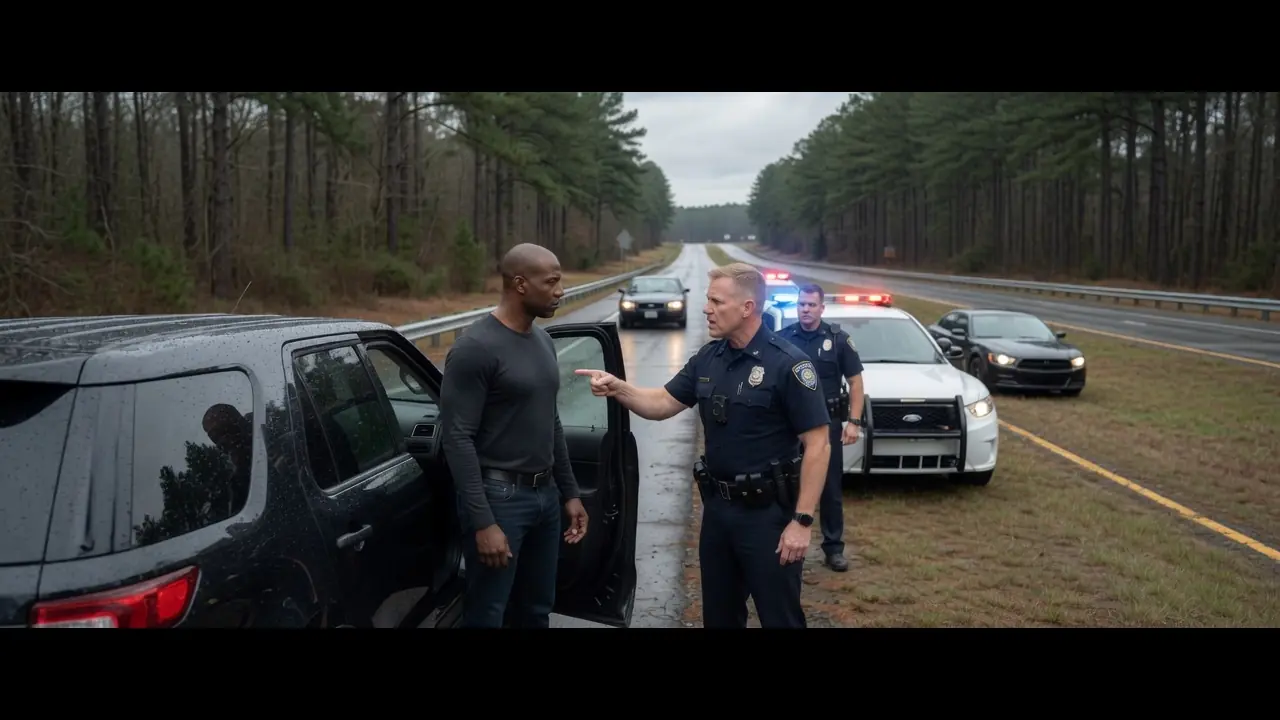
That was why the first ten seconds told him something was wrong.
The officer approached from directly behind rather than using the safer driver-side angle. His flashlight swept across the back seat, struck the mirror, then settled on Elias’s face.
The beam remained there.
“Window all the way down.”
Elias lowered it.
The officer leaned closer.
He appeared to be in his late thirties, broad through the chest, with a shaved head and a dark mustache trimmed closely above his lip. His nameplate read M. ROURKE.
“License, registration, insurance.”
Elias reached slowly toward the glove compartment.
“Tell me before you start digging around.”
“My registration and insurance are in the glove box.”
“I said tell me first.”
Elias paused.
“I am reaching for the documents you requested.”
The officer’s mouth tightened.
“Don’t get smart.”
Elias opened the compartment, removed the papers, and handed them over with his license.
Rourke examined the card.
The flashlight returned to Elias’s eyes.
“Elias Grant.”
“Yes.”
“Where are you coming from?”
“Work.”
“What kind of work?”
Elias watched the officer’s face.
“I work for the city.”
“That wasn’t the question.”
“It answers enough of it.”
Rourke gave a faint laugh.
“You people always decide what counts as enough.”
Elias did not react.
The officer glanced toward the empty passenger seat.
“What are you doing out this late?”
“Driving home.”
“From where?”
“Downtown.”
“Where downtown?”
Elias named the municipal administration building.
For a fraction of a second, Rourke’s expression changed.
Not recognition.
Calculation.
Then it vanished.
“You been drinking?”
“No.”
“Taking anything?”
“No.”
“Any weapons in the car?”
“Yes.”
Rourke’s posture shifted.
His hand moved toward his holster.
“Where?”
“Locked in a case inside the trunk.”
“What kind?”
“A department-issued handgun.”
The officer stared at him.
“You a security guard?”
“No.”
“Private investigator?”
“No.”
“What department?”
Elias held his gaze.
“The license will answer that question when you run it.”
Rourke’s voice hardened.
“I ask the questions here.”
Elias said nothing.
That seemed to irritate him more than an argument would have.
Rourke stepped back from the window and spoke into his shoulder radio.
“Dispatch, run Grant, Elias Nathaniel. Date of birth, February fourteen, nineteen sixty-eight.”
He read the license number.
Elias listened carefully.
No reason for the stop had been given.
That was violation one.
Violation two.
His positioning, language, and hand movements suggested escalation before any resistance existed.
Not necessarily unlawful.
But worth noting.
Elias had spent the past four months studying complaints involving Officer Marcus Rourke.
Fourteen formal complaints in six years.
Thirty-two informal allegations documented by community advocates.
Claims of illegal searches, threats, false statements, missing cash, and narcotics appearing in vehicles where none had been found initially.
Nothing had resulted in sustained discipline.
Body-camera malfunctions appeared in nine incidents.
Supervisors approved each explanation.
Elias had not expected to meet Rourke personally that night.
But the stop did not feel random.
A dispatcher’s voice came through the radio.
“Unit Twelve, return clear. Valid license. No wants.”
A second transmission followed, quieter.
“Subject listed law enforcement. Contact supervisor for details.”
Rourke lowered the radio volume.
His eyes remained on Elias.
“What department are you with?”
“You heard dispatch.”
“I asked you.”
Elias could have ended the confrontation.
His identification file, once fully opened, would reveal that he was a police captain assigned to the Office of Professional Standards. It would also reveal that his current posting had been restricted from ordinary department directories under an internal corruption operation.
He could have stated his rank.
He could have shown the credentials inside his coat pocket.
He did neither.
“I asked why you stopped me,” Elias said.
Rourke leaned through the window.
“One of your taillights flickered.”
“Which one?”
“Driver side.”
“It is functioning now.”
“It flickered.”
“Then you may issue a warning.”
Rourke smiled without warmth.
“You in a hurry?”
“No.”
“Then step out.”
“Why?”
“For my safety.”
Elias looked at the officer’s hands.
“Have I made any threatening movement?”
“Step out of the vehicle.”
Elias unlocked the door.
Before opening it, he said, “I am complying. I do not consent to a search.”
Rourke laughed.
“Everybody watches videos now.”
Elias stepped onto the wet pavement.
The night air pressed cold against his face. He was six feet two inches tall, lean, and still carried himself with the posture drilled into him decades earlier at the academy.
Rourke looked him up and down.
“Hands on the roof.”
“For a faulty taillight?”
“You want handcuffs?”
Elias placed both palms on the roof.
A porch light turned on across the street.
Someone had begun watching.
Rourke patted him down aggressively, pushing into his pockets and waistband rather than limiting the search to areas where a weapon might be concealed.
He removed Elias’s wallet.
Then his phone.
Then a small leather notebook.
“What’s this?”
“Notes.”
“About what?”
“Work.”
Rourke opened it.
Elias turned his head slightly.
“That is not part of a protective search.”
Rourke stepped closer.
“You giving me legal advice?”
“I am describing what you are doing.”
The notebook contained dates, badge numbers, vehicle identifiers, and brief observations from an internal review.
None were explained.
Rourke flipped through two pages.
His face became still when he saw his own badge number.
Elias noticed.
Rourke closed the book.
“How do you know me?”
“I read your nameplate.”
“My badge number is in here.”
“Then perhaps we have met before.”
“We haven’t.”
Rourke’s hand tightened around the notebook.
A second patrol car arrived.
Officer Kevin Bell stepped out first.
He was younger, perhaps twenty-nine, with a cautious expression and one hand resting near his belt.
A sergeant emerged from the passenger side.
Darren Pike.
Elias recognized him immediately.
Pike supervised Rourke’s squad.
His name appeared on seven reports involving disputed evidence.
He had approved six damaged body-camera statements.
He had also been photographed entering a warehouse connected to a narcotics informant who later disappeared.
Pike approached slowly.
“What do we have?”
Rourke handed him the notebook.
“Guy has police information.”
Pike opened it.
His eyes found Elias’s face.
The recognition was not based on rank.
It was based on fear.
Elias understood then that the stop had not been accidental.
Someone knew who he was investigating.
Perhaps not his title.
Perhaps not the full purpose of the operation.
But enough to follow him.
Pike closed the notebook.
“Search the car.”
Elias turned.
“I do not consent.”
Pike looked almost amused.
“We have probable cause.”
“For what?”
“Suspicion of impersonating a police officer.”
“You have my license.”
“You claimed to possess a department weapon.”
“I said exactly where it was.”
“Then we’ll verify.”
“You may secure the weapon with a warrant, my consent, or a lawful arrest. You have none of those.”
Rourke moved toward the driver’s door.
Elias stepped once in his direction.
Bell immediately reached for his taser.
“Don’t move.”
Elias stopped.
Hands visible.
Voice calm.
“Officer Bell, activate your body camera.”
Bell glanced at Pike.
“My camera is active.”
“The indicator light is not on.”
Bell looked down.
His expression changed.
Pike spoke sharply.
“Camera malfunction. We’ll document it.”
Elias looked at each officer.
Rourke.
Pike.
Bell.
Three badge numbers.
Three positions.
Two visible cruiser numbers.
A woman across the street now stood behind her screen door holding up a phone.
Another neighbor watched from an upstairs window.
Elias raised his voice slightly.
“My name is Elias Grant. I am not resisting. I do not consent to any search. I am asking the officers to state the reason for my detention.”
Rourke opened the car door.
“Shut up.”
He began searching.
Glove compartment.
Center console.
Under the seats.
He found nothing.
Pike moved to the trunk.
It remained locked.
“Key.”
Elias said nothing.
Pike held up the key fob taken from Elias’s pocket.
“You don’t need to speak.”
He opened the trunk.
Inside sat a locked black weapons case, an emergency medical kit, a folded coat, and a cardboard archive box containing duplicated complaint files.
Pike stared at the archive box.
“What’s that?”
“Documents.”
Rourke lifted it.
Elias stepped forward again.
Bell drew the taser.
“Stay back.”
Pike opened the box.
The upper folders held copies of civilian complaints against officers in the North District.
Rourke’s name appeared on the first tab.
Pike’s on the second.
The sergeant’s face drained of color.
Elias watched the two men silently communicate.
Rourke looked toward the woman recording across the street.
Then he lowered his voice.
“We need to take him in.”
“For what?” Bell asked.
It was the first time the young officer had questioned anything.
Pike looked at him.
“Obstruction. Impersonation. Possession of confidential records.”
Bell glanced at Elias.
“He said he works for the city.”
“People say things.”
Elias spoke directly to Bell.
“Officer, you ran my identification. Ask dispatch to complete the restricted credential return.”
Pike stepped between them.
“He doesn’t give you orders.”
“No,” Elias said. “Your oath does.”
Rourke slammed the archive box onto the trunk floor.
“Turn around.”
Elias did not move.
Rourke seized his arm.
Elias allowed himself to be turned.
Cold handcuffs closed around his wrists.
The metal tightened one click too far.
He felt the edge press into bone.
Rourke leaned near his ear.
“You should have kept your notebook at home.”
There it was.
Not a mistaken stop.
Not ordinary arrogance.
A warning.
Elias looked toward the wet pavement.
He kept his voice low.
“Thank you.”
Rourke pulled back.
“For what?”
“For saying that.”
They transported Elias to the North District station.
Rourke drove.
Pike followed with the files from the trunk.
Bell remained at the roadside to wait for a tow truck, though no lawful impound basis had been established.
During the ride, Rourke kept glancing into the mirror.
“You’re very calm.”
Elias looked through the partition.
“Should I be afraid?”
“You should be smarter.”
“About what?”
“Writing down names.”
The cruiser’s interior camera pointed toward the back seat.
Its status light was dark.
Rourke had likely disabled it.
Elias leaned back.
“Do you always turn off recording equipment before giving advice?”
Rourke’s jaw moved.
“You think you know how this department works.”
“I do.”
“You don’t know anything.”
The station smelled of old coffee, floor cleaner, and damp uniforms.
Two desk officers looked up when Elias entered in handcuffs.
One recognized him.
Lieutenant Sharon Wells had attended a command meeting with him three weeks earlier. Her eyes widened, but she did not speak.
Elias gave her no signal.
Rourke guided him toward processing.
Pike carried the archive box into the watch commander’s office.
Within minutes, the station’s mood changed.
Doors closed.
Phones rang.
A deputy chief was called.
Rourke placed Elias in an interview room and removed the handcuffs.
Red marks circled both wrists.
“You’ll sit here until we decide what to do with you.”
Elias looked at the ceiling camera.
Its small red light was on.
Finally.
“Officer Rourke.”
The officer stopped at the door.
“You never told me why you stopped the car.”
Rourke smiled.
“Your taillight.”
“It was inspected this afternoon.”
“Then it must have started flickering tonight.”
“Perhaps.”
Rourke stepped out.
The door locked.
Elias sat alone for twenty-seven minutes.
He used the time to reconstruct every word.
At 12:41 a.m., Lieutenant Wells entered.
She closed the door behind her.
“Captain.”
Elias looked at the camera.
Wells understood.
She kept her expression neutral.
“Mr. Grant, I need clarification regarding the records found in your vehicle.”
“My credentials are in my coat.”
“We have them.”
“Then you know what the records are.”
Wells leaned closer to the table.
“Deputy Chief Nolan is here.”
That was the name Elias had been waiting for.
Patrick Nolan oversaw the North District.
He also appeared repeatedly in the corruption review, though direct evidence had remained thin.
Complaints vanished after reaching his office.
Disciplinary hearings were delayed until witnesses withdrew.
Narcotics seized during arrests sometimes weighed less when entered into evidence than at roadside collection.
Rourke and Pike could not maintain that system alone.
“Where are my files?” Elias asked.
Wells paused.
“Pike has them.”
“Then this operation is now compromised.”
Her eyes flickered toward the camera.
Elias continued.
“You will contact Assistant District Attorney Naomi Brooks using the emergency number stored under authorization Grant Seven. You will tell her the trigger event has occurred.”
Wells straightened.
“Captain—”
“Do it now.”
The door opened behind her.
Deputy Chief Nolan entered.
He was sixty-two, white-haired, and carried the relaxed authority of a man accustomed to being obeyed before he finished speaking.
Rourke and Pike stood behind him.
Nolan looked at Elias.
“Well.”
Elias said nothing.
The deputy chief closed the door.
“You have created an unfortunate situation.”
“I was stopped.”
“By an officer performing his duty.”
“Then there should be no problem.”
Nolan sat opposite him.
“We can resolve this quietly.”
“Resolve what?”
“The misunderstanding.”
Elias looked at Rourke.
“Officer Rourke searched my vehicle without consent, seized protected investigative files, arrested me without probable cause, and disabled recording equipment.”
Rourke laughed.
“You had confidential police documents and a weapon.”
“I am a police captain.”
The words entered the room without force.
They did not need it.
Rourke’s smile disappeared.
Pike already knew.
Nolan did not react.
“You are a captain assigned temporarily to an administrative review,” he said.
Elias watched him.
Nolan knew more than he should.
The assignment had been disclosed only to the police commissioner, the district attorney, two internal investigators, and a federal liaison.
“Who told you the nature of my assignment?” Elias asked.
Nolan realized his mistake.
Only for a second.
Then he recovered.
“Your credentials are clear.”
“My credentials do not state the scope.”
Pike shifted near the door.
Elias looked directly at him.
“The stop was arranged.”
“No,” Nolan said.
“Rourke knew I was carrying department files.”
“He saw the notebook.”
“He warned me to keep it at home before anyone opened the archive box.”
Rourke’s face tightened.
Nolan turned toward him.
The officer looked away.
Elias continued.
“My vehicle was followed from the municipal building. The stop occurred on a street outside North District patrol boundaries. Rourke was six miles beyond his assigned sector.”
Pike spoke.
“We had a suspicious vehicle alert.”
“From whom?”
“Anonymous caller.”
“Time?”
Pike did not answer.
“Dispatch event number?”
Silence.
Elias leaned back.
“You have spent years relying on frightened civilians, missing footage, altered reports, and officers too dependent on the system to challenge it.”
His eyes moved to Wells.
“Tonight you chose someone who knew how to preserve the details.”
Nolan lowered his voice.
“You do not understand how much damage a public scandal will cause.”
“To the department?”
“To the city.”
“No. Damage has already been done to the city.”
Elias looked at Rourke.
“The public scandal will only reveal it.”
Nolan placed both hands on the table.
“Listen carefully. Those files contain preliminary allegations, many from unreliable people with criminal histories.”
“They contain video, dispatch audio, bank records, evidence-weight discrepancies, and sworn statements from six officers.”
Pike’s face changed.
Nolan stared.
Elias saw the fear spread.
They had not known how far the investigation had progressed.
“Six officers?” Nolan asked.
“That number was true yesterday.”
A knock came at the door.
Lieutenant Wells opened it.
Behind her stood Assistant District Attorney Naomi Brooks, two internal-affairs investigators, and four state police officers.
Rourke took one step backward.
Naomi entered holding a warrant.
“Patrick Nolan, Marcus Rourke, Darren Pike, do not touch your phones, weapons, lockers, desks, vehicles, or any department computer.”
Nolan rose.
“This is absurd.”
“Your offices and residences are being secured.”
Rourke looked toward the hallway.
State officers blocked the exit.
Naomi turned to Elias.
“Are you injured?”
“Minor wrist damage.”
“Was your property searched?”
“Yes.”
“Files taken?”
“Yes.”
Pike tried to speak.
Naomi cut him off.
“Anything you say from this point forward may become evidence. Counsel is available. I suggest you use it.”
Rourke’s face had gone pale.
He looked at Elias as if seeing him for the first time.
“You let us arrest you.”
Elias stood.
“No.”
He rubbed one wrist.
“You decided to.”
The investigation did not begin that night.
It had begun eleven months earlier, when a twenty-two-year-old delivery driver named Jamal Reed filed a complaint alleging that Officer Rourke took eight hundred dollars during a traffic search.
The complaint was closed for lack of evidence.
Jamal was arrested three weeks later for possession of cocaine found beneath his passenger seat.
He insisted the drugs were planted.
His public defender noticed that the evidence bag number appeared in another case handled by Rourke.
That error reached a prosecutor.
The prosecutor contacted internal affairs.
A pattern emerged.
Rourke stopped drivers late at night.
Mostly young men.
Mostly in neighborhoods where residents distrusted police enough to avoid complaints.
Cash disappeared.
Small quantities of narcotics appeared.
Charges were often reduced if defendants agreed not to pursue misconduct claims.
Sergeant Pike reviewed the reports.
Deputy Chief Nolan approved the closures.
An evidence technician altered logs.
A dispatcher warned officers when supervisors were monitoring radio traffic.
At least three prosecutors ignored inconsistencies because the arrests produced quick plea agreements.
Elias was brought in because he had no recent ties to the district.
He had spent the previous eight years overseeing training and major-crime coordination. Most patrol officers recognized his name, but younger members had never met him.
His appointment to professional standards was kept quiet.
He worked from the municipal building rather than police headquarters.
For four months, he reviewed cases, interviewed retired officers, and met secretly with complainants.
Someone began watching him in the second month.
A sedan appeared twice outside his home.
His office was entered without forced access.
A file drawer shifted.
One witness stopped answering calls after receiving threats.
Elias expected resistance.
He did not expect them to act so openly.
That arrogance became their greatest error.
The woman across from the traffic stop, Maria Hernandez, had recorded forty-three minutes on her phone.
Her video captured Rourke saying, “You should have kept your notebook at home.”
A home security camera showed the patrol cruiser following Elias for eleven minutes before activating its lights.
Dispatch records revealed no suspicious-vehicle call.
GPS data placed Rourke outside his sector without authorization.
Bell’s body camera had not malfunctioned.
It had been manually placed in standby mode shortly after Pike arrived.
The cruiser’s rear camera contained audio despite the dark status light. Rourke had disabled the indicator but not the hidden backup recording.
It captured his conversation with Pike before entering the station.
“He has all our names,” Rourke said.
Pike answered, “Nolan will handle it.”
Those six words broke the structure open.
Searches of Nolan’s office revealed sealed complaint files in a locked cabinet marked for destruction.
Investigators found cash in envelopes, photographs of officers meeting suspected dealers, and a second set of evidence-room access logs.
Rourke’s garage contained narcotics divided into small packets, three unregistered firearms, and personal property traced to prior detainees.
Pike had kept recordings of private conversations with officers and prosecutors.
Insurance, he called it.
When he understood the scale of the evidence, he began cooperating.
Within two weeks, twelve officers were suspended.
Three supervisors resigned.
Two prosecutors were placed on leave.
The evidence technician disappeared before federal agents reached his house. He was arrested three days later at a bus station in Arizona.
The scandal consumed the city.
Television trucks surrounded police headquarters.
Former defendants demanded case reviews.
Families brought photographs, court documents, and stories they had carried for years.
Some had been ignored.
Some had been threatened.
Some had stopped believing anyone with authority would listen.
Elias spent sixteen-hour days separating accusation from proof.
He refused to treat every officer as guilty.
That decision angered activists who wanted the entire North District dismantled.
It also angered officers who believed protecting the department required silence.
“The badge is not protected by defending wrongdoing,” Elias told a packed press conference. “It is protected by proving that wrongdoing has consequences even when committed by someone wearing it.”
Threats followed.
Someone left a dead rat on his porch.
His daughter’s car tires were slashed.
Anonymous messages warned him that retired officers could still have accidents.
Elias changed nothing about his public routine.
Privately, he increased security around his family.
His wife, Celeste, watched him leave before dawn and return after midnight.
One evening, she found him sitting alone at the kitchen table with photographs of complainants spread before him.
“You cannot carry every case personally,” she said.
“If I hand them off too quickly, people will think we are burying them again.”
“You have investigators.”
“I know.”
“You have not slept through a night in three weeks.”
He removed his glasses.
“I asked people to trust a department that had already failed them.”
“You did not fail them.”
“I wore the same uniform.”
Celeste sat beside him.
“You also stopped the men who were using it as camouflage.”
Elias looked toward the dark window.
“Not soon enough.”
“No reform begins soon enough for the first person who was hurt.”
She covered his hand.
“That does not make it useless for the next one.”
Officer Kevin Bell became one of the investigation’s most important witnesses.
For two days after the traffic stop, he claimed he had followed orders and seen nothing unusual.
Then he watched Maria Hernandez’s video.
He saw himself standing beside Elias with a taser drawn while Rourke searched the car unlawfully.
He heard Elias tell him to activate the body camera.
He saw himself look toward Pike instead of doing what policy required.
Bell requested an interview.
“I did not plant anything,” he told Elias.
“I did not ask whether you did.”
“I never took money.”
“I did not ask that either.”
Bell looked down.
“I knew Rourke was wrong.”
“When?”
“At the window.”
“Before I stepped out?”
“Yes.”
“And what did you do?”
“Nothing.”
Elias waited.
Bell’s eyes filled with shame.
“I wanted to keep the assignment. Pike controlled overtime. Good evaluations. Training slots.”
“So you chose your career.”
“Yes.”
“Over your oath.”
Bell nodded.
Elias did not raise his voice.
“That is how corruption recruits people who do not think they are corrupt.”
Bell became a cooperating witness.
He identified other unlawful stops.
He explained how officers signaled when cameras should be muted.
He revealed that Pike kept spare narcotics in a magnetic box beneath an abandoned rail bridge.
His testimony helped overturn twenty-seven convictions.
Bell was suspended and later resigned.
Elias did not recommend immunity from professional consequences.
Cooperation mattered.
So did accountability.
Rourke refused every plea offer.
He described himself publicly as the victim of a political purge.
At trial, his attorneys attacked Elias’s conduct during the stop.
They argued that the captain intentionally concealed his identity to provoke officers.
Elias took the witness stand.
“Could you have identified yourself immediately?” the defense lawyer asked.
“Yes.”
“Could you have prevented your arrest?”
“Possibly.”
“Yet you chose not to.”
“I chose to comply with lawful instructions and document unlawful ones.”
“You allowed the situation to escalate.”
“No.”
Elias looked toward the jury.
“Officer Rourke escalated it. A citizen is not required to reveal special status in order to receive constitutional treatment.”
The defense attorney approached.
“You were conducting an undercover test.”
“No.”
“You wanted Officer Rourke to fail.”
“I wanted him to act lawfully.”
“You knew he was under investigation.”
“Yes.”
“So this stop benefited your case.”
Elias’s expression did not change.
“The burglary of a house may benefit an investigation into a burglar. That does not mean the homeowner caused the break-in.”
Rourke was convicted of civil-rights violations, evidence tampering, theft, unlawful possession of narcotics, obstruction, and conspiracy.
He received fifteen years in federal prison.
Pike pleaded guilty and received eight.
Nolan fought the charges for nearly two years.
Financial records eventually connected him to protection payments from two drug organizations and a private towing company that received city contracts in exchange for cash.
He was convicted on racketeering, conspiracy, bribery, and obstruction charges.
Forty-one criminal cases were dismissed.
Seventy-three more were reviewed.
The city paid millions in settlements.
Money could not restore lost years.
It could not repair marriages destroyed by imprisonment or return jobs lost after false arrests.
But public acknowledgment mattered.
So did corrected records.
Elias required the department to send formal letters to every person whose case had been compromised.
Not legal notices written in distant language.
Letters stating plainly that police misconduct had contributed to the injustice.
Some officers objected.
“You are making us look guilty,” one commander said.
“We were guilty,” Elias answered.
“Not all of us.”
“Then honest officers should be the first to insist the truth is specific.”
The reforms began with cameras.
Officers could no longer place body cameras in standby mode during public contact without creating an automatic supervisor alert.
Vehicle cameras uploaded footage remotely.
Any interruption required independent technical review.
Traffic-stop data became public.
Searches required clearly recorded consent or documented probable cause.
Supervisors who repeatedly approved flawed reports faced review themselves.
But Elias knew policy alone would fail if the culture remained unchanged.
He changed promotions.
Complaint history mattered.
Use-of-force patterns mattered.
Officers were evaluated not only on arrests, but on de-escalation, accurate reporting, community feedback, and willingness to intervene when colleagues violated policy.
The academy introduced a scenario based on Elias’s stop.
Recruits watched the full roadside video.
The instructor paused when Bell looked toward Pike instead of activating his camera.
“What is Officer Bell deciding here?” she asked.
A recruit answered, “Whether to challenge his supervisor.”
“No.”
The instructor pointed toward Elias standing beside the car.
“He is deciding whether the law belongs to the person being stopped or to the people enforcing it.”
The lesson became known as the Ashland Stop.
Elias disliked the name.
It made him sound like the hero of a story involving hundreds of victims.
At community meetings, people applauded him.
He redirected the attention.
“Maria Hernandez held up her phone.”
“Jamal Reed filed the first complaint.”
“Public defenders compared evidence numbers.”
“Officers testified against their own unit.”
“No investigation is built by one person.”
The North District became smaller.
Several officers transferred.
Others retired early.
Recruitment fell.
Response times initially worsened.
Critics claimed the reforms had weakened policing.
For a time, they were partly right.
Removing corrupt officers did not immediately create trained replacements.
Elias refused to hide the difficulty.
“Integrity is not efficient in the beginning,” he told the city council. “Neither is rebuilding a bridge after discovering the foundation was false. You do it because continuing to drive across it is worse.”
Within three years, complaints fell.
So did unnecessary searches.
Community cooperation in homicide cases increased.
Witnesses became more willing to call detectives.
Young officers began reporting misconduct before patterns formed.
Trust did not return all at once.
It returned in small exchanges.
An officer admitting a mistake on a citation.
A supervisor releasing footage without being forced.
A frightened mother receiving a call back.
A teenager walking away from a police encounter angry but unharmed.
Elias remained captain of professional standards for six years.
He rejected two promotions.
The commissioner once asked why.
“I have enough authority to do the work.”
“You could do more as deputy chief.”
“Power does not automatically increase usefulness.”
“That sounds like something an old man says.”
Elias smiled.
“I am becoming one.”
His children were adults by then.
His son, Marcus, taught high school history.
His daughter, Alana, worked as an emergency-room nurse.
During family dinners, they sometimes asked about the traffic stop.
Marcus wanted to know whether Elias had been afraid.
“Yes,” he answered.
“You did not look afraid.”
“Looking calm and feeling safe are different things.”
“Did you know they would take you to the station?”
“No.”
“What if Rourke had planted drugs?”
“That possibility occurred to me.”
Alana stared.
“And you still stayed quiet?”
“I did not stay quiet. I stated my rights clearly.”
“You know what I mean.”
Elias looked at his children.
“I had advantages most people he stopped did not have. Training. Rank. Evidence stored elsewhere. People who would notice if I disappeared into a holding cell.”
He paused.
“My calm was not proof that the situation was safe. It was proof that I understood the danger.”
Years later, after his retirement ceremony, Elias drove home along Ashland Avenue.
The street had changed.
A corner grocery had become a pharmacy.
Several houses had new siding.
The tree beneath which he had been handcuffed was larger.
He slowed near the curb.
A woman sweeping rainwater from her steps recognized him.
Maria Hernandez.
Her hair had turned mostly gray.
She raised one hand.
Elias pulled over.
This time, no lights flashed behind him.
Maria walked toward the car.
“You still drive the same kind of sedan.”
“Not the same one.”
“Looks the same.”
He smiled.
“That may be the point.”
She leaned slightly toward the window.
“My grandson is joining the academy.”
“Is that good news?”
“I have not decided.”
“What does he think?”
“He says the department is different now.”
“It is.”
“Better?”
“Yes.”
“Good?”
Elias considered the word.
“Some days.”
Maria nodded.
“That is more honest than what they used to say.”
She looked toward the place where officers had searched his car.
“I almost went back inside that night.”
“Why didn’t you?”
“My husband said recording police would bring trouble.”
“He was not wrong.”
“No.”
She smiled faintly.
“But I was tired of trouble always belonging only to the person on the ground.”
Elias reached through the window and took her hand.
“Your video changed the case.”
“You would have found another way.”
“Maybe.”
He shook his head.
“But truth is strongest when more than one person carries it.”
At his retirement, Elias did not receive the loudest applause when the mayor mentioned his rank, his years of service, or the convictions resulting from the investigation.
The room stood when Jamal Reed walked to the podium.
Jamal was thirty-three by then.
His record had been cleared.
He owned a delivery company with twelve employees.
He looked toward Elias.
“When I filed my complaint, they called me unreliable because I had been arrested before.”
He paused.
“They used the arrest they created to prove I should not be believed.”
The room became still.
“Captain Grant did not begin by asking whether I was a good person.”
Jamal’s voice tightened.
“He asked whether the officers had obeyed the law.”
Elias looked down.
“That should not be rare,” Jamal continued. “But it was.”
After the ceremony, young officers lined up to shake Elias’s hand.
One recruit asked for advice.
Elias looked at the badge pinned to the man’s new uniform.
“Do not confuse being obeyed with being right.”
The recruit nodded solemnly.
“And remember that?”
“That every person you stop may be someone important?”
Elias shook his head.
“That every person is already important.”
He retired with honors.
The corrupt officers did not vanish into obscurity as cleanly as stories later suggested.
Their cases remained in legal textbooks.
Their names appeared in training.
Their damage continued inside families and neighborhoods.
Elias refused to describe the ending as complete justice.
Justice had arrived late.
It had repaired some things.
Exposed others.
Failed to restore many.
But the department changed because the city finally stopped treating secrecy as loyalty.
On the final evening before he cleared his office, Elias opened the small leather notebook Rourke had taken from him.
The pages still carried a crease where the officer’s thumb had pressed against them.
Names.
Dates.
Badge numbers.
Questions.
On the final blank page, Elias wrote:
Power reveals character most clearly when the person beneath it appears unable to fight back.
He closed the notebook and placed it in the archive.
Then he drove home through streets shining after rain.
His hands remained steady on the wheel.
Not because he had never been afraid.
Not because rank made him untouchable.
Because long before the blue lights appeared behind him, Elias Grant had decided what kind of officer he would be when obedience became easier than principle.
The traffic stop had been intended as a warning.
Keep quiet.
Stop asking questions.
Remember who controls the road.
Instead, it became evidence.
One officer’s arrogance exposed a sergeant.
The sergeant exposed a deputy chief.
The deputy chief exposed a system that had protected results while ignoring the methods used to obtain them.
Years later, people still told the story as if the corrupt officer’s greatest mistake had been failing to recognize a police captain.
Elias always corrected them.
“No,” he said.
“His mistake was believing the man in the car needed to be a captain before his rights mattered.”