“Tell me who wrote this for you.”
Professor Alistair Sterling held Marcus Thorne’s paper between two fingers as though it were something contaminated.
Marcus remained standing in front of the enormous walnut desk, his backpack still hanging from one shoulder. Snow melted from his boots onto the polished office floor.
“I wrote it,” he said.
Sterling leaned back in his leather chair.
The office walls were covered with framed degrees, photographs from international conferences, and awards bearing Sterling’s name. On the shelf behind him sat six books he had written, all arranged so their titles faced the door.
He tapped the paper.
“This derivation is beyond the level of your previous coursework.”
Marcus felt his jaw tighten.
“That’s because I spent three nights rebuilding the model.”
“Three nights.”
“Yes, sir.”
“And during those three nights, while working twenty hours a week in the dining hall, you somehow found a structural flaw that teams of experienced researchers have overlooked for nearly a decade.”
Marcus heard the disbelief in Sterling’s voice.
It was not the healthy skepticism of a scientist.
It was personal.
“You asked us to prove the model could not be solved,” Marcus said. “I couldn’t prove that because the premise was wrong.”
Sterling’s expression hardened.
“The premise was not wrong.”
“The transport coefficient was treated as constant.”
“Because under the conditions defined in the model, it is effectively constant.”
“Only at equilibrium. Once the field fluctuates, the coefficient changes with it. That creates a compensation term.”
Sterling gave a quiet laugh.
Marcus hated that laugh more than an insult.
An insult could be challenged.
That laugh reduced him to something too foolish to deserve an answer.
“Do you hear yourself?” Sterling asked. “You are suggesting that you corrected the Sterling Stability Conjecture.”
“I’m saying I found an assumption that should be tested.”
“You found nothing.”
Marcus looked at the paper on the desk.
There were thirty-two handwritten pages behind it. Each equation had been derived line by line. The notebook containing his earlier failed attempts was inside his backpack.
He had brought everything.
Sterling had not asked to see any of it.
“Professor, if you read the full derivation—”
“I read enough.”
“No, you didn’t.”
The words escaped before Marcus could stop them.
Sterling became completely still.
Marcus immediately understood that the meeting was no longer about science.
No student spoke that way to Alistair Sterling.
Especially not Marcus Thorne.
Sterling placed the paper on his desk with deliberate care.
“I will give you one final opportunity to tell the truth. Did another student produce this work?”
“No.”
“Did you purchase it?”
“No.”
“Did you use generative software?”
“No.”
“Did someone from outside the university assist you?”
Marcus shook his head.
“It is my work.”
Sterling stood.
He was a tall man in his early sixties, with silver hair, a perfectly tailored charcoal suit, and the calm confidence of someone who had spent decades being treated as the most intelligent person in every room.
“Mr. Thorne, this institution has standards.”
“I know.”
“Do you?”
The question landed softly.
That made it worse.
Sterling walked around the desk.
“You arrive late to seminars.”
“Twice. Because my dining-hall shift ran over.”
“You rarely participate.”
“You interrupt me whenever I try.”
“You sit in the back of the room.”
“Because the front doesn’t make you listen.”
A flash of anger crossed Sterling’s face.
He stepped closer.
“Students who belong in advanced theoretical physics do not make excuses. They demonstrate consistency, discipline, and a foundation strong enough to support work of this complexity.”
Marcus stared at him.
“What are you saying?”
“I am saying this paper does not align with your record.”
“My grades are among the highest in the course.”
“Grades are not the same as intellectual maturity.”
“And my background?”
Sterling did not answer immediately.
Marcus had learned to recognize that pause.
It appeared when someone wanted to say something ugly without using words that could later be quoted.
Sterling folded his arms.
“You entered Hawthorne through a scholarship initiative intended to widen access. That is admirable. But access should not be confused with readiness.”
Marcus felt heat rise beneath his skin.
“You think I’m here because standards were lowered.”
“I think this university sometimes mistakes opportunity for preparation.”
There it was.
Marcus looked toward the office door.
He imagined walking out.
He imagined returning to his dorm, packing his clothes, and taking the first train south.
But his mother’s face entered his mind.
Denise Thorne standing behind the customer-service counter at a Chicago grocery store.
Denise working double shifts when Marcus was a child.
Denise sitting at the kitchen table beside overdue bills, telling him that exhaustion was temporary but surrender could become permanent.
Marcus looked back at Sterling.
“The mathematics is either correct or it isn’t.”
Sterling’s eyes narrowed.
“You will not use my office to lecture me about mathematics.”
“I’m asking you to examine it.”
“I have examined it.”
“You looked at the name on the front.”
Sterling’s face reddened.
“That is enough.”
He returned to his computer and began typing.
Marcus heard the sharp clicking of the keyboard.
“What are you doing?”
“I am referring this matter to the Academic Integrity Board.”
The heat inside Marcus vanished.
His body turned cold.
“For what?”
“Suspected plagiarism, unauthorized assistance, and fraudulent representation of original work.”
“You have no evidence.”
“The work itself is evidence.”
Marcus stared at him.
“My work is evidence that I didn’t do the work?”
“The discrepancy is too significant to ignore.”
“What discrepancy?”
Sterling stopped typing.
Then he looked directly at Marcus.
“This level of reasoning is not something a student with your limitations produces overnight.”
Marcus’s hands closed into fists.
“My limitations.”
“You work in food service. You carry a full course load. You come from a secondary school with no meaningful research program. Yet I am expected to believe you succeeded where postdoctoral physicists failed.”
“I didn’t solve it overnight.”
“Three nights, according to you.”
“I have been studying your published paper for months.”
“Without authorization.”
“It was published.”
Sterling pointed toward the door.
“You may leave.”
Marcus did not move.
“You could ask me to explain it.”
“I have heard enough.”
“Give me a board and twenty minutes.”
“No.”
“Ten minutes.”
“No.”
“Ask me one question from the derivation.”
Sterling’s expression became almost pitying.
“You still do not understand what is happening.”
“I understand perfectly.”
“Do you?”
Sterling lowered his voice.
“You do not belong in this program, Mr. Thorne. Some students are simply not built for this level of theoretical work. That is not cruelty. It is reality.”
Marcus felt something inside him fracture.
Not his confidence.
Something thinner and older.
The layer of restraint he had built through years of swallowing comments, lowering his voice, and pretending not to notice when people made assumptions before he spoke.
He unzipped his backpack and removed a thick black notebook.
He placed it on Sterling’s desk.
“My first calculation is on page four,” Marcus said. “It fails. Page eleven fails too. I find the variable coefficient on page nineteen. Pages twenty through forty-seven show how I tested it. The dates are written at the top. The dining-hall cameras will show where I was when I wrote most of it.”
Sterling did not touch the notebook.
Marcus stepped back.
“If you accuse me, put that in the evidence.”
Then he walked out.
The office door closed behind him with a quiet click.
Two graduate students stood near the elevators.
They stopped talking when Marcus appeared.
He kept walking.
He made it through the physics building, across the stone courtyard, and halfway to his dorm before he realized he could barely breathe.
The February air in Cambridge cut through his sweatshirt.
Snow had begun falling again, small hard flakes striking his face.
Marcus stopped beneath an archway and pressed one hand against the wall.
Four years of work seemed to be collapsing around him.
His scholarship depended on academic standing.
An integrity violation could remove him from the program.
Dismissal would mean losing university housing.
Without housing, he could not remain in Massachusetts.
Without the scholarship, there was no money to finish anywhere else.
Sterling had not merely questioned a paper.
He had placed Marcus’s entire future on trial.
And he had done it without reading the notebook.
Three days earlier, none of that seemed possible.
At 8:12 on Monday morning, Marcus had entered Sterling’s lecture hall carrying a backpack filled with handwritten notes and wearing a sweatshirt that still smelled faintly of fryer oil.
He had finished a dining-hall shift at midnight.
Afterward, he studied until nearly four in the morning.
He slept for three hours, showered, and crossed the frozen campus before sunrise.
The lecture hall was already filling when he arrived.
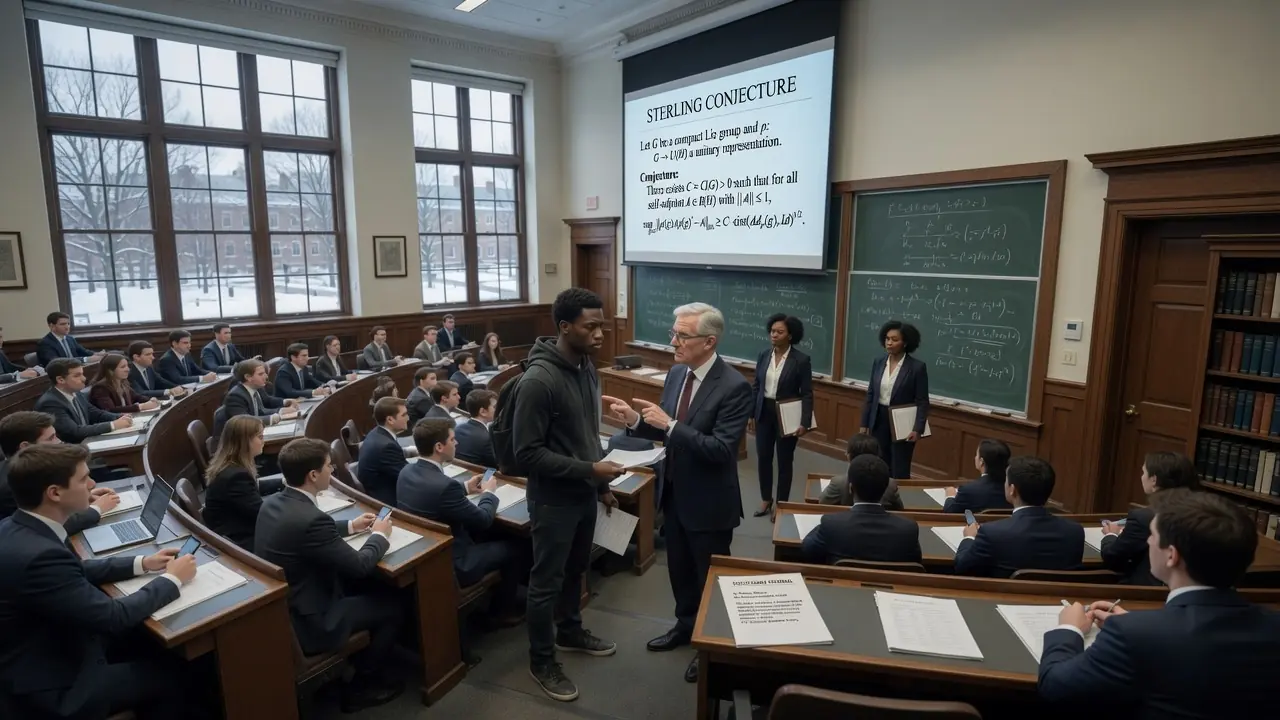
Hawthorne Institute of Technology was one of the most selective scientific universities in the country. Its students came from famous preparatory schools, research families, and homes where words such as fellowship, tenure, and endowment were part of ordinary conversation.
Marcus came from the South Side of Chicago.
His mother managed the evening shift at a neighborhood grocery store.
His father had disappeared before Marcus entered middle school.
The first computer Marcus owned had been assembled from discarded office parts by a science teacher named Mr. Landon.
Marcus learned calculus from library books because his high school could not offer the advanced class.
He earned a place at Hawthorne through grades, competitions, recommendations, and an entrance examination that placed him near the top of the incoming class.
Still, there were people who treated his presence as an administrative experiment.
A voice followed him as he moved down the lecture-hall aisle.
“You sure you’re in the right class, big man?”
A few students laughed.
Marcus recognized the speaker, Bryce Hamilton, whose father funded a laboratory on the west side of campus.
Marcus did not respond.
He took his usual seat in the rear row.
He had not chosen the back because he wanted to hide.
During his first semester, he sat near the front.
Sterling overlooked his raised hand three times in one lecture while calling on students seated behind him.
When Marcus challenged an assumption in a reading, Sterling dismissed the question before he finished speaking.
Two weeks later, a student named Andrew repeated the same observation.
Sterling called it insightful.
The back row gave Marcus space to think without waiting to be acknowledged.
At precisely 8:15, Sterling entered.
Conversation stopped.
He placed a leather folder on the podium and turned toward the screen.
“Today we begin the final assessment.”
A series of equations appeared behind him.
Even students familiar with the course became quiet.
“The Sterling Stability Conjecture,” he announced.
The model described energy behavior inside a theoretical quantum transport system exposed to fluctuating external fields.
Sterling first published it ten years earlier. The paper argued that beyond a certain instability threshold, no closed-form solution could exist.
The conjecture made him famous.
Other researchers attempted to resolve it, but every published approach eventually collapsed.
Sterling now treated the failure as part of the theorem’s prestige.
“Your assignment,” he said, “is not to solve the system. You will demonstrate why a stable analytical solution remains impossible under the specified conditions.”
Marcus leaned forward.
For months, something in the published model had bothered him.
The coefficient controlling resistance within the system was held constant even while surrounding variables changed.
Sterling justified the choice by assuming local equilibrium.
But the model was specifically designed to operate outside equilibrium.
Marcus had tried to ask about that contradiction during an earlier lecture.
Sterling interrupted him after the first sentence.
Now the same flaw appeared on the screen.
“If the coefficient changes with the field,” Marcus said quietly, “the collapse might not happen.”
The student beside him glanced over.
“What?”
Marcus shook his head.
“Nothing.”
Sterling continued explaining the assignment.
Then his eyes moved toward the rear of the room.
“Let me be perfectly clear. This is not a puzzle for creative guessing. It is an advanced test of mathematical discipline.”
His gaze settled on Marcus.
“Some problems must be respected before they can be understood.”
Marcus held his eyes for one second.
Then he looked back at the screen.
After class, Sterling passed him near the door.
He stopped.
“Mr. Thorne.”
Marcus turned.
Sterling smiled with professional politeness.
“Try not to lose perspective on this assignment. Some puzzles are beyond students who lack the appropriate foundation.”
Then he walked away.
Marcus stood alone in the nearly empty hall.
He should have followed the instructions.
He should have demonstrated why the model was impossible and collected the grade.
Instead, he spent the next three nights testing the assumption Sterling refused to question.
Marcus worked at a corner table in the dining hall after it closed. The ventilation system hummed above him. Kitchen employees washed steel trays nearby while pages of equations spread across the table.
The first approach failed.
The second produced an unstable loop.
At 2:17 on Wednesday morning, Marcus allowed the resistance coefficient to vary with field intensity.
The model changed.
A compensation term appeared where Sterling predicted collapse.
Marcus stared at the page.
He recalculated it.
Then he calculated it again using a different boundary condition.
The term remained.
By dawn, he had found a narrow but valid path toward stability.
It was not a full solution to every case.
It did prove the central claim of impossibility was wrong.
Before submitting the assignment, Marcus sent an email to Dr. Elena Vance.
Dr. Vance was one of the country’s most respected astrophysicists and mathematical physicists. Her work on variable-field systems had influenced the approach Marcus used.
She had once studied at Hawthorne before becoming director of the National Center for Computational Astrophysics.
Marcus did not expect a reply.
His message was respectful and brief.
He attached scanned pages and asked whether his handling of the variable coefficient was mathematically defensible.
Then he submitted the work to Sterling.
Two days later, Sterling accused him of fraud.
Marcus reached his dorm shortly after leaving the professor’s office.
Ashford Hall was one of the oldest buildings on campus. The window in his room did not close completely, allowing a thin stream of winter air to enter along the frame.
He dropped his backpack.
The room was barely large enough for a bed, desk, and narrow wardrobe.
His mother’s photograph stood beside the lamp.
Denise wore a blue grocery-store vest and held the acceptance letter Marcus received from Hawthorne. She had been smiling so widely that her eyes nearly closed.
Marcus sat on the bed.
For several minutes, he heard only Sterling’s voice.
This level of work is not something a student with your limitations produces.
You do not belong in this program.
He picked up his phone.
His mother’s contact was pinned at the top.
Mama.
It was shortly after three in Chicago. She would be checking inventory before the evening rush.
If he called, she would hear the truth immediately.
She always did.
Marcus imagined telling her that the scholarship might disappear.
He imagined the silence while she calculated whether any amount of overtime could help.
He could not place that fear inside her yet.
He set the phone down.
The black notebook was still in Sterling’s office.
Marcus suddenly regretted leaving it there.
What if the professor removed pages?
What if he claimed the dates had been added later?
Marcus had photographs on his phone, but panic made every protection feel inadequate.
He opened his laptop.
An official message waited in his university inbox.
NOTICE OF ACADEMIC INTEGRITY REVIEW
The hearing was scheduled for Monday.
Professor Sterling had accused him of unauthorized assistance and misrepresentation.
Marcus read the message three times.
His preliminary status prohibited him from accessing certain research facilities until the hearing was completed.
He closed the laptop.
On the desk lay earlier notebooks, textbooks, and index cards covered in formulas.
They seemed to belong to someone else now.
Someone who believed hard work would be enough.
Marcus stood and paced.
His mind returned to an orientation lecture from freshman year.
A visiting professor had spoken to scholarship students.
“There may come a day when your excellence makes someone uncomfortable,” she said. “Do not make yourself smaller to restore their comfort.”
At the time, Marcus found the sentence inspiring.
Now it felt like a warning delivered too late.
He looked toward the cold window.
Students crossed the courtyard below, throwing snow at one another.
Their lives appeared light.
Marcus had never experienced college that way.
For him, Hawthorne was not four protected years before adulthood.
It was a narrow bridge suspended above everything his family had survived.
One mistake could send him back.
One accusation could destroy what years of effort had built.
“Why does it always have to be this hard?” he whispered.
His laptop chimed.
Marcus turned.
A new email appeared.
FROM: Dr. Elena Vance
SUBJECT: Re: Sterling Stability Conjecture—Variable Coefficient
His hands began shaking.
He opened it.
Mr. Thorne,
I have reviewed the pages you sent, including the intermediate steps. Your observation is mathematically significant. I believe the compensation term is real, though several conditions require formal verification.
Do not discard your notes or alter the original files. Preserve all timestamps.
I will be at Hawthorne on Friday for the departmental colloquium. We need to speak before then.
Elena Vance
Marcus stared at the screen.
He read the message again.
Then a third time.
Your observation is mathematically significant.
He sat slowly.
Sterling had made him question his own mind.
Six sentences from a scientist who had actually read the work restored something the professor had tried to take.
Not certainty.
Marcus was still frightened.
But fear no longer stood alone.
Beside it was evidence.
Friday arrived beneath a gray sky.
The annual Hawthorne physics colloquium was the department’s most important public event of the winter term.
Students filled Kresge Auditorium long before the scheduled start. Professors stood near the stage discussing grants and appointments. Camera crews from the university communications office adjusted equipment along the walls.
Dr. Elena Vance was this year’s keynote guest.
Marcus entered through the rear doors.
He had met with her privately that morning in a small conference room.
For ninety minutes, she questioned him about every stage of his derivation.
She did not praise him.
She tested him.
She asked why he rejected two earlier methods.
She changed boundary conditions and asked him to predict the effect.
She removed a line from his calculation and waited to see whether he noticed.
Marcus answered when he knew.
When he did not know, he said so.
At the end, Dr. Vance closed the notebook.
“You did this work.”
Marcus released a breath.
“Yes.”
“I knew that after the first twelve minutes.”
“Why did we continue for another hour?”
“Because being correct once is not enough. I needed to understand how you think.”
Marcus nodded.
“Do you?”
“Yes.”
“What do you think?”
Dr. Vance looked at him for a long moment.
“I think Professor Sterling has made a very serious mistake.”
Now Marcus took a seat near the auditorium exit.
The Academic Integrity Board would convene in three days.
Sterling had not withdrawn his complaint.
Marcus wanted to hear Dr. Vance’s lecture, then leave without attention.
At the front of the room, Sterling greeted faculty members.
He wore a navy suit and red tie. Whatever anger he displayed in his office had vanished behind a polished public smile.
When Dr. Vance entered from the side door, the audience rose in applause.
She was forty-seven, with natural curls pinned away from her face and an understated black suit. She did not carry herself like a celebrity.
She carried herself like someone who no longer needed permission to occupy space.
Sterling hurried forward and shook her hand.
“Elena, welcome back to Hawthorne.”
“Thank you, Alistair.”
“We are honored.”
Dr. Vance gave him a small, unreadable smile.
Sterling moved to the podium.
He delivered a long introduction about excellence, innovation, and Hawthorne’s commitment to developing talent from every background.
Marcus almost laughed.
Sterling praised Dr. Vance as proof of the department’s tradition of inclusion.
She watched him without expression.
Finally, he invited her to speak.
The applause returned.
Dr. Vance adjusted the microphone.
“I prepared a lecture on variable-field dynamics in stellar plasma systems.”
A title slide appeared behind her.
“However, I am not going to deliver that lecture today.”
Sterling’s smile faltered.
Dr. Vance pressed the remote.
The title disappeared.
In its place appeared the first page of Marcus’s handwritten derivation.
His name was visible at the top.
A murmur moved through the auditorium.
Marcus’s heart struck hard against his ribs.
Dr. Vance looked toward the audience.
“Four days ago, a Hawthorne undergraduate sent me an email. He did not claim to have solved an impossible problem. He did not request publicity or recommendation. He asked for peer review.”
She changed the slide.
More pages appeared.
Crossed-out equations.
Margin notes.
Failed approaches.
“This is what original work often looks like,” she said. “It is not clean. It contains mistakes. It documents uncertainty. It reveals the path of the thinker rather than merely the final destination.”
Sterling stepped nearer to the podium.
“Elena, perhaps this is something we should discuss privately.”
Dr. Vance continued as if he had not spoken.
“The student identified a structural weakness in the Sterling Stability Conjecture. Specifically, the model assumes a constant transport-resistance coefficient while applying conditions that make local equilibrium impossible.”
The room became silent.
Dr. Vance displayed Marcus’s compensation term.
“When the coefficient is allowed to vary within a physically defensible range, the predicted collapse does not occur in every case.”
A professor in the front row leaned toward the screen.
Another began writing rapidly.
Sterling approached again.
“This has not been properly verified.”
“No,” Dr. Vance said. “It has not been fully verified.”
For a moment, relief appeared on Sterling’s face.
Then she continued.
“But it has been sufficiently verified to establish that the impossibility claim is unsupported.”
The relief vanished.
Dr. Vance turned toward the back of the auditorium.
“Marcus Thorne, would you stand?”
Every head turned.
Marcus remained seated for one second longer than he intended.
His legs felt unsteady when he rose.
“There you are,” Dr. Vance said.
Her voice softened.
“Please join me.”
Marcus considered the exit beside him.
He had spent years learning how to avoid becoming the center of a room.
Now hundreds of people were watching.
He began walking.
The aisle seemed longer than it had when he entered.
He passed Bryce Hamilton, who stared at him with his mouth slightly open.
He passed classmates who had avoided choosing him for group projects.
He passed professors who had never learned his name.
Dr. Vance waited at the edge of the stage.
When Marcus reached her, she held out the remote.
“Explain the first instability.”
Marcus looked toward the audience.
The lights blurred the people beyond the first few rows.
He placed one hand on the podium.
“My name is Marcus Thorne.”
His voice sounded steadier than he felt.
“I began by trying to complete Professor Sterling’s assignment as written. The first two approaches supported the conclusion that the system could not stabilize.”
He clicked the remote.
A page containing his failed calculations appeared.
“The third approach failed for a different reason. It required the resistance coefficient to remain constant while energy density and field strength changed independently.”
Marcus looked toward the screen.
“The model was asking one part of the system to ignore changes happening everywhere around it.”
He moved to the board and wrote the original coefficient.
“Once I allowed this term to vary, a secondary term appeared.”
He added the compensation expression beneath it.
“This does not solve every form of the model. It creates a stable path under a limited set of conditions. But one valid path is enough to disprove the claim that no path can exist.”
The auditorium remained silent.
Not bored silence.
Attention.
Marcus continued.
He described how he tested the term under three boundaries. He acknowledged the case that still produced instability. He identified two calculations that required computational confirmation.
A senior professor raised his hand.
“Mr. Thorne, why did you choose a nonlinear coefficient instead of a piecewise constant correction?”
Marcus answered without hesitation.
“A piecewise correction creates artificial discontinuities at the transition points. I tested it on page eleven. The solution appears stable until the derivative crosses the second boundary, then it fails.”
Dr. Vance displayed page eleven.
The professor studied it.
Then he nodded.
Another faculty member asked about energy conservation.
Marcus returned to the board and demonstrated where the conserved term reappeared.
The questions continued.
With every answer, his fear receded.
He was no longer standing before people who could decide whether he belonged.
He was discussing the work.
The mathematics did not care where he came from.
It did not know he fried chicken tenders after midnight.
It did not know his mother had never entered a university classroom.
It responded only to reasoning.
For the first time at Hawthorne, the room did the same.
Sterling stepped onto the stage.
“That is enough.”
The audience turned toward him.
His face had become pale.
“This presentation has moved far beyond the planned program. Unreviewed undergraduate speculation should not be treated as established science.”
Marcus lowered the chalk.
Dr. Vance looked at Sterling.
“No one has called it established science.”
“You called my conjecture unsupported.”
“Because its central assumption fails under conditions described in your own paper.”
Sterling’s jaw tightened.
“This student’s work is currently under academic-integrity investigation.”
The room erupted in whispers.
Dr. Vance became still.
“For what?”
“I am not permitted to discuss confidential disciplinary matters.”
“You just announced them publicly.”
Sterling realized his mistake.
He looked toward the faculty.
“The quality and sophistication of the submission raised legitimate concerns regarding authorship.”
Dr. Vance folded her arms.
“I examined Marcus for ninety minutes this morning.”
“That does not resolve the question.”
“I selected arbitrary points from the derivation. I changed variables. I asked him to reconstruct sections without notes. He demonstrated ownership of the work beyond any reasonable doubt.”
Sterling looked at Marcus.
“He could have memorized it.”
Dr. Vance stared at him.
“You believe he memorized forty-seven pages of nonlinear derivation, including failed methods, and learned to answer original boundary questions overnight.”
“I believe caution is appropriate.”
“No,” Marcus said.
The word passed through the microphone.
Everyone looked at him.
Marcus set the chalk on the ledge.
“You believed I cheated before asking me one mathematical question.”
Sterling’s face tightened.
“This is not the venue.”
“You made it the venue when you announced the investigation.”
“Mr. Thorne—”
“You said the work could not belong to someone with my background.”
A murmur moved through the students.
Sterling stepped forward.
“I said no such thing.”
Marcus reached into his jacket and removed his phone.
“I recorded our meeting.”
Sterling stopped.
Massachusetts law required consent from all parties for secret audio recording. Marcus knew that. He had not secretly recorded the conversation.
He opened an email instead.
“After the meeting, I wrote down your exact statements and sent them to my academic adviser before leaving the building. You replied to the adviser’s request for clarification.”
He looked at the screen.
“You wrote, ‘Mr. Thorne’s employment obligations, educational history, and inconsistent classroom engagement make authorship of research-level analysis improbable.’”
Several faculty members looked toward Sterling.
Marcus continued.
“My employment obligations mean I work in the dining hall.”
Sterling said nothing.
“My educational history means I attended a public school in Chicago.”
“Those are relevant contextual factors.”
“Would they be relevant if my father funded a laboratory?”
The audience went completely quiet.
Bryce Hamilton looked down.
Sterling’s eyes moved toward the department chair seated near the front.
“This is becoming an attack.”
Dr. Vance stepped nearer to him.
“No, Alistair. It is becoming a record.”
Sterling looked at her.
“You have always enjoyed turning academic disagreements into personal grievances.”
A change passed through Dr. Vance’s face.
“Twenty-five years ago, I submitted a paper challenging one of your early models.”
Sterling’s shoulders stiffened.
Dr. Vance faced the audience.
“Professor Sterling told the review committee that my analysis was too sophisticated to have been produced without unauthorized assistance.”
Gasps moved through the hall.
“I was a doctoral student,” she continued. “My paper was delayed for eleven months while the university investigated an accusation unsupported by evidence.”
Sterling shook his head.
“That case was resolved.”
“Yes. In my favor.”
“It has nothing to do with this.”
“It has everything to do with this.”
Dr. Vance gestured toward Marcus’s work on the screen.
“You did not examine his reasoning because examining it carried a risk. If he was correct, you would have to accept that the person who found your blind spot was someone you had already decided could not possess that ability.”
Sterling’s face flushed.
“You people are determined to make every intellectual standard into prejudice.”
The words escaped him.
He stopped.
No one moved.
Dr. Vance’s eyes narrowed.
“What people?”
Sterling looked toward the faculty.
“I meant activists. Students who politicize scholarship. Outsiders who—”
“You said what you meant,” Marcus replied.
Sterling pointed at him.
“You will not speak to me that way.”
Marcus looked at the hand aimed toward him.
Months earlier, the gesture would have made him step back.
He did not move.
“I came to your office asking you to read my work. You threatened to remove me from this university because believing I had written it would require you to reconsider what you believed about me.”
“I protected academic standards.”
“You protected your pride.”
A sound moved through the audience.
Not applause.
A collective breath.
Marcus continued before fear could stop him.
“I did not come here to humiliate you. I did not want a stage. I wanted the same thing every scientist wants—the work evaluated honestly.”
He looked toward the pages projected behind him.
“If the derivation is wrong, show me where. I will correct it. But my name, my job, my neighborhood, and my mother’s income are not mathematical errors.”
Dr. Vance began clapping.
One clear sound.
Then another.
Students joined her.
Faculty members rose.
Within seconds, the auditorium filled with applause.
Marcus stood beneath the lights, unable to move.
He had imagined proving Sterling wrong.
He had never imagined what it would feel like to be believed publicly.
The applause was not victory over a professor.
It was the sound of the room finally acknowledging that Marcus had been present all along.
Sterling did not clap.
He left the stage through the side door.
The colloquium did not continue as planned.
For another hour, Marcus and Dr. Vance discussed the model with faculty researchers. Two computational physicists offered to test the unstable regions. A graduate student asked permission to reproduce the results independently.
Marcus answered questions until his throat became dry.
When the session ended, students crowded near the stage.
Some wanted photographs.
Some wanted copies of the paper.
Three Black undergraduates waited until the crowd thinned.
One of them, a first-year engineering student named Isaiah, held out his hand.
“I sit in the back too,” he said.
Marcus shook it.
Isaiah glanced toward the empty podium.
“Maybe I won’t next week.”
Marcus did not know what to say.
Another student hugged him without asking.
“We needed to see that,” she whispered.
Outside the auditorium, snow had begun falling heavily.
Dr. Vance walked beside Marcus across the courtyard.
“You handled yourself well,” she said.
“My hands are still shaking.”
“They should be.”
Marcus looked at her.
“Why?”
“Courage without fear is usually performance. You were afraid and spoke anyway.”
They stopped beneath a stone archway.
Students passing nearby recognized Marcus.
Some nodded.
Others whispered.
“I don’t want to become a story,” Marcus said.
“You already were one.”
“That’s not what I mean.”
Dr. Vance understood.
“You want to do the work.”
“Yes.”
“Then do not let today become the most important thing you ever accomplish.”
Marcus looked at her.
“That sounds harsh.”
“It is freedom.”
She handed him a folder.
Inside was a printed copy of her technical review.
The first page stated that Marcus’s work was original, internally consistent, and worthy of formal publication after additional verification.
“I sent this to the Academic Integrity Board,” she said.
“Thank you.”
“I did not do you a favor. I performed a professional review.”
“That still matters.”
Dr. Vance studied him.
“The board will dismiss the accusation.”
“You sound sure.”
“I am.”
“What happens to Sterling?”
“That is not your responsibility.”
Marcus looked toward the physics building.
“He’s done this before.”
“Yes.”
“To you.”
“And others.”
“Then it feels like my responsibility.”
Dr. Vance shook her head.
“Your responsibility is to tell the truth when asked. It is the institution’s responsibility to respond. Do not let them make you carry both the injury and the repair.”
The Academic Integrity Board convened Monday morning.
Marcus entered with his academic adviser and a student advocate.
Sterling did not attend.
His attorney submitted a written statement claiming that the accusation had been a reasonable response to an unusual disparity in performance.
The hearing lasted twenty-two minutes.
Dr. Vance’s technical review was entered into the record.
So were the timestamps from Marcus’s files, dining-hall security footage showing him working at the corner table, and handwritten drafts documenting the development of the argument.
Three professors who questioned Marcus during the colloquium submitted statements confirming that he demonstrated complete command of the derivation.
The board dismissed every allegation.
Its chair looked at Marcus over a stack of papers.
“Mr. Thorne, this investigation should not have proceeded on the evidence presented.”
Marcus waited.
No apology followed.
“Will the accusation remain in my record?”
“No.”
“And Professor Sterling’s written statements about my background?”
The chair glanced at the university attorney.
“They are now part of a separate faculty review.”
Marcus nodded.
He had won.
Yet as he left the building, he felt no triumph.
Only exhaustion.
For days, people congratulated him.
Students he barely knew invited him to parties.
A reporter from the campus newspaper requested an interview.
Faculty members who had ignored him suddenly offered meetings.
Marcus accepted none of it immediately.
He called his mother.
Denise answered on the third ring.
“Baby, why are you calling in the middle of the day?”
Marcus tried to speak.
His voice failed.
Her tone changed.
“What happened?”
He sat on a bench beside the frozen river.
“I almost lost the scholarship.”
Silence.
Then, quietly, “Tell me everything.”
Marcus did.
He described Sterling’s accusation.
The hearing.
Dr. Vance.
The auditorium.
When he finished, Denise did not speak for several seconds.
“You should have called me sooner.”
“I didn’t want you to worry.”
“I am your mother. Worry is already included.”
Marcus laughed through tears.
“I’m sorry.”
“No. Don’t apologize for surviving something.”
He looked across the river.
“Mom, he made me doubt myself.”
“I know.”
“How?”
“Because people like that don’t start by taking your opportunity. They start by making you believe you never deserved it.”
Marcus closed his eyes.
Denise continued.
“You listen to me. You did not become brilliant when that woman put your pages on a screen. You were brilliant alone in that dining hall when nobody was clapping.”
Marcus pressed his hand over his mouth.
“You hear me?”
“Yes.”
“The applause did not create you.”
“No.”
“It only caught up.”
The university investigation lasted six weeks.
It uncovered seven previous complaints involving Professor Sterling.
Three students said he had dismissed their research proposals without review.
Two alleged that he publicly questioned whether their admissions had been based on merit.
A former graduate student provided emails showing that Sterling delayed her dissertation after she challenged an error in one of his publications.
Several complaints had been settled informally.
Others had disappeared inside departmental committees.
Sterling announced his retirement before the investigation concluded.
The public statement praised his decades of scholarship and described the departure as a personal decision.
Students protested the language.
Marcus did not.
He had no interest in rewriting Sterling as either a monster or a martyr.
The professor had contributed important work.
He had also used authority to decide who deserved to be recognized.
Both things were true.
Dr. Vance helped Marcus prepare the corrected model for formal review.
The process was slower than the dramatic moment in the auditorium.
Most research was.
Computational tests revealed that one of Marcus’s early boundaries was too broad. Another term needed correction. A graduate researcher found an error in a secondary proof.
Marcus did not feel humiliated.
He felt relieved.
This was what honest evaluation looked like.
People challenged the work without challenging his right to have produced it.
Six months later, the paper was accepted by a respected journal.
Its title did not mention Sterling’s failure.
It focused on the science.
Variable Resistance and Conditional Stability in Nonequilibrium Transport Systems
The authors were listed in order of contribution.
Marcus Thorne appeared first.
Dr. Elena Vance appeared last as supervising researcher.
Between them were three scientists who helped verify and expand the model.
When Marcus received the acceptance email, he was standing inside the dining hall carrying a tray of clean glasses.
He read the message twice.
Then he called his mother.
Denise screamed loudly enough that a customer asked whether something was wrong.
“Nothing is wrong,” she replied. “My son just got published.”
That spring, Dr. Vance offered Marcus a paid position in her summer research group.
The position included housing, a stipend, and continued support for graduate study.
Marcus read the offer beside the Charles River.
The snow had melted. Water moved swiftly beneath the bridge, carrying broken branches toward the harbor.
He remembered arriving at Hawthorne as a first-year student with two suitcases and a coat his mother bought on credit.
He remembered the first lecture where Sterling looked through him.
He remembered choosing the back row because disappearing felt safer than being rejected repeatedly in public.
The following semester, Marcus entered the same lecture hall as a teaching assistant for an introductory mathematical-physics course.
Students were still settling into their seats.
Isaiah, the engineering student from the colloquium, sat in the first row.
Marcus placed his notes on the podium.
He looked toward the back.
Several students sat alone, shoulders slightly lowered, trying not to attract attention.
He recognized the posture.
“Before we begin,” Marcus said, “I want to establish one rule.”
The room became quiet.
“No idea will be dismissed because of who presents it. That does not mean every idea is correct. It means every idea deserves to be tested by evidence rather than assumption.”
A student raised her hand.
“What if the question sounds basic?”
“Then we identify the basic part and build from there.”
“What if someone challenges the instructor?”
Marcus smiled.
“Especially then.”
Light laughter moved through the room.
He began the lesson.
Halfway through, a student in the rear raised his hand uncertainly.
Marcus called on him first.
Years later, people at Hawthorne still spoke about the colloquium when Dr. Elena Vance interrupted her keynote to display an unknown undergraduate’s handwritten equations.
Some remembered Sterling’s expression.
Some remembered the applause.
Others remembered Marcus’s statement that a person’s background was not a mathematical error.
Marcus remembered something quieter.
He remembered standing at the board after years of being overlooked and realizing that he no longer needed to prove he was worthy of entering the room.
He needed only to protect the part of himself that had continued thinking when the room refused to see him.
Alistair Sterling believed brilliance came with recognizable clothing, the right history, and enough free time to appear effortless.
Marcus’s brilliance arrived in a sweatshirt that smelled like a dining-hall kitchen.
It was written at two in the morning between closing duties and morning lectures.
It came from library books, repaired computers, bus rides, exhaustion, discipline, and a mother who taught him that other people’s doubt did not deserve to become his identity.
He did not solve the problem because he wanted to destroy Sterling’s legacy.
He solved it because one assumption bothered him, and he refused to stop asking why.
That was the part Sterling never understood.
Marcus Thorne had not been admitted to Hawthorne because someone lowered the standard.
He had spent his entire life learning to rise above standards designed without people like him in mind.
The university did not give him brilliance.
Dr. Vance did not create it.
The applause did not confirm it.
They simply reached the truth later than Marcus did.
He had belonged there from the beginning.