The rear axle broke with a sound Martha Hale would remember for the rest of her life.
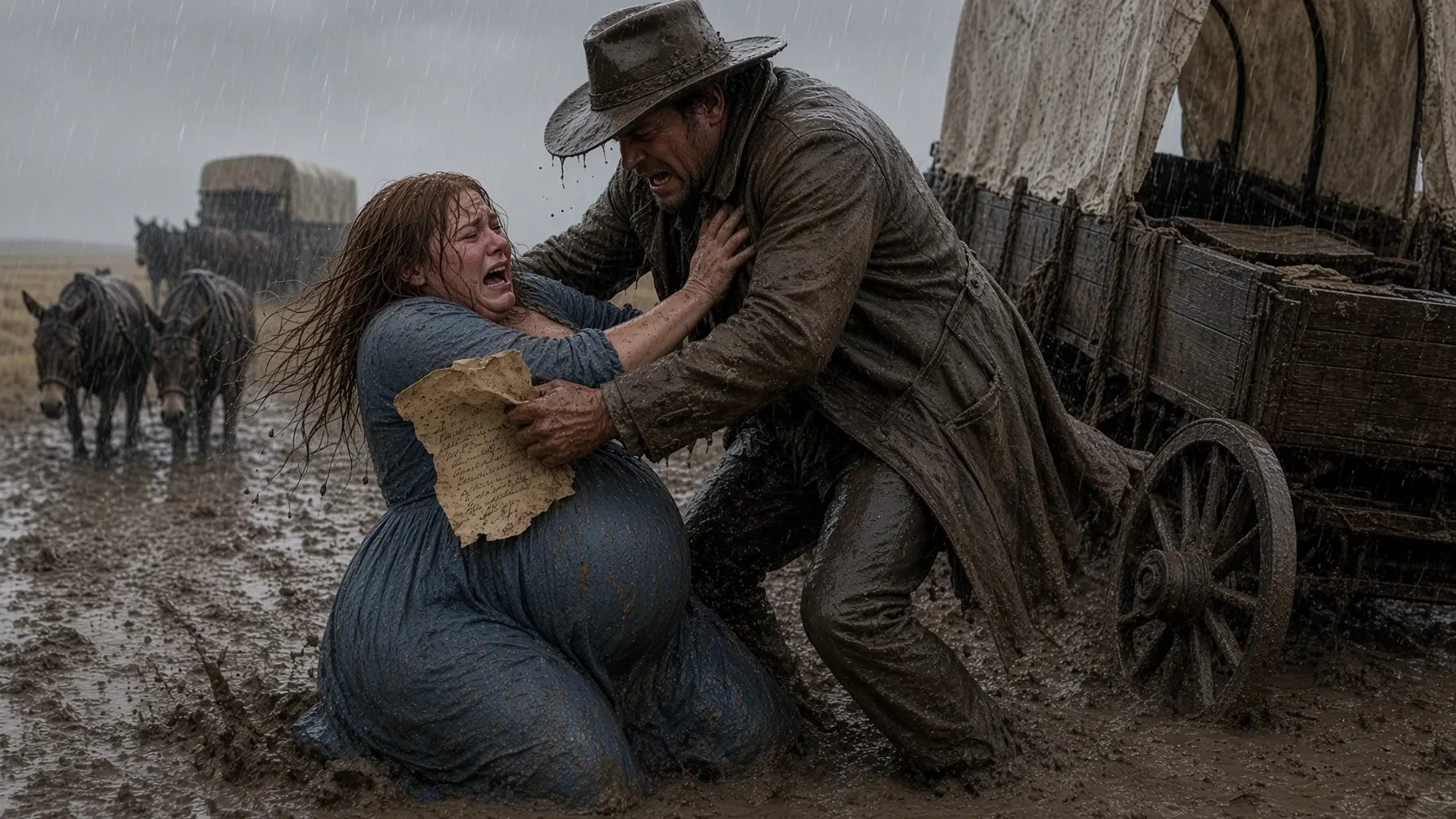
It was not a dramatic sound. No explosion. No great crash. Just one sharp crack beneath the wagon, followed by the ugly grinding of iron against dry earth as the left rear corner dropped.
The wagon lurched hard enough to throw Martha against the sideboard.
Pain flashed across her lower belly.
She grabbed the wooden rail with one hand and wrapped the other around the child inside her.
“Easy,” she whispered.
She did not know whether she was talking to the baby, the frightened mules, or herself.
The wagon dragged another six feet before stopping crooked on the trail.
Then there was silence.
Wyoming Territory stretched around her in every direction, bleached beneath the August sun. The Platte shimmered somewhere beyond a low line of cottonwoods, but from where Martha stood there was nothing except sagebrush, baked ground, and an enormous sky that seemed almost cruel in its emptiness.
She climbed down slowly.
At thirty-one years old, Martha had never considered herself weak. She had milked cows before sunrise, helped raise barns, carried sacks of corn, nursed her younger brothers through influenza, and once driven a wagon through a flooded creek while her husband shouted that they should turn back.
But pregnancy had changed the arithmetic.
She was nearly eight months along.
Her ankles were swollen. Her back hurt constantly. Sleep came in short pieces. The heat made her dizzy if she stood too quickly.
And five days earlier, she had buried her husband beside the Platte River.
Jeb Hale had lasted less than thirty hours after the cholera took hold.
One morning he had been walking beside the wagon making fun of Martha for insisting they save three heavy books he claimed no homestead needed. By sunset he could barely stand. Before the next afternoon, he was gone.
There had been no preacher.
No coffin.
No family.
Only Martha, two frightened mules, a shovel, and ground so hard she had needed half a day to make the grave deep enough.
She covered him with stones because she could not bear the thought of animals disturbing him.
Then she sat beside the grave until dark.
At sunrise, she harnessed the mules.
The child inside her was still alive.
That had become reason enough to keep moving.
Now she crouched beside the broken wagon and stared at the axle.
The wood had not merely cracked.
It had split lengthwise near the wheel hub, opening like a piece of firewood beneath a maul.
Jeb might have attempted a trail repair.
He had carried spare bolts, iron straps, rope, and tools for exactly that reason.
But Jeb was beneath a cairn of stones five days behind her.
Martha touched the splintered wood.
“No.”
The word came out quietly.
She tried telling herself she could brace it.
She found a length of oak beneath the wagon bed and spent nearly an hour trying to lash it against the broken axle with rawhide and rope. Sweat soaked through the back of her dress. Twice she had to sit because black spots appeared in her vision.
Finally she harnessed the mules.
“Come on.”
They pulled.
The wagon moved perhaps three feet.
The temporary brace shifted.
The broken axle twisted.
The wheel folded outward again.
Martha closed her eyes.
The mules stopped without being told.
One of them looked back at her.
“You’re no help,” she muttered.
The mule flicked an ear.
Martha almost laughed.
Instead, she sat beneath the thin shadow of the wagon.
Her remaining water filled less than half a five-gallon keg.
Enough for herself if she was careful.
Not enough for two mules under summer heat.
She had flour, beans, coffee, salt pork, and dried apples.
Food was not the immediate problem.
Water was.
Distance was.
And the child.
Martha looked toward the sky.
Three dark shapes circled high overhead.
Buzzards.
“Of course.”
She leaned her head against the wagon wheel.
“Well, little one,” she whispered, pressing a hand against her belly. “Looks like the buzzards finally won.”
The baby kicked.
Hard.
Martha stared down.
“All right.”
Another kick.
“I heard you.”
She pushed herself upright.
“I suppose surrendering without your permission would be poor manners.”
She had just reached for the water keg when she felt something through the soles of her boots.
A vibration.
Faint.
Rhythmic.
Martha froze.
It came again.
Then she heard it.
Harness chains.
Wheels.
Hooves.
She stepped into the trail.
A cloud of dust rose perhaps half a mile away.
Something large moved inside it.
Martha grabbed Jeb’s Winchester from beneath the wagon seat.
Travelers could mean help.
They could also mean trouble.
She stood with the rifle held across her body as four enormous draft horses emerged from the dust.
Behind them rolled a freight wagon twice the size of hers.
The driver sat high above the team.
He was a big man.
That was Martha’s first impression.
The second was that he had probably been living outdoors longer than she had been alive.
His beard was dark brown streaked with gray. His hat had lost whatever shape its maker originally intended. A faded buckskin coat lay beside him despite the heat, and the sleeves of his work shirt were rolled over thick forearms browned by sun.
A Henry rifle rested within reach.
The freight wagon slowed.
The man studied Martha.
Then the rifle in her hands.
“You planning on using that?”
“Depends.”
“On?”
“Whether you give me reason.”
He looked at the broken wagon.
“Fair enough.”
He pulled the team to a stop.
Then climbed down.
Martha tightened her grip.
He did not approach her first.
He walked directly to the rear axle.
Crouched.
Touched the split wood.
Checked the iron tire around the wheel.
Then examined the hub.
“Where’s your man?”
Martha’s face hardened.
“Dead.”
The stranger stopped.
For a moment, all the roughness disappeared from his expression.
“How long?”
“Five days.”
“Cholera?”
She nodded.
He looked away toward the eastern trail.
“Sorry.”
Martha said nothing.
The stranger returned to the axle.
He tested the wood again.
“Finished.”
“I have eyes.”
One corner of his mouth moved.
“Good.”
He stood.
“You got another wagon hidden somewhere?”
“No.”
“Then eyesight ain’t the problem.”
Martha disliked him immediately.
That was almost comforting.
Anger was easier than fear.
“Can it be repaired?”
“Not here.”
“I tried bracing it.”
“I can see that.”
“You could sound less pleased.”
“I ain’t pleased.”
He pointed toward the split.
“Axle’s broken too close to the hub. Lash a brace there and all you’ll do is keep the pieces together until the wheel takes side load. Then it’ll fold again.”
Martha stared at him.
“You a wagon maker?”
“Freighter.”
“That make you an expert?”
“No.”
He looked toward his enormous rig.
“Breaking enough wagons does.”
He walked around her wagon.
Checked the tongue.
The front axle.
Then the mules.
He lifted one mule’s lip and examined its gums.
“Hey.”
Martha stepped forward.
“What are you doing?”
“Checking dehydration.”
“They’re my animals.”
“I noticed.”
He released the mule.
“They’re thirsty.”
“I know.”
“How much water?”
“Enough.”
“How much?”
Martha hesitated.
He looked at the keg.
“Half?”
“A little less.”
The man looked toward her belly.
Then at the mules.
Then down the trail.
“You’re not walking.”
“I hadn’t planned to.”
“You staying here?”
“I hadn’t planned that either.”
“What did you plan?”
Martha’s temper finally broke.
“My plan was to reach Oregon with my husband before winter. My plan was for him to build a house and for me to have this baby somewhere that had walls. My plan was not to bury him beside the Platte and then have my wagon split itself open in the middle of Wyoming.”
The man said nothing.
Martha’s chest rose and fell.
She looked away.
“I apologize.”
“Don’t.”
“I shouldn’t have—”
“You answered the question.”
He walked toward his freight wagon.
“Get your things.”
Martha stared.
“What?”
“You’re coming with me.”
“I didn’t ask for charity.”
He turned.
“Ain’t charity.”
“What is it?”
“Arithmetic.”
She frowned.
“You stay here, you die.”
He pointed toward his wagon.
“I have room.”
Then toward her.
“You require room.”
He shrugged.
“Arithmetic.”
Martha almost told him to leave.
Then the baby moved.
She looked toward the buzzards.
Pride had its uses.
Keeping a woman alive in the Wyoming sun was not one of them.
“What’s your name?”
“Boon.”
“Boon what?”
“Calder.”
“Martha Hale.”
“I heard.”
“You didn’t.”
“You shouted about your husband.”
Martha closed her eyes.
“Right.”
Boon walked toward the broken wagon.
“What comes?”
“What?”
“Your belongings.”
“All of it.”
“No.”
Martha stiffened.
“That wagon contains everything I own.”
“And my wagon already contains three thousand pounds of freight.”
He pointed.
“You choose what matters.”
Everything mattered.
Jeb’s coat mattered.
Their cooking pot mattered.
The sack of seed he had bought in Omaha mattered.
The chair his father had made mattered.
The wooden chest Martha’s mother gave her mattered.
The iron stove mattered.
The plow blade tied beneath the wagon mattered.
Boon seemed to understand what she was thinking.
“We take what keeps you alive first.”
He began sorting with brutal practicality.
Water.
Food.
Blankets.
Rifle.
Ammunition.
Medical tin.
Winter clothing.
Cooking skillet.
Tools.
Martha’s sewing box.
Then he found three books wrapped in canvas.
He lifted them.
“Books stay.”
Martha looked surprised.
“You said necessities.”
“They weigh almost nothing.”
“They were Jeb’s.”
Boon put them carefully into his wagon.
“Then they stay.”
The chair did not.
Neither did the stove.
Nor the heavy plow blade.
Martha stood beside the wagon while Boon removed what could be reused: spare bolts, rope, an iron strap, the tongue chain, harness leather, two wheel pins, and one nearly new brake shoe.
“You’re stripping it.”
“Someone’ll come through eventually.”
“That makes it theft.”
“Then leave a note.”
She did.
WAGON ABANDONED BY MARTHA HALE AFTER AXLE FAILURE. TAKE WHAT YOU REQUIRE. LEAVE WHAT YOU DO NOT.
Boon read it.