Martha Hale had survived cholera, grief, and nearly six hundred miles of merciless trail, but in the end it was one shattered piece of wood that threatened to kill her.
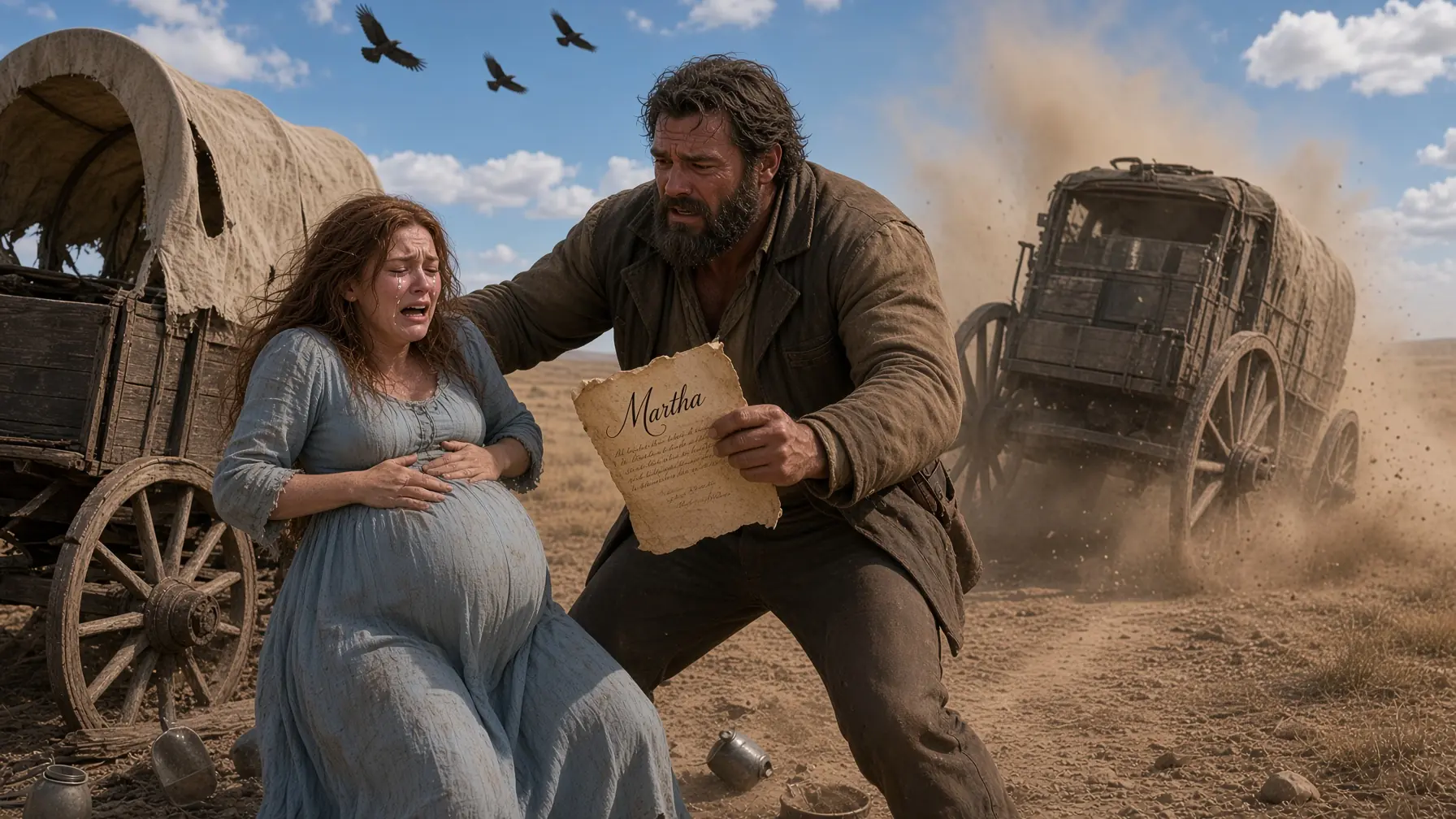
The rear axle of her wagon had splintered beneath a white Wyoming sun, dropping the wagon box sideways into the dust with a crack loud enough to send her two mules lunging against their traces. For several seconds Martha simply sat on the ground where the collapse had thrown her, one hand pressed against the hard curve of her belly and the other buried in hot dirt. She waited for pain. Blood. Anything that would tell her the child inside her had been injured.
Then came a kick.
Hard.
Low beneath her ribs.
Martha closed her eyes.
“Thank you,” she whispered.
She was seven months pregnant, alone, and still alive.
For the moment.
That last fact became less comforting when she examined the wagon.
The axle had not merely cracked. A knot buried inside the wood had finally failed, splitting the timber lengthwise until the right rear wheel twisted beneath the wagon box. One iron tire had partially separated from the rim. The hub sat crooked. Even if Martha somehow lifted the wagon high enough to straighten it, there was nothing left to fasten the wheel to.
She knew enough about wagons to understand the difference between damaged and finished.
This one was finished.
Martha sat beneath the sliver of shade cast by the wagon and looked west.
Nothing moved.
The trail stretched between low brown hills and endless pale grass until heat distorted the horizon. Fort Laramie remained somewhere ahead, though she no longer trusted the distances people gave her. One traveler had told her two days. Another said four. A trader headed east had said fifty miles.
Fifty miles might as well have been five hundred.
Her water barrel was nearly empty.
One mule had a sore shoulder.
The other had begun refusing feed that morning.
And the child inside her was not supposed to arrive for another six weeks.
Martha rested both hands over her stomach.
“Well, little one,” she murmured, looking toward the black shapes circling high above the prairie, “looks like the buzzards finally won.”
The words were meant as a joke.
They did not sound like one.
Five days earlier, she had buried her husband beside the Platte River.
Jeb Hale had survived Indian Territory, two wagon accidents, a rattlesnake beneath his blanket, and one winter in Missouri that froze the river solid enough to carry a loaded wagon. Cholera killed him in thirty-six hours.
There had been no doctor.
No minister.
No coffin.
Martha had dug until her hands blistered, then paid two passing teamsters to help finish the grave because she could no longer lift the shovel. They laid Jeb beneath a cottonwood and covered him with stones so wolves would not disturb him.
Martha placed his Bible beneath his folded hands.
Then immediately dug it back up.
She hated herself for doing that.
But Jeb had written the names of their dead parents inside the cover, along with their wedding date and the date they first felt the baby move. Martha could not leave the only written record of their little family beneath a pile of Wyoming stones.
So she kissed his forehead.
Took the Bible.
Covered him again.
And left.
There was no bravery in it.
There was simply nowhere else to go.
Going backward would not resurrect Jeb. Remaining beside his grave would kill her. The baby was alive, and that single stubborn heartbeat became enough reason to move west another mile.
Then another.
Then another.
Until the axle broke.
By three in the afternoon, Martha had made an inventory.
Less than a gallon of water.
A handful of oats.
Flour.
Salt pork.
Coffee.
Two blankets.
Jeb’s Winchester.
A skillet.
Three books.
The Bible.
Needle and thread.
A small tin containing twenty-seven dollars.
And two mules that could travel if freed from the wagon but could not carry everything she needed.
She considered riding one.
The thought lasted less than a minute.
Martha had ridden before pregnancy. She could probably manage several miles. But if the mule stumbled, if contractions began, if she fell, there would be nobody to help.
She sat beside the wagon until the sun moved lower.
The buzzards remained.
Then the earth began trembling.
At first Martha assumed it was thunder.
There were no clouds.
The vibration grew.
Harness bells.
Hooves.
Wooden wheels.
She climbed to her feet, one hand braced against the wagon.
A dark shape emerged through the heat.
Not a settler’s wagon.
A freight rig.
Massive.
High-sided.
Canvas-covered.
Four draft horses pulled it, each animal broad through the chest and heavy enough to make Martha’s tired mules look like foals. Dust rolled beneath the wheels in a thick brown cloud.
The man on the seat looked nearly as formidable as the wagon.
Broad shoulders beneath a sun-faded coat.
Thick beard.
Black hat.
A Henry rifle within easy reach.
He saw Martha.
Then the broken wagon.
The team slowed.
Martha reached for Jeb’s rifle.
The stranger noticed.
“Keep it if it makes you feel better,” he called. “Just don’t point it at my horses.”
His voice was deep and rough, more tired than threatening.
He halted beside the wreck.
For a moment he remained seated, studying everything.
Martha.
The wagon.
The mules.
The sky.
Then he climbed down.
He was enormous.
Not fat.
Built like someone who had spent most of his life lifting freight that should have required two men.
He removed his hat.
“Afternoon.”
Martha did not lower the rifle.
“Is it?”
He looked toward the sun.
“Technically.”
He walked around the wagon without asking permission.
Martha watched closely.
He crouched beside the broken axle.
Touched the split.
Inspected the wheel.
Then stood.
“Axle’s finished.”
Martha narrowed her eyes.
“I have eyes.”
The stranger looked at her.
Something almost like amusement moved beneath his beard.
“Apparently.”
He checked the right mule’s shoulder.
The animal flinched.
“Been rubbing for a while.”
“I know.”
“Other one’s dehydrated.”
“I know that too.”
His gaze finally moved toward her belly.
Martha immediately disliked it.
“You planning to tell me I’m pregnant?”
“No.”
“Good.”
“I was planning to tell you you’re in no condition to walk fifty miles.”
“I thought I might sit here until the coyotes found me.”
He looked toward the buzzards.
“They’ll complain you gave the job to somebody else.”
Despite herself, Martha nearly laughed.
She stopped it.
The stranger walked to his freight wagon.
“Get your things.”
She stared.
“What?”
“Get in my wagon.”
“I didn’t ask for charity.”
He turned.
“Ain’t charity.”
“What is it?”
“Arithmetic.”
Martha’s expression hardened.
He pointed toward her broken axle.
“You stay here, you die. You walk, probably die. You ride one of those mules pregnant with no water, good chance you fall and die. I have room.”
“That sounds remarkably like charity.”
“No. Charity makes people feel noble.”
He pulled a coil of rope from the side of his wagon.
“This is inconvenience.”
Martha stared at him.
“What do you want?”
“Right now?”
“Yes.”
“For you to stop wasting daylight.”
She did not move.
The stranger sighed.
“My name’s Boon.”
“Boon what?”
“Just Boon is enough.”
“That is suspicious.”
“Been told.”
“Where are you going?”
He looked west.
Then something flickered across his face too quickly for Martha to understand.
“Does it matter?”
“If I’m climbing into your wagon, yes.”
“Fort Laramie.”
That was enough.
Martha lowered Jeb’s rifle.
“My name is Martha Hale.”
“Good.”
“Good?”
“Now we’ve been introduced.”
He turned toward the wreck.
“Let’s work.”
Boon did not take everything.
That surprised her.
He salvaged what mattered and left what did not.
Food.
Blankets.
Tools.
Rifle.
Jeb’s books.
Martha’s clothes.
The small cedar box containing letters from home.
He inspected two iron pans, chose the better one, and left the cracked skillet.
Martha objected.
“That belonged to Jeb.”
Boon looked at the crack.
“Then remember him with something that won’t spill bacon grease into a fire.”
She glared.
He handed it back.
“Your choice.”
Martha held it for several seconds.
Then set it beside the broken wagon.
Boon said nothing.
He tied her mules behind his freight rig.
Then Martha faced the real problem.
The wagon floor stood nearly four feet above the ground.
Boon had a small step beneath the side door, but the freight wagon rode high to clear ruts and stream crossings.
Martha grasped the handle.
Raised one boot.
Her belly pressed painfully against her thigh.
She tried again.
Her foot slipped.
She fell backward into the dust.
Boon caught one arm, but not quickly enough to prevent her from landing hard on her backside.
Humiliation burned hotter than pain.
“I can’t.”
The words escaped before she could stop them.
For five days Martha had not said those words.
Not when she buried Jeb.
Not when she hitched the mules herself.
Not when she woke alone.
Not when she washed her husband’s final bloodstained shirt in the river and realized there was no reason to wash it at all.
Now one wagon step defeated her.
She covered her face.
Boon looked away.
That was kinder than staring.
After a moment he said:
“Grab the handle.”
Martha lowered her hands.
“What?”
“Grab it.”
“I just tried.”
“I know.”
He stepped behind her.
Martha stiffened.
“What are you doing?”
“Solving arithmetic.”
His hands settled firmly against her hips.
“Boon—”
“On three.”
Her face burned.
“I can climb.”
“You just demonstrated otherwise.”
“I slipped.”
“Then prove me wrong tomorrow.”
His voice held no mockery.
That made surrender easier.
Martha grabbed the handle.
“One.”
She bent her knee.
“Two.”
His grip tightened.
“Three.”
Boon lifted.
Not a shove.
Not a struggle.
One smooth motion.
For a brief ridiculous second Martha felt almost weightless.
Then her knees landed on the wagon floor.
She crawled inside.
Boon stepped back as if nothing unusual had occurred.
Martha looked down at him.
“You could at least pretend that was difficult.”
He picked up her rifle.
“I haul freight.”
“That isn’t an answer.”
“You weigh less than a barrel of nails.”
Martha stared.
Then laughed.
It was the first genuine laugh since Jeb died.
The sound frightened her.
She covered her mouth.
Boon pretended not to notice.
He loaded the last box.
Then climbed onto the seat.
The freight wagon turned.
Martha did not notice at first that the sun was now on the wrong side.
Boon spoke little during the first day.
Martha eventually learned his silence was not hostility.