In Crestfall, Wyoming, during the summer of 1883, everyone knew Rose Callahan could have married almost any man she wanted. She was twenty-six, the eldest daughter of Daniel Callahan, who owned the general store on Main Street, and she carried herself with the quiet strength of a woman raised among flour sacks, storm warnings, credit ledgers, and frontier pride. Men came into the store pretending to need nails, coffee, or rope, but most of them came because Rose was behind the counter. She smiled kindly, spoke warmly, and still sent every hopeful man away with nothing more than a polite answer and an ache he could not blame her for.
Rose was beautiful, but beauty was not the reason people remembered her. Her golden hair was usually pinned beneath a ribbon, and her green-gray eyes changed with the light, but what truly made her different was the way she noticed people. She remembered who had a sick child, who needed extra flour on credit, who had lost cattle in the spring rain, and who needed to hear something gentle without being pitied. In a hard country where survival often made people sharp, Rose remained warm without becoming weak.
There was one man she had been waiting for, though almost no one dared say it aloud. His name was Will Hadley, and he owned the livery stable on the south end of town. Will was thirty, broad-shouldered from work, dark-haired, steady-handed, and so honest people trusted his prices before he named them. He was not rich, not flashy, and not the kind of man who entered a room expecting anyone to notice him.
That was part of the problem. Will never imagined Rose Callahan might be looking at him with anything more than neighborly affection. They had grown up three streets apart, shared years of small conversations, and spoke with the easy rhythm of people whose lives had always touched at the edges. He looked at Rose the way a man looks at the mountains beyond town: grateful they exist, aware of their beauty, but never foolish enough to believe they might belong to him. Rose had been waiting for him to understand that she did not want a man who performed importance; she wanted the one man who never performed anything at all.
Every Wednesday, Will came into the general store for nails, feed orders, saddle soap, or some small thing he could have sent a stable boy to fetch. Rose always knew when he entered before she looked up, because Will carried the smell of horses, leather, dust, and open air with him. He would remove his hat, say, “Morning, Rose,” and she would answer, “Morning, Will,” while pretending her heart did not lift at the sound of him. Then he would pay, smile, and walk out, leaving her with another ordinary moment she treasured more than any bouquet another man had ever brought.
The town saw what Will did not. George Alcott, who had proposed to Rose twice and been refused both times, understood the situation with the dry patience of a man who had lost but still admired the winner. He once watched Will leave the store after a three-minute conversation that had made Rose smile in a way George had never earned in two years. “For a man who works with horses,” George muttered, “you have an astonishing talent for not seeing what is standing right in front of you.”
Will only frowned. “What are you talking about?” George looked toward the store window, where Rose was arranging jars of preserves with a softness still lingering on her face. “Nothing,” he said. “Absolutely nothing.” But George knew time was beginning to run against them, because Edward Marsh had started asking questions.
Edward Marsh owned the largest cattle operation in the county. He was forty-two, powerful, wealthy, and known for getting what he wanted through patience rather than noise. When his black carriage rolled through Crestfall, men stood straighter and shopkeepers paid attention, not because Edward was cruel, but because he carried consequence with him. He had built his ranch from nothing, and that made people respect him even when they did not entirely like him.
Rose respected Edward too. That was what made the situation difficult. He was not foolish, not vulgar, not weak, and not a man she could dismiss as unworthy. If her heart had been empty, Edward Marsh would have been a sensible answer to many questions a frontier woman had to consider.
But Rose’s heart was not empty. It had been waiting, quietly and stubbornly, for a man too humble to recognize his own place in it. She knew waiting forever could turn love into self-betrayal. Still, each time Will smiled at her from beneath the brim of his worn hat, she found herself giving him one more chance without telling him that was what she was doing.
The midsummer dance was held behind the feed store in a barn swept clean for the occasion. Lanterns hung from rafters, fiddle music filled the warm evening air, and women moved in pale dresses while men pretended their boots had been polished properly. Rose arrived in a cream dress with a lace collar her mother had fussed over for three days. She looked composed, but inside she felt tired of being watched by everyone except the one man whose gaze mattered.
Edward Marsh asked her to dance an hour after arriving. Refusing would have caused a ripple through the room, and Rose had never enjoyed making scenes. She placed her hand lightly in his and let him guide her into the dance. He moved well, with control and confidence, but his eyes studied her too carefully, as if he were measuring the shape of a future.
Across the barn, Will Hadley came in late, still dusty from the stable, and accepted lemonade from the refreshment table. Rose saw him almost immediately. She smiled at him, not the polite public smile she gave most men, but the quick private one she had saved for him for years. Will smiled back, and for one bright second, she thought perhaps he might finally cross the room.
Then Tom Fletcher stepped beside him and began talking about a horse trade. Will turned away with the easy blindness of a man who did not know a door had just opened. Rose felt something in her chest fall quietly. Edward Marsh noticed the direction of her gaze, though he said nothing.
Three days later, Rose was hanging laundry in the yard behind the general store when her father stepped onto the porch. Daniel Callahan was a careful man, kind but practical, and he had never pushed his daughter toward any match. He watched her pin a white sheet to the line before saying, “Edward Marsh came in yesterday.” Rose kept her hands moving, though she felt the world narrow slightly.
“He asked about you,” Daniel said. “Not in a casual way.” Rose reached for another clothespin. Her fingers were steady only because she forced them to be. “What did you tell him?” she asked.
“I told him you made your own decisions,” Daniel replied. “Because you do.” He paused, his voice softening. “But he is serious, Rose. A man like Marsh does not ask certain questions unless he intends to follow them.” The sheet lifted between them in the breeze, hiding his face for a moment.
Rose stared at the white cotton fluttering in the light. “Papa,” she said quietly, “do you know why I’ve refused everyone?” Daniel gave a small sigh, not of impatience, but of recognition. “I have had a theory. It wears a stableman’s hat.”
Rose looked away toward the livery roof visible beyond the buildings. “He does not see it.” Her voice did not break, but it came close. “I have waited two years for him to see it, and he looks at me as if I am something beautiful too far away to touch.” Daniel leaned against the porch post and said nothing, giving his daughter the space to tell the truth.
“Edward is a good man,” Rose continued. “He could give me comfort, security, and a name no one would question.” She folded a sheet slowly. “But he cannot give me what I have already given away.” Daniel’s eyes saddened because fathers sometimes understand heartbreak before daughters say the whole of it. “How long will you wait?” he asked.
Rose looked toward the mountains, where the sun lit the high ridges in pale gold. For years, waiting had felt faithful. Now, for the first time, it felt dangerous. “Not much longer,” she said. And this time, she meant it.
George Alcott found Will at the livery the following Monday. Will was bent over a horse’s hoof, checking a shoe with his usual concentration, when George leaned against the stall and said, “Edward Marsh is going to make a formal offer for Rose Callahan.” Will’s hand stopped. The horse shifted, sensing the change before Will understood it himself.
“Where did you hear that?” Will asked. George folded his arms. “From three people who should not know it unless it is true.” Will set the hoof down carefully. “What does that have to do with me?”
George stared at him for a long moment, almost amazed. “Will, Rose Callahan has turned down every man in this county for six years, and there is a reason for that.” Will frowned as if George had started speaking another language. “She would never look at me that way.” George pushed away from the stall wall. “She already has. For years.”
The stable seemed to go silent around them. Will looked toward Main Street, toward the store he had entered a thousand times without understanding that every ordinary visit had meant something. He thought of Rose’s smile, the way she remembered his injured mare, the way she always knew when he had worked too long without eating. Memories rearranged themselves in his mind until they became evidence.
“Marsh has land,” Will said slowly. “Money. Standing.” George’s face softened. “And still she waited for you.” The words struck Will harder than any blow could have. George placed a hand briefly on his shoulder and left him standing among hay dust, leather, and the sudden fear of losing what he had never dared claim.
For three days, Will barely slept. He worked because horses still needed shoeing, wagons still needed harness, and life did not pause simply because a man discovered he had been blind. But every sound in town seemed to measure time now: the hammer at the blacksmith’s, the church bell, wagon wheels, the store door opening and closing. Edward Marsh was coming closer, whether physically or not.
On Thursday afternoon, Rose walked up Main Street carrying a small package from the seamstress. She slowed near the livery because she always slowed there, though lately she had begun scolding herself for it. Will stood outside working harness leather, sleeves rolled, hat pushed back, dark hair damp at his temples from the heat. He looked up when she stopped, and something in his face was different.
“Rose,” he said. Not “Morning, Rose,” not the casual greeting he had used for years. Just her name, spoken like he had finally realized it was precious. She felt her pulse change.
“Will,” she answered. They spoke first of ordinary things because people often stand at the edge of life-changing truth and discuss the weather to keep from falling in too quickly. The heat, the livery business, the late summer rains. Then Will set the harness leather aside. His hands were rough, nervous, and more honest than any polished speech.
“I heard about Marsh,” he said. Rose went still. Across the street, someone hammered a crate shut. A wagon creaked past, and dust lifted around them in a soft brown haze. “I have no right to say anything,” Will continued, “because I have had time enough to speak and did not.”
Rose’s fingers tightened around the package. “Then why speak now?” It was not cruelty. It was the question he deserved. Will lowered his eyes for a moment, then looked back at her with a steadiness that made her chest ache.
“Because I was a coward,” he said plainly. “Not the kind that runs from horses or storms, maybe, but the kind that sees something beautiful and tells himself it is not meant for him because reaching would require courage.” Rose’s breath caught. “Will,” she whispered.
“I love you,” he said. The words came rough, not practiced, not graceful, but full of truth. “I think I have loved you for years and called it friendship because I was too slow to know what I was looking at.” His voice dropped lower. “I know saying it now may not change anything. But I could not let you think nobody saw you.”
Rose looked at him, and the years of patience pressed behind her eyes. All the dances, the declined offers, the Wednesdays, the conversations, the hope she had tucked away after every ordinary goodbye, all of it rose between them. She stepped closer. The street around them seemed to fade.
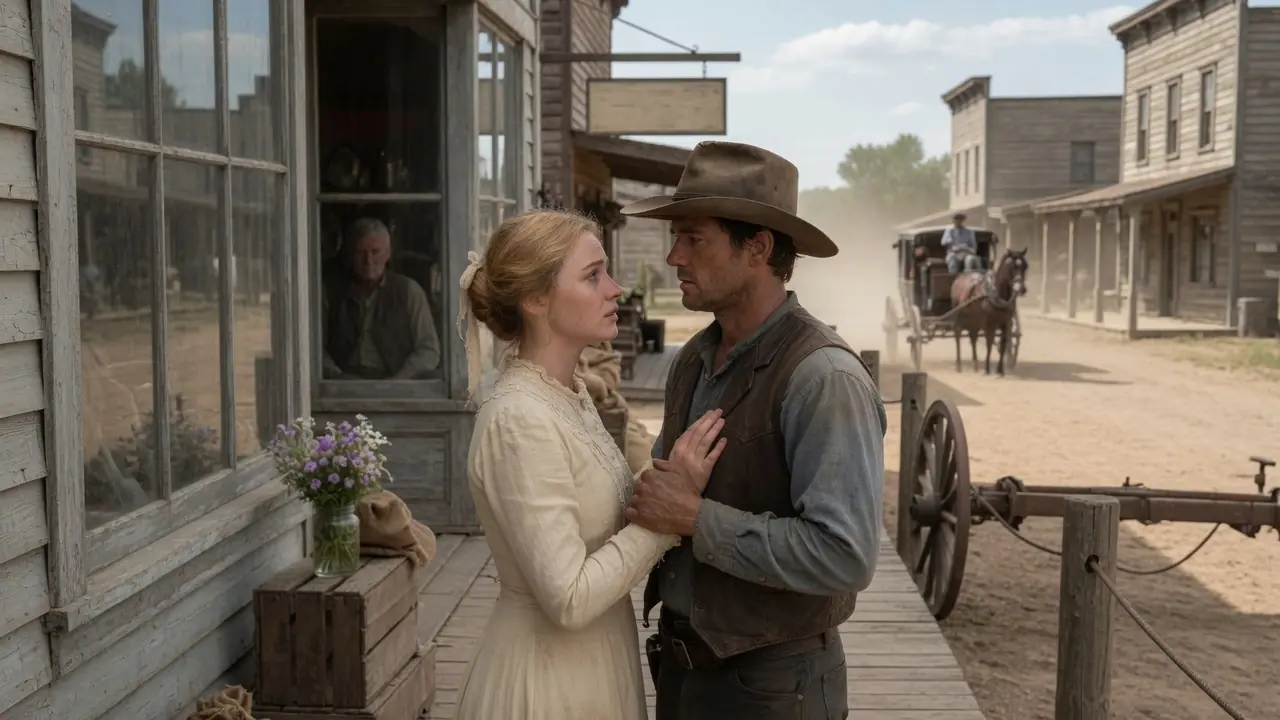
“Will Hadley,” she said softly, “I have been saving my heart for you for years.” His face changed as if the ground had shifted beneath him. “I just needed you to show up.” She placed one hand against his chest, feeling his heart beat hard beneath her palm. “Do not make me wait anymore.”
For a moment, Will did not move. Then he took her hand carefully, as if something so long hoped for might vanish if handled too quickly. His thumb brushed over her fingers, and the tenderness of it broke the last of her restraint. She looked up at him, tears bright but unshed.
In the distance, a black carriage appeared on the road into town. Rose saw it over Will’s shoulder, and so did he when her gaze shifted. Edward Marsh had arrived. The moment that had been private was about to become public.
Will turned toward the carriage, then back to Rose. Fear crossed his face, but this time it did not stop him. “Do you want me to leave?” he asked. Rose shook her head once. “No,” she said. “I want you to stand beside me.”
The carriage rolled closer, wheels stirring dust along Main Street. Edward Marsh stepped down with the controlled patience of a man who expected the world to arrange itself properly. He wore a dark coat despite the heat, his hat clean, his boots polished, and his face unreadable. His eyes moved from Rose’s hand in Will’s to Rose’s face.
“Miss Callahan,” Edward said, removing his hat. Then, after a measured pause, “Hadley.” Will nodded. “Mr. Marsh.” The street had begun to notice them now, though no one approached. Crestfall loved nothing more than pretending not to stare at something everyone was absolutely staring at.
Edward’s gaze returned to Rose. “I came to speak with your father.” His voice remained calm, but the meaning was clear. Rose lifted her chin. “About me.” Edward did not insult her by denying it. “Yes.”
Will’s hand remained steady around hers. Rose felt its warmth and drew courage from it. “Then I should answer before Papa is asked anything.” Edward watched her closely. “I would not have pressed without your agreement.”
“I know,” Rose said. “You are an honorable man.” Edward’s expression softened by a fraction. “But my answer would be no.” The words settled over the street like the stillness before rain.
Edward looked at Will then, not with hatred, but with understanding that arrived too late for his purposes. “Because of him.” Rose did not look away. “Because of my own heart.” Will felt that sentence go through him like grace. He had almost lost this woman, and she was still giving him more dignity than he deserved.
Edward nodded slowly. For a moment, Rose thought she saw pain cross his face, quickly hidden behind composure. “Then I wish you happiness,” he said. He turned to Will. “Do not waste what she has given you.” Will answered quietly, “I do not intend to.”
Edward returned to his carriage with no scene, no threats, and no wounded pride turned cruel. That made Rose respect him even more, though it did not change her heart. When the carriage rolled away, the town exhaled. Somewhere, a door closed too loudly because someone had been leaning out to watch.
Rose and Will stood beside the general store steps, still holding hands. Daniel Callahan appeared in the doorway, wiping his hands on a cloth though there was nothing on them. His gaze moved from Rose to Will to the disappearing carriage. “Well,” he said mildly, “that was a busy afternoon.”
Rose laughed then, a small breathless laugh that sounded half like relief. Will looked at Daniel with the seriousness of a man about to step into the rest of his life. “Mr. Callahan,” he said, “I would like permission to come calling on your daughter properly.” Daniel pretended to consider this very carefully.
“You may,” Daniel said. “Though you are late by several years.” Rose covered her mouth, and Will turned red beneath his tan. “Yes, sir,” he said. “I know.” Daniel stepped aside and muttered, “Good. Knowing is a start.”
The next morning, Will arrived at the general store with wildflowers gathered from beyond the creek. They were uneven, sun-touched, and far more beautiful to Rose than any arranged bouquet could have been. He had combed his hair, worn his best shirt, and looked as if he had spent half the night deciding how to stand on a porch. Rose put the flowers in a glass jar by the counter without explaining them to anyone.
“You know,” she said, “most men bring flowers before they confess love in the street.” Will looked at the jar, then back at her. “I am learning the proper order late.” She smiled, the real smile, the one that had always been his without his knowing. “Then you had better keep learning.”
Their courtship became the most discussed matter in Crestfall by the end of the week. Will came to Sunday supper and helped Daniel stack flour afterward without being asked. Rose and Will walked after church, rode along the ridge, and spoke with an honesty that made all their old conversations feel newly lit. They did not become different people; they became what they had always been, only truthful.
On a September afternoon, they rode to the ridge above the valley. The grass had turned gold, the mountains stood blue in the distance, and the whole county lay below them like a map of everything they had almost missed. Will tied the horses and sat beside Rose beneath a cottonwood. For a long time, they simply watched the light move over the land.
“Why me?” Will asked at last. Rose turned toward him. “You ask that as if you are a poor choice.” “There were richer men,” he said. “Men with better houses, better prospects, better words.”
Rose smiled faintly. “Every other man showed me something. Land, money, confidence, ambition.” She picked a blade of grass and rolled it between her fingers. “You simply showed up the same every time. Honest, steady, kind, and never trying to impress anyone.” She looked at him fully. “I always knew who you were. That is rarer than people think.”
Will lowered his head, humbled in a way that had nothing to do with shame. “Marsh could have given you a fine life.” “Yes,” Rose said. “But I did not want a fine life beside the wrong man.” She took his hand. “I waited for you, Will. Not because I had no choice, but because you were the choice.”
He kissed her hand first. It was a gentle, almost reverent thing, and Rose felt the years of waiting soften into something warm instead of painful. Then he leaned closer and kissed her properly, not with urgency, but with the quiet wonder of a man who understood how near he had come to losing her. The wind moved through the grass around them, and Rose closed her eyes. For the first time in years, she was not waiting.
In October, after the harvest social, Will stopped Rose outside the general store beneath a sky just beginning to sharpen with cold. He had carried his grandmother’s ring for two weeks, waiting for a moment that felt honest rather than staged. The street was nearly empty, and the store windows glowed behind them. Rose knew from the look on his face that something important was coming.
“I need to say this plainly,” Will began. “Because I was unclear for too long, and you deserved better.” Rose folded her hands to keep them from trembling. “I love you, Rose Callahan. I know it now the way I know the strongest things in my life. If you are willing to marry a man who was slow but intends to spend every day making up for lost time, I would be honored beyond words.”
Rose looked at him for one long moment. “Will Hadley,” she said, “you may be the least poetic man in Wyoming.” His mouth twitched. “I feared that might be true.” She stepped closer, eyes bright. “Yes.”
He placed the ring on her finger with hands that shook. Rose looked down at the simple gold band and felt not surprise, but recognition. It was not grand, not polished, not something meant to impress the town. It was his, and now it was hers, and that was enough.
They married in November before the first hard snow. The church was full, partly because people loved them and partly because half the town felt personally responsible for the match. George Alcott sat in the third pew, looking suspiciously moved for a man who claimed romance was a poor use of public attention. Edward Marsh did not attend, but he sent a pair of fine horses as a wedding gift with a note wishing them a strong life.
Rose wore her mother’s dress, altered at the waist, and walked toward Will with the calm certainty of a woman arriving where she had always meant to go. Will watched her come and understood, all at once, how close he had come to spending his life beside an emptiness he would not have been able to name. He thought of every Wednesday morning, every smile, every chance he had nearly wasted. When she reached him, he took her hand like a vow before the vows had even begun.
The years that followed were built from work, laughter, ordinary disagreements, and the steady gladness of coming home to someone who truly saw you. Rose helped with the livery accounts and discovered within a month that Will had been undercharging half the county out of kindness. She corrected the prices with brisk efficiency, and Will did not argue. He had already learned that Rose was usually right in matters involving sense.
Their son Thomas was born in the second year, patient and serious like Will. Their daughter Eliza arrived two years later, sharp-eyed and funny like Rose. The house grew louder, messier, and more alive than Will had ever imagined it could be. Some evenings, he stood at the gate after work just to listen before going inside.
One summer evening, six years into their marriage, Rose was hanging laundry in the yard when Will came home dusty from the livery. He stopped at the gate and watched her in the gold light. She noticed him and smiled over her shoulder. “You are staring.”
“I know,” he said. “You used to never stare,” she teased. He crossed the yard, took the laundry basket from her hands, and set it down. “I used to not know what I was looking at,” he said. “I have corrected that.”
Rose stepped into his arms, resting her head against his chest while the children argued inside over some very serious matter involving a wooden horse. Will pressed his lips to her hair. “I see you,” he whispered. She did not ask what he meant. She had always known.
Years later, Eliza asked her mother how she had known Papa was the one before he knew it himself. Rose was making pie dough, and the question came while flour dusted both their hands. She thought of Edward Marsh, of the carriage rolling toward town, of Will’s hand holding hers at the very last possible moment. She smiled softly.
“He never performed anything,” Rose said. “He simply showed up as himself.” Eliza frowned. “But you almost married Mr. Marsh.” Rose nodded because daughters deserve the truth. “Almost matters. That is the part you remember.”
“What does it mean?” Eliza asked. Rose covered her daughter’s hands on the rolling pin. “It means know what you want, speak the truth, and give the right person a chance to show up.” She paused. “But never wait forever for someone who will not walk toward you.”
Rose had waited, but not passively. She had lived, worked, loved her family, and held her heart with dignity until the moment came to speak plainly. Will was not a hero because he loved her; love had been there long before courage arrived. He became worthy of the love when he finally chose to stand beside it.
And that is what Crestfall remembered. Not just that a powerful rancher came to marry Rose Callahan and discovered her heart belonged to the stableman. Not just that Will Hadley finally woke up before it was too late. The town remembered the afternoon on Main Street when love stopped waiting in silence and became brave enough to be seen.
Because sometimes the life meant for you is standing close enough to touch.
But it still has to be chosen.
And chosen in time.