The Gentleman’s Thread occupied the third floor of the most exclusive shopping center in the city.
Everything inside the store seemed designed to remind visitors that ordinary people did not belong there.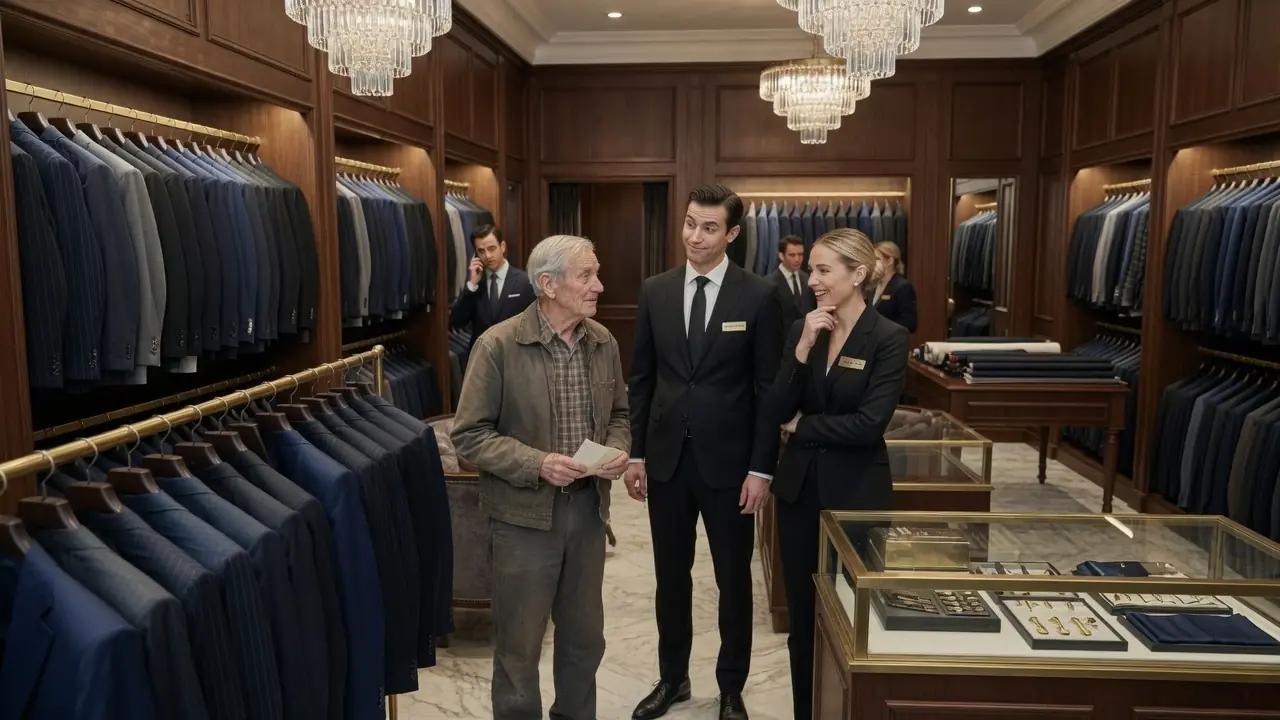
Crystal chandeliers hung from the high ceiling. Brass fixtures gleamed beneath soft white lights. The walls were lined with dark walnut, and the air carried the scent of expensive cologne, polished leather, and freshly pressed wool.
The least expensive suit cost nearly two thousand dollars.
Some of the custom pieces cost more than the cars parked outside.
The sales associates wore fitted black suits and silk ties. Their shoes shone like mirrors, and their smiles appeared only when a customer looked wealthy enough to deserve one.
At ten twenty on a rainy Thursday morning, the elevator doors opened.
An elderly man stepped out.
He was thin, slightly stooped, and perhaps seventy-five years old. Rain darkened the shoulders of his oversized brown jacket. His gray trousers had been carefully pressed, but one knee had been repaired with mismatched thread.
His shoes were polished.
The cracked leather and separating soles made it clear that polish could no longer hide their age.
In one hand, he carried a wooden cane.
In the other, he held a worn paper envelope.
The man stopped outside The Gentleman’s Thread and looked through the glass.
For several seconds, he studied the mannequins dressed in navy and charcoal suits.
Then he removed his cap, wiped the rain from it with his sleeve, and entered.
The first associate to notice him was Preston Vale.
Preston was twenty-six, ambitious, and proud of the small gold pin identifying him as a senior sales consultant. He had worked in the store for less than a year but already carried himself as though the building belonged to him.
His eyes moved immediately toward the old man’s shoes.
Then the patched trousers.
Then the envelope.
The welcoming smile disappeared before it fully formed.
“Can I help you?”
The elderly man nodded.
“Yes, son. I need a new suit.”
A second associate, Miles Corbett, glanced over from the tie counter.
He looked at Preston and raised one eyebrow.
Preston folded his hands in front of him.
“What kind of suit?”
“Something dark.”
The old man looked toward the displays.
“Simple. Proper.”
“For what occasion?”
The man hesitated.
“A ceremony.”
“A wedding?”
“No.”
“A funeral?”
His fingers tightened around the envelope.
“No.”
Preston waited for more.
The man did not explain.
“Our suits start at eighteen hundred dollars,” Preston said.
The old man nodded slowly.
“I was told they were expensive.”
“We also offer custom tailoring, but that costs considerably more.”
“That might be what I need.”
Miles covered a laugh by pretending to clear his throat.
The old man heard him.
He looked toward the associate but said nothing.
Preston stepped slightly into the aisle, blocking access to the main displays.
“There are several department stores on the lower level.”
“I saw them.”
“They have more affordable options.”
The man’s expression remained polite.
“I came here.”
Preston glanced at the damp jacket again.
“This is a luxury tailoring house.”
“I can read the sign.”
Miles laughed openly this time.
A businessman examining cuff links turned toward them.
A woman seated near the fitting rooms lowered her phone.
The old man removed his cap completely.
“I was hoping someone could measure me.”
Preston sighed.
“What is your budget?”
“I brought what I have.”
“How much is that?”
He approached the counter and opened the envelope.
Inside were folded bills.
Twenties.
Tens.
A few fives.
The man began counting.
His hands trembled slightly.
“One hundred.”
He placed the money carefully on the polished surface.
“Two hundred.”
Miles leaned against the counter.
Preston looked toward him and smirked.
“Three hundred.”
The old man continued.
Each bill was flattened before being added to the pile.
When he finished, the total was eight hundred and forty-six dollars.
He looked up.
“This is what I have today.”
Miles laughed.
The sound echoed through the quiet store.
Preston did not laugh as loudly, but he did not stop him either.
The old man’s face reddened.
Preston pushed the bills gently back across the counter.
“I’m afraid that will not buy a suit here.”
“Not even one from last season?”
“No.”
“Could I pay part now and the rest later?”
“We do not offer payment plans.”
The old man nodded.
“I understand.”
He looked toward the suits again.
“Could I at least see one?”
Miles shook his head.
“Why?”
The old man turned.
Miles gestured toward the racks.
“These are handmade garments. Italian wool. Full-canvas construction.”
He looked at the patched knee.
“They’re not costumes people try on for entertainment.”
The woman near the fitting room stood.
“That was unnecessary.”
Miles looked toward her.
“We are only explaining store policy.”
“It sounded like mockery.”
Preston intervened.
“Ma’am, we are trying to save everyone’s time.”
The woman folded her arms.
“Whose time?”
The old man raised one hand.
“Please. I don’t want trouble.”
He gathered his money slowly.
Preston watched him place the bills inside the envelope.
The man turned toward the entrance.
Then he stopped.
“One last question.”
Preston waited.
“Do you have a dark blue suit?”
“Yes.”
“Could I see it?”
Preston looked toward Miles.
Then he walked to a display near the private fitting area.
He selected one of the most expensive suits in the store.
The price tag read $4,800.
“This is midnight-blue,” Preston said.
The old man touched the sleeve with the tips of his fingers.
The fabric was smoother than anything he had worn in decades.
“It’s beautiful.”
“Super 150s wool.”
The man nodded as if the words meant something to him.
“Could I try it on?”
Preston looked at the rain-darkened jacket.
“The private fitting rooms are reserved for customers prepared to purchase.”
The old man slowly removed his hand from the sleeve.
“I am prepared.”
“You have eight hundred dollars.”
“Eight hundred and forty-six.”
Miles laughed again.
This time, no one else moved.
The old man lowered his eyes.
“I’m sorry I bothered you.”
He placed his cap back on his head.
At that moment, a door opened near the rear office.
Evelyn Cross, the store manager, stepped into the showroom.
She was fifty-eight, with silver-streaked hair and the calm posture of someone who never needed to raise her voice to command attention.
Her gaze moved across the store.
The money being returned to the envelope.
The expensive suit in Preston’s hand.
The old man walking toward the door.
Then she saw his face.
“Mr. Dalton?”
The old man stopped.
Evelyn hurried toward him.
“Henry Dalton?”
“Yes, ma’am.”
Her expression transformed.
“Oh, thank goodness. We’ve been waiting for you.”
Preston froze.
Miles straightened.
Henry looked confused.
“You have?”
“Of course.”
Evelyn took both his hands.
“You were expected earlier, but with the rain, I assumed you might be delayed.”
“I didn’t know anyone was expecting me.”
“That was supposed to be part of the surprise.”
Her eyes moved toward the envelope.
“What happened?”
Preston answered quickly.
“We were discussing Mr. Dalton’s budget.”
Miles added, “He wanted a custom suit.”
Evelyn looked at Henry.
“Did they assist you?”
Henry hesitated.
His silence answered.
The woman who had defended him spoke from across the room.
“They laughed at him.”
Evelyn turned.
“Excuse me?”
“They laughed when he counted his money.”
The businessman near the cuff links nodded.
“They also refused to let him try on a suit.”
Preston’s face lost color.
Evelyn looked at him.
“Is that true?”
“He could not afford the item.”
“That was not my question.”
Preston swallowed.
“Yes.”
Evelyn turned toward Miles.
“And you mocked him?”
Miles looked down.
“I made a joke.”
“A joke requires someone else to find it amusing.”
No one spoke.
Henry stepped closer.
“Please, ma’am.”
Evelyn looked at him.
“I don’t want anyone losing a job because of me.”
“This is not because of you.”
She faced the associates.
“It is because of their choices.”
Henry lowered his voice.
“I only need a suit.”
“And you will have one.”
Evelyn placed a gentle hand on his arm.
“Come with me.”
She led him toward the private fitting salon.
The room had leather chairs, a raised platform, and a three-way mirror normally reserved for politicians, professional athletes, and executives who spent more in one visit than Henry had saved in months.
Evelyn stopped at the doorway.
“Preston. Miles.”
Both men looked up.
“You will join us.”
Henry removed his wet jacket.
Beneath it, he wore a faded white shirt. The collar had been repaired by hand, and the cuffs were worn thin.
A small metal pin rested above his left breast.
Preston saw the words engraved beneath a shield and star.
CITY FIRE DEPARTMENT
FORTY YEARS OF SERVICE
His stomach tightened.
Evelyn took Henry’s measurements herself.
She wrapped the tape around his chest.
“Thirty-nine inches.”
Then his waist.
“Thirty-six.”
She knelt to measure the length of his trousers.
The manager of the most prestigious menswear store in the city worked without hesitation while her employees stood in silence.
When she finished, she brought three suits.
One black.
One charcoal.
One midnight-blue.
Henry tried the charcoal suit first.
It made him look pale.
The black suit fit better but seemed too severe.
Then he stepped from the dressing room wearing the blue one.
The room fell quiet.
The jacket followed the line of his shoulders perfectly. The deep blue fabric brought warmth to his weathered face.
Henry turned toward the mirror.
For several seconds, he did not speak.
Then his eyes filled.
“My wife would have liked this one.”
Evelyn smiled.
“I think she would have loved it.”
Henry touched the lapel.
“She always said blue made me look less tired.”
“When did she pass?”
“Twenty-two years ago.”
“I’m sorry.”
He nodded.
“I still hear her opinions when I buy clothes.”
Evelyn marked the sleeves for shortening.
“Then we should listen to her.”
Henry smiled faintly.
Preston looked away.
The man he had dismissed was no longer simply an old customer in worn clothing.
He was a widower remembering a woman he still loved.
Evelyn selected a white shirt and a burgundy tie.
Henry’s breath caught.
“My son wore that color.”
Evelyn paused.
“Is he attending the ceremony?”
Henry looked toward the mirror.
“He died twelve years ago.”
The room became still again.
“I’m sorry,” Preston said before he could stop himself.
Henry turned.
“Thank you.”
There was no anger in his voice.
That somehow made Preston feel worse.
Evelyn stepped back.
“The suit will be ready tomorrow morning.”
Henry looked at the price tag.
“I cannot afford it.”
“You are not paying for it.”
His expression changed immediately.
“No.”
“Mr. Dalton—”
“I did not come for charity.”
“This is not charity.”
Evelyn looked toward Preston and Miles.
“It was arranged before you arrived.”
Henry frowned.
“By whom?”
“The mayor’s office.”
He stared at her.
Evelyn continued.
“Tomorrow, the city is presenting you with the Medal of Civic Courage.”
Preston lifted his head.
Miles’s mouth opened slightly.
Henry looked uncomfortable.
“They told me it was only a small ceremony.”
“It has become much larger.”
Evelyn helped him remove the jacket.
The truth had been known to city officials for weeks.
Henry Dalton had served the fire department for forty-one years.
He entered the profession at twenty-one and retired at sixty-two.
During his career, he responded to apartment fires, factory explosions, floods, chemical leaks, highway accidents, and wildfires.
He had been injured six times.
He received eleven official commendations.
He had carried children from burning homes and stayed beside dying strangers so they would not spend their final minutes alone.
But the city was not honoring him for what he had done in uniform.
Three weeks earlier, Henry had been walking home from a discount grocery store when he noticed smoke pouring from the windows of an apartment building.
People stood outside screaming that a six-year-old boy remained trapped upstairs.
The fire department had been called.
The engines were still several minutes away.
Henry was seventy-four.
He had arthritis in both knees and a heart condition.
He entered the building anyway.
He wrapped his jacket around his mouth, climbed the smoke-filled stairs, and found Oliver Grant hiding inside a bedroom closet.
Part of the hallway ceiling collapsed as Henry carried the child toward the stairs.
He shielded Oliver with his own body.
Both survived.
Henry spent five days in the hospital with burns across his back and arm.
When reporters called him a hero, he refused interviews.
“The child needed help,” he said.
“That’s all.”
The mayor asked whether Henry wanted anything before the ceremony.
He repeatedly answered no.
Then Oliver’s mother discovered he planned to wear the same old suit he had purchased for his wife’s funeral.
The lining was torn.
The sleeves no longer fit.
Water damage had ruined one shoulder.
She contacted Evelyn.
The city offered to pay for a new suit.
Henry refused.
So they created another plan.
He would visit The Gentleman’s Thread, choose a suit, and be told afterward that the cost had already been covered.
The morning staff received a note that an honored guest named Henry Dalton would arrive.
Preston and Miles had not read it carefully.
Even if they had, the point remained the same.
They should not have needed his history before treating him with dignity.
Evelyn turned toward them.
“This is the man you laughed at.”
Neither answered.
Henry looked toward the paper envelope.
“I still want to pay something.”
“You saved that money for the suit?”
“Yes.”
“How long?”
“Seven months.”
Preston stared at the envelope.
Seven months.
The wrinkled bills they mocked had come from careful choices.
Skipped meals.
Delayed repairs.
Small sacrifices made by a man living on a pension.
Evelyn handed the envelope back.
“Keep it.”
Henry shook his head.
“I cannot accept the suit without paying.”
“Then we’ll find another use for it.”
He thought for a moment.
“Oliver’s mother started an education account for him.”
“She did.”
“Put the money there.”
Evelyn smiled.
“You want to donate all of it?”
Henry nodded.
“I was going to spend it on myself anyway.”
Preston lowered his eyes.
The poor man he assumed wanted charity had just given away seven months of savings to a child he had already risked his life to save.
Evelyn placed the envelope safely inside the office.
Then she turned toward her employees.
“Come with me.”
Inside her office, she closed the door.
For several seconds, she allowed silence to fill the room.
Preston spoke first.
“I made a mistake.”
“No.”
Evelyn sat behind her desk.
“You made several decisions.”
He looked at her.
“You decided his clothing told you the value of his time.”
She turned toward Miles.
“You decided his embarrassment was entertainment.”
Miles swallowed.
“I’m sorry.”
“To whom?”
“Mr. Dalton.”
“You will tell him.”
“Yes.”
“But an apology is not enough.”
Preston nodded.
“It won’t happen again.”
“How do you know?”
He looked confused.
Evelyn leaned forward.
“Ten minutes ago, you believed your judgment was correct.”
Neither man answered.
“Learning Henry Dalton is a hero does not solve the problem.”
She pointed toward the showroom.
“The next man may not have a medal.”
Her voice remained controlled.
“He may be unemployed. He may be lonely. He may have made terrible mistakes. He may have accomplished nothing the city considers important.”
She paused.
“He still deserves to enter a store without being humiliated.”
Miles looked toward the floor.
“Are you firing us?”
“You are suspended for the rest of today.”
Preston exhaled slightly.
Evelyn noticed.
“Tomorrow morning, you will report at six.”
“For the ceremony?”
“No.”
She folded her hands.
“You will clean the store with the maintenance team.”
Miles looked up.
“Clean?”
“You will mop the floors, polish the mirrors, empty waste bins, and prepare the fitting rooms.”
Neither man moved.
“You have spent too much time believing certain work belongs to people beneath you.”
Evelyn’s eyes hardened.
“Tomorrow, you will learn whose hands make this store look expensive.”
When Henry prepared to leave, Preston approached him near the elevator.
“Mr. Dalton.”
Henry stopped.
Preston’s confident posture had disappeared.
“I owe you an apology.”
Henry waited.
“I laughed at you.”
“Yes.”
“I refused to help because I assumed you could not afford anything here.”
“Yes.”
Preston swallowed.
“I was wrong.”
Henry studied him.
“You were wrong before your manager told you who I was.”
“I understand.”
“No.”
Henry placed the cap on his head.
“You understand that I’m receiving a medal.”
His voice was quiet.
“The question is whether you would be sorry if I were still only an old man with eight hundred dollars.”
The elevator doors opened.
Preston had no answer.
Henry stepped inside.
“That is something you should think about.”
The doors closed.
At six the next morning, Preston and Miles arrived at the shopping center.
The mall was dark.
Without the chandeliers, the store looked less magical.
Dust rested beneath the display tables. Fingerprints covered glass surfaces. Threads and tags collected beneath fitting-room benches.
A maintenance supervisor named Carlos Vega gave them gloves and cleaning supplies.
Miles held the mop awkwardly.
“I’ve never used one.”
Carlos looked at him.
“There’s a first time for every skill.”
They cleaned for four hours.
Preston’s back began aching after the first.
Miles complained about the chemicals.
Carlos did not respond.
A woman named Lydia arrived to empty waste bins.
Preston had seen her nearly every morning for eleven months.
He had never asked her name.
“How long have you worked here?” he asked.
Lydia looked surprised.
“Nine years.”
Preston glanced around the store.
Every polished surface had passed through her hands.
“Thank you.”
She studied him for a moment.
Then she nodded and returned to work.
By noon, the mall’s main atrium had been transformed.
Rows of chairs faced a raised stage. Firefighters in dress uniforms lined the front. City officials, reporters, former colleagues, and residents filled every level of the shopping center.
A banner displayed Henry’s name.
Preston expected a small gathering.
More than eight hundred people arrived.
The elevator doors opened.
Henry stepped out wearing the midnight-blue suit.
The burgundy tie rested neatly beneath his collar.
His old fire-service pin remained above his heart.
Oliver Grant walked beside him holding his hand.
When the crowd saw them, everyone rose.
Applause rolled through the atrium.
Henry stopped.
He looked overwhelmed.
Oliver tugged on his hand.
“They’re clapping for you.”
Henry looked down at the boy.
“No, son.”
He smiled.
“They’re happy you’re here.”
Preston heard the answer.
Even now, Henry refused to claim the moment.
Mayor Caroline Wells approached the podium.
She described Henry’s years of service.
The fires.
The rescues.
The lives he had touched.
Then Oliver’s mother stepped forward.
“Three weeks ago, I watched smoke pour from my son’s bedroom window.”
Her voice trembled.
“The fire department was coming, but I believed Oliver would be gone before they arrived.”
She looked at Henry.
“This man did not know my family.”
“He did not ask whether anyone would reward him.”
“He only heard that a child was inside.”
Oliver leaned closer to Henry.
“And he went.”
The mayor placed the Medal of Civic Courage around Henry’s neck.
The applause lasted nearly two minutes.
Afterward, people formed a long line to speak with him.
A woman in her forties held out an old photograph.
“You carried me out of an apartment fire when I was three.”
Henry studied the picture.
“I remember the building.”
“You don’t remember me?”
“You were smaller then.”
She laughed through tears and hugged him.
An elderly man stepped forward.
“You found my wife during the flood of 1987.”
A former paramedic embraced him.
“You kept pressure on my wound after the warehouse roof collapsed.”
Story after story emerged.
Henry seemed surprised by each one.
Preston watched from the edge of the crowd.
The cracked shoes and worn jacket had never hidden Henry’s worth.
They had only hidden it from people who believed worth had a dress code.
After the ceremony, Henry returned to the store.
Oliver came with him.
Evelyn handed Henry a receipt showing that his eight hundred and forty-six dollars had been transferred into the boy’s education account.
Henry folded it carefully.
“Thank you.”
Preston approached carrying a small box.
“This is for you.”
Henry opened it.
Inside was a pair of comfortable black leather shoes.
They were not the most expensive pair in the shop.
But they were sturdy.
Practical.
Chosen with care.
“I paid for them,” Preston said.
Henry looked at him.
“I know a gift doesn’t erase what I did.”
“No.”
“I noticed your shoes were separating.”
Henry looked down.
“You pay more attention now.”
“I’m trying.”
Henry touched the new leather.
“They are very nice.”
“You can exchange them if they don’t fit.”
“You measured my feet yesterday.”
Preston looked surprised.
“You noticed?”
Henry smiled faintly.
“I notice more than people assume.”
He accepted the shoes.
“Thank you.”
Preston nodded.
Henry looked toward Oliver, who was examining a row of ties.
“Do you remember what I asked before I left?”
“The next man might not have a medal.”
“Yes.”
Preston straightened.
“I’ll remember.”
Henry shook his head.
“Remembering is not the hard part.”
“What is?”
“Choosing differently when no one important is watching.”
Three months later, Preston began volunteering one morning each week at a community clothing center operated by the mall.
The center provided formal clothing to people preparing for interviews, funerals, court appearances, graduations, and weddings.
At first, he treated the assignment as punishment.
Then he began meeting people.
A father who lost everything in a house fire needed a suit for his daughter’s wedding.
A teenager needed one for a scholarship interview.
A widower needed a jacket for his wife’s funeral.
A man recently released from prison needed clothing for his first job interview in twelve years.
None of them cared about imported wool.
They cared about standing upright during moments when life had made them feel small.
Preston began to understand that clothing was not always vanity.
Sometimes it was armor.
Sometimes dignity.
Sometimes a final goodbye.
Miles quit after two weeks.
He said the store no longer felt right for him.
Evelyn did not try to stop him.
Preston stayed.
He learned the names of every cleaner and maintenance worker.
He stopped judging customers by their shoes.
And whenever someone entered looking uncertain, he asked the same question.
“What are we helping you prepare for?”
One year after the ceremony, Henry returned to The Gentleman’s Thread.
He wore the midnight-blue suit.
It still fit perfectly.
Preston smiled when he saw him.
“Mr. Dalton.”
Henry removed his cap.
“I need a tie.”
“For another award?”
“No.”
His expression softened.
“Oliver is being adopted by his aunt.”
“What color does he want?”
“Green.”
Preston brought several options.
He did not begin with price.
Henry selected a deep forest-green tie.
Then he placed a photograph on the counter.
It showed Henry and Oliver at the medal ceremony.
On the back, the boy had written:
TO MR. HENRY,
THANK YOU FOR COMING INSIDE.
Preston read the words twice.
Henry looked around the store.
“The suit did what I needed.”
“What was that?”
“It helped me stand in front of all those people without feeling like I should hide.”
Preston lowered his eyes.
“I’m sorry we made you feel like you should.”
Henry nodded.
“I know.”
“Do you forgive me?”
The old man considered the question.
“I think memory may be more useful than forgiveness.”
Preston looked at him.
“Remember what happened.”
Henry picked up the tie.
“Then make sure another person never needs a medal before you see him.”
Years later, employees still told the story of the rainy morning Henry Dalton entered carrying eight hundred and forty-six dollars inside a paper envelope.
Some remembered the packed ceremony.
Others remembered the rescued child.
Preston remembered something quieter.
Henry standing before the three-way mirror in the midnight-blue suit.
For the first time that morning, the old man had lifted his shoulders.
He did not look richer.
He did not look younger.
He simply looked like himself again.
A widower.
A father.
A firefighter.
A man who had spent a lifetime running into places other people were fleeing.
The Gentleman’s Thread had been filled with expensive fabric, polished brass, and crystal light.
But the most valuable person in the store arrived wearing cracked shoes.
The staff laughed because they believed dignity belonged only to those who could afford it.
By the end of the day, they understood the truth.
Henry had carried dignity through the doors with him.
They were the ones who had failed to recognize it.