She had $212 in her bank account. The roof was leaking. The mortgage was overdue. And 20 soaking wet strangers just walked through her door in the middle of the worst storm Harlan had seen in years. She could have turned them away. She could have apologized, pointed to the weather, blamed the hour. Instead, Carol Hendricks did something that made no financial sense whatsoever, and it changed everything. Not because of luck, not because of charity, but because of something that moved like electricity through 400 strangers online, and then 600 real people through one small door on Route 119 by morning. What she did that night nobody saw coming, least of all her. 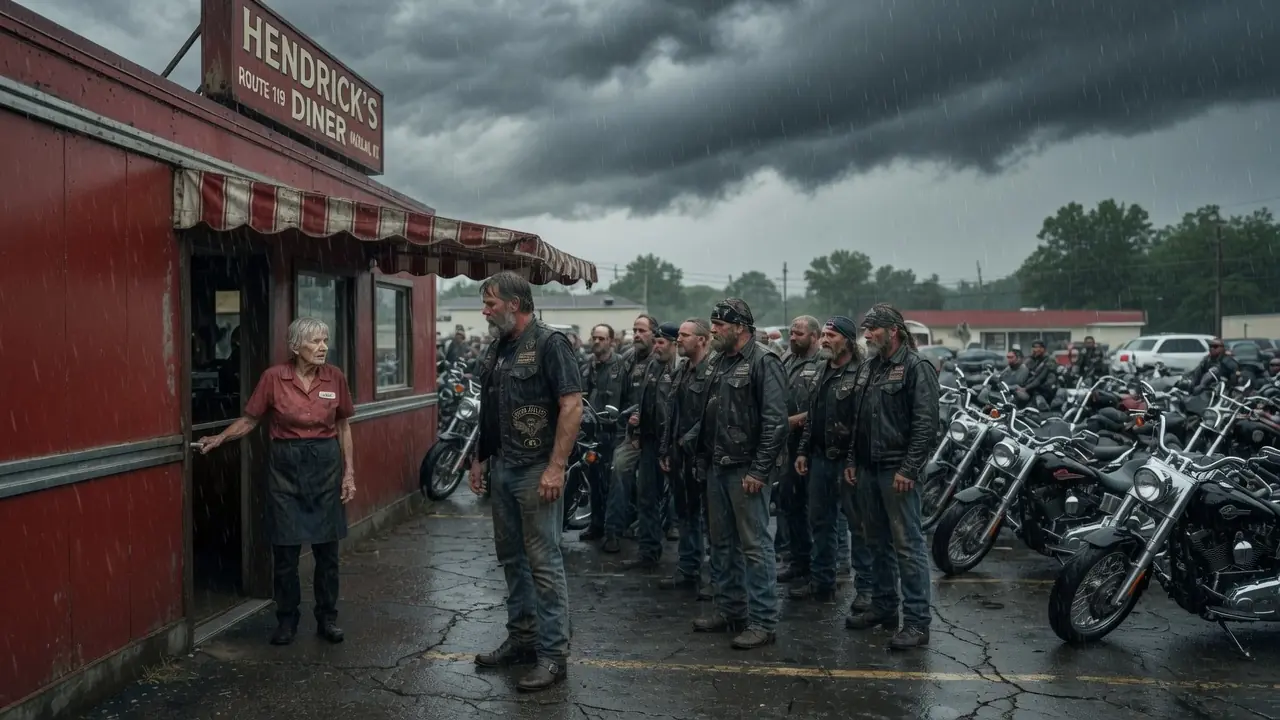
The storm hit Harlan before the 5:00 news. Carol Hendricks felt it coming long before the first crack of thunder split the October sky. She'd lived in this corner of Kentucky long enough to read the air, the way it thickened and went copper-colored at the edges, the way the leaves on the old oak across Route 119 turned their pale bellies upward like open hands asking for mercy. She'd wiped down the counter at Hendricks Diner three times already, which was what she did when she was anxious and couldn't sit still. You're going to rub the laminate right off that thing, Sandra called from the kitchen, her voice carrying easy over the hiss of the grill. Better the counter than my nerves, Carol said.
She wrung the rag out in the sink beneath the counter and hung it on the hook she'd installed herself eight years ago, the same summer her husband Ray had left and she'd decided that if she was going to run this place alone, she was going to do it her way. The hook was slightly crooked. She'd never fixed it. Some things you just learn to live around. The diner sat at the bend where Route 119 curved south toward Cumberland. It was a squat rectangular building with a flat roof that leaked when the rain came in sideways and a neon sign out front that said Hendrix Diner in red letters, the apostrophe long since burned out so it just read Hendrix Diner, which Carol had accepted as a kind of editorial comment on her life. The windows were large and steamed easily in cold weather. Right now, they showed nothing but a darkening sky and the first fat drops of rain beginning to spot the parking lot asphalt.
It was a Thursday. Thursdays were always slow. She had three tables occupied, a retired couple sharing a slice of coconut cream pie, a truck driver named Gus who came through every other week and always ordered the same thing, and a teenager doing homework in the corner booth nursing a Coke he'd been working on for 40 minutes. The register had seen $62 since noon. Carol was 50 years old. She knew exactly what $62 meant in the context of a day like this. It meant the gas bill, half of it.
The thunder cracked again, closer. Carol. Sandra appeared in the kitchen doorway, drying her hands on a dish towel. She was watching the window. You seeing this? Carol turned. Through the rain-streaked glass, she saw them. Headlights first, a long chain of them appearing around the southern bend like a procession of slow-moving fireflies. Then the sound reached her even through the walls and the storm. The deep, rolling growl of motorcycle engines, 20 or more of them, riding in tight formation. They moved with the kind of disciplined precision that told Carol these weren't kids on a joy ride. These were people who'd been riding together a long time.
They pulled into her lot in two organized rows, killed their engines almost simultaneously, and sat for a moment in the rain as if conferring. Then, one by one, they dismounted and moved toward her door. Carol reached for the counter rag, then remembered she'd already hung it up. The bell above the door rang once, twice, a dozen times. They came in shaking rain from their jackets and helmets, big men and a few women, most of them somewhere between 40 and 60, their leather vests dark with water. Carol counted without meaning to. Eight, 12, 16, 20. 20 riders. Several wore patches on their vests, a name she didn't recognize, a city she'd never been to, some kind of emblem she couldn't make out in the dim light.
The man who came in last was the tallest. He had a salt-and-pepper beard cropped close to a square jaw, and he moved through the doorway with a kind of unhurried authority, the way men move when they've stopped needing to prove anything to anyone. He looked around the diner once, taking in the space, the booths, the counter, the chalkboard specials, Carol standing behind the register with her hand resting on the ledger. His eyes, when they found hers, were an unremarkable shade of brown, but they were steady. Evening, he said. Name's Dale. We got caught in the weather. We'll take whatever you've got space for, and we don't need much. Just somewhere dry and something hot.
Carol looked at 20 people dripping on her floor. She looked at her register. She looked at the ledger. Sit wherever you find room, she said. Sandra, start a fresh pot. They pushed tables together without being asked, rearranging the diner with the practiced efficiency of people accustomed to making themselves fit in spaces not designed for them. The retired couple in the corner watched with wide eyes. The truck driver named Gus nodded at Dale Merritt the way men sometimes nodded at each other when they recognized something, a quality, a history, a kind of weathering. The teenager closed his notebook. Sandra came out of the kitchen with a tray of coffee mugs before the pot had finished brewing, distributing them with the cheerful competence of someone who'd been doing this her whole life and had made her peace with it.
Carol followed with the coffee, moving table to table, filling cups, listening to the rain hammer the flat roof above them. What's good here? asked a woman with cropped red hair and a tattoo of a compass on her forearm. Meatloaf, Carol said, Made it this morning. Then that's what I want. Same. said the man beside her. Same. echoed two more down the table.
Carol went back behind the counter and began writing the orders, but the conversations had already split and multiplied around the diner and people were calling things out. The meatloaf, the chicken pot pie, the soup, grilled cheese, fries, and she was writing fast the way she used to write when she was 25 and the diner was full every Friday night and Ray was working the grill and she hadn't yet learned what loneliness felt like from the inside. In the kitchen, Sandra had already pulled the remaining meatloaf from the warmer and was slicing it with the focused calm of a surgeon. How much we got? Carol asked. Sandra counted without looking up. Enough for maybe 12 full plates. After that, we can stretch with the soup and whatever's in the walk-in.
Carol did the math. 20 people, 12 full plates, a pot of soup that could serve six if she was careful, bread, butter, coffee, whatever was left in the pie case, half a coconut cream, a full apple, a small cherry that nobody had ordered all day. She leaned against the counter for a moment and closed her eyes. The numbers were simple. 20 people fed generously would come to somewhere between 200 and 280 dollars depending on how they ordered. She had enough food. She had enough coffee. What she did not have was any margin for a bill that didn't get paid, any cushion for a table that walked out or and this was the thought she turned over slowly, examining it, any reserve for what she already suspected was happening.
When she'd come back out with the first round of plates, she'd noticed Dale Merritt looking at the chalkboard where she listed the specials and then looking at her register and then looking at her. Not rudely, not prying, just noticing. The way perceptive people notice things when they're paying attention. She'd looked away first. Carol. Sandra's voice was low. You know we're not going to make anything tonight, right? After the food cost. I know. I mean if they order big Sandra. Carol set down the ladle she was holding and looked at her friend directly. It's a bad storm. They needed somewhere to come in. We're open. That's what being open means.
Sandra looked at her for a long moment. Then she picked up two plates and walked out to the floor. Carol served 20 people over the next 2 hours. She refilled coffee without being asked. She brought extra bread when the basket ran low. When the soup ran thin, she added the last of the chicken stock she'd been saving for Friday's special and brought it out in a tureen she almost never used, the one her mother had given her when she opened the place. The storm outside intensified. The lights flickered twice. The teenager in the corner booth who had not left was now watching the bikers with undisguised fascination, his homework long forgotten.
Dale Merritt caught Carol at the counter during a quiet moment. This is remarkable, he said nodding at the food. You do all this yourself? Sandra does the cooking, I do everything else. How long have you had this place? 18 years. She paused. 17 and a half. Opened in the spring. He nodded. He was looking at her the way he'd looked at her before, not intrusively, but with the full attention of someone who was genuinely interested in what they were seeing. It made her slightly uncomfortable, the way sincerity sometimes does when you're not used to receiving it. Place like this, he said, you must know everybody in Harlan. Most of them. She pulled the coffee pot from the burner. You want a refill? Please.
He held out his cup. And I'll have the bill whenever you're ready. She poured his coffee. She said nothing about the bill. Two hours later, when the storm had settled into a steady, exhausted rain, and Dale Merritt brought her a folded piece of paper, she assumed it was the group's order for dessert. She opened it at the counter away from the tables and found instead a handwritten note. We know what you did tonight. We won't forget it. DM. She turned back to the floor. The tables were empty. The diner was quiet. 20 people had eaten and left, and the register showed exactly what it had shown before they arrived, $62.
She stood at the counter for a long time after Sandra turned off the kitchen lights. Then she folded the note and put it in her apron pocket next to the ledger she hadn't opened and began to close up for the night. She drove home in the rain. Carol lived 6 minutes from the diner in a house that was technically hers, having survived the divorce proceedings through a combination of legal luck and Ray's guilt about leaving. It was a small house, two bedrooms, one bath, a kitchen with a window that faced east, so she got the morning light while she drank her coffee. She'd repainted it herself 3 years ago in a color called warm linen, which sounded like something from a hotel brochure, but turned out to be exactly the right shade of nothing wrong here for a house that had seen some things.
She parked in the driveway and sat in the car for a while with the engine off and the rain on the roof. The note was still in her apron pocket. She didn't take it out. Inside, she made decaf because it was past 9:00 and she needed to sleep. She sat at the kitchen table with the gas bill and the roof estimate and the business ledger open in front of her. And she went through the numbers the way you go through numbers when you've gone through them so many times that the act is less about finding new information and more about bearing witness to a truth you already know. The math was clear. If November was like October and there was no reason to think it wouldn't be, she would fall short on the mortgage by the end of the month. Not by much, but in the economy of small margins, not much was everything.
She could call the bank. She could ask for an extension. She had done this once before 2 years ago and the loan officer had been kind in the stiff, practiced way of someone doing his job well and she had hated every minute of the conversation. She closed the ledger. Outside, the rain was slowing. She could hear it changing from the hard, driving rhythm of a real storm to something gentler, residual, the kind of rain that didn't know yet it was almost over. She thought about the 20 people who'd sat in her diner tonight, their wet jackets steaming in the warmth, the way they'd talked across tables with the easy familiarity of people who'd been through things together. She thought about Dale Merritt's steady brown eyes and the way he'd said, We won't forget it. Like it meant something specific. She almost laughed at herself. She was 50 years old. She'd learn not to build things on notes from strangers. She went to bed at 10:15. She did not sleep well.
At 2:00 in the morning, she was awake, lying in the dark with the specific alertness of a mind that has found a worry it wants to work on. She thought about Sandra, who had worked tonight without complaint, and who Carol had not been able to give a full week's pay in 3 weeks. Sandra had not said anything about it. That was worse, somehow, than if she had. She thought about the roof, about the bypass, about what it would mean, practically, concretely, to close, where she would work, what she would do with the equipment, the furniture, the sign with its burned-out apostrophe, whether anyone would want the building, and what she would feel walking past it if someone else put their name on it. She thought about her mother, who had served coffee to miners and railroad workers for 30 years in a diner not unlike this one, in a town not unlike Harlan, and who had told Carol once, just once near the end, when the cancer had made her honest in ways she'd never been before, The only thing that was ever worth anything was when somebody needed something and you had it to give. At 3:40, she gave up on sleep and made regular coffee.
She was sitting at the kitchen table with her second cup when her phone buzzed. It was Sandra. The text said, Carol, are you awake? Something is happening. Check Facebook. Carol did not use Facebook with any regularity, but she found the app and opened it. Sandra had tagged her in something. She clicked through. It was a post. Dale Merritt had written it from a profile with a real name, a real photo, him on a motorcycle, squinting into the sun somewhere flat and western. The post said, Tonight in Harlan, KY, a woman named Carol at Hendrick's Diner fed 20 soaking wet riders for free in the middle of a storm. She didn't make a show of it. She didn't ask for anything. She just fed us and kept our cups full and treated us like we mattered. If you're ever on Route 119, stop in. Tell her Dale sent you. This woman deserves a full house. It had been shared at that point 412 times.
Carol set down her coffee cup. She read it again. Then she called Sandra. How many shares? Sandra asked instead of hello. 400. More than that now, it's moving. Carol? Sandra's voice was doing something complicated. You need to go open the diner. It's 4:00 in the morning. I know what time it is. Open the diner. Carol sat with the phone against her ear and looked at the east-facing window where there was not yet any light. Okay. She said.
She arrived at the diner at 4:40. The parking lot was empty. Route 119 was dark and quiet, still wet from the storm. The yellow center line gleaming under the single working street light at the bend. She unlocked the front door and turned on the lights and stood for a moment in the empty diner looking at the table she'd pushed back together last night, the counter she'd wiped three times, the register with its honest $62. She put on a pot of coffee. She unlocked the walk-in and looked at what she had. Eggs, three flats she'd ordered heavy this week, bacon, sausage, bread for toast, biscuit mix, potatoes. It was breakfast inventory, ordinary and unremarkable, the kind of supply that would serve a normal Thursday morning without drama.
She began to cook. At 5:15, Sandra arrived still in her coat, her natural hair not yet done for the day, moving with the focused energy of someone who had not really slept either. What are we making? Sandra asked tying her apron. Everything. Carol said, Start the biscuits. At 5:40, headlights appeared on Route 119. The first car pulled into the lot at 5:43. A couple from Middleborough, it turned out. They'd seen the post at midnight and set an alarm. They ordered eggs and biscuits and coffee and sat at the counter, and the woman looked at Carol with an expression that Carol didn't quite know what to do with. So, she just refilled their coffee and asked how the drive had been. The second car arrived at 6:00, then two more at 6:15. By 6:30, the lot had seven cars in it, and Carol had gone through her first flat of eggs.
At 7:00, the first motorcycle pulled in. By 7:30, there were 11 of them parked in a row along the side of the building, their chrome catching the early light. Dale Merritt arrived at 8:02. He came in alone. The diner was full by then. Every booth, every counter stool, three people standing by the door waiting for a table. The noise was extraordinary to Carol, who had not heard her diner sound like this in years. The overlap of conversations, the clatter of silverware, Sandra calling orders through the pass-through, the bell above the door ringing in a near constant percussion.
Carol was running plates, pouring coffee, seating people, running the register, doing four things at once the way she'd done when she was young and the place was thriving, and she felt something she hadn't felt in a long time. Something that sat in her chest like a coal, giving off heat. She saw Dale come in, and he caught her eye across the crowded room. He didn't wave or make a show of it. He just nodded once, the same nod she'd seen Gus give him the night before, that recognition between people who understood something without needing to explain it. And took the one empty stool at the far end of the counter.
She got to him 12 minutes later. Coffee? she said. Please. She poured it. He wrapped both hands around the mug. He looked around the diner with an expression that was not quite satisfaction and not quite pride, but something in between, something that belonged to a man watching a thing he set in motion become real. You didn't have to do that, Carol said. I know. I wasn't looking for I know that, too. He looked at her. That's exactly why.
She stood with the coffee pot and didn't say anything for a moment. The diner roared around her, orders being called, laughter from the corner booth, a child at the table by the window who had apparently found the sugar packets and was building a small fortress with them while her parents ate and pretended not to notice. How'd they all find out? she asked, though she knew the answer. Word moves fast when it's true, Dale said, and when people are ready to hear it. By 9:00, there were people parked on the road shoulder because the lot was full. Carol's neighbor from down the block, a retired schoolteacher named Margaret, who had never set foot in Hendrick's diner in 18 years of living nearby, appeared at the door and said, I heard you might need help. I used to waitress in college. Carol handed her an apron without a word. A man from Harland's local paper arrived at 9:30 with a camera. Carol let him take one photo of the counter full of people, coffee cups everywhere, and then told him she was too busy for an interview, which was true and also a relief.
By 10:00, she had served somewhere between five and six hundred people. She had run out of eggs and sent Margaret's husband to the grocery store with $80 from the register and a list. She had brewed 22 pots of coffee. She had seated strangers next to strangers who had begun talking to each other with the casual intimacy of people sharing something that felt worth sharing. She was standing at the register entering an order when she felt a hand on her arm. It was Sandra who had come out from the kitchen, which Sandra almost never did during a rush, with her dish towel over her shoulder and an expression on her face that Carol had never seen before. Come look at this, Sandra said.
She followed Sandra to the back, to the small hallway that led to the walk-in and the office. On the desk in the office, which Carol used mostly to store paperwork and avoid, Sandra had laid out the register receipts from the morning. Carol looked at them. Then she looked at Sandra. That can't be right, she said. I counted twice, Sandra said. The morning's receipts totaled $347. Carol sat down in the office chair, which creaked the way it always did. She looked at the receipts. She thought about the gas bill and the roof estimate and the mortgage payment and the $847 in the business account. She put her hands over her face. She did not cry because she was not a woman who cried easily, but her shoulders shook once, just once. And Sandra put a hand on her back and said nothing, which was exactly right.
There's more, Sandra said after a moment. What do you mean, more? Sandra pointed to the desk. Beneath the receipts was a folded envelope. Carol opened it. Inside was a handwritten note and a cashier's check. The note said, For the roof from the writers, DM. The check was for $4,200. Carol held it in both hands for a long time. She thought about her mother, about what it was worth when somebody needed something and you had it to give. She thought about 20 people dripping rain on her floor and how she had not hesitated, not really, even when she knew what it would cost her. She thought about the crooked hook beneath the counter and the burned-out apostrophe and 18 years of being open on Route 119 in a town that was slowly turning away. She thought, This is what kindness looks like when it comes back around.
The last customer left at 2:15 in the afternoon. Carol stood in the doorway and watched a minivan pull out of the lot and merge onto Route 119, its brake lights flashing once at the bend before it disappeared. She could still hear the echo of the morning, the laughter, the orders, the ringing bell, Margaret's retired teacher voice carrying over the noise with surprising authority. But now the diner was quiet in the particular way of a place that has held something large and just released it. She turned back inside. Sandra was in the kitchen methodically working through the end-of-day cleaning with the thorough patience of someone who had decided this moment deserved doing properly. Margaret, still in the borrowed apron, was wiping down tables with a focus that suggested she had missed this more than she knew. She'd worked 7 hours without sitting down and had refused to accept anything for it.
You'll come back, Carol told her at the door, And eat on the house. I'll come back, Margaret said, and bring my bridge club. Carol believed her. She went behind the counter and began the closing routine. Coffee urns, condiment stations, the register count. Her hands moved through the familiar motions automatically, the way they'd moved through them thousands of times over 18 years. But everything felt slightly different. The way a room feels different after you've rearranged the furniture, even if it's the same room. Dale Merritt had left around noon. Before going, he'd stopped at the counter and they'd talked for 20 minutes, really talked, the way Carol rarely did with customers, about the riders and where they'd come from, Eastern Tennessee most of them, a group that rode together every year in October, and about Harlan and about the diner. He told her the check from the riders was their own idea, not his, that he'd mentioned the roof offhandedly in his post, and 12 people had messaged him within the hour wanting to contribute.
People want to do something, he'd said. They just need to see that doing something is worth it. Carol had looked at him. You really believe that? I've been riding with the same 20 people for 11 years, he said. The first time I met most of them, they were strangers. Somebody was generous with their time or their table or their spare tire, and that was enough to start. Generosity creates its own momentum. You know this. You practiced it last night without thinking about it. I was just open, she said. That's all. That's everything, he said. Now, alone behind the counter with the receipts in the office and the cashier's check in her apron pocket, she hadn't moved it, not yet, not until she was ready to believe it was real. Carol thought about what he'd said. She thought about momentum and about the difference between being open as a verb and being open as a practice, a posture, a way of meeting what came through the door.
She had not opened her diner last night calculating a return. She had not thought about shares or reposts or what 20 strangers could become if treated with dignity. She had thought about a bad storm and 20 wet people and what it meant to be a place on the road where someone could come in and yet here it was, $3,147 in the register and $4,200 in her pocket and Margaret from down the block who hadn't spoken to her in 18 years promising to bring her bridge club. She thought about the ledger. She didn't open it, not yet. Sandra came out of the kitchen and sat at the counter stool closest to the register, which was her usual spot when the day was done and they were just two women in an empty diner.
You okay? Sandra asked. Yes. Carol said. And then, because Sandra had been her friend for 11 years and deserved more than that, I keep trying to make it into a lesson and I don't think it is one. I think it's just what it is. Which is what? Carol thought for a moment. Outside the window, Route 119 went on the way it always did, steady, indifferent, moving things from one place to another. The afternoon light had gone gold and slant the way it did in October when the day started giving up early. I think, she said slowly, that for a long time I've been telling myself a story about how alone I am in this, how it's just me and the numbers and the roof and the bypass and the $62 in the register. And I wasn't wrong about the numbers, but I was wrong about the alone part.
Sandra said nothing. She was watching Carol with the attentiveness of someone who understood that not every important thing needed a response. Last night, I fed 20 people because they needed it, Carol continued. I didn't think about what would happen because I didn't expect anything to happen. And maybe that's the thing. Maybe when you do something without expecting a return, it comes back in a shape you couldn't have predicted, from a direction you weren't watching. She paused. Or maybe I'm just tired and making poetry out of a good day. Sandra smiled. Maybe both.
Carol laughed, a real laugh, the kind that surprises you with its size. It felt good in the quiet diner, big and unguarded. She went to the office and got the ledger. She brought it back to the counter and opened it to the current page. And for the first time in weeks, she wrote numbers that moved in the right direction. The gas bill, covered. The mortgage shortfall, covered. The roof estimate, covered, and then some. She kept writing slowly, the way you write something you want to remember. Sandra watched without speaking. When Carol closed the ledger, she left her hand on it the way she had earlier, but different now. Not the way you rest your hand on a problem, the way you rest it on something that has been carried a long way and can finally be set down.
I'm going to fix the apostrophe, Carol said. Sandra blinked. What? The sign. The apostrophe in Hendrick's. It's been out for years. I'm going to fix it. Sandra looked at her. Then she looked at the window, where the sign was barely visible in the late afternoon light. Its red letters steady, even with the gap. About time, Sandra said.
Carol put on her coat. She went to the door and stood in the threshold for a moment, looking out at the parking lot where 600 people had been. And now there was only light and the smell of rain still in the asphalt. She thought about tomorrow. Thursday again, eventually, with its slow afternoons and honest tallies. She thought about the breakfast rush and whether Margaret's bridge club really would come and what it would mean to make new regulars out of people who driven an hour to show up for something true. She thought about 20 bikers in the rain and a note that said, We won't forget it. And how she hadn't believed it, not really, until she was standing in an office holding a check for the exact amount of a roof she couldn't afford. She thought about her mother. The only thing that was ever worth anything was when somebody needed something and you had it to give. She'd had it to give. She hadn't known she did, not in the way that mattered, until she gave it and found out what happened next.
The street was quiet. The light was gold. Carol Hendricks locked the door of her diner, walked to her car, and drove home through a Harlan that felt for the first time in a long while like a place she was meant to be.