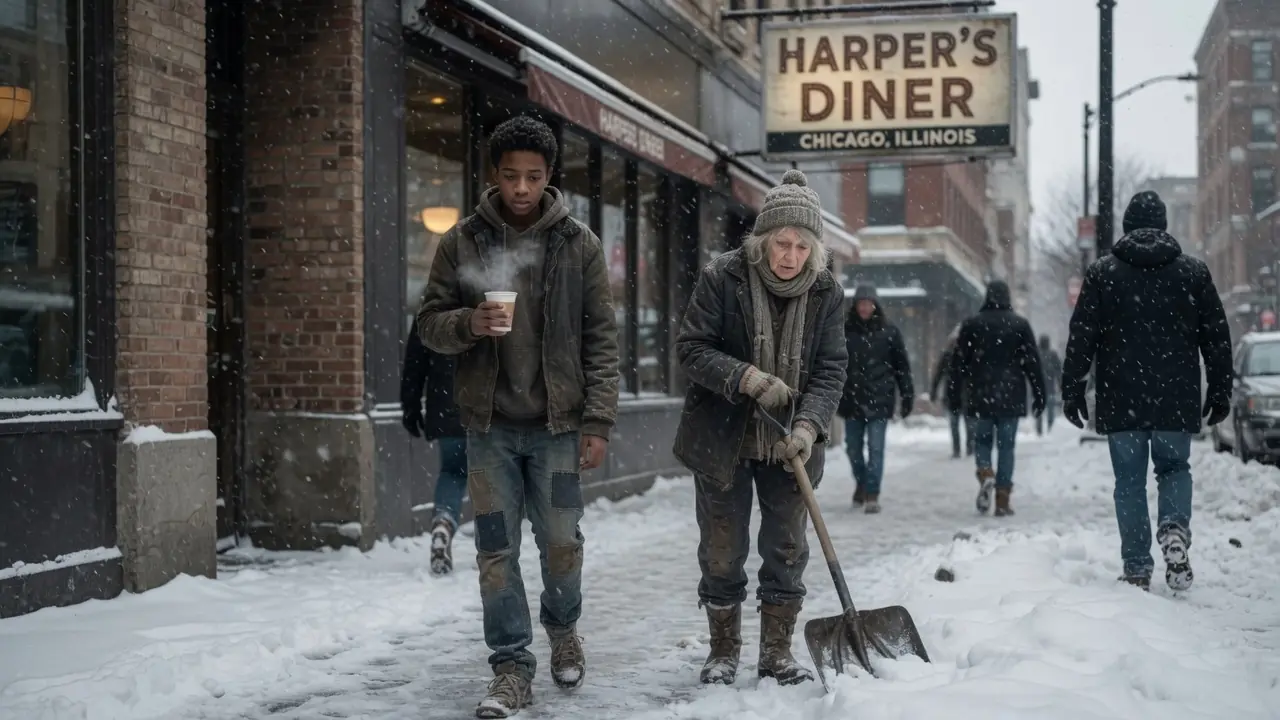
One snowy winter morning, a young waiter exhausted after three straight hours of work, happened to see an old woman shivering as she shoveled snow on the sidewalk. The woman wore only a thin coat, her lips turning blue from the cold. Without hesitation, the 15-year-old boy pulled out a crumpled $5 bill. Almost all the money he had left bought a cup of hot ginger tea, and stepped into the freezing wind to give the old woman the only warmth of that day. He had no idea that this small act would set off a chain of events where the woman's true identity would change his life forever.
The diner's door chimed for the hundredth time that morning. The boy barely looked up. His hands moved on autopilot pot in one hand mug in the other. Poor smile. Move on. The routine had become muscle memory after working at Harper's Diner. Outside, Chicago was drowning in snow. Fat flakes fell thick and fast, piling up on the sidewalks, on car hoods, on everything. The street lights glowed dim and yellow through the white chaos.
Inside the diner was warm, but that warmth didn't reach the boy. Not really. His fingers were cracked and raw from the cold. The walk here, three neighborhoods on foot at 4 in the morning, had been brutal, but rent didn't pay itself, and the bus fare added up. Excuse me, hello. A sharp voice cut through his thoughts. The boy turned. Table six. A woman in an expensive coat phone in one hand, barely looking at him. This coffee is cold, the woman said, pushing the mug forward like it personally offended her. What kind of place is this?
The boy's chest tightened. The coffee wasn't cold. He'd poured it 2 minutes ago, but he smiled anyway. That thin practice smile that said, "I'm sorry." without actually apologizing. "I'll get you a fresh one right away, ma'am." Make it fast. I don't have all day. The boy took the mug and walked back to the counter. His reflection caught in the metal coffee dispenser. Tired eyes, hair pulled back tight, that worn scarf around his neck, his mother's scarf. The edges were frayed now, but it was all he had left of her.
You can be poor baby, his mother used to say, but don't ever let your kindness freeze up inside you. He poured the new coffee, added cream without being asked. He remembered this woman from last week. Same order, same attitude. When he set it down, the woman didn't even look up from her phone. Finally, no thank you, no eye contact, nothing. The boy stepped back. That familiar feeling settling in his stomach, invisible. That's what he was to most people here. A waiter, a body that brought food and took plates away.
Not a person with a name, with a life, with a mother he'd buried two years ago. Harper's voice boomed from the kitchen pass through. He was a big man with a bigger voice, but he wasn't mean, just always rushing. We got a lunch rush coming. Need you sharp, kid. I'm on it, he called back, forcing brightness into his voice. He wiped down table three, cleared table 7, refilled coffee at 9:00. His legs ached. His back ached. But he kept moving because stopping meant thinking. And thinking meant remembering how small his bank account was. How the landlord's last warning had been 3 days ago.
The door chimed again. More cold air rushed in carrying snow and noise. A group of businessmen laughing loud, shaking off their coats like they own the place. Sweetheart, can we get some service over here? One of them called out, not bothering to wait for a host. The boy grabbed menus and headed over. Good afternoon, gentlemen. What can I get you? Just coffee for now. Black. All of us. He didn't look at the boy's face. Just his name tag. Coming right up.
As he walked away, he heard one of them mutter, "Service is slow here." He'd been there for 10 seconds. His hands shook slightly as he grabbed the coffee pot. Not from anger. He couldn't afford anger. From exhaustion, from being seen, but not really seen. from existing in a space where he was useful but never visible. Through the window, the snow kept falling. People rushed past, heads down, collars up, everyone trying to escape the cold, everyone in their own world. And the boy kept pouring coffee, kept smiling, kept being the invisible kid in the corner of their busy lives.
His eyes drifted to the window without really seeing, just staring out at the white blur of falling snow, the gray shapes of people passing by. Then he saw her. An old woman stood on the sidewalk across the street, bent over a snow shovel. Her coat was thin, too thin, the kind you'd wear on a cool autumn day, not in the middle of a Chicago blizzard. She moved slowly, scraping snow from the sidewalk in front of a closed shop. Snow kept falling. The pile she'd cleared was already filling in again.
The boy watched a man in a business suit approach. He saw the old woman stepped wide around her. Didn't slow down. Then a young couple. They laughed at something on a phone. Nearly bumped into the woman and the guy said something sharp. The old woman stumbled back. They kept walking. Orders up. He blinked, pulled himself back. Coming. But his eyes drifted to the window again as he picked up plates. The old woman was still there, still shoveling. A gust of wind hit and she staggered, catching herself on the shovel handle. Nobody stopped.
A teenager walked past earbuds and eyes on his phone. An older man crossed the street to avoid her completely. A woman with shopping bags actually said something the boy couldn't hear it, but the dismissive wave of her hand said, "Enough. Get out of my way." The old woman bent down to pick up something, a scarf that had fallen. Before she could grab it, someone's boot landed right on it. They didn't notice, just kept walking, grinding it into the slush.
The boy's chest went tight. "Am you good?" he turned. Harper stood at the counter, looking at him with raised eyebrows. "Yeah, I just" He gestured toward the window. "That woman out there, she's been shoveling in this cold for not our problem, kid." Harper's voice wasn't mean, just practical. He'd seen too much to get involved in everything. "You got tables?" I know, but table 6 wants their check. Table 9 needs ketchup. The boy nodded. He grabbed the ketchup bottle, delivered it with a smile he didn't feel printed the check for table 6, but he kept looking out that window.
The old woman had moved further down the sidewalk now, still shoveling, still alone. A delivery truck rumbled past, spraying slush. It hit her. She turned away, wiping her face with her sleeve. Not one person stopped to ask if she was okay. Snow can be cold, the boy thought, but people are colder. He remembered his mother working as a custodian at that office building downtown. Coming home with stories about how people talked over her, walked past her, treated her like furniture. They don't see us, baby, his mother had said once, sitting at their kitchen table with swollen feet. To them, we're just part of the scenery.
That old woman outside, she was scenery, too. Something to step around, something in the way. The boy's hands clenched around the coffee pot. A businessman pushed through the diner door, shaking snow from his coat. Jesus, it's brutal out there. They really should clear these sidewalks. Better almost tripped over some old bag with a shovel. He laughed. Actually laughed. The boy's stomach twisted. He wanted to say something. Wanted to tell him that old bag was a human being freezing and struggling while he complained about almost tripping. But he just smiled. Sit anywhere you'd like, sir.
He took table five, ordered coffee, complained it was too hot. Through the window, the old woman's scarf, the one that had fallen, was now just a dirty rag in the snow, trampled, forgotten. Just one person, the boy thought. One person could stop and help. One person could change this. He looked around the diner, warm, full people eating, laughing, scrolling through phones. Outside, an old woman worked alone in the freezing cold. And the world just kept moving.
The boy sat down the coffee pot. His hand went to the scarf around his own neck. His mother's scarf. The last thing he had to remember her by. His mother would have stopped. His mother would have done something. Harper. His voice came out steadier than he felt. I need to take 5 minutes. He looked up from the grill. Now we're slammed. 5 minutes, please. Something in his face made him pause. Then he sighed. Five. That's it.
The boy nodded. He was already reaching for the hot water kettle because someone had to stop. And if no one else would, then it had to be him. The boy's last $5 sat on the counter in front of him. Rent money, bus fare, dinner for the next two days. All of it right there in one crumpled bill. He stared at it for 3 seconds. Then he picked it up. One ginger tea to go. Harper glanced up from the grill. you buying? Yeah. He didn't ask why. Just made the tea. Hot water. Fresh ginger. A squeeze of lemon honey. The kind of drink that warmed you from the inside out.
The boy wrapped his hands around the paper cup. Heat seeped through to his cold fingers. He grabbed his thin jacket from the hook. You're going out there. Harper stared at him like he'd lost his mind. In this 5 minutes, you said the boy. But he was already pushing through the door. The cold hit him like a fist. Wind tore through his jacket, cut straight through to his bones. Snow stung his face. His breath came out in white clouds. God, it's freezing. Across the street, the old woman had stopped shoveling. She leaned against the building wall, shoulders hunched, trying to catch her breath.
The boy's feet crunched through the snow. Each step felt harder than the last. The wind pushed against him. His fingers were already going numb around the cup. Just keep walking. Just get there. A car rushed past, spraying slush. Some of it hit his jeans. The cold soaked through immediately. He kept going. The old woman looked up as the boy approached. Her face was weathered, lined with age and exhaustion. Her lips had a blue tint. Her hands shook even though they were wrapped around the shovel handle. "Ma'am." The woman blinked, confused. People didn't stop. People didn't talk to her.
I brought you this. The boy held out the cup. It's ginger tea. Still hot. Please drink it. The old woman stared at the cup like it might disappear if she reached for it. I I don't have money to It's not for sale. The boy pressed it into her hands. It's a gift. It's cold out here. Dangerous cold. You need to warm up. The woman's fingers wrapped around the cup. Her whole body seemed to relax at the heat. Why would you? Her voice cracked. Nobody ever. Everyone deserves to be seen, the boy said quietly. Everyone deserves to be cared for.
The old woman's eyes filled with tears. She brought the cup to her lips with trembling hands and took a sip. Then another steam rose between them, a small cloud of warmth in the frozen air. "Thank you," the woman whispered. "So few people. They just walk past like, "I'm not even here." "The boy knew that feeling. Lived it every single day in that diner. "I see you," he said simply. The wind howled around them. Snow swirled. The boy's teeth were starting to chatter, but he didn't move. Not yet.
The old woman looked at him. Really looked at him. Something shifted in her expression. Recognition maybe or understanding. What's your name, child? The boy. The boy Carter. That's a beautiful name. The woman took another sip, holding the cup close like it was the most precious thing in the world. Thank you, the boy. Not just for the tea, for stopping, for seeing an old woman who everyone else walks right past. Are you okay out here? Do you need? I'll be fine now. Thanks to you.
The woman smiled and despite the cold, despite the exhaustion, it was genuine, warm. You have a kind heart. Don't ever lose that. The boy felt something catch in his throat. His mother used to say the same thing. If mom could see me now, she'd be proud. Stay warm, okay? The boy touched the woman's shoulder gently. Please, I will. And you too, dear. Get back inside before you freeze. The boy nodded. He turned to go, his jacket already soaked through his body, shaking from the cold.
The boy. He looked back. The old woman was still holding the cup with both hands, steam rising around her face like a halo. Kindness like yours is rare, rarer than you know. The boy managed a small smile, then hurried back across the street. The diner door felt like it weighed 1,000 lb. He pushed through it and the warmth hit him all at once. His fingers burned as feeling came back. Harper looked up. You're insane. You know that. Maybe. He was shivering so hard he could barely talk, but I couldn't just watch.
That tea was five bucks. I know. That was all you had. I know. Harper shook his head, but something softened in his face. He grabbed a towel. Dry off, then get back to work before I regret being nice. The boy took the towel, rubbing his wet hair. Through the window, he could see the old woman still standing there holding the cup, drinking slowly. For just a moment, their eyes met across the distance. The woman raised the cup slightly, a gesture, a thank you. The boy raised his hand in return.
Then he turned away, tied his apron back on, and went back to work. He was broke, freezing, exhausted. But something in his chest felt warm. For the first time in a long time, he felt like he'd done something that mattered. Maybe kindness is never wrong, he thought. Maybe it just takes courage to hold on to it. Outside, the snow kept falling. But in that moment, the world felt a little less cold. The shift ended at 9:00. The boy's feet screamed with every step as he walked home. The snow had stopped, but the cold hadn't. It pressed down on the city like a weight. His breath came out in short white puffs. His fingers were numb inside his thin gloves.
Southside looked different at night, darker, emptier. The street lights threw long shadows across the snow covered sidewalks. Most of the shops were closed. Metal gates pulled down. and graffiti tags sprayed across them. He passed a group of guys on a corner. They didn't bother him. He was a regular face here, just another tired worker walking home. His building stood at the end of the block, a three-story brick structure with cracked windows in a front door that didn't lock properly. The hallway smelled like old cooking oil and mildew. Stairs creaked under his weight as he climbed to the second floor.
Apartment 2 C home. He unlocked the door and stepped inside. The cold hit him immediately. No heat. The radiator had been broken for a week and the landlord kept saying he'd fix it tomorrow. Tomorrow never came. That you boy. His roommate Maya sat on the couch wrapped in two blankets, breath visible in the cold air. The only light came from a small lamp in the corner. They were trying to keep the electric bill down. Yeah, it's me. The boy dropped his bag by the door. His whole body ached. Rough day, aren't they all? Maya pulled the blanket tighter. There's half a sandwich in the fridge if you're hungry. Turkey. I saved it for you.
The boy's stomach clenched. He was starving. Had been since lunch. You didn't eat dinner. I ate. This is extra. It wasn't extra. Maya was lying. They both knew it. But the boy was too tired to argue. He went to the tiny kitchen. More of a closet with a hot plate and mini fridge. Open the fridge. The sandwich sat on a paper towel carefully wrapped. Next to it, three eggs, a/4 gallon of milk, some wilted lettuce. That was it. That was everything they had until Friday's paycheck.
The boy took the sandwich, cut it in half, and brought both pieces to the couch. We're sharing. Boy, I told you. We're sharing. Maya took the half sandwich without another word. They ate in silence, sitting side by side under the blankets. The cold seeped through everything. The walls, the floor, their clothes. Electric bill came today, Maya said quietly. The boy stopped chewing. How much? $147. Do in 5 days or they shut it off? $147. The boy had 32 in his bank account. Maya probably had less.
We'll figure it out, the boy said, but his voice sounded hollow even to himself. Yeah. Maya didn't sound convinced. We always do. They finished eating. Maya went to bed. The bedroom was slightly warmer with the door closed and both of them sharing body heat. But the boy stayed up. He couldn't sleep yet. Too much spinning in his head. He pulled out his notebook, a small spiralbound thing he'd had since school. Inside he kept track of everything. Every dollar, every bill, every shift. Rent $650 due in 12 days. Electric $147 due in five. Phone $45 due in 8. He had $32, would make maybe another 120 by Friday if he picked up an extra shift. The math didn't work. It never worked.
The boy's pen hovered over the page. His hand was shaking, not from cold this time, but from something else. Fear maybe, or exhaustion, or both. $5 for that tea, $5 I didn't have. He closed his eyes, saw the old woman's face, heard her voice. Thank you, the boy. Was it worth it? His mother's voice answered in his head. Kindness is always worth it, baby. Always. But kindness didn't pay bills, didn't keep the lights on, didn't put food on the table. The boy sat down the pen and rubbed his face. God, he was tired. So bone deep tired that thinking hurt.
He lay down on the couch, pulling the thin blanket over himself. The springs dug into his back. He'd gotten used to them years ago. Outside, wind rattled the window. Somewhere down the hall, a baby cried. "Just get through tomorrow," he told himself. Then the day after that, just keep going. Sleep came slowly, dragging him down into restless dreams of snow and cold and empty pockets. The sound woke him, something sliding under the door, a soft scraping noise. The boy's eyes opened. The room was dim early morning light filtering through the dirty window. He checked his phone. 5:47 a.m. He sat up, confused. Who would footsteps in the hallway? heavy, deliberate, moving away down the stairs. Gone.
The boy threw off the blanket and stood shivering in the cold. He walked to the door, looked down. A white envelope lay on the floor. His heart started beating faster. He picked it up, turned it over. Thick paper, expensive, the kind you'd use for a wedding invitation or something official. His name was written on the front in elegant script. Master the boy Carter. No return address, no stamp, hand delivered at dawn. What the hell? he whispered. His fingers trembled as he opened it. Inside a single card, heavy card stock. More elegant handwriting. Master Carter, your kindness yesterday did not go unnoticed. I would like to meet with you today at noon. Come to the address below. This meeting may change your life if you're brave enough to attend. The choice is yours. Ew.
Below that, an address downtown near Millennium Park, the fancy part of the city where the boy never went because everything costs too much. He read it twice, three times. The words didn't change. This meeting may change your life. The boy's hand shook. Who was EW? How did they know his name? How did they know where he lived? The old woman. It had to be. But that didn't make sense. That woman had been shoveling snow in threadbare clothes. She'd looked like she had nothing. Unless. No way. The boy breathed. That's crazy. But what else could it be?
Boy. Maya appeared in the bedroom doorway, squinting. Why are you up so early? The boy held up the card. Someone just slid this under our door. What? Maya was awake now. He crossed the room, took the card. Read it. His eyes went wide. Holy [ __ ]. What is this? I don't know. This address. This is downtown. Like expensive downtown. Maya looked at him. Who do you know with this kind of money? Nobody. Then who's EW? I think I think it might be that woman. the one I gave the tea to yesterday. Maya stared at him, the homeless lady shoveling snow. She wasn't homeless, I don't think. I mean, maybe she was testing people or something.
The boy knew how it sounded. Insane. Like something from a bad movie. Testing people. Maya's voice was flat. Boy, this is Chicago. People don't test other people with kindness experiments. They scam them. But what if it's real? What if it's not? Mia grabbed his shoulders. What if you show up and it's some creep or a human trafficking thing? Or I know, I know it sounds crazy. It doesn't sound crazy. It sounds dangerous. Maya's grip tightened. Please don't go. The boy looked at the card again. The handwriting was beautiful. Careful. The paper felt real, solid, not some cheap printout. This meeting may change your life.
God, he wanted his life to change. Wanted it so badly it physically hurt. Wanted to stop counting pennies. Stop choosing between food and heat. Stop being invisible. But Maya was right. This could be anything. A trap, a scam, something worse. I need to think about it, the boy said finally. There's nothing to think about. Don't go. Maya, promise me you won't go. The boy pulled away gently. I have to get ready for work. Boy, I'll be careful. I promise. He went to the bathroom, closed the door, and leaned against it. His reflection stared back from the cracked mirror. Tired eyes, worry lines too deep for 15. The card sat on the sink edge, white and pristine against the stained porcelain. If you're brave enough to attend, his mother's voice whispered in his memory. Miracles only come to people brave enough to believe in them, baby. But you got to be smart, too. Brave and smart. Brave and smart. Could he be both?
The boy splashed cold water on his face. He had 7 hours to decide. 7 hours to choose between playing it safe and taking the biggest risk of his life. Outside the city was waking up. Car engines, distant sirens, the rumble of the train. And somewhere out there, someone was waiting to see if the boy Carter would show up. If he was brave enough, if he was desperate enough, if he still believed that kindness could matter in a world that had given him every reason not to. The boy stood in front of the building at 11:53 a.m. His heart hammered so hard he could feel it in his throat. The address had led him here a glass tower in the loop, all steel and shine, the kind of building he'd only ever seen from bus windows. Wells foundation was etched into the marble entrance in gold letters. He'd almost turned back three times on the train ride over. Maya's warning still rang in his ears, but something stronger pulled him forward. curiosity, hope, desperation, maybe all three.
The lobby was enormous. Marble floors so polished he could see his reflection. A massive chandelier hung from the ceiling like frozen light. Everything smelled like money and leather and something floral he couldn't name. A security guard sat behind a desk. He looked up as he approached, taking in his worn coat and secondhand boots. Can I help you? His tone said he didn't belong here. I'm here to see. The boy pulled out the card. Ew. I have an appointment at noon. The guard's expression changed immediately. He straightened. Master Carter. Yes. Miss Wells is expecting you. Take the elevator to the 18th floor. Someone will meet you there.
Miss Wells. So EW was a woman. That confirmed it. The old woman from yesterday. It had to be. The boy's hands were sweating as he crossed to the elevator. The doors opened with a soft chime. He stepped inside, pressed 18. The doors closed and the floor dropped out from under him. The elevator was so smooth he barely felt it move. Soft music played. The walls were mirrored. He caught sight of himself. Nervous eyes, cheap clothes that scarf around his neck. He didn't belong here. The doors opened on the 18th floor. A woman waited mid-50s, perfectly tailored suit, sharp eyes behind designer glasses. Master Carter, I'm Patricia Misswells, executive assistant. Please follow me.
They walked down a hallway lined with abstract art. Everything was white and gray and expensive. Their footsteps were silent on the thick carpet. Patricia stopped at a set of double doors. Miss Wells will see you now. She opened the doors. The office was huge. Floor to ceiling windows showed the entire city, Lake Michigan, stretched out like a sheet of gray glass buildings rising like fingers toward the sky. The furniture was minimal but elegant. a desk, two chairs, a small sitting area, and by the window, standing with her back to the door, was the old woman from yesterday. Except she didn't look old anymore. She turned around. The woman wore a cream colored dress that probably cost more than the boy's entire wardrobe. Her silver hair was styled perfectly. Her posture was straight, commanding. She looked like she belonged on magazine covers and boardrooms at gallas, but her eyes, those were the same. Kind, sharp, knowing.
Hello, the boy. Her voice was warm. Thank you for coming. I wasn't sure you would. The boy stood frozen in the doorway. You're You were shoveling snow in the cold. The woman smiled. Yes, that was me. But why? You're clearly not. The boy gestured vaguely at everything. The office, the view, the wealth dripping from every surface. Not what poor homeless. The woman walked closer. No, I'm not. My name is Eleanor Wells. I'm the founder and CEO of Wells Foundation. We manage charitable giving across the Midwest. Assets worth about $400 million. The boy felt dizzy. $400 million. He couldn't even imagine that kind of money. Please sit. Eleanor gestured to the chairs by her desk. The boy sat. His legs felt shaky.
Eleanor sat across from him, crossing her legs elegantly. I imagine you have questions. Why? The word burst out. Why were you out there? Why did you test me? Test is a harsh word. Eleanor's expression softened, but not entirely inaccurate. Let me tell you a story, the boy, about a woman who built an empire but lost herself in the process. She stood, walked to the window. The city spread out below them. I started this foundation 30 years ago. My husband had just died, cancer, very sudden. We had no children. He left me everything. A fortune neither of us had expected. Eleanor's voice was steady, but something painful lived underneath. I threw myself into work, into giving money away properly, into making a difference.
That sounds good, the boy said quietly. It was good. It is good. But somewhere along the way, I forgot something important. Eleanor turned to face him. I forgot what it felt like to be human, to be vulnerable, to need help and not receive it. She walked back, sat down again. I have everything, the boy. money, power, respect. People line up to meet with me, to ask for funding, to kiss up and flatter and pretend to care about me personally. Her jaw tightened. But they don't see me. They see my bank account, my influence, my ability to make their problems disappear with a checkbook.
The boy thought about the diner, about being invisible to customers who only saw a waiter. I have spent three decades meeting with people who claim to care about helping others, Eleanor continued. They come with presentations and proposals and promises. They wear expensive suits and use impressive words. They tell me exactly what I want to hear. She leaned forward. But I never know if they mean it. I never know if their kindness is real or if it's just another performance for my money. So, you went out there to find out, the boy said slowly. To see who would help someone who couldn't do anything for them in return. Exactly.
Eleanor's eyes locked on his. I spent 3 hours out there yesterday, the boy. 3 hours in the freezing cold, shoveling snow, struggling, clearly in need. Do you know how many people stopped to help? The boy shook his head. One. Eleanor's voice broke slightly. In 3 hours, in a city of millions, you were the only person who stopped, the only one who saw a human being instead of an inconvenience, the only one who gave up something money you clearly didn't have to help a stranger. The boy's throat felt tight. I just I couldn't watch anymore. Everyone was ignoring you.
They ignore people like that every day. People like your mother was, I imagine. The boy's head snapped up. How do you know about my mother? After you gave me that tea, I had someone look into you. I hope you don't mind. Eleanor's voice was gentle. Your mother, Grace Carter, worked as a custodian for 15 years. Died 2 years ago from a heart condition she couldn't afford to treat properly. She raised you alone after your father left. taught you to be kind despite how hard life was. Tears burned the boy's eyes. Hearing someone say his mother's name acknowledge her existence. Treat her like she'd mattered. It hurt in a way he hadn't expected.
She sounds like she was an extraordinary woman. Eleanor said softly. She was. The boy's voice cracked. She was invisible, too. Just like me. Just like you were yesterday. But you saw me just like you saw your mother. Just like you see everyone. Eleanor stood and walked to a cabinet. She pulled out a leather folder, brought it back to the desk. I've spent 30 years looking for someone to help me run this foundation, someone who understands what it means to struggle, someone whose kindness isn't a strategy or a performance, someone real. And she opened the folder. Inside were documents, papers with official looking seals. I'm 72 years old, the boy. I don't have forever. and I refuse to leave my life's work to someone who only sees dollar signs.
Elellanar looked at him directly. I want to offer you a position, assistant to the CEO. You'll work directly with me. Learn how we operate. Help decide where our money goes and who we help. The boy's mouth went dry. I don't understand. I'm a waiter. I don't have a degree. I don't know anything about. You know the most important thing. Eleanor's voice was firm. You know what it's like to need help. You know what it feels like to be overlooked, and you still chose to be kind when you had every reason not to be. But there must be hundreds of people more qualified. Qualified Eleanor's laugh was sharp. I've hired qualified people for 30 years. They know spreadsheets and tax codes and grant proposals, but they've never had to choose between buying food or paying rent. They've never been invisible. They don't understand the people we're supposed to help.
She pushed the folder toward the boy. This foundation gives away millions of dollars every year to homeless shelters, food banks, community programs, medical clinics. We're supposed to help people who need it most. Don't you think someone who's lived that life should have a say in how we do it? The boy stared at the folder. His hands trembled. I know this is overwhelming, Eleanor said gently. Take your time, read the offer, think about it, but know this. The boy, yesterday you gave me something I haven't had in years. You gave me hope that good people still exist, that kindness isn't extinct, that someone out there still cares about strangers in the cold." She reached across the desk and placed her hand over the boy's. "You reminded me why I started this work in the first place. And I want you to help me remember every single day going forward."
The boy looked up. Eleanor's eyes were wet. "I'm not offering you a job," Eleanor said quietly. I'm offering you a purpose, a chance to help thousands of people who are exactly where you were yesterday, who are scared and struggling and wondering if anyone sees them." The words hit the boy like a wave. He thought about his mother, about every shift at the diner, about every time he'd been treated like furniture, about Maya shivering under blankets because they couldn't afford heat. "If mom could see this," he whispered. "She can," Eleanor said. "I believe that. and I think she'd be incredibly proud of the young man you've become. The boy wiped his eyes. Can I really do this? I don't want to mess it up. I don't want to let you down. The fact that you're worried about that tells me everything I need to know. Elellanar smiled. You'll learn. I'll teach you. And more importantly, you'll bring something to this work that no amount of education can provide. You'll bring heart. Eli pulled the folder toward him. Opened it. The top page showed a salary number that made him dizzy. $6500 per year. More than double what he made at the diner. More than he'd ever imagined earning.
That's just starting, Eleanor said with benefits, health insurance, retirement, everything you need. Health insurance, the boy thought about his mother dying because treatment costs too much. I He couldn't form words. Emotions crashed through his disbelief. Hope, fear, joy, everything at once. You don't have to answer today, Eleanor said. Take the weekend, think it over. Talk to people you trust, then let me know Monday. But the boy was already shaking his head. I don't need time. Eleanor raised an eyebrow. Yes. The boy's voice grew stronger. Yes, I'll do it. I want to do this. I want to help. I want to matter. Eleanor's smile transformed her entire face. She stood, came around the desk, and pulled the boy into a hug. You already matter," she whispered. "You always have. Now the world is going to know it, too."
The boy hugged her back, tears streaming down his face. All the exhaustion and fear and struggle of the past years poured out in that embrace. When they pulled apart, Eleanor wiped her own eyes, laughing. "Look at us." Two people crying in a corner office, very professional. The boy laughed, too. A real laugh, the first genuine one he'd had in months. "When do I start?" he asked. Monday 9:00 a.m. Patricia will have everything ready for you. I need to give notice at the diner already taken care of. I'll make sure Harper is compensated for the inconvenience. And I'll send something extra for your regular customers, the ones who were kind to you.
The boy thought of the few regulars who'd learned his name, who'd left decent tips, who'd treated him like a person. Thank you, he breathed. No. Eleanor's voice was firm. Thank you for stopping, for caring, for reminding me that kindness still exists in this world. She walked the boy to the door. One more thing, Elanor said. That scarf you wear, your mother's The boy's hand went to it automatically. Yes. Never take it off. Not here, not anywhere. It reminds you where you came from, and that matters more than any degree or qualification. Eleanor's eyes shown. Your mother raised you right, the boy. She gave you something rare and precious. A kind heart in a cruel world. Don't ever lose that. I won't, the boy promised.
He left the office in a daze, rode the elevator down, walked out into the cold Chicago afternoon. The city looked different. The same buildings, the same streets, the same snow, but different somehow. Full of possibility instead of threat. He pulled out his phone and called Maya. Boy, are you okay? Where are you? I'm downtown. I went to the meeting. What I told you, Maya? The boy's voice was steady, calm, happy. It was real. It was all real. I got a job, a real job at a foundation with salary and benefits. And wait, what? Slow down. We can pay the electric bill. The boy said and started laughing. We can pay rent. We can buy groceries. Real groceries. We can fix the radiator. Maya was silent for a long moment. Then, "Are you serious?" Completely. "Oh my god. Oh my god, boy."
They both started laughing, crying, talking over each other. People on the street stared at the boy, this young man standing in the snow, phone to his ear, tears streaming down his face, laughing like he'd won the lottery. In a way, he had. He'd won something better than money. He'd won the chance to matter, to help, to turn his own pain into purpose. As he walked to the train station, the boy looked up at the gray sky. Snow was starting to fall again, light flakes drifting down like blessings. I hope you're watching, mom," he whispered. "I hope you're proud." The wind picked up cold, but not cruel. And somewhere in that wind, the boy felt his answer. "I am baby. I always was."
Monday morning, 8:47 a.m. The boy stood in front of Wells Foundation again, but this time everything was different. This time, he wasn't a visitor. He was walking into his new life. He'd spent the weekend in a blur. Told Harper he was leaving. He'd been shocked but happy for him. Cried with Maya. Called the electric company and paid the bill in full. Bought real groceries, milk, eggs, fresh vegetables, meat that wasn't discounted because it was about to expire. It felt like breathing after being underwater for years. Now he wore the best outfit he owned. Black pants from Goodwill, a white shirt Maya had helped him iron his mother's scarf tucked carefully around his neck. His hands shook as he pushed through the revolving door. The security guard from Friday looked up and smiled. Morning, Master Carter. Welcome to Wells Foundation. Thank you. His voice came out smaller than he intended. The elevator ride to 18 felt longer this time. He watched the numbers climb his reflection in the mirrored walls. You belong here, he told himself. Eleanor chose you. You belong. The doors opened. Patricia waited perfectly put together as before. Good morning, the boy. Ready for your first day? I think so. You'll be fine. Patricia's smile was genuine. Follow me.
They walked past Eleanor's office to a smaller room down the hall. It had a window, not as big as Eleanor's, but real and filled with natural light, a desk with a computer, a bookshelf, a small plant in the corner. This is your office, Patricia said. The boy stopped breathing. My office? Of course. Your assistant to the CEO. That comes with an office. Patricia gestured inside. Computers all set up. Login credentials are in that envelope on the desk. Elellanar wants to see you at 9:30 for orientation. Okay. The boy stepped inside. It was the size of his entire apartment, maybe bigger. Coffee is in the break room two doors down on the right. Bathrooms across the hall. If you need anything, my extension is 201. Just pick up your phone and dial it. Patricia left. The boy stood alone in his office, his office. He walked to the window. The view showed buildings and streets, the morning rush of people heading to work. 48 hours ago, he'd been one of them, invisible, struggling. Now he was up here looking down.
He sat at the desk. The chair was soft, ergonomic, probably cost more than his couch. The computer was new, a sleek monitor with a wireless keyboard. He opened the envelope. Inside, login credentials, an employee ID badge with his name and photo, when did they take that? And a welcome packet. The badge made it real. The boy Carter, assistant to the CEO. He pinned it to his shirt. At 9:30, he knocked on Eleanor's door. Come in. Eleanor sat at her desk reading glasses perched on her nose papers spread everywhere. She looked up and smiled warmly. There he is. How does it feel? Surreal. The boy admitted. Good. That means you're paying attention. Eleanor gestured to the chair. Sit. Let's talk about what comes next. The boy sat. Here's how this works. Eleanor began. You'll spend the first month learning, observing, asking questions. I want you in every meeting I take, every grant review, every site visit. You'll see how we operate, the good, the bad, and the ugly. Okay?
People here will underestimate you. They'll see your age, your background, your lack of formal education. They'll assume I made a mistake hiring you. Eleanor's voice hardened. Let them think that, then prove them wrong. The boy nodded, his jaw tightening. I didn't choose you because you're qualified by traditional standards. I chose you because you understand something they never will. What it means to need help and not receive it. That perspective is worth more than any MBA. What if I mess up? You will. Eleanor's bluntness was refreshing. Everyone does. The question is whether you learn from it, whether you stay humble and hungry and willing to grow. I will, the boy promised. Good. Now, let's meet your team. Ellaner stood. The boy followed her down the hall to a conference room. Inside, five people sat around a table. Three women, two men, all dressed professionally, all looking successful and accomplished. They looked up as Eleanor entered. Their eyes slid to the boy with thinly veiled curiosity and judgment. Everyone, this is the boy Carter. He's my new assistant and will be working closely with me on all foundation business. The boy, meet the team. Elellanar went around the table. Marcus, director of grant programs. Lisa, chief financial officer. Jennifer, communications director. David, operations manager, and Rachel, director of community outreach. They each nodded, polite smiles that didn't reach their eyes.
The boy comes from a different background than most of you. Eleanor continued. He's going to bring a fresh perspective to our work. I expect all of you to support him as he learns. Of course, Marcus said smoothly. He was mid-40s, expensive suit, sllicked back hair. We're happy to help, though. I'm curious. What's your educational background, the boy? The question was a test. Everyone in the room knew it. High school diploma, the boy said clearly. I've been working in service industry for the past years. A flicker of something surprised disdain crossed Marcus' face. Interesting choice, Elellanor. Unconventional. The best choices usually are. Eleanor's tone left no room for argument. All right, everyone, back to work. The boy and I have a busy day.
As they left the conference room, the boy heard whispers behind them. He couldn't make out words, but the tone was clear. Who does he think he is? Why did Eleanor hire him? He doesn't belong here. Ignore them, Eleanor said quietly as they walked. Their opinions don't matter. Results do. But as the day progressed, the boy realized ignoring them wouldn't be easy. He sat in on a grant review meeting. Marcus presented proposals from various organizations requesting funding. His language was technical, full of jargon and acronyms the boy didn't understand. The ROI on this youth mentorship program is questionable, Marcus said, flipping through papers. Their overhead costs are at 32%. Industry standard is 25 or below. I recommend we pass. What about outcomes? The boy asked quietly. Everyone turned to look at him. I'm sorry. Marcus' tone was icy. You mentioned costs, but what about outcomes? What results have they achieved? That's factored into ROI, return on investment. I know what ROI means. The boy's voice stayed level. But sometimes numbers don't tell the whole story. What are they actually doing for the kids in the program?
Marcus' jaw tightened. According to their metrics, graduation rates improved by 15%. College enrollment by 12%. Recidivism down 8%. That sounds good. The boy said the costs are still too high. Maybe the costs are high because they're doing it right because they actually care about the kids instead of just checking boxes. Silence fell over the room. Marcus stared at him like he'd slapped him. Eleanor leaned back in her chair, a small smile playing at her lips. Interesting point, the boy. Marcus pulled more detailed outcome data. Let's review it again next week before we decide. Marcus's face flushed red. Of course, after the meeting, as people filed out, Marcus stopped next to the boy's chair. "A word of advice," he said quietly. "You might want to learn how things work here before questioning processes that have been in place for years. I'm not questioning the process. I'm questioning whether we're measuring the right things." His eyes went cold. You've been here for 4 hours. I've been poor for years. That's a different kind of education. He walked away without another word. The boy sat alone in the conference room, his heart pounding. He'd gone too far. Lost his temper. proven Marcus right about his inexperience. Eleanor appeared in the doorway. That was ballsy, she said. Was it wrong? No, it was honest and necessary. Eleanor sat down next to him. Marcus is good at his job, but he's been here too long. He's forgotten that numbers represent human lives. You just reminded him he hates me now. He'll get over it or he won't. Either way, you were right to speak up. Jennifer spoke up. For what it's worth, I thought your presentation was solid. You made a good case. Thank you. But Marcus isn't going to forget this. He doesn't handle being challenged well. I figured. After the meeting ended and everyone left, Eleanor gestured for the boy to stay. Close the door. The boy did. His stomach churned. Eleanor studied him for a long moment. How do you feel? Honestly terrified. I just made a powerful enemy on my first week. Yes, you did. But you also just saved a program that helps dozens of kids. You proved you have backbone and you showed the other directors that new perspectives matter. Eleanor's expression softened. I'd say that's a successful first week. Marcus hates me. Marcus is threatened by you. There's a difference. He's been the smartest person in the room for a long time now. Someone's questioning him and he doesn't know how to handle it. What if he tries to push me out? Let him try. Eleanor's voice turned steel. I hired you, the boy. I believe in you. And as long as you keep doing what you did today, bringing heart and truth to this work, you have my full support. The boy felt tears prick his eyes. Thank you. Don't thank me yet. This job is going to be hard. People will underestimate you, judge you, try to make you feel like you don't belong. You'll have to prove yourself over and over. I know. But if you stay true to why you're here, if you remember that kid crying in the corner, that mother working herself to death, that old woman shoveling snow while people walk past, you'll be fine. The boy nodded, throat too tight to speak. Go home, rest this weekend. Monday, we start round two.
The boy left the office exhausted, but oddly energized. He'd survived his first week. Made waves, made enemies, but also made a difference. In the elevator down, he caught his reflection in the mirrored walls. He looked tired, but also alive, purposeful. His phone buzzed. A text from Kesha at Southside. Eleanor just called. We got the funding. Full amount plus more. Thank you for fighting for us, for these kids. You're an angel. The boy leaned against the elevator wall, reading the message three times. He thought about Maya about having somewhere safe to go 7 days a week now. About 42 kids who'd keep having a refuge. Not an angel, he texted back. just someone who remembers what it's like. Outside, snow was falling again. But this time, when the boy stepped into it, he didn't feel the cold as sharply. He had a purpose now, a place where his voice mattered, where his past wasn't baggage, but perspective. He pulled his mother's scarf tighter and walked toward the train station, a small smile on his face despite everything. One week down, a lifetime of work ahead. But for the first time in years, the boy Carter felt like he was exactly where he belonged.