The desert air in Barstow, California didn't carry the promise of rain. It carried something heavier. The bite of rust, the reek of old gasoline, and the quiet electricity of something about to go terribly, beautifully wrong. When a fourteen-year-old boy with grease-stained hands pulled a dead Harley out of the dirt, he didn't just breathe the life back into a broken machine. He unknowingly lit a fuse that would bring three hundred Hells Angels thundering straight to his door.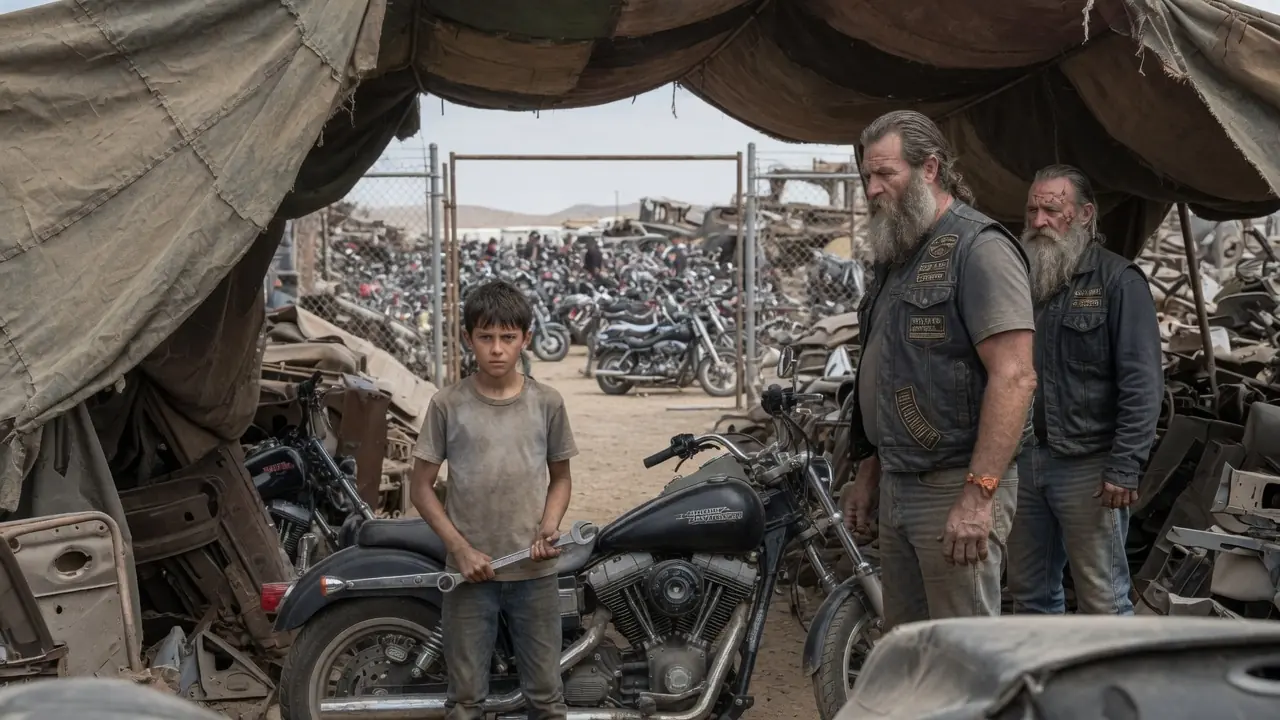
Barstow wasn't the kind of town people chose. It was the kind of town that kept people through heat, through poverty, through the slow erosion of hope. The asphalt cracked under the weight of triple-digit summers, and the air always carried that faint, ancient taste of dry earth and exhaust fumes. On the town's ragged outskirts, sat O'Malley's Scrap and Salvage, a vast, sprawling graveyard of crumpled steel, shattered windshields, and the rusting bones of things people had given up on. Most residents drove past it without a second glance.
For fourteen-year-old Leo Rossi, it was the closest thing to a home he had Leo was the kind of kid that hard circumstances built. Lean, wiry, with sharp eyes that missed nothing and hands that were never clean. No amount of industrial soap could fully scrub the dark from his knuckles. He hadn't had the luxury of a normal childhood. His father had vanished years ago, leaving behind nothing but a gap in the rent money and a wound in the family that never fully healed.
His mother, Sarah, was a thin, exhausted woman who wore herself down to the bone working double shifts at a roadside diner, fighting not just poverty, but the crushing monthly cost of her asthma medication to keep the lights on and her prescriptions filled. Leo had walked away from school entirely. Frank O'Malley, the junkyard's weathered, chain-smoking owner, paid him under the table, $5 an hour, and an open invitation to haul home whatever junk he could carry. It wasn't much, but for Leo, it was everything. The discovery happened on a scorching mid-July afternoon.
Frank had sent Leo to clear out section G, a half-forgotten corner of the yard that had been left alone for nearly a decade. The rattlesnakes had claimed it as their own, curling in the cool shadows beneath the hollow shells of 1970s muscle cars. Leo was wrestling with a heavy tow chain wrapped around the collapsed frame of a Ford Bronco when the earth beneath him seemed to shift. As he dragged the tin roofing and years of compacted tumbleweeds aside, the sun caught a flash of something underneath, a dull, scratched glimmer of chrome buried in the dark. He spent the next three hours on his hands and knees digging it out.
What he uncovered made him forget about the heat, the snakes, and the aching in his shoulders. It was a motorcycle, or rather, the ghost of one, a 1998 Harley-Davidson Dyna Super Glide. Though it took Leo's practiced eye to identify the frame beneath the devastation, the front forks had been folded inward like broken fingers. The gas tank was deeply caved in and deeply scorched from fire damage. What remained of the leather seat had been torn to shreds by coyotes and desert rats.
The engine block was buried under a thick shell of oil residue and compacted dirt, so heavily seized it looked less like metal and more like stone. But when Leo pressed his gloved palm against the cylinder heads, he swore he felt something. Not heat, not life, but the echo of it. A quiet, stubborn refusal to be completely dead. "You dug yourself up a ghost, kid.
Frank said, materializing behind him, a cigarette dangling from his lower lip. He squinted at the wreckage through the haze. State troopers towed that thing in about twelve years ago. There was a bad wreck out on Route 66. Rider didn't survive.
Have it, boy. That engine's fused together tighter than a bank vault on Christmas. Frame's probably warped beyond saving. You'd be throwing your time into a hole. But if you want to bust your hands on it in your off hours, I'm not stopping you.
Just don't let it touch your sorting work. What followed was eight months of the most grueling, consuming labor Leo had ever known. He built a crude shelter over the bike using old tarp and bent rebar. Every dollar he scraped together beyond what his mother needed went towards second hand tools from pawn shops. He became a scavenger with purpose, pulling a carburetor from a gutted Sportster, lifting clutch cables from a junked Honda, stripping brake lines from a dead Yamaha that had been crushed flat by a semi.
He learned motorcycle anatomy from books or YouTube, but from the machine itself through pain and repetition and a hundred stupid mistakes. His knuckles were permanently cracked and bleeding. There were nights he sat out there alone in the cold, starless desert, tears cutting tracks through the oil on his face, swearing and shaking and refusing to walk away. But the machine was teaching him something else, too. As he stripped it down layer by layer, he found things that didn't belong on any factory-built Harley.
The exhaust pipes had been hand-welded, thick and heavy and made with intention. Beneath the burned paint of the gas tank, barely visible but unmistakable, was an airbrushed design, a winged death's head, precise and haunting. And inside the hollow core of the bike's custom handlebar, sealed tight in a short length of PVC pipe, Leo found two things: a pair of military dog tags and a heavy silver ring. The tags bore a name, Arthur Dutch Holland. The ring bore three words, Hells Angels NC.
Even at fourteen, Leo understood the gravity of that name. The Hells Angels were not a rumor in the Mojave. They were a fact, a force, a brotherhood written in asphalt and blood. But Leo was a boy who had spent his life surrounded by broken things. He didn't understand the sacred unwritten codes of the club world.
He didn't know that a dead member's motorcycle was considered hallowed ground. That touching it without permission, let alone rebuilding it, was the kind of transgression that could end lives. To Leo, it was simply a machine that had been left to die in the dirt. And machines deserved better than that. On a cool late March evening, eight months after the excavation, Leo hooked up a salvaged battery, fed fresh gasoline into the patched tank, and kicked the starter.
Nothing. He kicked it again. Silence. Sweat dripping into his eyes, he threw every ounce of his slight body weight into a third savage kick. The engine coughed.
A thick belch of dark smoke erupted from the exhaust dot. And then, with a roar so enormous it rattled the tin fencing of the entire junkyard, a sound like a thunderclap born from the earth itself, the Harley-Davidson screamed back into the world. But it didn't idle smoothly. It snarled and bucked, uneven and violent, like something feral being dragged back from the other side. Leo collapsed onto his knees in the dirt, face slick with oil and tears streaming freely, listening to the most magnificent sound he had ever heard in his short, hard life.
By April, the bike wasn't just alive, it was rolling. Leo had spent weeks hammering out the worst of the dents, forced the bent fork straight using Frank's hydraulic press during the old man's afternoon naps, and coated the entire machine in flat charcoal primer to blend the mismatched salvage parts into something cohesive. It was ugly. It was rough. It looked like a machine stitched together from nightmares, but it ran fast and it ran loud.
And that was enough. Leo started riding it at twilight, out through the dry riverbeds and abandoned firebreaks behind the yard, where the roads were empty and the desert stretched out forever. For the first time in his memory, something in his chest unclenched. The weight of his mother's medical bills, the endless sorting of other people's garbage, the claustrophobic bleakness of Barstow, all of it dissolved when he twisted that throttle and let the machine carry him forward. But a bike that loud is not a thing you can keep hidden.
The moment of reckoning came on a Tuesday afternoon at a desolate Shell station 2 miles from the yard. Leo had run dry and was forced to push the heavy machine to the pumps, counting crumpled bills in his palm, when a battered pickup rattled into the adjacent lane. The driver was a man the locals called Greasy Pete, a bottom feeder who ran small quantities of methamphetamine and orbited the criminal elements of the high desert like a vulture waiting for something to die. Pete climbed out of his truck and immediately zeroed in on the matte charcoal Harley. He walked over slowly, his eyes crawling over the custom exhaust welds, the distinctive frame geometry, the faint raised outline of the death's head pressing through the cheap primer.
"Where does a little rat like you get a bike like this? " Pete sneered, moving in too close. "Built it," Leo muttered, keeping his eyes down, screwing the gas cap back on. Pete laughed, a phlegmy, contemptuous sound. "That's rich. You didn't build that frame, kid.
That geometry's custom. And those pipes? " He yanked out a cracked smartphone and openly snapped three photographs of the bike, catching Leo's face clearly in one of them. "Those pipes look real familiar to me. I know people who pay serious money for leads on missing hardware. " "Get away from me," Leo said, his heart slamming against his ribs. He kicked the starter, the engine's explosion making Pete stumble backward, and he tore out of the station in a spray of gravel, riding hard back toward the junkyard.
He believed he had gotten away. He was wrong. Within twenty minutes, Pete had sent the photographs to a contact in San Bernardino. Within an hour, those images were forwarded to a clubhouse in Oakland. By midnight, they were being projected onto a wall in a smoke-thickened back room, where the senior officers of the Hells Angels Motorcycle Club sat in absolute stillness.
Doc Dutch Holland had not simply been a member. He had been a legend, a fierce, loyal enforcer who had personally pulled three chapter presidents back from the brink of death at different points in the club's history. When he went down on Route 66, the highway patrol had told the club the bike had burned to nothing and been disposed of. The Hells Angels had never believed it. For years, they had quietly searched salvage yards and police impound lots across the Southwest.
The trail had gone cold long ago. Now, staring at the photograph, Big Jim Callahan, Nomad chapter president, a man built like a concrete wall with a thick iron gray beard and eyes the color of weathered slate, leaned slowly forward in his chair. He recognized the weld pattern on the exhaust. He recognized the rake of the frame. And he saw the fourteen-year-old boy sitting on their sacred, stolen history mount up.
"Big Jim said. " His voice was quiet. It needed to be. "We ride to Barstow Three days later. " The town of Barstow stopped breathing. Dot it began as a vibration, a deep trembling felt through the soles of shoes and the legs of diner chairs. Coffee sloshed over mug rims.
Dogs began barking from the ends of their chains. Then the sound arrived, a low, synchronized, earth-shaking drone, like an approaching weather system made of steel and fury. Leo was sorting copper wire near the back fence when the ground beneath him began to hum. He looked toward the gate. They came down the main highway in a perfect, staggered formation.
They did not slow for traffic lights. They did not yield. Local sheriffs' cruisers sat frozen at the roadside. Officers standing outside their vehicles watching in stunned, immobile silence as the column of leather and chrome flooded through the heart of town like a dark tide. 305 of them.
They encircled O'Malley's scrap and salvage entirely. The air turned thick and trembling with the heat of 300 idling Harley-Davidson engines. The sheer mass of them, the sound, the presence, the collective weight of their history and reputation was not just intimidating, it was something closer to apocalyptic. It felt like a military occupation. Frank O'Malley burst out of his tin walled office, clipboard slipping from his fingers, face completely blubless.
"Lord almighty," he breathed. Then, in near perfect unison, the engines died. The silence that replaced them rang like a bell. Doc Big Jim Callahan kicked out his stand and swung off his motorcycle. He was followed by four enormous, expressionless men wearing filthy few patches on their cuts, the club's elite, its most decorated and feared.
Jim walked to the chained gate without hurrying, without posturing, without making a sound. He wrapped one enormous leather gloved hand around the chain and turned his eyes to Frank. "Open it. " Frank's hands shook so badly he nearly dropped the keys. He got the padlock open and pulled the gate wide, backing away immediately. "We don't want any trouble here, gentlemen.
Whatever you need, whatever you're looking for. " Jim was already past him. His eyes swept the yard with practiced efficiency until they found the tar tents at the back and beneath it the bike and in front of the bike the boy. Leo had not run. He stood there, gripping a heavy iron wrench in both hands, shaking visibly but planted. He stepped out from under the tarp and placed himself squarely between the Nomad president and the motorcycle he had bled to resurrect.
Big Jim stopped ten feet short. Behind him the four enforcers fanned out. Outside the gates three hundred men stood in perfect watching silence. "That machine doesn't belong to you, boy," Jim said, his voice a low, controlled rumble. "It belongs to a dead man and you're going to step away from it right now. " Leo swallowed.
The wrench in his hands was trembling. He knew, with complete clarity, that he was standing in the most dangerous moment of his life. He looked directly into the eyes of the most powerful outlaw biker on the West Coast. "No," Leo said. His voice thin, but unbroken.
"I brought it back to life. I earned it. " A murmur moved through the line of bikers outside the fence like a current through water. The four enforcers shifted their weight. Behind Jim, a veteran biker named Bobby "Chains" Higgins, a man whose face told the story of forty years of bad nights, took a deliberate half step forward, his boots grinding the gravel. "Hold it, Bobby. " Jim said quietly, raising a single hand without turning around.
He didn't look away from Leo. The junkyard fell completely still. The only sound was the slow rhythmic ticking of 300 cooling exhaust pipes. Big Jim stared at the boy for a long moment. Something in his expression shifted, not to softness, but to something more complicated, something like recognition.
"You've got sand," Jim said, "More than most men I've ridden with, but you're standing on consecrated ground, kid, and you don't even understand what that means. " Leo's voice cracked down the middle. "I found it buried in the dirt. The engine was a solid block of corrosion. The forks were folded. I worked on this machine every night for 8 months.
I didn't steal anything. I saved something. " Jim crouched down beside the motorcycle with the careful deliberateness of a man who has learned patience the hard way. He ran a bare, calloused hand over the engine, slowly, the way you might touch something you thought you'd lost forever. His fingers traced the cylinder heads. They stopped on the exhaust welds.
"Dutch laid these down himself. " Jim said quietly, not really speaking to Leo now. "Oakland Charter, 1996. He traded labor to a navy shipyard welder to get access to a TIG rig. Said he wanted pipes that sounded like the sky splitting open. He rose back to his full height.
"Tell me how you freed the pistons. " Jim said. And it wasn't quite an order. There was something else in it. Curiosity, perhaps. The respect of one mechanic examining another's impossible work.
Leo's survival instincts were at war with his mechanical pride, and pride won. "Three weeks of soaking," he said, words spilling out in a nervous torrent. "Diesel fuel cut with automatic transmission fluid. Straight into the cylinders. Then I used a breaker bar on the crankshaft nuts.
Just rocking it fractions of a millimeter every single night after my shift. Carburetor was rebuilt from Sportster parts. I re-machined the brake rotors on Mr. Mayall's lathe. " Another ripple moved through the front line of bikers by the fence. Different this time. Quieter.
The sound of men who understood exactly what that work entailed and were doing the math on what it meant that a teenage boy had done it alone in a junkyard with scavenged parts. Jim studied him. "Hands of a surgeon. Stubbornness of a mule. " He paused. "There was a hollow in the handlebar.
Custom cavity. What did you find inside it? " The blood drained from Leo's face. He set the wrench down slowly. He walked to a dented red toolbox balanced on a cracked cinder block and opened the bottom drawer. From beneath a stack of oil-stained rags, he pulled the PVC pipe.
He brought it back and placed it in Big Jim's open palm without a word. Jim twisted the cap free. He upended it over his hand. The silver ring and the dog tags tumbled out catching the flat desert sun. The Nomad president went completely still.
He held the ring between two fingers and stared at it. The winged death's head, precisely engraved, worn smooth in places from years of wear. A ring forged from the blood and fire of the club's history. A symbol of a brotherhood so absolute it transcended death. The fearsome, immovable presence of Big Jim Callahan, the man who had kept hundreds of hardened men in line through sheer force of will, seemed to dissolve in that moment, replaced by something raw and unguarded.
"Arthur Holland," he said softly, "Dutch. " His thumb moved across the raised letters of the dog tags. "He was my sponsor when I was a prospect, Berdoo Charter, 1983. Taught me everything I know about riding in a formation, about watching the man beside you, about what the brotherhood actually means when it costs you something. When he went down on Route 66, the troopers told us the fire had taken everything. No bike, no colors, no ring, nothing left. " Jim looked up, and for the first time, his eyes were wet.
"His widow has lived twelve years without this ring. His brothers have lived 12 years believing the road swallowed him whole. You didn't just dig up a motorcycle, son. You dug up a ghost we've been carrying in our chests for for over a decade. " Leo's throat tightened. He looked at the motorcycle, the machine he had woken up before dawn to work on, the one he had bled into, cried over, dreamed about.
His only real possession, his only way out. "So, you're taking it? " he said. His voice flat. Big Jim carefully slipped the ring and the dog tags into the breast pocket of his cut, directly over his heart. He looked at the bike for a long moment, then back at the boy.
"Club law doesn't bend," he said, and his voice had returned to its hard, measured authority. "A civilian cannot hold a fallen patch members machine. It's not property. It's a relic. It goes back to Oakland.
It sits at the center of the table in honor of the man who rode it. That's not cruelty, kid. That's what we owe him, a pause. I'm sorry. The tears that hit Leo's eyes were the hot.
Humiliated kind. The ones you feel most when you fought hard and lost anyway. He didn't care that 300 dangerous men were watching him. Rage moved through him like a flash flood. That's not right.
His voice cracked and echoed off the tin walls. You didn't spend your nights out here in the cold. You didn't tear your hands apart on seized bolts. I needed this bike. I need the money it can bring in so I can pay for my mother's medication.
She can barely breathe and she's drowning in debt. And this, this was the only thing I had that was worth anything. The silence that followed was different from all the silences before it. It had weight up Bobby Chains. Higgins snorted softly.
Jim turned on him with a look so sharp it cut. And Bobby went rigid. Doc Jim turned away from Leo and faced the crowd beyond the gate. He raised his right fist in the air. Officers, he roared.
Front and center. We're having church right there. In the dust and heat of a Barstow junkyard surrounded by the crumpled remains of things the world had given up on. The Hells Angels Motorcycle Club called a meeting. 50 of the most senior men present, chapter presidents, vice presidents, sergeants-at-arms from charters stretching across California, moved through the gates and formed a dense closed ring around Big Jim, the resurrected motorcycle, and a baffled and terrified Leo Rossi.
Frank O'Malley was watching through his office blinds. Barely breathing. We have a situation before us. Jim addressed the circle, his voice steady and commanding. This boy found Dutch's iron buried in a forgotten corner of this yard.
He freed an engine block that should have been beyond saving. He found the ring, and he kept it safe. He didn't sell it. He didn't pawn it. He didn't strip the machine for parts.
He treated it with more respect than most prospects manage. The bike comes back with us. Jim, a thick-necked man with a San Francisco rocker, spoke without hesitation. Sonny's rules, Dutch's machine sits in Oakland. That's settled.
I know the rules better than you do. Mike, Jim shot back, quiet and cold. The bike goes to Oakland. That part isn't being debated. But the Hells Angels do not take from civilians who render us a service.
This boy handed us our brother back. He spent eight months and everything he had bringing a dead machine back to life. And now he's telling us his mother is sick, and he had nothing to his name but this bike. Jim turned slowly, making eye contact around the circle, letting the words land where they needed to. We talk about loyalty.
We talk about honor. We talk about what a man's life is worth. So I'm asking you, what is the price of a brother's soul? Not a single man spoke. Then they looked at the bike, and they looked at the boy, thin, trembling, oil-stained, standing completely alone in the middle of the most dangerous congregation in California, refusing to look away.
Mike, the San Francisco president, was the first to move. He reached inside his cut and pulled out a thick roll of hundred-dollar bills, secured with a rubber band. He crossed the circle and tossed it onto the seat of the Harley without ceremony. Dutch pulled me out of a bad night in Reno when I was twenty-three years old, Mike said. I owe him everything.
Pay the kid. " A second biker stepped forward. He pulled a gold money clip from his vest pocket, peeled off a thick sheaf of bills, and let them fall onto the pile. "Dutch rode two hundred miles through rain and fog to help me bury my father. " He said simply, "Pay the boy. " And then it moved like a wave. One by one, the most feared men on the West Coast stepped forward into the blistering afternoon heat of that junkyard. They reached into their pockets and dropped hundreds, fifties, and twenties onto the leather seat of the Harley that had once belonged to their dead brother.
They weren't paying Leo Rossi. They were settling a debt with a ghost, honoring Dutch Holland through the only vessel available to them, the skinny, grease-covered kid who had dragged his memory out of the earth. Leo stood in the center of it all, completely unable to move, watching the pile of cash grow taller than he had ever imagined possible. When the last man stepped back, Big Jim walked to the motorcycle and gathered the entire stack, easily twenty thousand dollars in mixed bills. He carried it across the circle and pressed it into Leo's trembling hands.
"The club pays what it owes," Jim said. His voice quieter now. "This covers your labor, your storage, and your mother's bills. You take this home to her today. You understand me? " Leo stared at the money in his hands.
His voice had left him completely. "You don't need to say anything," Jim said. He gave a nod dot to club prospects, jogged into the yard, rolling a custom low-deck trailer hitched to a heavy-duty pickup. With careful, almost reverential hands, they guided the matte charcoal Harley up the ramps and strapped it down. Leo watched it go.
The machine that had been his world, his obsession, his salvation. There was grief in watching it leave, but it was a grief he could carry because the crushing dread of his mother's medical debts, which had lived in his chest like a stone for years, was gone. Then Jim let out a sharp whistle. Bobby Chains Higgins rode his Road King slowly into the yard. Beside him, he was steering a second motorcycle with one hand, ponying it alongside his own.
It was a 2004 Harley-Davidson Sportster 1200. The paint was faded and chipped. The chrome had gone dull. The exhaust was completely stock. It had clearly lived a rough life, but it was complete.
It ran. And it was legally clean. Bobby kicked down his stand, walked away, and left the Sportster sitting in the dust next to Leo. "Starter bike," Jim said. "Clean title.
Keys are in it. Belonged to a prospect who decided the life wasn't its. It needs a carburetor rebuild, fresh paint, and a lot of attention. But I've seen today what you can do with a pile of junk and some time, so I'm not worried about that. " Leo looked from the Sportster to Big Jim, his jaw open. "That's for me? " "A mechanic without a machine to ride is a waste of God-given talent," Jim said.
The faintest ghost of a smile moved across his weathered face. "And kid, when you turn eighteen, if you ever find yourself tired of sorting scrap for Amalie, you ride that Sportster out to San Bernardino, walk into the Berdoo Charter, tell them Big Jim sent you. We always have a place in the shop for a surgeon. " He held Leo's gaze for one last moment, then turned his back and walked toward his bike. The fifty officers fell in behind him, filing out of the junkyard in a silence that somehow felt ceremonial.
Jim swung onto his machine and turned the key. The engine bellowed to life, and the sound spread outward like a shockwave, three hundred four other engines answering the call in rolling thunder, rattling the tin rooftops of Barstow one final time. Leo stood in the settling dust, the fortune in his hands, the Sportster waiting beside him, and watched the great dark column of the Hells Angels unwind itself from the town and pour back out onto the open desert highway, a massive living thing dissolving into the heat shimmer of the horizon, carrying the ghost of Dutch Holland home. Finally, after twelve years, the silence they left behind was profound, but something had changed in the air.
The smell of rust and stagnant hopelessness that had always clung to O'Malley's scrap and salvage was different now, cut through with the sharp, clean bite of high-octane fuel and the wide-open promise of an empty road. The story of what happened in that junkyard spread through Barstow quietly at first, then in the way that true legends do, taking root, growing, becoming part of the town's identity in ways that outlasted the people who had been there to witness it done. Leo Rossi hadn't simply rebuilt a dead engine. He had reached into the past with grease-stained hands and pulled out something the world thought was lost.
He had given a brotherhood back a piece of its broken heart, and in return, that brotherhood, rough and dangerous and bound by a code most people would never understand, had given him something he had never dared to imagine, a future. His mother's prescriptions got filled, the debt got paid, and in the long, golden evenings that followed, Leo could be found behind the junkyard riding the beat-up Sportster through the empty riverbeds, learning the machine the way he learned everything from the ground up, with his hands and with a kind of stubborn love that no one had ever been able to explain and no one had ever been able to break. He had learned in the most unlikely way possible that freedom isn't something you find waiting for you on an open road. Sometimes you have to dig it out of the dirt yourself, bolt by bolt, night by night, until it roars back to life beneath you.