She had $342 in her bank account, two freezing children wrapped in a single army's blanket, and nearly 100 massive bikers pounding on her door in the middle of a blizzard. Any sane woman would have grabbed her kids and run. Naomi Reyes opened the door anyway. That one decision made in 4 seconds in the dark in the worst winter storm Pennsylvania had seen in 20 years would cost her everything she had left. And then give her something she never knew existed.
If this story already has your heart, hit that subscribe button right now. Drop a comment telling me what city you're watching from and stay with me until the very end. I want to see how far this story travels. The electric bill had been sitting on the kitchen counter for 11 days. Naomi Reyes hadn't touched it.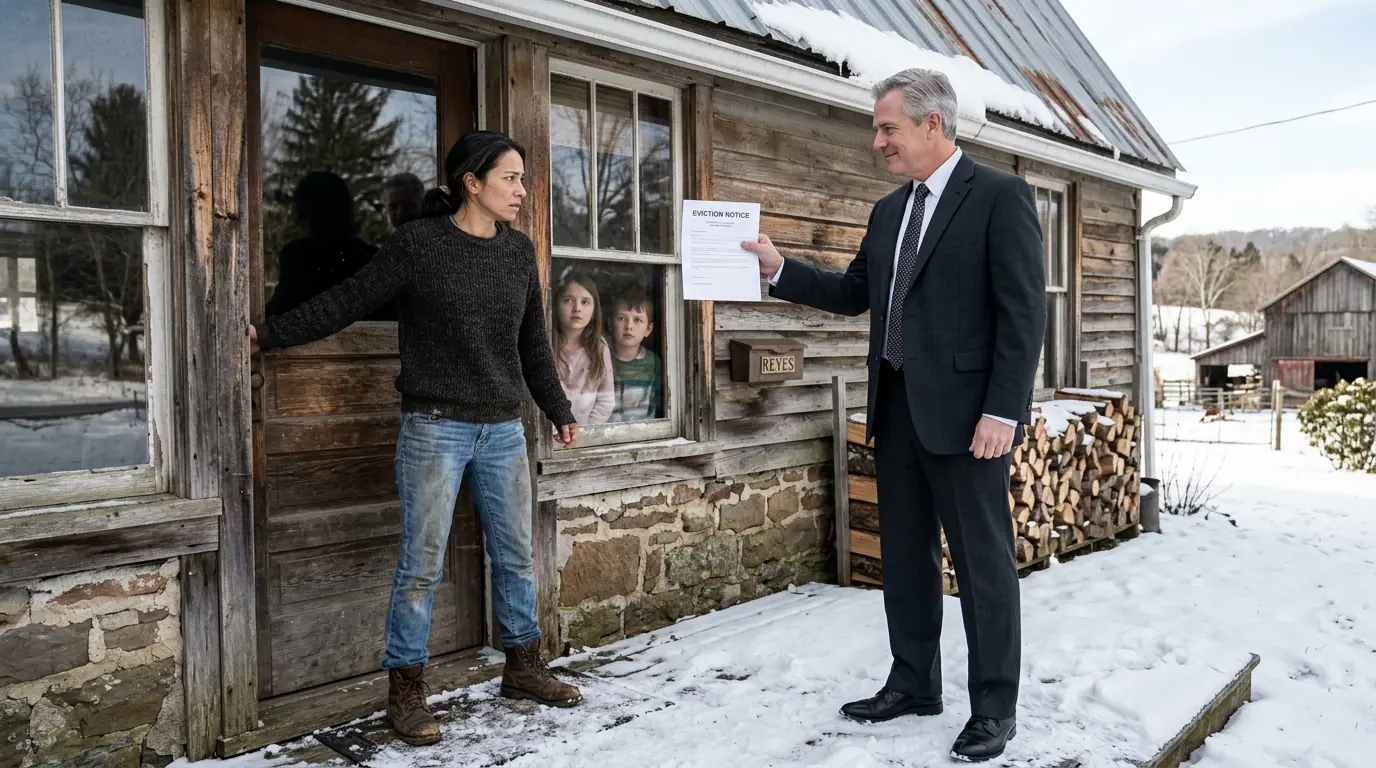
Not because she forgot, not because she was careless, but because every time she reached for it, her hand stopped just short like her body already knew that picking it up meant having to face a number she couldn't fix. and she had enough unfixable things piling up around her without adding one more. She was 35 years old. She worked 6 days a week at a diner called Patty's Place on Route 9, where the vinyl booths were cracked and the coffee was weak and the tips averaged out to maybe $40 on a good shift. She had two kids, Eli, who was eight and already too serious for his age, and Rosie, who was six and had asthma that got worse every time the weather changed. She had a rented farmhouse on the edge of Blackwater, Pennsylvania that cost $900 a month and was worth maybe half that.
She had a 2009 Honda Civic with a cracked serpentine belt. She'd been nursing along with prayer and denial for 4 months. And she had $342. That was it. That was the whole picture.
The storm had started on a Tuesday. By Wednesday morning, the National Weather Service was calling it historic. By Wednesday night, the power was gone. By Thursday, the night the story really begins, the temperature inside Naomi's farmhouse had dropped to 41°, and Eli had dragged every blanket in the house to the living room floor and built his little sister a nest beside the fireplace where Naomi was burning the last of a broken wooden chair she'd found in the barn. She stood in the kitchen wearing two sweaters and a coat, staring into the freezer. half a bag of frozen peas, one chicken breast, a container of leftover rice from two days ago, and four slices of bread on the counter that were starting to harden at the edges.
She'd already eaten less than her children twice that week. They didn't know. She made sure they didn't know. When Rosie asked why Mama wasn't eating her soup, Naomi said she'd eaten earlier at work. She hadn't.
The diner had closed early because of the incoming storm. And Patty, her boss, a woman whose generosity had hard edges, had sent everyone home without pay for the missed hours. Naomi closed the freezer. She picked up her phone. 14% battery.
No Wi-Fi since the power went out. One bar of data that flickered in and out. She opened the calculator app. She did the math she'd already done a 100 times in her head. The math she kept hoping would come out different if she just ran it one more time.
Rent was due in 8 days, $900. Rosie's inhaler prescription needed refilling $47 with the discount card because the insurance Naomi had through the diner had a $500 deductible she hadn't touched yet this year. Eli's winter boots had a hole in the left sole. She'd been covering it with duct tape. The duct tape was no longer holding. $342.
She pressed the home button and the screen went dark. Mom. Eli was standing in the kitchen doorway holding a flashlight. Rosie's coughing again, he said. Naomi didn't hesitate.
She moved. Rosie was sitting up in her blanket nest, breathing in the shallow, rapid way that always made Naomi's chest seize. Not a full asthma attack, not yet, but the kind of breathing that was a warning shot. A reminder of what could happen. Hey, baby.
Naomi knelt beside her daughter and pressed her palm to the little girl's forehead. No fever. Good. You doing okay? My chest feels tight, Rosie said quietly.
I know. Naomi rubbed slow circles on her back. I know it does. Breathe with me. Okay, slow and easy.
Eli sat down cross-legged beside his sister without being asked, without a word, and took her hand. 8 years old and already he understood that some moments didn't need words. They just needed presence. Naomi watched her son hold her daughter's hand in the firelight and felt something move through her chest that she didn't have a name for. Something that was love and grief and pride all tangled together so tightly she couldn't separate them.
They're okay. She told herself. They're okay right now. Right now is what matters. She got Rosie's inhaler from her coat pocket.
The one with two puffs left in it, maybe three, and helped her use it. Then she stayed on the floor beside them, her back against the couch, listening to the storm howl against the windows and watching the fire burn lower. She was calculating again how many pieces of the chair were left when she heard it. At first, she thought it was the wind. The wind had been doing strange things all night, groaning around the corners of the house, rattling the storm shutters, making sounds that didn't quite sound like wind.
So, when the new sound started low and distant and rhythmic, she dismissed it. Then it got louder. Eli lifted his head. "Mom," he said slowly. "What is that?" Naomi stood up.
The sound was coming from outside, from the road, from multiple directions at once. A deep mechanical thunder that was building and building, getting closer, getting louder, rattling the single pane windows in their frames. Engines. Not one engine, not two or three. Dozens of engines.
"Stay here," Naomi said. She kept her voice even. She kept her voice the way she always always kept her voice around her kids steady like the floor beneath them was solid even when she knew it wasn't. She grabbed the flashlight from Eli's hand and went to the front window. The sight stopped her breathing.
Headlights. A river of headlights coming up her gravel road through the blizzard two lanes wide, stretching back so far she couldn't see where they ended. The beams cut through the snow like something out of a fever dream. And underneath the headlights, the low growling, unmistakable roar of motorcycle engines. Not 10, not 20.
She lost count after 60. Mom. Um. Eli had appeared behind her despite being told to stay put because he was eight and curious. And this was apparently louder than obedience.
Go back to Rosie, Naomi said. But what is Eli? She turned and looked at him. One look. He went back.
Naomi stood at the window for three more seconds. Then she made a decision that most people would call reckless and a handful would call brave and which she would later describe as simply having no other option. She put her hand on the doorknob and she opened the front door. The cold hit her like a wall. Snow swirled into the entryway.
The roar of engines was suddenly enormous, surrounding the whole house. And at the front of the line, pulling up onto the gravel closest to her porch, was the biggest motorcycle she'd ever seen in her life, ridden by the biggest man she'd ever seen in her life. He cut the engine. Silence rushed in behind it, the relative silence of wind and snow, and the rider swung off the bike with the practiced ease of someone who'd been doing it for 40 years. He was enormous, 63, maybe 6'4. gray hair pulled back, gray beard face weathered to the texture of old leather.
He wore a thick black jacket covered in patches she couldn't read in the dark. And he moved toward her porch with both hands visible and open at his sides. Behind him, engines began shutting off one by one, rippling back through the line like dominoes falling in slow motion. The silence that replaced them was almost startling. The big man stopped at the bottom of her porch steps and looked up at her.
"Evening, ma'am," he said. His voice was deep and unhurried. The kind of voice that had stopped being in a hurry a long time ago. I'm going to be very straight with you, he said, because I think you deserve straight right now. My name is Boonee Walker.
I'm the road captain for a group of about 98 riders. We were coming back from a veterans benefit ride in Pittsburgh when this storm moved faster than anybody forecast. We've been on the road for 4 hours. Three of my guys are showing signs of hypothermia. Every motel and shelter between here and Harrington is closed or full.
The roads ahead are blocked. State police confirmed it 20 minutes ago. There is no moving forward tonight. He paused. I saw your light from the road.
Naomi stared at him. He waited. He didn't push. He didn't step forward. He just waited like he understood he'd landed something enormous on her doorstep and he was giving her the time to process it.
How many? She finally said 98. She almost laughed. Not from humor, from the sheer geometric impossibility of it. 98 people.
Yes, ma'am. In this house. I understand it's a lot to ask. His voice didn't apologize, but it wasn't hard either. It was just honest.
I've got guys who served two, three tours overseas. Guys who have been sober for 10 years. Guys with grandkids. He glanced back at the line of riders standing silent in the snow. We're not what people think we are when they see the patches, but I can't prove that to you standing on a porch.
You're going to have to make a call. Naomi looked past him at the army of massive leather-clad strangers standing motionless in her driveway in a blizzard. She thought about Rosie's shallow breathing. She thought about $342. She thought about what Eli would do if something happened to her.
And then, and she could never fully explain this part, not even years later. She thought about the way Boonee Walker had said, "I think you deserve straight right now." As if her dignity was a thing he'd noticed. And decided to respect even before he knew whether she'd help him. She stepped back from the door. "Get your hypothermia cases inside first," she said.
"Then we'll figure out the rest." Boone looked at her for one long moment. Something moved across his face. Not relief exactly, more like recognition. Yes, ma'am, he said quietly. Thank you.
The next 40 minutes were the strangest of Naomi's life. She'd lived 35 years, and she'd seen a lot of things she hadn't expected. But she had never in any version of any future she'd imagined, stood in her kitchen, boiling water, and listening to the sound of nearly 100 motorcycle boots filling her living room, her hallway, her front porch, the barn. She never used anymore. They were enormous, most of them. big men with big shoulders and ink running up their necks and names like Crash and Dutch and T-Bone that sounded like they belonged in a movie, but they moved through her house like they were aware, acutely, carefully aware that they were guests.
Nobody touched anything that wasn't offered. Nobody raised their voice. They sat on the floor when there were no chairs. They pressed against walls to make room. Three of the riders who'd shown the worst hypothermia symptoms were brought into the kitchen and wrapped in everything Naomi owned that could pass as a blanket, including the Afghan her grandmother had made, which she handed over without letting herself think too hard about it.
A man who introduced himself as Doc, not a real doctor, just what they call me. I was a field medic in Iraq, was already moving through the house, doing a systematic check of every rider. Eli had appeared again. He was standing in the kitchen doorway staring. Eli.
Then, because he was his mother's son, he squared his 8-year-old shoulders and went. Naomi turned back to the stove. She had one chicken breast, frozen peas, rice, and a lot of water. She started doing the arithmetic of what she could stretch it into. A hand appeared beside her, a massive hand covered in tattoos, and set a duffel bag on the counter.
"Don't touch your food," said the man attached to the hand. He was enormous with a shaved head and a jaw like a block of granite, and he was looking at the bag rather than at her like he was trying to make this easier. "We've got supplies. road food mostly. Not fancy, but there's enough. Naomi looked at the bag.
I wasn't going to take your food, she said. I know you weren't. He still didn't look at her. I'm offering it. He unzipped the bag and stepped back.
She opened it. Granola bars, jerky, instant oatmeal packets, a family-sized bag of trail mix, two cans of soup, a box of crackers, three apples that were slightly bruised but whole. Naomi stared at the apples. She couldn't explain later why the apples were the thing that got to her. They just were.
"Thank you," she said, and she said it in a voice that meant more than the words covered. "Name's Big Ray," the man said and walked out of the kitchen. "" By 9:00, Naomi's farmhouse held 98 bikers and two children and one woman who kept moving because stopping meant thinking, and thinking meant feeling, and feeling meant the risk of completely falling apart in front of strangers. She distributed water. She heated soup. She pointed people toward the one bathroom and apologized for the water pressure and got a universal shrug in response.
These were people who had apparently slept in far worse conditions and found the whole thing perfectly reasonable. Rosie had woken from her doze and was now sitting on the living room floor wrapped in her blanket, staring at the enormous tattooed men arranged around her with the focused intensity of a scientist observing a new species. A biker with a silver hoop earring and a beard down to his chest caught her staring. "What?" he said. "You have a spider on your arm," Rosie said.
He looked down at his forearm tattoo. "Yeah, that's Charlotte." "Like Charlotte's web." He blinked like that was the last thing he'd expected. "Yeah, actually, exactly like that. My mom reads us that book," Rosie said. The spider dies at the end.
I cried for a whole day. The man whose road name was Spider-Man, which he did not share with the six-year-old, looked at Rosie for a long moment. Then he sat down cross-legged on the floor across from her so he wasn't looming and said, "Me too, kid. Me too." Naomi watched from the doorway and felt something shift in the room. It wasn't dramatic.
It was quiet. The way the temperature in a space changes before you can pinpoint why, just a subtle settling, a loosening of something that had been pulled too tight. These men were afraid of nothing, but they were being gentle with her daughter. It was Boone who found the bills. He hadn't been looking for them.
He'd asked Naomi where he could find a broom. A pipe had dripped on the hallway floor, and he wanted to deal with it, and she'd pointed him toward the closet near the kitchen, and the stack of envelopes on the counter near the closet was impossible not to see, because it had been there long enough to develop its own gravity, pulling her eyes toward it every time she passed. He didn't say anything about it then, but later when the house had gotten quieter, Ryder sleeping in every available space, the storm still hammering outside, he found her in the kitchen, sitting at the table with her hands flat on the surface and her eyes closed, not sleeping, just existing in the only quiet she'd had all day. He pulled out the chair across from her and sat down. She opened her eyes.
"You didn't sleep," he said. "It wasn't a question." "I don't sleep much," she said. He nodded. He was quiet for a moment. Then he said, "How long has the heat been out?" She looked at him.
"I noticed the fireplace," he said. "And the coats inside the house and the bills." "You shouldn't have." "I wasn't prying," he said quietly. "I just see things. It's a habit from a long time ago when seeing things was how you stayed alive." Naomi looked at her hands on the table. "3 days," she said.
"Heater's been out 3 days. You've been managing on the fireplace. We were fine. I didn't say you weren't, he said. And somehow that was worse than if he had the absence of the argument the way he just let her defensiveness sit there without fighting it.
She looked up at him. What do you want me to say, Mr. Walker? Nothing, he said. I'm not looking for a confession. I'm just He paused.
I grew up in a house where the heat was out for longer than 3 days and my mother wore two coats indoors and told us she wasn't cold. He stopped. I was nine before I understood she was lying to protect us. Naomi didn't say anything. How long?
He said, "Have you been skipping meals?" The question landed like something physical. She hadn't told anyone. Not her sister in Ohio. Not Patty at the diner. Not the social worker who'd done a routine check-in 3 months ago when Rosie's school had flagged a concern about her weight.
She'd answered all the questions correctly, smiled at the right moments, sent the social worker away satisfied. She hadn't told a single person. "I don't know what you're talking about," she said. Boone looked at her for a long time. His face was unreadable in the way of people who've learned to keep things inside because the outside world wasn't a safe place to put them.
Okay, he said and he stood up. He walked to the counter where the granola bars were and picked up three of them and set them on the table in front of her. Good night, Ms. Reyes, he said, and he walked out of the kitchen. Naomi stared at the granola bars. She ate all three.
At 2:30 in the morning, she was woken by a sound she couldn't place. She'd fallen asleep at the kitchen table, her head on her arms. She sat up fast, heart hammering, the way she always woke, immediately alert. immediately cataloging threats, the reflexes of someone who had been the only adult in the house for 4 years. The sound was coming from outside. She followed it through the dark house, stepping over sleeping bikers in the hallway in the living room on every flat surface and pushed open the front door.
The storm had died down. The snow had stopped. The air was brutally cold and absolutely still. And on her roof in the 3:00 in the morning darkness with flashlights clenched between their teeth and tools she didn't own. Three bikers were sealing the gaps in her shingles where snow had been leaking through.
She stood in the doorway in her coat and stared up at them. One of them noticed her and pulled the flashlight out of his mouth. "Sorry if we woke you," he said like this was a perfectly normal thing. Boone said to wait till the storm broke. Couldn't sleep anyway.
"You're fixing my roof," Naomi said. "Yes, ma'am. in the middle of the night. It's the best time. No wind. She stood there another moment.
"Can I bring you coffee?" she said. "I have instant." A pause. "That'll be real nice," the man said. She went back inside and made three cups of instant coffee in the dark and brought them out in the cold and handed them up to men she didn't know who were fixing something she hadn't asked them to fix. And the only words any of them said were, "Thank you, and you're welcome." And somehow that was enough.
She went back inside. She sat in the chair by the dying fire. And for the first time in longer than she could honestly remember, Naomi Reyes closed her eyes and slept without dreaming about money. morning came gray and cold and quiet. The storm was completely gone. The world outside was buried in white.
And in Naomi's farmhouse, 98 bikers were beginning to wake up slowly, stiffly, the way large men wake when they've been sleeping on hardwood floors. She'd expected awkwardness. She'd expected the strange morning after quality of people who'd shared something intimate under circumstances and now had to face each other in daylight. She'd expected, if she was honest, for the clarity of morning, to make these men seem frightening again, in a way the crisis of the night had temporarily suspended. Instead, what happened was this big ray found Naomi's leaking bathroom pipe and fixed it with tools from his saddle bag, whistling quietly to himself.
A writer named Church, who had enormous hands in a gentle manner, spent 45 minutes sitting beside Rosie, checking her breathing and asking calm, specific questions that told Naomi he had been around asthma before a lot of it. His daughter, he said quietly when she asked. His daughter had it worse than Rosie. Eli had somehow been recruited into helping a group of bikers in the barn. Where they were, she discovered when she went to check chopping the dead wood from her fallen fence into fireplace logs, enough to last her 3 weeks.
She stood at the barn door and watched her son bundled in his coat, trying to swing an axe under the careful supervision of a biker named Dutch, who was built like a wardrobe, and moved the axe like it weighed nothing. "Other hand higher," Dutch was saying. "There you go. See how that feels different." Eli swung the woodsplit perfectly. He turned to Dutch with a look of absolute incandescent pride.
Dutch held up a hand for a high five. "You're a natural kid." Naomi leaned in the doorway and watched her son laugh. She couldn't remember the last time she'd heard him laugh like that, full and unguarded and completely unself-conscious. He was 8 years old, and he'd already learned to be careful. Careful with his mother's worries, careful with Rosie's health, careful with hope.
But right now, he was just a boy who had split a log perfectly, and the whole world had shrunk to that single moment of uncomplicated joy. She turned away before he could see her face. By noon, the state police had confirmed that the main roads were open. Boone gathered his riders with a low whistle that carried through the farmhouse and the barn with the efficiency of a signal they all knew. Within 15 minutes, they were assembled outside, bikes, ready gear loaded.
The transformation was startling. The same men who'd been sprawled on her floors were suddenly organized, purposeful, crisp. Boone came to find her. He pulled an envelope from the inside of his jacket and held it out. for the inconvenience, he said. Naomi looked at the envelope.
I don't want your money. It's not for you, he said. It's for Rosie's inhaler. She looked up at him. Doc checked her this morning.
Boone said she needs a refill. And he said the one she's got is running low. Naomi stared at the envelope. She wanted to say no. Every instinct in her had been trained by four years of single parenthood to refuse help because accepting it meant acknowledging she needed it.
And acknowledging she needed it meant confronting how close to the edge she actually was. And she couldn't afford to do that and keep functioning. But she thought about Rosie's tight chest in the fire light the night before. She took the envelope. Thank you, she said.
Boone nodded. He started to turn away then stopped. Naomi. It was the first time he'd used her name. this town you're in, Blackwater," he paused. "People been good to you here." She considered lying.
She'd gotten very good at the particular kind of lying that involves saying fine when someone asks how you're doing. "It's a small town," she said instead. Boone looked at her for a long moment. "That's not a yes." "No," she agreed. "It's not." He was quiet.
Something moved behind his eyes that she couldn't read. Not anger exactly, but something adjacent to it. something old and very certain. "Okay," he said. He turned and walked to his bike. 98 engines started up one by one until the air was full of thunder again, and then they were gone.
Naomi stood in her driveway in the snow and watched the last tail light disappear around the bend in the road. The silence they left behind was the loudest thing she'd ever heard. She stood there until her feet went numb. Then she went inside to figure out what was left of her life. She didn't know yet that what was left of it was about to be taken piece by piece by people who'd been waiting years for the right excuse.
And she didn't know yet that a gray-haired man on a motorcycle somewhere on a Pennsylvania highway had just made a phone call. A phone call that would set something in motion that the town of Blackwater had no way of preparing for. The envelope Boone had given to her contained $400 in cash. Naomi had counted it three times standing in her kitchen like the number might change if she looked at it long enough. It didn't. $400 more money than she'd held in her hands at one time in over a year.
Enough for Rosie's inhaler. Enough for groceries. Enough to keep the lights on for another month if she was careful. And she was always careful. She'd put it in the coffee can above the refrigerator where she kept her emergency fund, a fund that until this moment had contained exactly $11 and some change. and she'd stood there with her hand on the can and let herself feel for just a few seconds something that was almost like breathing room.
Then her phone rang. It was Linda Marsh from Two Roads Over. Linda was the kind of woman who knew everything about everyone in Blackwater and had strong opinions about all of it. Delivered with a cheerful efficiency of someone who had decided long ago that other people's business was her primary occupation. Naomi.
Her voice was bright in the particular way of someone who has news they can barely contain. I heard you had some visitors last night. Naomi set the coffee can back on the shelf. Roads were blocked. They needed somewhere to wait out the storm.
Hell's Angels, though. A pause that was doing a lot of work. You know who they are, right? What they do. They were veterans on a charity ride, Naomi said.
They fixed my roof. Honey. Linda's voice shifted into something softer and more dangerous. The tone of someone who has decided your problem is actually her concern. I'm just saying people talk and in a town this size, people have been talking since about 6:00 this morning.
Naomi said goodbye and hung up. She stood very still in the kitchen. Then she picked up her keys and drove Rosie to the pharmacy to get her inhaler refilled before anything else could happen. She would later understand that the damage was already done before she'd even gotten in the car. The pharmacy was a 12-minute drive into town.
She made it in 9. Rosie sat in the passenger seat with her backpack on her lap, humming something that might have been a song she'd invented, occasionally touching the fogged up window with one finger and drawing shapes. The pharmacist, a quiet man named Gerald, who'd been filling Rosie's prescriptions for 2 years, wouldn't quite meet Naomi's eyes when he handed over the inhaler. She noticed. She didn't say anything.
She took the inhaler and paid and thanked him and walked out. In the parking lot, she passed two women from the school district she knew by face, if not by name. They were looking at her. When she met their eyes, they looked away. Both of them at the same time.
The way people do when they have been talking about you and haven't finished. Mom, Rosie said, slipping her hand into Naomi's. Those ladies were rude. They're just busy, Naomi said. They were staring.
Don't worry about it. Rosie was quiet for a moment. Then, is it because of the motorcycle men? Naomi stopped walking. She looked down at her daughter, 6 years old, asthma lunged, sharper than anyone gave her credit for, and felt something move through her chest that she couldn't name.
"No," she said. "It's not about anything." Rosie looked up at her with the calm, unblinking certainty of a child who knows when she's being protected from the truth. "Okay, mom," she said. She kept holding her hand all the way to the car. Naomi was back at work by Thursday afternoon.
The storm had passed. The diner had reopened and she needed the hours she always needed the hours. Patty's place was warm and smelled like coffee and bacon grease and the particular brand of small town familiarity that Naomi had once found comforting and now found slightly suffocating. She tied on her apron clocked in and started her section. The first table she approached went quiet when she walked up. four women regulars, the kind who came in every Thursday for the soup special, and talked loudly enough that Naomi had over two years of serving them learn more about their families than she'd ever wanted to know.
They looked up at her with the same expression she'd seen in the pharmacy parking lot, that particular combination of curiosity and judgment that people wear when they've decided something about you. Morning, ladies. Naomi said the usual. Naomi, the one who spoke was Donna Crane, whose husband was on the town council. Her voice was carefully neutral in the way that isn't neutral at all.
Is it true you had gang members at your house? Naomi kept her face completely still. Two years of waitressing had given her a face that could absorb almost anything without showing it. I had stranded veterans shelter from a blizzard, she said. Yes, Hell's Angels aren't veterans.
They're a criminal organization. Several of them are both, Naomi said evenly. The soup today is beef barley. Can I get you started with that? Donna Crane looked at her for a long moment.
I don't think it was wild, she said finally, exposing your children to that kind of element. Naomi wrote down the orders and walked away. She made it to the kitchen before her hands started shaking. She stood at the pass through and pressed both palms flat against the stainless steel counter and breathed through her nose until the shaking stopped. It took longer than she would have liked.
"You okay?" said the cook, a teenager named Marcus, who was the only person in the building who seemed unaware that anything was wrong. "Fine," Naomi said. "Table four wants the soup special, all four of them." "Got it," she went back out on the floor. She got through the rest of her shift by becoming very small inside herself, retreating to that internal place she'd learned to find when things got bad, a place that was quiet and narrow and required very little feeling. She smiled when she needed to smile.
She refilled coffee when coffee needed refilling. She said, "You're welcome and have a great day and let me know if you need anything on a loop that required nothing from her." At 4:30, Patty called her into the back office. Patty was a 60-year-old woman with red hair that came from a box and reading glasses that lived on top of her head and a directness that Naomi had always respected, even when it cut against her. "Sit down," Patty said. Naomi sat.
Patty didn't sit. She stood behind her desk with her arms crossed and her expression doing something complicated. Something that looked like guilt trying to hide behind practicality. I've had four calls today, Patty said. From customers about the situation.
The situation, Naomi repeated. The bikers, the Patty waved a hand. All of it. I help stranded people survive a blizzard. Naomi said, "That's a situation.
I know that's how you see it. That's how it was." Patty pressed her lips together. "Naomi, I've got a business to run and I've got customers telling me they're not comfortable." "Not comfortable," Naomi said. Coming in knowing that my staff is is what Naomi said. And something in her voice had shifted.
Something quiet had come into it. something that was the opposite of retreat. Is what? Patty, what exactly am I that makes your customers uncomfortable? Patty was quiet for a moment. I need to let you go, she said.
Effective end of today. The words fell into the room and sat there. Naomi looked at the woman who'd employed her for 2 years, who'd given her Thanksgiving leftovers twice, who'd let her adjust her schedule twice when Rosie was in the hospital, and she waited for something to make sense. Nothing did. I'll have your check ready Friday, Patty said.
Naomi stood up. She untied her apron. She folded it carefully because she was not going to give this woman the satisfaction of seeing her throw it and she set it on the desk and she walked out without another word. She sat in her car in the parking lot for 11 minutes. Then she drove home.
The letter from her landlord was in the mailbox. Ray Gunderson had owned the farmhouse for 30 years and managed it with the benign neglect of someone who collected rent checks and preferred not to think too hard about the properties generating them. He was not as landlords went the worst. He fixed things when she asked mostly. He hadn't raised the rent in 2 years.
She believed in the cautious way she allowed herself to believe things that she was safe there. The letter was two paragraphs. The first paragraph cited a clause in her lease about maintaining the character and safety of the property and refraining from activities that could attract criminal elements or create liability for the owner. The second paragraph gave her 30 days. Naomi read it standing in the driveway.
She read it again. Then she folded it very precisely along its original crease and went inside and put it on the counter next to the other envelopes. The stack was getting taller. She stood in the kitchen for a long time without moving. Then she called her sister in Ohio.
Dana picked up on the second ring with a cheerful, "Hey, you." That immediately became something else when she heard the silence on Naomi's end. "What happened?" Dana said. "I got fired today." "Oh, nay. And my landlord is evicting me." A pause. "For what?" "For letting stranded veterans sleep on my floor during a blizzard." Another pause longer.
"I'm coming down there. You're not coming down here. Naomi. Dana. I'm fine.
I just needed to say it out loud to someone. Naomi's voice was steady. She was good at steady. She'd had a lot of practice. I just needed one person to know.
You need more than that. You need a plan. You need I know what I need. Naomi said. I'll figure it out.
She said goodbye and hung up. She looked at her phone. 2% battery. She plugged it in. She went to check on the kids.
Eli was at the kitchen table doing homework. Rosie was on the living room floor with her crayons drawing something complicated that involved, as far as Naomi could tell, a lot of motorcycles. "Mom," Rosie said without looking up. "Did you know that Spider-Man's real name is Kevin?" Naomi stopped. "How do you know his real name?" "He told me." Rosie added a wheel to one of her Crayon motorcycles before they left this morning.
He came and said goodbye. He said his daughter's name is Emma and she's seven and she likes horses. Naomi crouched down beside her daughter. He came to say goodbye specifically. Mhm.
Rosie added flames to the side of the motorcycle. He said I was brave for asking about his tattoo. She looked up. Was I brave? Yeah, baby.
Naomi said you were. Rosie smiled and went back to her drawing. Naomi stood up. She looked at the crayon motorcycles filling the page and felt something not sentimentality, not nostalgia, but something more complicated and more urgent gathering at the back of her throat. Then her phone buzzed.
Unknown number. She almost didn't answer. She answered, "M Reyes," a woman's voice clipped and professional. "This is Janet Hollis from the Blackwater County Department of Child and Family Services. We've received a report regarding the welfare of your children.
I'd like to schedule a home visit at your earliest convenience. The room went very quiet around Naomi. A report, she said. Yes, ma'am. Regarding potential exposure to criminal activity and concerns about adequate housing and nutrition.
Naomi kept her voice completely flat. It was the only way she knew to manage the thing rising in her chest. Who filed the report? She said, I'm not able to share that information. When can you come?
We prefer within 48 hours when a report has been filed. Fine, Naomi said. Come whenever you need to, she ended the call. She stood in the kitchen and looked at the stack of envelopes and thought with the clarity that was almost peaceful. Someone is doing this deliberately.
Not one thing. Not Linda Marsh gossiping, not customers complaining to Patty, not her landlord's sudden concern for liability. all of it together within 48 hours of the bikers leaving her driveway. Someone had decided to bury her and she didn't even know who yet. She found out the next morning. She'd been up since 5 cleaning, not because the house was dirty, but because she needed her hands to be doing something specific and controllable while her mind worked through everything else.
She scrubbed the kitchen floor. She organized the cabinets. She made sure Rosie's bedroom was immaculate, that the bathroom had clean towels, that there was nothing nothing that a child services investigator could point to as evidence of anything. At 7:15, there was a knock on her door. She opened it expecting a neighbor or possibly Janet Hollis arriving early.
It was a man in a suit, mid-50s silver hair, the particular kind of soft that comes from having things other people want. He was holding a business card between two fingers like an offering. Ms. Reyes. He said, "Harold Pike. I'm on the Blackwater Town Council.
I wonder if I could have a few minutes of your time." She knew his name. Everyone in Blackwater knew Harold Pike's name. He'd been on the council for 12 years, ran the biggest real estate development company in the county, and had a reputation for getting what he wanted with the patient, methodical efficiency of someone who had never had to hurry because time always ran in his direction. She also knew in the way you know things in a small town without ever being told directly that Harold Pike had been trying to buy the land her farmhouse sat on for 2 years. The land backed up to a creek.
The creek bordered a parcel he was developing into something with the words luxury and retreat in its name. Her landlord had mentioned it once off-handedly. The way people mention things they have already decided don't concern you. She looked at Harold Pike on her porch and understood completely and immediately that the events of the past 48 hours had his fingerprints all over them. "Mr. Pike," she said.
"I know who you are." "Then you know I'm someone worth talking to." He smiled. It was a good smile, the kind that had been practiced until it looked natural. "May I come in?" "No," she said. A flicker behind the smile. "Just a flicker.
This doesn't have to be difficult, Ms. Reyes. What doesn't your situation? He tucked the business card back into his jacket pocket with the calm of someone who'd done this before. I understand you're facing some challenges right now. Housing instability, employment issues.
I'm in a position to help. How I'm prepared to offer you a very fair relocation package, he said. Enough to get you and your children to settled somewhere more suitable. A fresh start. New town, new school for the kids, the resources to actually make something work.
Naomi stared at him. You did this, she said. All of it. The report to child services, my landlord. I help people understand their interest, he said pleasantly.
Patty, a pause. Small business owners make their own decisions. You want my land, Naomi said. My landlord's land. and you used what happened the other night to manufacture a reason to force us both out. Harold Pike looked at her for a long moment.
When he spoke again, the practice pleasantness was still there, but something underneath it had shifted something that was harder and more patient and much less interested in the performance. I want you to think carefully, he said, about what your position actually is right now. No income, facing eviction, child services, opening an investigation, bank probably not far behind given your payment history. He let that sit. I'm offering you a way out that leaves you with something.
If you wait, if you make this difficult, you'll leave with nothing, and your children will leave with nothing. Naomi held the door. She looked at Harold Pike, this man in his good suit, with his good smile, who had in less than 48 hours systematically dismantled every fragile structure she had built around her children's survival. "Get off my property," she said. Something moved across his face.
"Not anger, something colder than anger." "Think about what I said," he told her. She closed the door. She stood in the hallway with her back against the door and her eyes closed and her heart slamming against her ribs with the force of something trying to get out. Then she heard Rosie in the kitchen asking Eli if he wanted cereal. She pushed off the door.
She went to the kitchen. She made her children breakfast and sat with them while they ate and asked Eli about his homework and listened to Rosie explain the complicated mythology of the motorcycle drawings she'd been making, which had apparently developed into an entire saga with named characters and ongoing plot. She laughed at the right moments. She kept her voice steady. She was excellent at this.
And underneath all of it, moving through her like cold water through a cracked foundation, was the knowledge that Harold Pike was right about one thing. She was almost out of road. The child services visit happened the next afternoon. Janet Hollis was a small precise woman in her 40s who carried a clipboard and wore an expression of careful neutrality that gave nothing away. She walked through the farmhouse methodically asking questions in a calm, unhurried voice while Naomi followed beside her and answered everything directly.
The house was clean. The refrigerator was stocked. She'd spent $60 of Boone's money on groceries the night before, hating herself for the calculation and doing it anyway. Rosie's medication was in order. Eli's schoolwork was on the table.
Every surface that could be explained was explainable. Janet Hollis made notes. At the end of the walkthrough, she sat down at Naomi's kitchen table and folded her hands on her clipboard. Ms. Reyes, she said, I want to be direct with you, please. The report that was filed was specific, as she said, detailed.
The kind of specific that suggests someone with particular knowledge of your circumstances. Naomi waited. The concerns about the children's welfare don't appear to be substantiated by what I'm seeing today. She paused. However, the report also included documentation, financial records, employment status.
She looked at Naomi carefully. How that information was obtained is something I find concerning. Not about you. Naomi felt the air shift. What are you saying?
She said, I'm saying that in my 11 years doing this job, I have occasionally seen this process used as a tool. Janet Hollis spoke carefully like someone who has learned to be precise about which things they can say out loud. I can't act on that, but I can tell you that the report itself is weak, and I will be documenting what I observed today accurately. Naomi looked at this woman, this quiet, careful woman with her clipboard and her neutrality. That wasn't as complete as it appeared.
"Thank you," Naomi said. "Don't thank me yet," Janet said. "If someone is determined to make your life difficult, one visit won't stop them." She stood up and gathered her things. "Do you have anyone in your corner, Ms. Reyes?" Naomi thought of Dana in Ohio 6 hours away. She thought of Patty, who had folded in under 48 hours.
She thought of Boonee Walker driving away on a Pennsylvania highway. I'm working on it," she said. Janet Hollis nodded once like that was a reasonable answer. She left. Naomi sat at the kitchen table after she was gone and put her face in her hands.
She didn't cry. She'd gotten very good at not crying because crying was a luxury that required someone else to be there to see it. And she was almost always alone. She just sat there in the silence of her clean kitchen in her crumbling farmhouse and let herself feel for exactly 60 seconds how completely exhausted she was. Then she lifted her head.
She picked up her phone. She didn't have Boonee Walker's number. He hadn't given it to her. She hadn't asked for it because why would she have? They were strangers who'd shared a Blizzard, not people with ongoing connection.
But she remembered the name, Boonee Walker, road captain. She typed it into the search bar. She wasn't sure what she was looking for. She wasn't sure she had a plan. She had a suspicion growing stronger by the hour that whatever was coming next was bigger than she could handle alone and that somewhere on a Pennsylvania highway was the only person who'd looked at the full truth of her situation and not flinched.
She typed. She found a chapter of the wage, a contact form for veterans benefit ride coordination. She stared at it for a long time. She started typing. She got three sentences in before her phone buzzed in her hand.
An incoming call number she didn't recognize. Different from the child services number. She answered, "Naomi Reyes." A man's voice. Older grally, not Boonee. Yes.
My name is Roy Hardin. I'm the loan officer at at First County Bank. I'm calling regarding the mortgage on the property at I rent. Naomi said. I don't have a mortgage.
A pause. Yes, ma'am. I'm aware you rent. I'm actually calling regarding a conversation I had today with the property owner, Mr. Ray Gunderson. Another pause.
Longer this time. He's agreed to sell the property to a development company. The closing is scheduled for 3 weeks from Friday. 3 weeks. 30 days from her landlord's letter.
3 weeks to closing. That's not enough time. Naomi said. I understand this is difficult news. Where am I supposed to go?
Her voice stayed flat, but something underneath it had cracked. Just a hairline fracture invisible to everyone but her. I have two children. 3 weeks is not enough time. I'm sorry, Ms. Reyes, the man said, and he sounded like he meant it, which made it worse.
I thought you deserve to hear it directly. She said thank you because she'd been raised to say thank you and hung up. She sat very still. Three weeks, no job, no savings beyond $400 that needed to cover a prescription and groceries and G eviction in 30 days sale closing in three weeks. Child services watching Harold Pike somewhere in the background, patient as geology waiting for her to run out of road.
She looked at the contact form still open on her phone. She finished the three sentences. She wrote three more. She typed her phone number at the bottom. She pressed send.
Then she put her phone face down on the table, got up, and went to start dinner for her kids because whatever was happening around her, whatever was closing in from every direction, her children were going to eat tonight. She was still at the stove when her phone lit up on the table. A text, unknown number, four words, "We're already on the way." She read the text four times. "We're already on the way." No name, no explanation, no number she recognized. Just those four words sitting on her screen in the blue light of her kitchen while something on the stove was starting to bubble over and her children were arguing in the next room about whose turn it was to pick the movie.
She turned off the burner. She typed back, "Who is this?" The reply came in under 30 seconds. Boone. Doc gave me a backup phone. We've been watching the situation since we left.
Don't ask how. Just know we weren't going to leave you hanging. Naomi stared at that message for a long time. We've been watching the situation. She didn't know what that meant.
She wasn't sure she wanted to know what that meant. What she knew was that her hands had stopped shaking for the first time in 2 days and she hadn't even noticed until right now. She typed, "It's worse than you know." He replied, "Tell me." So she did. Standing at her stove with the pot still cooling and the kids still arguing, she typed it all out. Patty the landlord.
Harold Pike on her porch with his card and his calm threats. The child services visit the bank. Call the three weeks. She typed it the same way she told Dana flat flat factual. No editorializing because the facts were bad enough without decoration.
She sent it. She waited. Boone's reply was four sentences. Don't sign anything. Don't talk to Pike again.
Don't move one box. We'll be there Thursday. Naomi looked at Thursday on the calendar on her wall. 2 days. She typed, "How many of you?" The pause before his answer was longer than the others.
"Then enough." She put the phone down. She called her kids to dinner. She didn't sleep that night, but it was a different kind of not sleeping. Not the grinding panicked arithmetic. She'd been running for weeks, but something more like waiting, alert, like the air before a storm when the pressure changes and everything goes very still and even the birds stop.
Something was coming. She just didn't know yet what something meant at this scale. Yeah, man. Wednesday passed the way bad days do when you're waiting for something slowly full of small humiliations that each felt outsized against the backdrop of everything else. She went to the grocery store and felt the weight of eyes on her in the produce section.
She went to Eli's school to drop off a permission slip and the secretary behind the desk was 20 seconds slower than usual to acknowledge her. And those 20 seconds told a whole story. She drove past Patty's place and saw it was open and full, which meant the world had decided Patty's decision was the right one, which meant the world had decided Naomi's was wrong. She drove home. She applied for two jobs online.
A cleaning company in Harrington, 20 minutes away. a grocery store in Milfield 40 minutes. Both applications felt like dropping paper into a well necessary, but with no guarantee of ever hearing anything back. She called her landlord. Ray Gunderson picked up on the fourth ring with the careful voice of a man who knows the call he's receiving and has already made his peace with having to take it. Naomi, he said, Ray, she kept her voice even.
I wanted to call and ask directly. Did Harold Pike come to you or did you go to him? A long pause. He's been after that land for 2 years, Ray said. Finally.
You know that. I know. I'm asking which direction the conversation went. Another pause. Longer.
He called me, Ray said quietly. The morning after the storm. Said there had been some activity at the property. Said his attorney was looking into liability questions. Said the timing might be right to think about the offer again.
And you said yes. Naomi, I'm 71 years old. My wife has medical bills. The offer is fair. And how long did it take you to say yes, Ray?
The silence on his end was answer enough. You've been a good tenant. He said, I want you to know that. I know, she said. Goodbye, Ray.
She hung up. She sat in her car in her own driveway and stared at the farmhouse, at the roof that strangers had fixed in the middle of the night, at the firewood stacked neatly against the barn wall, at the window where Ros's crayon drawings were taped to the glass because she'd run out of refrigerator space. She thought about what it would mean to pack up everything in 3 weeks. Where she would go, how she would explain it to Eli, who had already lost so much stability in his 8 years, that another upheaval would register in his body the way cold does. getting into the joints, settling deep, taking a long time to leave. How she would tell Rosie that the farmhouse with the big yard where she liked to run was no longer theirs.
She thought about this for exactly as long as she could stand to. Then she went inside and helped Rosie with her letters and checked Eli's math homework and read them both a chapter of their book and turned out their lights. She went back to the kitchen and looked at the stack of envelopes. "Not yet," she said out loud to no one. to the stack to Harold Pike and Ray Gunderson and everyone who had decided her powerlessness was an opportunity. Not yet.
Thursday morning came in cold and clear. She'd gotten the kids to school and come back to the farmhouse and was trying to draft a letter to a legal aid organization. A letter that kept stalling because she didn't know how to explain the situation without it sounding either paranoid or too ordinary when she heard it. faint at first, then building, then unmistakable engines. She stood up so fast her chair scraped back. She went to the front window.
The road was empty, but the sound kept growing, coming from the east, from the direction of the highway, getting louder with the steady compounding quality of something very large, moving very fast. Her heart was in her throat. She pressed her hand against the glass. Then the first one came around the ben. Then the second.
Then 20. Then 50. They kept coming. They kept coming and kept coming and kept coming. And Naomi stood at her window with her hand on the glass and her heart making a sound she could feel in her teeth.
And the road filled. And then the road overflowed and they were pulling onto the shoulder and into the field beside the road. And the sound had become something total. Not just something you heard, but something you felt in your chest, in your bones, in the floor under your feet. She counted to a hundred and stopped counting.
Her phone rang. "Boone," she answered. "Look out your window," he said. "I am," she said. Her voice came out strange, compressed, like someone had squeezed the air out of it.
"1,500 riders," he said. "17 chapters, four states." A pause. "You're not alone anymore, Naomi." She pressed her hand harder against the glass. "Boone," she said. "What are you going to do?" "What we should have done before we left," he said.
"Hold on." He hung up. She watched him ride up to the front of the line, swing off his bike, and start walking toward her door. She opened the door before he knocked. He looked different in daylight than he had in a blizzard, older maybe, or just more visible. The gray in his hair was silver in the morning sun.
He had lines around his eyes that went deep, the kind that come from squinting into weather or trying to see things that don't want to be seen clearly. He looked at her the way he'd looked at her from the porch steps the first time straight on no performance. You look like yes, you haven't slept in 4 days, he said. Three, she said, close enough. He nodded at the inside of the house.
Can we talk? They sat at the same kitchen table where they'd sat in the middle of the night four days ago. And Naomi told him everything she hadn't put in the text, the details, the tone, the specific way Harold Pike had smiled when he talked about her children leaving with nothing. Boone listened without interrupting. His hands were flat on the table.
His face was completely still. When she finished, he didn't say anything for a moment. Harold Pike, he said. Town council development company. Yes, he's got the landlord.
He's got your employer. He's got child services on call. He said it like he was reading a map. What else? The bank called about the sale.
Naomi said 3 weeks to closing. The bank, not your landlord. Roy Hardin, loan officer at First County. Boone was quiet. I want to ask you something, he said.
And I need you to be straight with me. Okay. Is there anything anything about your situation that isn't clean? anything Pike could actually use if someone looked hard enough. Naomi looked at him. I've been skipping meals to feed my kids, she said.
I have $342 in my account. Well, had I have a car with a belt that's going to go sometime in the next month. I'm behind on one credit card by 60 days. She paused. That's it.
That's everything that's real. Boone held her eyes. Okay, he said. That's what I needed to know. He stood up.
He pulled out his phone and made two calls in rapid succession. Both brief, both in the shorthand of people who work with each other enough that full sentences aren't necessary. When he hung up, he looked at her with something that wasn't quite a smile, but was adjacent to one. "We're going to town," he said. "" What happened in Blackwater that Thursday afternoon would be talked about for years. The way 1,500 motorcycles move through a small Pennsylvania town was something that didn't translate to language easily.
It had to be heard and felt the way a thunderstorm has to be experienced to understand why people used to think it was the voice of something bigger than themselves. They came in orderly. Two lanes, signal lights. Every traffic law followed with a precision that was itself a kind of statement. We are not what you think we are and we will prove it by doing everything exactly right.
People came out of their houses. People came out of their businesses. Children pressed faces to school bus windows. The police chief of Blackwater, a man named Earl Pruitt, who'd been doing the job for 19 years and thought he'd seen most things this town had to offer, stood on the steps of the municipal building and watched the motorcycles fill Main Street and said out loud to no one in the particular, "Lord have mercy." His deputy standing next to him said, "Should we call the state police?" Pruitt watched Boonee Walker swing off the lead bike, look up at him, and raise one hand in greeting, unhurried, respectful, the gesture of someone who has an appointment. "No," Pruitt said.
"I think we better just hear what they have to say." Two news vans had appeared from somewhere. A local reporter Naomi vaguely recognized was already moving toward the crowd with a microphone. Someone was live streaming on a phone. Within 20 minutes, the intersection of Main and Route 9 in Blackwater, Pennsylvania, had more cameras pointed at it than it had seen in its entire documented history. Boone walked to the steps of the municipal building.
He didn't have a microphone. He didn't need one. When he spoke, his voice carried the way voices do when they're rare used to being heard over engine noise and wind. "My name is Boone Walker," he said. "I'm a veteran.
I'm a former paramedic. I'm a road captain for one of the oldest veterans charitable organizations in this country. And 5 days ago, a 35-year-old single mother named Naomi Reyes opened her door to 98 of my riders in a blizzard and probably saved three lives. He paused. The crowd, which had grown to fill the sidewalk and spill into the street, was completely silent.
In the 4 days since we left her driveway, Boone continued, Naomi Reyes has lost her job, received an eviction notice, had a report filed against her with child services, and been visited by a town council member who offered to pay her to disappear. Murmuring in the crowd, Naomi standing near the edge of it watched faces shift. "Her name is Harold Pike," Boone said. "And I've got documentation." The murmuring got louder. Harold Pike was somewhere in the crowd.
Naomi didn't see him yet, but she saw the moment people started looking for him. The way heads turned scanning that collective ripple of a group trying to locate someone. Boone reached into his jacket and pulled out a folder. Financial records showing that Pike's development company made an offer on this land two years ago. Call logs between Pike's office and First County Bank.
A timeline that puts his call to Ray Gunderson at 6:47 in the morning, less than 18 hours after we left Naomi's driveway. He held up the folder. "How we got those bank records?" Naomi said quietly to Doc, who was standing next to her. "You don't want to know," Doc said without looking at her. "I absolutely do want to know." "We have a guy," Doc said.
"He used to work in finance. He's very motivated." Boone was still talking. "This woman didn't do anything wrong. She did something right. And the town she's lived in for 4 years came after her for it." He lowered the folder.
We're not here for trouble, he said. We're here because trouble found her first. The crowd had gone completely still again. And then from somewhere near the back, a woman's voice said, I believe him. Another voice, different direction.
I know Naomi. She's a good mother. And then, because crowds have a tipping point, a moment where the direction suddenly becomes clear, and everyone who's been uncertain feels which way to fall, more voices. Not a roar, not a chant, just a layering of sound agreement, finding its volume. Chief Pruitt descended the steps.
He walked to Boone and extended his hand. I'd like to see that documentation, he said. Boone handed it to him. Harold Pike made one mistake. He'd been in the crowd from the beginning, maintaining the composure of a man who was calculating odds and had not yet concluded he was losing.
But when the chief took the folder, when the camera swung toward him in response to someone pointing, when the reporter from the local news started moving his direction with the microphone, he made the mistake of turning and walking quickly toward the parking lot. In a smaller crowd, it might have been mistaken for ordinary movement. In a crowd this size, where 1500 people who'd ridden four states to get here were watching everything it looked like exactly what it was. Naomi watched him go and felt something settle in her chest. Not triumph, not satisfaction, something quieter.
The feeling of a weight shifting, not gone yet, but no longer entirely hers to carry. Doc's hand appeared briefly on her shoulder and disappeared. "It's not over," he said. "But it's different now." "What happens next?" she said. "Right now, about 60 of our guys are in your landlord's driveway having a very calm, very polite conversation with Ray Gunderson." Naomi turned to look at him.
Boone sent them before we even got here. Boone sent them before we left Pennsylvania. Doc said he's been planning this since you sent that contact form. She stared at him. He read the contact form.
He's been monitoring the chapter email since before we left your driveway. Doc paused. He wasn't going to leave you hanging. He just didn't tell you because he didn't want to give you something to hope for that might not come together. Naomi turned back to the crowd, to the cameras, to the chief with his folder 1,500 bikers standing quietly along Main Street like the most organized, most improbable cavalry anyone had ever mustered.
He was already planning this before I sent anything," she said. "Yeah," Doc said. She absorbed that. "Why," she said. Doc was quiet for a moment, then because Boone has a daughter.
She's 32, raising two kids alone in West Virginia. And when he walked into your kitchen that night, he stopped. He doesn't talk about it, but I've ridden with this man for 20 years. I know what his face looks like when something means something to him. Naomi pressed her lips together.
She was not going to cry on Main Street in Blackwater, Pennsylvania, in front of 1500 bikers in two news cameras. She was absolutely not. Okay, she said, voice perfectly steady. What do we do right now? right now. Doc said, you let us handle the outside.
What's happening out here is already moving and the inside. He looked at her. You go get your kids from school. She blinked. What?
Go get them, he said simply. Bring them here. Let them see this. Let them see that what you did mattered enough for this many people to show up. He paused.
Let Eli see it. Naomi thought about her 8-year-old son, who had learned too early to be careful with hope. She turned and walked to her car. She drove to the school. She signed them out at the front desk with the form she filled out with hands that were entirely steady.
And she walked down the hallway to Eli's classroom and appeared in the doorway. He looked up from his desk. The first thing he did was scan her face for the thing that was wrong. That instant reflexive assessment she'd watched him develop over years. The way children learn to read their parents' faces, the way other people read weather.
He didn't find what he was looking for because her face wasn't carrying a bad news. "Come on," she said. "I need to show you something." He grabbed his backpack without questions. They picked up Rosie from the room on on the hall and Naomi drove her children back toward town. When they came around the last bend before Main Street, and the sound hit them, that wall of engines and voices and something enormous happening, Eli sat up very straight in his seat.
"Mom," he said. "I know," she said. Is that all for us?" she said. "Yes." Rosie was already pressed against the window, eyes enormous mouth open. "There's so many," she whispered.
"Yeah, baby," Naomi said. "There really are." She parked and they got out, and she took both her children's hands, one on each side, and they walked toward the crowd. "Big Ray saw them first." He was standing near the edge of the street, and when he spotted Naomi with the kids, he made a sound that was something between a whistle and a signal. and it rippled outward and within 30 seconds a path had opened through the crowd. Not performed, not theatrical, just people stepping back to make space. Naomi walked her children through it.
And when they reached the center where Boone was standing with Chief Pruitt and the news reporter and the folder of documentation that was probably going to keep Harold Pike busy for a very long time, Boone turned. He looked at Eli. Eli looked at him. "You're the one who split the log," Boone said. Eli straightened up.
Yes, sir. Dutch told me. Boone nodded. Said you were a natural. Eli's face did something complicated and moved.
Like something he'd been holding very carefully for a very long time had just been given permission to put itself down. Rosie was already tugging on the sleeve of the nearest biker. She recognized, pointing to something in the crowd, and asking questions in the rapid, fearless way of a child who has decided the world is full of people worth talking to. Naomi stood in the middle of the noise and the crowd and the cameras and the 1500 engines cooling quietly along Main Street. And she held her children's hands and she let herself feel it.
All of it, the weight of the past 5 days and the four years before them, the skipped meals and the stack of envelopes and the $342 and the ceiling that leaked and the car with the failing belt. And every morning she'd gotten up and done it anyway because there were two people who needed her to. She let herself feel all of it. And then she let it be smaller than what was around her. Because what was around her was 1,500 people who had ridden across four states for a woman they'd known for one night.
A woman who had opened her door when every reasonable instinct said, "Don't and discovered that the most dangerous looking people in the room were sometimes the only ones who showed up when it mattered." Boone appeared beside her. "Ray Gunderson wants to talk to you," he said quietly. "He's in his truck around the corner. Our guys gave him some space. What does he want?
He's asking if there's a way to undo the sale. Boone paused. Pike apparently made some representations to him that weren't entirely accurate, and Ray is now aware that those inaccuracies are on the record. Naomi looked at him. Boone, she said, "What exactly do you have on Harold Pike?" Boone was quiet for a moment.
His expression remained completely composed. "Enough," he said. "And that's the same answer you gave me about how many riders were coming." It's a good answer, he said. She looked at him for another moment. I want to know.
He met her eyes. Pike's development company, he said carefully, has been receiving approval on permits through channels that would not survive a formal audit. Several of those permits involve property acquisitions where the previous owners were motivated to sell quickly. He paused. We've got names, dates, and amounts.
Our finance guy is thorough. Naomi absorbed this. You've known this since when? Since yesterday morning. And you waited until we had everything, he said.
You don't go at someone like Pike with half a case. You wait until you have the whole one. She looked at the crowd, at the cameras, at Chief Pruitt, reading through the folder with the focused attention of a man who has just understood that his quiet little town is about to become significantly less quiet. "It's going to get bigger before it gets smaller," she said. "Yes," Boone agreed.
My kids are in the middle of it. Your kids are watching their mother get justice. He said that's different. She thought about Eli's face when Boone had said, "You're a natural. That loosening, that putting down of something heavy." "Yeah," she said.
"Okay." She squeezed her children's hands once, then she walked around the corner to talk to Ray Gunderson. And behind her along Main Street in Blackwater, Pennsylvania, 1500 engines waited like held breath, patient present, going nowhere. Ray Gunderson was a man who had the look of someone who'd been sitting with a bad decision long enough to know exactly how bad it was. He was in his truck with the engine off and both hands on the steering wheel, even though he wasn't going anywhere. And when Naomi knocked on the passenger window, he flinched like she'd caught him doing something wrong, which in every way that mattered, she had.
She opened the door and got in. They sat in silence for a moment. I didn't know, Ry said finally. About what he'd done to you, the child services report. He shook his head slowly.
When he called me that morning, he made it sound like a liability issue, like the bikers being on the property had created some legal exposure I needed to deal with. He manufactured the liability. Naomi said, "I know that now. You knew something was wrong when you called me." She said, "You said I deserve to hear it directly. That's not what you say when you think everything is clean." Ray's hands tightened on the wheel.
"I told myself I was just selling land," he said. "That you'd land somewhere. That it wasn't my problem to He stopped. I'm 71 years old and I know better than that." Naomi looked at the windshield outside. She could hear the crowd on Main Street voices.
The occasional rumble of an engine turning over the distant sound of a news reporter doing a stand-up. "Can you undo the sale?" she said. "I talked to my attorney an hour ago," Ry said. "The contract has a 30-day inspection period before it's final. We're in day three.
I can pull out." He paused. "Pike will sue. His company will make it expensive. He's going to have bigger problems than suing you," Naomi said. Ray looked at her for the first time since she'd gotten in.
Really looked at her at 35 years of holding things together visible in the lines around her eyes at a woman who had every reason to be furious with him and was instead sitting in his truck. They having a straight conversation. "I'm sorry, Naomi," he said. And it wasn't the polished apology of someone managing their reputation. It was the rough, uncomfortable kind that cost something.
She nodded once. Pull out of the contract, she said, and lower my rent by $200. Ray blinked. That's That's fair, she said. And you know it.
A long pause. $800 a month, he said. Starting last month, she said. Another pause, even longer. Starting last month, he said. She got out of the truck.
She walked back around the corner to where her children were. And Big Ray was teaching Rosie how to shake hands like she meant it. And Eli was standing next to Boone, asking him something in a low voice that Boone was answering with the careful attention of a man who takes children's questions seriously. She stopped walking. She just looked at them for a moment.
Then Doc materialized beside her the way he always seemed to, quietly without preamble, already reading the situation. Gunderson, he said, "800 a month retroactive." She said he's pulling out of the sale. Doc made a sound that wasn't quite a word. Boone's going to want to know. Tell him later, she said.
Right now, I need to ask you something. Okay. The documentation on Pike, she said. The permits, the other acquisitions, the people who were motivated to sell quickly. She turned to look at him.
How many people? Doc held her gaze. Four properties in the last 6 years, he said. We've identified three previous owners who had pressure applied before they sold. Two of them are still in the county.
They're still here, Naomi said slowly. In this town? Yes. She looked back at the crowd on Main Street, at the cameras, at Chief Pruitt, who was now on his phone with the body language of someone making a call he'd been preparing for. "Those people need to be here today," she said.
"We thought you'd say that." Doc said, "We've already reached out." She turned to look at him. Oh, he you've already We've been working this for 48 hours, Naomi. His voice was matter of fact not proud, just explaining. Boone doesn't go anywhere without knowing the full map. She shook her head slowly.
Who are you people? She said. Doc almost smiled. The people who showed up, he said. The next hour moved fast.
Chief Pruitt was on the phone with the county district attorney's office. Two of the three previous property owners Doc had mentioned, a retired teacher named Margaret Clover and a veteran named Dennis Shawless, who'd sold his family's farmland six years ago under what he'd always suspected was manufactured pressure, arrived on Main Street within 45 minutes of Doc's calls. Margaret Clover was 68, small and absolutely furious in the contained way of someone who has been waiting years for a room where her fury would matter. She shook Naomi's hand with both of hers. He told me my foundation was condemned, she said, not bothering with hello.
He had a man come out and inspect it. Said it would cost me $8,000 to fix, then made an offer the next week. She looked at Naomi steadily. I never got a second opinion. I couldn't afford one.
I've regretted it every single day for 4 years. The foundation wasn't condemned, Naomi said. The new owners did a full renovation. Margaret said, "I drove past two years ago. It's got a pool now." Dennis Shawless was 55 and quiet in the way of men who've carried anger so long.
It's changed shape into something exhausted. He'd driven 30 minutes to get there. He was still in his work clothes. My father built that farmhouse, he said to Naomi, to Doc, to no one in particular. I didn't want to sell.
Pike's attorney told me there was an easement issue on the deed that would make it unsellable and possibly leave me liable for He stopped. "My attorney said it would cost 30,000 to fight it. I had 11,000 in savings." He looked at the ground. I took the offer. "The easement issue," Naomi said.
"Didn't exist," Dennis said flatly. "Found that out 2 years later when I finally got someone to look at the original deed. I just didn't have the money to." He stopped again. Naomi looked at these two people, Margaret with her four-year-old fury and Dennis with his $11,000 in his father's farmhouse, and felt something clarify inside her. This was never only about her.
Harold Pike had been doing this for years, moving through Blackwater, the way water moves through limestone, patient, methodical, finding the weak places and wearing them wider. He'd found her because she was convenient, because she was poor and alone, and the blizzard had handed him a pretext that looked on the surface like community concern. But she was just the latest. She turned to Doc. I need to talk to the reporter, she said.
She's been asking for you for the last hour. Doc said, "Get her right." The reporter's name was Clare Moss. She was young, maybe 26, with the slightly overwhelmed energy of someone whose assignment had expanded about 500% in the last 90 minutes. She had a cameraman in a notebook and a phone she kept checking with one arm one eye even while she was looking at Naomi. They stood slightly apart from the crowd.
I want to talk about Harold Pike, Naomi said. But not just about me. Clare Moss' eyes sharpened. What do you mean? I mean, there are two other people here today who were pushed off their property by the same man using the same methods, Naomi said.
And I think there are probably more we haven't found yet. Clare Moss looked over Naomi's shoulder at Margaret and Dennis. Can they talk to me? She said they want to, Naomi said. That's why they came.
Clare Moss clicked her pen. Ms. Reyes, she said, and her voice had shifted into something more careful and more serious. I need to tell you something because I think you deserve to know before this goes any further. Naomi waited. Harold Pike's development company has been an advertiser with our station for 3 years.
Clare said, "Which means when I file this story, I'm going to face push back from people above my pay grade." She held Naomi's gaze. I'm going to file it anyway. But I want you to know what you're setting in motion. Once this goes out, it doesn't stop. It gets picked up.
It gets bigger. It gets people involved who I can't predict. Are you ready for that? Naomi thought about the stack of envelopes on her counter. She thought about Eli scanning her face every time she walked through a door.
She thought about $400 in a coffee can in a job she no longer had and a man who had sat on her porch and smiled while he explained to her how little power she had. Yes, she said. Okay, Clare said. She waved her cameraman over. Harold Pike was arrested at 4:17 that afternoon.
Not on Main Street, he left before that became inevitable. He was arrested at his office by two county detectives who'd been briefed by the district attorney's office after Chief Pruitt hand-delivered the documentation Boone had assembled. The charges included fraud, coercion, and three counts of wire fraud related to the manufactured property defects used against Dennis Shawless and two other land owners whose cases had emerged by early afternoon. As word spread and people started calling the police department, Naomi heard about the arrest from Doc, who heard it from Boonee, who heard it from someone he declined to name with a slight smile that suggested the someone was the kind of person who had access to police scanner traffic. She was sitting on the hood of her car when Doc told her the crowd on Main Street had thinned somewhat.
The cameras had relocated to the county courthouse, but there were still hundreds of bikers along the street and sidewalk. And the energy had changed from confrontational to something else. Something that felt almost like a street fair, which was not something Naomi had expected from 1500 Hell's Angels, but which she was increasingly learning was a thing she should stop being surprised by. He's been charged, she said. formally charged. Doc said arrangement tomorrow.
His attorney is already talking about bail, but the DA is pushing back. Three victims and documented evidence of a pattern that's not a quick release situation. Naomi sat with that. So, she waited for the surge of satisfaction she expected. It didn't come exactly.
What came instead was something quieter, a slow deflation of something that had been holding itself taught inside her for 5 days, for 4 years, maybe longer. My kids are going to be okay, she said. Not a question. Just a thing she was trying on out loud, testing the weight of it. Yes, Doc said simply, she nodded.
Rosie appeared from somewhere in the crowd, running with a Hell's Angel's patch in her hand. Given, not taken. Naomi confirmed with a glance at the nearest biker who was watching Rosie run with the soft expression of a grandfather. Mom. Mom, look.
Rosie held up the patch. Kevin gave it to me. He said, "I'm an honorary member." "Honorary?" Naomi said. He said, "You have to actually ride a motorcycle to be a real member, but since I'm six, I can be honorary." Rosie examined the patch with intense satisfaction. I'm going to put it on my backpack.
That sounds good, baby. Rosie ran back into the crowd. Eli appeared a moment later, walking rather than running with the careful dignity of a boy who had decided he was slightly too old to run publicly. He stopped beside his mother. The man from the news talked to me, he said.
Naomi looked at him. What did he say? He asked me how I felt about everything. About the bikers and about what happened to you. Eli was quiet for a moment.
I told him I felt like when you read a book and the bad part happens and you're scared, it won't get better and then it gets better. Naomi looked at her son. He was looking at the crowd, not at her. the way he sometimes looked away from things he'd said that cost him something to say. That's a really good answer, she said. I thought so, he said, then quieter.
Is it actually better or does it just look like it right now? She put her arm around his shoulders. It's actually better, she said. The thing that was trying to push us out that's being dealt with. The house is ours again.
Longer than 30 days. He absorbed this. Because of them. He nodded at the crowd. because of them and because of some things we did and because some people who were wrong decided to be less wrong, she paused. It's usually more than one thing.
Eli nodded slowly like he was filing this away somewhere important. Dutch said I can come visit the chapter house sometime, he said. If you say it's okay. I'll talk to Dutch, she said. A small, careful smile appeared on Eli's face.
He walked back toward the crowd. Naomi watched him go and thought about the boy he'd been a week ago. Shoulders up, eyes down, the posture of a child, braced for impact. And the boy he was right now walking through 1500 strangers with his chin up. She pressed her fingers against her eyes for exactly 3 seconds.
Then she got off the hood of her car and went to find Boone. He was at the far end of Main Street on his phone with the focused stillness of a managing several things at once. When he saw her coming, he ended the call and waited. The arrest, she said, confirmed. He said, the other land owners, Dennis and Margaret.
The DA is opening a formal investigation into all of Pike's property acquisitions for the last 10 years. Margaret is meeting with them tomorrow. Dennis has already given a statement. He looked at her. There are going to be more Naomi when something like this breaks open.
I know, she said. He nodded. She looked down the street at the bikers at the few remaining cameras at the main street of Blackwater, Pennsylvania, which looked both exactly like itself and completely different from what it had been this morning. What do you need right now? He said practically today.
She thought about it. My car, she said the serpentine belt. It's been about to go for a month. If I don't get a job in the next 2 weeks, I can't afford to fix it. And if it goes while I'm driving, where are your keys?
She looked at him. What? your car keys. Boone, there's a mechanic in the group. He said, former NASCAR pit crew. If you give him the keys and tell him what's wrong, it'll be done in 2 hours.
I can't let you. You opened your door in a blizzard, he said, and his voice was not unkind, but it was very firm. Stop performing independence and let people help you. The words landed with the precision of something true. She reached in her pocket and held out her keys.
He took them and walked away. She stood there a moment. Then she walked back toward the center of town because there were still things happening and people to talk to. And Naomi Reyes had never in her life stood still when things needed doing. What happened in the days after that Thursday in Blackwater was not a single dramatic moment.
It was dozens of smaller ones layered together the way a quilt is made. Each piece its own shape. The pattern only visible when you step back far enough. The bikers didn't leave that night. They'd arranged camping in the field adjacent to Naomi's farmhouse with her permission, which she gave without hesitation because she had already had 98 strangers in her living room.
And apparently her threshold for unexpected guests had been permanently recalibrated. They set up efficiently the way people do who've slept outdoors, often enough that it doesn't require much thought. And by evening there were campfires going and food being shared and the sound of men telling stories in the particular way that men who've been through things tell stories sideways with humor with gaps where the hard parts used to be. Eli sat at the edge of one of the fires with Dutch and three other writers listening with the total absorption of a boy who was learning something important about the world. Rosie had fallen asleep in the living room on Spider-Man's jacket, which he had offered without ceremony, and watched her curl up on without any expression except quiet satisfaction.
And Naomi was in her kitchen with Boone and Doc and a woman named Sylvie, the chapter's treasurer from the Pittsburgh chapter, who turned out to have an MBA and the brisk efficient manner of someone who considers financial disorganization a personal affront going through Naomi's actual numbers. all of them. The full picture that Naomi had been carrying alone. Sylvie had a yellow legal pad and a pen that she clicked with the focused energy of someone who runs toward problems rather than away from them. "Okay," Sylvie said, clicking the pen. "Rent is now 800, which means your monthly fixed cost dropped by 200, which is real money.
The credit card that's 60 days late, what's the balance?" 1,200. Naomi said, "Click. Manageable. The car's done belts replaced. They also found a brake pad issue and fixed it.
Don't argue about it. Click. Now employment. You said you applied to two places. Harrington Cleaning Company and the Milfield grocery store.
Sylvie made a noise. Not a good noise. 40-minute drive each way to Milfield is going to eat your gas budget. Harrington is better, but cleaning company wages in this county are approximately terrible. She looked at Naomi over the legal pad.
What do you actually want to do? Not what's available. What do you want? Naomi blinked. It was such a direct question.
People didn't ask it, not to her. Not in this specific way. What do you want? Assume that what you wanted was a relevant factor. And Naomi had spent four years operating on the assumption that relevance was a luxury.
I want to cook, she said. And the honesty of it surprised even her the way things do when you haven't said them out loud before. I'm good at it. what I made that night for 98 people out of almost nothing. She stopped. "You fed nearly a hundred people on next to nothing and nobody complained," Boone said from across the table.
"I didn't complain. I'm notoriously hard to please about food." "You're notoriously hard to please about everything," Doc said. "The diner on Route 9," Sylvie said, not looking up. "Patty's place." "She fired me," Naomi said. Right.
Which means there's an established customer base on that road who no longer have a reason to be loyal to Patty specifically. Sylvie clicked her pen. What would it cost to open something small? Not a full restaurant, something with low overhead, a diner counter service, soul food, comfort food, the kind of thing that doesn't require a massive kitchen buildout. Naomi stared at her.
I don't have capital, she said. We know, Sylvie said simply. That's why I'm asking what it would cost. The silence that followed was the specific silence of a question that is also an offer. And Naomi had enough experience with people offering things that came with conditions to know the difference between that and something clean.
She looked at Boone. He was looking at the table. The chapter has a veterans community fund, he said to the table. We've used it to fund three small businesses in the last 5 years. All veteranowned, all successful.
He paused. The committee would have to vote, but I'm the road captain and I've got standing to bring a recommendation. He finally looked up. Would you let us bring a recommendation? Naomi thought about every time she'd said no to help because saying yes meant acknowledging the need and about the conversation she'd had with herself on the hood of her car that afternoon about Eli scanning her face about $342, about 4 years of performing strength in an empty house.
She thought about what Boone had said on Main Street. Stop performing independence and let people help you. Yes, she said. Sylvie was already writing. The next morning, something happened that no one had planned.
It started with Church, the rider, who'd sat with Rosie and asked about her asthma. He'd spent the night making calls, quiet ones, away from the main camp. And in the morning, he appeared at Naomi's door with three other riders and a list. There are 11 families in this county whose heating bills are more than 90 days overdue. He said, "We've got the list from a contact at the utility company." He held it out.
"We'd like to go pay them." Naomi took the list. She looked at the names. She recognized four of them. "Some of these people weren't kind to me this week," she said quietly. "I know, Church said.
You want us to skip them?" She looked at the names again. She thought about Margaret Clover, who'd been waiting four years for a room where her fury mattered. She thought about the pharmacy and Gerald not meeting her eyes. She thought about what it meant to be the kind of person who pays heating bills for people who weren't kind to you, whether that was strength or foolishness or some complicated combination of both that didn't have a clean name. No, she said, don't skip anyone.
Church nodded. One more thing, he said. Spider-Man Kevin wants to know if you'd like a vegetable garden put in before we leave. He used to work landscaping. He says the soil on the south side of your house is good.
Naomi looked at him. A vegetable garden? She said in the spring you'd have tomatoes, peppers, beans, maybe squash. He paused. Rosie expressed interest in growing things.
Naomi thought about Rosie expressing interest. Rosie expressed interest in approximately everything loudly and immediately. And apparently she'd found time between her crayon motorcycles and her honorary membership and falling asleep on Spider-Man's jacket to advocate for a garden. "Tell Kevin yes," she said. The thing that broke the remaining ice in Blackwater happened at 11:15 that morning, and it had nothing to do with cameras or documentation or anything that could be planned.
It happened because of a woman named Dot Pearson who was 77 years old and had lived four houses down from the Route 9 intersection for 40 years and whose furnace had gone out the previous December and who had spent 6 weeks existing on space heaters and extra sweaters because the repair cost was more than she had. The bikers found out about this the same way they seemed to find out about everything through a network of quiet conversations that Naomi was beginning to understand was simply what happened when you put 1500 people in a small town and they started talking to residents. By noon, a team of four riders with HVAC experience and one of them, a quiet man named Garrett, was an actual licensed technician had Dot Pearson's furnace running. Dot came out onto her porch while they were finishing. She was a small woman in a house coat and she stood on her porch and watched them pack up their tools and then she did something that nobody had arranged or expected.
She started to cry, not quietly, the way very old people sometimes cry when something touches the place where their whole life has made them tender, full and uncomplicated and without any apparent concern for who was watching. The biker nearest to her, a man named Cole, who was 6'2 and had a scar across his chin from a motorcycle accident 12 years ago, froze for a second. Then he walked up to her porch steps. "Ma'am," he said. "I'm sorry," Dot said, wiping her face with the back of her hand.
"I'm sorry. I don't mean to. It's just that nobody." She stopped. Tried again. Nobody came all winter.
I asked my neighbor twice and she said she was busy and I didn't want to be a bother and so I just she stopped again. Cole stood there. Then he took off his leather jacket, the one with the patches, the one that had been riding with him for 15 years, and put it gently around her shoulders. You're not a bother, he said. You never were.
Someone in the small crowd that had gathered took a photo. Within 4 hours, it was on every major news platform in the country. Dot Pearson 77. the jacket, the furnace, the porch. The caption someone wrote, "They came for one woman. They stayed for everyone.
By midnight, it had been viewed 6 million times. By morning, the number was 11 million." Naomi found out when her phone fully charged for once started ringing with numbers she didn't recognize. And Donna called from Ohio and a voice that was entirely unlike her usual voice. "Naomi," Dana said, you need to turn on your computer. "What the photo?
You need to. Dana's voice cracked. Nay, it's everywhere. It's absolutely everywhere. Naomi opened her laptop with the creeping uncertain feeling of someone who has been the center of a story for long enough that the story has developed a life beyond her.
She found the photo. She read the caption. She looked at the number of views. She sat in her kitchen in the 6:30 morning quiet while her children slept and the campfires in the field had burned down to coals and the world outside had apparently decided overnight that a story about a woman in Blackwater, Pennsylvania, and the people who showed up for her was worth 11 million of its attention. She closed the laptop.
She sat very still. Her phone rang again. Unknown number. She answered because at this point, what was the protocol even? Ms. Reyes, a woman's voice, brisk, warm, professional.
My name is Andrea Walsh. I'm a producer at Morning America. We'd like to talk to you about coming on the show. Naomi looked at the closed laptop. She thought about her coffee can with the $400.
She thought about Sylvie's yellow legal pad and the question, "What do you actually want?" She thought about the name that had been forming in the back of her mind since the night in the blizzard when a six-year-old had fallen asleep in a leather jacket and everything had been impossibly okay. "I might be interested," Naomi said carefully. "But I'd need to bring some people with me." "Of course," Andrea Walsh said. "We'd love to, and I need to tell my own story," Naomi said, not have it told for me. A brief pause.
"That's exactly what we want," Andrea said. Naomi looked at the campfires through the window, at the hundreds of motorcycles parked in her field at the farmhouse. That was her again for longer than 30 days for 800 a month with a south-facing wall where tomatoes would grow in spring. Okay, she said, "Let me call you back." She hung up. She put on her coat and walked out to the field.
Boone was already awake. He was almost always already awake. He was sitting on a log with a cup of coffee that had to be cold by now, looking at the tree line. The way people look at things when they're thinking about something else entirely. She sat down beside him.
Tell me about Rosie's Hearth, she said. He turned to look at her. It was Sylvie's phrase, he said. She said it at the meeting 2 days ago. We've been talking about what you wanted to build.
And Sylvie said, he paused. She said some fires keep a whole house warm. and she called it Rosie's Hearth. Naomi looked at the tree line, Rosie's Hearth, a warm place where nobody hungry was turned away, where the coffee was hot and the food was real, and the door opened for everyone, including the people the world had decided weren't worth the trouble. There's a building on Route 9. Naomi said, "Three down from Patty's place.
It's been empty for 2 years. The owner is a woman named Frances Hull, and I've seen her at the grocery store twice, and she always looks tired. "Okay," Boone said. "I want to call her today," Naomi said, before anything else. Before Morning America and the story and all of it, I want to have a real conversation with a real person about a real building." She looked at him.
"Is that strange?" "That's exactly right," he said. She nodded. They sat there another moment in the cold morning quiet with the coals glowing in the field and the town of Blackwater coming slowly awake around them changed in ways that weren't fully visible yet the way ice changes under a thaw before the surface shows it. Then Naomi stood up. I'm going to make breakfast.
She said for everyone. Naomi, there are 400 people out here. I know, she said. I'm going to need help. She walked back to the farmhouse. behind her.
She heard Boone get up, heard him start talking to the people nearest him, heard the particular sound of people organizing around a purpose quick direct alive. She went into her kitchen and started the coffee. She had a phone call to make about a building on Route 9 and a show to call back in New York and a story that was bigger than her now and moving on its own and children who were going to wake up in an hour and need breakfast. She put on the largest pot she owned. She got to work.
Frances Hull picked up on the second ring. She sounded exactly the way she looked at the grocery store, tired, careful the voice of someone who had stopped expecting good news from unknown callers. "Ms. Hull," Naomi said. "My name is Naomi Reyes. I don't know if you know who I am." "I know who you are," Francis said.
And her voice had shifted not into warmth exactly, but into something more awake. "Half the county knows who you are this morning." "I want to talk to you about the building on Route 9," Naomi said. The one that's been empty. I want to know if you'd be willing to lease it. A pause.
For what? Francis said, "A diner," Naomi said. "Small counter service. The kind of place where nobody goes hungry if they can't pay." Another pause. Longer.
"I've been trying to lease that building for 2 years," Francis said slowly. "Nobody wants a space that small on a road that slow." "I want it," Naomi said. "You have capital. I have people behind me, Naomi said. And I have a very determined treasurer named Sylvie, who was probably more frightening than anyone you've negotiated with before.
Frances Hull was quiet for a long moment. Then she laughed. It was a short surprise sound, the laugh of someone who hadn't expected to do it. Come see it today, Francis said. Afternoon.
I'll be there. Naomi hung up. She looked at the 400 people eating breakfast in and around her farmhouse. the organized chaos of it, the sound, the smell of coffee and food moving through the cold morning air, and felt something she hadn't felt in so long. She almost didn't recognize it. Forward motion, not surviving, not managing, not calculating which thing to sacrifice to protect which other thing, actually moving forward.
Eli appeared beside her with a plate of eggs and a look of serious purpose. Dutch says I can call him, he said. He gave me his number. Is that okay? That's okay, Naomi said.
He said he's going to teach me to change my own oil when I'm old enough. That's a useful skill, Naomi said. He said it's more useful than most things they teach in school. Eli considered this. I think he's probably right.
Naomi took the plate from him. Eat your own breakfast. I ate, he said with the slight indignation of someone whose efficiency is being questioned. I ate 20 minutes ago. I've been helping Big Ray with the dishes.
She looked at her son. This boy who had somewhere in the last 5 days stood up straighter. Eli, she said. Yeah, I'm proud of you, she said. I know I say it, but I want to make sure you actually hear it.
He looked at her. For a moment, his face was entirely unguarded, the 8-year-old underneath the careful older brother efficiency completely visible. I hear it, he said quietly. He went back inside. Naomi ate her eggs standing in the cold morning air and watched the field full of motorcycles and campfire coals and men drinking coffee.
And she thought, "This is what chosen family looks like. Not the family you're born into, which arrives without your consent and shapes you in ways you spend years sorting through. The family that shows up in a blizzard. The family that fixes your roof at 3:00 in the morning. the family that rides four states because the math of someone suffering doesn't add up and they can't unknow it. She'd spent four years believing she was alone.
She'd been wrong about that. The building on Route 9 was smaller than she'd hoped and more possible than she'd expected. Frances Hull met her there at 12:30 with a key and a quiet directness that Naomi immediately respected. She was 60 angular with the nononsense manner of a woman who had owned commercial property for 30 years and had long since stopped having patience for anything that wasn't honest. She unlocked the door and stepped back.
Naomi walked in. Sylvie was behind her with her legal pad. Doc had come too for reasons he didn't explain and which Naomi suspected had to do with Boone wanting a second pair of eyes. The space was empty and cold and smelled like old wood and potential. Naomi walked the length of it.
12 tables, maybe 15 if she went counter seating on the far wall. A kitchen in the back that needed work, but had the bones, the hood, the gas lines, the walk-in that just needed the compressor replaced. She stood in the center of it. She closed her eyes for exactly 3 seconds. She opened them.
"What's the lease?" she said. Francis named a number. It was fair. Not cheap, but fair. The kind of number that assumed the person paying it was going to succeed and ought to.
Sylvie clicked her pen. Six-month trial period, Sylvie said, not to Francis, but to Naomi, laying out the framework as she'd clearly already calculated it. Monthto month after that, until the business is established, then annual. We'll cover the buildout cost through the fund, I've already run the preliminary numbers. Kitchen equipment, the compressor, the seating.
We're looking at about 18,000 to open functional. Francis looked at Sylvie, then at Naomi. You really do have a treasurer. She's more frightening than she looks, Naomi confirmed. I look pretty frightening, Sylvie said without looking up from the legal pad.
Francis almost smiled. When do you want to open? Naomi thought about it. She thought about what needed doing, what she had, what the community fund could move, in what timeline. She thought about the stack of envelopes that was no longer on her counter because she dealt with each one in the last four days.
Not all solved, but all faced, all handled, all no longer just sitting there generating dread. Eight weeks, she said. Sylvie clicked her pen. Doable. 8 weeks, Francis said.
Okay. She held out her hand. Naomi shook it. And in the empty building on Route 9 that smelled like old wood in the future, Naomi Reyes signed the lease for what would become Rosie's Hearth. She flew to New York 4 days later.
She had never been on a national morning show. She had never been on television at all. She'd prepared for this the way she prepared for everything by thinking through the worst case version until it was smaller than she could be and then walking toward it. Andrea Walsh met her in the green room with the practiced warmth of someone who was genuinely kind and also professionally efficient. And those two things coexisted in her without contradiction.
How are you feeling? Andrea asked. Honest answer, Naomi said. please. Like I'm about to do something I don't fully understand yet, Naomi said. But I know why I'm doing it.
Why are you doing it? Naomi looked at the monitor showing the live studio at the lights, the cameras, the audience. Because if someone had told me a year ago that the most dangerous looking people in any room were going to be the only ones who showed up for my kids, she said, "I wouldn't have believed it." And I think a lot of people are walking around with the same wrong idea I had. And some of them are in situations like mine and they've closed their door. She paused.
I want to talk to those people. Andrea Walsh was quiet for a moment. That's exactly the interview, she said. They went out. The interview was 11 minutes long.
Naomi told a story the way she'd lived it directly without performance with the specific detail that makes things true. She talked about $342. She talked about the army blanket in the fireplace and the chair she'd burned to keep her children warm. She talked about opening the door. She talked about what Boone had said from the porch steps.
I think you deserve straight right now. And she said it was the most dignity anyone had shown her in a year. And it came from a man covered in Hell's Angel's patches in the middle of a blizzard. She talked about Eli helping split firewood. She talked about Rosie and the Charlotte Tattoo.
She talked about 3 in the morning and men fixing her roof and three cups of instant coffee. And then she talked about Harold Pike and Blackwater and the people who had been pushed off their land before her and what it meant that a corruption investigation was now open on a man who had operated for 6 years on the assumption that powerless people stayed that way. The studio was very quiet while she talked. When she finished, Andrea Walsh said, "What do you want people to know? one thing if you could only say one. Naomi thought about it.
Don't decide who someone is before you know who they are. She said the people I was most afraid of were the only ones who came back. The applause started before she was done speaking. She didn't know the clip would be viewed 40 million times in the next 72 hours. She didn't know that Dot Pearson watching at home in Blackwater would call her daughter in Pittsburgh afterward and say that girl has iron in her spine and grace in her heart and I am going to eat at her diner every single week.
She didn't know that Dennis Shawless watching in his apartment would sit forward in his chair when she said pushed off their land and feel for the first time in 6 years that the weight of what had happened to him had been publicly acknowledged and named. She just got off the set and called her sister. Dana picked up immediately. You were perfect, Dana said. Her voice was thick.
I was myself, Naomi said. That's what I said. The eight weeks moved the way weeks move when you're building something faster and slower simultaneously. Days that disappeared in work and moments that expanded into permanence. The kitchen buildout happened in 10 days because 15 bikers descended on Route 9 with tools and expertise and the focused efficiency of people who had decided this project was happening on their timeline.
Garrett, the licensed HVAC technician, handled the compressor. Two other writers who'd worked commercial kitchen installation, handled the hood and ventilation. Big Ray personally oversaw the counter seating because he informed Naomi with complete seriousness he had opinions about counter height. She let him have his opinions. The counter was perfect.
Sylvie ran the finances with the precision of a military operation, sending weekly updates that were so organized and clear that Naomi started looking forward to them the way she'd never in her life look forward to financial documents. The community fund came through at 17,000 a,000 under Sylvie's estimate because Sylvie's estimates were designed to come in under. The name went up on the sign 3 weeks before opening. Rosie's Hearth. Naomi stood on Route 9 and looked at it for a long time.
Then Rosie stood beside her because Rosie went everywhere Naomi went, had developed a fierce proprietary interest in the building. She seemed to understand, bore her name, and regularly interrogated construction workers about their progress with a directness that made grown men answer her seriously. It says Rosie, Rosie said. It does. Rosie considered this.
That's me. That's you. I think it should also say and Eli, Rosie said thoughtfully. The hearth part is Eli. Naomi said, "A hearth is the center of a house, the thing that keeps everyone warm." Rosie thought about this carefully.
"Okay," she said finally. "He can be the hearth." "See," Naomi hired four people before opening day. Marcus, the teenager from Patty's place, who was the only person in that building who'd been kind to her on her last day and who texted her three days after she was fired to say that wasn't right. What Patty did a small thing, a true thing, the kind of thing that stays with you. A woman named Grace, who'd been out of work since the factory in Harrington closed, who could cook, who showed up to the interview 20 minutes early and had a handwritten list of references. a retired veteran named Phil who wanted part-time front of housework and whose steadiness Naomi recognized immediately as something a room needed.
And Eli on weekends for a wage that was appropriate to an 8-year-old's contribution, which was primarily busing tables and making people feel welcome by the force of his serious, genuine interest in every person who walked in. He took the job with the gravity of someone beginning an important career. Rosie appointed herself unofficial greeter, a role no one had offered her in which she had accepted on her own authority. Opening day was a Tuesday in April. The parking lot filled before 7:00 in the morning.
Not with customers, the doors didn't open until 8. The parking lot filled with motorcycles. 17 chapters, same as the day on Main Street here. Quietly for the opening, the same way they'd been there for everything else, not announced, not performed, just present. Boone was leaning against his bike when Naomi came out at 7:15.
She stopped. She looked at the parking lot. She looked at him. You didn't have to come back, she said. We wanted to see it open, he said simply.
You've been back three times in 8 weeks. We're invested, he said. She shook her head. Boone Naomi. They looked at each other for a moment. the particular look of two people who have been through something together that neither of them would have predicted in which permanently changed the internal map of how they understand the world.
"Thank you," she said. And she meant all of it. Every piece of the 8 weeks in the blizzard, in the 3:00 in the morning, in the main street, in the lease, and all of it. And he knew she meant all of all of it. "Open your diner," he said.
She went back inside. At 8:00, she unlocked the front door. The first person through it was Dot Pearson, who was wearing her good coat and had brought a friend and who sat down at the counter and said to Naomi, "I want whatever's best today, and I want a lot of it." Naomi smiled. "Yes, ma'am." Margaret Clover came in at 8:30 with Dennis Shawless, which surprised Naomi. She hadn't known they knew each other, and they sat in the corner booth and talked for 2 hours. the kind of conversation that two people have when they've shared an experience they've been carrying separately for too long.
Chief Pruitt came in at 9:00. He ordered the biscuits and gravy and left a 30% tip and said on his way out, "This was the right thing, Naomi." And she understood he meant more than breakfast. The diner stayed full all day. Not because of television or the internet or the 40 million views. Though all of that had brought people from towns over and one couple who' driven three hours from Pittsburgh specifically to eat here, it stayed full because the food was real and the welcome was real.
And Rosie stood at the door and greeted every single person who walked in with her hand extended and her six-year-old authority completely intact. By 2:00 in the afternoon, Naomi had run through her first full prep and was on her second. And Marcus was holding the kitchen with the focused energy of someone who had found his place. And Grace was moving through the dining room with the ease of someone who'd been doing this for years rather than one day. Naomi stood at the pass through and watched it.
Watched her diner, her name on the sign, her children in her building, her people, filling the room, and let herself have it fully without qualification, without the reflex to minimize or deflect or prepare herself for the part where it fell apart. She let herself have it. And then the bell above the door rang. She was cleaning the counter when she heard it. The hesitation in the footstep.
The particular quality of someone who has pushed through a door they weren't sure they had the right to push through. She looked up. A young woman, mid20s. She was wearing a coat that was too thin for the weather and carrying a child on her hip. a little boy, maybe 18 months, with his face pressed into her neck and his fingers gripping her collar with the total trust of a child who has decided this one person is the whole world. The woman looked around the diner with the careful eyes of someone reading a room for whether she belonged in it.
Naomi had seen that look before. She saw it every morning in her own mirror, four years running. The woman spotted the counter and moved toward it. And when she sat down, she set the baby on the stool beside her and kept one hand on his back to steady him. and she looked at the menu board that Phil had written in chalk, the daily specials, the prices the nobody goes hungry that Naomi had insisted be at the bottom in letters big enough to read from the door. She looked at the prices.
Then she looked at that last line. Then she looked at Naomi behind the counter. "Do you have anything cheap?" she said quietly. "Or maybe something for a kid he doesn't eat much." Naomi looked at her. She saw the thin coat, the careful eyes, the way the woman's hands stayed on the baby's back.
That automatic constant contact of a parent who has learned that small people need to feel where you are. She saw herself one year ago, the frozen peas and the cracked windows and $342 and the choice between her children eating and herself eating and the choice she made every single time. And the way she'd told herself it was fine because she was good at fine. She put down the cloth she'd been holding. She came around the counter.
She pulled out the stool on the woman's other side and sat down so they were at the same level, not behind the counter, not serving just two women side by side. What's his name? Naomi said, nodding at the baby. The woman blinked like she hadn't expected a question to come before an answer. James, she said.
Jamie. Hi, Jamie. Naomi said. Jamie looked at her from the safety of his mother's neck with enormous cautious eyes. How old?
Naomi said 16 months. The woman said he just started walking last week. They're scary once they're walking. Naomi said my daughter didn't walk. She ran first step and then full speed.
Something loosened very slightly in the woman's face. I'm Naomi. Naomi said. I know. The woman said, I saw you on TV.
She paused. I drove 40 minutes to get here. I didn't have enough. I mean where? She stopped, started again.
I saw what it said at the bottom of the menu, and I just She didn't finish. She didn't need to. Naomi looked at this woman, this young woman with her 16-month-old and her thin coat in the 40minute drive, and the particular courage it takes to walk through a door when you're not sure if you belong, and felt something move through her chest that was both old and new at once. "What does Jaime like?" Naomi said. Eggs, the woman said, and bread.
Pretty much anything soft. Naomi stood up. She went back behind the counter. She looked at the woman one more time. Honey, she said, and her voice was quiet and entirely certain.
Sit down. Around here, nobody eats alone. She went to the kitchen. Marcus was at the grill and he looked up when she came in. Table for two, she said.
The baby gets scrambled eggs and toast cut small. Mama gets the full breakfast plate. put it on the house tab. Marcus nodded without a single question asked because he was 20 years old and already understood which moments required efficiency over explanation. Naomi went back out. She refilled Dot Pearson's coffee.
She checked on Margaret and Dennis in the corner booth. She helped Rosie explain to a confused customer that yes, she was six and yes, she was working. And the distinction between honorary membership and employment was actually quite interesting if you wanted to hear about it. She moved through her diner on a Tuesday in April in Blackwater, Pennsylvania, while motorcycles filled the parking lot and the smell of coffee and real food moved through the room. And the bell above the door rang every few minutes with someone new coming in.
And she held all of it. Held it the way you hold something you've earned rather than something you've been given, which is with both hands and your whole attention in the specific gratitude of someone who knows exactly what it cost. Later, much later, after the last customer had gone and Marcus and Grace had cleaned the kitchen and Phil had stacked the chairs and Rosie had fallen asleep in the back booth and Eli had very seriously tallied his tips, Boone came inside. He was the last one. The parking lot was mostly empty, just a few bikes remaining.
Their riders having dinner at the diner down the road or heading toward wherever Thursday took them next. He sat at the counter. Naomi poured him a cup of coffee. "How was day one?" he said. She thought about the full dining room and dot Pearson's good coat and Margaret and Dennis talking in the corner booth and Jaime's 16-month-old hands gripping his mother's collar and the way it had felt to say nobody eats alone and mean it with every cell in her body.
"It was the best day I've had in years," she said. He wrapped his hands around the mug. "Boone," she said. "Yeah, the night you pulled up to my door," she said. in the blizzard before you knocked. What were you expecting?
He looked at the coffee. Honestly, he said, I was expecting the door to stay closed. He paused. Every other house on that road stayed dark. I'd knocked on two before yours.
Nobody answered. He looked up. When your door opened, I didn't know what to do for about half a second. You seemed like you knew exactly what to do, she said. I've had a lot of practice looking like that, he said.
She looked at him. this gay-haired man who had ridden through a blizzard and made phone calls she'd never know the full content of and assembled 1500 people for a woman he'd known less than 24 hours because the math of her situation didn't sit right with him. And he was the kind of man who acted on things that didn't sit right. Why me? She said, there are people everywhere with situations like mine. Why did you?
Because you opened the door, he said simply. Everyone else kept theirs closed. You opened yours. He paused. And then you made soup out of nothing for a hundred strangers and put your grandmother's blanket on a man you'd never met and brought coffee out at 3:00 in the morning to people fixing your roof.
He looked at her steadily. You kept opening the door, Naomi. Every time it would have been easier to close it, you opened it. He paused. People like that deserve people who show up.
The diner was very quiet. Outside, a motorcycle started up somewhere in the parking lot. Naomi pressed her hands flat on the counter. same time next year," she said. "Every table's on me." Something moved through Boone's face that wasn't quite a smile, but was everything a smile means. "We'll hold you to that," he said.
He finished his coffee. He put on his jacket. He walked to the door. "Boone," she said. He stopped.
"The family I never knew I needed," she said. "That's you. All of you." He stood there for a moment with his hand on the door. "Ye," he said. "You're ours, too." He walked out.
The bell above the door rang once clean and clear. Outside, the last motorcycle in the parking lot started up and moved away down Route 9. His tail light, a red point in the dark, getting smaller and then going around the bend and disappearing. Naomi stood behind the counter of Rosie's Hearth on a Tuesday in April in the building on Route 9 that smelled like coffee and biscuits and everything she had built out of $342 and a blizzard in a door she had opened when every reasonable voice said don't.
She looked at the dining room, at Rosie asleep in the back booth, at Eli's careful tally of tips on the counter, his handwriting, still the deliberate printing of a boy who takes accuracy seriously, at the nobody goes hungry on the chalkboard, at all of it. And Naomi Reces, who had survived four years alone in a blizzard and a corrupt man's patience, in a town that had tried to make her small, stood in the middle of everything she had made. Not by waiting for the world to be kind, but by being kind first, even when it cost her, even when it frightened her, even at 3:00 in the morning with coffee and nothing to spare, and understood completely, and finally that the storm had not broken her. The storm had brought her