The first person to notice the green row was not Noah Carver.
It was his father.
Samuel Carver had crossed the lower field every morning for nearly twenty years. He knew where the ground dipped, where water once collected after spring rain, and where the soil cracked first during a hard summer.
That July morning, he was carrying a broken cultivator blade toward the barn when something made him stop.
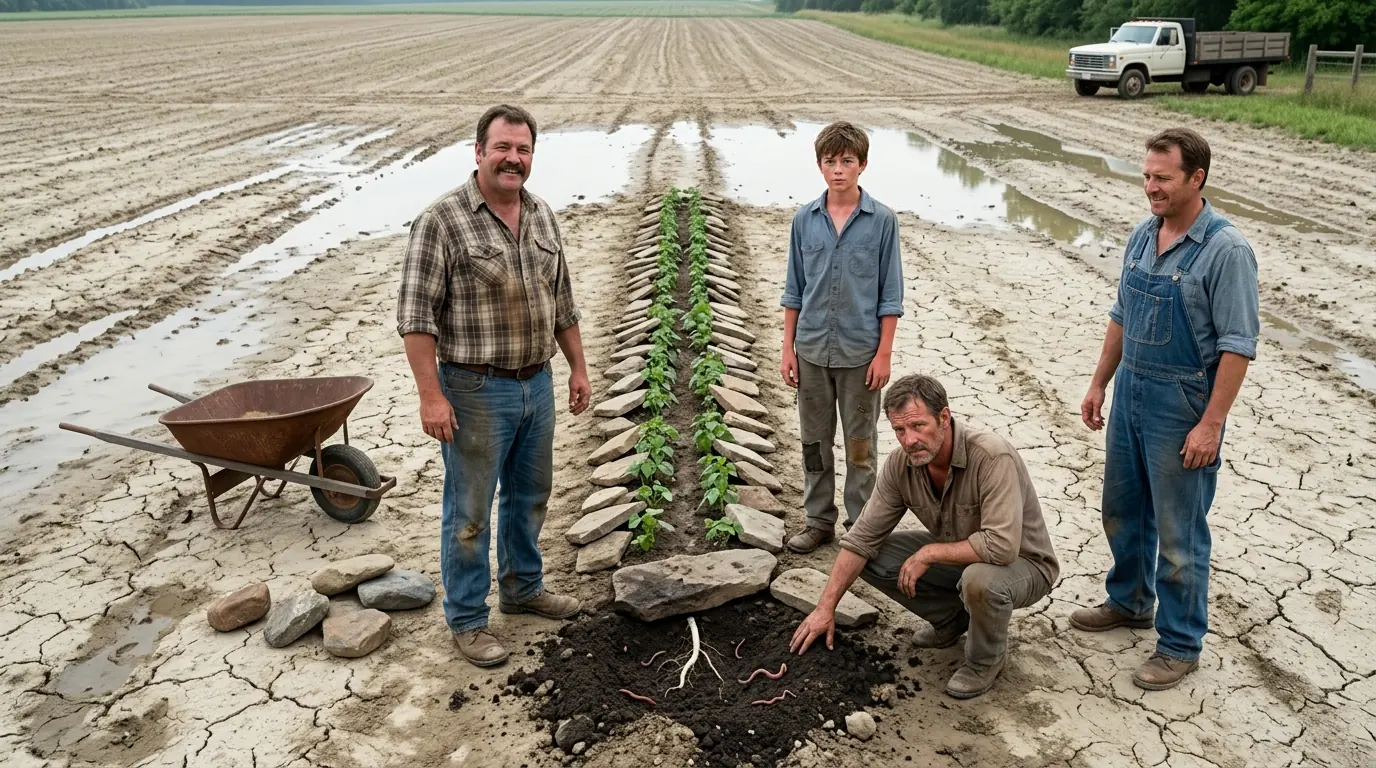
In the center of the field, surrounded by pale, exhausted earth, stood a narrow strip of bean plants.
They were not merely alive.
They were green.
Samuel lowered the blade.
For several seconds, he stared at the leaves as though they had appeared overnight.
Then he looked at the stones surrounding their roots.
Flat gray stones.
Dark creek stones.
Pieces of an old boundary wall.
Hundreds of them, placed carefully across the ground by his fourteen-year-old son.
For most of the summer, Samuel had believed the stones were evidence that Noah did not understand farming.
Now, standing beneath the rising heat, he began to wonder whether the boy understood something everyone else had forgotten.
Three months earlier, people in Ashford Hollow had laughed whenever Noah pushed his wheelbarrow down the road.
They laughed because every sensible farmer spent spring removing stones from fields.
Noah was carrying them back.
Ashford Hollow was a small farming town hidden between dry hills and a river that had been shrinking for years. Older residents remembered when the water reached the cottonwoods in spring. By the time Noah was born, children could cross most of it without getting their knees wet.
The soil had once been dark and loose.
Farmers used to brag that a person could drop seed into the ground and watch green shoots appear before reaching home.
Then the summers became hotter.
Rain arrived late or not at all.
The topsoil lost its softness. Cracks opened across the fields like wounds. Wind lifted dust from the road and carried it through kitchen windows.
The Carver farm sat at the western edge of town.
It contained only four acres, but those acres had belonged to Noah’s great-grandfather, then his grandfather, and finally Samuel.
Samuel worked from before sunrise until the shadows disappeared.
Work no longer guaranteed anything.
The corn emerged thin and yellow.
Bean vines climbed only a few inches before curling beneath the heat.
Tomatoes split before ripening.
The farm had produced no dependable harvest in three years.
At night, Noah sometimes heard his parents talking in the kitchen.
They tried to keep their voices low.
The walls were thin.
“The bank sent another letter,” his mother, Grace, whispered one evening.
“I know.”
“What happens if September is like last year?”
Samuel did not answer immediately.
“We sell the north acre.”
“That won’t be enough.”
“Then we sell the rest.”
The silence that followed was worse than the words.
Noah lay awake in the room above the kitchen, staring at the ceiling.
He imagined another family living in the farmhouse.
He imagined Samuel working for someone else.
He imagined the barn empty and the fields divided by new fences.
The next morning, Grace worked in the garden beside the porch.
She grew herbs, tomatoes, and a few peppers in soil she protected with compost and kitchen water.
Even when the plants looked weak, she hummed.
Noah watched her from the steps.
“How can you sing when everything’s dying?”
Grace looked toward him.
“Not everything.”
She held up a small basil leaf.
“Sometimes you have to look closer.”
The person who looked closest was Noah’s grandmother.
Mae Carver was seventy-seven and had lived in Ashford Hollow her entire life.
She remembered taller corn, cooler nights, and storms that began beyond the western ridge before arriving over the valley.
Her knees hurt too much for fieldwork, but she spent most mornings seated on an overturned crate near the fence.
She watched the land the way other people watched television.
She noticed where birds gathered.
Where weeds survived.
Where the first shadows touched the ground.
One evening, Noah found her at the driest corner of the property.
She had lowered herself carefully beside a crack in the soil and was running one finger along its edge.
“Feel this,” she said.
Noah crouched.
The soil was still hot even though the sun had nearly disappeared.
“It feels dead.”
Mae shook her head.
“Dead ground doesn’t complain.”
Noah looked at her.
“This ground is complaining?”
“It’s screaming.”
She broke off a piece of dry clay.
“It doesn’t hold water. Doesn’t hold cool. Sun bakes it all day, and by morning it has forgotten everything.”
Noah did not fully understand.
Still, the sentence stayed with him.
The ground had forgotten how to keep anything.
Over the following days, he began noticing details that had always been present.
The old stone wall beside Amos Bell’s property had collapsed years earlier. Grass grew beneath the fallen rocks even where the surrounding field had turned brown.
Along the dry creek bed, flat stones covered patches of soil that remained darker than the exposed earth.
Noah started lifting them.
Beneath each one, the ground felt cooler.
Some patches were damp.
Tiny insects moved beneath stones in places where the surface seemed incapable of supporting life.
He lifted another.
Then another.
Every time, he found the same thing.
Shade.
Moisture.
Living soil protected from the worst heat.
At dinner, he tried to explain.
“What if we put rocks around the beans?”
Samuel stopped chewing.
“Rocks?”
“The soil beneath them stays cool.”
“Rocks don’t grow beans.”
“I know, but—”
“We need every inch of workable ground clear.”
Samuel’s voice was not cruel.
It was exhausted.
He had no energy left for uncertain ideas.
A theory could not pay the bank.
A child’s observation could not replace rain.
Noah lowered his eyes.
Across the table, Mae gave him a small nod.
It was barely visible.
It was enough.
Before sunrise the next morning, Noah found an old wheelbarrow beside the barn.
One handle had split, and the wheel leaned slightly left.
He pushed it toward the dry creek.
The first load contained eight stones.
The second contained eleven.
By noon, his palms had blistered.
He carried stones from the creek, the collapsed wall, and a pile Amos Bell had cleared from his own land years earlier.
Amos watched from his porch.
“You building a house?”
“No, sir.”
“A fort?”
“No.”
“What are you building?”
Noah looked toward the lower field.
“I’m not sure yet.”
Amos laughed.
By evening, other people knew.
In a town as small as Ashford Hollow, unusual behavior traveled faster than news.
At the feed store, men discussed the Carver boy carrying rocks onto a field that already produced nothing.
One suggested the heat had damaged his mind.
Another said he was building a grave for the farm.
Dale Mercer stopped his truck beside the road one afternoon.
“You know most farmers remove those things.”
Noah continued pushing.
“You hear me?”
“Yes, sir.”
“Then why are you doing it backward?”
Noah did not answer.
He reached the field and tipped the stones beside a ten-foot strip containing several struggling bean plants.
At first, he arranged the rocks tightly around the stems.
He believed more coverage meant more protection.
He stacked some two or three layers high.
For several days, the ground beneath them remained cool.
Then a rare thunderstorm crossed the valley.
The rain came quickly, striking hard enough to raise dust before soaking it.
Noah ran from the barn to watch.
Water hit the tightly packed stones and rolled away.
Instead of entering the soil evenly, it formed two channels.
One side of the strip flooded.
The other remained dry.
Within days, two bean plants died.
A third began turning yellow.
Noah removed several stones and stared at the damaged roots.
The laughter from town returned in his mind.
Rocks don’t grow beans.
He sat beside the failed strip until evening.
Mae found him there.
She lowered herself carefully onto the ground.
“I killed them.”
“You tried something.”
“And it didn’t work.”
“That part is obvious.”
Noah looked toward her, surprised.
Mae picked up one stone.
“You expected me to say it worked?”
“No.”
“You failed.”
He looked down.
She continued.
“Now decide whether failure gave you an answer or only an excuse.”
Noah turned the stone over in his hands.
“What answer?”
“You packed them too close.”
“That’s all?”
“I don’t know.”
Mae began rising.
“That is your work.”
She did not solve the problem for him.
She never did.
The following morning, Noah began again.
He used flatter stones.
He left narrow spaces between them.
He kept the layers low.
When another small rain arrived, more water reached the soil.
For a week, the result seemed better.
Then the exposed spaces between the stones began baking.
By afternoon, the unprotected soil became hotter than the surrounding field.
New cracks appeared.
Whatever moisture the stones preserved overnight disappeared through the gaps by noon.
Noah knelt beside the strip and pressed one hand against the ground.
Too hot.
The second design had failed differently.
He adjusted again.
Larger gaps near the stems.
Smaller ones farther away.
He placed several stones at angles.
Before he could learn whether the arrangement worked, a hailstorm struck Ashford Hollow.
The storm lasted less than fifteen minutes.
It flattened part of Grace’s garden, damaged the young corn, and scattered half of Noah’s carefully placed stones.
The next morning, the lower strip looked destroyed.
Dark soil that had begun to improve dried quickly after being exposed.
Noah stood beside the wheelbarrow.
He did not touch it.
For six days, he stayed away from the experiment.
He completed chores, repaired fence wire, and helped Samuel in the barn.
But he did not carry another stone.
People noticed.
At the feed store, someone said the Carver boy had finally come to his senses.
Noah heard it when he entered for nails.
He said nothing.
That evening, Grace found him sitting on the porch.
She placed a glass of cool water beside him.
“Your grandmother says the soil in that strip still looks better than it did last year.”
“It’s ruined.”
“Half of it.”
“The plants keep dying.”
“Some are still alive.”
Noah looked toward the field.
Grace sat beside him.
“Your father keeps every broken machine part.”
“Because he might need it.”
“He says a broken part can teach you how the machine failed.”
Noah understood what she meant.
Grace stood.
“Seems strange to learn this much and stop before finding out why.”
Before sunrise, Noah returned to the field.
This time, he did not begin by moving stones.
He watched the shadows.
He noticed which side of each rock remained cool after midday.
He poured a cup of water onto different arrangements and studied how it traveled.
He dug small channels.
He recorded distances in a school notebook.
He stopped guessing.
He started observing.
Larger stones were angled so their afternoon shadows covered the exposed gaps.
Smaller stones were arranged loosely around the roots.
Narrow channels guided rain toward the plants instead of away from them.
He left enough space for water and air to enter.
The work became slower.
More careful.
Some afternoons, he moved only twelve stones.
The first success was so small that nobody else noticed.
One bean plant in the center of the strip remained greener than the rest.
Noah marked it in his notebook.
A week later, two more plants showed the same color.
He dug beneath a stone and found the soil damp.
Not wet.
Not dry.
Damp.
Then he found an earthworm.
He held it in his palm as though it were something precious.
The farm had not produced a worm in three summers.
Birds appeared next.
They landed near the stone strip early in the morning, searching for insects.
Samuel noticed them before noticing the plants.
“Why are those birds there?”
Noah shrugged.
“Food, maybe.”
Samuel walked closer.
He touched one bean leaf.
Then he knelt and pushed two fingers into the soil beneath a flat stone.
The ground was cool.
He said nothing.
He stood and returned to the barn.
But the following morning, he paused there again.
Old Amos Bell arrived one evening carrying an empty wrench box.
He claimed he needed to borrow a half-inch socket.
Samuel knew he owned three.
Amos walked past the barn and toward Noah’s strip.
He crouched slowly.
He examined the arrangement.
He lifted a stone and rubbed the soil between his fingers.
“Stone mulch,” he muttered.
Noah looked at him.
“What?”
“Read about it years ago.”
Amos sat back on his heels.
“Farmers in dry places used stones to protect soil. Some still do.”
Samuel approached.
“You’ve seen this?”
“Not around here.”
Amos pointed toward the field.
“The stones shade the ground. Slow evaporation. Catch moisture. If they’re spaced right, water moves beneath them instead of running away.”
He looked toward Noah.
“Boy found it without knowing the name.”
Samuel examined the strip again.
“It’ll work across a whole field?”
Amos shrugged.
“Maybe. Maybe not. Soil changes. Slope changes. Too much stone could create another problem.”
Noah nodded.
That answer did not discourage him.
It sounded honest.
Word of Amos’s visit spread quickly.
The jokes changed.
People still laughed, but now they drove more slowly past the farm.
Several watched the green strip through open truck windows.
A county agricultural agent named Rebecca Sloan arrived in late June.
She wore a white shirt, work boots, and carried a metal soil probe.
Noah expected her to speak mostly with Samuel.
Instead, she asked him to explain every design.
He showed her the failed pile.
The cracked second section.
The hail damage.
The angled stones.
The channels.
Rebecca recorded soil temperatures beneath the rocks and in the exposed field.
The difference surprised her.
At midday, the protected ground was significantly cooler.
Moisture readings were higher.
Organic activity had begun returning.
“You kept records?” she asked.
Noah handed her the notebook.
The pages contained dates, rainfall amounts, stone spacing, plant color, and rough diagrams.
Rebecca read silently.
Then she looked toward the men gathering near the fence.
Dale Mercer had arrived.
So had two farmers from the feed store.
They waited for the expert to explain why the boy was wrong.
Rebecca stood.
“Who has been laughing at him?”
Nobody answered.
She held up the notebook.
“He made three designs that failed, recorded why they failed, and corrected them. That is field research.”
Dale crossed his arms.
“So you’re saying we should cover every acre in rocks?”
“No.”
Rebecca’s tone sharpened.
“I’m saying you should stop confusing unfamiliar with foolish.”
She pointed toward the plants.
“This strip is retaining more moisture and supporting healthier roots than the exposed ground around it. Whether the method can be expanded safely requires testing.”
Noah looked toward Samuel.
His father’s expression was difficult to read.
That evening, Samuel entered the lower field carrying two shovels.
Noah was adjusting a row.
Samuel placed one shovel beside him.
“How wide should the next section be?”
Noah stared.
“You believe me?”
Samuel looked toward the green beans.
“I believe the soil.”
He paused.
“And I believe you listened when I didn’t.”
The apology was not elaborate.
Samuel was not an elaborate man.
It was enough.
Father and son worked until darkness.
They widened the stone strip one careful section at a time.
They did not cover everything.
They tested.
A quarter row.
Then half.
They adjusted spacing based on the slope.
Near the corn, they used broader stones to shade the roots.
Near the beans, they left more openings.
Grace helped mark channels.
Mae watched from her crate, correcting them whenever she believed they were moving too quickly.
“Land doesn’t care how tired you are,” she called. “Pay attention.”
By July, nearly one quarter of the lower field showed improvement.
The beans developed fuller leaves.
Corn in the protected rows grew taller.
The soil beneath the stones remained dark even after several hot days.
Then the bank sent another letter.
Samuel opened it at the kitchen table.
Payment was due before harvest.
If the farm failed again, foreclosure proceedings would begin.
The green rows were promising.
Promising did not mean profitable.
They needed enough harvest to sell.
Noah read the letter over his father’s shoulder.
“We need more stone.”
Samuel looked toward the field.
“We need time.”
They had little of either.
The next morning, Amos Bell arrived with a wagon.
It was filled with flat stones from his collapsed boundary wall.
“You can have them,” he said.
Samuel looked surprised.
“You spent the summer laughing.”
“Doesn’t mean I have to spend the fall being stupid.”
That afternoon, Dale Mercer brought another load.
He did not apologize.
He tipped the rocks beside the barn and asked Noah one question.
“How far apart?”
Noah showed him.
Within a week, neighbors who once stopped to mock the wheelbarrow arrived carrying stones.
Some brought labor.
Some brought tools.
They did not suddenly become generous because they loved the Carvers.
They had seen the field.
They understood that if the method worked, their own farms might survive the next dry season.
Noah taught them anyway.
He did not repeat their jokes.
He did not ask who had called him foolish.
He walked the rows and explained each failure.
“Don’t stack them high.”
“Leave room for water.”
“Watch the afternoon shadows.”
“Make channels on the slope.”
“Test a small section first.”
Rebecca Sloan returned with two colleagues from the county office.
They took more readings and helped design controlled plots.
One plot remained bare.
Another used straw mulch.
A third used Noah’s stone arrangement.
The results differed depending on location, but the stone-protected sections performed especially well where wind and heat dried the surface fastest.
Rebecca explained that stone mulch was not magic.
It would not replace rainfall.
It would not improve every field.
But on the Carver farm, with shallow rocky soil and severe surface evaporation, it reduced heat stress and conserved precious moisture.
Noah listened carefully.
He did not want the story to become larger than the truth.
The truth was enough.
By late August, the lower field no longer looked abandoned.
Green rows crossed nearly half the property.
Bean pods hung full beneath the leaves.
Corn stalks stood taller than Samuel’s shoulders.
Dew appeared beneath some stones in the early morning.
Grace found Noah there before sunrise one day.
He was kneeling beside the first plant that had turned green.
“You remember this one?”
“It was the first.”
Grace touched the leaf.
“You kept looking when everyone else had decided there was nothing to see.”
Harvest began in September.
The Carvers did not produce more than every farmer in Ashford Hollow.
They did not become wealthy.
They did not discover a miracle.
They produced enough.
Enough beans to sell.
Enough corn to store.
Enough income to meet the bank’s deadline.
Enough proof to earn another season.
Samuel carried the payment into town himself.
The banker examined the amount twice.
“I heard about the rocks.”
Samuel nodded.
“Your boy’s idea?”
“Our boy’s work.”
When he returned, the family ate dinner outside.
Mae sat at the head of the table.
Grace served beans from the lower field.
Samuel raised his glass toward Noah.
He was not comfortable giving speeches.
“I spent my life believing experience meant knowing the answers.”
He looked toward the stone rows.
“Turns out it can also mean knowing when to listen.”
Noah lowered his eyes.
Mae tapped the table.
“Don’t become proud. The ground dislikes pride.”
Everyone laughed.
The following spring, several Ashford Hollow farms established small stone-mulch test plots.
Some succeeded.
Some did not.
The method worked best where soil, slope, stone type, and weather allowed it.
Noah helped farmers adjust their arrangements.
He continued keeping records.
Rebecca entered his field notes into a regional youth agricultural competition.
He won a scholarship to study soil science after high school.
Years later, Noah returned to Ashford Hollow as a conservation agronomist.
The Carver farm remained small.
Samuel still repaired equipment in the barn.
Grace still grew basil beside the porch.
Mae’s crate remained near the fence even after she was gone.
Noah never removed the first ten-foot strip.
Visitors sometimes asked why the stones were uneven.
Why one section had larger gaps.
Why another looked poorly arranged.
“Those are the failures,” he told them.
“Why keep them?”
“Because the good rows don’t make sense without them.”
The farm survived because Noah found the correct arrangement.
But he found it only after creating three wrong ones.
He stacked the stones too high.
Left the soil too exposed.
Lost his work to hail.
Stopped for nearly a week.
Then returned.
That was what the people of Ashford Hollow eventually remembered.
Not merely that a fourteen-year-old boy found a way to protect moisture in a dying field.
They remembered that he was willing to look foolish long enough to learn.
Every farmer who laughed had seen the same stones.
Every farmer had walked beside the same dry creek.
Every farmer knew grass grew greener beneath the old wall.
The answer was never completely hidden.
It was simply beneath something they had already decided was worthless.
During the summer everyone else cleared stones from their land, Noah Carver carried them back.
One wheelbarrow at a time.
One failed arrangement at a time.
One careful observation at a time.
He did not save the farm because he was stronger than the drought.
He saved it because he listened longer than everyone else.
And sometimes, the difference between useless ground and living soil is not a miracle.
It is one patient person willing to lift a stone and look beneath it.