“Don’t get into that car.”
The warning came from behind the rose hedge.
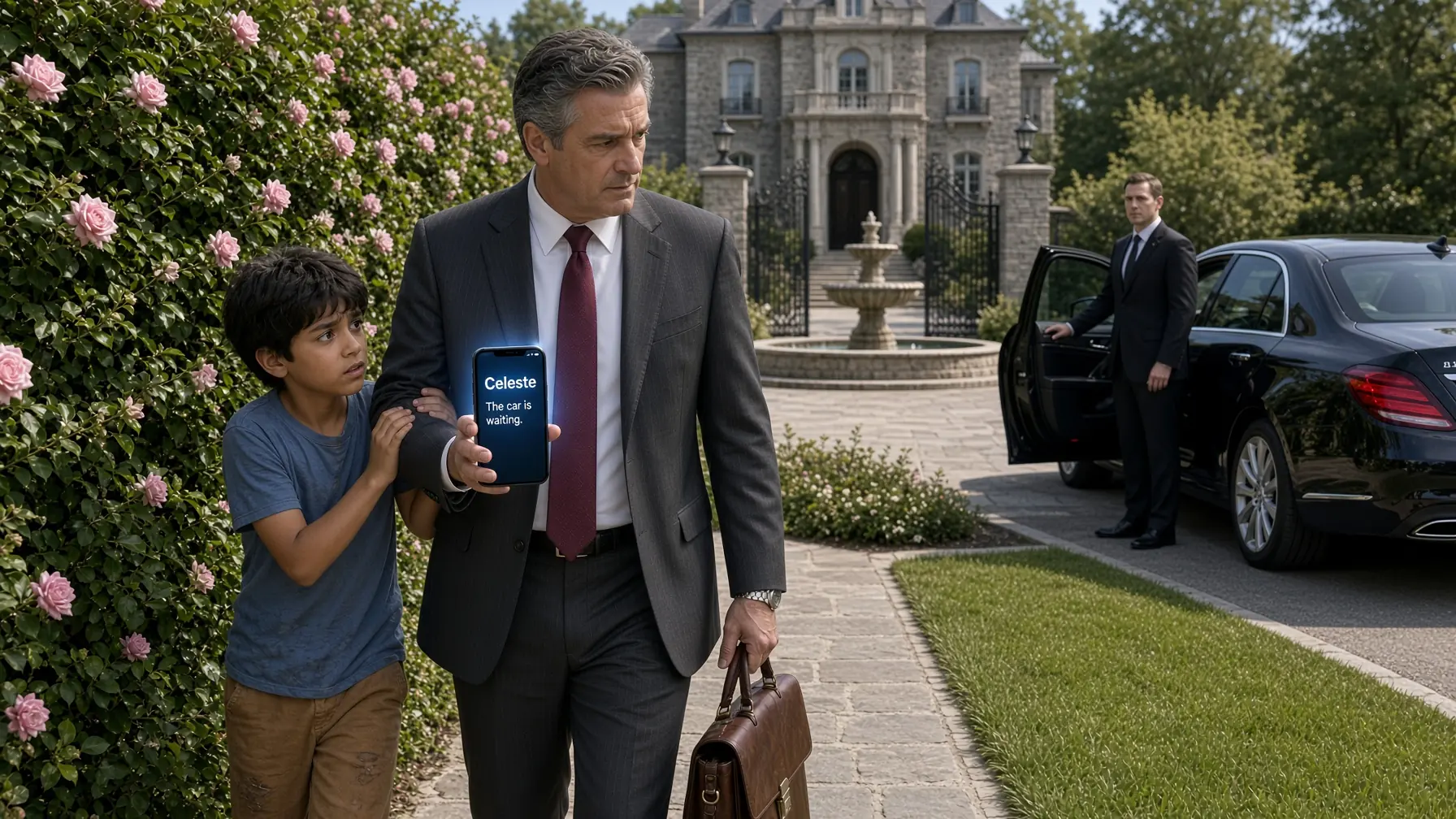
Jonathan Mercer stopped halfway down the stone walkway leading from his mansion to the iron front gate.
At fifty-four, Jonathan had spent most of his adult life moving according to schedules. He woke at 5:30, read overnight freight reports before breakfast, left the house at 8:30, and reached Mercer Continental Freight headquarters before nine.
That morning was no different.
He had already answered three emails, rejected an amendment to a warehouse acquisition, and mentally moved on to the board meeting waiting for him across the city.
A leather briefcase hung from his left hand.
His phone was in his right.
Beyond the fountain, a polished black town car waited with its engine running.
A chauffeur stood beside the open rear door.
Everything looked exactly as it should.
Then the boy emerged.
Jonathan recognized him only vaguely.
Small.
Maybe ten.
Warm brown skin.
Messy dark hair.
Faded blue T-shirt, worn tan pants, old sneakers.
He had seen the child carrying grocery bags behind the kitchen or sitting near the staff cottage with a sketchbook balanced across his knees.
Jonathan could not remember his name.
The boy hurried toward him and caught his suit sleeve with both hands.
“Please, sir.”
Jonathan looked down, irritated.
“What are you doing?”
“Don’t let the driver see you listening.”
That changed something.
Not enough for fear.
Enough for attention.
Jonathan glanced toward the gate.
The chauffeur was looking at his phone.
“Why?”
The boy swallowed.
“Because if you get into that car, I don’t think you’re coming home.”
Jonathan stared at him.
His first instinct was to dismiss it.
He had built Mercer Continental from nine trucks and a rented warehouse into one of the largest privately controlled freight companies on the East Coast. He had survived lawsuits, strikes, hostile acquisitions, fraud attempts, and one former executive who tried to steal an entire regional division.
He did not reorganize his life because a frightened ten-year-old appeared in his driveway with a warning.
“I’m late,” Jonathan said. “Whatever happened, tell your mother. I’ll speak with both of you tonight.”
The boy did not release his sleeve.
“I heard your wife.”
Jonathan stopped trying to pull away.
For the first time, he looked directly into the boy’s eyes.
“What did you hear?”
“She was talking to a man behind the kitchen last night.”
The boy glanced nervously toward the car.
“They said your name. They said the driver would be different this morning.”
Jonathan slowly turned toward the gate.
His regular chauffeur was Martin Hale.
Martin had worked for him for five years.
Forty-three years old. Former Army mechanic. Quiet. Punctual almost to the second.
And Martin wore one thing Jonathan had noticed hundreds of times without ever thinking it important.
A thick silver ring on the thumb of his left hand.
It had belonged to Martin’s father.
He never removed it.
The chauffeur beside the car rested his left hand on the door.
No ring.
Jonathan’s phone vibrated.
A message from his wife appeared.
Celeste: You’re going to be late again. The car is waiting.
He read it once.
Then slid the phone into his pocket.
“Walk beside me,” he told the boy.
“What?”
“Do not run. Don’t look at the gate.”
Jonathan turned away from the driveway as if he had forgotten something and began walking toward the eastern garden.
The boy followed.
Neither hurried.
The chauffeur did not call after them.
Once the tall cypress trees blocked the gate from view, Jonathan stopped.
Then he crouched.
“What is your name?”
“Caleb Turner.”
“Your mother is Rosa?”
“Yes, sir.”
Now Jonathan remembered.
Rosa Turner had been employed as one of the household staff for nearly three years. She and Caleb lived in a small cottage behind the south wing of the estate.
Jonathan had personally approved the housing arrangement.
He had never once visited the cottage.
“Tell me exactly what happened.”
Caleb’s hands trembled.
His voice did not.
“I came downstairs last night because I left my drawing book in the kitchen. Mom was making tea. The radio was loud.”
“And?”
“Mrs. Mercer was outside on the back patio with a man.”
“Someone you know?”
Caleb shook his head.
“She said you always leave at eight thirty.”
Jonathan felt something tighten inside his chest.
Caleb continued.
“She said you walk toward the car while looking at your phone. She said you almost never look at the driver.”
Jonathan glanced toward the trees.
The black car remained visible in thin flashes through the branches.
“What else?”
“She said your normal driver had already been taken off the schedule.”
Jonathan’s jaw hardened.
“And where was the new driver supposed to take me?”
Caleb hesitated.
“Blackwater Reservoir.”
Jonathan knew the road immediately.
A narrow two-lane route outside Fairmont.
Steep drop on one side.
Reservoir below.
Guardrail damaged in several places by winter crashes.
Caleb lowered his voice.
“They said it was supposed to look like an accident.”
The sounds of the garden suddenly became too clear.
The fountain.
Birds in the hedge.
The low idle of the car outside the gate.
Jonathan studied Caleb’s face.
“How do you know they meant me?”
“They said ‘Jonathan Mercer’ three times.”
Caleb blinked quickly.
“And Mrs. Mercer said when it was done, she’d finally be free.”
For perhaps five seconds, Jonathan said absolutely nothing.
Celeste.
His wife of fifteen years.
The woman who had slept in a hospital chair for three nights after his heart procedure.
The woman who handled his mother’s funeral arrangements because Jonathan had been too overwhelmed to think.
The woman who had kissed him before breakfast less than an hour earlier.
He wanted the boy to be wrong.
Desperately.
Then Caleb reached inside his shirt pocket.
“There’s more.”
He produced an old phone.
The screen was cracked diagonally.
“My mom gave me this when she got a new one. It doesn’t make calls anymore, but it records.”
Jonathan stared at it.
“You recorded them?”
“Some of it.”
Caleb opened an audio file.
11:18 PM.
Duration: 11 minutes, 47 seconds.
Jonathan pressed play.
At first came distant kitchen noises.
A radio.
Dishes.
Then a sliding door opened.
And his wife’s voice appeared.
Clear enough that there was no possibility of confusion.
“He has to get into the vehicle himself. If anyone sees force, it ruins everything.”
A male voice answered.
“The replacement driver understands. Mercer barely looks up from his phone in the morning.”
Jonathan increased the volume.
“The car stops near the reservoir,” the man continued. “He gets out. The guardrail there is already compromised.”
“And the driver?”
“Paid.”
Celeste asked another question.
“What about the insurance?”
The man laughed quietly.
“You tell me.”
Celeste’s answer came without hesitation.
“Seventy million if the death is ruled accidental.”
Jonathan stopped the recording.
His face remained motionless.
Inside, something had begun collapsing.
Not explosively.
More like a building being quietly emptied floor by floor.
“Play the rest,” he said.
Caleb did.
The recording continued.
His life-insurance policy had been increased fourteen months earlier.
Thirty-five million dollars.
Double indemnity for accidental death.
Celeste listed as sole beneficiary.
The man discussed Jonathan’s company shares.
Celeste explained that a trust would receive a substantial portion of Jonathan’s personal holdings if he died.
“The board cannot block it,” she said.
“He signed?”
“Yes.”
“When?”
“Boston.”
Jonathan closed his eyes.
Boston.
The merger negotiations.
Three days with almost no sleep.