The rain fell in cold, unforgiving sheets, drumming a tired rhythm against the greasy windows of the Starlight Diner, turning the broken pavement outside into a dark, treacherous mirror. Street lights sputtered, their weak yellow glow doing little to pierce the oppressive gloom of the late hour.
It was well past midnight, and the diner should have been locked up tight. But David Johnson had never been the one to rush a job. Not when the world itself was already in such a hurry to chew people up and spit them out. 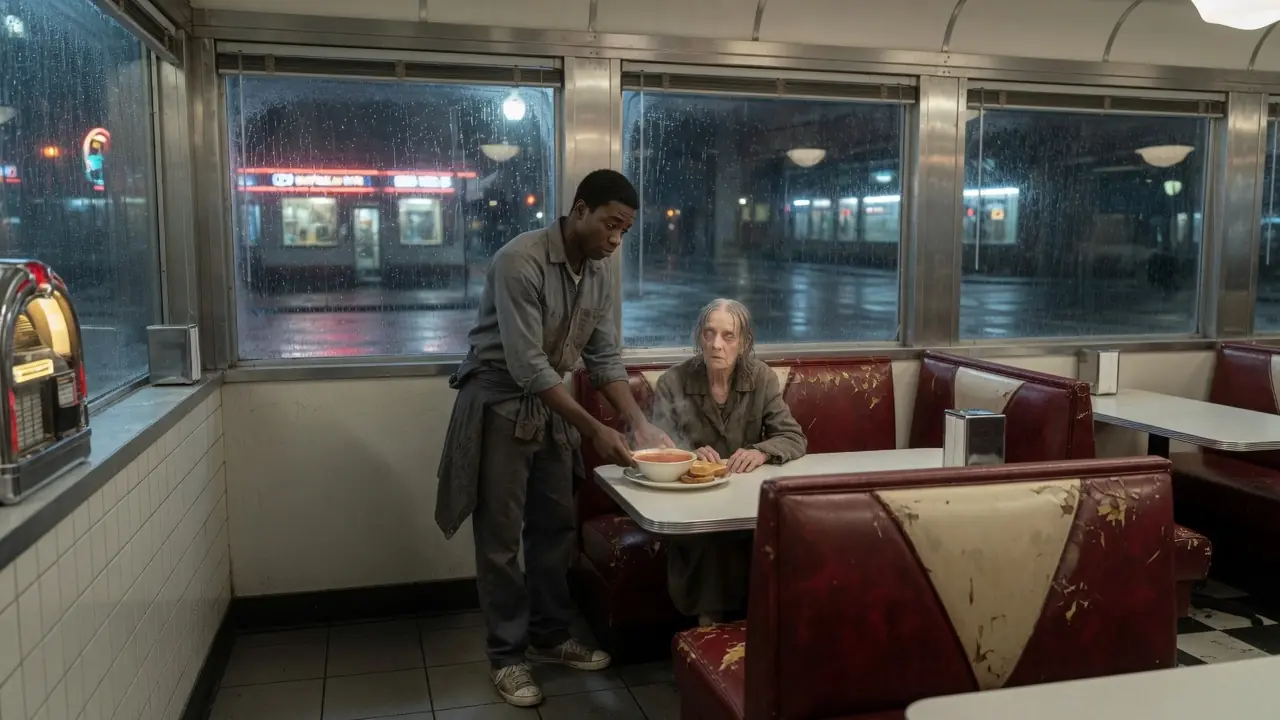
He was mopping the grimy checkered floor, his broad shoulders aching and his dark skin beaded with sweat from the heat of the grill, when he noticed the figure outside. It was a woman hunched against the brick work just beyond the flickering red neon of the diner sign.
Her sparse gray hair plastered to her scalp, a thin worn coat offering almost no protection from the biting wind. Her eyes, milky and unseeing, stared blankly into the street. David stopped, the wooden handle of the mop resting in his hand.
His hand went to his pocket, fingers brushing against the three quarters and a dime nestled in the worn fabric. His only way to get home without a 12 km walk. He looked back at the woman, her body trembling with a cold that had nothing to do with just the weather.
He exhaled, a small cloud of white in the cold air. He set his mop aside. He pushed the diner door open, a gust of frigid wind making him shiver.
"Ma'am," he called softly, his voice a low rumble against the hiss of the rain. "Ma'am, you can't stay out here." He crouched beside her, his knees cracking.
She flinched, turning her face toward the sound of his voice. "Let me get you something warm. It's on me." The woman hesitated, a flicker of fear in her clouded eyes, but then gave a slow, tired nod.
David gently took her arm and guided her inside. The warmth of the diner hit them instantly, the smell of old coffee and frying onions, a comforting blanket against the chill. He settled her into a cracked vinyl booth near the kitchen, then walked to the counter.
A few moments later, he placed a steaming bowl of thick tomato soup and two slices of buttered toast in front of her. She began to eat, her hands shaking so much she could barely hold the spoon. David watched her for a moment, a familiar ache settling in his chest, the one that always came when he saw the quiet, desperate battles people fought just to survive another day.
When his shift was over, he pulled the collar of his thin jacket up to his ears, and stepped out into the storm. His worn sneakers were soaked through in minutes, the icy water seeping into his socks. The 12 km walk stretched before him, a long, dark path through a sleeping city.
He just lowered his head against the wind and kept walking. What he didn't know was that someone was watching. Across the street, a sleek black Lincoln Continental sat silent in the shadows, its engine purring almost imperceptibly, its tinted windows reflecting the diner's dying neon glow.
Inside the Lincoln Continental, the world outside the rain streaked windows was a silent film. The air was still, carrying only the scent of expensive leather and polished wood, a quiet cocoon insulated from the storm. Susan Fletcher did not move.
Her sharp blue eyes, the ones that had captivated millions on the silver screen, remained fixed on the empty stretch of sidewalk where the janitor had been swallowed by the night. Her face, a carefully preserved mask of timeless beauty, betrayed nothing, but her fingers gripped the armrest, her knuckles white.
The woman on the sidewalk, Mary, was her mother, a ghost from a life she had buried decades ago. But it wasn't sentiment that tightened Susan's jaw. It was something colder, more precise.
She lifted her phone, the screen illuminating her face in a sterile white glow. It rang only once before a crisp, professional voice answered. "Linda." Susan's voice was low, cutting through the silence with the effortless authority of a woman who had never had to raise it.
"Starlight Diner on Elm. There's a woman outside. My mother, handle it." There was no surprise in her assistant's voice, only immediate acceptance. "Understood, Miss Fletcher."
"And the other matter?" Susan's gaze drifted back to the diner's flickering sign. "The man," she said, "The janitor who helped her. I want to know who he is."
The line was silent, waiting. "Find out everything you can about him," Susan continued, her tone dropping even lower, each word a carefully placed stone. "Name, address, background. I want a full report on my desk by morning."
A beat of hesitation on the other end. "Ma'am," Susan's grip on the phone tightened. "I don't believe in kindness, Linda," she said, the words clear and cold as ice. "I believe in debts, and that man just created one."
She hung up without another word, plunging the car back into near darkness. Moments later, a second, more discreet sedan, pulled up to the curb across the street. A woman in a practical coat, Linda, stepped out and moved with swift, non-nonsense efficiency toward the diner.
The problem was already being erased. The Lincoln pulled away from the curb, its tires hissing on the wet asphalt, the diner shrinking in the rear view mirror. But Susan Fletcher wasn't looking back. She was looking forward, her mind already working, already calculating.
She was thinking about David Johnson and the price of his unsolicited decency. The 12 km walk had chilled him to the bone, a deep gnawing cold that no thin jacket could ever hope to fend off.
David Johnson trudged up the three flights of stairs to his one-bedroom apartment, the building smelling of its usual damp plaster and boiled cabbage. He shut the door behind him, the sound echoing in the small space, and leaned against it, rubbing a hand down his exhausted face.
The heat barely worked, and the walls were so thin he could hear his neighbors television two doors down. He had just kicked off his soaked sneakers when a knock sounded at the door. It wasn't a polite tap.
It was sharp, authoritative, and completely out of place in this building. David stiffened. No one ever came here, especially not at this hour.
He moved silently to the door and peered through the peephole. His stomach flipped. A woman stood on the other side, tall and poised, wrapped in an expensive black coat that looked like it cost more than his entire year's rent.
Her face was sharp, her eyes cold and assessing, as if she had already dissected his life before he even opened the door. He didn't open it. "Who is it?" he called out, his voice flat.
A pause, then a voice, deep and controlled, answered back. "My name is Susan Fletcher." The name meant nothing to him. "What do you want?" he asked, his hand resting on the deadbolt.
Another pause. "To talk." His guts screamed at him to say no, but a sliver of curiosity won out. Slowly he unlatched the lock and opened the door just enough to see her clearly.
It was a face he vaguely recognized from old movie posters, a sculpted, timeless beauty that age had sharpened rather than softened. Her eyes, the color of a winter sky, seemed to look right through him. She did not belong here in his building, in his world.
"I don't know you," he said. Her expression didn't change. "No," she replied. "But you helped my mother."
David's pulse skipped. He studied her now. The way her presence seemed to shrink the already tiny hallway. The way her coat was immaculate despite the storm, his grip tightened on the doorframe.
"The woman at the diner," he said slowly. "You're her daughter." Her nod was barely perceptible. "I was across the street tonight."
The chill in his bones turned sharp as ice. "You were watching?" "I was," she confirmed. He exhaled through his nose, a surge of anger mixing with his exhaustion.
"So what? You're here to complain that I bought your mother a bowl of soup?" "No," Susan said, her gaze unreadable. "I'm here because I don't believe in charity, but I do believe in paying debts."
And without waiting for a response, she stepped past him into the room, pulling a thick cream colored envelope from her coat and placing it on his rickety kitchen table. David didn't move. He stared at the envelope, at the weight of it, at what it represented.
He swallowed hard. "What is that?" "A job offer," she said flatly. David's brain stalled. He let out a short, incredulous laugh.
"A job? You think I want to work for some rich woman who thinks handing out a check makes everything even?" Susan didn't flinch. "I don't think you want charity, David. That's why I'm not offering it."
His name in her mouth made something tighten in his chest. He folded his arms. "You don't know the first thing about me." "I know enough."
Her voice was steady, unshakable. "I know you gave my mother a meal with what was probably your last dollar without expecting a thing in return. I know that's rare."
He looked from her face to the absurdly expensive envelope sitting on his cheap table. "And what would I be doing? Making coffee?" For the first time, the corner of her mouth twitched, a flicker of something like amusement.
"No, you'd be working with me. I need someone who understands people, not just profits. I have enough sharks. I need an anchor."
Silence stretched between them, heavy and waiting. His pride screamed at him to throw her and her offer out, but six figures. It meant no more late rent, no more choosing between groceries and the power bill, no more 12 km walks in the rain.
"Why me?" he finally asked, his voice barely a whisper. Susan held his gaze. "Because you saw my mother," she said, her voice softer now, as if the admission cost her something.
"Not a nuisance, not a statistic. You saw a person, and you helped." Without another word, she turned and left, closing the door softly behind her. David stood there long after she was gone, the weight of the envelope in his hand feeling heavier than it should, because he already knew he wasn't just going to think about it, he was going to say yes.
The first day at Fletcher Entertainment felt like stepping onto another planet, a world where the polished marble floors smelled like money and the air was thick with the chilling hum of quiet power. David walked into the towering glass building in his best suit, a charcoal gray one from a thrift store that he'd had tailored, and felt every pair of eyes snap toward him the moment he crossed the lobby.
It wasn't simple curiosity. It was evaluation, calculation, and judgment. He kept his head high and his shoulders squared. Linda Winters was waiting for him by the elevators, her posture as sharp and unforgiving as her tailored dress.
A tablet was held in one hand, her welcome was a thin, practiced smile that didn't reach her eyes. "Mr. Johnson, welcome to Fletcher Entertainment." David met her gaze, offering a slow nod.
"Good to see you again, Miss Winters." Something flickered in her eyes before she turned and led him toward the executive suite. Susan was waiting in her office, a sprawling, sleek space with floor to ceiling windows that looked down on the city like a queen surveying her kingdom.
She didn't look up when he walked in, just gestured toward the chair across the vast expanse of her desk. "You're late," she said. David arched a brow as he sat. "By 2 minutes."
Susan finally looked at him, her blue eyes sharp. "That's 2 minutes I don't get back." Before he could form a reply, she was already sliding a thick file across the desk.
No small talk, no settling in. "The Langford Group," she said, her voice all business. "They are a major partner in our merchandising division. They want to push through a new contract that would move all production overseas to cut labor costs."
She paused, letting the words sink in. "That means layoffs. Nearly 2,000 people." David skimmed the file, a cold knot forming in his stomach.
The conference room was even colder than Susan's office, all steel and glass, and a long, intimidating table that felt designed to make people uncomfortable. David sat beside Susan, facing three men in immaculate suits, each one radiating the kind of lifelong confidence that came from knowing they could ruin lives with a single signature.
The leader, James Langford, a man in his 60s with white hair slicked back by arrogance, barely glanced at him. Susan opened the conversation, cutting straight to the point.
"You want to move production? You say it will increase efficiency." She paused. "I say it will destroy a workforce that has been loyal to this brand for over a decade."
Langford gave a slow, thin-lipped smile. "Susan, you misunderstand. It's not personal. It's just business." David's fingers curled into a fist beneath the table.
Not personal. He'd heard that phrase his whole life. He cleared his throat, and the room's attention shifted to him.
"Funny," he said, his voice calm and steady. "It's always just business until it's your town that gets boarded up." Langford's eyes finally snapped to him, laced with irritation.
"And you are David Johnson," he said, not backing down. Langford gave him a dismissive onceover. "Look, son," he said, waving a hand.
"I appreciate the sentiment, but this is about numbers on a spreadsheet. It's what makes the most sense." "Son," David's jaw locked.
He leaned forward slightly, matching Langford's posture. "All right," he said coolly. "Let's talk numbers."
He slid a single sheet of paper from his own folder across the table. "This is a breakdown of what happens when you offshore this kind of work. Sure, you cut costs for the first two years, but in year three, when local demand for skilled labor over there rises, your new cheap hub gets expensive."
"You'll spend millions on restructuring, dealing with supply chain failures and fighting the PR nightmare when the headlines read, 'Langford Group betrays American workers for profit.'" He tapped the paper. "That's not sentiment. That's a market pattern. It's what happens next."
Langford stared at the paper but didn't touch it. David held his gaze unblinking. "You can make this short-term gain," he said, his voice quiet but deadly.
"Or you can explain to your investors in 5 years why it cost you your reputation and your long-term returns." The silence in the room was absolute.
Finally, Langford picked up the paper, his expression unreadable. "We'll revisit the proposal," he clipped out. As they left, David felt Susan's gaze on him.
He turned to her. She studied him for a long moment, then said, "I knew I hired you for a reason." A small, weary smirk touched David's lips, and for the first time since he'd walked through those glass doors, he felt the ground firm up beneath his feet.
He felt like he belonged. Two months in, David had found his rhythm at Fletcher Entertainment, or at least he thought he had. But victories at the top were short-lived, and he was about to learn that the most dangerous enemies were not the ones across the negotiating table, but the ones down the hall.
He had just returned from a client meeting when Linda caught him by the elevators. "We have a problem," she said, her tone sharp, urgent, stripped of all pleasantries.
David frowned. "Define problem?" Linda didn't answer. She just handed him a single printed sheet of paper.
David's stomach sank the second his eyes scanned the contents. It was a company report containing highly classified financial data. Details of a pending acquisition that were strictly confidential.
It had been leaked to a major news outlet and the email that had forwarded it sent from an internal server had his name on it. The words blurred, the air in the room shifted, turning dense and heavy.
He forced himself to take a breath. "This isn't me," he said, his voice a low rasp. "I know," Linda said, her expression unreadable.
"But someone wants it to be." David's pulse began to thrum in his ears. He had been in situations like this before, not in a corporate tower, but on the street.
He knew how fast things could spiral. A man in a powerful space didn't get the benefit of the doubt. He didn't get to be innocent until proven guilty.
He was guilty the second they said he was. "Who else has seen this?" he asked, his hand gripping the paper so tightly it crinkled.
"Susan," Linda said. "And the board." His breath hitched. The board.
He had barely clawed his way into this company, and now they were about to rip him out. Susan's office felt colder than usual. Or maybe it was just the way she was looking at him.
Her hands were clasped on the polished surface of her desk, her face an unreadable mask of control, but her sharp blue eyes were studying him, weighing him. David felt something clench tight in his chest.
"Tell me I wasn't wrong about you," she said, her voice low, controlled. Each word a chip of ice.
David slammed the printed email down on her desk. "This isn't me." Susan didn't look at the paper. She didn't have to.
Her eyes stayed locked on his. "I want to believe that," she said, her voice steady. "But this is a catastrophic leak, David. Millions in exposure, stock price implications, federal investigations."
"You understand how bad this is." He leaned forward, planting his hands flat on her desk. "I understand perfectly," he bit out.
"I also understand that whoever did this knows exactly what they're doing. I was the easy target, right? The outsider, the janitor who got lucky."
"Who's going to believe me over some executive who's been here for 10 years?" Susan didn't flinch, but she didn't disagree either. The silence stretched for an agonizingly long time, thick with accusation.
His nails dug into his palms. "Do you think I did this?" he finally asked, the question hanging in the air between them.
Susan held his gaze. "No," she said. The single word was enough to let the air rush back into his lungs.
But she continued, her voice flat. "The board does." David swore under his breath, pacing the length of the expensive rug.
He could feel the noose tightening. "So what happens now?" he asked, forcing the words out.
Susan exhaled slowly, rubbing a hand over her temple. "We find the real leak." David froze.
"We, not you, not me. We." For the first time since he'd walked into her office, the ice in his chest began to crack.
She stood up, her decision made. "Whoever set you up," she said, her jaw tight with a familiar cold resolve, "is about to find out exactly what kind of fight they just started."
The truth unraveled faster than they had expected. David and Linda, a newly formed and unlikely alliance, worked through the night, combing through server logs and tracing digital breadcrumbs with a forensic tech team Susan had hired.
Whoever had framed David had been careful, but not careful enough. The leak had been routed through a secondary account, one tied to a ghost server, but the initial command had left a single microscopic fingerprint.
It belonged to Robert Evans, a senior executive with 15 years at Fletcher Entertainment and a pristine reputation for keeping his hands clean while others took the fall. David stormed into the boardroom on the 40th floor before they could summon him like a criminal to his own execution.
The air in the room was thick with tension and the smell of expensive cologne. A dozen polished, powerful men in tailored suits sat around the long mahogany table, their faces a gallery of stern disapproval, staring him down as if he were something they'd found on the bottom of their shoe.
Susan sat at the head of the table, her expression unreadable. Two seats down, Robert Evans offered David a thin, smug smile.
An older board member, a man with a dismissive air, gestured to the single empty chair across from them. "Mr. Johnson, I assume you know why you're here."
David didn't sit. He never planned to. "I do," he said, his voice steady, carrying across the silent room.
"And I assume you all know you're about to make a very expensive mistake." A flicker of something that might have been amusement crossed Susan's face, but she didn't interfere.
"Mr. Johnson," the board member started, but David cut him off. "I was an easy target, wasn't I?" he said, pacing slowly along the windows, his presence commanding the space.
"The new hire, the outsider, the one you could pin this on and sweep neatly under the rug." He stopped and placed a thick folder on the table with a soft thud.
"Except you picked the wrong one." He slid the folder toward the center of the table. A long silence stretched as the men skimmed the documents, their expressions shifting from dismissive condescension to something closer to alarm.
Robert Evans's face was paling by the second, his smugness evaporating like a phantom. "These are traced emails," David continued, his voice calm, deliberate.
"Encrypted messages, bank transfers to an offshore account belonging to a certain journalist. All of it originating from an IP address linked directly to Mr. Evans."
"Not me," he crossed his arms. "And before you ask, yes, our legal team already has copies, and so does the press, waiting for a single phone call, so if you want to talk about damage control, I suggest you start right there."
A low murmur swept through the room. Evans shot to his feet, his voice a little too sharp, too desperate. "This is ridiculous. He's bluffing. He's trying to save his own skin."
David turned his head slowly and looked at Susan, lifting a single questioning brow. "Am I?" Susan finally spoke, her voice quiet, but as sharp as cut glass, slicing through the tension.
"No," she said, "He's not." The words landed like a physical blow. Evans's mouth snapped shut.
He sank back into his chair as if his strings had been cut. Susan stood up, adjusting the cuff of her blazer.
"Effective immediately, Robert Evans is terminated from this company," she announced, her gaze sweeping across the stunned faces of the board. "Full legal action for corporate espionage and fraud will be pursued. The company will cooperate fully with federal investigators."
She let the weight of her words settle before continuing, her eyes landing on each and every man in the room. "And if anyone else in this company so much as thinks they can play this same game, let this serve as your one and only warning."
The silence that followed was absolute, heavy, and final. David didn't smile. He didn't need to.
He had won. And as he met Susan's gaze across the room, he saw not the cold calculation of a boss, but the hard won respect of a partner.