“Take one more step, and this gets much worse for you.”
Seventy-two-year-old Walter Pierce froze halfway up the porch stairs of the home he had owned for thirty-nine years.
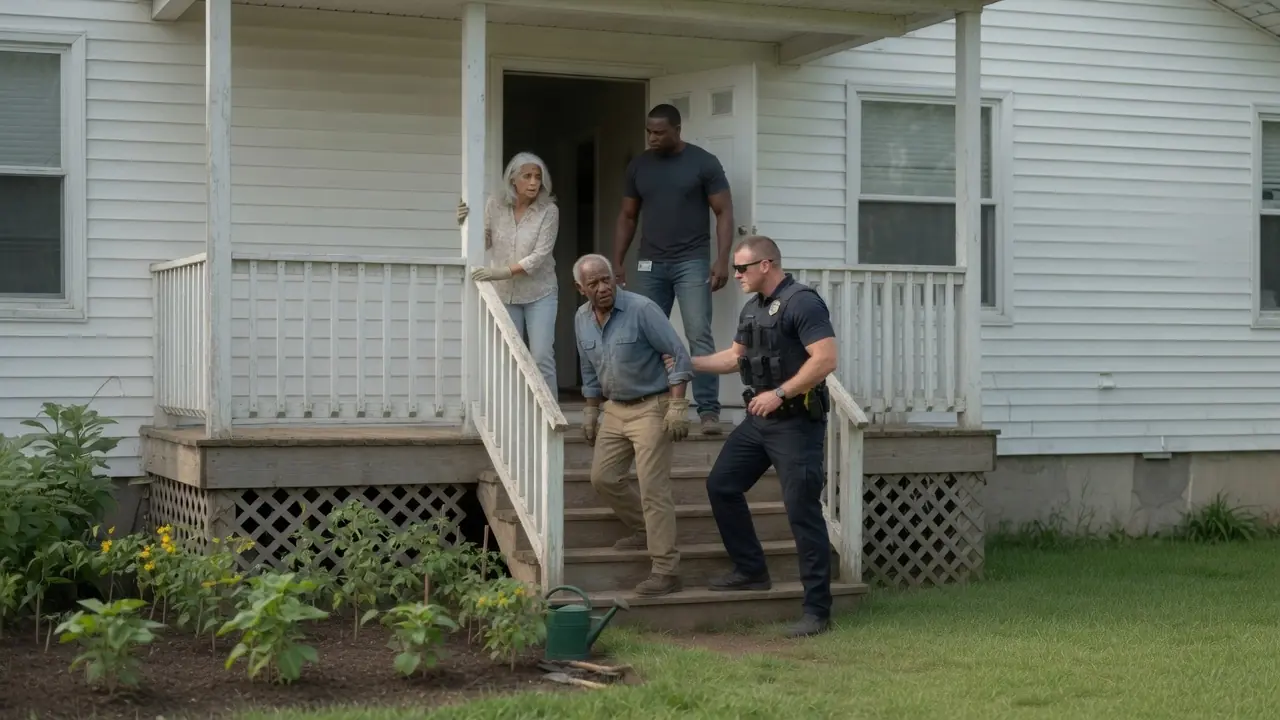
His gardening gloves were still covered in soil. One knee remained bent above the lower step, and both hands were raised where Officer Grant Keller could see them.
Behind Walter, his wife stood beside a row of tomato plants, staring at the officer as though she could not understand how a peaceful Saturday morning had become dangerous.
“Officer,” Walter said carefully, “you told me to go inside and get my identification.”
Keller moved toward him with one hand resting on his duty belt.
“Are you deaf?”
“No, sir.”
“I gave you a direct order.”
“You told me to get my wallet.”
“I told you not to move until I said so.”
Walter slowly turned.
Before he could speak again, Keller seized his left arm and forced it behind his back.
Pain tore through Walter’s shoulder.
He cried out.
“Please let go. You’re hurting me.”
“Stop resisting.”
“I’m not resisting.”
Walter’s wife, Eleanor, rushed from the garden.
“Let go of my husband!”
Keller shoved her backward with his free hand.
Eleanor struck the porch railing and nearly fell.
Then she screamed toward the open front door.
“Marcus! Someone is hurting your father!”
Heavy footsteps sounded inside the house.
A large man appeared in the doorway.
He crossed the porch and stepped into the morning sunlight, his eyes fixed on the officer twisting Walter’s arm.
Keller released the old man and reached for his taser.
“Stop right there!”
The man kept walking.
Not running.
Not charging.
He moved with the controlled, deliberate steps of someone trained to remain calm when everyone around him had lost control.
He stopped several feet away.
His hands remained open at his sides.
“Officer,” he said in a low voice, “I strongly suggest you keep your hands off my father.”
Keller had no idea that the man standing before him had spent most of his adult life in the United States Navy.
He also had no idea that the decisions he made that morning would expose something buried inside his department for years.
The day had begun quietly on Sycamore Lane in the small Virginia city of Westbridge.
Sunlight filtered through oak branches. Sprinklers hissed across lawns. A lawn mower rattled somewhere near the end of the street.
Walter Pierce knelt beside the vegetable garden behind his front walkway, removing weeds from around the tomatoes.
His knees hurt whenever he remained bent for too long, but he refused to surrender the garden to age.
He had planted tomatoes in the same patch of earth every spring since 1986.
The house behind him had been purchased when he and Eleanor were newly married and uncertain whether they could afford the monthly payment.
They raised their only child there.
They replaced the roof twice, rebuilt the porch after a storm, and spent entire weekends refinishing the floors themselves.
The house had survived layoffs, medical bills, rising taxes, and nearly four decades of ordinary life.
It was not simply property.
It contained the history of their family.
“You’re going to get trapped down there one morning,” Eleanor said as she carried a basket toward him.
Walter looked over his shoulder.
“Then put a birdbath beside me and tell people I’m decorative.”
Eleanor laughed.
They had been married forty-three years, and Walter still considered that laugh one of the finest sounds in the world.
Across the street, Denise Caldwell watched them through a narrow opening in her curtains.
She had watched them often during the previous two months.
Denise did not see an elderly couple working in the garden outside the home where they had raised their son.
She saw the last obstacle standing between her and a large payment.
Nearly two years earlier, Stonebridge Renewal Partners began purchasing houses along Sycamore Lane and the two streets behind it.
The company wanted to demolish most of the block and build luxury townhomes, a private fitness club, and a row of expensive shops.
Denise served on the neighborhood association board and owned a small financial interest in one of the limited-liability companies connected to the project.
If every remaining homeowner sold before the zoning vote, she stood to receive more money than Walter had earned during some entire years of his working life.
The Pierces refused every offer.
The first was generous.
The second was higher.
The third came with a warning that changing property values might eventually leave them with less.
Walter remained polite.
“We appreciate the offer, but this is our home.”
Denise had smiled.
Then she began looking for pressure points.
That Saturday morning, she picked up her phone and called emergency services.
The dispatcher asked for the nature of the emergency.
Denise softened her voice and made it tremble.
“There are two people outside a house on Sycamore Lane,” she said. “I don’t recognize them. They’re walking around the windows and going through the yard. I’m afraid they may be trying to break in.”
She knew exactly who Walter and Eleanor were.
She had lived across from them for seven years.
But she also knew fear traveled faster than truth.
Ten minutes later, a patrol vehicle entered the street.
Walter saw it while reaching for another weed.
Something tightened inside his chest.
He could not explain why.
The officer’s arrival did not feel routine.
Officer Grant Keller stepped from the driver’s side wearing dark sunglasses. His right hand remained close to his belt as he studied the yard.
His partner, Officer Luis Ortega, exited the passenger side and stayed beside the cruiser.
“Morning,” Keller said.
The word sounded less like a greeting than a warning.
Walter slowly stood and brushed dirt from his trousers.
“Good morning, Officer. Is something wrong?”
“We received a report of suspicious activity at this address.”
Keller looked from Walter to Eleanor.
“You two live here?”
“For thirty-nine years,” Eleanor said.
Keller showed no reaction.
“I need identification.”
Walter looked toward the open garage, the gardening tools, and the framed family photograph visible through the front window.
“For working in our own yard?”
“I didn’t ask what you were doing.”
Keller’s voice sharpened.
“I asked for identification.”
Eleanor moved closer to Walter.
“We haven’t committed a crime.”
“Ma’am, I wasn’t speaking to you.”
Walter felt anger rise.
He pushed it down.
He had spent most of his career supervising maintenance crews at a regional hospital. He knew how quickly a disagreement changed when one person believed authority excused disrespect.
“My wallet is inside,” he said. “On the kitchen counter.”
“Then get it.”
Walter hesitated.
Keller’s hand remained near his belt.
“I’m going to walk through the front door and retrieve it,” Walter said. “I’m telling you before I move.”
Keller said nothing.
Walter raised his hands slightly and turned toward the porch.
He walked slowly.
One step.
Then another.
He placed his boot on the first stair.
“Stop!”
Keller’s shout cracked across the yard.
Walter froze.
“I’m getting the identification you requested.”
“I told you not to move.”
“No, Officer. You told me to get my wallet.”
Keller crossed the lawn in three fast strides.
“You don’t listen very well.”
He grabbed Walter’s arm and twisted it behind him.
Walter gasped.
“Please. I have arthritis in that shoulder.”
“Stop pulling away.”
“I’m not.”
Eleanor rushed forward.
“Let him go! He hasn’t done anything!”
“Back up!”
Keller shoved her.
Her hip struck the wooden railing.
She caught herself with one hand, but the force sent the basket tumbling from her arm. Tomatoes rolled across the porch and dropped into the grass.
Across the street, a teenage boy stopped his bicycle near the curb.
He pulled out his phone.
An older woman stepped onto her porch with another phone raised.
Officer Ortega remained near the cruiser.
His posture showed discomfort, but he said nothing.
Walter’s breathing became shallow.
He stood in his own yard with his arm being forced upward because he had followed the officer’s command.
“Please,” he whispered. “You’re hurting me.”
“That’s what everybody says.”
Keller twisted the arm higher.
Eleanor looked toward the house.
Their son had arrived three days earlier for a brief period of leave. He was upstairs unpacking and had not heard the beginning of the confrontation.
“Marcus!” she screamed.
Her voice carried through the open windows.
“Marcus, help us!”
For one terrible second, nothing happened.
Then the front door opened.
Marcus Pierce filled the doorway.
At thirty-nine, he stood several inches over six feet and carried the broad, powerful build of a man who had spent most of his adult life maintaining physical readiness.
He wore a navy T-shirt and faded cargo pants.
A small duffel bag remained open in the upstairs bedroom.
Marcus saw his mother against the railing.
He saw the red marks forming on his father’s arm.
He saw Keller’s hand forcing Walter forward.
Something old and dangerous moved inside him.
Marcus had served in the Navy for eighteen years, much of it in maritime security and special operations support.
He had boarded vessels at night, entered narrow compartments with armed teams, and learned that the first duty in a dangerous situation was not aggression.
It was control.
He crossed the porch.
Keller released Walter and turned.
“Get back!”
His hand closed around the taser.
Marcus continued across the lawn.
Every instinct demanded speed.
Training demanded something else.
He slowed.
Kept his hands visible.
“That’s my father.”
“Stop moving!” Keller shouted. “I will use this taser.”
Marcus stopped six feet away.
Walter held his injured shoulder.
Eleanor pressed a shaking hand against her mouth.
Neighbors stood frozen behind their phones.
“My name is Marcus Pierce,” he said. “I am an active-duty chief petty officer with the United States Navy. That man is my father. This is my parents’ property.”
“I don’t care who you are.”
Keller’s voice had begun to shake.
“My military identification is clipped to my belt. You can verify it without reaching for a weapon.”
Officer Ortega moved closer.
He looked at Marcus’s identification and then at the old Navy tattoo on his forearm.
“Grant,” Ortega said quietly. “Stand down.”
Keller glanced at the card.
The man facing him was physically capable of overwhelming him, yet Marcus had made no threat.
His hands remained open.
His voice had never risen.
Keller resisted anyway.
“That doesn’t change what happened.”
“It changes what you should do next,” Ortega said. “Take your hand off the taser.”
For several seconds, no one moved.
Then Keller slowly released it.
“All right,” he muttered. “Everyone needs to calm down.”
“We are calm,” Marcus said. “You need to decide whether you’re going to continue making this worse.”
Keller looked around and noticed the phones.
His face reddened.
He turned toward Walter.
“Sorry about the misunderstanding.”
There was no regret in his voice.
Only embarrassment.
Officer Ortega placed a hand near Keller’s elbow.
“We should leave.”
They returned to the cruiser.
Before getting inside, Keller looked back at Marcus.
The expression contained something darker than humiliation.
The patrol car disappeared around the corner.
Slowly, neighbors lowered their phones.
Within minutes, Sycamore Lane looked ordinary again.
But the Pierce family no longer felt safe inside it.
Marcus examined his father’s arm.
Finger-shaped marks were forming beneath the skin.
“You need urgent care.”
“I’ll be fine,” Walter said.
“You’re not fine.”
Marcus guided him toward the porch.
Eleanor sat beside her husband and touched the bruising carefully.
“That officer had no right.”
“No,” Marcus replied. “He didn’t.”
That evening, the three of them sat beneath the yellow light above the kitchen table.
No one ate much.
Walter’s arm rested on a folded towel.
Eleanor replayed the confrontation repeatedly.
Finally, she put down her fork.
“Denise was watching before the police arrived.”
Walter looked up.
“She watches everyone.”
“No. She was standing behind the curtain with her phone.”
Marcus’s attention sharpened.
“Has she spoken to you recently?”
“About the development,” Eleanor said. “She keeps asking whether we’ve reconsidered.”
Walter shook his head.
“She may be greedy, but calling the police would be extreme.”
Marcus said nothing.
Years of military service taught him to pay attention when facts failed to align.
Before bed, he checked every door and window.
From the porch, he looked toward Denise Caldwell’s darkened home.
He wanted to believe the matter had ended.
Across town, Grant Keller was creating a different version of the morning.
The precinct was nearly empty when he sat before his computer.
He could still see the neighbors’ phones and Ortega’s disapproving expression.
He remembered Marcus standing calmly while his own hand trembled near the taser.
He had looked weak.
Keller refused to allow that to become the official account.
He wrote that Walter had behaved evasively.
He claimed the older man moved toward the house after being ordered to remain still and appeared to reach for an unknown object.
He wrote that Marcus charged across the lawn with clenched fists and ignored repeated commands.
According to the report, Keller drew the taser because he feared for his life.
When the form asked whether body-camera evidence had been uploaded, Keller paused.
The camera had recorded everything.
He removed the memory card and placed it in his pocket.
Then he typed:
DEVICE FAILURE. NO USABLE RECORDING RECOVERED.
The following morning, Walter and Eleanor visited the precinct to file a formal complaint.
Walter described the pain in his shoulder, the shove that nearly knocked Eleanor down, and the threat against Marcus.
The desk sergeant accepted the form.
“Internal review will contact you.”
Walter wanted to believe that.
The complaint reached Deputy Chief Nolan Keller before noon.
Nolan was Grant’s uncle.
For years, he had protected his nephew from consequences.
He read Walter’s complaint twice.
Then he placed it inside a locked drawer beneath several others.
He opened Grant’s incident report.
It was exaggerated and inconsistent, but it created the possibility of charges.
Nolan contacted an assistant prosecutor he had known for years.
“We have an active-duty serviceman who interfered with an arrest and threatened an officer,” he said.
The prosecutor asked for video.
“Body camera failed.”
“Witnesses?”
“Several, but the officer says they were hostile.”
“What are you requesting?”
“An arrest warrant for obstruction and attempted assault.”
The prosecutor hesitated.
Then asked for sworn statements from both officers.
Grant signed one.
Ortega refused.
“I didn’t see Marcus threaten anyone,” he told Nolan.
The deputy chief closed the office door.
“You understand loyalty?”
“I understand false statements.”
“You’re making a serious accusation.”
“I’m refusing to support one.”
Nolan removed him from patrol pending an administrative review.
He found another officer willing to sign that Grant appeared distressed after the incident.
It was weak evidence.
Still, a magistrate approved a limited warrant for obstruction and disorderly conduct based on the written report.
By late afternoon, two patrol vehicles turned onto Sycamore Lane.
Walter and Marcus were replacing garden stakes damaged during the confrontation.
Walter noticed the cruisers first.
Grant Keller stepped from the second car and leaned against the open door.
A thin smile appeared.
“Marcus Pierce,” another officer called. “We have a warrant for your arrest.”
Marcus stood.
“For what?”
“Obstruction of an officer and threatening conduct.”
Walter’s face went pale.
“That is a lie.”
“Sir, step back.”
The officer removed handcuffs.
Eleanor ran from the house.
“No. Please. He didn’t threaten anyone.”
Marcus did not resist.
Any sudden movement would become another sentence in their report.
He turned and placed his hands behind his back.
The cuffs closed around his wrists.
Keller walked close enough that only Marcus could hear.
“You don’t look so powerful now.”
Marcus looked straight ahead.
Neighbors emerged again.
Phones rose from porches.
As Marcus was placed inside the patrol vehicle, he saw Walter press a hand against his chest.
“Dad?”
“I’m fine.”
He was not.
That evening, a phone recording of the arrest spread online beneath the caption:
NAVY CHIEF ARRESTED AFTER DEFENDING ELDERLY PARENTS.
Eleanor spent the night contacting attorneys.
The following morning, civil-rights lawyer Dana Whitaker arrived at the Pierce home carrying a leather briefcase and a yellow legal pad.
“Begin with the first moment the officer entered the street,” she said. “Do not skip anything because it seems unimportant.”
Walter and Eleanor described the false suspicious-person call, Keller’s aggression, Marcus’s intervention, and the arrest.
Dana requested body-camera footage.
The department responded that the recording had been corrupted.
“Convenient,” Walter said.
“Too convenient,” Dana replied.
She requested dispatch audio, vehicle GPS records, radio transmissions, and all written reports.
Then she began looking for independent video.
While Dana worked, investigative reporter Lena Brooks reviewed Keller’s history.
She found four previous complaints.
Two accused him of unnecessary force.
One accused him of making a false statement during a traffic stop.
Another involved an elderly veteran who claimed Keller had forced him against a vehicle after he asked why he had been stopped.
Every complaint had been dismissed.
Every dismissal carried Deputy Chief Nolan Keller’s approval.
Lena found an old police academy announcement congratulating Grant as the deputy chief’s nephew.
She contacted Dana.
“There is a pattern,” she said.
Dana agreed to meet.
Together, they discovered a second part of the story.
Property records showed Stonebridge Renewal had purchased nearly every home surrounding the Pierce property.
Several purchases involved shell companies sharing the same legal representative.
Denise Caldwell held a profit-sharing interest through one of them.
Minutes from the neighborhood association showed she had repeatedly pressured the Pierces to sell.
The false emergency call had not been a misunderstanding.
It had been leverage.
Before Dana could share everything with the family, Walter suffered a cardiac event.
Eleanor found him sitting in the kitchen, sweating and unable to catch his breath.
Marcus had been released pending arraignment.
He knelt beside his father while Eleanor called an ambulance.
“Stay with me,” Marcus said. “Look at me.”
Walter tried to answer.
No sound came.
At the hospital, doctors diagnosed a mild heart attack.
The damage was limited, but the physician warned that additional stress could create serious danger.
Marcus sat beside the bed throughout the night.
“This happened because I came outside,” he said.
Walter opened his eyes.
“Don’t apologize for protecting your mother and me.”
“I should have handled it differently.”
“You handled it with more control than I had any right to expect.”
Walter reached for his hand.
“I’m proud of you.”
The following morning, Lena published her investigation.
The story described Grant Keller’s complaint history, his relationship with the deputy chief, the false report, and the financial link between Denise Caldwell and Stonebridge Renewal.
Public pressure grew.
News vehicles gathered outside police headquarters.
The department announced that an outside law-enforcement agency would review the incident.
Deputy Chief Keller insisted the review was unnecessary.
The city manager overruled him.
The Virginia State Police Public Integrity Unit assumed control.
Officer Ortega provided a statement.
He described Grant twisting Walter’s arm, shoving Eleanor, and escalating after Marcus appeared.
He also explained that Grant’s body camera had been operating when they returned to the cruiser.
Investigators searched Grant’s locker and home under warrant.
They did not find the memory card.
Then an anonymous social-media account released an eight-second clip.
It showed Marcus moving quickly across the lawn while Keller reached toward his taser.
It did not show Walter being restrained.
It did not show Eleanor being shoved.
It did not show Marcus slowing, opening his hands, and stopping at a safe distance.
The caption read:
NEW VIDEO SHOWS “HERO” CHARGING OFFICER.
The clip spread rapidly.
Strangers who had praised Marcus now called him dangerous.
Television commentators repeated the same eight seconds while asking whether the original story had been manipulated.
The Navy temporarily suspended Marcus’s access to classified facilities while the criminal charge remained unresolved.
That evening, Walter experienced another cardiac episode.
This one was more serious.
Marcus sat in the ambulance as paramedics treated his father.
He watched hospital lights pass above them.
For the first time since the confrontation, anger threatened to overwhelm his discipline.
Someone had lied about his parents.
An officer had hurt them.
A department leader buried the complaint.
Now an edited video had turned the truth into a debate.
At the hospital, Lena asked Eleanor to speak publicly.
“People have seen fragments,” she said. “Fragments are easy to control.”
Eleanor agreed.
During the interview, she described watching an officer twist her husband’s arm and threaten her son.
She spoke about the false arrest, the hospital visits, and the pressure to sell their home.
“I do not want revenge,” she said. “I want the truth to matter before another family is destroyed.”
The interview changed public sentiment.
But Dana knew sentiment was temporary.
They needed evidence.
She went from house to house asking about security cameras.
Most systems had recorded nothing useful.
Some faced only doorways.
Others had already overwritten the date.
At the end of the street lived eighty-year-old Samuel Price, a retired electrician.
A weathered camera hung above his detached garage.
“I installed it after somebody stole my lawn mower,” he said. “Not sure the thing still works.”
It did.
The system stored footage on a small recorder in his workshop.
Dana found the date.
The entire confrontation appeared on screen.
Grant arriving with his hand near his belt.
Walter raising his hands.
Grant ordering him to retrieve identification.
Walter walking toward the house.
Grant grabbing him.
Eleanor being shoved into the railing.
Marcus crossing the lawn.
Slowing.
Stopping.
Hands open.
Everything was there.
Dana copied the file to three drives.
She gave one to state investigators.
One went into a secure evidence repository.
She kept the third with her attorney work product.
State investigators compared Samuel’s footage with the eight-second clip released online.
The edited version came from the same camera angle.
Someone had copied Samuel’s recording without his knowledge.
Investigators examined access logs.
Two days after the incident, a neighborhood-association contractor had visited Samuel’s property claiming the city required an inspection of exterior camera wiring.
Samuel allowed him into the garage.
The contractor worked for a company partially owned by Stonebridge Renewal.
His phone records showed multiple calls with Denise Caldwell.
The scheme began to unravel.
Denise admitted requesting the false police response but claimed she only wanted the officers to “encourage” the Pierces to reconsider selling.
The contractor admitted copying the video and sending it to Denise.
She forwarded it to an intermediary connected to Stonebridge’s public-relations consultant, who cut the eight-second segment and released it anonymously.
The state police recovered Grant Keller’s missing body-camera card inside a locked drawer in Deputy Chief Nolan Keller’s office.
The recording matched Samuel’s footage.
It also captured Grant speaking inside the cruiser after leaving the Pierce home.
“I’m going to make that sailor regret walking at me,” he said.
Ortega answered, “He did not walk at you. He stopped.”
Grant replied, “Then the report needs to say he didn’t.”
The city council scheduled an emergency public hearing.
The chamber filled beyond capacity.
Walter attended in a wheelchair beside Eleanor.
Marcus wore his Navy service uniform, not to influence the process, but because he had been ordered to report to his commanding officer immediately afterward.
Grant Keller sat near his attorney.
Deputy Chief Nolan Keller sat behind him.
Denise Caldwell occupied a separate table with counsel for Stonebridge Renewal.
Dana presented Samuel Price’s complete recording.
The room became silent when Grant twisted Walter’s arm.
Several people gasped when Eleanor struck the railing.
The video showed Marcus clearly.
He slowed.
Stopped.
Kept both hands open.
“This is not a man charging an officer,” Dana said. “This is a son positioning himself between his parents and an officer who had already used force without lawful justification.”
State investigators played the body-camera audio from the cruiser.
Grant’s voice filled the chamber.
I’m going to make that sailor regret walking at me.
Then they presented the report stating the camera had malfunctioned.
A state investigator explained where the memory card had been found.
The council chair turned toward Deputy Chief Keller.
“Why was an officer’s evidence inside your private desk?”
Nolan’s face tightened.
“I was safeguarding it.”
“After your department reported that no recording existed?”
“I was reviewing the matter internally.”
“Without documenting possession?”
He could not provide a credible answer.
Denise’s 911 call played next.
She described the Pierces as unknown people trespassing around a house.
Records showed she had attended neighborhood meetings with them for years and personally delivered two development offers.
Stonebridge’s internal email followed.
The Pierce property was described as the “final holdout.”
One message recommended increasing “compliance, nuisance, and public-safety pressure.”
The council did not determine criminal guilt.
That belonged to the courts.
But it could act on employment, policy, and public accountability.
After a long recess, the members returned.
The chair read the findings.
“All municipal charges against Marcus Pierce are withdrawn.”
Eleanor began crying.
Walter gripped his son’s hand.
Marcus lowered his head and released a breath he felt he had held for weeks.
The chair continued.
“Officer Grant Keller is terminated and referred for criminal prosecution regarding falsification of official records, evidence tampering, unlawful use of force, and civil-rights violations.”
Two state officers approached Grant.
His face lost its color.
They placed him in handcuffs.
Deputy Chief Nolan Keller was suspended and later charged with evidence concealment and obstruction.
Denise Caldwell faced charges related to the false emergency report, conspiracy, and evidence manipulation.
The state attorney general opened an investigation into Stonebridge Renewal’s property-acquisition practices.
The development project collapsed.
Several contracts were terminated.
Investors withdrew.
The neighborhood rezoning vote was postponed indefinitely.
The criminal cases took more than a year.
Grant pleaded guilty to falsifying a report, evidence tampering, and misdemeanor assault.
Nolan accepted a separate plea involving obstruction and concealment of evidence.
Denise was convicted of filing a false emergency report and conspiracy related to the manipulated video.
The company settled civil claims brought by several homeowners who said they had been pressured into selling.
No verdict repaired Walter’s shoulder.
No settlement erased Eleanor’s fear when she saw the officer reach for his taser.
But accountability mattered.
The city agreed to pay Walter’s medical expenses and the family’s legal costs.
It also purchased an annuity covering future cardiac care linked to the stress-related episodes.
The police department adopted new rules requiring automatic cloud upload of body-camera footage and outside review whenever a command officer had a family relationship with the subject of a complaint.
The Navy restored Marcus’s full clearance.
His commanding officer, Master Chief Daniel Grant, met the family at the Pierce home.
“Chief Pierce,” he said, “your record has been cleared.”
Marcus shook his hand.
“Thank you, Master Chief.”
“You showed discipline when anger would have been easier.”
Marcus glanced toward his father.
“I had a good example.”
One week after Walter’s final hospital discharge, the family returned to Sycamore Lane.
Neighbors filled the street.
Some held signs.
Others brought food, flowers, and folding chairs.
The teenage boy who recorded the first encounter stood near the curb holding a piece of cardboard.
WELCOME HOME, MR. PIERCE.
Many neighbors approached Walter to apologize.
They had watched from porches.
Some had recorded.
Few had spoken while the officer remained in the yard.
Walter accepted their apologies without pretending their silence had not mattered.
“Next time,” he told them, “do not wait for somebody powerful to arrive before deciding a person deserves help.”
Samuel Price stood near the garden.
“I’m glad I never figured out how to delete old footage.”
Walter smiled.
“So am I.”
Dana Whitaker arrived carrying the completed civil agreement.
Lena Brooks brought no camera crew.
She came with a pie.
By evening, the street had grown quiet again.
Walter sat beside the tomato plants with one arm resting carefully against his chair.
Eleanor watered the garden.
Marcus stood on the porch, looking toward the place where Grant had grabbed his father.
He remembered the taser.
The handcuffs.
The hospital monitors.
The edited video.
The strangers debating whether his parents deserved what happened.
Then Walter called from the garden.
“You planning to stand there all night?”
Marcus turned.
“Just thinking.”
“That has always been dangerous for you.”
Eleanor laughed.
The sound moved through the warm evening air.
Marcus walked down the porch steps.
This time, no one shouted for him to stop.
The Pierces kept the house.
The development company never returned.
Walter continued planting tomatoes, though Marcus built raised beds so he no longer had to kneel.
Eleanor painted the porch railing where her hip had struck it.
She chose bright blue.
“You know it doesn’t match anything,” Walter said.
“That is why I like it.”
The house remained ordinary.
That was its victory.
People later told the story as though Marcus’s military service had saved his parents.
It helped.
His training allowed him to remain calm.
His uniform attracted public attention.
His commanding officer supported him.
But the truth did not belong only to someone with rank.
Walter and Eleanor deserved dignity before anyone knew their son served in the Navy.
They deserved it because they were human beings standing on their own property.
The full recording mattered because it showed what authority tried to hide.
The neighbors mattered because some eventually chose evidence over fear.
Ortega mattered because he refused to sign a false statement.
Samuel mattered because his old camera preserved the truth.
And the Pierces mattered because they did not sell, disappear, or accept a quiet apology designed to protect the system that failed them.
On the anniversary of the confrontation, Walter placed a small wooden sign beside the tomatoes.
Marcus had carved the words for him.
TRUTH GROWS SLOWLY.
PLANT IT ANYWAY.
Walter stood beside it with Eleanor.
The porch light came on behind them.
Marcus watched from the doorway.
For nearly forty years, the house had sheltered birthdays, arguments, illnesses, ordinary dinners, and the long work of becoming a family.
Now it held something else.
Proof that intimidation could fail.
That a false report could be challenged.
That a clipped video could be answered by the whole truth.
And that an elderly couple standing quietly in their own garden could force an entire city to confront what it had spent years refusing to see.