The federal courtroom fell silent when the security footage reached the moment Officer Derek Malloy raised his hand.
On the large monitor, a Black woman in a navy business suit stood on the front steps of the Jefferson Federal Courthouse. A leather briefcase rested in her right hand. Her left hand remained open near her waist.
She had not threatened anyone.
She had not attempted to run.
She had not raised her voice.
Malloy stepped in front of her, said something the courtroom microphones had not yet amplified, and struck her across the face.
The impact turned her head sharply.
Her briefcase fell.
Folders opened across the stone steps, sending sealed motions and sentencing memoranda into the morning wind.
Several jurors flinched.
A woman in the gallery covered her mouth.
At the defense table, Derek Malloy stared straight ahead.
He had watched the footage before.
His attorneys had studied every angle.
Federal investigators had slowed it down, enlarged it, compared it with body-camera recordings, and synchronized it with courthouse audio.
But this was the first time the public had seen the entire encounter without police reports explaining what viewers were supposed to believe.
The prosecutor increased the volume.
Malloy’s voice filled the courtroom.
“You people think you can walk wherever you want.”
The woman on the screen reached slowly toward the identification wallet inside her jacket.
Malloy slapped her hand away.
Then he seized her by the collar, drove her backward, and forced her against the courthouse wall.
The side of her face struck stone.
Her expression tightened from pain.
She still did not fight him.
Another officer approached from the left.
Instead of intervening, he laughed.
A third officer lifted his phone and began recording.
Malloy leaned close to the woman’s ear.
The courthouse microphone captured his next words clearly.
“People like you belong in cages, not courtrooms.”
No one inside the federal courtroom moved.
Malloy lowered his eyes.
At the witness table sat the woman from the recording.
Her name was Judge Helena Ward.
The bruising on her cheek had disappeared months earlier. A thin scar remained near her jaw where her skin had split against the stone.
She wore a dark suit instead of judicial robes.
She was not presiding over the trial.
She could not.
She was the victim, the principal witness, and the person whose assault had exposed one of the largest police-corruption investigations in the state’s history.
Special Prosecutor Rachel Kim paused the video.
“Judge Ward,” she said, “had you committed any crime before Officer Malloy struck you?”
“No.”
“Had you refused security screening?”
“No.”
“Had you entered a restricted area?”
“No.”
“What were you doing?”
Helena looked toward the jury.
“I was going to work.”
Nine months earlier, Derek Malloy believed he was beginning an ordinary Monday.
That was what made the truth so disturbing.
He had not awakened planning to assault a federal judge.
He had awakened believing his uniform would protect whatever decision he made.
At 8:37 that morning, Helena Ward drove into the secured judicial garage behind the Jefferson Federal Courthouse.
The electronic gate did not open.
A maintenance worker emerged from a utility room and waved apologetically.
“System failure, Judge. They’re resetting it.”
“How long?”
“Maybe twenty minutes.”
Her first hearing began at nine.
The maintenance worker pointed toward a temporary parking lot across the street.
“You can leave your car there. The main entrance is open.”
Helena thanked him and parked.
She had served on the federal bench for sixteen years. Before that, she spent nearly a decade in the Justice Department’s Civil Rights Division prosecuting cases involving unlawful force, fabricated evidence, and public officials who treated authority as personal ownership.
At fifty-three, Helena had developed a reputation for patience.
Lawyers feared her silence more than anger.
She listened completely.
She remembered small contradictions.
When a witness lied, she rarely interrupted. She allowed the story to grow until it carried enough weight to collapse on the person telling it.
That morning, she wore no robe.
Her clerk had called to report that the courthouse cleaning service had mistakenly removed the spare one from her chambers.
Helena took her regular robe from the car, folded it over her arm, and carried a briefcase containing sealed documents for the morning docket.
She had twenty-three minutes.
Officer Derek Malloy stood near the courthouse steps.
He was forty-four, broad through the shoulders, and had served sixteen years with the Metropolitan Police Department.
Malloy was not assigned to courthouse security.
He had transported a detainee for a preliminary hearing and was waiting for paperwork before returning to his district.
Two officers stood beside him.
Officer Calvin Reese was forty and had partnered with Malloy for nearly six years.
Officer Noah Briggs was twenty-nine, recently transferred, and still eager to earn acceptance from the older men.
Malloy noticed Helena as she crossed the street.
He saw her suit.
Her briefcase.
The folded black robe.
The direct way she walked toward the entrance.
Then he made a decision.
“Hold it.”
Helena stopped.
“Good morning, Officer.”
“Where do you think you’re going?”
“Inside.”
“That entrance is for court business.”
“Yes.”
Malloy looked at the access card clipped discreetly beneath her jacket. From his angle, he could see only the corner.
“What business do you have here?”
“I work in the building.”
Reese smiled.
Malloy glanced toward him before facing Helena again.
“Doing what?”
Helena read his nameplate.
“Is there a security concern, Officer Malloy?”
“I’m asking the questions.”
The sentence came easily, as if he had used it hundreds of times.
Helena looked toward the glass doors. Federal security officers were visible inside.
“Then ask a relevant one.”
Reese laughed quietly.
Briggs looked down, trying to hide his smile.
Malloy stepped closer.
“You have identification?”
“Yes.”
“Give it to me.”
Helena rested the briefcase on a stone ledge and moved her hand slowly toward the inside of her jacket.
Malloy grabbed her wrist.
“Don’t reach.”
She froze.
“You asked for identification.”
“I did not tell you to reach inside your clothes.”
“My credential is in the interior pocket.”
Malloy released her.
“Put the bag down.”
“It contains sealed federal documents.”
His expression changed.
Not toward caution.
Toward triumph.
“What kind of documents?”
“Court records.”
“Where did you get them?”
“From my chambers.”
Reese laughed openly.
Malloy looked toward him.
“You hear that? She has chambers.”
Helena kept her face controlled.
“I suggest you contact courthouse administration.”
“I suggest you stop pretending to be important.”
Briggs shifted uneasily.
The name Helena Ward should have meant something inside the courthouse.
Her photograph hung in the central lobby.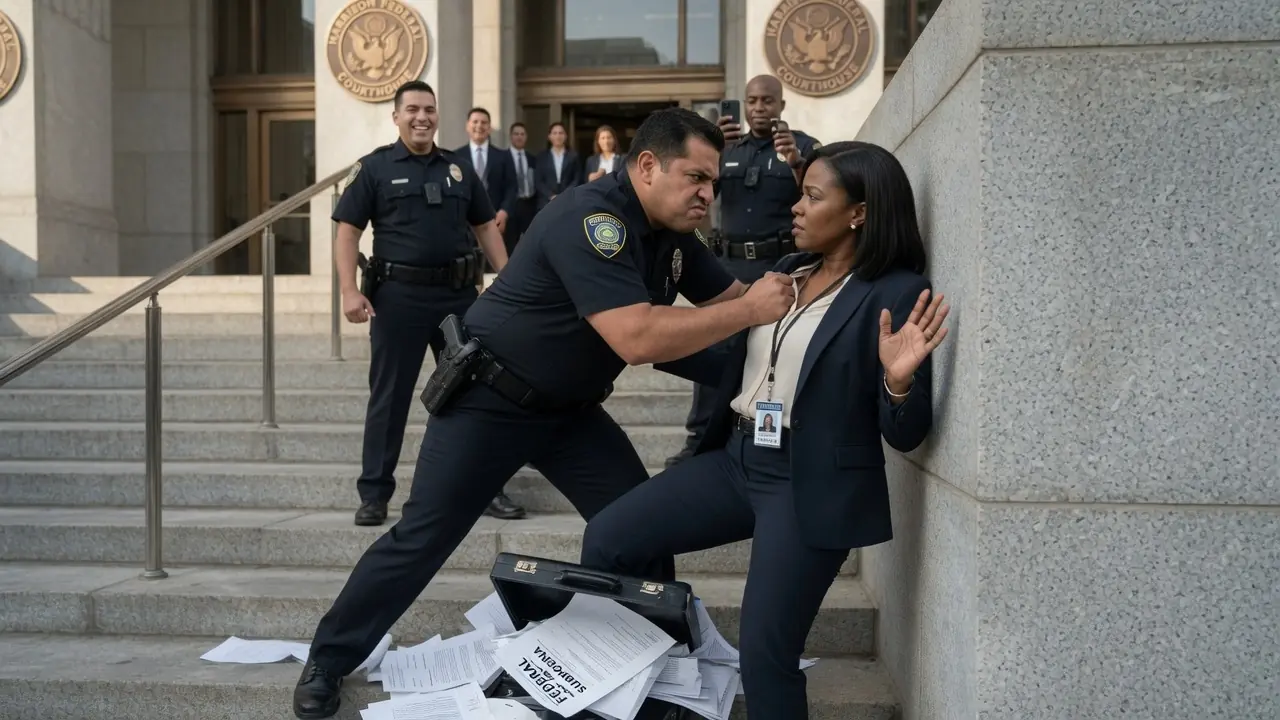
Her name appeared on the bronze directory beside the entrance.
But Malloy had entered through the detention garage dozens of times and rarely looked at anything unrelated to his own movement.
He saw a Black woman in civilian clothing.
Then he constructed a story around that fact.
“You’re going through public screening,” he said.
“I normally use the judicial entrance.”
“Not today.”
Helena reached toward her credential again.
This time, Malloy struck her.
The open-handed blow landed across her left cheek.
For a fraction of a second, the officers around him became still.
Helena’s briefcase fell.
The latches opened.
Documents slid down the steps.
A sentencing memorandum stopped near Reese’s boot.
The page carried federal letterhead.
At the top, in bold type, were the words:
THE HONORABLE HELENA M. WARD
UNITED STATES DISTRICT JUDGE
Reese looked down.
He saw the name.
He did not pick up the paper.
Malloy grabbed Helena by the collar and slammed her against the wall.
Her shoulder struck first.
Then her face.
“You don’t ignore commands.”
“I was showing you my identification.”
“Stop resisting.”
“I am not resisting.”
He twisted one arm behind her back.
Helena inhaled sharply.
“Activate your body camera.”
Malloy paused.
The camera on his chest was dark.
“You don’t tell me what to do.”
“Your department requires activation during enforcement contact.”
Reese’s smile disappeared.
Helena turned her head as far as the pressure allowed.
“Officer Reese, yours is recording.”
Reese looked down.
A red light blinked near his chest.
Concern entered his face.
Malloy tightened his grip.
“You know a lot about policy.”
“I know enough to understand what you’re doing.”
Briggs lifted his phone.
Whether he intended to record evidence or entertainment was not yet clear.
Malloy closed handcuffs around Helena’s wrists.
The metal cut deeply into the skin.
Several courthouse employees had stopped behind the glass doors.
A security officer stepped outside.
“What happened?”
Malloy answered immediately.
“Suspicious person attempting unauthorized entry. Possible stolen federal records.”
Helena looked at the security officer.
“Call Marshal Benjamin Cole.”
Malloy laughed.
“Now she knows the marshal.”
“I work with him.”
“Everyone knows somebody after they get caught.”
Helena’s eyes remained on the security officer.
“Call Chief Judge Margaret Sloan.”
The guard hesitated.
Malloy pushed Helena toward the doors.
“She’s under arrest.”
“For what?” the guard asked.
“Trespassing, resisting, assaulting an officer, and possession of suspected stolen documents.”
Helena looked at Malloy.
“I never touched you.”
“You scratched me.”
He held up his wrist.
A faint red line crossed the skin.
Reese knew the mark came from Malloy’s own watchband as he forced Helena’s arm behind her back.
He said nothing.
The security officer should have stopped the transfer.
He should have verified Helena’s identity.
Instead, Malloy’s certainty overwhelmed everyone around him.
That was one of the most dangerous abilities an abusive officer possessed.
Not strength.
Not speed.
Narrative control.
Malloy spoke first.
He spoke loudly.
He used familiar phrases.
Suspicious behavior.
Officer safety.
Failure to comply.
Aggressive resistance.
Possible weapon.
The language arrived before anyone asked what had actually happened.
Helena was led through the public entrance in handcuffs.
Court clerks saw her.
Attorneys saw her.
Several recognized her immediately but assumed there must be some explanation.
Others saw only a woman in custody.
That distinction disturbed Helena long after the bruises faded.
People who greeted her respectfully when she wore a robe looked away when she wore handcuffs.
She was taken to a holding room on the courthouse’s lower level.
Her briefcase and credential wallet were logged into evidence without being opened.
At 9:04, Helena’s law clerk, Sophie Chen, called for the fourth time.
No answer.
At 9:09, Sophie contacted Marshal Benjamin Cole.
“Judge Ward never arrived.”
“Her car?”
“In the temporary lot.”
“Chambers?”
“Empty.”
Cole checked the access logs.
Helena’s card had not been used.
Then one of the courthouse guards approached.
“There was an arrest at the front entrance.”
Cole looked up.
“What arrest?”
“A woman carrying court papers. Claimed she worked here.”
The marshal became still.
“Name?”
“The officers didn’t give one.”
Cole moved toward the detention level.
At the same time, Derek Malloy began preparing his report.
He described Helena as hostile from the beginning.
He wrote that she approached the courthouse while scanning the building suspiciously.
He claimed she refused identification.
He said she reached suddenly toward her waistband.
He described the slap as an emergency distraction technique used to prevent access to a possible weapon.
According to his report, Helena scratched him, pushed backward, and attempted to flee.
Calvin Reese signed a supporting statement.
Noah Briggs submitted a shorter report saying he arrived after the confrontation began.
Malloy claimed his body camera had malfunctioned.
Reese’s camera remained active.
Neither officer remembered that department policy required the device to upload automatically every sixty seconds whenever connected to the city network.
At 9:41, Helena was brought before Magistrate Judge Peter Lang for an emergency initial appearance.
Lang was sixty-three and had been called from another courtroom because Helena’s scheduled hearings had been delayed without explanation.
He did not recognize her immediately.
The swelling across her cheek had worsened.
Her hair had come loose.
Her jacket was torn at the collar.
She sat at the defense table in handcuffs while Malloy stood near the prosecutor, composed and confident.
Assistant U.S. Attorney Monica Grant had received only the police reports.
She had not reviewed video.
She had not examined the documents.
She had not opened the credential wallet.
Emergency hearings moved quickly.
Police accounts often became the temporary foundation of everything that followed.
“Officer Malloy,” Judge Lang said, “describe what occurred.”
Malloy straightened.
“I observed the defendant attempting to access the courthouse through a restricted entrance.”
Helena listened.
“She carried what appeared to be confidential federal material. When I requested identification, she became aggressive.”
Malloy’s voice settled into the rhythm of practiced testimony.
“She used profanity, refused repeated lawful commands, and reached suddenly inside her jacket. I believed she might be armed.”
“Did you use force?”
“Only the minimum necessary.”
Helena looked at the cuffs cutting into her wrists.
Malloy continued.
“She struck my arm, scratched me, and attempted to force her way past security. I restrained her to protect courthouse personnel.”
Judge Lang examined the photograph of the scratch.
“Was your body camera recording?”
“Unfortunately, the device malfunctioned.”
“How convenient,” Helena said softly.
Lang looked toward her.
“Do not interrupt.”
“Yes, Your Honor.”
Something about the response made him pause.
The tone was respectful.
Professional.
Familiar.
Malloy continued.
“She repeatedly claimed to be a federal judge.”
A few people in the gallery smiled.
“These individuals often make grand statements when caught,” Malloy said. “Lawyers. Judges. Federal agents. It’s a common tactic.”
Helena looked directly at him.
Malloy mistook her silence for defeat.
Reese testified next.
He confirmed Malloy’s account.
He said Helena became combative.
He described the force as necessary and restrained.
Briggs claimed he saw her shouting.
The three stories matched almost perfectly.
Too perfectly.
Sophie Chen entered the courtroom during Reese’s testimony.
She stood near the rear wall, staring at the woman in handcuffs.
She recognized Helena’s posture before her face.
“Marshal,” she whispered to Cole, who had arrived beside her. “That’s Judge Ward.”
Cole’s expression emptied.
He moved toward the bailiff.
On the witness stand, Malloy was explaining the documents.
“They included sealed motions and court schedules,” he said. “The defendant had no lawful reason to possess them.”
Helena stood slowly.
The short chain connecting her wrists made a faint metallic sound.
“May I respond, Your Honor?”
Lang looked toward her.
“You will have an opportunity.”
“I believe the court should first verify the identity of the person being charged.”
The prosecutor rose.
“The defendant refused identification during the arrest.”
“No,” Helena said. “Officer Malloy refused to examine it.”
The bailiff approached the bench and handed Judge Lang a note.
He read it.
Then read it again.
His face changed.
Before he could speak, the courtroom doors opened.
Chief Judge Margaret Sloan entered with Marshal Cole and two federal court administrators.
Everyone rose automatically.
Margaret was sixty-two, silver-haired, and had supervised the district for nearly a decade.
She looked first at Judge Lang.
Then at Helena.
The bruise.
The torn jacket.
The handcuffs.
Her expression became colder with each detail.
“Marshal,” she said, “remove those cuffs from Judge Ward.”
Malloy turned sharply.
Reese stopped breathing.
The prosecutor stared at Helena.
Judge Lang rose from the bench.
“Judge Ward?”
Cole reached the defense table and unlocked the handcuffs.
Helena rubbed one wrist.
Chief Judge Sloan looked toward Malloy.
“Officer, step away from her.”
Malloy attempted to recover.
“Your Honor, she was arrested while—”
“I heard enough from the hallway.”
Margaret approached Helena.
“Are you injured?”
“My face and shoulder.”
“Medical staff are waiting.”
“I want the evidence preserved first.”
“All courthouse footage has already been secured.”
Helena looked toward Reese.
“His body camera was active.”
The blood left Reese’s face.
Malloy turned toward him.
“You said—”
Reese lowered his eyes.
Chief Judge Sloan faced Judge Lang.
“This proceeding is terminated. Judge Ward is not a defendant.”
She looked toward the prosecutor.
“No charge against her will proceed without an independent investigation.”
Then she faced the three officers.
“You are not to leave this building until federal investigators arrive.”
Malloy’s voice weakened.
“I acted in good faith.”
Helena picked up the credential wallet from the evidence table.
She opened it.
The gold judicial seal caught the courtroom light.
“You testified under oath that I refused identification.”
Malloy stared at the credential.
“You testified that I struck you.”
He said nothing.
“You testified that your camera malfunctioned.”
His mouth opened.
Helena’s voice remained quiet.
“I suggest that you stop speaking until you have counsel.”
That advice likely prevented him from adding another lie to the record.
The courthouse entered lockdown within twenty minutes.
Federal marshals separated the officers.
The Justice Department’s Civil Rights Division was notified, along with the FBI’s Public Corruption Unit.
Multiple copies of every available recording were preserved.
The courthouse cameras had captured the confrontation from four angles.
Reese’s body camera recorded the entire encounter.
Briggs’s phone contained his own video.
It also contained several comments made before Malloy approached Helena.
“Watch him teach her where she belongs,” Briggs said.
Reese laughed.
“Malloy loves mornings like this.”
The phone continued recording during the assault.
It captured Reese looking at the judicial letterhead near his boot.
“You think she actually works here?” Briggs whispered.
Reese answered:
“Doesn’t matter now. We stay together.”
That sentence transformed an assault into a conspiracy investigation.
Helena spent the afternoon at a hospital.
Her left shoulder was badly bruised but not fractured. Her cheek required three stitches. The handcuffs left deep cuts around both wrists.
Chief Judge Sloan sat beside her.
“You cannot participate in the prosecution,” Margaret said.
“I know.”
“You will need to recuse from every matter involving these officers.”
“I know.”
Helena stared through the hospital window.
“But I can make sure nothing disappears.”
“That has been done.”
“There is more.”
Margaret looked toward her.
Helena had been supervising a sealed federal review for seven months.
The review examined patterns of police testimony across the district.
Defense attorneys had complained that Derek Malloy used nearly identical language in dozens of arrests.
Defendants appeared nervous.
Defendants reached suddenly.
Defendants ignored commands.
Body cameras malfunctioned.
Contraband appeared after searches that began without consent.
The allegations seemed weak when viewed separately.
Together, they suggested a method.
Malloy’s name appeared repeatedly.
So did Reese’s.
The investigation had not yet reached charging decisions.
Then Malloy assaulted the judge supervising it.
“He testified before me ten times,” Helena said.
Margaret remained silent.
“I believed parts of his testimony.”
“That is not your fault.”
“It is my responsibility.”
“There is a difference.”
“Not to the people convicted.”
Within forty-eight hours, investigators searched Malloy’s home, patrol locker, personal car, and electronic devices.
They found copies of reports altered after supervisors had approved them.
Group messages showed officers joking about vulnerable targets.
One message from Malloy read:
No camera, no problem. Write fear, reach, resist. Judges accept the pattern.
Another officer replied:
Same language. Same result.
Investigators reopened forty-nine cases.
A pattern emerged.
Malloy targeted people he believed would not be trusted.
Teenagers.
Immigrants.
People with old criminal records.
Poor residents.
Black professionals in neighborhoods where he assumed they did not belong.
He created minor reasons for contact, escalated encounters, and described questions as aggression.
Reese supported him.
Briggs treated the humiliation as entertainment and later adjusted his reports to match the preferred version.
Supervisors dismissed complaints without reviewing full recordings.
When video contradicted reports, Internal Affairs called the evidence inconclusive.
A seventeen-year-old named Jordan Miles served fourteen months after Malloy claimed to find cocaine inside his backpack.
Evidence records later showed that the package had been logged in an unrelated case six weeks earlier.
Dr. Leonard Green, a cardiologist, was arrested outside his own home after Malloy refused to believe he lived there.
The city settled his lawsuit for nearly half a million dollars.
Malloy remained on patrol.
Sixty-eight-year-old Rosa Alvarez reported that Malloy called her a racial insult and slammed her face against her car.
Internal Affairs found no evidence.
A gas-station camera had recorded the encounter, but investigators never requested the footage before it was deleted.
Different people.
The same phrases.
The same confidence.
The same institutional response.
Helena read every file.
Not as the judge who would decide guilt.
That responsibility belonged to an independent judge from another district.
She read them as someone confronting the consequences of routine trust.
Months later, Derek Malloy went to trial.
He faced federal charges for deprivation of civil rights under color of law, falsification of records, obstruction, conspiracy, perjury, and evidence tampering.
Calvin Reese pleaded guilty and cooperated.
Noah Briggs did the same.
Both testified that Malloy taught younger officers to create legal justification after force had already been used.
“Describe the process,” Special Prosecutor Kim told Reese.
He looked toward the jury.
“Say the person looked nervous.”
“What comes next?”
“Claim they reached toward something.”
“If they asked why they were being stopped?”
“Write that they became argumentative.”
“If they refused a search?”
“Say you smelled drugs.”
“If body cameras were active?”
“Turn sideways. Block the view. Activate them late.”
The courtroom remained silent.
“What happened outside the courthouse?”
Reese lowered his head.
“Malloy saw Judge Ward and decided she did not belong.”
“Did she threaten him?”
“No.”
“Did she strike him?”
“No.”
“Did you know your report was false?”
“Yes.”
“Why did you sign it?”
Reese looked toward Malloy.
“Because we had done it before.”
Helena testified on the fourth day.
She entered through the witness door.
She wore no robe.
No one rose.
That mattered to her.
The jury needed to hear her as a witness, not submit to her as a judge.
Rachel Kim asked her to describe the morning.
Helena answered carefully.
She separated memory from inference.
She repeated Malloy’s words without exaggeration.
She admitted when she could not see what Reese or Briggs were doing behind her.
She described her injuries.
Then the prosecutor asked the central question.
“When did Officer Malloy learn that you were a federal judge?”
“Inside the courtroom.”
“Did your profession change whether his conduct was unlawful?”
“No.”
“Why not?”
Helena looked toward the jury.
“Constitutional protection does not begin when a person reveals an impressive title.”
“Why did this case receive so much attention?”
“Because I had access to systems capable of preserving evidence.”
Her voice remained even.
“Many people Officer Malloy confronted did not.”
The defense attorney approached.
He suggested Helena had used her position to turn a misunderstanding into a federal prosecution.
“You were angry.”
“Yes.”
“You wanted Officer Malloy punished.”
“I wanted his conduct investigated.”
“That is not the same answer.”
“No. It is the accurate one.”
“You requested preservation of the security footage.”
“Yes.”
“You were already investigating him.”
“I supervised a sealed review of recurring testimony patterns.”
“So you had formed an opinion.”
“No.”
Helena looked directly at him.
“I had formed questions.”
The attorney changed direction.
“Officer Malloy could not have known who you were.”
“That is correct.”
“Doesn’t that explain the encounter?”
“No.”
“Why not?”
“Because he should not have needed to know my profession before deciding not to strike me.”
The attorney remained silent.
Helena continued.
“He believed I was powerless.”
She looked toward Malloy.
“That belief did not excuse his conduct. It explained why he felt safe.”
The jury convicted Malloy on every major count.
Sentencing took place three months later before Judge Rebecca Stone, who had been assigned from another district to avoid any appearance of conflict.
Helena sat in the gallery beside Rosa Alvarez, Dr. Green, Jordan Miles, and eleven other people whose cases had been reopened.
Judge Stone reviewed the law.
The harm.
The pattern.
The years during which Malloy used public authority to create victims he believed the system would disregard.
He received twenty-two years in federal prison.
Reese received six years after his cooperation.
Briggs received four.
Three supervisors were charged with obstruction and destruction of complaint records.
The Internal Affairs commander resigned and later pleaded guilty to falsifying findings.
More than four hundred cases were reviewed.
Sixty-four convictions were vacated.
Dozens of pending charges were dismissed.
Jordan Miles left prison after the planted evidence was traced to another case.
His mother met him outside the courthouse and held him for several minutes without speaking.
Dr. Green’s arrest record was erased.
Rosa Alvarez received a public apology from the city.
She listened without smiling.
“I asked them to believe me fourteen years ago,” she told reporters. “They waited until he struck a judge.”
Her words appeared in newspapers across the country.
Helena printed them and kept them inside her chambers.
The police department entered federal oversight.
Body cameras began uploading continuously.
Unauthorized deactivation triggered immediate supervisory review.
Complaints containing repeated language or involving the same officer were grouped automatically for pattern analysis.
Investigators were required to locate external video before dismissing allegations.
Prosecutors had to disclose sustained credibility findings involving police witnesses.
The reforms mattered.
They were also late.
Helena returned to the bench after recovering.
On her first day back, courtroom staff stood as she entered.
She wore the black robe she had worn for years.
The bruising had disappeared.
The scar near her jaw remained.
Before beginning the docket, she looked toward the attorneys, witnesses, and defendants.
“I want to clarify something,” she said.
The courtroom became still.
“You may have heard that Officer Malloy made a terrible mistake because he assaulted a federal judge.”
Helena rested her hands on the bench.
“That was not the mistake.”
Her voice filled the room without rising.
“The mistake was believing any person could be assaulted, humiliated, and falsely accused because an officer assumed no one important would object.”
She looked across the courtroom.
“My title made the truth visible.”
“It did not make the truth true.”
Years later, the courthouse steps were repaired.
The stone where Helena’s face struck the wall was removed during renovation.
She asked that the damaged section be preserved.
It was placed inside the courthouse training center beneath a simple plaque:
POWER REVEALS ITS TRUE CHARACTER WHEN IT BELIEVES NO ONE POWERFUL IS WATCHING.
Helena refused to have the courthouse renamed after her.
She declined book contracts and television offers.
One reporter asked whether she considered herself unusually courageous.
“No,” Helena said.
“You confronted three armed officers.”
“So did people before me.”
She looked toward the courthouse entrance.
“They had the same courage. They lacked the protection of being recognized afterward.”
Sophie Chen later joined the Justice Department’s Civil Rights Division.
Marshal Cole created new procedures requiring immediate identity verification before local police could transfer anyone arrested on federal property.
Judge Lang changed the way he handled emergency hearings.
He no longer treated polished testimony as a substitute for evidence.
Prosecutor Monica Grant established a review unit for cases involving officers with credibility complaints.
Each person carried something forward.
Not guilt alone.
Responsibility.
Helena understood the difference.
Guilt looked backward and asked how decent people had allowed the system to fail.
Responsibility looked forward and asked what they would change after learning the truth.
Derek Malloy believed his badge made his version stronger than reality.
For years, the system supported that belief.
Complaints vanished.
Reports were approved.
Settlements were paid quietly.
Defendants accepted pleas.
Judges heard familiar language and assumed it described familiar danger.
Then, one Monday morning, Malloy stopped a woman outside the courthouse.
He refused to examine her identification.
He struck her.
He called her an animal.
He handcuffed her and carried her into a courtroom where he believed his uniform would complete the lie.
He did not know the building had recorded every angle.
He forgot Reese’s body camera uploaded automatically.
He failed to recognize the name printed on the papers beneath his feet.
He did not understand that the woman listening silently at the defense table had spent her career examining lies built exactly like his.
But those were not his greatest mistakes.
His greatest mistake was simpler.
He looked at Helena Ward and believed he had found someone the system would never choose over him.
For fifteen minutes, he treated her exactly as he had treated dozens of other people.
That was why the case mattered.
Not because he assaulted the wrong woman.
Because, for the first time, the system was forced to see what he did when he believed he had chosen the right one.