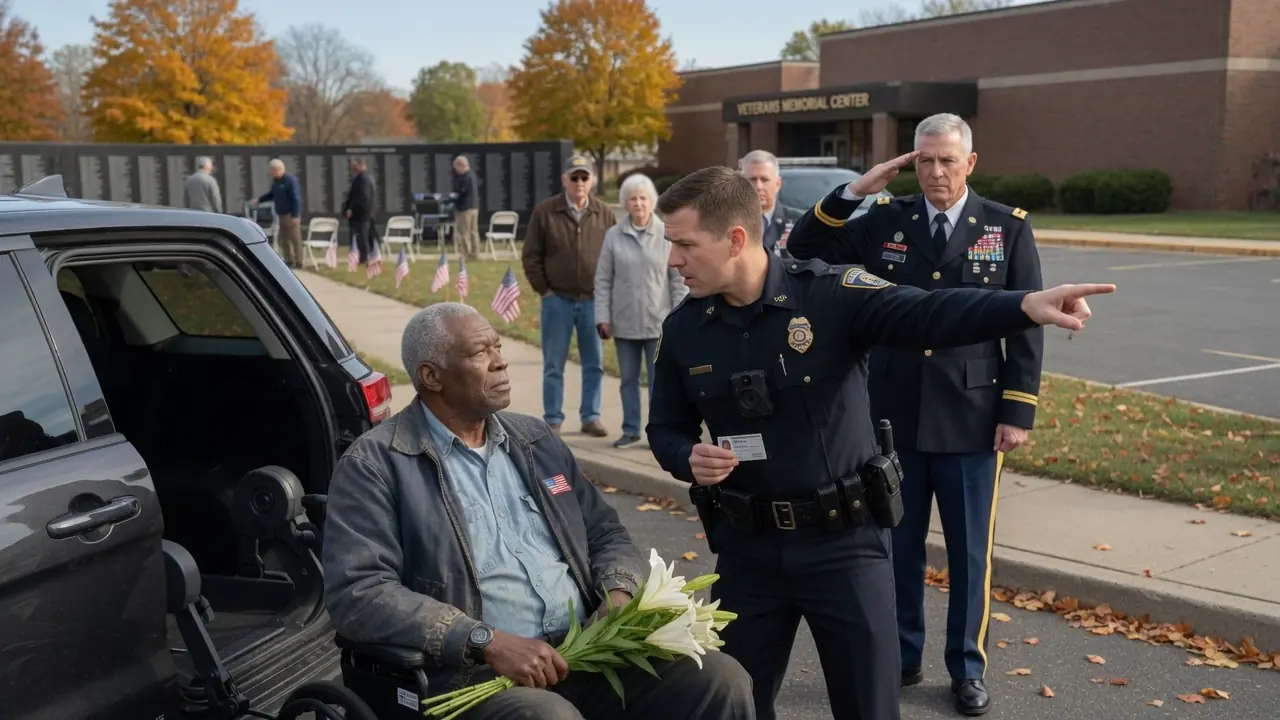
The white lilies never left Isaiah Bennett’s lap.
Even when Officer Ryan Keller ordered him to remain beside the parking space.
Even when visitors slowed to watch.
Even when a second police cruiser entered the Veterans Memorial Center and stopped behind Isaiah’s specially equipped SUV.
The elderly veteran kept one hand beneath the bouquet, protecting the fragile stems from the autumn wind.
He had brought nineteen lilies.
One for each man who had entered Red Canyon with him.
Only four had come home.
Ryan stood in front of Isaiah’s wheelchair, holding his driver’s license and registration.
Every document was valid.
The accessible parking permit matched the vehicle. The vehicle identification number matched the registration. Isaiah’s address was current, and the adaptive-driving endorsement on his license had not expired.
There was no violation.
Yet Ryan continued asking questions.
“Why did you arrive so early?”
“The ceremony begins at ten,” Isaiah answered.
“It’s barely nine.”
“I prefer to spend time with the names before the speeches begin.”
“What names?”
Isaiah glanced toward the polished granite wall inside the memorial garden.
“Men I knew.”
Ryan followed his gaze but did not return the identification.
A military band was warming up near the stage. Volunteers unfolded chairs beneath rows of American flags. Families carried flowers and framed photographs toward the entrance.
Isaiah had attended the ceremony every year for sixteen years.
He knew most of the volunteers by name.
That morning, however, Officer Ryan Keller looked at the expensive adaptive SUV, the reserved parking area, and the quiet Black man in the wheelchair and decided something did not fit.
Ryan could not have explained exactly what bothered him.
Perhaps it was the vehicle.
Perhaps it was Isaiah’s calmness.
Perhaps it was the fact that a man dressed in a neatly pressed Navy-blue jacket appeared completely unafraid of being questioned.
Whatever the reason, Ryan had begun the encounter with a conclusion and was now searching for evidence to support it.
“Are you involved with the event?” he asked.
“Yes.”
“In what capacity?”
Isaiah’s fingers rested lightly on the lilies.
“I remember people.”
Ryan frowned.
“That isn’t what I asked.”
“It is the most accurate answer I have.”
Several visitors turned toward them.
Isaiah noticed.
He had spent years learning how quickly a crowd could make a tense situation worse. He kept his voice low and his hands visible.
“Officer, may I ask what offense you believe has occurred?”
“I’m making sure everything is in order.”
“The documents appear to be in order.”
“I decide when I’m finished.”
Isaiah nodded once.
“Of course.”
The response was polite.
Ryan heard defiance anyway.
Then the side doors of the memorial building opened.
Twelve soldiers in Army dress uniforms stepped into the morning light.
They formed two silent lines beside the entrance.
The commanding officer looked across the parking lot, saw Isaiah in the wheelchair, and immediately turned toward him.
One by one, every member of the honor guard followed.
Ryan had just enough time to wonder why.
Then twelve white-gloved hands rose in a formal salute.
Four hours earlier, Isaiah had awakened before the alarm.
He lay in the darkness of his small brick home outside Richmond and listened to the heating system come alive beneath the floor.
His legs had been gone for twenty-three years.
The pain remained.
Doctors called it phantom pain, as though naming it made the sensation less real.
Some mornings, Isaiah felt pressure around ankles that no longer existed. Other mornings, he felt heat or stabbing pain in feet buried beneath foreign soil half a world away.
He rarely complained.
At five thirty, he transferred into his wheelchair and moved through the same routine he had followed since leaving military rehabilitation.
Shower.
Shave.
Medication.
Black coffee.
He pressed his jacket before wearing it, though it had been cleaned the previous week. Discipline had survived everything the war took from him.
On the fireplace rested a folded American flag inside a wooden case.
Beside it was a photograph of nineteen young soldiers standing beneath a pale desert sky.
Isaiah was twenty-nine in the photograph.
He stood in the center with one arm around Staff Sergeant Benjamin Ross and the other resting on the shoulder of Specialist Andrew Cole.
All nineteen men were smiling.
They had not yet entered Red Canyon.
Isaiah polished the brass plate beneath the flag.
MASTER SERGEANT ISAIAH BENNETT
UNITED STATES ARMY
His official records listed him as a retired master sergeant.
The memorial program still identified him by the rank he held during the mission that changed everything: staff sergeant.
He never corrected the organizers.
The younger version of himself was the one the dead men had known.
Isaiah moved to the dining table, where a bouquet of white lilies rested in a vase.
His wife, Helen, had chosen lilies for Benjamin Ross’s funeral.
After she died from cancer seven years earlier, Isaiah continued bringing the same flowers to every remembrance ceremony.
Some traditions held the dead close without pretending they were still alive.
Before leaving, he touched the old unit photograph.
“I’ll see you boys soon.”
The house gave no answer.
It never did.
The Veterans Memorial Center stood on twenty acres outside Richmond.
A curved granite wall carried the names of Virginians killed during military service. At its center was a reflecting pool surrounded by oak trees planted for local units.
Isaiah arrived forty minutes early.
He parked in the accessible space nearest the memorial path and lowered the hydraulic ramp from his SUV.
A volunteer named Emily Harper offered assistance.
“I’m all right,” Isaiah told her.
“You always say that.”
“And I’m usually correct.”
She smiled.
“Your seat is ready near the front.”
“Thank you, Emily.”
Isaiah placed the lilies across his knees and began moving toward the garden.
Officer Ryan Keller entered the parking lot moments later.
The city assigned two officers to manage traffic during the annual ceremony. Ryan had expected an easy overtime shift: direct vehicles, answer questions, and remain visible until the crowd left.
He noticed Isaiah’s SUV because it occupied a reserved space near the entrance.
The vehicle was less than a year old and modified with an expensive automated ramp, rotating driver’s seat, and hand controls.
Ryan looked at Isaiah.
Then at the vehicle.
The suspicion formed so quickly that he did not recognize it as suspicion.
He simply felt that something required investigation.
“Sir, stop there.”
Isaiah stopped his wheelchair.
“Yes, Officer?”
“This space is reserved.”
“The permit is displayed.”
“I can see that.”
Ryan examined the windshield placard.
It was valid.
“Is this your vehicle?”
“Yes.”
“Do you have identification?”
Isaiah looked toward the memorial path.
“May I ask why?”
“It’s a routine verification.”
There was nothing routine about checking whether a disabled man owned the vehicle beside him, but Isaiah did not argue.
He handed over his license.
Ryan returned to his cruiser and ran the information.
Everything matched.
He should have returned the documents and ended the contact.
Instead, he saw an old departmental notation associated with Isaiah’s address.
Federal protective flag—contact supervisor before forced entry.
The notation existed because Isaiah had received threats years earlier after testifying before a congressional committee about failures during Red Canyon.
Ryan did not know that.
He interpreted the flag as evidence that Isaiah might be dangerous or politically connected.
He returned to the wheelchair.
“Do you have any weapons?”
“No.”
“Any firearms in the vehicle?”
“There is a legally owned pistol secured in a locked compartment.”
Ryan’s posture changed.
“You’re armed?”
“The weapon is locked inside the vehicle. I am not carrying it.”
“Give me the key.”
“Why?”
“For officer safety.”
Isaiah looked at him carefully.
“You have no reason to enter my vehicle.”
Ryan folded his arms.
“Are you refusing?”
“I am asking for the legal basis.”
Several years earlier, Isaiah might have answered more sharply.
Age had taught him that calmness often protected people in situations where justice arrived too slowly.
“Officer, my documents are valid. The permit is valid. I have committed no offense.”
Ryan stepped closer.
“You don’t determine that.”
Isaiah looked toward the lilies.
“No. Facts do.”
That sentence prolonged the encounter by twenty minutes.
People began recognizing Isaiah.
An elderly veteran named Frank Delaney passed them on the way to the garden.
“Morning, Isaiah.”
“Good morning, Frank.”
Frank looked toward the bouquet.
“Nineteen again?”
“Nineteen.”
Frank’s expression softened.
He turned to Ryan.
“Officer, the ceremony begins soon. Is everything all right?”
“I’m handling it.”
Frank nodded and continued walking, though he looked back twice.
A woman at the registration desk waved.
“Mr. Bennett, your usual place is ready.”
“Thank you.”
Ryan noticed every greeting.
His suspicion should have weakened.
Instead, it changed shape.
Perhaps Isaiah expected special treatment because he knew influential people.
Perhaps the community had been fooled by him.
The mind was remarkably talented at protecting a bad first conclusion.
“Who exactly are you here to honor?” Ryan asked.
Isaiah looked toward the memorial.
“Benjamin Ross. Andrew Cole. Marcus Gaines. Thomas Webb. Daniel Ortiz.”
He continued naming men.
Ryan interrupted.
“That’s enough.”
Isaiah became silent.
Ryan looked at the lilies.
“Nineteen flowers?”
“Yes.”
“For nineteen people?”
“For nineteen soldiers.”
“How many died?”
Isaiah’s face did not change.
“Fifteen.”
The answer briefly removed the authority from Ryan’s posture.
He glanced toward the wheelchair.
“Were you with them?”
“Yes.”
“What happened to your legs?”
Isaiah’s hands tightened around the bouquet.
“That is not relevant to the parking permit.”
Ryan immediately knew the question had crossed a line.
Pride prevented him from admitting it.
“I’m trying to understand the situation.”
“You are trying to understand me.”
Isaiah met his eyes.
“They are not the same thing.”
Retired Colonel Matthew Hayes arrived ten minutes before the ceremony.
He had commanded Isaiah’s battalion during its final deployment.
When he saw the prolonged encounter, he walked directly toward them.
“Sergeant Bennett.”
Isaiah smiled.
“Colonel.”
Matthew extended his hand.
Isaiah accepted it.
“I was afraid the traffic would keep you away,” Matthew said.
“I left early.”
Matthew noticed the identification in Ryan’s hand.
“Is there a problem, Officer?”
“I’m verifying information.”
Matthew looked at the valid parking permit.
“Regarding?”
Ryan hesitated.
“The vehicle and a secured weapon.”
“Has Sergeant Bennett violated a law?”
“I haven’t completed my investigation.”
Matthew’s expression remained courteous.
“Accuracy matters. So does knowing when an investigation has produced its answer.”
Ryan felt corrected.
He disliked being corrected in front of visitors.
“I know how to perform my duties, sir.”
Matthew nodded.
“Then I trust you’ll perform them.”
He turned back toward Isaiah.
“General Whitaker is arriving shortly.”
Isaiah sighed.
“You invited him?”
“He invited himself.”
“He’ll make a speech.”
“He’s a general. They do that.”
Isaiah smiled faintly.
Ryan watched them.
The title Sergeant Bennett echoed in his mind.
He looked again at Isaiah’s Navy-blue jacket.
There were no medals displayed. No rank. Only a small American flag pin.
“You served in the Army?” Ryan asked.
Isaiah nodded.
“For a while.”
Matthew almost laughed.
Isaiah gave him a warning look.
Ryan noticed.
“What does that mean?”
“It means I served.”
“What unit?”
Isaiah’s eyes moved toward the memorial wall.
“Third Battalion, Seventy-Fifth Rangers.”
Ryan had heard of the Rangers.
The answer altered his understanding but did not erase the previous thirty minutes.
“You were Special Operations?”
“Yes.”
“And Red Canyon?”
Matthew spoke before Isaiah could stop him.
“He commanded the recovery element.”
Isaiah lowered his voice.
“Colonel.”
Ryan looked between them.
“What was Red Canyon?”
Matthew’s face became serious.
“A mission this country spent too many years misunderstanding.”
Red Canyon had occurred in Afghanistan in 2003.
Isaiah’s squad was assigned to escort an intelligence team into a remote valley where a group of aid workers was being held.
The operation was expected to last six hours.
It continued for three days.
Intelligence underestimated the enemy force.
The extraction route collapsed.
Two helicopters were damaged, and communications failed inside the canyon.
Isaiah was a staff sergeant with nineteen men under his immediate command.
During the second night, an explosion destroyed the lead vehicle.
Isaiah lost both legs below the knee.
He remained conscious.
He refused morphine until every wounded soldier received treatment.
For eleven hours, he directed defensive positions from the ground while the unit protected the hostages and waited for air support.
When ammunition became scarce, Isaiah ordered the men to divide into two groups.
One would carry the wounded and hostages toward an alternate extraction point.
The other would remain behind and slow the enemy.
Isaiah chose to remain.
Benjamin Ross refused to leave him.
So did fourteen others.
The decision saved the hostages and four badly wounded soldiers.
It also cost fifteen lives.
A rescue team arrived the following morning.
They found Isaiah unconscious beneath Benjamin Ross’s body.
Benjamin had used himself to shield Isaiah from shrapnel during the final attack.
The Army awarded Isaiah the Distinguished Service Cross.
Isaiah rarely wore it.
He did not consider the medal proof that he had been brave.
He considered it evidence that other men had died close enough for their blood to reach him.
After rehabilitation, he spent years advocating for wounded service members and families of the dead.
The federal notation on his address had been added after threats connected to his public testimony about inadequate armored vehicles and evacuation planning.
None of that was visible in the parking lot.
Only the wheelchair was visible.
The adaptive SUV.
The flowers.
And an old man asking to reach the memorial before the names were read.
The honor guard emerged from the building.
Its commander recognized Isaiah immediately.
He called the formation to attention.
The soldiers turned.
All twelve saluted.
Isaiah returned the salute from his wheelchair.
Ryan looked toward the visitors.
Conversation had stopped.
Then a black government sedan entered the parking area.
Lieutenant General William Whitaker stepped out in dress uniform.
Two aides followed.
He passed the stage and walked directly toward Isaiah.
Ryan instinctively straightened.
Whitaker stopped three feet from the wheelchair and saluted.
“Master Sergeant Bennett.”
Isaiah returned it.
“General.”
“It’s good to see you.”
“You say that every year.”
“I mean it every year.”
Whitaker glanced toward Ryan, then at the driver’s license still in the officer’s hand.
“Is there an issue?”
Ryan’s confidence disappeared.
“I was conducting a verification, sir.”
Whitaker did not raise his voice.
“Has it been completed?”
Ryan looked at the documents.
“Yes.”
“Then perhaps Mr. Bennett would like them returned.”
Ryan handed the identification back.
Isaiah placed it inside the wheelchair pouch.
Whitaker looked toward the lilies.
“Nineteen?”
“Nineteen.”
The general’s expression changed.
He knew what each flower represented.
“The families are waiting.”
Isaiah nodded.
Ryan stepped away.
No one shouted at him.
No one demanded his badge.
No general threatened his career.
The absence of humiliation made the lesson harder to escape.
Isaiah had given him every opportunity to end the encounter privately.
Ryan had continued because admitting uncertainty felt like surrendering authority.
Now the entire parking lot could see what his assumptions had cost.
The ceremony began beneath a clear Virginia sky.
Isaiah sat in the front row.
Ryan remained at the edge of the crowd.
The names were read slowly.
When the announcer reached Benjamin Ross, Isaiah closed his eyes.
Andrew Cole.
Marcus Gaines.
Thomas Webb.
Daniel Ortiz.
Fifteen names.
After the final one, the honor guard fired three ceremonial volleys.
A bugler played taps.
Isaiah’s hands trembled slightly around the lilies.
People often assumed the hardest part of memory was pain.
For Isaiah, the hardest part was detail.
Benjamin complaining about instant coffee.
Andrew singing badly while cleaning his rifle.
Marcus carrying photographs of a daughter he had never met because she was born after the unit deployed.
Every man remained young in Isaiah’s memory.
He alone had been required to grow old.
When the ceremony ended, he rolled toward the granite wall.
He placed one lily beneath each name.
The remaining four rested beneath a smaller plaque honoring survivors who later died from injuries connected to the mission.
Matthew stood behind him.
“You still blame yourself.”
Isaiah did not turn.
“I gave the order to stay.”
“You gave the others a path out.”
“Fifteen stayed with me.”
“They chose.”
“I was their leader.”
“And they trusted you.”
Isaiah looked at Benjamin’s name.
“Sometimes trust feels like another form of debt.”
Matthew rested a hand on his shoulder.
“That doesn’t mean you have to repay it by suffering forever.”
Isaiah said nothing.
Some arguments continued for decades because neither side was completely wrong.
Police Lieutenant Rebecca Morgan arrived before the ceremony ended.
Ryan had notified dispatch of the secured firearm and the unusual federal flag. Department policy required a supervisor to review prolonged investigative contacts at public events.
Rebecca watched the body-camera footage inside her cruiser.
She saw Isaiah provide valid documents.
She heard Ryan ask irrelevant questions.
She watched him continue after every lawful concern had been resolved.
She found no racial insult, no physical force, and no explicit threat.
The failure was quieter.
Ryan had treated uncertainty as evidence and dignity as suspicious behavior.
Rebecca approached him after the crowd dispersed.
“You’ll write a complete report.”
“Yes, Lieutenant.”
“Include the original reason for contact.”
Ryan looked toward Isaiah.
“I thought the parking permit might be misused.”
“Why?”
“The vehicle was expensive.”
Rebecca waited.
Ryan heard the answer only after saying it.
“That isn’t probable cause,” she said.
“No.”
“You confirmed the permit immediately.”
“Yes.”
“Why did the encounter continue?”
Ryan looked down.
“I don’t know.”
“That answer will not be sufficient in the report.”
He nodded.
Rebecca’s voice softened slightly.
“Do not write the answer that protects you. Write the answer that might prevent you from doing it again.”
Ryan approached Isaiah before leaving.
The veteran was alone near the reflecting pool.
“Mr. Bennett.”
Isaiah turned.
“I owe you an apology.”
“Yes.”
Ryan had expected Isaiah to make the apology easier.
He did not.
“I formed assumptions before speaking to you.”
Isaiah waited.
“I kept looking for a violation after I knew the documents were valid.”
“Yes.”
“I treated your questions like resistance.”
“Yes.”
Ryan took a breath.
“I’m sorry.”
Isaiah studied him.
“Do you know what concerns me most?”
“That I embarrassed you?”
“No.”
Isaiah looked toward a young veteran moving along the memorial path with a prosthetic leg.
“You did this to someone whose history happened to become visible.”
Ryan followed his gaze.
“Next time, the person may not have a general arriving. There may be no colonel, no honor guard, and no crowd that knows his name.”
“I understand.”
“Not yet.”
Isaiah’s voice remained gentle.
“You understand that you were wrong about me. The harder lesson is understanding that my medals should not have been necessary for you to treat me fairly.”
Ryan lowered his eyes.
“You’re right.”
“Perhaps.”
Isaiah extended his hand.
Ryan shook it.
“Make the next encounter shorter,” Isaiah said.
“I will.”
“Make it better.”
Ryan nodded.
“I will.”
The administrative review took eleven weeks.
Investigators examined body-camera footage, dispatch records, accessibility policies, and previous complaints involving Ryan.
They found no evidence that he had fabricated charges or used physical force.
They did find a pattern of extending minor encounters after legal concerns had been resolved, particularly when motorists questioned his decisions.
Ryan received a formal reprimand, mandatory constitutional-policing instruction, and supervised field evaluation.
Some people believed he should have been fired.
Isaiah did not publicly comment.
Accountability, he believed, should correct what could be corrected and remove what could not.
A civil claim followed.
The city’s attorneys initially argued that Isaiah had suffered no physical injury.
His lawyer responded that unlawful detention did not become harmless merely because the victim remained polite.
The matter ended in a negotiated settlement considerably smaller than the sensational figures circulating online.
Isaiah used most of it to establish the Red Canyon Mobility Fund.
The fund purchased adaptive vehicles, home modifications, and transportation services for injured veterans.
He kept enough money to repair his roof and replace the aging heating system.
When Matthew asked why he did not keep more, Isaiah answered simply.
“I already have a vehicle.”
Ryan completed every required training session.
He did not enjoy them.
That was part of why they mattered.
He reviewed footage of his encounter with Isaiah multiple times.
At first, he focused on what he had not done.
He had not drawn a weapon.
He had not used insulting language.
He had not touched the wheelchair.
Eventually, an instructor stopped the recording.
“You keep measuring yourself against the worst possible behavior.”
Ryan looked at the screen.
“I didn’t abuse him.”
“You prolonged a detention after its legal basis disappeared.”
“I was being cautious.”
“Caution requires information.”
The instructor pointed toward Isaiah on the frozen image.
“This man gave you information. You rejected it because it did not support your original belief.”
Ryan watched his own body standing beside the wheelchair.
“What should I have done?”
“Returned the license.”
“When?”
“Within the first five minutes.”
The simplicity of the answer stayed with him.
One year later, Ryan returned to the Veterans Memorial Center as part of a community-policing program for academy recruits.
Isaiah arrived early.
The same accessible parking space was waiting.
The same nineteen lilies rested across his knees.
Ryan approached, stopping at a respectful distance.
“Good morning, Master Sergeant.”
Isaiah looked up.
“Good morning, Officer Keller.”
“You’re early.”
“So are you.”
“I learned from someone.”
Isaiah smiled faintly.
Ryan introduced the recruits.
One asked Isaiah why he returned every year when the ceremony was clearly painful.
Isaiah looked toward the memorial wall.
“Pain is not always a reason to stay away.”
“What is it, then?”
“Sometimes it is evidence that a promise still matters.”
Another recruit asked about Red Canyon.
Isaiah redirected the question toward the men who died.
Ryan recognized the habit.
After the recruits moved toward the stage, he remained beside Isaiah.
“The fund delivered its fiftieth adaptive van last month,” Ryan said.
“I heard.”
“You don’t seem excited.”
“I am.”
“You hide it well.”
Isaiah adjusted the lilies.
“I learned long ago that doing useful work is more important than looking pleased with yourself.”
Ryan accepted the correction.
“Are we all right?”
Isaiah considered the question.
“We are better than we were.”
“That isn’t the same thing.”
“No.”
“Is it enough?”
“For today.”
They moved together toward the memorial garden.
Ryan walked slowly enough to remain beside the wheelchair without making the pace feel deliberate.
During the ceremony, the names echoed again across the grounds.
Isaiah placed the lilies beneath the granite wall.
This time, Ryan stood several rows behind him with the recruits.
No one saluted Isaiah until the appropriate moment.
No general intervened.
No revelation transformed him into someone worthy of respect.
He was simply a veteran in a wheelchair carrying flowers.
That should always have been enough.
After taps ended, a young boy approached Isaiah.
The child’s father wore an artificial leg and had received transportation assistance through the Red Canyon fund.
“Were you a hero?” the boy asked.
Isaiah looked toward the father.
“Who told you that?”
“My dad.”
“Your dad exaggerates.”
The boy frowned.
“Did you save people?”
“I was part of a team.”
“How many?”
Isaiah looked at the names.
“Not enough.”
The boy did not understand the answer.
Perhaps he would one day.
Isaiah gave him one of the small flags distributed during the ceremony.
“Take care of your father.”
“I do.”
“Good.”
The boy ran back.
Ryan had heard the exchange.
“You always do that.”
“Do what?”
“Move the story away from yourself.”
Isaiah looked toward the memorial.
“The story was never mine alone.”
Years later, the parking-lot encounter became part of the city police academy’s ethics curriculum.
The case study did not identify Isaiah by name.
It presented a simple sequence:
An officer observed a disabled motorist legally parked in an accessible space.
The documentation was valid.
No offense occurred.
The officer continued investigating because the person did not match an unspoken expectation.
Recruits were asked to identify the moment professional caution became unsupported suspicion.
Most chose the request for identification.
Others chose the questions about the weapon.
The correct answer was earlier.
The failure began when Ryan saw the man, the vehicle, and the reserved space and quietly decided that one of them did not belong.
Everything after that was an attempt to prove the first assumption correct.
Ryan sometimes taught the session himself.
He stood before new officers and described the experience without minimizing it.
“I kept waiting for Sergeant Bennett to show me why I was right,” he told them.
“He kept showing me why I was wrong, and I refused to update my judgment.”
A recruit once asked why Isaiah had forgiven him.
Ryan answered honestly.
“I don’t know that he did.”
The room became quiet.
“He gave me an opportunity to become better. That is not the same thing as erasing what happened.”
Isaiah continued attending the remembrance ceremony until his health no longer allowed him to travel alone.
The final year, Ryan drove him.
Nineteen lilies lay across Isaiah’s lap.
As they approached the memorial, Isaiah looked toward the young oak trees lining the path.
“They were smaller when we started.”
“So was I,” Ryan said.
Isaiah laughed quietly.
They stopped before the wall.
Ryan helped arrange the flowers.
Isaiah read each name aloud.
His voice weakened near the end but never failed.
When they finished, Ryan asked the question he had carried for years.
“Why were you so patient with me that first morning?”
Isaiah looked toward Benjamin Ross’s name.
“I wasn’t patient for you.”
“Who were you patient for?”
“Everyone who might have suffered if the encounter became worse.”
Ryan absorbed the answer.
“That sounds exhausting.”
“It was.”
“I thought you weren’t afraid.”
Isaiah smiled.
“Fear and discipline often sit in the same chair.”
The autumn wind moved through the flags.
Ryan looked at the wheelchair, the lilies, and the old soldier who had once commanded men through a canyon while bleeding into the sand.
The strongest person in the parking lot had never been the officer standing beside the chair.
It was the man seated within it, choosing restraint while someone else confused authority with certainty.
Isaiah reached toward the final lily.
Ryan placed it beneath the last name.
Neither man spoke for a while.
Some lessons needed no speech once they had finally been learned.
The memorial held thousands of names.
Most visitors knew only a few.
But every engraved life carried a story invisible to strangers passing by.
That was what Ryan had failed to understand years earlier.
And it was what Isaiah had known all along.
A person’s dignity did not begin when others discovered his medals.
It did not increase when a general saluted him.
It did not depend on whether a crowd recognized his name.
Dignity existed before anyone noticed.
The duty of every person carrying authority was not to grant it.
It was to avoid becoming the reason someone had to prove it.