The red and blue lights appeared in Isaiah Bennett’s rearview mirror three blocks after he turned onto Alameda Street.
For a moment, he assumed the patrol car was trying to pass.
He slowed and moved toward the curb.
The cruiser followed.
Its siren chirped once.
Isaiah felt his stomach tighten.
“Dad,” he said into the phone, “I’m getting pulled over.”
His stepfather’s voice sharpened immediately.
“Where are you?”
“Alameda, just past the old bond office.”
“Did you speed?”
“I don’t think so.”
“Were you holding the phone?”
“It’s connected to the car.”
“Keep your hands visible. Don’t argue.”
Isaiah looked at the screen mounted beside the steering wheel.
The call was still active.
“I know how a traffic stop works.”
“I know you do.”
There was a brief pause.
“Call me after.”
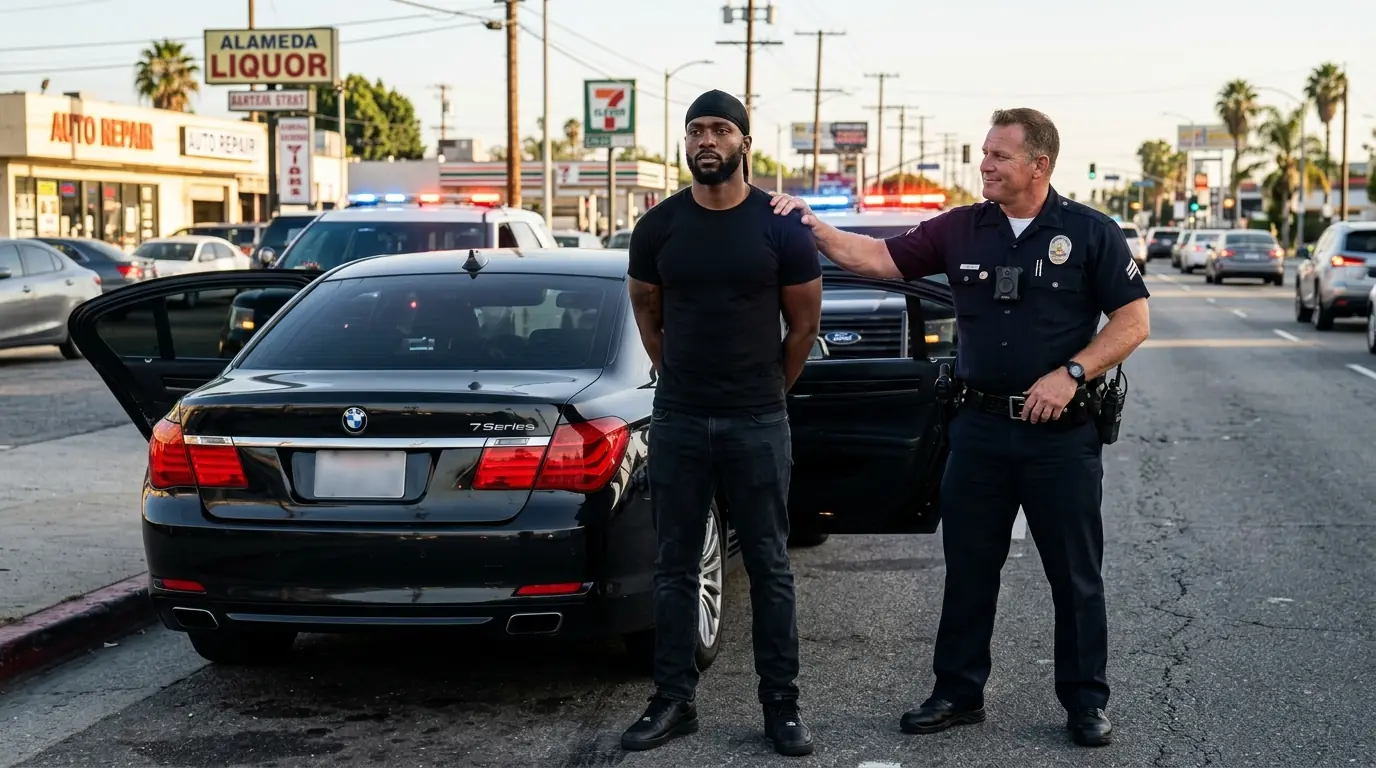
The patrol officer was already stepping from his cruiser.
Isaiah did not end the call.
He pressed the volume button until his father’s voice disappeared from the speakers but left the line connected.
Then he lowered both hands onto the steering wheel.
The officer approached from the driver’s side.
He was white, perhaps fifty, with a broad build and a face that looked permanently tightened by anger. His badge identified him as Officer Grant Mercer.
Mercer stopped behind the doorframe rather than beside the open window.
“License and registration.”
“Good evening, Officer. May I ask why I was stopped?”
Mercer leaned down.
“I’ll ask the questions.”
Isaiah nodded.
“My registration is in the glove compartment. My license is in my wallet, which I think is inside the garment bag on the back seat.”
“Why isn’t it in your pocket?”
“I changed clothes after an audition.”
Mercer looked at the black do-rag tied around Isaiah’s head, the oversized jacket, and the heavy chain that the costume department had allowed him to keep until morning.
“What kind of audition?”
“A television role.”
Mercer’s eyes moved slowly over him.
“You an actor?”
“I’m trying to be.”
The officer gave a quiet laugh.
“What were you playing?”
Isaiah hesitated.
“A gang member.”
“Figures.”
The single word landed harder than Isaiah expected.
He kept his hands on the wheel.
“May I reach for the registration?”
“Slowly.”
Isaiah opened the glove compartment with his right hand.
Inside were insurance papers, maintenance receipts, and a leather document holder embossed with the initials C.B.
He handed the registration through the window.
Mercer shone his flashlight over it.
“This vehicle belongs to Charles Bennett.”
“Yes.”
“Who is Charles Bennett?”
“My father.”
Mercer studied Isaiah’s face.
“You two don’t have the same last name.”
“He’s my stepfather. He raised me.”
“Convenient answer.”
“It’s the truth.”
Mercer looked toward the back seat.
The garment bag lay beside a folded Army jacket and a cardboard box containing two bottles of prenatal vitamins, a package of diapers, and a small stuffed bear.
“Where are you going?”
“Home.”
“Where’s home?”
“Long Beach.”
“Why are you on Alameda instead of the freeway?”
“Traffic was backed up near the entrance.”
“You expect me to believe you took this route because of traffic?”
“Yes.”
Mercer’s jaw shifted.
Isaiah had seen that expression before.
Not on police officers specifically.
On drill instructors, casting directors, landlords, store clerks, and strangers who had already decided what kind of man stood before them and became irritated when reality refused to cooperate.
Mercer handed nothing back.
“If I run your name, what am I going to find?”
“My military record, probably.”
“I asked about criminal history.”
“I don’t have one.”
“No warrants?”
“No.”
“Gang affiliation?”
“No.”
Mercer pointed the flashlight toward Isaiah’s clothes.
“You dress like this for fun?”
“I told you. It was wardrobe.”
“What’s your full name?”
“Isaiah Thurman Bennett.”
“You said your last name was different from the registered owner.”
“It is.”
“You’re getting nervous.”
Isaiah almost laughed.
“I’m being questioned by an armed stranger who appears to think everything I say is suspicious.”
Mercer straightened.
“An armed stranger?”
“An officer. Sorry.”
“No, say what you meant.”
Isaiah looked toward the dashboard.
His father remained connected silently through the phone.
“I meant I’m nervous.”
“Why would an innocent man be nervous?”
Isaiah took a slow breath.
“Because innocent men can still be hurt.”
Mercer’s eyes hardened.
“You have drugs in the vehicle?”
“No.”
“Marijuana?”
“No.”
“Weapons?”
“No firearms.”
“What does that mean?”
“There may be a prop knife inside the garment bag. The blade is rubber.”
Mercer stepped back half a pace.
“You have a knife.”
“A rubber prop.”
“Step out of the vehicle.”
Isaiah’s fingers tightened around the steering wheel.
“Officer, I am telling you exactly what is in the car.”
“And I’m telling you to step out.”
“Why was I stopped?”
“Your left taillight is dim.”
“It was replaced last week.”
“So you’re calling me a liar?”
“No. I’m saying I didn’t know.”
“Step out.”
Isaiah glanced at the cruiser behind him.
No second officer.
Few vehicles on the road.
The nearest business had already closed.
“I will comply,” he said. “But I do not consent to a search.”
Mercer smiled without warmth.
“You don’t need to.”
“What is your probable cause?”
“You failed to produce identification. You’re driving someone else’s vehicle. You admitted there is a weapon inside.”
“A rubber prop.”
“And I smell marijuana.”
Isaiah stared at him.
There was no marijuana in the car.
He had never used it.
His pregnant fiancée became nauseated at the smell of ordinary cigarette smoke. He would not even allow friends to smoke near their apartment.
“You do not smell marijuana.”
Mercer’s hand moved toward the door handle.
“Are you accusing me of falsifying probable cause?”
“Yes.”
The word escaped before Isaiah could measure the cost.
Mercer pulled the door open.
“Out.”
Isaiah unfastened his seat belt.
Every movement became deliberate.
He stepped onto the pavement with his hands visible.
Mercer immediately turned him toward the car.
“Hands on the roof.”
Isaiah complied.
His body remembered military inspections, roadside checkpoints overseas, and the discipline of remaining still while someone with a weapon decided what happened next.
Mercer kicked his feet farther apart.
“You people always think knowing a few legal phrases makes you untouchable.”
Isaiah turned his head slightly.
“What people?”
“Face forward.”
“You said ‘you people.’”
Mercer grabbed his wrist.
“Stop resisting.”
“I’m not resisting.”
The second cuff tightened around Isaiah’s other wrist.
He heard his father’s voice faintly from inside the car.
“Isaiah?”
Mercer noticed it too.
He leaned inside and looked at the phone screen.
The call timer showed more than nine minutes.
“Who are you recording?”
“My father is on the line.”
Mercer disconnected the call.
Isaiah closed his eyes briefly.
“You should not have done that.”
Mercer looked at him.
“Is that a threat?”
“No.”
“It sounded like one.”
“It was advice.”
Mercer pushed him toward the rear of the vehicle.
Isaiah’s hip struck the metal.
“Stay there.”
“You have no legal basis to search this car.”
Mercer pulled open the rear door.
He removed the garment bag and dropped it onto the pavement.
The zipper opened.
A red bandana, black jacket, fake gold chains, rubber knife, and casting pages spilled across the road.
Mercer lifted the prop blade.
“This looks like a weapon.”
“It bends.”
Mercer flexed it in one hand.
The rubber folded.
He threw it down.
Then he searched the cardboard box.
Prenatal vitamins.
Diapers.
The stuffed bear.
“What’s this?”
“My fiancée is eight months pregnant.”
Mercer looked toward him.
“You’re bringing a child into this?”
“Into what?”
“This life.”
Isaiah felt anger rise into his throat.
He forced it back down.
“What life do you think I have?”
Mercer ignored him.
He searched beneath the seats, inside the center console, through the garment bag, and around the spare tire.
He found no drugs.
No firearm.
No stolen property.
No evidence of a crime.
The search should have ended.
Instead, it seemed to make him angrier.
Isaiah remained cuffed beside the trunk.
“You done?” he asked.
Mercer slammed the door.
“You think you’re funny?”
“No.”
“You were laughing earlier.”
“When?”
“When you said I wouldn’t find anything.”
“I said you wouldn’t.”
Mercer stepped close enough that Isaiah could smell stale coffee on his breath.
“You think you’re a comedian?”
Isaiah looked at the costume scattered on the road.
“I think this stop has become difficult to explain.”
“I’ll give you something to laugh about.”
Mercer’s right hand settled near his holster.
Isaiah stopped breathing for a moment.
The officer’s eyes no longer appeared focused on the traffic stop.
He was looking at something from somewhere else.
Someone else.
“My son was killed eight years ago,” Mercer said.
Isaiah remained still.
“A drive-by shooting.”
“I’m sorry.”
“Three Black men in a car.”
Isaiah felt the cold night air against his face.
Mercer continued.
“They looked just like you.”
“No, they didn’t.”
The officer’s expression changed.
“What did you say?”
“You don’t know me.”
“I know enough.”
“You know my skin color and my clothes.”
Mercer’s fingers touched the grip of his weapon.
“That may be reason enough.”
Isaiah looked directly at him.
“You don’t want to do this.”
“Don’t tell me what I want.”
“You’re grieving.”
“Shut up.”
“But I did not kill your son.”
Mercer drew the weapon halfway from its holster.
Isaiah did not move.
He thought of Maya waiting at home.
Eight months pregnant, irritated because they had run out of milk.
He thought of the small crib they had assembled in the corner of their bedroom.
He thought of his father on the disconnected phone line.
He thought of eight years in the Army, two deployments, and every time he had been told his uniform represented a country that promised equal protection under law.
On Alameda Street, none of that felt visible.
Only his skin was visible.
“Officer Mercer.”
The voice came from behind them.
Mercer turned.
A dark sedan had stopped several yards away.
Charles Bennett stepped out wearing suit pants, a white dress shirt, and no jacket. At sixty-two, he was tall and silver-haired, with the posture of a man accustomed to courtrooms.
He left both hands clearly visible.
“What are you doing here, Charles?”
Mercer knew him.
That changed the danger but did not erase it.
Charles looked at Isaiah in handcuffs.
“I was speaking to my son when you stopped him.”
Mercer glanced toward Isaiah.
“Your son?”
“Yes.”
“He says you’re his stepfather.”
Charles’s expression hardened.
“I became his father when he was five years old. I do not require your approval of the title.”
Mercer lowered the weapon but did not holster it completely.
“Stay back. This is an active investigation.”
“For a dim taillight?”
“He failed to produce identification.”
“His wallet is in the garment bag you threw onto the road.”
“He resisted.”
“I heard the conversation.”
“You heard his version.”
“I heard yours too.”
Mercer looked toward the car.
“I ended the call.”
“After nine minutes.”
Charles pointed toward the windshield.
“And the rest was recorded.”
For the first time, Mercer looked uncertain.
“What are you talking about?”
“That vehicle has a dual-facing dash camera.”
Isaiah turned his head.
He had not known.
Charles continued.
“It records the road, the cabin, and audio whenever the ignition is active. The footage uploads automatically to a secure server.”
Mercer looked through the windshield.
A small black camera rested behind the mirror.
His hand finally moved away from the weapon.
Charles took one slow step closer.
“I heard you claim you smelled marijuana.”
Mercer said nothing.
“I heard you call my son’s race probable cause.”
“That is not what I said.”
“The camera heard you.”
“He was argumentative.”
“He asked why he was detained.”
“He admitted there was a knife.”
“A rubber prop from an acting audition.”
Mercer gestured toward Isaiah’s costume.
“Look at him.”
Charles followed the gesture.
He saw the do-rag, chains, oversized jacket, and handcuffs.
Then he looked back at Mercer.
“I see a veteran who served this country for eight years.”
Mercer’s jaw tightened.
“I see a man who returned home, worked construction, attended night classes, and is trying to build an acting career before his daughter is born.”
Charles’s voice remained controlled.
“I also see my car searched without consent, my property thrown into the road, and my son restrained after no contraband was found.”
“Charles, you weren’t here from the beginning.”
“You are correct.”
He took another step.
“But the camera was.”
Mercer looked toward his cruiser radio.
Charles noticed.
“Before you decide what to report, understand that I have already contacted your watch commander.”
“You called my department?”
“I called Captain Alvarez directly.”
Mercer’s face paled slightly.
Charles Bennett had practiced civil-rights law for more than thirty years. Before opening his own firm, he served as an assistant district attorney and later as counsel to the county’s independent police oversight commission.
He knew Mercer’s name.
More importantly, he knew Mercer’s history.
“I have reviewed four excessive-force cases involving you in the past fourteen years,” Charles said.
“All dismissed.”
“Settled.”
“Same thing.”
“No. It is not.”
Mercer glanced toward Isaiah.
“You raised a smart mouth.”
“I raised a man who knows his rights.”
Charles’s eyes moved to the handcuffs.
“Remove them.”
Mercer did not move.
“Charles, you don’t command me.”
“No. Your policies do.”
“You think because you’re a lawyer—”
“I think because the original purpose of this stop has ended, the search produced nothing, and you are continuing a detention without articulable suspicion.”
Sirens approached.
Mercer looked toward the road.
Two patrol cars arrived, followed by an unmarked supervisor’s vehicle.
Captain Elena Alvarez stepped out.
She was a twenty-year veteran of the department and one of the few supervisors Mercer appeared to respect.
“Officer Mercer,” she said, “holster your weapon and step away from the detainee.”
Mercer obeyed.
“Captain, this is being exaggerated.”
“We’ll determine that.”
Alvarez approached Isaiah.
“Sir, are you injured?”
“My wrists hurt.”
She examined the cuffs.
“They’re too tight.”
She unlocked them herself.
Red grooves marked Isaiah’s skin.
Charles moved beside him but did not touch him immediately.
“Are you all right?”
Isaiah rubbed his wrists.
“I don’t know yet.”
Alvarez asked another officer to photograph the marks and collect the items from the road.
Mercer began explaining.
“He was driving a vehicle not registered in his name. He did not produce identification. He admitted to possessing a knife and became confrontational.”
Alvarez held up one hand.
“Did you find drugs?”
“No.”
“A weapon capable of causing injury?”
“There was a knife.”
The second officer held up the rubber prop, which folded over his fingers.
Alvarez stared at Mercer.
“Did he attempt to flee?”
“No.”
“Threaten you?”
“He was verbally aggressive.”
Isaiah looked toward her.
“I asked why I was stopped.”
Alvarez turned back to Mercer.
“Why was he stopped?”
“Defective taillight.”
She walked behind the vehicle.
Both taillights were working.
One appeared slightly less bright than the other, but it remained visible.
Alvarez returned.
“Did you issue a repair notice?”
“Not yet.”
“Why not?”
Mercer had no answer.
Charles held up his phone.
“The complete dash-camera footage has already been preserved.”
Alvarez looked toward him.
“I will need a copy.”
“You’ll receive it through counsel.”
Mercer laughed once.
“So now we’re doing lawsuits.”
Charles faced him.
“This stopped being a traffic matter when you told an innocent man his race justified suspicion.”
“My son is dead.”
The words came out suddenly.
Everyone became quiet.
Mercer’s anger fractured, exposing something raw underneath.
“My son was twenty.”
Alvarez’s expression softened, but her voice did not.
“I remember.”
“They never caught the shooter.”
“I know.”
Mercer looked at Isaiah.
“Every time I see one of them—”
Alvarez interrupted.
“One of whom?”
Mercer stopped.
The silence answered.
Charles spoke quietly.
“Your grief deserves treatment. It does not deserve a badge.”
Mercer looked at him with hatred.
“You have no idea what I lost.”
Charles stepped closer.
“No. But neither does my son.”
Alvarez instructed Mercer to surrender his weapon and badge pending investigation.
He stared at her.
“You’re taking his side?”
“I’m removing you from duty because your conduct is in question and you drew a firearm during a nonviolent stop.”
“I barely drew it.”
“That is not the defense you think it is.”
Mercer handed over the weapon.
Then the badge.
Without them, he looked smaller.
Not harmless.
Only exposed.
Isaiah watched him enter the rear of another patrol car for transport back to the station.
He felt no victory.
His hands were still shaking.
Charles gathered the audition clothes from the pavement.
He picked up the stuffed bear last.
One side had become dirty from the road.
“I didn’t know about the camera,” Isaiah said.
“I installed it after your mother was sideswiped last year.”
“You never told me.”
“She said you would complain that I was spying.”
“I would have.”
Charles placed the bear inside the box.
“Tonight, I accept your gratitude instead.”
Isaiah almost smiled.
Then his face tightened.
“Dad.”
Charles looked at him.
“I thought he was going to shoot me.”
The sentence changed everything.
Charles dropped the box and pulled him into his arms.
Isaiah had not hugged his father that way since returning from his second deployment.
For several seconds, he was no longer a veteran, actor, future father, or grown man.
He was somebody’s son.
Charles held the back of his head.
“I know.”
“I stayed calm.”
“I know.”
“I did everything right.”
“I know.”
“It almost didn’t matter.”
Charles had no answer.
So he remained there.
At home, Maya was waiting on the front steps in slippers and one of Isaiah’s Army sweatshirts.
Her pregnant belly made standing awkward.
The moment Isaiah stepped from the car, she ran toward him anyway.
“What happened?”
He tried to say he was fine.
She saw his wrists.
Her face collapsed.
Charles carried the milk inside while Isaiah and Maya remained in the driveway.
“You went out for milk,” she whispered.
“I know.”
She touched his cheek.
“What did they do?”
He closed his eyes.
“Not tonight.”
Maya nodded.
She did not demand the story.
She led him inside.
At two in the morning, Isaiah sat beside the unfinished crib.
Maya slept in the bedroom.
Charles had gone home after confirming three times that the dash-camera files were secure.
Isaiah held the stuffed bear.
He had bought it for the baby that afternoon after the audition.
The casting director had told him he looked “authentic” in the gang costume.
Isaiah had laughed because actors learned to laugh when refusing a stereotype might cost them work.
Hours later, a police officer had looked at the same costume and seen a criminal.
Different industries.
Same shortcut.
He opened his laptop and withdrew from the role.
Then he stared at the law-school application he had left unfinished for four months.
His father had encouraged him to join the family firm.
Isaiah always resisted.
Law felt like Charles’s dream, not his.
Acting was the one place where he believed he could become anyone.
That night showed him the problem.
Some people would decide who he was before he spoke.
He completed the application before dawn.
He did not abandon acting.
He refused to let fear make that decision for him.
He chose both.
The internal investigation into Mercer lasted seven weeks.
The dash-camera footage contradicted nearly every important claim in his report.
No traffic violation clearly justified the stop.
Isaiah remained cooperative.
The vehicle contained no marijuana odor detectable by a second officer or the canine unit later called to the scene.
Mercer searched beyond the limited areas where identification might reasonably have been located.
Most damaging was the audio.
His statements about race.
His reference to Isaiah resembling the men who killed his son.
The threat near the roadside.
Investigators reopened earlier complaints.
A Black college student said Mercer forced him to sit handcuffed on a curb for forty minutes after mistaking his car for a stolen vehicle.
A Latino mechanic reported that Mercer searched his truck after claiming to smell drugs.
A mother said he drew a weapon on her seventeen-year-old son during a bicycle stop.
None of those people had a lawyer in the family.
None had a dash camera uploading to a secure server.
Their cases had been dismissed as conflicting accounts.
Together, they formed a pattern.
Mercer was terminated.
The district attorney charged him with official misconduct and unlawful detention. The most serious federal claims required a longer review, but the department could no longer hide behind uncertainty.
Charles filed a civil action on Isaiah’s behalf.
Isaiah insisted that any settlement include policy changes, not only money.
The department agreed to require documented justification for consentless vehicle searches, early-warning reviews for repeated complaints, and counseling evaluations following severe personal trauma involving officers.
Mercer’s grief became part of the public discussion.
Some defended him.
They argued that losing a son could break anyone.
Isaiah responded only once.
“Pain can explain why someone becomes dangerous. It cannot make innocent people responsible for healing him.”
Six months later, Isaiah’s daughter was born.
They named her Amara Grace Bennett.
Charles held her in the hospital room with tears on his face.
“You know,” Isaiah said, “you were the first person who told me I’d be a good father.”
Charles adjusted the blanket around the baby.
“I was correct.”
“You also said I’d never make it as an actor.”
“I said you were too polite to play a criminal.”
“That wasn’t exactly what you said.”
Charles smiled.
“Memory improves with age.”
Maya looked toward Isaiah.
“Tell him the other news.”
Isaiah handed his father an envelope.
Inside was an acceptance letter from Pacific Coast School of Law.
Charles read it twice.
Then he looked up.
“You’re going?”
“At night.”
“And acting?”
“During the day.”
“And the baby?”
Maya laughed.
“Apparently none of us plan to sleep.”
Charles held out one hand.
“Welcome to the family business.”
Isaiah shook it.
“I haven’t agreed to work for you.”
“Three years from now, I’ll ask again.”
“Four.”
“Three and a half.”
“Lawyers are exhausting.”
“You’ll fit in.”
Isaiah’s acting career did not transform overnight.
He still auditioned for criminals, soldiers, athletes, drivers, fathers, and men identified only as Black Male, 30s.
But he began declining roles that existed only to make another character look dangerous.
A year after the traffic stop, he earned a recurring part as a public defender in a television drama.
The role was small at first.
Then viewers responded to him.
The writers expanded it.
During one episode, his character represented a teenager subjected to an illegal search.
Isaiah stood inside a fictional courtroom and delivered lines about probable cause, dignity, and the danger of allowing fear to become evidence.
The scene felt too close to Alameda Street.
After filming, he sat alone in his trailer.
Charles called.
“I saw the episode.”
“You watched television?”
“I made an exception.”
“What did you think?”
“You objected too late.”
Isaiah laughed.
“There he is.”
“But you were good.”
The words mattered more than Isaiah expected.
Mercer eventually pleaded guilty to a reduced official-misconduct charge.
At sentencing, he spoke publicly about his son.
He described the call from the hospital, the unsolved investigation, and the years of rage that followed.
Then he looked toward Isaiah.
“I made you carry something that belonged to me.”
Isaiah listened.
“I saw the men who killed my son every time I looked at someone who reminded me of them.”
Mercer lowered his eyes.
“That was not policing. It was revenge against strangers.”
The judge imposed jail time, probation, and a permanent ban from law enforcement.
Isaiah did not speak at the hearing.
Outside, a reporter asked whether he accepted the apology.
“I accept that he finally told the truth,” Isaiah said.
“That is not the same as forgiveness.”
“Will you forgive him?”
“I don’t know.”
The reporter waited for a more inspirational answer.
Isaiah did not provide one.
Some wounds did not become lessons immediately.
Some remained wounds.
Years later, after Isaiah passed the bar, he joined Charles’s firm for what he called a temporary period.
The temporary period lasted.
He handled civil-rights cases and continued acting when schedules allowed.
His office wall displayed his Army commendations, a photograph of Maya and Amara, and one framed page from the television script that changed his career.
It did not display the settlement amount from the Mercer case.
Nor did it display news clippings.
Inside his desk, however, he kept the small stuffed bear from the night of the stop.
Maya had cleaned it, but one dark mark remained near the paw where it touched the road.
Isaiah never removed it.
It reminded him of how quickly a person’s entire life could become invisible.
Army service.
Family.
Work.
Plans.
Fear.
Love.
To Mercer, he had been a Black man in costume driving a car registered to someone else.
Everything true about him became suspicious because the officer had already chosen the conclusion.
The dash camera did not make Isaiah innocent.
He had been innocent before the camera recorded anything.
It simply forced other people to confront that truth.
That distinction shaped every case Isaiah later accepted.
He represented men who did not have influential fathers.
Teenagers whose phones had stopped recording.
Mothers whose complaints contained no video.
Workers who could not describe unlawful treatment in perfect legal language.
Whenever someone across a conference table said, “It’s only my word against the officer’s,” Isaiah leaned forward.
“Your word is evidence,” he told them. “Now we find what supports it.”
Charles overheard him say it once.
After the client left, he stood in Isaiah’s doorway.
“You sound like a lawyer.”
“I was hoping for actor.”
“You can be both.”
Isaiah smiled.
“That’s what I keep telling casting directors.”
Charles looked toward the old bear inside the open drawer.
“You still think about that night?”
“Every time I see lights behind me.”
“Does it get easier?”
“No.”
Isaiah considered the question.
“But I know what to do with it now.”
He used to believe survival meant remaining calm enough to make other people comfortable.
The traffic stop changed that.
Calm had kept him alive.
It had not made Mercer fair.
The law had helped afterward.
The camera had preserved the truth.
His father had arrived.
But none of those facts erased the moment when an armed man looked at him and decided his grief was more important than Isaiah’s life.
That moment remained.
So did another.
Charles stepping onto the road with both hands visible.
Maya waiting in slippers.
His daughter sleeping against his chest years later.
Clients entering his office certain nobody would believe them.
Pain had shaped all of them.
The difference was what they chose to build from it.
Mercer used pain to justify suspicion.
Isaiah used it to recognize fear in others.
One became dangerous because he believed his suffering gave him permission.
The other became useful because he understood suffering did not.
And whenever Isaiah drove down Alameda Street, he remembered the question Officer Mercer had asked before searching the car.
What kind of life do you have?
The answer was larger than anything that could have been found beneath a seat.
He had been a soldier.
An actor.
A student.
A lawyer.
A husband.
A father.
A son driving home with milk, prenatal vitamins, and a stuffed bear.
Mercer had seen none of it.
But it had all been there.