“Make the cuffs tighter, Dad.”
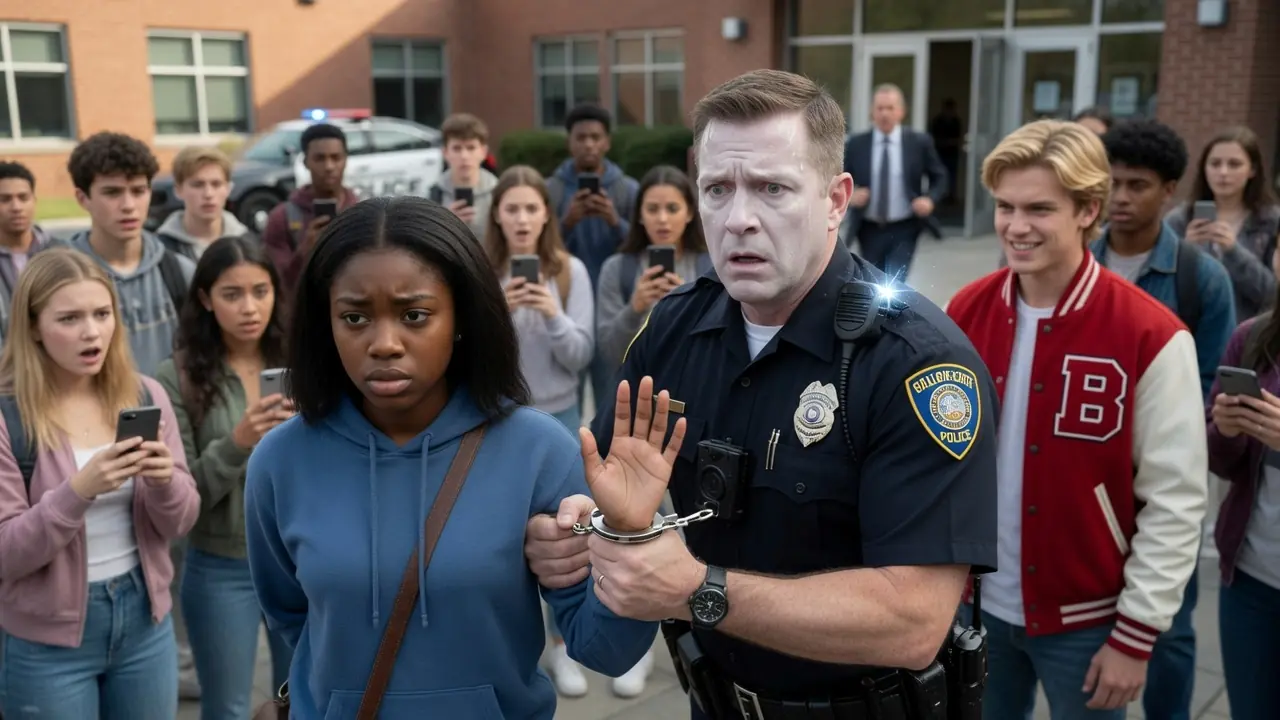
Tyler Harlan stood in the middle of Westbridge High School’s courtyard with a smile on his face as Officer Grant Harlan twisted seventeen-year-old Nia Bennett’s arms behind her back.
The metal restraints closed around her wrists.
Nia gasped.
She had not resisted. Her hands had been raised from the moment the officer approached, and dozens of students were shouting that she had done nothing wrong.
Grant ignored them.
“Troublemakers like you come into a good school and think the rules don’t apply,” he muttered.
He tightened the cuffs another notch.
Pain shot through Nia’s hands and shoulders, but she refused to cry in front of them.
Tyler moved closer, holding his phone toward her face.
“Not so confident now, are you?”
Around them, students stood frozen beneath the afternoon sun. Some watched in fear. Others recorded with trembling hands. Teachers remained near the cafeteria doors, looking at one another as though waiting for someone else to intervene.
Principal Jonathan Reeves hurried into the courtyard.
“Officer Harlan, stop. We have not established that any crime occurred.”
Grant shoved Nia forward.
“She assaulted my son.”
“That isn’t what happened!” a student shouted.
“He knocked her lunch out of her hands!”
“We have videos!”
Grant turned toward the crowd.
“Delete those recordings, or I’ll confiscate every phone as evidence.”
The courtyard erupted with protests.
Nia forced herself to stand straight.
“You cannot seize their phones without legal authority,” she said. “And you have not told me why I’m under arrest.”
Grant’s face hardened.
“Assault. Disorderly conduct. Resisting arrest.”
“I’m not resisting.”
“You want to add another charge?”
He gripped her upper arm and marched her toward the parking lot.
Tyler followed, enjoying every step.
He believed his father’s badge had ended the argument.
He believed Nia was just another student his family could frighten into silence.
He had no idea that before the afternoon was over, his father would stare at her arrest form and realize he had chosen the one name in the county he should have recognized.
Three days earlier, Nia had entered Westbridge High carrying a leather messenger bag and a freshly printed class schedule.
Morning sunlight poured through the glass doors, reflecting from polished floors and rows of blue lockers. The hallways were filled with the familiar energy of a new school year—shouting friends, slamming doors, squeaking sneakers, and teachers directing lost students toward classrooms.
Nia paused near the entrance.
Her first class was advanced literature in Room 237.
She had transferred to Westbridge after her mother accepted a new judicial appointment in Ashford County. It was Nia’s third school in five years, so she knew the routine.
Walk with confidence.
Observe before speaking.
Do not let curious stares become fear in your own mind.
She adjusted the strap on her bag and followed the room numbers down the academic wing.
She was approaching the next door when someone struck her shoulder hard enough to spin her sideways.
Books and papers scattered across the floor.
The hallway immediately quieted.
Nia looked up.
A tall senior in a varsity jacket stood above her belongings.
Tyler Harlan was eighteen, broad-shouldered, and accustomed to people moving out of his way. His father was a respected patrol officer. His grandfather, Wade Harlan, had served as county sheriff for more than thirty years.
At Westbridge, the Harlan name carried more authority than most school rules.
“Watch where you’re going,” Tyler said.
Nia remained on one knee.
“You walked into me.”
A few students looked at one another.
No one corrected Tyler.
He kicked one of her notebooks farther down the hall.
“This school has standards. New people should learn where they fit.”
The meaning beneath his words was unmistakable.
Nia slowly gathered her books.
Tyler expected embarrassment.
Instead, she removed her phone and began recording.
“I suggest you leave me alone.”
His expression changed.
“You filming me?”
“Yes.”
“That’s illegal.”
“No, it isn’t.”
More phones appeared around them.
Tyler’s face reddened.
He had created dozens of confrontations at Westbridge, but students usually lowered their eyes or apologized. They understood that reporting him often brought a visit from his father or a quiet warning from the principal’s office.
Nia did not understand that system yet.
Or perhaps she understood it too well.
“You think you’re smart?” he asked.
“I think you deliberately knocked me down and damaged my property.”
“You have no idea who you’re dealing with.”
Nia held the camera steady.
“I’m dealing with someone who needs his family name to frighten people.”
The words landed harder than shouting would have.
Several students covered nervous smiles.
Tyler stepped toward her, but the warning bell rang.
Teachers opened classroom doors.
The audience began moving.
“This isn’t over,” Tyler said.
Nia picked up her final notebook.
“I didn’t expect it to be.”
By the end of the day, almost everyone knew about the confrontation.
Students watched Nia in classrooms and whispered in the cafeteria. A few offered subtle smiles, but most kept their distance.
Tyler stared at her whenever their paths crossed.
When Nia reached her assigned locker after the final bell, she found deep scratches around the lock. The dial would not turn.
She photographed the damage and noted the time.
Her mother had taught her to document everything that mattered.
Facts survived when memory was challenged.
The following morning, Tyler waited outside the cafeteria.
He leaned against the wall where the nearest security camera could not see him.
“Going somewhere?” he asked.
Nia stopped several feet away.
“I’m getting lunch.”
“You made me look bad yesterday.”
“You managed that yourself.”
His smile disappeared.
Students slowed nearby, sensing another confrontation.
Tyler stepped aside and allowed her to enter.
Nia knew he had not surrendered.
He was simply choosing a larger audience.
She carried her lunch into the courtyard and looked for a seat near the cafeteria windows. Teachers were visible inside, and cameras covered most of the open area.
Tyler’s voice followed her.
“Hey, new girl.”
His friends sat at a table wearing matching varsity jackets.
Nia continued walking.
Tyler came after her.
“You can’t film people without permission.”
“You keep repeating that. It still isn’t true.”
Students began raising their phones.
Tyler moved close enough that Nia could smell mint gum on his breath.
“You came here acting like you own the place.”
“I came here to attend school.”
“Girls like you always want attention.”
Nia felt anger rising, but she controlled it.
“The only person performing is you.”
Tyler knocked the tray from her hands.
The sandwich, apple, and water bottle struck the concrete.
Water splashed across Nia’s shoes.
The courtyard filled with gasps.
Tyler immediately grabbed his arm.
“She tried to hit me!”
For a moment, Nia stared at him in disbelief.
Then she understood.
He was not merely lying.
He was constructing a story for someone with authority.
“There are cameras everywhere,” she said. “Everyone saw what you did.”
Tyler removed his phone.
“We’ll see whose story matters.”
He called his father.
“Dad, that new girl attacked me. She tried to hit me with her tray.”
Students began protesting.
Tyler raised his voice above them.
“She’s been following me and recording me. I think she’s dangerous.”
Nia started a recording of her own.
“At approximately twelve twenty-five, Tyler Harlan knocked my lunch from my hands and falsely accused me of attacking him. Multiple witnesses are present.”
Tyler glared at her.
“She’s threatening me now,” he said into the phone. “Get here before she does something worse.”
Nia’s stomach tightened when she heard distant sirens.
No school official had called emergency services.
Tyler’s father was coming because his son demanded it.
Several students urged Nia to leave.
She remained where she was.
Running would allow them to describe her as guilty.
She wiped water from her hands and waited.
Officer Grant Harlan entered the school through the main doors less than ten minutes later.
He did not report to the office.
He did not speak to the principal.
He did not interview witnesses.
He moved through the hallway with one hand resting near his utility belt and anger already set across his face.
Principal Reeves attempted to stop him.
“We need to determine what happened before any action is taken.”
“My son was assaulted.”
“We have not confirmed that.”
Grant brushed past him.
When he entered the courtyard, Tyler pointed toward Nia.
“That’s her.”
Grant looked only at his son.
“Are you hurt?”
“She tried to hit me.”
Students immediately objected.
“He’s lying!”
“We recorded it!”
“Tyler knocked the tray down!”
Grant ignored every voice.
He approached Nia.
“Stand up.”
“I am standing.”
“Hands where I can see them.”
Nia raised her hands.
“I would like to explain what happened.”
“Shut your mouth.”
He seized her arm and twisted it behind her back.
Pain traveled through her shoulder.
She did not pull away.
“I am cooperating.”
Tyler smiled.
“Make her learn.”
Grant pulled Nia’s second arm behind her and applied the handcuffs.
Principal Reeves stepped closer.
“Officer Harlan, she has displayed no violent behavior. We should speak in my office and contact her guardian.”
Grant tightened the cuffs.
“She assaulted my son. That makes her dangerous.”
Nia kept her voice clear for the phones recording nearby.
“What am I being charged with?”
“Assault and disorderly conduct.”
“Based on what evidence?”
“Resisting arrest, too.”
“I have not resisted.”
Grant shoved her toward the exit.
As they crossed the courtyard, students followed from a distance. Teachers watched from windows. Tyler recorded the humiliation like a victory parade.
At the patrol car, Principal Reeves tried once more.
“You cannot remove a minor without notifying her parent.”
“I am the procedure now,” Grant said.
He forced Nia into the back seat and slammed the door.
Through the glass, Tyler waved at her.
Nia sat carefully with her hands trapped behind her.
Her shoulders hurt.
The restraints had already left red marks around her wrists.
Grant entered the driver’s seat and adjusted the mirror.
“You thought you were clever.”
Nia met his eyes through the reflection.
“Every second of this is being documented.”
He pulled away from the school.
At the station, Grant marched her through a side entrance and pushed her into a hard plastic chair beside his desk.
Several officers glanced up.
None asked why a teenager was handcuffed so tightly.
Grant began writing the arrest report.
Name.
Age.
Address.
School.
He reached the section for parent or guardian information.
Nia watched his pen stop.
Her surname appeared several times on the page.
Bennett.
Grant read it again.
A younger officer named Lucas Ward hurried toward the desk.
“Sir.”
Grant looked up.
Lucas leaned closer and lowered his voice.
“The front desk just received a call.”
“From whom?”
“Judge Celeste Bennett.”
Grant’s pen remained suspended above the form.
Lucas looked toward Nia.
“That’s her daughter.”
The pen fell from Grant’s fingers.
It struck the desk and rolled to the floor.
Grant’s face lost its color.
Judge Celeste Bennett served on the state superior court and was widely respected for her rulings on government misconduct, civil rights, and unlawful searches.
Grant had attended training sessions where her decisions were discussed.
He had complained about her more than once.
Now her daughter was sitting several yards away with visible injuries caused by his handcuffs.
“How long?” he asked.
“She said she’ll be here in ten minutes.”
Grant stood so quickly that his chair struck the wall.
Around the station, officers began whispering.
They had ignored Nia when they thought she was an ordinary student.
Now they gathered near the desks, anxious to understand how much had been recorded.
Lucas glanced at the restraints.
“Should I remove the cuffs?”
“No.”
Grant’s answer came too sharply.
He lowered his voice.
“No. The arrest was lawful.”
Nia watched him attempt to rebuild his confidence.
It did not fit anymore.
The station doors opened eight minutes later.
Judge Celeste Bennett entered wearing a charcoal suit and carrying a leather briefcase.
She did not shout.
Her controlled expression frightened Grant more than anger would have.
“Judge Bennett,” he began. “There was an incident—”
“Where is my daughter?”
“I can explain.”
“I did not ask for an explanation.”
Lucas opened the holding area.
Celeste walked inside and stopped before Nia.
Her expression softened only slightly.
“Are you injured?”
“The cuffs are too tight. My shoulder hurts.”
Celeste looked at the swollen marks around her wrists.
“Remove them.”
Lucas immediately unlocked the restraints.
Nia brought her arms forward slowly.
The station became silent as every officer saw the bruising.
Celeste turned toward Grant.
“State the probable cause for this arrest.”
“My son reported an assault.”
“What independent evidence did you review?”
“I responded to an urgent call.”
“Did you interview witnesses?”
Grant hesitated.
“Did you examine video?”
“No.”
“Did you speak to school administrators before placing a minor in restraints?”
“Judge Bennett, she was being disruptive.”
Nia spoke calmly.
“Students were telling him Tyler attacked me. Officer Harlan ordered them to delete their videos.”
Celeste’s eyes narrowed.
“Did you threaten to confiscate student phones?”
Grant did not answer.
“Preserve every record,” Celeste said. “Body-camera footage, dispatch logs, radio traffic, arrest forms, vehicle video, and station surveillance. If one second disappears, it will become evidence of a separate offense.”
Grant stepped forward.
“Your daughter assaulted my son.”
Celeste faced him.
“You should contact your union representative and an attorney before saying anything else.”
She placed one hand on Nia’s shoulder.
They left the station together.
Outside, Nia’s phone connected to the network and filled with messages.
Videos from the courtyard had already spread across local social media.
One showed Tyler knocking down her tray.
Another showed Grant ignoring witnesses.
A third captured Nia saying she was not resisting while he tightened the cuffs.
Then an anonymous text appeared.
DROP THIS OR IT GETS WORSE.
Nia showed her mother.
Celeste photographed the message.
“Do not delete anything.”
That evening, mother and daughter sat at the kitchen table surrounded by notes, screenshots, and complaint forms.
Celeste asked Nia to describe every event in order.
“What were Officer Harlan’s first words?”
“Hands where I can see them.”
“And then?”
“I raised my hands. I tried to explain. He told me to shut my mouth and grabbed me.”
Celeste wrote each detail.
On the television in the next room, a news report began.
Footage of Nia’s arrest appeared on the screen.
The presenter described a controversy involving a student, a police officer, and allegations of excessive force.
The police union released a statement defending Grant’s professional judgment.
It described Nia as “combative” and claimed she had presented a threat to school safety.
The school board announced an internal review into “all actions that may have contributed to the incident.”
Nia read the wording twice.
“They’re trying to blame me.”
“This is the first stage,” Celeste said. “Deny. Deflect. Discredit.”
Messages arrived from courthouse colleagues.
Some expressed sympathy.
Others urged Celeste to settle the matter privately.
Think about your future.
Do not make an enemy of the department.
These situations damage everyone.
Celeste placed the phone facedown.
Nia studied her mother.
“They protect one another.”
“Yes.”
“So what do we do?”
“We build a record they cannot ignore.”
The next morning, Nia returned to school.
Her locker had been covered in racist insults and threats written in black marker.
Students walked past without stopping.
Principal Reeves arrived with Vice Principal Sandra Cole.
“We are very sorry,” Reeves said. “Maintenance will clean this immediately.”
“Have you reviewed the security cameras?” Nia asked.
Cole shifted her clipboard.
“That camera experienced a technical problem yesterday.”
“After working normally all semester?”
“We are investigating.”
Down the hallway, three of Tyler’s friends watched and smiled.
Nia photographed the locker from every angle. Then she removed a notebook and recorded the time, the names of the administrators present, and their responses.
Cole frowned.
“What are you writing?”
“A record.”
“There is no need for that.”
“My mother disagrees.”
Both administrators became visibly uncomfortable.
Throughout the day, Nia documented whispered threats, deliberate collisions, and teachers who looked away.
Tyler was officially suspended, but during lunch she saw him walking through the main corridor.
No administrator stopped him.
He followed her into an isolated stairwell.
“No cameras here,” he said.
Nia’s phone was already recording inside her pocket.
“You’re not supposed to be on campus.”
“Who’s going to stop me?”
He reached for her jacket.
“Give me the phone.”
Nia slipped under his arm and ran to the office.
When she played the recording, Vice Principal Cole focused on the method rather than the threat.
“Unauthorized recording may violate school policy.”
“He cornered me.”
“Tyler denies being present.”
Nia stared at her.
“You are listening to his voice.”
“We will look into it.”
The official investigation moved slowly.
The intimidation did not.
A black sedan followed Nia and her mother home from the grocery store. Anonymous texts arrived late at night. Teachers who initially offered statements suddenly stopped answering calls.
Then the video of Nia’s arrest went national.
Reporters appeared outside the school. Students began sharing older recordings of Tyler harassing classmates. One clip showed him shoving a freshman into a wall. Another captured him using racist language toward younger students.
For the first time, people who had lived under the Harlan family’s influence began speaking.
A student named Sarah Delgado provided a statement explaining that Tyler had pushed her brother down a staircase the previous year.
A former football player described being removed from the team after confronting Tyler.
A teacher’s aide claimed administrators had been instructed to minimize complaints involving the Harlan name.
Civil rights attorney Amelia Torres joined Nia’s legal team.
She reviewed the files at a café outside town.
“You’ve documented this better than many adults would,” Amelia told Nia.
“My mother taught me.”
“Your evidence is strong. But the arrest is only one part. The larger case is institutional protection.”
She displayed messages from families describing visits from Officer Harlan after they reported his son.
“He used his badge to frighten complainants,” Amelia said. “And the school allowed it.”
The breakthrough came from inside the police department.
Officer Lucas Ward requested a private meeting with Celeste at the courthouse.
He arrived carrying a small flash drive.
“The department says Grant’s body camera malfunctioned,” he said. “That isn’t true.”
Celeste remained still.
“What happened?”
“He ordered the recording deleted.”
“Did you comply?”
“I copied it first.”
The flash drive contained the entire arrest.
It showed Grant entering without authorization, ignoring the principal, seizing Nia while she complied, and tightening the restraints after she stated they were hurting her.
The microphone also captured remarks Grant had not included in his report.
“Your kind always brings trouble.”
The recording did not end there.
Lucas had preserved previous footage showing Grant threatening minority students during traffic stops and laughing while Tyler described “putting people in their place.”
Other officers were heard discussing how complaints could be buried through missing reports and technical failures.
Celeste looked at Lucas.
“You understand what this may cost you.”
“I do.”
“Why come forward?”
Lucas looked toward the courthouse window.
“Because I watched everyone at the station care only after they learned who Nia’s mother was. She should not have needed to be a judge’s daughter for us to treat her lawfully.”
The misconduct hearing was scheduled for the following week.
Two nights before it began, Nia carried trash toward the bins beside the garage.
The smell reached her first.
Gasoline.
She stopped.
Orange light flashed beneath the garage door.
“Mom!”
Flames erupted across the side wall.
Celeste called emergency services while neighbors rushed outside. Firefighters contained the blaze before it spread to the house, but the garage was destroyed.
An investigator spent less than fifteen minutes examining the scene before suggesting an electrical failure.
“My daughter smelled gasoline,” Celeste said.
“No accelerant evidence so far.”
“You have not completed testing.”
A police officer who had once partnered with Grant stepped closer.
“Given your current dispute with the department, Judge Bennett, you should be careful about making accusations.”
Celeste met his eyes.
“Is that official advice?”
He smiled without warmth.
“Friendly advice.”
The following morning, Wade Harlan appeared on television.
The former sheriff wore his old uniform and described the allegations against his son and grandson as a politically motivated attack.
He praised Grant’s service and accused Celeste of using her position to destroy a respected law-enforcement family.
Threats flooded Nia’s phone.
Several told her to die.
At school, supportive students were pressured by their parents to avoid her. Courthouse colleagues stopped taking Celeste’s calls.
That evening, Nia found her mother studying photographs of the burned garage.
There were visible pour patterns across the floor.
“They’re trying to break us,” Nia said.
Celeste removed her glasses.
“They believe fear will make us choose silence.”
“I am afraid.”
“So am I.”
Nia sat beside her.
“But if we stop now, every student Tyler hurt learns that powerful people can win by becoming dangerous enough.”
Celeste took her daughter’s hand.
“Courage is not the absence of fear.”
“It’s refusing to let fear make the decision.”
Together, they continued preparing.
More witnesses came forward.
A janitor reported seeing Tyler vandalize Nia’s locker.
Sarah recorded Tyler bragging that his family would destroy the Bennetts.
A teacher provided internal emails showing Wade Harlan pressuring school administrators to “handle the girl quietly.”
The morning of the hearing, the county courthouse was packed beyond capacity.
Uniformed officers filled one side of the chamber in support of Grant.
Students, parents, teachers, and civil rights advocates occupied the other.
Grant sat in dress uniform beside his attorney.
Tyler and Wade watched from the row behind him, still carrying the confidence of men who believed local power would protect them.
A three-member civilian review panel entered.
Commissioner Daniel Walsh called the hearing to order.
“Officer Grant Harlan, you are accused of false arrest, excessive force, evidence tampering, and abuse of authority. How do you respond?”
Grant stood.
“I responded to a report of a violent student. She was combative and refused lawful commands.”
“And your body camera?”
“Equipment failure.”
Walsh looked toward the clerk.
“Play the recovered footage.”
The lights dimmed.
Grant’s own camera displayed the truth across a large screen.
The chamber watched him storm onto campus.
They heard students telling him Tyler had lied.
They saw Nia standing with her hands raised.
They heard her say she was cooperating.
They watched Grant twist her arms, tighten the cuffs, and dismiss every witness.
Then his quiet racist remark played through the speakers.
The officers seated behind him shifted uncomfortably.
Grant’s attorney stood.
“My client invokes his right to remain silent regarding the footage.”
“Noted,” Walsh said.
Nia was called to testify.
She walked to the witness chair wearing a dark blue blazer. Her hands were steady as she took the oath.
She described her first encounter with Tyler.
The damaged locker.
The cafeteria assault.
The false accusation.
Grant’s arrival.
The pain of the restraints.
The threats that followed.
Videos and photographs supported every part of her account.
Then she described the garage fire.
A voicemail played.
BACK OFF, OR NEXT TIME THE FIRE WON’T STOP AT THE GARAGE.
The chamber became completely silent.
“This is not about revenge,” Nia said. “It is about whether people with authority can punish anyone who refuses to fear them.”
She looked toward the panel.
“No student should need a powerful parent to receive protection. No person should have to prove they are connected to someone important before the law treats them with dignity.”
Grant lowered his eyes.
After Nia’s testimony, additional witnesses were called.
Sarah described her brother’s assault.
Former employees explained how complaints disappeared.
The janitor testified about the vandalism.
Lucas Ward authenticated the body-camera archive and explained the deletion order.
Celeste submitted forensic records showing unauthorized access to the police server using Grant’s credentials.
She also presented emails between Wade Harlan, school administrators, and department officials.
One message from Wade read:
The Bennett situation must disappear before it damages the family. Use every relationship we have.
Wade suddenly stood.
“This is a witch hunt!”
Walsh struck the gavel.
“Sit down.”
“I built law enforcement in this county. I made calls for half the people in this room.”
He stopped.
His own admission hung in the silence.
Walsh looked toward the bailiffs.
“Secure Mr. Harlan for questioning concerning interference with an official proceeding.”
Wade’s confidence collapsed into rage.
“You think you can do this to my family?”
Celeste faced him.
“No one did this to your family except the people in it.”
The panel recessed for forty minutes.
When it returned, Grant was ordered to stand.
Commissioner Walsh read the decision.
“The panel finds overwhelming evidence of false arrest, excessive force, discriminatory conduct, dishonesty, retaliation, and attempted destruction of evidence.”
Grant stared straight ahead.
“Effective immediately, you are terminated from the Ashford County Police Department. This panel is forwarding evidence to the district attorney for criminal investigation.”
His badge and service weapon were surrendered to a bailiff.
The panel referred Tyler’s conduct to juvenile authorities and ordered the school district to begin expulsion proceedings.
A state civil rights investigation was opened into Westbridge High and the police department.
Wade’s communications were subpoenaed.
The school principal and vice principal were placed on administrative leave.
When the hearing ended, Nia and Celeste remained inside until the first rush of reporters left.
Then they walked toward the courthouse entrance.
The doors opened.
Hundreds of people stood outside.
Students held purple ribbons and signs demanding accountability. Teachers who had once looked away now faced Nia openly. Parents applauded.
Sarah began a chant.
“Thank you, Nia.”
Others joined.
Nia stopped on the courthouse steps.
For weeks, those steps had appeared on television behind officials defending the Harlans.
Now the community was watching a different image.
A teenager standing beside her mother, no longer in handcuffs.
Reporters called questions.
Nia approached a microphone.
“This case changed only because people documented what happened and found the courage to speak,” she said.
She looked across the crowd.
“But justice cannot depend on a viral video. It cannot depend on who someone’s parent is. It must exist before the cameras arrive.”
The months that followed brought deeper consequences.
Grant was charged with misconduct, unlawful restraint, and evidence tampering.
Investigators connected associates of the Harlan family to the threats and the garage fire.
Wade lost his remaining political appointments and faced obstruction charges.
Tyler was expelled from Westbridge and entered a court-supervised juvenile program that included counseling and community service.
The police department adopted independent review procedures for complaints involving officers’ relatives.
Body-camera files could no longer be deleted through local credentials.
Westbridge installed external reporting channels for students and required administrators to document every allegation of discriminatory harassment.
Principal Reeves resigned after admitting he had failed to protect students.
Vice Principal Cole was dismissed for altering disciplinary records.
Lucas Ward received whistleblower protection and later joined a newly formed professional standards unit.
Nia returned to school under a different administration.
The first morning was quiet.
No hostile posters covered the lockers.
No one followed her through the halls.
Students who had once avoided her now walked beside her openly.
At lunch, she carried a tray across the courtyard.
Sarah and several others joined her.
“You don’t need an escort anymore,” Nia said.
“We know,” Sarah replied. “We should have walked with you from the beginning.”
A new security camera covered the place where Tyler had knocked away her lunch.
Nia looked at it for a moment.
Then she sat down.
Later that semester, she was invited to speak to a government class.
A freshman asked how she had stayed fearless.
“I wasn’t fearless,” Nia said. “I was terrified many times.”
The room became quiet.
“Courage is not feeling nothing. It is deciding that something else matters more than your fear.”
After class, Nia passed the locker that had once been covered in threats.
The black words were gone.
In their place, students had created a mural showing many hands raising one another upward.
At the bottom, someone had painted a sentence:
THE TRUTH NEEDS A WITNESS.
Nia stood before it for several seconds.
Her mother’s position had exposed Grant’s panic at the station.
But it had not created the evidence.
It had not made Tyler knock down the tray.
It had not forced Grant to abuse his badge.
And it had not given the Harlan family the prejudice and arrogance they had carried for years.
They had revealed themselves because they believed Nia was powerless.
That remained the most important truth.
The system should not have begun working only after someone recognized her surname.
Every student Tyler had tormented deserved the same protection.
Every person Grant had intimidated deserved the same investigation.
Every witness who had been pressured into silence deserved to be heard.
Nia had not defeated the Harlans because she was a judge’s daughter.
She defeated the power surrounding them because she recorded the truth, refused to surrender it, and gave others the courage to add their own voices.
The day Grant handcuffed her in the courtyard, he thought he was teaching the new girl where she belonged.
Instead, he showed an entire community exactly what happened when authority forgot whom it was supposed to protect.