Jordan Ellis had heard the sentence before the officer finished saying it.
“You can’t park here. This is disabled parking.”
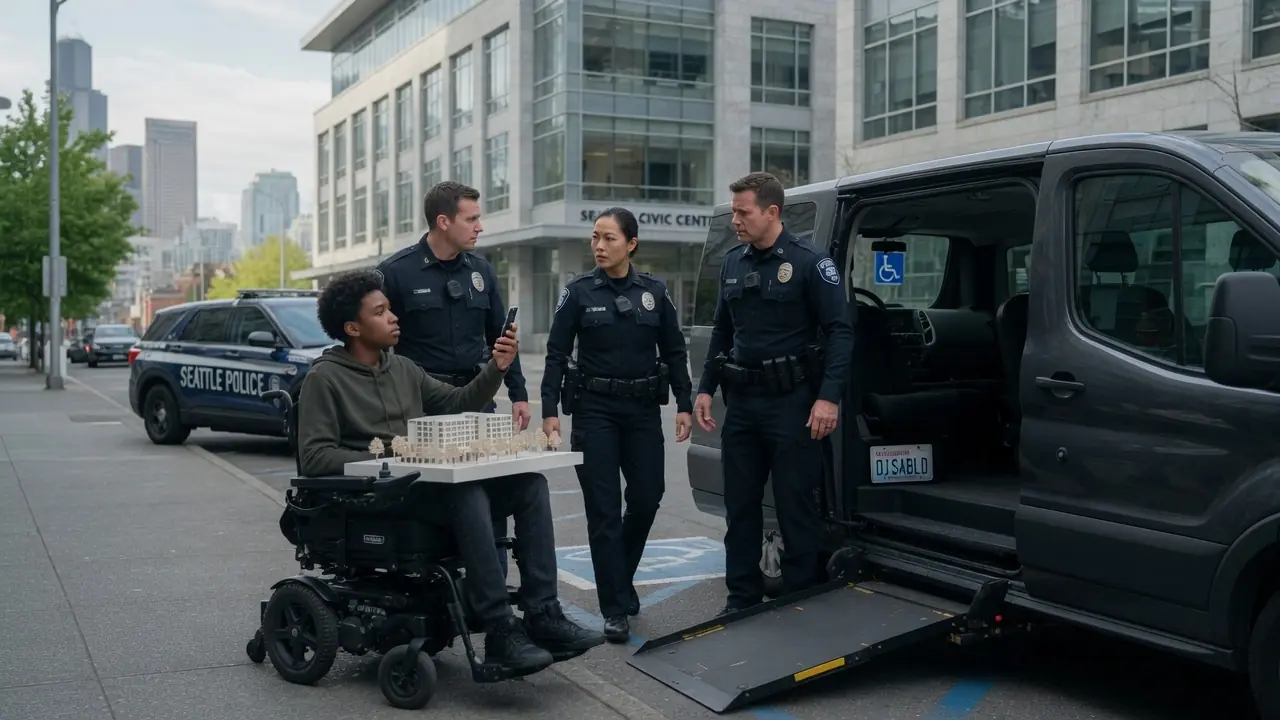
Jordan stopped his wheelchair beside the open door of his mother’s van.
For half a second, he thought the officer must be speaking to someone else.
The accessible parking placard hung from the rearview mirror.
The van carried disabled plates.
Its side door stood open, and the power ramp remained extended onto the striped access aisle.
Jordan himself sat in a black electric wheelchair with a backpack hooked behind the seat and a three-foot architectural model balanced carefully across his lap.
Tiny paper trees lined the model’s entrance.
A miniature ramp curved through a courtyard toward a glass-walled community center.
Jordan looked from the officer to the placard.
Then down at his own legs, resting motionless on the footplates.
“I have a placard,” he said.
The officer barely looked at it.
“I need to verify that you’re entitled to use it.”
Jordan was sixteen.
He had spent the last two years learning that words like verify often sounded reasonable until someone explained what they meant.
“What do you need to verify?”
The officer stepped closer.
“Proof that you actually have a disability requiring the space.”
Jordan stared at him.
Traffic moved behind them on the downtown Seattle street. Buses hissed at the curb. Office workers passed carrying coffee. Somewhere across the intersection, a delivery truck reversed with a repeating electronic beep.
Jordan wondered whether the officer could hear himself.
“I’m sitting in my wheelchair.”
“A wheelchair does not automatically tell me whether the placard belongs to you.”
“That’s my mother’s van. I’m the disabled passenger.”
“Do you have medical documentation?”
Jordan’s hands tightened around the edges of the model.
“No police officer has ever asked me to carry medical records to park.”
The officer’s nameplate read DANIEL KESSLER.
He was in his thirties, broad through the shoulders, with mirrored sunglasses pushed onto the top of his head.
“I’m asking now.”
Jordan looked toward the building entrance.
Above the glass doors, a security camera pointed toward the parking area.
A red indicator light showed it was recording.
That mattered.
Jordan had learned something else during the previous two years.
When an interaction began to feel wrong, remember the details.
Names.
Time.
Location.
Witnesses.
And if possible, record.
He carefully shifted the architectural model onto a rolling equipment cart beside the ramp.
Then he removed his phone.
Officer Kessler noticed immediately.
“What are you doing?”
“Recording.”
“Put the phone away.”
Jordan tapped the screen.
The recording began.
“I’m in public.”
“I’m telling you to put it away while I conduct my investigation.”
Jordan’s heart was hammering now.
But his voice remained quiet.
“What investigation?”
Kessler pointed toward the accessible space.
“Possible misuse of disabled parking.”
Jordan turned his camera briefly toward the placard, the plate, the ramp, and then back toward the officer.
“My name is Jordan Ellis. I’m sixteen years old. I’m legally parked in an accessible space. The van has disabled plates and a valid placard. I use an electric wheelchair because I have a spinal cord injury.”
Kessler’s face hardened.
“You don’t need to narrate this.”
“I do if you’re asking me to prove I’m disabled.”
“Move away from the vehicle.”
Jordan blinked.
“I can move my chair.”
“I said step away from the vehicle.”
The words hung between them.
Jordan stared at him.
“I can’t step anywhere.”
Kessler gave an impatient exhale.
“Don’t play word games with me.”
“I’m not.”
Jordan lowered the phone slightly.
“I’m paralyzed from the waist down.”
Something moved inside the building.
The security guard had been watching.
His name was Samuel Park, fifty-six, former Coast Guard, twelve years at the building.
Samuel knew Jordan.
Not well.
But enough.
Jordan’s father had attended planning meetings there for years, and Jordan had sometimes accompanied him carrying sketchbooks and asking questions adults underestimated.
Samuel had watched the kid change after the accident.
First came the hospital visits.
Then the wheelchair.
Then months when Jordan barely spoke.
Eventually he returned carrying drawings again.
Today Jordan was scheduled to present a proposal for a youth design competition.
Samuel stepped through the glass doors.
“Officer?”
Kessler turned.
Samuel held his own phone at chest level.
“That young man is expected inside.”
“This is a police matter.”
“I’m just telling you he has a scheduled appointment.”
“Step back.”
Samuel stopped.
He did not lower the phone.
“Jordan is one of the student presenters for the community arts project.”
Kessler looked toward the architectural model.
“That belongs to him?”
Jordan felt the question before understanding it.
“Yes,” he said.
Kessler looked at him.
“You built that?”
There was something in his tone Jordan knew too well.
Not curiosity.
Disbelief.
The same disbelief a substitute teacher had shown when Jordan earned the highest score on an engineering test.
The same disbelief adults sometimes gave his father when learning he owned an architectural firm instead of working for one.
Jordan’s face became hot.
“Yes. I built it.”
“With help?”
“Of course with help. It’s a school project. But the design is mine.”
Kessler looked back toward the van.
“I still need to verify the placard.”
Jordan held the phone steady.
“Then verify the placard number. Don’t ask me for my medical records.”
A woman passing on the sidewalk slowed.
She had heard enough to understand the shape of the argument.
She looked at Jordan.
Then at the wheelchair ramp.
Then at Kessler.
“Is something wrong?” she asked.
“Keep moving,” Kessler said.
The woman stopped instead.
“He’s in a wheelchair.”
“I said move along.”
“I heard you.”
Another pedestrian paused.
Then another.
Within two minutes, five strangers had stopped.
Phones appeared.
Jordan hated that part.
He did not want an audience.
He wanted to get inside, place his model on the conference table, straighten the tiny trees, and explain why public buildings should not make disabled people enter through side doors.
Instead, his disability had become public evidence in a sidewalk argument.
Kessler seemed to feel the attention around him.
Instead of slowing down, he became more rigid.
“All of you need to give us space.”
Samuel kept recording.
Jordan said, “Officer Kessler, I am asking for your supervisor.”
“You don’t decide how I conduct an investigation.”
“I’m asking for your supervisor.”
“You can ask after we finish here.”
Jordan looked directly into his phone camera.
“At 2:46 p.m., Officer Daniel Kessler has refused my request for a supervisor.”
Kessler stepped closer.
“Turn the phone off.”
“No.”
“Give it to me.”
Jordan immediately pulled the phone toward his chest.
“Don’t touch my property.”
Kessler reached.
Jordan jerked the chair backward instinctively.
The movement struck the rolling cart.
His architectural model tilted.
A miniature tree snapped from the courtyard and fell beneath the wheelchair.
Jordan caught the building with both hands before it slid to the pavement.
For one terrible second, no one said anything.
Then the woman on the sidewalk spoke.
“He’s a child. What are you doing?”
Kessler turned toward her.
“Back up.”
“You reached for his phone.”
“Back up.”
Samuel stepped sideways, keeping the interaction in frame.
Jordan stared at the broken paper tree near his wheel.
It was ridiculous that the thing upset him.
A tiny piece of cardboard.
Nothing compared with paralysis.
Nothing compared with surgery.
Nothing compared with the first time he tried transferring from a hospital bed and fell.
But he had glued that tree in place at one in the morning.
His father had cut the base.
His mother had painted the leaves.
It belonged to something Jordan had created.
And now it was lying in the street because a stranger had decided Jordan needed to prove himself.
The building doors opened again.
“Jordan?”
A man in a navy suit hurried outside.
His name was Gregory Walsh, the project coordinator.
He took in the scene.
The officer.
The crowd.
The wheelchair.
The open van.
The model.
“What happened?”
Jordan’s relief was immediate.
“Mr. Walsh, he says I need to prove I’m disabled and prove I’m allowed to park here.”
Gregory looked toward Kessler.
“Officer, this student is scheduled to present upstairs in fifteen minutes.”
“I’m investigating possible misuse of an accessible parking permit.”
Gregory glanced at the disabled plate.
Then at the placard.
Then at Jordan.
“What exactly suggested misuse?”
Kessler’s jaw tightened.
“Sir, stay out of the investigation.”
“I manage the building program he is attending.”
“You can confirm his appointment after I finish.”
“I’m confirming it now.”
Samuel spoke from several feet away.
“I called dispatch and requested a supervisor.”
Kessler looked at him sharply.
Jordan did not speak.
Something had changed.
For the first time, someone other than the sixteen-year-old was forcing the officer to explain himself.
Eight minutes later, Sergeant Melissa Chen arrived.
She parked behind Kessler’s cruiser and approached slowly.
Her eyes moved across the scene before she said anything.
Open wheelchair ramp.
Accessible placard.
Disabled plates.
Teenager in electric wheelchair.
Several witnesses filming.
Officer standing beside him.
Sergeant Chen stopped near Kessler.
“Walk me through it.”
“Possible misuse of disabled parking.”
“What indicated misuse?”
“Vehicle occupant appeared young. I was attempting to verify eligibility.”
Jordan saw the woman beside him shake her head.
Sergeant Chen looked toward Jordan.
Then at the wheelchair.
“You asked him for documentation?”
“I asked him to verify the disability.”
“Why?”
Kessler hesitated.
“Because fraud happens.”
“Did the placard return invalid?”
“I hadn’t run it yet.”
“Did the plate?”
“No.”
“Did anyone report misuse?”
“No.”
Sergeant Chen remained silent for a moment.
Jordan could almost see the questions arranging themselves in her mind.
Finally, she turned toward him.
“What is your name?”
“Jordan Ellis.”
“Jordan, are you the person the placard was issued for?”
“My mother carries the placard for transporting me. The van is registered with disabled plates because I’m the wheelchair user.”
“Thank you.”
She glanced at the ramp.
“You are unloading for an appointment inside?”
“Yes.”
Gregory raised the folder under his arm.
“He is a scheduled student presenter.”
Sergeant Chen nodded.
Then she looked at Kessler.
“Return to your vehicle.”
His expression changed.
“Sergeant—”
“Now.”
He walked away.
Sergeant Chen turned back to Jordan.
“I’m sorry this became what it did.”
Jordan swallowed.
His eyes burned.
He hated that.
“I want to make a complaint.”
“You can.”
“I want the part about him reaching for my phone included.”
“It will be.”
“And him telling me to step away after I told him I couldn’t walk.”
“Yes.”
“And asking whether I built my own model.”
Sergeant Chen’s face shifted slightly.
“Yes.”
Samuel stepped forward.
“I recorded from before that point.”
The woman on the sidewalk raised her hand.
“So did I.”
Gregory said, “The building security system has the entire parking area.”
Sergeant Chen nodded.
“We’ll preserve all of it.”
Jordan looked toward the broken tree.
The woman beside him noticed.
She bent, picked it up carefully, and handed it to him.
“You made this?”
“Yes.”
She studied the model.
“It’s beautiful.”
That almost did what the officer had failed to do.
It almost made Jordan cry.
Instead, he placed the tree inside his backpack.
“Thank you.”
He entered the building eighteen minutes late.
Gregory offered to postpone the presentation.
Jordan refused.
“If I go home, this becomes the only thing I remember about today.”
The conference room held eleven people.
Architects.
City staff.
Teachers.
Three student finalists.
Jordan positioned his model on the table.
His hands shook during the first slide.
Then he began talking about buildings.
That was easier.
He explained why accessibility should not be treated as equipment added after design was finished.
A ramp could be part of the architecture.
An accessible entrance should be the main entrance whenever possible.
Quiet rooms should not look like punishment rooms.
Restrooms should provide space without forcing a wheelchair user to navigate storage closets and cleaning carts.
He had created tactile navigation strips that connected entrances, elevators, performance areas, and exits.
His model included a central ramp sweeping through the main atrium.
One reviewer asked why he had made it so visible.
Jordan looked at the model.
“Because people always hide accessibility.”
The room became still.
“They put ramps behind buildings. Lifts near loading docks. Accessible entrances next to dumpsters. They treat access like something embarrassing.”
He rested one hand on his wheelchair armrest.
“I wanted the ramp to be the first thing people see.”
Nobody interrupted.
“It should say, ‘This building expected you.’”
When Jordan finished, the room remained quiet for a second longer than normal.
Then the questions began.
Not about his accident.
Not about the officer.
About design.
That mattered.
That evening, Jordan’s mother watched Samuel’s recording at the kitchen table.
Monica Ellis had spent two years teaching herself not to panic whenever Jordan left the house without her.
The accident had changed her too.
For months afterward, she would wake at night convinced she heard metal crushing.
Eventually she learned to let Jordan go to school without calling every hour.
She learned to watch him cross streets alone.
She learned that loving a disabled child could not mean imprisoning him inside protection.
Then she watched a police officer stand over her son and order him to prove something that should never have required humiliation.
By the time the video ended, her hands were shaking.
Jordan’s father, Marcus, sat beside her.
Marcus did not shout.
He rarely did.
He watched the video twice.
Then he asked Jordan one question.
“What do you want to happen?”
Jordan had expected his father to say he would handle it.
Instead, he had asked.
Jordan thought for a moment.
“I want him investigated.”
“Okay.”
“I don’t want them calling this a misunderstanding.”
“Okay.”
“And I want the department to explain what officers are actually allowed to ask disabled people.”
Marcus nodded.
“Then that is where we start.”
The family contacted an attorney from a disability-rights organization.
Her name was Rebecca Sloan.
Rebecca did not promise a lawsuit.
She did not promise millions of dollars.
She asked for documents.
Placard registration.
Vehicle records.
School appointment confirmation.
Videos.
Names of witnesses.
The building footage.
Then she asked Jordan to write down everything he remembered before repetition changed the memory.
“That part matters,” she told him. “Not because I doubt you. Because good evidence should not depend on memory alone.”
The police department opened an internal investigation.
Captain Luis Mendoza supervised it.
The first discovery was simple.
Officer Kessler had never run the placard.
He had never checked the plate.
He had begun by demanding medical proof.
The second discovery was harder to explain.
Kessler had received seven previous complaints involving disabled motorists.
Two involved people with invisible disabilities.
One involved a veteran with a prosthetic leg.
Another involved an older woman with multiple sclerosis.
Most had been classified as communication problems.
None produced significant discipline.
Captain Mendoza reviewed Kessler’s citation history.
A pattern emerged.
His accessible-parking citations were challenged at an unusually high rate.
Many were later dismissed after drivers produced documentation they already possessed during the original encounter.
No single case proved intentional discrimination.
Together, they raised questions the department should have asked earlier.
Then investigators reviewed training records.
Kessler had completed the required disability-awareness course.
He had passed.
The problem was not that he had never been taught.
The problem was that training had existed only as a box checked inside a personnel file.
Jordan’s video changed the review because it removed nearly every factual dispute.
Kessler could not claim Jordan had been aggressive.
He could not claim the placard was hidden.
He could not claim the van lacked disabled plates.
He could not claim no wheelchair was visible.
Most damaging was his own language.
You expect me to believe you built that?
The sentence had nothing to do with parking.
Internal affairs sustained multiple findings against him, including improper detention, unprofessional conduct, interference with lawful recording, failure to follow parking-verification procedures, and biased policing.
Kessler was suspended during the investigation.
Several months later, after an administrative hearing, he was dismissed.
Jordan expected to feel victorious.
He did not.
He mostly felt tired.
The family also filed a civil claim against the city.
The case did not end in a dramatic courtroom confession.
It ended the way many real disputes did.
Depositions.
Mediation.
Draft agreements.
Arguments over language.
The city eventually settled without admitting every allegation.
Part of the payment covered Jordan’s legal costs and damages.
The more important provisions, from his perspective, required procedural changes.
Officers enforcing accessible parking had to begin with permit verification, not medical interrogation.
Disability-related complaints would receive supervisory review.
The department created a written policy clarifying that officers generally should not demand private medical records merely because a person’s disability was questioned during routine parking enforcement.
Complaint data would be audited for recurring patterns.
A civilian disability-access advisory group would review training materials.
Jordan attended the first meeting.
He hated it.
Not because the people were hostile.
Because everyone kept asking him to tell the story again.
Eventually he said, “You have four videos.”
The room became quiet.
“You don’t need me to perform what happened every time you want to remember it.”
One of the advisors nodded.
Jordan continued.
“If you really want this to change, build a system that remembers for you.”
That sentence became the principle behind the new complaint-tracking policy.
Samuel Park’s video spread online after the family authorized its release.
Jordan became recognizable for several weeks.
Strangers stopped him in grocery stores.
Reporters called.
Disability organizations invited him to speak.
At first he rejected almost everything.
He did not want to become “the wheelchair kid from the parking video.”
His life was larger than the worst afternoon someone else created for him.
Then a thirteen-year-old boy emailed him.
The boy used forearm crutches and had been accused by a school employee of exaggerating his disability because he could sometimes stand without them.
He wrote:
I showed my mom your video because I didn’t know how to explain why it makes me so mad when people ask me to prove things.
Jordan read that message three times.
After that, he accepted a few invitations.
Not all.
Enough.
A year after the incident, he spoke before a city transportation committee.
He wore a dark blue blazer over a white shirt.
His mother sat behind him.
His father sat beside her.
Samuel was in the back row.
Jordan rolled toward the microphone.
“When people talk about accessible parking,” he began, “they often talk about fraud.”
He paused.
“Fraud exists. Rules matter. Placards should be verified when there is a lawful reason to verify them.”
Several officials looked surprised by the opening.
“But verification is not humiliation.”
He looked down the long table.
“An officer could have checked the placard number. He could have checked the plate. He could have asked whether the disabled passenger was present.”
Jordan touched the armrest of his wheelchair.
“Instead, he looked directly at me and asked me to prove my body.”
The room was silent.
“That distinction matters.”
Jordan did not ask the city to stop enforcement.
He asked it to make enforcement accurate.
He spoke about disability rights.
Bias.
Privacy.
And design.
Especially design.
“A bad system depends on the person with less power knowing every rule perfectly while the person with authority is allowed to improvise.”
His father smiled slightly.
That sounded like something an architect would say.
Jordan continued designing.
His community arts proposal won the student competition.
The final building did not copy his model exactly, but several of his ideas survived.
The main entrance used one broad, gently sloping approach instead of stairs beside a separate ramp.
Accessible seating was integrated throughout the performance hall.
Quiet rooms appeared near common areas.
Navigation signs combined visual text, raised lettering, and tactile elements.
Three years later, Jordan began architecture school.
Marcus offered him a summer internship at his firm.
Jordan accepted only after making one condition.
“No special assignments.”
“You are my son.”
“I know.”
“You are also the only intern who negotiated terms before receiving the offer.”
“I learned from you.”
Marcus laughed.
Jordan spent that summer doing tedious work.
Door schedules.
Material samples.
Measurements.
Revisions nobody noticed.
He loved it.
At twenty-three, he helped design a youth learning center on the south side of Seattle.
The building contained an open central ramp that curved through a three-story atrium.
During the design review, one consultant suggested moving it toward the rear because the ramp consumed valuable visual space.
Jordan looked at the rendering.
“No.”
The consultant pointed toward a service corridor.
“We could make access more efficient over here.”
“Efficient for whom?”
“It gives us a cleaner lobby.”
Jordan rotated his wheelchair toward the projected image.
“The ramp is the lobby.”
The room went quiet.
He smiled.
“That’s the point.”
The finished building opened two years later.
On opening day, Jordan’s parents stood in the crowd.
Samuel Park attended too.
He had retired by then.
Near the entrance was a small landscaped courtyard.
Jordan had personally insisted on the trees.
His mother noticed.
“Those look familiar.”
Jordan smiled.
“They are harder to break than paper.”
Before the ribbon cutting, he rolled to the microphone.
He did not mention Officer Kessler by name.
He did not mention the settlement amount.
He did not describe himself as someone who had overcome tragedy.
He looked toward a group of children using wheelchairs, walkers, canes, and communication devices near the front.
“When I was sixteen,” he said, “someone asked me to prove I belonged in a place that had already been marked for people like me.”
His father lowered his eyes.
Jordan continued.
“I spent a long time believing the important part of that story was the person who asked.”
He shook his head.
“It wasn’t.”
“The important part was everyone who stopped accepting the question.”
He looked toward Samuel.
“A security guard spoke up.”
Toward his parents.
“My family listened before deciding what I needed.”
Toward the building behind him.
“Designers changed what they were building.”
Jordan rested his hand on the wheelchair joystick.
“My father once told me the chair was never the tragedy.”
Marcus looked up.
“The tragedy is a world designed to make people prove they belong.”
Jordan glanced toward the wide entrance behind him.
No stairs separated it from the ramp.
No side door.
No special route.
Everyone entered through the same place.
“So we built one that already knows.”
He moved away from the microphone.
The doors opened.
Children entered first.
Years earlier, a police officer had looked at a sixteen-year-old in a wheelchair and seen suspicion before evidence.
The placard had been visible.
The plate had been valid.
The ramp had been deployed.
The truth had been sitting directly in front of him.
But assumptions can become stronger than evidence when the person holding them also holds authority.
Jordan never forgot that.
He also never forgot what happened next.
One person raised a phone.
Another stopped walking.
A supervisor asked the right question.
Witnesses remained.
Records were preserved.
And a teenager who had been told to prove he belonged went upstairs, placed a damaged model on a conference table, and explained how to build a world where fewer people would ever have to.