The jury heard Officer Darren Cole’s voice before they saw his face.
It came through the federal courtroom speakers, clear beneath the faint hum of traffic in a shopping-center parking lot.
“Nice car,” Cole said. “Who did you steal it from?”
On the large screen, a Black woman sat behind the wheel of a black Mercedes-Benz. Afternoon sunlight reflected from the hood. Both of her hands rested where they could be seen on the steering wheel.
The woman answered calmly.
“I own this vehicle.”
Cole laughed.
“Someone like you doesn’t own a car like this.”
Several jurors shifted in their seats.
At the defense table, Darren Cole stared at the screen without moving. He no longer wore the dark-blue uniform that had carried him through fifteen years of traffic stops, arrests, complaints, and internal investigations.
He wore a gray suit.
His badge was gone.
His service weapon had been taken months earlier.
The recording continued.
The woman identified herself as Victoria Hale. She explained that the vehicle registration was inside the glove compartment and described every movement before reaching for it.
Cole examined her license.
Then the registration.
Both documents matched.
The Mercedes belonged to her.
A reasonable officer could have returned them, explained the alleged violation, and ended the stop.
Cole did not.
“These could be fake,” his recorded voice said. “Step out of the car.”
Victoria remained composed.
“You have verified my identity and the registration. What legal reason do you have to remove me from my vehicle?”
Cole reached for the door handle.
“Because I told you to.”
Special Prosecutor Leah Monroe paused the video.
The courtroom became silent.
Leah walked toward the witness stand, where Victoria sat wearing a dark navy suit and a thin silver pin shaped like the state seal.
“Ms. Hale,” Leah said, “what position did you hold on the afternoon of this stop?”
“I had been appointed state attorney general six days earlier.”
“Had you officially taken office?”
“No. My term was scheduled to begin the following Monday.”
“Did Officer Cole know who you were when he initiated the stop?”
“No.”
“Would your title have changed whether his conduct was lawful?”
Victoria looked toward the jury.
“No.”
Her answer was simple.
That simplicity was the reason the case had become larger than one officer, one driver, or one afternoon in a parking lot.
The story did not begin when Darren Cole discovered that he had placed the incoming attorney general in handcuffs.
It began when he saw a Black woman driving an expensive car and decided that possession itself was evidence of a crime.
Victoria Hale spent that Saturday morning shopping for her new office.
At forty-four, she had already served as a county prosecutor, directed a public-corruption unit, and spent nearly a decade supervising complex criminal cases for the state.
Her appointment as attorney general had been announced the previous Sunday.
The governor described her as precise, independent, and unwilling to confuse loyalty to an institution with loyalty to the law.
Victoria accepted the appointment quietly.
She knew the office she was inheriting.
The state faced a growing number of complaints involving unlawful searches, fabricated probable cause, missing body-camera recordings, and internal investigations that repeatedly cleared the same officers.
Reform proposals had stalled for years.
Victoria intended to revive them.
That Saturday, however, she was not attending a policy meeting.
She was buying picture frames, notebooks, a desk organizer, and a brass reading lamp for the office she would enter on Monday.
The Mercedes had taken her years to afford.
She purchased it after completing a major public-fraud prosecution that consumed almost three years of her life. She saved carefully, refused to accept a loan larger than she could comfortably repay, and waited until buying the car no longer felt irresponsible.
The Mercedes was not proof of wealth to her.
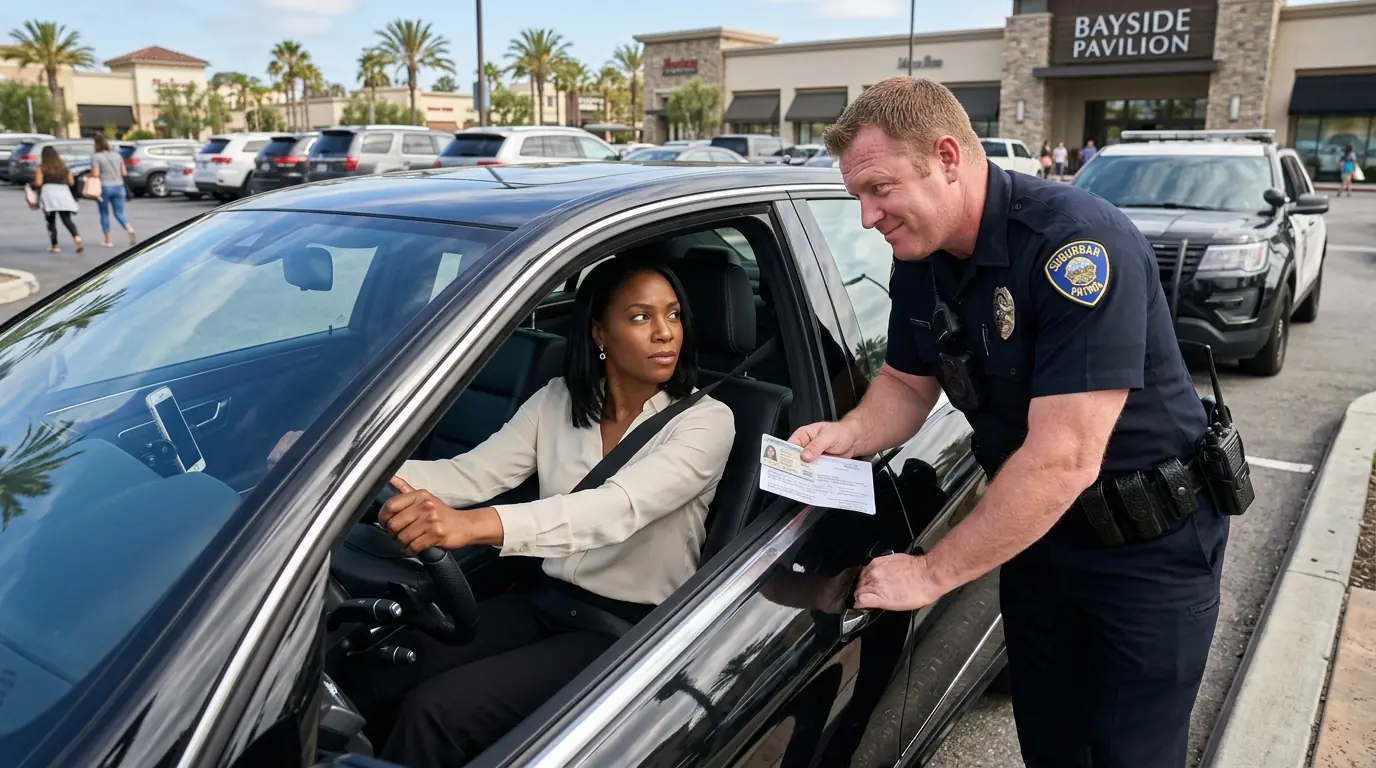
It was proof of patience.
At 3:12 that afternoon, Victoria drove through Ridgeway Plaza, an upscale shopping district outside the state capital.
Families crossed between stores.
Teenagers carried drinks toward the movie theater.
Couples pushed carts filled with weekend purchases.
Victoria remained within the speed limit.
She signaled before turning.
She stopped at the pedestrian crossing.
Officer Darren Cole saw the Mercedes from a patrol car parked near the north entrance.
His partner, Officer Ethan Miles, sat in the passenger seat completing an incident report.
Cole was forty-five and had spent most of his career in the Ridgeway District.
He described his suspicions as instinct.
Those instincts often began with a conclusion.
Certain people belonged in certain neighborhoods.
Certain vehicles belonged to certain drivers.
Some explanations deserved belief.
Others required pressure.
Cole pointed toward the Mercedes.
“That car is wrong.”
Ethan looked up.
“What’s wrong with it?”
“The driver.”
Ethan watched the Mercedes move toward the plaza exit.
“She didn’t do anything.”
“Give it a minute.”
Cole started the patrol vehicle.
Ethan looked toward him.
“Darren, we need a violation.”
“She crossed the center line.”
Ethan had been looking directly at the road.
“No, she didn’t.”
Cole activated the emergency lights.
“She did enough.”
Victoria saw the lights in her mirror.
She felt the familiar tightening in her stomach.
It was not because she believed every police encounter became dangerous.
It was because she had spent fifteen years reading case files in which ordinary traffic stops became something else after an officer decided that questions were disrespect.
She signaled and pulled into an empty section of the parking lot.
Then she placed the Mercedes in park, lowered the window, and rested both hands on the steering wheel.
Her phone remained mounted near the dashboard.
With one touch, she activated an audio recording.
Cole approached with one hand near his holster.
His body camera was recording.
He did not introduce himself.
He did not explain the alleged violation.
He looked through the window at the leather interior, the shopping bags, and Victoria.
“Nice car.”
Victoria waited.
“Who did you steal it from?”
For one second, she wondered whether she had heard him correctly.
“I’m sorry?”
“You heard me.”
“I own this vehicle.”
Cole leaned closer.
“Someone like you doesn’t own a hundred-thousand-dollar Mercedes.”
The insult landed.
Victoria’s expression did not change.
“Officer, please state the legal reason for this stop.”
“Possible stolen vehicle.”
“Was this car reported stolen?”
“License and registration.”
“I will provide both. I am also asking what traffic violation or reported offense justified stopping me.”
Cole straightened.
“Keep arguing and you’ll make this worse.”
Victoria slowly moved one hand.
“My registration is inside the glove compartment. I am opening it now.”
Cole watched her as if hoping she would move too quickly.
She removed the registration.
Then she explained that her wallet was inside her purse on the passenger seat.
After receiving permission, she retrieved it and handed both documents through the window.
Cole read the name.
VICTORIA ELAINE HALE
He compared the photograph with her face.
Then he checked the vehicle information.
Everything matched.
Ethan remained in the patrol car.
He watched Cole examine the papers twice.
He expected the stop to end.
Instead, Cole returned to the window.
“These documents could be counterfeit.”
Victoria looked at him.
“You can verify them through dispatch.”
“I’m going to need you to step out.”
“For what purpose?”
“To confirm ownership.”
“You are holding confirmation.”
Cole’s face tightened.
“Step out.”
Victoria spoke slowly, ensuring her phone and his body camera captured every word.
“I do not consent to a search. I do not consent to being removed without legal cause. Please articulate the basis for continuing this detention.”
People near the pharmacy entrance had begun watching.
Two teenagers raised their phones.
A woman pushing a shopping cart stopped several yards away.
The attention did not make Cole more careful.
It made him more determined not to appear wrong.
“Last warning.”
Victoria remained seated.
“I am not refusing a lawful command. I am requesting the justification for it.”
Cole opened the door.
Victoria did not grab it.
She did not pull away.
Cole seized her wrist.
“You’re getting out.”
“I am complying under protest.”
He pulled her from the seat.
“I am not resisting.”
Cole turned her toward the hood.
“Stop fighting me.”
“I am not fighting.”
He forced her chest against the Mercedes and drew one arm behind her back.
The shopping bags shifted in the rear seat.
A picture frame fell and struck the floor.
The first handcuff closed around Victoria’s wrist.
It was painfully tight.
Then came the second.
At least six people were recording.
Ethan finally left the patrol car.
“What are you doing?”
“Possible stolen vehicle,” Cole answered. “She became uncooperative.”
Ethan looked toward the registration still in Cole’s hand.
“It matches.”
“Could be fake.”
“Did dispatch say the car was stolen?”
Cole ignored him.
Victoria turned her head enough to see Ethan.
“My name is Victoria Hale.”
The younger officer’s expression changed slightly.
“I was appointed state attorney general last Sunday. I take office Monday morning.”
Cole laughed.
“Of course you are.”
Victoria kept her eyes on Ethan.
“Your body camera is recording. You have witnessed a stop without an observed violation, a continued detention after ownership was established, and the use of restraints after I complied.”
Ethan swallowed.
Something in her tone separated the statement from an attempt to intimidate officers with an invented title.
She did not sound desperate.
She sounded like a prosecutor creating a record.
“Darren,” Ethan said quietly, “we need a supervisor.”
“We don’t need anyone.”
“Yes, we do.”
Ethan stepped away and used his radio.
“Unit Twelve requesting a supervisor at Ridgeway Plaza, north parking area.”
Cole turned.
“Cancel that.”
Ethan did not.
The woman with the shopping cart held her phone higher.
“She didn’t do anything,” she called. “I saw the whole stop.”
Cole pointed toward her.
“Back up or you’ll be cited for interference.”
“I’m standing in a public parking lot.”
“You’re interfering with an investigation.”
“I’m recording you.”
More voices joined the crowd.
“The registration matched.”
“Why is she handcuffed?”
“Let her go.”
Cole felt control leaving him.
He had experienced that sensation many times.
Each time, he responded by increasing pressure until the person before him became angry enough to justify the danger he wanted to describe.
Victoria did not become angry.
That made him reckless.
He walked to the passenger side of the Mercedes.
“I’m searching the vehicle.”
Victoria remained against the hood.
“You do not have my consent.”
“I don’t need it.”
“What is your probable cause?”
Cole opened the door.
“I smell marijuana.”
Ethan closed his eyes.
There was no smell.
He had sat behind the Mercedes with his window partly open.
Cole had never mentioned marijuana during the first several minutes.
The claim appeared only after the registration matched and Victoria refused to accept an unsupported detention quietly.
“There is no marijuana in my car,” Victoria said.
Cole began searching.
He opened the glove compartment.
Looked under the seats.
Removed shopping bags from the back.
Picture frames.
Notebooks.
A small lamp.
Receipts from three stores.
He examined each item as though an ordinary purchase might become evidence if he handled it long enough.
The crowd watched.
So did the cameras.
Sergeant Robert Nash arrived four minutes later.
He had served twenty-seven years and carried the observant, weary expression of a man who no longer accepted the first explanation offered at a chaotic scene.
He saw the Mercedes.
The open doors.
The crowd.
The woman in handcuffs.
Cole leaning into the passenger compartment.
Ethan standing several feet away, visibly uncomfortable.
“Step out of the vehicle,” Robert ordered.
Cole turned.
“Sergeant, I have probable cause.”
“Step away.”
Cole obeyed.
Robert looked toward Ethan.
“What happened?”
Cole answered before his partner could.
“Possible stolen vehicle. Driver refused proper identification, became combative, and I detected marijuana.”
Robert walked toward Victoria.
“Ma’am, I’m Sergeant Nash. Tell me what happened.”
Cole interrupted.
“She’s been lying since the stop started.”
Robert looked over his shoulder.
“Officer Cole, remain silent.”
Then he faced Victoria again.
Her wrists were visibly reddened.
“My name is Victoria Hale. Officer Cole stopped me without explaining a legitimate violation, accused me of stealing my vehicle, rejected valid registration, removed me by force, fabricated an odor claim, and searched without consent.”
Robert studied her.
She spoke in organized facts.
No exaggeration.
No unnecessary insult.
“Was the vehicle reported stolen?” he asked.
“No.”
“Did dispatch verify the registration?”
“Officer Cole did not contact dispatch in my presence.”
Robert turned toward Cole.
“Show me the theft report.”
Cole hesitated.
“It matched vehicles involved in recent thefts.”
“What description?”
“Black Mercedes.”
Robert raised his radio.
“Dispatch, confirm any active stolen black Mercedes associated with Ridgeway Plaza or the surrounding district.”
The answer came quickly.
“Negative, Sergeant. No active report matching that vehicle.”
Robert picked up Victoria’s registration from the driver’s seat.
He entered the plate into his portable terminal.
Valid.
Registered to Victoria Hale.
No warnings.
No theft report.
No warrants.
“Why is she handcuffed?”
“She refused to cooperate.”
“What lawful command did she refuse?”
“She wouldn’t exit the vehicle.”
“Why did you order her out?”
“To verify ownership.”
“The registration verified ownership.”
“It might have been counterfeit.”
“Did you verify it before using force?”
Cole remained silent.
Robert turned toward Ethan.
“What did you observe?”
Ethan looked at Cole.
Four years earlier, Cole had helped train him.
He taught Ethan how to complete reports, control hostile scenes, and survive dangerous calls.
He also taught him when loyalty required silence.
Now that silence threatened to make Ethan part of what happened.
“Officer Cole initiated the stop without an observed traffic violation,” Ethan said.
Cole’s head turned sharply.
Ethan continued.
“The car did not cross the line. The registration matched. I did not smell marijuana.”
The crowd became quiet.
Cole stared at his partner as if betrayal were a greater offense than dishonesty.
Robert looked toward Victoria.
“Are you a government attorney?”
“No.”
The answer surprised him.
Victoria continued.
“I am the incoming state attorney general.”
Cole made a bitter sound.
“Here we go again.”
Robert’s expression changed.
“What did you say?”
“She’s pretending to be important.”
Victoria looked toward the Mercedes.
“My temporary state credential is in the wallet on the front seat. Sergeant, you have permission to retrieve it.”
Robert opened the wallet.
Inside was an identification card issued by the governor’s executive office.
Victoria’s photograph appeared beside the official seal.
Beneath it were the words:
STATE ATTORNEY GENERAL — APPOINTED
Robert went pale.
Ethan took one step backward.
Cole stared at the card.
“That can’t be real.”
“The previous officeholder retired,” Victoria said. “His photograph remaining on your department wall does not make him the current attorney general.”
Robert moved behind her.
“I’m removing the cuffs.”
The metal opened.
Victoria brought her hands forward and rubbed the marks around her wrists.
“I deeply apologize,” Robert said.
She looked directly at him.
“Preserve every recording.”
“Yes, ma’am.”
“Body cameras, dashboard footage, dispatch communications, vehicle-location data, and all civilian recordings offered by witnesses.”
“Yes.”
She turned toward Ethan.
“You called the supervisor.”
“I should have done more before that.”
“Yes.”
The honesty made him lower his eyes.
Then Victoria looked at Cole.
For the first time, he appeared uncertain.
“I spent the last week reviewing misconduct summaries in preparation for taking office,” she said.
His expression changed.
“Your name appeared repeatedly.”
Cole said nothing.
“Twenty-six civilian complaints.”
The color drained from his face.
“I intended to request a broader pattern review after taking office.”
Victoria glanced toward the open doors of her Mercedes.
“You have placed yourself at the beginning of that review.”
On Monday morning, Victoria entered the attorney general’s office at seven twenty-five.
Staff members greeted her with flowers, coffee, and a framed copy of the appointment announcement.
She thanked them.
Then she made three requests.
An independent special prosecutor.
Immediate preservation orders covering Cole’s complete employment record.
And a meeting with Police Chief Raymond Calder.
The chief arrived expecting a formal introduction.
Instead, Victoria showed him the recordings.
Cole accusing her of stealing the Mercedes.
Rejecting valid documents.
Pulling her from the car.
Claiming to smell marijuana.
Searching bags filled with office supplies.
Chief Calder watched without speaking.
When the final recording ended, he sat back.
“This happened to you.”
Victoria folded her hands.
“This happens to people who do not arrive at the next meeting as attorney general.”
Calder looked down.
“You intend to prosecute him?”
“I am the victim and a witness. I will not control the charging decision.”
She slid a signed recusal order across the desk.
“Special Prosecutor Leah Monroe will lead the criminal investigation.”
Calder read it.
“What will your office do?”
“My job.”
Cole was suspended that morning.
Internal Affairs initially described the incident as a breakdown in communication.
That explanation survived less than twenty-four hours.
The videos were too clear.
The complaint history was worse.
Twenty-six civilians had accused Cole of profiling, unlawful searches, excessive force, false statements, or invented reasons for detention.
Every complaint had been closed by Captain Howard Briggs.
Several files contained no witness interviews.
Some lacked dispatch records.
Others said body-camera footage was unavailable without documenting whether anyone had attempted to recover backup files.
Victoria’s office obtained a judicial preservation order covering the department’s digital systems.
Investigators found deleted footage.
Not all of it could be restored.
Enough survived.
One recording showed Cole stopping a college professor outside an expensive home and demanding proof that he belonged there.
Another showed him searching a delivery driver’s van after claiming to smell marijuana.
No drugs were found.
A third captured a young man repeatedly explaining that the luxury SUV he drove belonged to his employer.
Cole arrested him for obstruction.
The charge was later dismissed.
Patterns emerged.
Cole’s traffic stops in affluent neighborhoods disproportionately involved Black and Latino drivers.
His search rate was far higher than that of officers assigned to the same district and shifts.
His rate of finding illegal evidence was lower.
His reports relied on repeating phrases.
Appeared nervous.
Avoided direct answers.
Strong odor of marijuana.
Reached toward waistband.
Became combative.
The words created danger on paper even when recordings showed calm people attempting to cooperate.
Ethan Miles agreed to cooperate.
He admitted Cole sometimes selected vehicles before observing any violation.
“He called it fishing,” Ethan told investigators.
“What did that mean?” Leah asked.
“You stop the person first and find the reason afterward.”
“Did you object?”
“Sometimes.”
“What happened?”
“He told me questioning instinct would get an officer killed.”
“Did you believe him?”
Ethan looked down.
“I wanted to.”
Captain Briggs’s messages showed that he had protected Cole for years.
The two men communicated after complaints were filed.
One message from Briggs read:
Another one claiming bias. I’ll clean it up.
Cole responded:
Knew you would.
The investigation expanded beyond one officer.
Two supervisors were suspended.
The department’s evidence manager reported altered property records connected to several of Cole’s arrests.
Prosecutors admitted that they had privately doubted Cole’s credibility but continued using his testimony because openly challenging him would damage relationships with the department.
Old cases were reopened.
A nurse named Angela Morris had lost her professional license after Cole claimed to find unauthorized medication under her driver’s seat.
The evidence bag had originally belonged to another investigation.
A mechanic named Luis Ortega spent eleven months in jail after officers found an unregistered handgun inside his truck.
Records showed the weapon had previously been stored in the department’s evidence room.
A nineteen-year-old named Terrell Jackson accepted probation for marijuana possession.
Dashboard footage showed that Cole searched Terrell’s car before documenting the supposed odor that justified the search.
The consequences reached backward through fifteen years.
Victoria attended no charging meetings related to her own stop.
She did not select counts.
She did not give public speeches calling Cole guilty.
She understood that accountability could be weakened if it appeared to be personal revenge by a powerful official.
Instead, she focused on the systems that allowed the pattern to survive.
Repeated complaints against the same officer could no longer be investigated as isolated events.
Body-camera failures triggered automatic technical review.
Supervisors were required to compare stop data, search rates, outcomes, and demographic patterns.
Civilian oversight investigators received direct access to video and dispatch records.
Prosecutors had to disclose sustained credibility findings involving law-enforcement witnesses.
The reforms faced immediate resistance.
The police union accused Victoria of punishing officers for proactive policing.
Several legislators argued that statistical analysis treated officers like numbers rather than individuals.
Victoria answered during a public hearing.
“Numbers do not replace evidence.”
She placed Cole’s search records before the committee.
“They reveal where institutions repeatedly decided not to look for it.”
Darren Cole went to trial eleven months after the traffic stop.
The charges included deprivation of civil rights under color of law, false imprisonment, falsification of records, obstruction, and conspiracy related to previous cases.
Victoria testified for one day.
The defense attorney suggested that she had transformed a misunderstanding into a statewide campaign because her pride had been injured.
“Were you humiliated?” he asked.
“Yes.”
“Were you angry?”
“Yes.”
“Did you want Officer Cole punished?”
“I wanted his conduct investigated.”
“That was not my question.”
Victoria looked toward him.
“Punishment should follow evidence and law, not my personal wishes.”
The attorney moved closer to the jury.
“You informed Officer Cole that you were the incoming attorney general.”
“After he had already removed and handcuffed me.”
“You expected your title to influence the situation.”
“I expected the truth to prevent further escalation.”
“Would this stop have received national attention if you were not attorney general?”
“No.”
The answer seemed to please the defense.
Then Victoria continued.
“That is why this case matters.”
The attorney stopped.
Victoria looked toward the jury.
“The conduct would have been equally unlawful if I worked at the pharmacy across the parking lot.”
The courtroom became still.
“My office did not create my rights. It gave me access to people who could preserve the proof.”
Leah later played Cole’s body-camera footage again.
This time, the jury watched his expression when the registration matched.
The case did not depend only on Cole’s initial assumption.
It depended on what he did after that assumption was disproved.
He claimed the documents were counterfeit.
Then invented noncompliance.
Then claimed marijuana.
Each new justification existed to protect the previous mistake.
Ethan testified against his former partner.
“Why did you call a supervisor?” Leah asked.
“Because I believed Ms. Hale.”
“Why did you believe her?”
“She spoke like she understood exactly what was happening.”
“Would you have responded differently if she did not sound educated or legally informed?”
Ethan hesitated.
“I hope not.”
“That was not the question.”
He lowered his eyes.
“At that time, probably.”
The admission damaged him.
It also made his testimony believable.
The jury convicted Cole on the major federal counts.
Captain Briggs later pleaded guilty to obstruction and destruction of evidence.
Two other officers accepted agreements permanently barring them from law-enforcement employment.
Cole received eight years in federal prison.
The judge declined to impose the maximum sentence but emphasized the repeated nature of the conduct.
“This court is not sentencing you because you stopped an attorney general,” the judge said.
“It is sentencing you because the evidence shows that you repeatedly used public authority to manufacture criminal suspicion around people you had already chosen to distrust.”
More than three hundred cases were reviewed.
Forty-six convictions were vacated.
Dozens of pending charges were dismissed.
Angela Morris regained her nursing license.
Luis Ortega’s conviction was erased.
Terrell Jackson enrolled in community college after his record was cleared.
The city created a compensation program for people harmed through fabricated reports, unlawful searches, and mishandled evidence.
Victoria never described the work as complete.
Stop disparities narrowed.
Complaints declined.
Searches became less frequent.
But she refused to celebrate statistics without asking why they changed.
“An officer may stop documenting misconduct without stopping the behavior,” she warned her staff. “Accountability requires continued observation, not a successful press release.”
Ethan remained in the department.
He received a suspension for failing to intervene immediately, then returned under a new training supervisor.
Some people believed he should have been fired.
Others considered his cooperation courageous.
Victoria believed both conclusions were incomplete.
Ethan had failed when it mattered.
Then he told the truth when silence would have protected him.
The second act did not erase the first.
But institutions needed ways for people to interrupt wrongdoing before silence hardened into loyalty.
Three years later, Ethan stood before a police-academy class.
He played the first seven minutes of the Mercedes recording.
Then he paused the video before Victoria identified herself.
“Tell me what matters,” he said.
One recruit mentioned the expensive car.
Another focused on the registration.
A third noted the absence of an observed traffic violation.
Ethan nodded.
“What does not matter?”
The room remained quiet.
Finally, a young woman in the second row answered.
“Who she turns out to be.”
Ethan looked toward the frozen image on the screen.
“Correct.”
Victoria served two full terms as attorney general.
Her office created the state’s first independent police-credibility database and expanded legal representation for people challenging unlawful seizures.
The Mercedes remained in her garage.
The scratches left by Cole’s belt buckle were repaired, but Victoria kept the body-shop receipt.
She stored it beside the first reform order she signed.
One represented the damage.
The other represented what she chose to build from it.
Years after leaving office, Victoria spoke to a group of law students.
A student asked whether Cole ever understood what he had done.
“I don’t know,” Victoria said.
“Do you forgive him?”
The student immediately looked embarrassed.
“I’m sorry. That was too personal.”
“It was personal,” Victoria replied. “But it was also the wrong measure.”
She looked across the lecture hall.
“A system should not depend on a victim’s forgiveness before it corrects injustice.”
“What should it depend on?” another student asked.
“Evidence.”
“Transparency.”
“Consequences.”
“And the courage to examine patterns before another person is harmed.”
That was the lesson most people missed.
News reports preferred the dramatic reveal.
A biased officer accused a woman of stealing her own luxury car.
Then he discovered that she was the incoming attorney general.
The reversal made the story satisfying.
It gave humiliation a powerful answer.
But Victoria never believed her title was the important part.
Darren Cole was already wrong when he saw the Mercedes and treated its driver as suspicious.
He was wrong when he ignored valid registration.
Wrong when he used physical force to protect his pride.
Wrong when he claimed an odor that did not exist.
Wrong when he searched for evidence to justify a decision already made.
The state credential in Victoria’s wallet did not transform those acts.
It merely forced people to take them seriously.
Cole believed power came from the badge on his chest.
Victoria understood something he had forgotten.
The badge borrowed its authority from the law.
It did not replace it.
When an officer used borrowed power to deny another person’s rights, the uniform stopped being protection.
It became evidence.
On that Saturday afternoon, Cole believed he had stopped a woman who could be intimidated, discredited, and forgotten.
He was wrong about her identity.
But that was not the mistake that destroyed him.
His real mistake was believing that any driver should require an important title before her name, her ownership, and her rights became worthy of respect.