The police dog noticed the little girl before any officer did.
At 4:18 on a crowded Friday afternoon, Atlas stopped in the middle of Terminal 4 at John F. Kennedy International Airport and refused to move.
Travelers flowed around him in both directions.
Businessmen hurried toward departure gates with phones pressed to their ears. Families wrestled with carry-on bags and tired children. Flight announcements echoed beneath the high ceiling, mixing with the rolling thunder of suitcase wheels and the distant roar of aircraft.
Atlas ignored all of it.
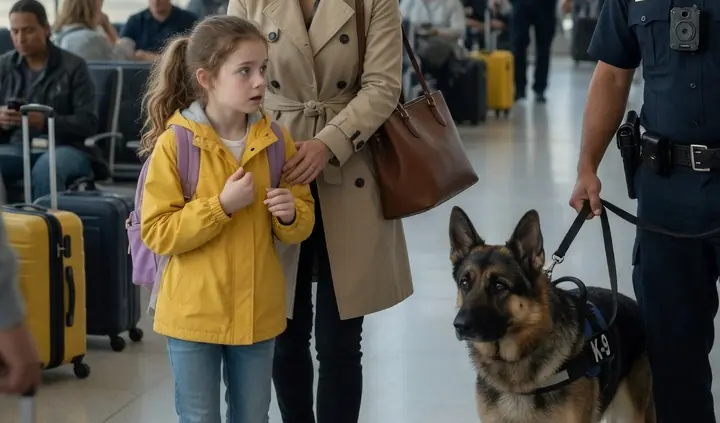
The seven-year-old German Shepherd stood beside Officer Daniel Reyes near the international arrivals corridor, his body completely still.
His ears were raised.
His dark eyes followed a small girl in a yellow coat walking approximately forty feet ahead.
Daniel gave the leash a light signal.
“Forward.”
Atlas did not move.
Daniel looked down.
The dog was trained to detect explosives, firearms, and several common narcotics. He was also trained to ignore ordinary distractions unless commanded otherwise.
He had never refused a forward command inside a terminal.
“What is it?” Daniel whispered.
Atlas’s nose lifted.
But he did not sniff the luggage around them.
He watched the girl.
She appeared about eight years old.
Small for her age.
Straight brown hair reached just below her shoulders, though one side had been cut unevenly near the jaw. She wore dark leggings, white sneakers, and a yellow raincoat despite the clear weather outside.
Her left hand was wrapped around the strap of a red backpack.
Her right hand was held firmly by a tall woman in a gray coat.
The woman was in her early forties, with blond hair pulled into a low bun. She moved quickly without seeming rushed, steering the child through the crowd while scanning the signs overhead.
Nothing about them looked unusual at first.
The girl appeared tired.
The woman appeared impatient.
That described thousands of travelers passing through JFK every day.
Daniel touched the radio clipped to his shoulder.
“Central, K-9 Fourteen. I’m stationary near arrivals lane C.”
A dispatcher answered.
“Copy, Fourteen. Issue?”
“Not sure.”
Daniel shortened the leash slightly.
Atlas remained focused.
The girl looked back.
Only once.
Her eyes met the dog’s.
Then Daniel’s.
The expression lasted less than a second.
Fear was common in airports. Children feared flying, losing parents, unfamiliar uniforms, loud noises, and police dogs.
But this was not ordinary fear.
The girl did not look afraid of Atlas.
She looked relieved that he had seen her.
The woman pulled her hand.
The child turned forward again.
Daniel began walking at a distance.
Atlas moved immediately.
Not toward any bag.
Toward the girl.
Daniel’s unease deepened.
“Central, have behavioral detection observe a female adult and juvenile moving east from arrivals C. Adult, white female, gray knee-length coat, blond hair. Child, approximately eight, yellow coat, red backpack.”
“Any articulable reason?”
“Negative. K-9 behavioral anomaly.”
There was a brief pause.
“Copy. Camera unit notified.”
Daniel had worked with Atlas for five years.
Before joining the Port Authority Police Department, Daniel served twelve years in the Army Military Police Corps. He trusted training, procedure, and evidence.
But he also trusted Atlas.
The dog did not build theories.
He responded to scent, behavior, stress, and patterns humans often missed.
The woman and child approached the main concourse.
The girl’s steps shortened.
The woman leaned down and said something close to her ear.
Whatever it was caused the girl to stiffen.
Daniel could not hear the words.
He saw only the effect.
The child’s shoulders rose.
Her grip tightened around the backpack.
Then her free hand moved.
Three fingers touched her chin.
Her thumb folded into her palm.
The hand closed.
Opened.
Closed again.
Daniel nearly walked past the significance.
Then memory caught up with him.
The signal.
He had seen it during a mandatory trafficking-awareness training two months earlier. A silent distress gesture designed for someone who could not safely speak.
Thumb tucked into the palm.
Fingers closing over it.
The girl performed it once more.
Low near her waist.
Hidden from the woman’s direct line of sight.
“Central, upgrade. Juvenile displayed recognized distress signal. Begin discreet containment. Do not alert subject.”
The response came immediately.
“Copy. Terminal response protocol initiated.”
Nothing visible happened.
That was the point.
The terminal continued operating.
Announcements continued.
Travelers continued walking.
But beneath the ordinary movement, the airport shifted.
Plainclothes officers stepped away from kiosks.
A Transportation Security Administration supervisor repositioned near the security entrance.
Two uniformed officers entered the concourse from opposite ends without activating lights or sirens.
Camera operators locked onto the pair.
Daniel continued following.
He did not hurry.
Atlas walked at his left side, eyes forward.
The woman approached an elevator leading toward the AirTrain connection.
A man in a black baseball cap waited beside the doors.
He carried no visible luggage.
When he saw the woman, he touched the brim of his cap.
She responded with a slight nod.
The girl looked toward him and stopped walking.
The woman pulled.
The child resisted.
Only for a moment.
The man stepped closer.
Daniel changed direction and moved toward a nearby trash bin, pretending to check Atlas’s harness while keeping them within view.
The man said something to the woman.
She glanced around the terminal.
Her eyes passed over Daniel.
Then returned.
She had noticed the dog.
Daniel looked down before she could study his face.
The elevator doors opened.
The woman moved toward them.
The girl did not.
She dropped the red backpack.
The woman bent quickly and grabbed it.
That gave the child less than two seconds.
She turned toward Daniel.
Her lips moved.
No sound reached him.
But he understood the word.
Help.
The man in the cap seized her upper arm.
Atlas growled.
The sound was low enough that most travelers did not hear it.
Daniel did.
He released the safety strap on the leash.
“Port Authority Police,” he said clearly. “Let go of the child.”
The woman froze.
The man tightened his grip.
Passengers nearest the elevator stepped away.
The man forced a smile.
“This is a family matter.”
Daniel approached slowly.
“Remove your hand from her arm.”
The woman stepped between them.
“He’s her father. She’s having a tantrum.”
The girl shook her head.
The man pressed his fingers deeper into her coat.
Daniel saw pain cross her face.
Atlas moved half a step forward.
The man looked at the dog.
“Control that thing.”
“Let go of the child.”
“I said she’s ours.”
Daniel’s voice became colder.
“Children are not property.”
The terminal response team closed in without running.
Officer Mia Chen approached from the right in plain clothes, displaying her badge.
Officer Joseph Burke came from behind the elevator.
A TSA supervisor blocked the route toward the AirTrain.
The woman saw them.
Her composure vanished.
She released the backpack and ran.
Mia intercepted her after six steps.
The man pulled the girl against his chest and reached inside his jacket.
Daniel gave one command.
“Atlas.”
The dog launched forward.
The man’s hand emerged holding a folding knife.
He never opened it.
Atlas struck his forearm and clamped down on the padded sleeve beneath the coat. The man cried out and released the girl.
Daniel pulled her behind him.
Burke forced the man against the wall.
The knife fell to the floor.
Within seconds, both adults were in handcuffs.
The entire confrontation lasted less than twenty seconds.
To the passengers standing farther away, it looked sudden and confusing.
To the officers, it had begun several minutes earlier with a dog refusing to look away.
The girl stood beside Daniel.
She did not cry.
That worried him.
Children cried when the immediate danger ended.
They shook.
Called for parents.
Asked questions.
This girl stared at the handcuffed woman as though waiting for punishment.
Daniel crouched to her height.
“You’re safe.”
She looked at Atlas.
The dog had returned to Daniel’s side.
Blood from the man’s arm marked a small section of his muzzle, but the injury appeared superficial.
The girl whispered, “Is he going to hurt me?”
“Atlas?”
She nodded.
“No.”
Daniel softened his voice.
“He was watching you because he knew you needed help.”
The girl looked toward the man in handcuffs.
“No. Him.”
Daniel followed her gaze.
The man glared back.
Daniel moved so his body blocked the view.
“He cannot reach you.”
“Not here.”
The words were barely audible.
Daniel felt a chill.
“What is your name?”
The girl hesitated.
The woman called from across the concourse.
“Lucy! Don’t speak to them!”
The child flinched.
Daniel looked at the woman.
Mia moved her farther away.
Daniel returned his attention to the girl.
“Is your name Lucy?”
She shook her head.
“What is it?”
The girl pressed her lips together.
Daniel pointed gently toward Atlas.
“His name is Atlas.”
The child studied the dog.
“He doesn’t tell secrets,” Daniel said.
The smallest trace of a smile appeared.
“My name is Emma.”
“Emma what?”
She looked down.
“I’m not supposed to say.”
“Why?”
“They said my old name was dangerous.”
Daniel did not ask more in the terminal.
He requested a child-protection specialist and moved Emma to a secure family interview room away from public view.
Atlas remained with them.
Emma would not release the dog’s harness.
She sat on a couch with the red backpack beside her feet and one hand buried in the fur near Atlas’s shoulder.
A nurse examined the marks on her arm.
There were older bruises too.
Several shaped like fingers.
A healing cut crossed one knee.
A small circular scar marked the inside of her wrist.
Daniel stood near the door while Detective Lena Brooks entered.
Lena worked with the Port Authority’s human-trafficking task force. She was forty-eight, soft-spoken, and patient enough to wait through silence without trying to fill it.
She did not begin by asking about the adults.
She sat across from Emma and spoke about Atlas.
“Does he like children?”
Daniel answered.
“He likes people who share snacks.”
Emma looked toward him.
“I don’t have snacks.”
Atlas rested his head on her knee.
Lena smiled.
“He may make an exception.”
Emma touched one of his ears.
For ten minutes, they asked nothing important.
What color she liked.
Whether she preferred cats or dogs.
Whether she had ever been on an airplane.
Emma answered only the last question.
“No.”
Lena glanced toward Daniel.
The woman had claimed they were traveling as a family.
“What were you doing at the airport?” Lena asked.
Emma’s fingers tightened in Atlas’s fur.
“Going somewhere.”
“Where?”
“I don’t know.”
“Did the woman tell you?”
“She said another family wanted me.”
Daniel’s chest tightened.
Lena kept her expression calm.
“What is the woman’s name?”
“Rebecca.”
“Is she your mother?”
Emma shook her head.
“How long have you been with her?”
“I don’t know.”
“Days?”
“No.”
“Weeks?”
Emma looked toward the wall clock.
“They took the Christmas tree down after I got there.”
It was April.
Lena wrote nothing visibly.
“Where did you live before Rebecca?”
Emma’s eyes filled for the first time.
“With my mom.”
“What is her name?”
“Sarah.”
“Do you know her last name?”
Emma nodded.
“Bennett.”
The name meant nothing to Daniel.
Lena’s tablet search returned hundreds of results.
“Where did you live?”
“Near a big water tower with a red star.”
“Which city?”
“I don’t remember.”
The girl’s breathing changed.
Atlas lifted his head.
Daniel sat beside her.
“You don’t have to remember everything at once.”
“They said my mom stopped looking.”
“Who said that?”
“Rebecca.”
“What else did she tell you?”
“That the police thought I ran away. That Mom had a new daughter. That nobody wanted trouble because of me.”
Tears slid silently down Emma’s face.
Atlas leaned closer.
She buried her face against his neck.
Daniel looked at Lena.
This was not an improvised abduction.
The child had been psychologically controlled for months.
The adults’ identification appeared legitimate at first.
The woman carried a New Jersey driver’s license in the name Rebecca Sloan.
The man was identified as Aaron Pike from Pennsylvania.
The child’s travel documents named her Lucy Sloan, daughter of Rebecca and Daniel Sloan.
The passport contained the girl’s photograph.
The birth certificate looked authentic.
The airline reservation showed three tickets to Lisbon, with a continuing flight scheduled to Casablanca.
But no Daniel Sloan appeared in the terminal.
Investigators quickly discovered that the records had been constructed around the identity of a child who died in infancy nine years earlier.
The birth certificate number was real.
The child was not.
The passport had been issued using fraudulent supporting documents and help from someone inside a records office.
The case expanded before sunset.
Federal agents arrived.
Customs and Border Protection placed alerts on related names.
Airport cameras traced Rebecca and Aaron backward through the terminal.
They had arrived in separate cars.
A third person had accompanied them to the drop-off area and left before they entered.
The vehicle plate belonged to a rental car reported stolen that morning.
Daniel remained near Emma while Lena searched missing-child databases.
They began with the name Emma Bennett.
Twenty-three active records appeared nationally.
Most did not match her age.
Then Lena found a photograph.
The screen displayed a smiling six-year-old with shoulder-length brown hair and a missing front tooth.
Location: New Haven, Connecticut.
Name: Emma Grace Bennett.
Age at disappearance: six.
Current age: eight.
Lena turned the tablet toward Daniel.
The girl in the photograph had longer hair and rounder cheeks.
But the eyes were the same.
Daniel looked toward Emma.
“Can you show her the picture?” he asked quietly.
Lena crouched in front of the couch.
“Emma, I found a photograph. You don’t have to look if you don’t want to.”
Emma lifted her head from Atlas.
Lena turned the screen.
The child stared.
Her lower lip trembled.
“That’s my birthday.”
“You remember?”
“My mom made the cake.”
She touched the screen.
“There were strawberries.”
Lena’s voice remained steady.
“Emma, your mother has been looking for you every day.”
The girl shook her head violently.
“No.”
“She has.”
“Rebecca said—”
“Rebecca lied.”
Emma looked toward the door as if the woman might enter and punish her for listening.
Lena opened the case record.
“Your mother never stopped.”
She showed Emma photographs from vigils.
Sarah Bennett holding missing-person posters.
Volunteers searching parks.
Police standing beside enlarged images of Emma.
News reports posted month after month.
The girl covered her mouth.
A sound escaped her.
Not quite a cry.
More like the first breath after being underwater too long.
“She didn’t get another girl?”
“No.”
“She still wants me?”
“Yes.”
“Are you sure?”
Lena looked directly into her eyes.
“I am completely sure.”
Emma began crying.
Not quietly this time.
Her whole body shook.
Daniel sat beside her while Atlas remained pressed against her knees.
The officer had spent years witnessing fear, violence, and grief.
Few things affected him as deeply as the way Emma kept asking the same question.
“She still wants me?”
Every time, Lena answered.
“Yes.”
Sarah Bennett received the call at 7:06 that evening.
She was working at a pharmacy in New Haven when her phone rang from an unfamiliar New York number.
For eighteen months, every unknown call had carried the possibility of life or devastation.
She nearly let it go to voicemail.
Then answered.
“This is Sarah.”
“Ms. Bennett, my name is Detective Lena Brooks. I’m calling from JFK Airport.”
Sarah gripped the counter.
The pharmacy noise faded around her.
“Did you find something?”
“We have located a child we believe is Emma.”
The bottle in Sarah’s hand fell.
Pills scattered across the floor.
“Alive?”
“Yes.”
Sarah collapsed into a chair.
Her manager rushed toward her.
“Is she hurt?”
“She has minor injuries and will need a full medical evaluation, but she is safe.”
Sarah pressed one hand to her chest.
“I want to hear her.”
“We need to confirm identity carefully.”
“That’s my daughter.”
“We believe so.”
“Please.”
Lena looked toward Emma.
The girl sat beside Atlas, wrapped in a gray blanket.
“Emma,” Lena said, “your mother is on the phone.”
Emma stopped breathing for a moment.
“She wants to talk to you.”
The girl shook her head.
Daniel was surprised.
“Why not?”
“What if it isn’t her?”
Lena placed the phone on speaker but did not bring it closer.
“Sarah, can you tell us something only Emma would know?”
A woman’s broken voice came through.
“Ask her about Moonlight.”
Emma’s eyes widened.
Lena waited.
“What is Moonlight?”
Emma stared at the phone.
Sarah answered through tears.
“It’s what she named the stuffed horse she took everywhere. One ear came loose, and she made me sew it with purple thread because she said brown was boring.”
Emma slipped from the couch.
She approached the phone slowly.
“Mom?”
Sarah sobbed.
“Baby.”
Emma covered her face.
“You didn’t get another daughter?”
“Oh, Emma.”
The grief in Sarah’s voice filled the room.
“No. No, sweetheart. I have been looking everywhere for you.”
“Rebecca said you stopped.”
“She lied.”
“She said I made you sad.”
“You did not do anything wrong.”
Emma sank to the floor beside the table.
Daniel moved the phone closer.
“I tried to come home.”
“I know.”
“I didn’t know where we were.”
“I know, baby.”
“I’m sorry.”
“No.”
Sarah’s voice became firm despite the tears.
“You never apologize for surviving.”
Emma cried into Atlas’s fur while her mother repeated that she was coming.
The drive from New Haven took nearly two hours.
During that time, investigators interviewed Rebecca and Aaron separately.
Rebecca claimed she rescued Emma from a neglectful home.
Aaron claimed he was paid only to provide transportation.
Neither account survived contact with the evidence.
Rebecca possessed photographs of six other children.
Some appeared to have been taken secretly at playgrounds, supermarkets, and school exits.
Aaron’s phone contained encrypted messages discussing ages, medical conditions, passports, and fees.
The planned journey to Morocco was only one transfer point.
The final destination remained unclear.
Investigators initially believed Emma had been selected for illegal adoption.
Then they found messages indicating something broader.
Rebecca belonged to a network that acquired children through several methods.
Some were kidnapped.
Some were taken from vulnerable parents through fraudulent temporary-custody arrangements.
Others were moved between countries under altered identities.
The network sold children into illegal domestic labor, forced begging operations, fraudulent adoption schemes, and, in several cases, sexual exploitation.
Emma had been held in three locations across two states.
She remembered little about the first months because the adults kept changing names and homes.
She slept in locked rooms.
She was instructed to call every woman “Mom” in public.
If she gave the wrong name, food was withheld.
If she spoke to police, she was told Sarah would be arrested.
The yellow coat had been given to her that morning.
Inside one pocket, investigators found a sedative tablet wrapped in tissue.
They believed Rebecca planned to drug her during the flight.
Emma had learned the distress hand signal from another child.
Her name was Maya.
She was older.
Maybe eleven.
They had been held together briefly in a basement room.
Maya showed Emma the signal after seeing it on a public-service video played at school before she disappeared.
“Do this if you see someone safe,” Maya whispered.
“What happens then?” Emma asked.
“Maybe they help.”
Maya was moved two days later.
Emma never saw her again.
That single memory changed the direction of the investigation.
Lena asked Emma to describe Maya.
Dark skin.
Braided hair.
A small burn scar on the right arm.
One front tooth chipped.
She spoke with a Southern accent and knew a song about the Mississippi River.
The description matched an eleven-year-old girl missing from Memphis for eight months.
Maya Ellis.
Federal agents reopened every movement connected to Rebecca.
A search of a rented house in Queens uncovered clothing, fake school records, medication, and a locked cabinet containing thirty-one identity packets.
One belonged to Maya.
Another belonged to a nine-year-old boy missing from Baltimore.
Within forty-eight hours, simultaneous raids occurred in New York, New Jersey, Pennsylvania, and Delaware.
Fourteen people were arrested.
Three children were recovered from a residence outside Newark.
Two were found in an apartment in Philadelphia.
Maya was not among them.
The network’s leaders began destroying evidence.
Several members fled.
The investigation became a race.
Emma’s memory provided small details.
A red church visible from one basement window.
Freight trains passing at night.
A man called Uncle Victor.
A blue delivery van that smelled like oranges.
Individually, the details seemed weak.
Together, analysts narrowed possible locations.
Rail lines near produce distribution facilities.
Churches painted red or built from red brick.
Properties linked to known associates.
A traffic camera captured a blue produce van near one address in Camden, New Jersey.
Agents searched the building.
The first floor was empty.
The basement contained bedding, restraints, children’s drawings, and the remains of burned documents.
Maya was gone.
But one wall held a message scratched into the paint.
EMMA REMEMBER THE HAND.
Daniel saw the photograph during a task-force briefing.
He thought of the tiny signal near the elevator.
Maya had given Emma the only tool she could safely carry.
Now Emma wanted to help find her.
Doctors and psychologists warned investigators not to pressure her.
Lena agreed.
“We don’t turn one rescued child into evidence until she breaks.”
Emma listened from the hospital bed.
“I want to help.”
“You already have,” Lena said.
“Maya helped me first.”
They conducted interviews slowly.
No repeated interrogation.
No aggressive questioning.
Emma drew pictures instead.
The basement.
The blue van.
A bridge.
A man with a snake tattoo behind his ear.
An older woman wearing red glasses.
She drew a sign with half a word visible through the van window.
—BOR FRESH.
Investigators searched regional produce businesses.
Harbor Fresh Distributors operated warehouses in New Jersey, Maryland, and Virginia.
The company had reported a blue van stolen six months earlier.
The owner claimed no connection to the network.
But fuel records showed the van’s company card remained active after the supposed theft.
Federal agents searched a warehouse near Wilmington, Delaware.
Behind a refrigerated storage room, they found a concealed door.
Inside were four children.
Maya was one of them.
She was thin, dehydrated, and terrified of every adult who approached.
A female agent told her Emma had been found.
Maya did not believe her.
Then the agent showed her a drawing Emma made.
Two hands.
One showing the distress signal.
The other reaching toward it.
Beneath the drawing, Emma had written:
YOU WERE RIGHT. SOMEBODY HELPED.
Maya began crying.
She was brought home to Memphis three days later.
The public learned only part of the story.
News reports showed footage of the arrests and images of police vehicles outside warehouses.
Officials spoke about coordinated trafficking investigations and improved airport awareness.
Emma’s identity remained protected.
So did Atlas’s exact role until Sarah agreed to share it months later.
At first, she wanted no publicity.
She wanted only to take her daughter home.
The reunion at JFK happened shortly after nine that evening.
Sarah entered the secure corridor running.
She wore black work pants, a green pharmacy sweater, and one shoe that had not been tied properly.
A detective tried to slow her.
She ignored him.
Emma stood near the end of the hallway holding Atlas’s leash.
When she saw Sarah, she did not move.
Neither did Sarah.
For several seconds, mother and daughter stared at each other across twenty feet of polished floor.
Emma had changed.
She was taller.
Thinner.
Her hair had been cut.
Sarah looked older too.
Grief had hollowed her face and streaked gray through her hair.
The eighteen months between them filled the corridor.
Sarah opened her arms.
She did not rush forward.
“Can I hug you?”
The question undid Emma.
She ran.
Sarah dropped to her knees and caught her.
The sound she made was not a word.
It was every day of searching collapsing at once.
Emma buried her face against her mother’s neck.
“You came.”
“I will always come.”
“They said you wouldn’t.”
“They were wrong.”
Sarah held her without squeezing too tightly.
Without assuming touch was safe simply because she was her mother.
Daniel looked away.
Lena did not.
She believed witnesses should remember what the work was for.
Atlas sat beside Daniel.
His eyes remained on Emma.
Even after the girl was safe in her mother’s arms, the dog continued watching.
Sarah and Emma returned to New Haven after three days of medical care and interviews.
Coming home was not the simple ending people imagined.
Emma did not remember her bedroom accurately.
The walls had been painted blue before she disappeared. Sarah had left them unchanged, but Emma insisted they had once been green.
She woke screaming at the sound of doors closing.
She hid bread beneath her mattress.
She asked permission to use the bathroom.
She called Sarah “Rebecca” twice and became hysterical afterward.
Sarah never corrected her angrily.
“That was a name you had to use to stay safe,” she said. “You know my name when you’re ready.”
For weeks, Emma slept with the hallway light on.
She refused to attend school.
Crowds frightened her.
Airplanes passing overhead made her crawl beneath furniture.
Recovery did not move in a straight line.
Some days, she laughed.
The next day, she stopped speaking.
Sarah took unpaid leave from work until a community fund helped cover expenses.
Therapists came to the house.
Police installed additional security.
Neighbors delivered meals but were told not to knock unexpectedly.
Daniel and Atlas visited when Emma requested them.
The first time, Atlas walked directly into her bedroom and lay beside the bed.
Emma sat on the floor with him for almost an hour.
She told Daniel about Maya.
“How did Atlas know?” she asked.
Daniel considered the question.
“He probably noticed you were afraid.”
“There were lots of afraid people.”
“That’s true.”
“Maybe he knew I was asking.”
“Maybe.”
She touched the dog’s collar.
“Did you see my hand?”
“Yes.”
“What if you didn’t?”
Daniel answered honestly.
“I might have missed it.”
Emma looked down.
“But Atlas stopped.”
“Yes.”
“So he helped you see.”
Daniel smiled.
“He does that often.”
The investigation continued for more than a year.
Twenty-seven people were eventually charged across four states.
A passport clerk admitted accepting bribes to create fraudulent documents.
A family-law attorney falsified guardianship papers.
Two airline employees sold passenger-routing information.
Several properties were seized.
Eleven children were recovered alive.
Not every missing child connected to the records was found.
That truth remained painful.
Officials held press conferences celebrating the operation.
Lena refused to describe it as complete.
“A child still missing is not a closed chapter because another child came home,” she said.
Rebecca Sloan was not her real name.
She had used nine identities.
Her legal name was Margaret Vale.
She had once worked for a private adoption agency that lost its license after financial irregularities.
She understood paperwork, frightened families, and the gaps between state systems.
She built a criminal network around those gaps.
At trial, her defense argued that Emma had been cared for.
Fed.
Clothed.
Transported without serious physical injury.
The prosecutor placed Emma’s red backpack on the evidence table.
Inside were six identity cards bearing different names.
Lucy.
Anna.
Grace.
Chloe.
Sophie.
Megan.
All carried Emma’s photograph.
The prosecutor looked at the jury.
“A child does not need visible chains when every name she is given removes the path home.”
Margaret Vale received a sentence that ensured she would spend the remainder of her life in prison.
Aaron Pike pleaded guilty and cooperated.
His information led investigators to accounts used to finance the network.
Several defendants received long federal sentences.
Sarah attended none of the sentencing hearings.
She asked only for written notification.
“I spent eighteen months giving them every hour of my life,” she told Lena. “They do not get the rest.”
Emma and Maya met again eleven months after the airport rescue.
Their therapists prepared carefully.
The meeting occurred in a quiet park outside Memphis.
Emma saw Maya near a picnic table.
For a moment, neither child moved.
Then Emma raised one hand.
Thumb tucked into the palm.
Fingers closed over it.
Maya smiled and made the signal back.
They ran toward each other.
No cameras were allowed.
No reporters.
Only their families, two therapists, and an officer standing far enough away not to intrude.
Emma brought a photograph of Atlas.
Maya looked at it.
“He’s bigger than I thought.”
“He smells bad sometimes.”
“Did he bite the man?”
“Yes.”
Maya smiled.
“Good dog.”
The girls did not spend the entire day discussing what happened.
They played cards.
Argued over music.
Ate too much ice cream.
Survival did not require them to remain symbols of suffering.
Years passed.
Emma never forgot the airport.
But the memory changed.
At first, she remembered the man’s hand on her arm.
Rebecca’s warning.
The elevator doors opening.
Later, she remembered Atlas refusing to move.
Daniel’s voice telling the man to let go.
The quiet way officers appeared without turning her fear into a spectacle.
She remembered her mother asking permission before hugging her.
At sixteen, Emma spoke at a private training seminar for airport personnel.
She stood beside a photograph of Atlas, who had retired two years earlier.
“People ask why I didn’t scream,” she said.
The room remained silent.
“I had been taught that screaming would get someone I loved hurt. I had been taught police would arrest me. I had been taught every adult was already part of it.”
She demonstrated the hand signal.
“This was all I could do.”
An officer asked, “What should we look for?”
Emma considered the question.
“Don’t look for a perfect victim.”
She glanced toward Daniel, sitting near the front.
“I wasn’t crying. I wasn’t running. I was walking beside an adult and carrying valid documents.”
Her voice became firmer.
“Look for the person whose body is saying something their situation is trying to hide.”
Daniel retired when Atlas was ten.
The dog lived with him in Queens.
His muzzle turned gray. Arthritis slowed him. He no longer jumped easily into vehicles.
Emma visited often.
On Atlas’s final birthday, she brought him a red backpack filled with treats.
Daniel laughed.
“He’ll eat the bag too.”
Emma sat beside the old dog.
“Do you think he remembers me?”
Atlas lifted his head.
His tail moved once across the floor.
Emma smiled.
“I think that means yes.”
When Atlas died the following winter, Daniel called Sarah before the department released the news.
Emma was seventeen.
She came to the memorial wearing a yellow coat.
Not the same one.
She had burned that coat years earlier during a therapy ceremony.
This one she chose herself.
A photograph of Atlas stood beside his harness.
Officers spoke about explosives detected, weapons found, and countless patrol hours.
Daniel spoke last.
He looked toward Emma.
“Atlas performed many important tasks.”
His voice roughened.
“But the most important thing he ever did was stop.”
The room became still.
“He saw a child everyone else nearly allowed to disappear into the crowd.”
Daniel rested one hand on the harness.
“He reminded us that attention is an action.”
Emma approached after the service.
She placed a small card beside Atlas’s photograph.
On it, she had drawn the hand signal.
Below it, she wrote:
YOU SAW ME BEFORE I COULD SPEAK.
The story of the airport rescue spread widely after Atlas’s death.
People told it as though the dog magically knew Emma was missing.
The truth was less mysterious and more important.
Atlas noticed fear.
Daniel trusted the change in his behavior.
An officer remembered training.
Camera operators followed procedure.
Other officers moved without creating panic.
A child used a signal another missing child had taught her.
A mother never stopped searching.
No single moment saved Emma.
A chain of people chose to pay attention.
The terminal had been crowded that afternoon.
Thousands of travelers passed within sight of the girl.
Most noticed nothing.
They saw a woman holding a child’s hand.
A family moving toward a flight.
Documents that looked correct.
A scene ordinary enough to disappear inside all the other ordinary scenes.
Atlas saw something different.
He saw the stiffness in the girl’s body.
The scent of fear.
The way she looked toward him and then away.
He stopped.
And because he stopped, Daniel looked more closely.
Because Daniel looked, he saw the tiny hand close around a hidden thumb.
Because he understood, the terminal quietly closed around the people who believed they could carry a stolen child through one of the busiest airports in the world without anyone asking the right question.
Emma Bennett came home.
Maya Ellis came home.
Nine other children came home.
Years later, when people praised Emma for being brave, she corrected them.
“I was scared.”
Then she added what Daniel once taught her.
“Bravery is not the absence of fear. Sometimes it is only one small movement made while someone dangerous is holding your other hand.”
And whenever she told the story, she began in the same place.
Not with the arrests.
Not with the fake passports.
Not with the network investigators uncovered.
She began with a German Shepherd standing in the middle of JFK Airport.
Travelers rushing around him.
Announcements filling the terminal.
His handler giving the command to move.
And Atlas refusing.
Because somewhere in the crowd, a little girl needed one living creature to keep watching long enough for everyone else to finally see her.