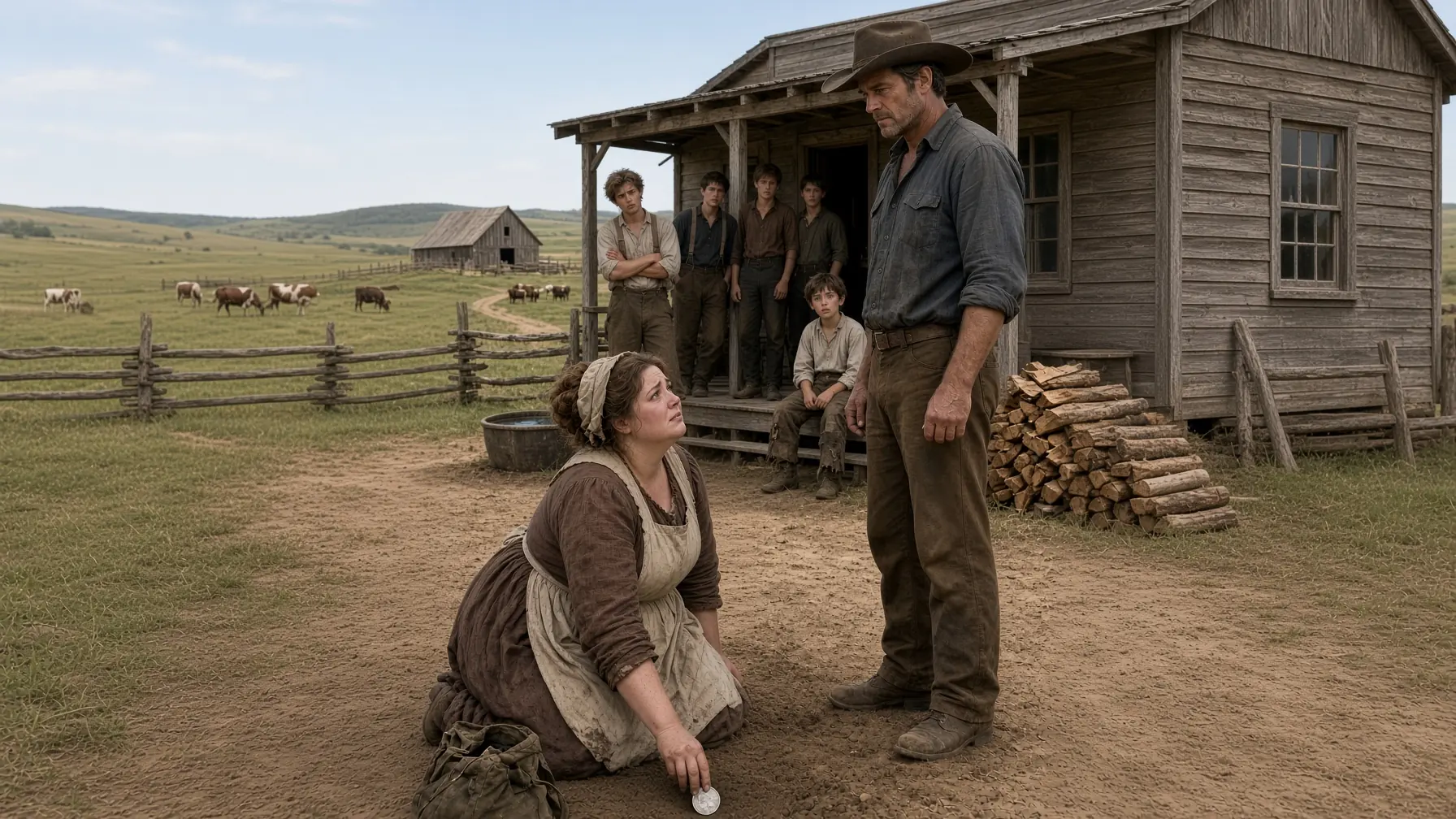
Maggie Sullivan dropped to her knees in the dirt of the Hartley ranch and pushed her last silver dollar beneath the soil.
Six boys watched from the porch.
Their father stood in the yard ten feet away, broad-shouldered and gray at the temples, saying nothing.
Maggie pressed the dirt flat with her palm.
“I don’t want your bed,” she said.
Her voice nearly failed, but she forced the rest out.
“I don’t need charity either. I need one corner indoors. Just one. Somewhere nobody can drag me out before sunrise.”
The oldest boy stared at her.
Another looked away.
A sixteen-year-old with anger written across his face gave a bitter laugh.
Gideon Hartley did not.
He looked from Maggie to the place where she had buried the coin.
“Why’d you put your money in my yard?”
“So you’ll know I had something when I came.”
“And why not give it to me?”
“Because it’s all I’ve got.”
Maggie stood slowly.
Her knees had stopped cooperating half a mile before she reached the house, but she refused to let seven strangers watch her crawl.
She was thirty years old, broad-bodied, strong through the shoulders, with auburn hair escaping a worn braid and a canvas bag that contained everything left of her life.
One spare dress.
A needle case.
A Bible belonging to her dead husband.
And nothing else worth selling.
Gideon studied her face.
“What can you do?”
“Cook.”
One of the boys snorted.
Maggie looked at him.
“For how many?”
“Depends.”
“I fed thirty cattle hands on a trail drive for six years.”
That silenced him.
“I mend clothes. Preserve food. Keep books well enough to know when somebody’s cheating me. I can stretch flour, save spoiled meat, treat a burn, set a table, and keep six growing boys from eating a pantry bare in three days.”
The boy who had laughed almost smiled.
Almost.
Gideon nodded toward the road.
“Where’d you come from?”
“The Danner ranch.”
“They fire you?”
“Yes.”
“Why?”
Maggie could have lied.
She had collected useful lies the way other women collected ribbons.
My mother became ill.
The work dried up.
We disagreed.
But she looked at those boys, at the youngest one sitting on the porch step hugging his knees, and found herself too tired to begin a new life with dishonesty.
“Mrs. Danner said a woman my size ate more than she earned.”
No one moved.
“She said I was a poor advertisement for her kitchen.”
The youngest boy frowned.
“That’s mean.”
His oldest brother immediately said, “Benji.”
“What? It is.”
Maggie looked at him.
“Yes, sweetheart. It was.”
“How long are you asking to stay?” Gideon said.
“A week.”
“A week?”
“You work me hard. If I earn the food, we talk again. If I don’t, I leave without complaint.”
The angry sixteen-year-old stepped off the porch.
“Pa, you can’t seriously—”
“Peter.”
“She’ll eat through the winter stores.”
Gideon’s voice hardened.
“That’s enough.”
Peter went quiet, but resentment remained in his eyes.
Maggie had seen that kind of anger before.
It did not frighten her.
Cruel people enjoyed causing pain.
Hurt people sometimes threw pain because they had nowhere else to put it.
Peter looked like the second kind.
Maggie turned back to Gideon.
“I heard about your family in town.”
His face changed.
“What did you hear?”
“That your wife died last year.”
Every boy became still.
Maggie regretted the sentence before it finished leaving her mouth.
“I’m sorry. That was poorly said.”
The fourteen-year-old standing in the doorway had gone pale.
Maggie noticed immediately.
Gideon noticed her noticing him.
“They said the Hartley house had gone quiet,” Maggie continued softly. “I came anyway.”
“Why?”
“Because quiet houses still need breakfast.”
Something moved behind Gideon Hartley’s tired eyes.
Not affection.
Not trust.
But maybe recognition.
He turned toward the oldest boy.
“Elliot.”
“Yes, sir?”
“Show Mrs. Sullivan the pantry room.”
Peter exploded.
“You’re letting her stay?”
“One week.”
“Pa—”
“One.”
Gideon looked back at Maggie.
“The room’s small. Cot’s bad. Window’s stuck.”
“Does the door shut?”
“Yes.”
“Does it latch from inside?”
He hesitated.
Then nodded.
“It does.”
Maggie looked down quickly.
That single detail came closer to breaking her than anything else had.
A door that latched.
A room nobody could enter without her permission.
She had not slept behind one in eighteen months.
“Thank you.”
“Don’t thank me yet.”
Gideon’s expression became hard again.
“My wife Rebecca died fourteen months ago. Since then this house has been broken in a way I don’t know how to repair. Elliot’s twenty-two and thinks he has to hold all five brothers together with his bare hands. Jesse jokes so nobody hears him grieving. Wade stopped speaking after the funeral. Peter’s mad at God, me, himself, and anybody standing close enough. Micah believes something about his mother’s death he won’t tell me. Benji is starting to forget her.”
He looked toward the house.
“You said you cook and mend.”
“Yes.”
“Do that.”
“I will.”
“But don’t come in here planning to save anybody.”
Maggie met his eyes.
“I don’t save people, Mr. Hartley.”
“What do you do?”
“I make breakfast.”
For the first time, his mouth almost smiled.
“Then make breakfast.”
The pantry room smelled of flour, mice, and old grease.
Maggie loved it instantly.
Not because it was beautiful.
Because it was safe.
She set down her canvas bag, tested the latch twice, then went into the kitchen.
There she understood what grief had done to the Hartleys.
The kitchen was not filthy from laziness.
It had simply stopped being touched properly.
A blue ceramic cup rested high on a shelf.
A rolling pin still held the faint imprint of smaller hands.
An apron hung behind the door beneath fourteen months of dust.
Maggie did not touch any of those things.
They belonged to Rebecca Hartley.
Maggie had learned something important after burying her own husband.
Grieving people sometimes needed objects left exactly where the dead had placed them.
So she cleaned around the memories.
She scrubbed the stove.
Sorted the flour.
Trimmed the good pieces from a smoked ham.
Soaked beans.
Mixed biscuit dough.
By sunset, the kitchen smelled alive.
Peter found her there.
He stood in the doorway.
“You moved Ma’s things.”
Maggie kept stirring.
“No.”
“The kitchen looks different.”
“I removed dirt.”
“You touched her stuff.”
Maggie turned.
“Blue cup is where she left it. Rolling pin is in the same drawer. Apron’s still behind the door.”
Peter blinked.
“How do you know they were hers?”
“The cup is the prettiest thing in the room, and nobody’s using it.”
She nodded toward the drawer.
“The rolling pin is worn by hands smaller than any man in this house.”
“And the apron?”
Maggie looked at him.
“Because all six of you walk around it.”
Peter’s anger faltered.
She turned back toward the beans.
“I can read a kitchen.”
“You don’t know my mother.”
“No.”
“You don’t know anything about her.”
“No.”
His voice cracked.
“I hate you being here.”
“I know.”
“We don’t need you.”
“I know that too.”
Peter stood there breathing hard.
“Then why won’t you say something mean back?”
Maggie stopped stirring.
She looked at him properly.
Because you’ve already got enough mean things inside you, she thought.
Instead she said:
“Molasses?”
“What?”
“In your beans.”
He stared.
“With or without?”
Peter swallowed.
“Without.”
“Your mother make them that way?”
His eyes filled.
“Yes.”
“Then without it is.”
He left quickly.
Maggie returned to the pot.
She did not smile.
Trust earned too easily usually broke just as easily.
Supper was quiet at first.
Seven men sat around the table watching Maggie’s food as though it might disappear.
She placed runny eggs beside ten-year-old Benji.
He looked up.
“How did you know?”
Maggie glanced toward Elliot without turning her head.
“A bird told me.”
Benji grinned.
The first crack in the house came five minutes later.
Jesse bit into a biscuit and stared at it.
“This is criminal.”
Everyone looked at him.
Maggie raised an eyebrow.
“What is?”
“These biscuits.”
He pointed accusingly toward Elliot.
“You told me bread was supposed to taste like rocks.”
“I never said that.”
“You let me believe it.”
“You did the cooking.”
“That only strengthens my case. I’ve been poisoning this family.”
Benji laughed.
The sound escaped before he could stop it.
His hand flew over his mouth.
Everyone went still.
Benji’s frightened eyes moved toward Gideon.
For fourteen months, the boy had apparently learned that laughter felt disloyal inside a house where his mother was dead.
Gideon stared at him.
Then said quietly:
“It’s all right.”
Benji lowered his hand.
“Your mother laughed louder than anybody.”
Something passed through the room.
Maggie looked down and refilled the biscuits.
That was all.
One plate at a time.
One ordinary thing after another.
That was how houses came back.
Micah barely ate.
After supper, Maggie found him washing his plate.
“You didn’t care for the ham?”
“It was good.”
“You just weren’t hungry.”
The fourteen-year-old shrugged.
“That happens.”
She kept her eyes on the dishwater.
“When my husband died, I stopped eating properly for months.”
Micah became still.
“Why?”
“Felt wrong.”
“What did?”
“Living.”
He looked at her.
Maggie continued washing.
“I’d eat a biscuit and think Thomas couldn’t. I’d sleep and think Thomas couldn’t. Every ordinary thing felt like something I was stealing.”
Micah whispered:
“Does that stop?”
“Mostly.”
“The guilt?”
Maggie put down the plate.
“What guilt?”
His face folded.
“I was supposed to fetch Dr. Ames.”
She waited.
“When Ma got bad.”
His breathing shortened.
“Pa sent me.”
“I took the ridge trail.”
“I got lost.”
“I was gone four hours.”
“And when I got back—”
He could not finish.
Maggie dried her hands.
“You think your mother died because you took the wrong road.”
Micah started crying.
Silently.
Ashamed of every tear.
Maggie crouched beside him but did not touch him.
Not yet.
“You were fourteen.”
“I should’ve been faster.”
“You were a child riding scared through country you couldn’t see.”
“She needed the doctor.”
“Then we ask the doctor.”
He stared at her.
“What?”
“You want to know whether four hours mattered?”
His chin trembled.
“Yes.”
“Then we find out.”
“What if it was my fault?”
Maggie’s voice became firm.
“Then we deal with truth.”
She leaned closer.
“But grief has been trying you without evidence for fourteen months, and I don’t trust any court where grief is both prosecutor and judge.”
Micah almost laughed through his tears.
Almost.
“I’ll ask Dr. Ames.”
“You promise?”
“I don’t make promises lightly.”
She held out her hand.
“But this one I make.”
Micah looked at it.
Then took it.
That night Maggie heard Benji crying.
She found Elliot sitting beside his younger brother’s bed, exhausted beyond words.
Twenty-two years old.
Trying to become a mother, father, brother, bookkeeper, foreman, and grief counselor because nobody had told him he was allowed to remain a son.
“I’ve got him,” Maggie whispered.
Elliot looked up.
“I’m fine.”
“You look dead.”
“I’m fine.”
“Wonderful. Be fine tomorrow.”
She nodded toward the hall.
“Go sleep.”
He hesitated.
Then surrendered.
When he reached the door he whispered:
“He’s forgetting her voice.”
After Elliot left, Benji rolled toward Maggie.
“I can’t hear Ma sing anymore.”
Maggie sat beside him.
“What if I forget her face too?”
“You won’t forget all of her.”
“I already am.”
“No.”
She brushed his hair away from his forehead.
“You like runny eggs?”
He nodded.
“Your mother did too.”
His eyes widened.
“She did?”
“Elliot told me.”
Maggie smiled.
“There you are.”
“Where?”
“Part of her.”
“In eggs?”
“In you.”
Benji considered this with the seriousness only children could bring to strange truths.
“So even if I forget her voice…”
“She still left things behind.”
“In us?”
“Yes.”
He closed his eyes.
“Will you make the eggs tomorrow?”
“Every morning you want them.”
His eyes opened.
“But you’re only here a week.”
Maggie’s throat tightened.
“We’ll worry about tomorrow when tomorrow gets here.”
“I don’t like that answer.”
“Smart boy.”
He eventually fell asleep.
Maggie remained beside him.
She had asked for a corner.
Somewhere between Peter’s beans, Micah’s guilt, Benji’s eggs, and Elliot surrendering the midnight watch, the request had changed.
She no longer wanted a room.
She wanted these people.
And that frightened her more than hunger ever had.
By the end of the week, Gideon did not let her leave.
Neither did the boys.
He offered wages.
She accepted.
Benji accepted with far more enthusiasm.
The pantry room became hers.
The house changed slowly.
Wade, the silent eighteen-year-old, carved small birds from pine and left them where Maggie would find them.
She never embarrassed him with gratitude.
She simply requested another.
Two weeks later, while she kneaded bread, Wade entered for water.
He stared at the dough.
Then said:
“You forgot salt.”
Maggie’s hands stopped.
It was the first thing he had spoken since his mother’s funeral.
She did not turn.
Did not cry.
Did not call Gideon.
She simply said:
“Good catch.”
Then:
“Pass me the tin.”
A trembling hand placed the salt beside her.
At supper that night Jesse criticized her biscuits as usual.
Wade muttered:
“They’re still better than yours.”
The table froze.
Then Jesse shouted loud enough to shake the windows.
“He speaks!”
Wade almost smiled.
Gideon pressed his knuckles against his mouth.
Maggie kept eating.
Miracles frightened easily when everybody stared at them.
Micah’s promise came due when Benji caught a summer fever.
Dr. Franklin Ames rode out and declared it nothing worse than a seasonal chill.
Before he left, Maggie pulled him aside.
She told him about Rebecca’s death.
The four hours.
The lost boy.
Dr. Ames went pale.
“He believes that?”
“For fourteen months.”
The doctor closed his bag.
“Get him.”
Micah came downstairs terrified.
Dr. Ames sat across from him.
“Your mother was dying from an illness I could not stop.”
Micah’s face emptied.
“If you’d found me four hours sooner, she would still have died.”
“What if—”
“No.”
The doctor leaned forward.
“No ‘what if.’ You hear me?”
Micah stared.
“Your mother asked about you before she died.”
His lips parted.
“She kept saying, ‘Is Micah back? Is he safe?’”
The boy began shaking.
“She wasn’t angry?”
“She was terrified you’d hurt yourself riding too hard.”
Micah folded over the table.
“It wasn’t me.”
Maggie finally gathered him into her arms.
“No.”
“It wasn’t me.”
“Never.”
He cried until there was nothing left.
Across the room Gideon stood with tears running openly down his face.
That night on the porch, he took Maggie’s hand for the first time.
He did not call it love.
Neither did she.
Some things were too important to name before they were ready.
Trouble arrived wearing a banker’s coat.
Edwin Carroway owned the largest bank in the county.
He also held the mortgage on the Hartley ranch.
His wife Lenora considered herself guardian of local morality.
She had already visited Maggie twice.
Both times she managed to mention Maggie’s body, lack of family, suspicious presence in a widower’s home, and the unfortunate things respectable people might say.
Gideon threw her off the property the second time.
Edwin came next.
He remained in his buggy.
Men like Edwin rarely got down when they intended to take something.
“Your note comes due September first,” he told Gideon.
“Fourteen hundred dollars.”
Maggie watched Gideon’s shoulders change.
Just slightly.
Enough.
Edwin smiled.
“You don’t have it.”
“I’ll have it.”
“Cattle market is weak.”
“I said I’ll have it.”
Edwin looked toward the creek.
The Hartley property controlled one of the best stretches of reliable water in that part of the valley.
“I could take the creek quarter against the balance.”
Gideon stepped closer.
“Without that water, my cattle die in a dry year.”
“Then perhaps you should have considered that before borrowing.”
“My wife was sick.”
“Business doesn’t become charity because life is unfortunate.”
Maggie saw the truth.
Edwin did not merely want repayment.
He wanted the water.
Take the Hartley creek, and he could pressure every smaller ranch below it.
Gideon refused.
Edwin left with a warning.
September.
Full payment.
Or the creek.
After the buggy disappeared, Maggie turned to Gideon.
“How much do you have?”
“It’s not your trouble.”
She stared.
He corrected himself.
“Four hundred, maybe.”
“Then we need a thousand.”
“Maggie—”
“You asked me to stay.”
He went quiet.
“You don’t get to tell a woman she belongs in the house and then put her outside the trouble.”
Gideon looked at her.
She pointed toward the kitchen.
“Books.”
“What?”
“Bring me every ledger.”
That night the Hartley family changed again.
They stopped being seven grieving men and the woman who fed them.
They became a team.
Maggie found forty dollars a year being wasted on overpriced store credit.
A hay field being loaned for free.
Old preserving recipes Rebecca had once used to earn cash.
Maggie baked pies.
Peter tanned hides using skills his mother had taught him.
Wade carved birds.
Jesse hauled goods into town.
Elliot tightened the ranch accounts.
Gideon and the older boys worked cattle.
Even Benji kept the silver coin Maggie had buried on her first day after digging it up with his own hands.
Maggie found him at the gate one morning, kneeling in the dirt.
His fingers were black.
He held up the coin.
“I found it.”
Her heart stopped.
“Benji.”
“Now you have money.”
He pushed it toward her.
“You can’t leave because you’re poor anymore.”
She knelt.
“No.”
His face fell.
She closed his fingers around the silver.
“You keep it.”
“But—”
“You dug it up.”
“That’s the law of buried things.”
He looked suspicious.
“There’s a law?”
“There is now.”
He almost smiled.
Then Maggie’s voice softened.
“Listen to me. A woman should never stay somewhere because she’s too poor to leave.”
Benji stared.
“She stays because she wants to wake up there.”
“Do you?”
Maggie’s throat closed.
She touched his cheek.
“I can’t imagine a morning where I don’t make your terrible eggs.”
He threw both arms around her.
Maggie sank into the dirt for the second time since arriving at the Hartley ranch.
The first time she had begged for a corner.
This time a child held her as though he was afraid the earth might take her away.
Gideon watched from the barn.
That evening he said:
“Stay.”
“I already did.”
“No.”
He looked embarrassed.
“Stay longer than a wage.”
Maggie’s heart began beating harder.
“I’m not asking the whole question yet.”
“What question?”
He shook his head.
“When I ask, you’ll know.”
Lenora Carroway made the situation uglier.
At church, she stood before the congregation and questioned whether an unmarried woman had any business living under the roof of a widower and six boys.
Maggie sat very still.
Gideon started to rise.
She stopped him.
Then Elliot stood instead.
Twenty-two.
Tired.
Straight-backed.
“My mother would’ve wanted us fed,” he said.
The church went silent.
“She would’ve wanted Benji laughing.”
“She would’ve wanted Micah to know her death wasn’t his fault.”
“She would’ve wanted Wade talking again.”
He looked directly at Lenora.
“And in fourteen months after my mother died, you didn’t bring us one loaf of bread.”
A woman in the back began clapping.
Then another.
Not everyone.
Enough.
Maggie should have felt victorious.
Instead, that night she packed her bag.
Lenora had been cruel.
But beneath the cruelty lived one danger Maggie could not ignore.
People could use her presence against Gideon.
Against the boys.
Against the ranch.
She decided she would leave before she became another weapon in Edwin Carroway’s hands.
She almost succeeded.
Then Edwin himself stopped her wagon on the county road.
He held out two hundred dollars.
“Take it.”
Maggie stared at the money.
“Leave tonight.”
“Why?”
“You’re the reason Gideon keeps fighting.”
There it was.
The truth.
Edwin continued.
“Before you arrived, that house was finished.”
“Now you’ve got them baking and selling and searching books and believing they can somehow beat arithmetic.”
Maggie slowly smiled.
Edwin frowned.
“What?”
“You made a mistake.”
“I rarely do.”
“You told me what I’m worth.”
He looked confused.
“You’re offering two hundred dollars just to make me disappear.”
She gathered the reins.
“That means my staying frightens you.”
His smile disappeared.
“You’ll regret this.”
“I’ve regretted plenty.”
Maggie drove around him.
“This won’t be one of them.”
She returned home.
The bag remained unpacked.
What she found there stopped her in the hallway.
Her pantry-room door was gone.
For one terrible second, Maggie thought Gideon had changed his mind.
Then she saw what was behind it.
A real room.
Fresh pine walls.
A proper bed.
A clean window that opened.
Blue curtains.
A small washstand.
A shelf for her Bible.
Six handmade details betrayed six boys.
Wade had carved two meadowlarks into the bedframe.
Peter had tanned the leather pull on the trunk.
Jesse had attempted to paint one wall and left a visible streak near the floor.
Benji stood inside waiting, unable to contain himself.
“You were supposed to be gone longer.”
Maggie covered her mouth.
Gideon appeared behind her.
“You kept saying the pantry was enough.”
“It was.”
“It wasn’t.”
“I had a door.”
“You deserved a room.”
She turned toward him.
Something inside her finally broke.
“What if I leave someday?”
Gideon looked at her carefully.
“The lock works from your side.”
“What?”
“The door.”
He nodded toward it.
“You lock us out.”
“We don’t lock you in.”
Maggie started crying.
Not quietly.
Not politely.
The boys pretended not to notice and failed badly.
Gideon stepped toward her but stopped short.
Waiting.
Maggie crossed the remaining distance herself.
She put her forehead against his chest.
His arms came around her.
That night the pantry room disappeared forever.
Not because Maggie had been pushed out.
Because the Hartleys had built her a place.
Summer hardened into August.
They still did not have fourteen hundred dollars.
Worse, Edwin began squeezing the cattle market.
A buyer who had dealt honestly with Gideon for years suddenly offered half value.
The buyer owed Edwin money.
Everyone understood the message.
Edwin controlled credit.
Credit controlled buyers.
Buyers controlled price.
Gideon returned from the railhead with less than half what he expected.
“I can’t beat him,” he said.
Maggie opened the strongbox containing Rebecca’s old loan documents.
“You don’t beat a banker with cattle.”
“How do you beat him?”
“Paper.”
She spent three nights sorting receipts.
But before she found what she needed, the sky turned orange.
A grass fire was running toward the valley.
Gideon and the four oldest boys rode to move the herd across water.
Maggie remained with Micah and Benji.
“Listen to me.”
Both boys were frightened.
“We do exactly what I say and we’re eating breakfast here tomorrow.”
Something in her certainty steadied them.
She filled barrels.
Wet blankets.
Moved flour, preserved meat, Rebecca’s Bible, and the strongbox.
The documents went into oilcloth and then beneath soil in the plowed garden.
“Earth doesn’t burn,” she told Micah.
Neighbors arrived.
Men with shovels.
Wet sacks.
No plan.
For one second they looked around the yard for someone to lead them.
The only person there was Maggie.
“Anybody have a better plan?”
Nobody answered.
“Then stop staring at me.”
She pointed toward the draw.
“Three-foot firebreak along the ridge.”
“Wet every roof.”
“Backburn the grass between the break and the draw.”
“If the main fire reaches dirt with nothing left to eat, it stops.”
Men moved.
Nobody questioned whether a heavy woman should command a fire line.
Flames did not care about prejudice.
Neither did Maggie.
Then Edwin Carroway arrived.
Still in his buggy.
Maggie ran toward him.
“You control the downstream headgate.”
“I do.”
“Open it.”
Edwin smiled.
“Why?”
“Back the creek into the draw. Flood it and the fire dies low.”
“That bottomland is mine.”
“Half this valley burns if you don’t.”
He looked toward the flames.
Then at Maggie.
“Tell Gideon I’ll open it if he signs over the creek quarter.”
The men nearest them stopped digging.
Maggie stared.
“What?”
“Business is business.”
“And if he refuses?”
Edwin shrugged.
“Then perhaps the house burns.”
Old rancher Clive Norton dropped his shovel.
Everyone looked at him.
“You’d let children lose their home for that creek?”
Edwin’s face changed.
“I said I’m willing to negotiate.”
“You said let it burn.”
Clive walked toward his wagon.
Returned carrying chain.
“I helped build that headgate thirty years ago.”
He looked at the other ranchers.
“Two riders with me.”
Edwin shouted:
“You touch that gate and I’ll—”
“You’ll what?”
Clive turned.
“Call every note in the valley?”
Men began looking at Edwin differently.
Clive’s voice lowered.
“Maybe tomorrow we all walk into your bank together and see how much money you actually have.”
For the first time, fear entered Edwin’s eyes.
Two riders left for the gate.
Then Micah screamed from the roof.
“The barn!”
A spark had found the hayloft.
Benji grabbed a bucket.
Before Maggie could stop him, he ran inside.
The loft ignited.
“Benji!”
Maggie dropped everything.
People had spent her entire life calling her slow.
Too large.
Too heavy.
Built wrong for hard work.
She crossed that yard faster than any of them.
Smoke filled the barn.
She heard coughing.
Found Benji near the stall.
Wrapped one arm around him.
Carried him through the doorway just as burning hay collapsed behind them.
They hit the ground together.
Benji coughed against her chest.
“I couldn’t save the barn.”
Maggie gripped him.
“The barn is lumber.”
She held his face between her blistering hands.
“You are not.”
Then water came rushing into the low draw.
Clive’s men had pulled the gate.
The creek rose.
Fire met flood.
Steam covered the bottomland.
The barn burned.
The house survived.
So did every home downwind.
Gideon returned before sunrise.
He expected ashes.
Instead he found a wet roof.
Exhausted neighbors.
His cattle alive beyond the creek.
And Maggie sitting on the porch, black with smoke, hands blistered, Benji asleep against her shoulder.
“What happened?”
Clive Norton removed his hat.
“Your woman happened.”
Maggie looked up sharply.
Clive continued.
“Ran the fire like a trail boss.”
“Saved your boy from the barn.”
“Saved every spread behind yours.”
He turned toward the gathered neighbors.
“And Edwin Carroway offered to let this place burn unless Gideon signed away his water.”
Nobody looked at Edwin, because Edwin had already gone.
The valley had heard enough.
Gideon sat beside Maggie.
He took one burned hand carefully.
“You could have died.”
“So could Benji.”
“You went inside anyway.”
Maggie leaned against him.
“You would have too.”
He was quiet.
Then:
“When your hands heal…”
“What?”
“I’m asking the question.”
Despite the smoke and exhaustion, Maggie smiled.
“The whole one?”
“The whole one.”
“I’ll try to survive until then.”
The day after the fire, Clive Norton walked into Edwin Carroway’s bank and withdrew every dollar he owned.
Three other ranchers followed.
Then six.
Then twelve.
People who had been frightened of Edwin for years discovered fear changed direction when enough people stood together.
But the stronger blow came from Rebecca Hartley’s strongbox.
Maggie sat at the kitchen table with bandaged hands while Elliot turned pages for her.
Loan note.
Fourteen hundred dollars.
Ten percent interest.
Then receipts.
Year after year.
Maggie added them.
Once.
Again.
A third time.
Then she became very still.
“Gideon.”
He looked up.
“Bring me the original note.”
He did.
She placed it beside the receipts.
“Ten percent.”
“Yes.”
She pointed.
“He’s been collecting twelve.”
Elliot leaned closer.
“What?”
“Every year.”
Maggie looked at Gideon.
“You’ve overpaid him almost three hundred dollars.”
Gideon stared.
“That can’t be right.”
“It is.”
She tapped the receipts.
“He wrote ten on the contract.”
“Collected twelve at the window.”
“And gave you signed receipts proving it.”
Elliot whispered:
“That’s fraud.”
Maggie smiled without humor.
“That’s a banker who assumed grieving people don’t check arithmetic.”
She closed the ledger.
“We don’t fight Edwin Carroway with fists.”
“What do we fight him with?” Gideon asked.
Maggie pushed the receipts toward him.
“His handwriting.”
They took everything to the territorial authorities.
Clive brought his records.
So did two other ranchers.
Same pattern.
Inflated interest.
Manipulated payments.
Pressure on water rights.
Edwin’s power did not collapse in one dramatic gunfight.
It collapsed the way dishonest systems usually did.
Receipt by receipt.
Witness by witness.
Account by account.
Faced with investigation, angry depositors, and multiple claims from borrowers, Edwin settled the legitimate Hartley balance after the overcharges were credited back.
The family combined its cattle money, hides, preserves, pies, savings, and corrected account.
The ranch was paid.
The creek remained Hartley land.
Edwin and Lenora left before winter.
Nobody organized a farewell.
One Sunday, after Maggie’s hands healed, Gideon told her to come into the parlor.
All six boys were standing there.
Clean shirts.
Suspicious smiles.
Benji bouncing on his heels.
Maggie stopped.
“What did you boys break?”
“Nothing,” Jesse said.
“That makes me more nervous.”
Gideon stepped forward.
He wore his good coat.
Maggie looked at him.
“Oh.”
“Yes.”
“Oh.”
“I told you I’d ask properly.”
Peter muttered:
“Pa, if you take any longer, Benji is going to explode.”
“I am not.”
“You are vibrating.”
Gideon ignored them.
He took Maggie’s hands.
“The first day you came here, you knelt in my yard and asked for a corner.”
Her eyes filled immediately.
“I gave you a pantry room and thought I had done something generous.”
He shook his head.
“I didn’t understand that before your first week was over, you had already given this house more than it had given anyone in fourteen months.”
Maggie tried to speak.
He continued.
“You made Benji laugh.”
“Gave Micah back the truth.”
“Waited for Wade’s voice instead of dragging it out of him.”
“Found the love hiding inside Peter’s anger.”
“Made Jesse quiet enough to grieve.”
“And convinced Elliot he didn’t have to carry five brothers and a father by himself.”
Elliot looked away.
Gideon’s grip tightened.
“And you gave me my sons back.”
Maggie cried openly now.
No rule.
No shame.
Not in this house.
“I don’t want you sleeping in a room inside my home.”
Her heart stopped.
Gideon smiled.
“I want it to be your home.”
He drew a breath.
“I want these boys to be yours in every way they can be without taking anything away from Rebecca.”
“And I want to be the man who gets to sit beside you when we’re both gray and complain that Jesse still talks too much.”
Jesse nodded.
“Reasonable concern.”
“Quiet.”
Then Gideon looked only at Maggie.
“Will you marry me?”
Benji whispered:
“Say yes.”
Peter elbowed him.
Maggie laughed through her tears.
“I stopped looking for a place to sleep somewhere around the second week.”
She pressed Gideon’s hand to her chest.
“By then I’d found a family.”
She looked at the boys.
“I just didn’t dare call it mine.”
Then back at Gideon.
“Yes.”
Benji screamed.
Jesse grabbed Wade.
Peter pretended the fireplace urgently required his attention.
Micah cried without shame.
Elliot sat down because his knees suddenly stopped working.
Gideon kissed Maggie in front of all six of them.
The house had survived grief.
Debt.
Cruelty.
Fire.
It survived six boys cheering too.
They married in the same church where Lenora Carroway had tried to humiliate Maggie.
The pews were full.
Clive Norton came.
Dr. Ames came.
Neighbors who had once whispered came too.
Some because they loved Maggie.
Some because they were ashamed.
Some because people occasionally deserved the chance to become better than their worst moment.
Maggie wore blue.
Near the altar stood Rebecca Hartley’s blue ceramic cup filled with wildflowers.
Gideon had questioned it.
“You sure?”
Maggie had nodded.
“I’m not replacing her.”
She touched the cup gently.
“Those boys had a mother.”
“They still do.”
“She loved them before I ever knew their names.”
“I’m not the second Rebecca.”
“I’m Maggie.”
She smiled.
“And families can make room for more than one love.”
Years passed.
Elliot eventually married a schoolteacher and learned to sleep entire nights.
Jesse kept joking, but his laughter no longer hid anything.
Wade’s voice returned one word at a time, and his paired wooden meadowlarks became known throughout the county.
Peter turned his mother’s tanning lessons into a leather business.
Micah grew into a steady young man who never again confused grief with guilt.
And Benji kept Maggie’s silver dollar.
He carried it into adulthood.
Whenever anyone asked about the worn coin, he said:
“My mother tried to pay for one week with us.”
Then he would smile.
“We never collected.”
All six eventually called her Mother.
Maggie never requested it.
The first was Peter.
Of course it was Peter.
He was twenty and angry over something involving a horse when he shouted from the barn:
“Ma, where’d you put the liniment?”
The whole yard stopped.
Peter froze.
Maggie looked toward him.
Neither said anything.
She simply pointed toward the medicine shelf.
“Top box.”
He nodded.
“Thanks.”
From that day forward, the word belonged to them.
Many years later, Maggie and Gideon sat on the porch together.
Their hair was gray.
Children and grandchildren filled the house behind them.
Someone was laughing in the kitchen.
Someone else had burned biscuits.
Gideon held Maggie’s hand.
“You ever think how close you came to leaving?”
“All the time.”
“You had your bag packed.”
“Yes.”
“Another few hours…”
“I would’ve been gone.”
Gideon shook his head.
“I nearly let a whole county’s opinion cost me the best thing that ever came up my road.”
Maggie rested her head against his shoulder.
“But you didn’t.”
“No.”
“And I didn’t go.”
“No.”
“So don’t live inside almost.”
She looked across the creek they had nearly lost.
“A person can’t live in almost, Gideon.”
“Only in what is.”
He smiled.
“And what is?”
Maggie listened to the house.
To grown sons arguing.
Grandchildren running.
Dishes clattering.
A voice shouting that somebody had eaten the last biscuit.
Then she answered.
“This.”
Gideon squeezed her hand.
“The house never felt empty again after you came.”
Maggie smiled.
“I didn’t fill it.”
“You’ll never take credit for anything, will you?”
“No.”
“Then who filled it?”
“All of us.”
She looked toward the doorway.
“You gave me a room.”
“The boys gave me reasons to stay.”
“I gave them breakfast.”
“They gave me a family.”
“That’s how homes work.”
Gideon was quiet.
Then Maggie added:
“You make room.”
“That’s all.”
“You take the good cup off the shelf.”
“You build a door that locks from the inside.”
“You let a tired boy stop being a father to his brothers for one breakfast.”
“You tell a guilty child the truth.”
“You wait for a silent boy to speak.”
“You let an angry one love sideways until he learns another way.”
“And when somebody comes up your road believing there isn’t one place left in the world that wants them…”
She looked at Gideon.
“You make room.”
The silver coin Maggie had buried decades earlier eventually passed from Benji to his oldest daughter.
The girl once asked why her grandmother had buried money instead of spending it.
Benji told her:
“Because she thought that dollar was everything she had left.”
“Was it?”
He laughed.
“No.”
“She just didn’t know us yet.”
And that became the story people remembered about the Hartley ranch.
Not that it ran the most cattle.
It did not.
Not that Gideon Hartley became wealthy.
He did well, but wealth was never what saved him.
They remembered the summer a penniless widow came walking up the road carrying a canvas bag.
The summer she knelt in the dirt and asked for one corner where nobody could throw her out before sunrise.
They remembered the six grieving boys who watched her like a stranger.
The father who warned her not to try saving them.
The banker who nearly stole their water.
The fire that nearly took the house.
The woman everyone had judged too heavy and too ordinary who ran into a burning barn while stronger men stood outside.
But those who knew the story best always said the fire was not the important part.
Neither was the debt.
Neither was the wedding.
The important part happened much earlier.
A small room.
A cheap cot.
A door that latched from Maggie’s side.
A plate of runny eggs set before a grieving child.
That was where the Hartley family began becoming a family again.
And Maggie Sullivan, who had spent eighteen months walking from place to place convinced she was too much for every room she entered, lived the rest of her life in the one house where nobody ever asked her to become smaller before they made space for her.
She had arrived begging for a corner.
She stayed long enough to become the heart of the whole place.