Officer Ryan Mercer noticed the silver Jaguar before he noticed the woman driving it.
The car moved slowly through Hawthorne Ridge, a wealthy neighborhood outside Charlotte, North Carolina, where stone houses stood behind iron gates and security cameras watched from brick pillars.
The Jaguar was clean but not new.
Its driver obeyed the speed limit, used her turn signal, and stopped long enough at each intersection for the car to settle completely.
Ryan followed it for almost three minutes.
His patrol partner, Officer Miles Bennett, looked up from the report he had been reading on the computer mounted between them.
“What did she do?”
Ryan kept his eyes on the Jaguar.
“She slowed down when she saw us.”
“The limit is thirty-five.”
“She’s doing thirty-one.”
“That is not illegal.”
Ryan leaned forward slightly.
“Look at the way she keeps checking the mirror.”
“You’ve been following her through four turns.”
“People get nervous when they have something to hide.”
Miles looked through the windshield.
The driver appeared to be a Black woman in her late forties or early fifties. Her posture was straight. Both hands remained on the steering wheel.
There was no weaving.
No sudden acceleration.
No traffic violation.
“Maybe she is looking because a police cruiser is following her,” Miles said.
Ryan smiled.
“That is why we ask questions.”
Before Miles could respond, Ryan activated the emergency lights.
The Jaguar pulled to the curb immediately.
Ryan opened his door.
Miles remained seated for a moment.
He had worked with Ryan for six months.
In that time, he had noticed a pattern.
Ryan rarely described people as drivers, residents, or pedestrians.
He called them types.
Drug type.
Gang type.
Welfare type.
Doesn’t-belong-here type.
When Miles challenged the language, Ryan usually laughed and said experience had taught him to recognize trouble before paperwork could confirm it.
That morning, Miles had already completed eleven years in law enforcement.
He knew the difference between experience and assumption.
He also knew how easy it was to remain quiet when another officer’s confidence filled the space where judgment should have been.
Miles activated his body camera and stepped from the cruiser.
The Jaguar’s window lowered.
The woman behind the wheel wore a cream blouse beneath a dark gray jacket. Her hair was pulled back from her face, and a pair of reading glasses rested on the passenger seat beside a thick leather folder.
“Good morning,” she said.
Ryan stopped beside her window.
“Nice car.”
“Thank you.”
“This belong to you?”
The woman looked at him for one second longer than expected.
“Yes.”
Ryan glanced across the leather interior.
“You live around here?”
“No.”
“What are you doing in the neighborhood?”
“Driving to work.”
“Through here?”
“It is a public road.”
Ryan’s expression tightened.
“I did not ask whether the road was public.”
“No,” she said calmly. “You asked why I was using it.”
Miles stopped several feet behind Ryan.
The woman did not appear nervous.
She appeared attentive.
There was a difference.
Ryan rested one hand on the edge of the open window.
“Do you know why I stopped you?”
“No.”
“You were driving unusually slowly.”
“The posted limit is thirty-five. I was traveling at thirty-one.”
“That can be dangerous.”
“There were no vehicles behind me except yours.”
Ryan looked toward Miles as if inviting agreement.
Miles said nothing.
The woman noticed.
“Was I observed violating a traffic law?” she asked.
Ryan’s jaw moved slightly.
“I am still determining that.”
“After initiating the stop?”
“I’ll ask the questions.”
The phrase came quickly.
Practiced.
The woman’s hands remained on the steering wheel.
“All right.”
“Any weapons in the vehicle?”
“No.”
“Drugs?”
“No.”
“Illegal prescription medication?”
“No.”
“Large amounts of cash?”
“No.”
Ryan tilted his head.
“You hesitated.”
“I answered each question immediately.”
“People who are hiding something often try to sound calm.”
The woman studied his nameplate.
“Officer Mercer, what specifically about my driving suggested weapons, drugs, or cash?”
“You slowed down when you saw me.”
“I approached a turn.”
“You kept checking the mirror.”
“You were following me.”
Ryan stepped closer to the window.
“You seem defensive.”
“I am asking why I was stopped.”
“That attitude is exactly what turns a simple conversation into something more difficult.”
Miles felt his shoulders tighten.
Ryan had reversed the encounter in less than two minutes.
The woman’s questions were now the problem.
His lack of an answer was not.
“License and registration,” Ryan said.
The woman nodded toward her handbag.
“My license is inside the front pocket. May I reach for it?”
Ryan appeared irritated by the question.
“Slowly.”
She removed a dark leather wallet and handed him her license.
Then she opened the glove compartment and produced the registration and insurance card.
Ryan read the name aloud.
“Catherine Ellis.”
“Yes.”
The registration matched.
The insurance was current.
The Jaguar belonged to Catherine Marie Ellis.
Ryan read the address.
“You live downtown.”
“Yes.”
“Then why are you driving through Hawthorne Ridge?”
“You have asked me that already.”
“And you still have not answered.”
“I am traveling to the county courthouse. The main boulevard is closed for construction, and the navigation system redirected me.”
Ryan looked toward the leather folder on the passenger seat.
“What is in the folder?”
“Work.”
“What kind of work?”
“Legal documents.”
His expression sharpened.
“You an attorney?”
“I work in the legal system.”
“That is not what I asked.”
Catherine looked directly at him.
“It is the answer I am giving.”
Ryan turned toward Miles.
“You hear this?”
Miles glanced at the registration.
The name seemed familiar.
Catherine Ellis.
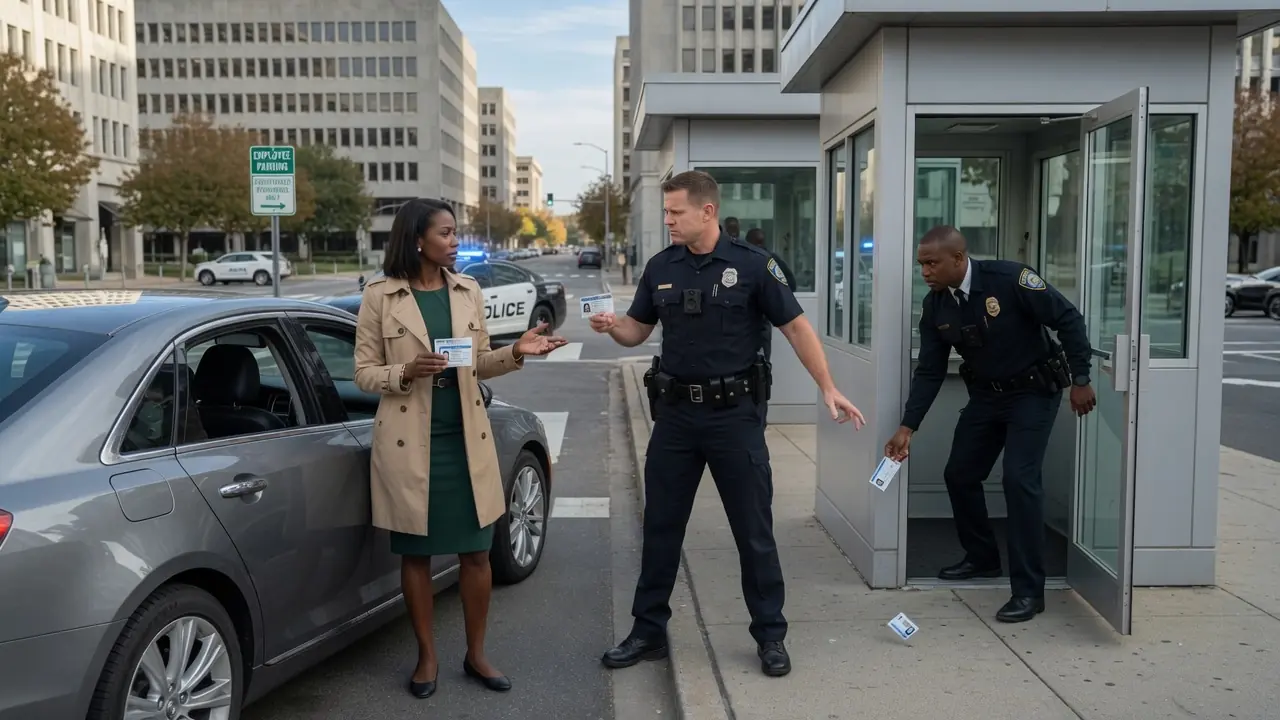
He had heard it during department training, though he could not immediately remember where.
Ryan walked back to the cruiser.
Miles followed.
“What are you writing?” Miles asked.
“Impeding traffic.”
“She was four miles under the limit.”
“She caused us to slow down.”
“We were following her.”
“She made an unnecessary turn.”
“It was a legal turn.”
Ryan opened the citation program.
“You want to handle the stop?”
“I want to know what law she violated.”
Ryan looked at him.
“You have been doing this long enough to understand discretion.”
“Discretion is not permission to invent a violation.”
The smile disappeared from Ryan’s face.
“You think I invented what I saw?”
“I think you decided she looked wrong in that car and started searching for a reason.”
For several seconds, neither man spoke.
The patrol computer hummed between them.
Ryan leaned closer.
“You should be careful accusing another officer of bias.”
“You should be careful creating evidence for a stop you cannot explain.”
Ryan turned back to the screen.
“I’m issuing a warning for slow driving.”
“Then issue it and release her.”
Ryan typed for another minute.
When he finished, he removed a metal flashlight from the driver’s door.
Miles looked at it.
“It is daylight.”
“I’m checking the rear plate.”
“You can see the plate from here.”
Ryan did not answer.
He walked toward the Jaguar.
Catherine watched him through the side mirror.
He passed her window without speaking and stopped behind the vehicle.
The Jaguar had two exterior cameras built into the rear body panel. A third camera near the trunk operated whenever movement occurred close to the vehicle.
Ryan did not notice them.
Miles stopped near the rear passenger side.
The taillights were intact.
Ryan crouched beside the left one.
He ran a finger along the red plastic.
Then he glanced toward Catherine’s mirror.
The angle prevented her from seeing his hand clearly.
Ryan lifted the flashlight.
There was a sharp crack.
A triangular piece of red plastic fell to the pavement.
Miles stared.
For one second, he could not believe what he had seen.
Ryan struck the lens again, widening the break.
Then he stood.
“What did you just do?” Miles asked.
Ryan picked up the broken piece.
“Discovered an equipment violation.”
“That light was intact.”
“You inspect it before the stop?”
“I saw it when we approached.”
“No, you didn’t.”
“I watched you hit it.”
Ryan stepped closer.
“You saw me test a damaged lens.”
“You broke it.”
“Lower your voice.”
“Why?”
“Because you are standing on a roadside challenging your partner in front of a driver.”
Miles looked toward Catherine.
She had turned in her seat and was watching both men.
Ryan’s voice dropped.
“We discuss this later.”
“There should not be anything to discuss.”
Ryan’s eyes hardened.
“You do not know what you saw.”
Miles’s body camera recorded every word.
Ryan returned to the driver’s window carrying the warning and the broken piece of plastic.
Catherine looked at his hand.
“What happened to my light?”
“You have a damaged taillight.”
“It was not damaged when you stopped me.”
“You sure about that?”
“Yes.”
Ryan held up the plastic.
“This was loose.”
“You struck it with your flashlight.”
His face remained blank.
“I inspected it.”
“I watched your arm move in the mirror.”
“You did not have a clear view.”
“The vehicle has exterior cameras.”
A small silence followed.
Ryan looked toward the rear of the Jaguar.
His eyes found one lens.
Then another.
Catherine noticed the change in his expression.
“The footage is stored remotely,” she said.
Ryan placed the plastic on the roof.
“You are being issued a citation for unsafe equipment.”
“You stopped me for driving slowly.”
“I discovered an additional violation.”
“After creating it.”
“You need to be very careful with that accusation.”
Catherine took the warning from his hand and read it.
It listed her speed as twenty-four miles per hour.
She looked up.
“My dashboard camera records speed.”
Ryan’s jaw tightened.
“You want to keep arguing?”
“I want the record to be accurate.”
“You people always think that having money makes you smarter than everyone else.”
Miles turned toward him.
Catherine’s expression did not change.
“What do you mean by ‘you people’?”
“You know exactly what I mean.”
“No,” she said. “I would like you to say it.”
Ryan leaned toward the window.
“You drive a car like this through a neighborhood where you do not live. You act like basic questions are beneath you. Then you start throwing around cameras and legal language.”
Catherine folded the warning once.
“Nothing I have said explains why you assumed the vehicle was not mine.”
“I never said that.”
“You asked whether it belonged to me before asking for identification.”
“That is routine.”
“Is it routine for every driver?”
Ryan did not answer.
Catherine turned toward Miles.
“Officer, was my taillight intact when you approached?”
Miles looked at Ryan.
Ryan stared back.
The decision arrived quietly.
No siren.
No shouting.
No obvious threat.
Only a question and the knowledge that one answer would place Miles outside the protection officers often offered one another.
He thought about his mortgage.
His daughter’s college application.
The specialized assignment he had requested.
He thought about every officer who had been called unreliable after reporting a partner.
Then he saw Catherine’s hands.
Still resting openly on the steering wheel.
She had done everything officers asked citizens to do.
Ryan had still created a violation.
“Yes,” Miles said.
Ryan’s head turned.
Miles continued.
“The light was intact.”
“You are mistaken.”
“No.”
“You were standing on the passenger side.”
“I saw it clearly.”
Ryan stepped away from the window.
“You want to destroy your career over a taillight?”
Miles touched the supervisory alert on his body camera.
“No. I want to stop pretending a small lie stays small because it happened during a traffic stop.”
Ryan stared at him.
Catherine remained silent.
The dispatcher’s voice came over both officers’ radios.
“Unit Thirty-One, supervisor responding to your location.”
Ryan grabbed his microphone.
“Cancel the supervisor. Stop is complete.”
“Negative, Thirty-One. Lieutenant Graham is already en route.”
Ryan turned toward Miles.
“You called her?”
“I requested review.”
“This is between partners.”
“No. It is between the department and a citizen.”
Ryan moved closer until only inches separated them.
“You think she will protect you?”
Miles kept his hands at his sides.
“I’m not asking her to.”
The second patrol vehicle arrived four minutes later.
Lieutenant Andrea Graham stepped out with her body camera active.
She had supervised the district for five years and knew both officers well enough to recognize tension before anyone spoke.
“What happened?”
Ryan answered immediately.
“Routine stop. Driver became argumentative and is making false accusations about vehicle damage. Officer Bennett appears confused about what he observed.”
Andrea looked toward Miles.
“Your account.”
“The vehicle was traveling thirty-one in a thirty-five. No traffic was obstructed. Documents were valid. Officer Mercer issued a warning claiming twenty-four miles per hour. He then struck the left taillight twice with his flashlight and attempted to cite the driver for the damage.”
Ryan laughed once.
“That is insane.”
Andrea faced Catherine.
“Ma’am, do you have video?”
“Yes.”
“May I view it?”
Catherine held up her phone.
“You may watch it here. I am not surrendering the device.”
“That is fine.”
She opened the vehicle-security application.
The recording began twenty seconds before Ryan reached the rear bumper.
The taillight was intact.
The footage showed his hand.
The flashlight.
The first strike.
The second.
The plastic falling.
His face turning toward the mirror.
No one spoke when the clip ended.
Andrea looked toward Ryan.
“Hand me your weapon.”
His confidence disappeared.
“Lieutenant—”
“Now.”
“It looks worse than it was.”
“Your weapon and badge.”
“I was checking a damaged light.”
“The video shows an intact lens.”
“The plastic may have been cracked already.”
“You struck it twice.”
Ryan looked toward Miles.
“You set me up.”
Miles shook his head.
“You chose every part of this.”
Andrea removed Ryan’s weapon and instructed him to stand near her cruiser.
Then she turned toward Catherine.
“I apologize for what happened.”
Catherine looked at her.
“Would you be apologizing this quickly if the car had no cameras?”
Andrea did not answer immediately.
“I would like to believe so.”
“That was not my question.”
“No,” Andrea said. “I cannot promise that the accusation would have been treated the same without video.”
Catherine nodded once.
“That is the larger problem.”
Andrea reviewed the warning.
“This will be voided.”
“I want a copy.”
“You can keep it.”
“I also want the original uploaded before any correction is made.”
Andrea looked at her more carefully.
“Are you an attorney?”
Catherine reached into the inside of her jacket.
This time, no officer told her not to move.
She opened a credential wallet.
The seal of the North Carolina Superior Court appeared beneath her photograph.
Andrea’s face changed.
“Judge Ellis.”
Ryan looked up from beside the cruiser.
Miles finally remembered where he had heard the name.
Judge Catherine Ellis had served on the superior court bench for thirteen years. Before that, she led the county public defender’s office and later chaired a statewide commission examining false arrests and unreliable police testimony.
Her courtroom was located less than five miles away.
Ryan stared.
“You’re a judge?”
Catherine looked toward him.
“Yes.”
“Why didn’t you tell me?”
She closed the credential wallet.
“Because it should not have changed your conduct.”
“You could have avoided all of this.”
“No.”
Her voice remained calm.
“You could have avoided all of this.”
Ryan glanced toward the lieutenant.
“I would never knowingly disrespect a judge.”
Catherine’s eyes hardened.
“That is not reassuring.”
He appeared confused.
“You are saying you would have treated me differently if you believed I had power over you.”
“That is not what I meant.”
“It is exactly what you meant.”
Ryan looked away.
Catherine placed the credential back inside her jacket.
“Every person you stop is entitled to lawful treatment. The unemployed man. The teenager. The woman cleaning offices at night. The person with a criminal record. The driver who has no camera and no title.”
She looked toward the broken taillight.
“I am not more innocent because I am a judge.”
Andrea arranged for another officer to drive Ryan back to the station.
Before Catherine left, Miles approached her window.
“I should have challenged the stop earlier.”
“Yes.”
“I knew there was no violation.”
“Yes.”
He accepted each answer.
“I was thinking about what would happen to me if I contradicted him.”
Catherine looked toward Ryan, now sitting in the back of a patrol vehicle.
“And he was counting on that.”
Miles lowered his eyes.
“I’m sorry.”
Catherine studied him.
“I believe you regret it.”
He looked up.
“That is not the same?”
“No.”
“What would make it different?”
“What you do the next time, before someone has to ask.”
Catherine drove away with one taillight broken.
She arrived at the Mecklenburg County Courthouse thirty-seven minutes late.
Court staff had delayed the morning docket after her clerk received notice of a police incident.
When Catherine entered the courtroom in her black robe, everyone stood.
The sight disturbed her.
Ryan Mercer believed the robe would have changed everything.
Inside that room, it did.
People rose.
They used the title “Your Honor.”
They waited before speaking.
On the highway, without the robe, she had been treated as a suspicious woman who needed to prove she belonged inside her own car.
Catherine took her seat.
Her clerk approached quietly.
“Are you all right?”
“No.”
“Should we postpone?”
Catherine looked toward the defendants waiting in the gallery.
Several had taken unpaid time from work.
One woman held a sleeping child.
A young man in jail clothing waited beside his attorney.
“No,” Catherine said. “We proceed.”
The first case involved a motion to suppress evidence found during a vehicle search.
The arresting officer claimed the driver became nervous and reached toward the center console.
Catherine listened.
Normally, she would have evaluated the testimony with careful neutrality.
That morning, every familiar phrase sounded different.
Nervous.
Argumentative.
Officer safety.
Sudden movement.
Refused consent.
The language was not always false.
Police officers faced real danger.
But language could also become a shield placed between conduct and evidence.
Catherine recessed the hearing and disclosed the morning incident to both attorneys.
“I will recuse,” she said.
The prosecutor appeared surprised.
“Judge, this officer is from another agency.”
“The legal questions overlap with an incident in which I am now a complainant.”
The defense attorney nodded.
Catherine transferred the matter to another judge.
Then she signed preservation requests for every recording connected to her stop.
She did so not as the judge directing the investigation, but as the victim ensuring that no evidence could be lost before an independent prosecutor took control.
The police department issued a public statement that afternoon.
It described the encounter as an “equipment inspection that resulted in disputed property damage.”
Catherine read the statement twice.
The word disputed remained even though the video showed Ryan striking the taillight.
She called Andrea Graham.
“Who approved this language?”
“Department communications.”
“Have they seen the footage?”
“Yes.”
“Then the damage is not disputed.”
“They are trying to avoid prejudging the investigation.”
“They are prejudging it in favor of ambiguity.”
The statement changed the next morning.
The revised version acknowledged that an officer had intentionally struck the vehicle and had been placed on administrative suspension.
By then, the video had reached the district attorney.
An outside agency opened the criminal investigation.
Internal Affairs reviewed Ryan’s body-camera history.
They found repeated activation failures.
In twenty-one traffic stops over the previous year, Ryan turned on his camera only after drivers were already outside their vehicles.
Six drivers accused him of threatening arrest after they refused searches.
Four reported unexplained vehicle damage.
Three said Ryan mocked them for driving expensive cars in affluent neighborhoods.
Each complaint had been examined separately.
Each had been dismissed as unproven.
Together, they formed a pattern.
A nurse named Kiara Mills said Ryan broke the plastic cover over her license plate after she refused to open her trunk.
He cited her for an obscured tag.
She paid the fine because taking another day off work would have cost more.
A college student named Malik Turner was charged with obstruction after asking whether he was legally required to answer questions about where he obtained his car.
The charge was dismissed.
His arrest still appeared during background checks.
A retired postal worker named Samuel Price alleged that Ryan damaged a side mirror while searching for drugs that did not exist.
Internal Affairs concluded there was no video and therefore no evidence.
The absence of evidence had been treated as proof that Ryan was telling the truth.
Miles Bennett gave a full statement.
He admitted that Ryan regularly referred to certain stops as “matching exercises.”
“What did that mean?” the investigator asked.
“He saw a driver and a vehicle that did not match in his mind.”
“Based on what?”
“Race. Clothing. Neighborhood. Age.”
“Did you report it?”
“No.”
“Why?”
Miles sat silently.
Finally, he answered.
“Because every time I thought about reporting it, I imagined what the other officers would say about me.”
“What did you imagine?”
“That I could not be trusted.”
The investigator leaned forward.
“And what did remaining silent require of you?”
Miles looked down at his hands.
“To become someone citizens could not trust.”
The criminal case against Ryan moved slowly.
He resigned before the disciplinary hearing.
His resignation did not end the prosecution.
He was charged with obstruction of justice, falsifying a public record, malicious damage to property, and misconduct in public office.
His attorney portrayed the event as an overreaction caused by Catherine’s status.
“This case,” the attorney told reporters, “would never have received this level of attention if the driver had not been a judge.”
Catherine heard the comment on the evening news.
It was intended as a defense.
Instead, it confirmed her greatest concern.
The attorney was probably right.
Weeks later, Catherine appeared before a special legislative committee reviewing discretionary traffic stops.
She brought the broken red plastic from her taillight in a clear evidence bag.
A senator asked why she kept it.
“Because it is a physical example of how quickly authority can manufacture the fact it claims to discover.”
Another legislator asked whether Ryan had targeted her because she was Black.
“I cannot testify to his private thoughts,” Catherine said.
“I can testify to his words, his actions, and the patterns in his previous stops.”
“Do you believe your position protected you?”
“Afterward.”
“What do you mean?”
“My position did not prevent the stop. It did not prevent the lie or the damage.”
Catherine held up the plastic.
“It gave me immediate access to people who knew how to preserve evidence and insist on review.”
She looked across the committee.
“The average citizen should not need a judicial credential to make a truthful complaint credible.”
Ryan’s trial began seven months after the stop.
Catherine wore a navy suit.
No robe.
She entered through the witness door and sat at the same level as everyone else.
The prosecutor played the vehicle footage.
Ryan struck the taillight.
Once.
Twice.
The image was too clear for reinterpretation.
Miles testified.
He admitted that he had remained silent during earlier stops.
The defense attorney attacked him.
“You are protecting your own career.”
“I damaged my career when I stayed quiet,” Miles answered.
“You expect this jury to believe you suddenly became courageous?”
“No.”
Miles looked toward Catherine.
“I became afraid of what my silence was helping another officer become.”
Ryan testified in his own defense.
He claimed the lens had already been cracked.
The flashlight, he said, merely exposed hidden damage.
The prosecutor enlarged the first frame.
The plastic was complete.
Ryan claimed Catherine had been hostile.
The prosecutor played the audio.
Her voice remained calm throughout.
Ryan claimed he had never questioned whether the Jaguar belonged to her.
The first sentence of the stop played again.
Nice car. Yours?
The prosecutor approached the witness stand.
“When did you learn Catherine Ellis was a judge?”
“After the supervisor arrived.”
“Did that information affect your behavior?”
“I became more cautious.”
“Why?”
“Because I understood the seriousness of the situation.”
“The situation became serious when you learned her title?”
“That is not what I said.”
“Was the damage less serious when you believed she was an ordinary citizen?”
Ryan looked toward the jury.
“No.”
“But you asked why she did not identify herself as a judge.”
“I meant it could have prevented confusion.”
The prosecutor paused.
“What confusion?”
Ryan had no answer.
The jury convicted him on three of the four charges.
He received a prison sentence measured in months rather than decades, followed by probation and a permanent prohibition against law-enforcement employment in the state.
The judge who sentenced him emphasized that the monetary damage was small.
The institutional damage was not.
“You did not merely break a light,” she said. “You attempted to break the relationship between observable truth and official authority.”
Ryan lowered his head.
The department reopened dozens of cases.
Kiara Mills’s citation was vacated.
Malik Turner’s arrest record was cleared.
Samuel Price received compensation for the mirror and the repair costs he had paid himself.
Other cases were harder.
Video no longer existed.
Memories had faded.
Drivers had moved.
Some had died.
Accountability arrived late enough that it could not repair everything.
Miles received a suspension for failing to intervene in earlier stops.
Some officers stopped speaking to him.
One placed a toy rat on the hood of his car.
Another refused to sit beside him during roll call.
Miles reported every incident.
He no longer confused belonging with integrity.
A year later, while training a new officer, Miles saw an aging sedan moving twenty-eight miles per hour in a thirty-five zone.
The rookie reached toward the emergency lights.
“Why are you stopping it?” Miles asked.
“Unusually slow speed.”
“Is traffic obstructed?”
“No.”
“Any equipment violation?”
“No.”
“Any report matching the car?”
“No.”
The rookie lowered his hand.
“So we just let him go?”
Miles looked at the elderly driver through the windshield.
“We were never entitled to stop him.”
The correction came before the lights.
Before the questions.
Before someone had to prove he belonged.
Catherine continued serving on the bench.
She replaced the taillight but kept the broken fragment inside her chambers.
Beside it, she placed copies of the first police statement, the corrected statement, and the voided warning claiming she had driven twenty-four miles per hour.
The documents reminded her that official language could hide reality without stating a direct lie.
Disputed damage.
Unusual behavior.
Possible hazard.
Professional discretion.
Each phrase could become a curtain.
Two years after the stop, Catherine addressed a graduating class at the police academy.
She did not tell the recruits to be careful because the driver of an expensive car might be a judge.
She told them that lesson was dangerous.
“The citizen who frightens you least may reveal your character most clearly,” she said.
The room became quiet.
“You will meet people who know the law better than you. You will meet others who cannot read the forms you hand them.”
She looked across the rows of new uniforms.
“You will stop doctors, laborers, teenagers, people without homes, people with convictions, and people who have never received a parking ticket.”
Her eyes moved from one recruit to the next.
“None should need to impress you before the Constitution applies.”
After the ceremony, a young recruit approached.
“Judge Ellis, when you showed Officer Mercer your credential, did it feel good to see his reaction?”
Catherine considered the question.
“No.”
“Why not?”
“Because his fear proved that he understood restraint.”
She looked toward the academy doors.
“He had simply decided not to use it until he believed the person before him could hurt his career.”
The recruit lowered his eyes.
Catherine continued.
“Professionalism is what you do before consequences become visible.”
Years later, people told simplified versions of the story.
An arrogant officer stopped a judge.
He broke her taillight.
Then he received the shock of his life when he discovered who she was.
Catherine disliked that version.
It made her identity the surprise.
It made Ryan’s mistake appear to be choosing the wrong victim.
But he had not chosen the wrong victim.
There was no right one.
The true story began when an officer saw a Black woman driving an expensive car and decided the image required explanation.
Every fact afterward was forced to support that first belief.
Her safe speed became suspicious.
Her legal questions became attitude.
Her valid documents became defiance.
When the violation he expected did not exist, he created one with two strikes of a flashlight.
Then a partner finally spoke.
A camera preserved the truth.
A supervisor refused to call the evidence unclear.
And a title made institutions respond faster than they had for the people who complained before her.
Catherine’s robe never made the broken light more serious.
Her courtroom did not make the lie more false.
The credential only revealed how differently Ryan believed citizens could be treated depending on their power.
He asked why she had not told him she was a judge.
For the rest of his prosecution, her answer followed him.
Because she should not have needed to.
The light was intact before he touched it.
The road was public before he followed her.
The car belonged to her before he believed it did.
And her rights existed long before he learned her name.