The police cruiser remained less than ten feet behind the old green pickup.
So close that Nathan Brooks could no longer see its headlights in his rearview mirror.
He checked his speed again.
Forty-two miles per hour in a forty-five-mile-per-hour zone.
Both hands remained loosely on the steering wheel. His seat belt was secured. The truck held the center of the lane without touching either line.
Beside him, his seventeen-year-old son, Cameron, stopped talking about basketball.
“Dad, why is he following us like that?”
Nathan looked into the mirror once more.
The officer had pulled out from behind an abandoned gas station almost a mile earlier. Since then, the cruiser had stayed on the pickup’s bumper through every bend in Highway 9.
“Keep your hands where he can see them,” Nathan said.
Cameron looked down at his phone.
“Put that away.”
“I’m not recording.”
“I know. Put it away anyway.”
The flashing lights came on a second later.
Nathan activated his turn signal and slowed carefully. He passed the narrow section of shoulder beneath the overpass and stopped where there was enough gravel to place the truck completely outside the traffic lane.
He shifted into park, turned off the engine, and lowered the window halfway.
Then he placed both hands on top of the steering wheel.
Cameron followed his father’s example and rested his hands on his thighs.
A door slammed behind them.
The approaching officer was young, perhaps twenty-eight or twenty-nine. His uniform fit tightly across his shoulders, and dark sunglasses concealed his eyes even though the sun was already dropping behind the pine trees.
His nameplate read MILLER.
His right hand rested on the grip of his holstered pistol.
“Hands where I can see them.”
Nathan did not move.
“They’re on the wheel, Officer.”
“License, registration, and insurance.”
“My wallet is in my left front pocket. The registration and insurance card are in the glove compartment. May my son open it?”
The officer stopped beside the window.
“I didn’t ask for a briefing. Get me the documents.”
Nathan glanced toward Cameron.
“Slowly open the glove box.”
Cameron moved carefully.
Officer Miller leaned forward, watching the boy’s hands as if expecting a weapon to appear among the napkins and vehicle manuals.
Cameron handed the papers to his father.
Nathan reached slowly into his pocket and removed a worn brown wallet. He took out his license and passed everything through the window.
Miller snatched the documents.
“Where are you coming from?”
“Oakridge High School.”
“What were you doing there?”
“My son had basketball practice.”
Miller looked past Nathan at Cameron’s jersey.
“Oakridge is four miles behind us.”
“Yes.”
“And you live where?”
“Pine Street.”
“That’s across town.”
“This is the direct road from the school to our house.”
Miller tapped Nathan’s license against the metal door.
“You were drifting over the fog line.”
Nathan kept his voice calm.
“I was traveling forty-two miles per hour, and my tires remained inside the lane.”
Miller lowered his sunglasses slightly.
“Are you calling me a liar?”
“No. I’m telling you what I observed from the driver’s seat.”
“I observed you weaving.”
“If your cruiser has a dash camera, it should show the truck’s position.”
The muscles along Miller’s jaw tightened.
Nathan recognized the reaction immediately.
It was not the reaction of a man gathering information.
It was the reaction of a man who had expected submission and received a measured answer instead.
“Step out of the vehicle.”
Cameron turned toward his father.
Nathan remained still.
“Am I being asked to step out because of the alleged lane violation?”
“You’re being ordered out.”
“Understood.”
Nathan looked at Cameron.
“Stay inside. Do not reach for anything.”
He opened the door slowly and stepped onto the gravel.
Nathan was fifty-eight years old and stood a little over six feet tall. Years of early morning exercise had kept his shoulders broad and his posture straight, though silver now marked the hair near his temples.
His faded flannel shirt and scuffed work boots made him look like a mechanic or contractor returning from a long shift.
That appearance was not accidental.
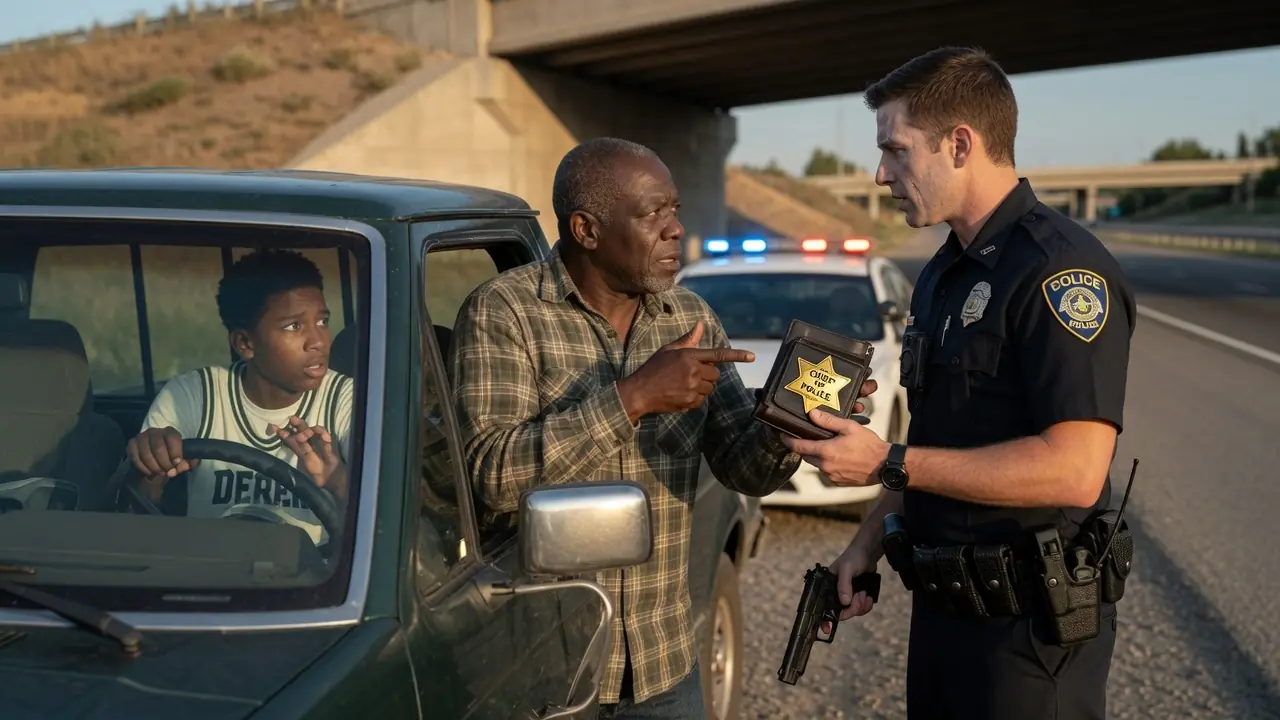
Nathan had spent the afternoon repairing a fence at his sister’s house before picking up Cameron. He had not changed because he saw no reason to dress differently for a high school gym.
Miller pointed toward the side of the truck.
“Face the vehicle. Hands behind your head.”
Nathan obeyed.
The officer grabbed his wrists and forced them downward.
Nathan’s chest struck the truck.
“Spread your feet.”
“I am complying.”
“Stop talking.”
Miller kicked one of Nathan’s boots farther apart and began a rough pat-down.
Passing drivers slowed to look.
Inside the truck, Cameron watched through the open door, fear replacing the confidence he carried on a basketball court.
Miller reached into Nathan’s back pocket and removed the wallet.
He opened it again.
Behind the license was a thick stack of one-hundred-dollar bills.
Miller whistled softly.
“That’s a lot of cash.”
“It’s two thousand dollars.”
“I can count.”
“It’s for my son’s basketball camp.”
“Of course it is.”
Nathan turned his head slightly.
“Please do not remove anything from my wallet.”
Miller pushed his shoulder against the truck.
“Face forward.”
He thumbed through the bills.
“Where did you get this?”
“The Harbor County Credit Union.”
“You have a receipt?”
“In the wallet.”
Miller found it but barely examined it.
“People move cash for all kinds of reasons.”
Nathan breathed in slowly.
The officer’s search had found no weapon.
No drugs.
No illegal item.
Still, Miller continued acting as though suspicion itself were evidence.
“You are crossing a serious line,” Nathan said.
Miller laughed once.
“I decide where the line is during my traffic stop.”
“No, Officer. The law decides that.”
The wallet landed open on the hood.
Miller removed his handcuffs.
“Hands behind your back.”
Nathan did not move immediately.
“For what offense am I being detained?”
“Suspicious activity.”
“That is not an offense.”
“Failure to obey commands will be.”
“I have obeyed every lawful command.”
Miller grabbed Nathan’s left wrist and twisted it toward the center of his back.
Cameron pushed open the passenger door.
“He’s not resisting!”
Nathan’s head snapped toward him.
“Cameron, stay inside.”
The teenager stepped down onto the shoulder.
“He didn’t do anything.”
Miller released Nathan and drew his pistol.
The movement was immediate.
One second, his hand rested near the holster.
The next, the gun was pointed directly at Cameron’s chest.
“Get back in the truck!”
Cameron froze.
The color left his face.
Nathan moved between them.
He did not reach toward Miller.
He did not raise his fists.
He simply placed his body in the path of the gun.
“Lower your weapon.”
Miller took a step backward.
“Both of you on your knees!”
“My son is unarmed.”
“Get on your knees!”
“You are pointing a loaded firearm at a frightened seventeen-year-old because he spoke.”
“He exited during a traffic stop.”
“And he stopped moving the moment you drew your weapon.”
Miller’s hand trembled.
“Do not tell me how to do my job.”
Nathan’s voice dropped.
“Then do it correctly.”
For the first time, Miller appeared uncertain.
The older man in front of him did not sound like a frightened motorist.
He sounded like someone accustomed to giving commands in rooms where the consequences mattered.
Miller kept the pistol raised.
“You think you know the law?”
“I know enough to understand that every second of this is being recorded.”
“You threatening me with a lawsuit?”
“No.”
Nathan looked toward the wallet on the hood.
“I am giving you an opportunity to stop before this becomes worse.”
Miller glanced at the wallet.
“Why?”
“Open the inside flap.”
“What’s in it?”
“Something you should have noticed before pointing your weapon at my son.”
“Don’t move.”
“I have not moved.”
Miller shifted closer to the hood while maintaining the gun in Nathan’s direction.
With his free hand, he picked up the wallet.
Behind the currency was a narrow leather compartment.
Miller opened it.
Inside was a gold five-pointed badge.
The lettering across the upper edge read:
STATE POLICE STANDARDS COMMISSION
Beneath it was an identification card carrying Nathan’s photograph and full title.
Nathaniel Brooks
Chairman, State Law Enforcement Standards and Accountability Commission
Former Chief, Harbor City Police Department
Miller stared at the card.
His pistol lowered several inches.
Nathan’s name was familiar to nearly every officer in the state.
For twenty-seven years, he had served in law enforcement. He had commanded Harbor City’s police department, overseen reforms following a federal civil-rights investigation, and helped write the current standards on traffic stops, use of force, and duty to intervene.
His commission did not have the power to fire an officer instantly.
It did have the authority to investigate certification violations and recommend suspension or revocation of a state peace-officer license.
Miller’s lips parted.
“Chief Brooks?”
“Former chief.”
Nathan held out his hand.
“My wallet.”
Miller gave it back slowly.
The gun remained pointed toward the ground.
“I didn’t know who you were.”
Nathan took the wallet.
“That is the problem.”
“Sir, I was responding to suspicious driving.”
“You claimed I crossed the fog line.”
“You did.”
“Then cite me or allow the evidence to be reviewed.”
Miller looked toward Cameron.
“I didn’t know he was your son.”
“Would the gun have been appropriate if he belonged to someone else?”
Miller said nothing.
Nathan’s eyes remained on the officer’s pistol.
“Holster your weapon.”
Miller hesitated.
Nathan’s voice sharpened.
“Officer Miller, holster it before your own camera records another bad decision.”
The pistol went back into the holster.
Cameron remained behind his father, breathing rapidly.
Nathan reached back and touched his shoulder.
“You’re all right.”
“No, I’m not.”
“I know.”
Miller adjusted his belt.
“Chief, maybe we can start over.”
“There is no starting over after drawing on a child.”
“He exited the vehicle.”
“You escalated a questionable stop into a gunpoint detention without identifying a threat.”
“I was alone.”
“You created the danger you now want to use as justification.”
Miller’s face reddened.
“Are you going to report me?”
Nathan looked at him.
“You are going to report yourself.”
“What?”
“Call your watch commander. Tell dispatch you drew your weapon on an unarmed juvenile during a traffic stop and request a supervisor at the scene.”
Miller looked toward his cruiser.
“That isn’t necessary.”
“It is department policy after a firearm is pointed at a person.”
“I can document it later.”
“You will request the supervisor now.”
“You can’t order me. You’re not my chief.”
Nathan’s expression did not change.
“You’re correct. I am not your chief.”
He nodded toward the body camera.
“But your chief will hear you refuse to follow your own policy after being reminded of it.”
Miller reached reluctantly for his shoulder microphone.
“Dispatch, Unit 214.”
“Go ahead, 214.”
“Requesting a supervisor at Highway 9 near mile marker fourteen.”
“Nature of request?”
Miller swallowed.
“Use-of-force review.”
The dispatcher’s tone changed.
“Was force deployed?”
“Firearm presentation.”
“Any injuries?”
“No.”
“Subject in custody?”
Miller looked at Nathan.
“No.”
“Stand by. Sergeant Ellis is en route.”
Nathan spoke before Miller released the microphone.
“Ask for Chief Administrator Richard Cole.”
Miller stared at him.
“That is not standard.”
Nathan removed his phone.
“I can call him directly.”
Miller’s fear became visible.
“No, sir. I’ll request him.”
The radio transmission went through.
Within minutes, the quiet highway shoulder began filling with vehicles.
Chief Administrator Richard Cole arrived first in an unmarked black SUV.
He was responsible for the regional department that employed Miller and had known Nathan for more than twenty years.
He exited without urgency, but his face became hard when he saw Cameron standing behind Nathan.
Sergeant Ellis arrived moments later with two patrol units.
Cole approached Nathan.
“Are either of you hurt?”
“No physical injuries,” Nathan said.
Cole looked at Cameron.
“Son?”
Cameron shook his head.
“I’m okay.”
His voice suggested otherwise.
Cole turned toward Miller.
“Secure your weapon in your cruiser.”
Miller’s shoulders sagged.
“Chief, I can explain.”
“You will. After you secure the weapon.”
“I followed procedure.”
“Then the recordings will support you.”
Miller removed the pistol and locked it in the cruiser’s storage compartment.
Cole instructed Sergeant Ellis to retrieve the dash-camera recording and preserve every body-camera file.
He separated Miller from Nathan and Cameron.
Then he asked Nathan to describe the encounter from the beginning.
Nathan did so without embellishment.
The cruiser’s proximity.
The alleged lane violation.
The pat-down.
The cash.
The attempt to handcuff him.
Cameron leaving the truck.
The weapon being drawn.
Cole listened without interrupting.
When Nathan finished, Cameron spoke.
“He pointed it right here.”
The teenager touched the center of his jersey.
“I thought he was going to shoot me.”
Cole looked toward Miller.
The officer stood near another cruiser, speaking rapidly to Sergeant Ellis.
Nathan noticed his son’s hands shaking.
He turned away from the investigation and faced him fully.
“Look at me.”
Cameron did.
“Breathe slowly.”
“I did what you told me.”
“You left the truck.”
“He was hurting you.”
“I know.”
“Was I wrong?”
Nathan chose his answer carefully.
“You reacted because you were afraid for me. But walking toward an armed officer increased the danger.”
“So this was my fault?”
“No.”
Nathan placed both hands on his son’s shoulders.
“The officer is responsible for his decision to draw. You are responsible for learning how to protect yourself when someone else makes a bad decision.”
Cameron looked down.
“I hate that.”
“So do I.”
Sergeant Ellis returned after reviewing the initial recording.
His face revealed little, but he spoke privately with Cole for several minutes.
Cole then called Miller over.
“Officer Miller, you are relieved of field duty pending administrative investigation.”
Miller went pale.
“You’re suspending me because he’s important?”
“I am removing you because the footage raises serious concerns.”
“He was noncompliant.”
“The driver complied with your exit order.”
“He challenged everything I said.”
“Speech is not resistance.”
“The kid came out of the truck.”
“Your body camera shows that you drew your weapon less than two seconds after he stepped down.”
“He could have been armed.”
“Did you see a weapon?”
“No.”
“Did his hands move toward his waistband?”
“No, but—”
“Did he threaten you?”
“No.”
“Then the review will determine whether your decision was objectively reasonable.”
Miller looked toward Nathan.
“He’s going to destroy my career.”
Nathan heard him.
“No,” he said. “Your decisions will determine your career.”
Miller’s voice became desperate.
“I didn’t know he was a police chief.”
Nathan stepped closer.
“You keep saying that as though it helps you.”
Miller looked confused.
“You believe the mistake was failing to recognize me.”
Nathan pointed toward the highway.
“The mistake was believing respect depended on who I was.”
He glanced at the old truck.
“You saw an older Black man in work clothes driving a vehicle you considered beneath the neighborhood. You decided the cash was suspicious before reading the withdrawal receipt. You treated calm disagreement as defiance.”
“That isn’t fair.”
“Perhaps not.”
Nathan nodded toward the cameras.
“That is why there will be an investigation rather than a roadside punishment.”
Cole instructed an officer to drive Miller back to headquarters.
He was not handcuffed.
He had not committed a crime merely because an internal investigation had begun.
His equipment was inventoried, and his patrol authority was temporarily suspended.
Miller entered the passenger seat of another cruiser.
Before the door closed, he looked at Nathan.
“I am sorry your son was frightened.”
Nathan held his gaze.
“Tell the investigators the truth.”
The cruiser left without lights or sirens.
Nathan’s truck was not allowed to leave immediately.
A collision technician inspected the dash camera and vehicle position. The footage showed Nathan maintaining his lane before the stop.
No weaving violation appeared.
The original basis for the detention became another subject of review.
Cole returned Nathan’s documents personally.
“The department will arrange a ride if you don’t feel comfortable driving.”
Nathan looked at Cameron.
“We’ll drive.”
Cole lowered his voice.
“I’m sorry.”
“You didn’t point the gun.”
“He wore my department’s badge.”
Nathan understood the weight of that answer.
“That is why the review matters.”
Cole nodded.
“Call me tomorrow.”
“I will.”
Nathan climbed behind the wheel.
Cameron sat beside him but did not reach for his phone.
For several minutes after they returned to the highway, neither spoke.
The blues song playing earlier had ended.
Only soft static came from the radio.
Finally, Cameron asked, “Were you scared?”
“Yes.”
“You didn’t look scared.”
Nathan kept his eyes on the road.
“Courage is not looking calm because you feel nothing.”
“What is it?”
“Doing what protects the people around you while fear is telling you to do something reckless.”
Cameron leaned against the window.
“When you stepped in front of me, I thought he might shoot you.”
“So did I.”
“Why did you do it?”
Nathan glanced at him.
“Because I am your father.”
The investigation lasted seven weeks.
Internal-affairs officers interviewed Nathan, Cameron, Miller, and every responding officer. They reviewed the dash-camera footage, dispatch records, body-camera video, and Miller’s previous complaints.
Three earlier motorists had accused him of using unnecessary threats during minor stops.
Two complaints had been classified as unsubstantiated because no video clearly contradicted his reports.
The Highway 9 footage did.
Investigators found no evidence that Nathan crossed the fog line.
Miller had not clearly explained the reason for the pat-down.
He treated legally possessed cash as suspicious despite discovering a matching bank receipt.
His report stated that Cameron “charged aggressively from the passenger side.”
The camera showed Cameron taking one step from the truck and stopping.
Most damaging was Miller’s recorded explanation to a supervisor after the stop.
“I didn’t expect the old guy to be anybody.”
The sentence was not proof of racial bias by itself.
Combined with the rest of the encounter, it revealed the assumptions driving his conduct.
The department sustained findings for an unjustified stop, improper search, unnecessary display of a firearm, discourtesy, inaccurate reporting, and failure to follow use-of-force notification policy.
Miller was terminated.
The local prosecutor reviewed whether the firearm presentation amounted to criminal assault. After examining state law and the legal standard for proving criminal intent, the office declined to file charges.
Nathan did not publicly attack the decision.
Accountability did not always mean prison.
It meant the officer could no longer make traffic stops while carrying the authority he had abused.
The state certification board opened a separate case.
After a hearing, Miller’s peace-officer license was suspended for three years and conditioned on extensive retraining before any possible reinstatement.
Nathan requested that Cameron attend the hearing only if he wanted to.
The teenager refused.
“I don’t want to see him.”
“You don’t have to.”
“Are you going?”
“Yes.”
“Why?”
“Because the board needs the complete account.”
Cameron looked toward the repaired truck in their driveway.
“Will he apologize?”
“Possibly.”
“Does it matter?”
“That depends on whether he understands what he is apologizing for.”
At the hearing, Miller expressed regret.
He said he had perceived Cameron’s exit as a developing threat and acted from fear.
Nathan listened.
When given an opportunity to speak, he addressed the panel rather than Miller.
“This case should not turn on the fact that I once carried a chief’s badge,” he said.
“If I had been a carpenter, a mechanic, a factory worker, or an unemployed father, the conduct would still have been unacceptable.”
He placed the old wallet on the table.
“The badge inside did not create my rights. It only forced the officer to recognize rights that already existed.”
Several board members wrote down the sentence.
Nathan continued.
“Training often teaches officers to identify danger quickly. It must also teach them to update their judgment when facts change. Fear may explain a decision. It does not automatically justify it.”
Miller looked down.
Nathan never raised his voice.
He did not need to.
Cameron’s Friday-night game arrived before the investigation ended.
The school gym was packed.
College scouts sat near the center court with notebooks on their knees.
Oakridge trailed West Lake by one point with six seconds remaining.
Cameron received the inbound pass.
Two defenders moved toward him.
For a moment, the entire gym expected him to take the final shot.
Instead, he drew both defenders and passed to an open teammate beneath the basket.
The ball went in as the buzzer sounded.
Oakridge won by one.
Students flooded the court.
Nathan stood in the bleachers, clapping.
Beside him, Richard Cole laughed.
“Seven assists.”
Nathan smiled.
“The last one mattered most.”
After the gym emptied, Nathan waited beside the green pickup.
Cameron emerged carrying his sports bag.
“Coach says the scout liked my decision at the end.”
“He should.”
“I could have taken the shot.”
“You could have.”
“But Marcus was open.”
Nathan handed him a bottle of water.
“That is leadership.”
Cameron leaned against the truck.
“Everybody at school knows about Highway 9.”
“I assumed they would.”
“Some people think you got Miller fired because you’re powerful.”
Nathan looked at him.
“What do you think?”
“I think the camera got him fired.”
“That is closer.”
“They say he would still have a job if you weren’t important.”
“He might.”
Cameron frowned.
“That’s messed up.”
“Yes.”
“What was the point of showing him the badge, then?”
“The badge ended an immediate danger.”
“But it shouldn’t have been necessary.”
“No.”
Nathan looked toward the dark school windows.
“That is the lesson I hope you remember. Sometimes status protects people from mistreatment. Justice begins when protection no longer depends on status.”
Cameron was silent for a while.
“I thought strength meant making people back down.”
“What do you think now?”
“I think it means not becoming the worst person in the situation.”
Nathan smiled faintly.
“That is a good beginning.”
He opened the driver’s door.
Cameron remained beside the truck.
“Dad?”
“Yes?”
“When he pointed the gun, did you know everything would be okay?”
“No.”
“Then how did you stay calm?”
Nathan considered the question.
“Because panic would have belonged to me. Responsibility belonged to both of us.”
He rested one hand on the roof of the truck.
“I could feel afraid and still choose what gave you the best chance of going home.”
Cameron nodded slowly.
They climbed inside.
The engine started with its familiar rough rumble.
As Nathan pulled from the parking lot, Cameron turned on the radio.
The same blues station filled the cab.
For the first time since the stop, the sound did not make him think of flashing lights.
Nathan drove beneath the pine trees toward Pine Street.
The gold badge remained hidden inside the wallet in his pocket.
It was not the source of his authority.
It had never been.
Real authority had been visible on the highway before Miller opened the wallet.
It was in Nathan’s restraint.
In the way he shielded his son without reaching for the gun.
In his refusal to let humiliation become violence.
In his insistence that the officer receive a fair investigation even after denying that fairness to him.
A badge could command temporary obedience.
Fear could force someone onto the side of a road.
But neither was the same as strength.
Strength was knowing where the line stood even when the person with the weapon claimed he could move it.