The pearl-white Lamborghini Urus had been traveling exactly three miles below the speed limit when the red and blue lights appeared in its rearview mirror.
Marcus Hale saw them and felt no surprise.
He checked the road ahead, activated his turn signal, and guided the SUV onto the shoulder. Then he placed the transmission in park, lowered the window, and rested both hands where they could be clearly seen on the steering wheel.
The patrol car stopped behind him.
For several seconds, nothing happened.
Marcus watched the officer through the mirror.
The man remained inside his cruiser, apparently entering the Lamborghini’s license plate into his computer. When he finally stepped out, his right hand rested near his holster.
He approached slowly, studying the vehicle before looking at its driver.
“License, registration, and proof of ownership.”
There was no greeting.
No explanation.
Marcus remained calm.
“Officer, could you tell me why you stopped me?”
The officer’s expression tightened.
“I said license, registration, and proof of ownership.”
Marcus turned toward the center console.
“I’m reaching for my wallet and documents.”
He moved slowly, removed the paperwork, and passed it through the window.
The officer examined the license.
Marcus Hale.
Age forty-six.
Address in the neighboring city of Kingston.
He looked at the registration.
The Lamborghini was legally registered to the same name.
Still, he did not return the documents.
“This is your vehicle?”
“Yes.”
“You expect me to believe that?”
Marcus’s hands returned to the steering wheel.
“The registration confirms it.”
The officer looked at him, then at the cream-colored leather interior.
“How did you afford something like this?”
Marcus’s face became still.
“That has nothing to do with a traffic stop.”
“It does when the car looks out of place.”
“Out of place where?”
The officer gestured toward the surrounding neighborhood.
District Nine consisted of modest houses, independent stores, apartment buildings, and narrow streets shaded by old trees. It was also the area where the city had received the largest number of complaints concerning unnecessary traffic stops.
Marcus already knew that.
It was why he had chosen the route.
“You’re driving a two-hundred-thousand-dollar vehicle through this neighborhood,” the officer said. “That’s suspicious.”
“No,” Marcus replied. “It isn’t.”
The officer leaned closer to the window.
“You want to argue with me?”
“I want to know what traffic law I violated.”
“You people always think knowing a few legal words makes you untouchable.”
Marcus held his gaze.
“What do you mean by ‘you people’?”
The officer ignored the question.
“Step out of the vehicle.”
“On what legal basis?”
“I gave you an order.”
“That does not answer the question.”
The officer’s voice rose.
“Get out now, or I’ll place you under arrest.”
“Arrest me for what?”
The officer bent toward the open window.
“I’m the one asking questions. You have two choices. Step out, or leave in handcuffs.”
Marcus looked straight ahead for a moment.
He could have identified himself.
One sentence would have changed the officer’s attitude instantly.
But that was precisely the problem.
A citizen should not need an impressive title to receive lawful treatment.
Marcus opened the door.
“I am exiting under protest,” he said clearly. “I have committed no traffic violation, and I do not consent to any search of my person or vehicle.”
The officer stepped back.
“Hands on the hood.”
Marcus complied.
The Lamborghini’s engine ticked softly beneath his palms as the officer conducted a pat-down.
Nothing was found.
The officer walked toward the passenger side.
“I’m searching the vehicle.”
Marcus turned his head.
“I do not consent.”
“I don’t need your consent.”
“You need probable cause or a warrant.”
“I have reasonable suspicion.”
“Based on what?”
“Your attitude. The vehicle. The neighborhood.”
“None of those is probable cause.”
The officer opened the passenger door anyway.
His name was Officer Tyler Briggs.
He had served with the Crestwood Police Department for eight years.
That afternoon, he believed he was teaching an arrogant driver to respect authority.
He had no idea that every sentence, every movement, and every decision was being recorded.
Three days earlier, Marcus Hale had entered Crestwood Police Headquarters through a side door before sunrise.
The building was mostly quiet.
A dispatcher looked up from her desk, recognized him, and immediately stood.
“Good morning, Chief.”
“Morning.”
Marcus had officially become Crestwood’s chief of police seventy-two hours earlier.
The city council had recruited him from another department after two federal reviews and years of complaints concerning discriminatory policing.
Crestwood had not reached the point of collapse.
It was worse in a different way.
The department still functioned.
Calls were answered.
Arrests were made.
Reports were filed.
But trust had slowly disappeared.
Residents in several neighborhoods believed officers treated them as suspects first and citizens second. Drivers described being stopped without explanation. People reported being questioned about vehicles registered in their own names. Some said officers demanded permission to search and became threatening when consent was refused.
Most complaints ended the same way.
Insufficient evidence.
Officer acted within discretion.
No policy violation established.
Marcus had spent twenty-three years in law enforcement. He had worked patrol, investigations, professional standards, and command. He had testified in court, reviewed body-camera recordings, and terminated officers who confused authority with ownership.
He had accepted the Crestwood position under one condition.
The mayor and city council would not interfere when accountability became uncomfortable.
Mayor Elaine Brooks had agreed.
“You will have the authority to reform the department,” she said.
Marcus understood that written policies would not be enough.
Departments rarely failed because the rules did not exist.
They failed because people learned that the rules would not be enforced.
On his first morning, Marcus reviewed traffic-stop data.
District Nine stood out immediately.
Drivers from minority communities were searched at more than twice the city average, although those searches produced illegal items less frequently than searches of other drivers.
Several officers accounted for much of the disparity.
Tyler Briggs was near the top of the list.
His personnel file contained three complaints.
The first came from Dr. Aaron Mitchell, a physician stopped while driving a new BMW home from the hospital. Briggs demanded purchase records and held him beside the road for thirty-seven minutes.
The second complaint came from restaurant owner Isaiah Grant, who was driving a Mercedes registered in his name. Briggs searched the trunk after Grant refused permission, later claiming he smelled marijuana.
No drugs were found.
The third involved a college professor whose vehicle was searched because Briggs believed the man was “too nervous.”
Each investigation ended with no formal discipline.
The supervising lieutenant recommended verbal counseling.
The counseling was never documented.
Marcus closed the file and stared through the office window.
The department had not lacked warning.
It had lacked courage.
He decided to observe patrol operations personally.
Not from the chief’s office.
Not during a scheduled ride-along where every officer knew he was watching.
Marcus owned a Lamborghini Urus, purchased after years of careful investments and a successful security business he operated before accepting the chief’s position.
He rarely drove it to work.
For the next three days, he used it to travel through the districts where complaints were highest.
He obeyed every law.
He signaled every turn.
He made sure every light and plate was clearly visible.
On the first day, Officer Daniel Price followed him for several blocks and initiated a stop.
When Marcus asked for the reason, Price admitted the Lamborghini had drawn his attention but acknowledged that he had not observed a violation.
“That is not sufficient for a stop,” Marcus said.
Price immediately recognized the problem.
“You’re right.”
Marcus identified himself.
Price apologized without becoming defensive.
He was ordered to complete retraining, but Marcus did not suspend him.
The officer had made a poor decision and corrected it before violating additional rights.
On the second day, another officer approached the SUV after it was parked outside a grocery store.
She asked whether everything was all right and explained that a business owner had reported a suspicious vehicle circling the area.
Marcus showed her the GPS route demonstrating he had driven there only once.
She thanked him, apologized for the inconvenience, and left.
Her conduct was professional.
Then came the third day.
District Nine.
Officer Tyler Briggs.
Marcus saw the cruiser turn around two blocks after the Lamborghini passed.
Briggs followed closely through three intersections.
Marcus maintained the speed limit and stayed centered in his lane.
The lights activated anyway.
Now Briggs stood beside the open passenger door, searching the vehicle without consent.
He opened the glove compartment.
Insurance papers.
Service records.
A pair of sunglasses.
He searched beneath the seats, inside the center console, and through a gym bag.
Marcus remained beside the hood.
“For the record,” he said, “I am again stating that I do not consent to this search.”
Briggs glanced at him.
“You can state whatever you want.”
He walked toward the rear of the Lamborghini and opened the cargo area.
Inside were a folded jacket, a gym bag, and a black leather briefcase.
Briggs pulled the briefcase toward him.
“That contains private documents,” Marcus said.
“Then maybe you should have cooperated.”
“I have cooperated with every lawful command.”
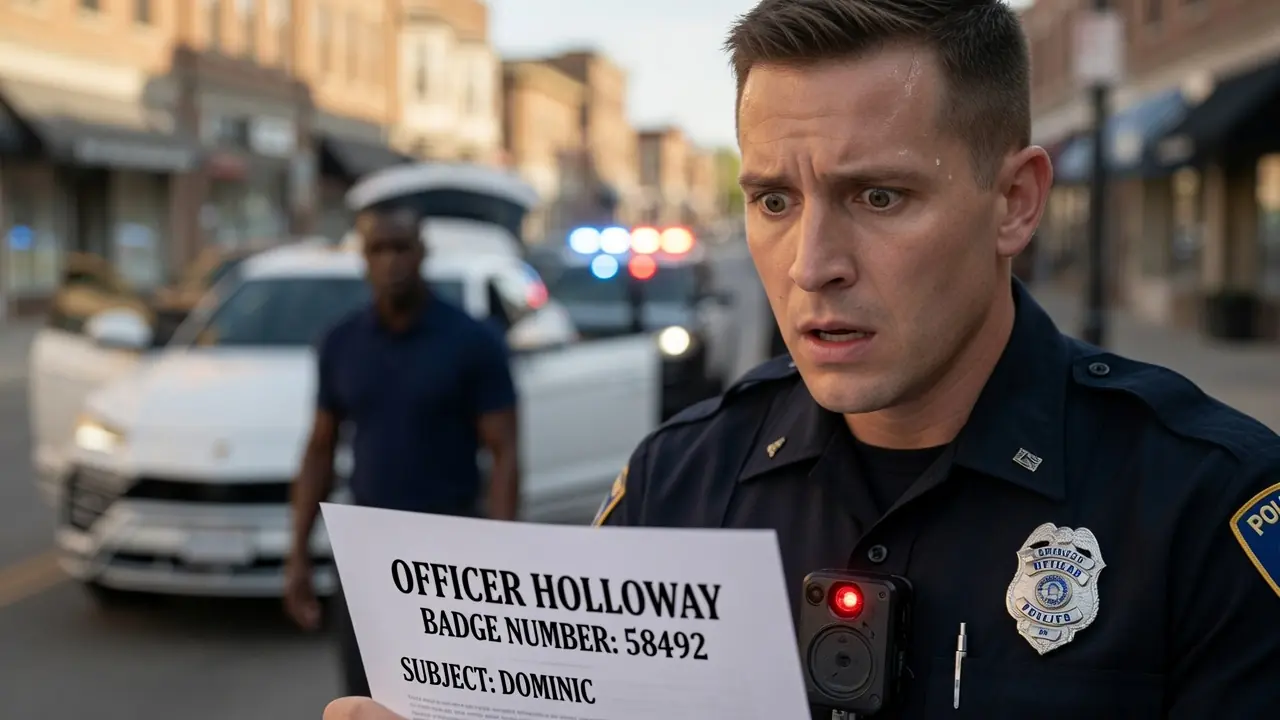
Briggs released the latches.
The briefcase opened.
Several folders rested inside.
Each displayed the Crestwood Police Department seal.
Briggs frowned.
He removed the first document.
The heading read:
NOTICE OF EMERGENCY SUSPENSION AND RECOMMENDATION FOR TERMINATION.
Below it appeared a name.
OFFICER TYLER BRIGGS.
Badge number 3184.
Briggs stopped breathing for a moment.
He read the first paragraph.
The document described an anticipated constitutional violation involving an unsupported traffic stop, coercive detention, and unlawful vehicle search.
The effective date was that day.
At the bottom was a signature.
Chief Marcus Hale.
Briggs stared at it.
Then he looked toward the man beside the Lamborghini.
He returned to the license in his hand.
Marcus Hale.
His mouth opened.
No sound came out.
Marcus stepped away from the hood.
Briggs’s body camera captured the exact moment recognition reached him.
“You’re…”
His voice weakened.
“You’re the new chief.”
Marcus’s expression remained calm.
“Yes.”
Briggs looked down at the letter again.
“You planned this.”
“I drove through a public neighborhood while obeying the law.”
“You were testing me.”
“I was observing whether officers followed constitutional standards when they believed no supervisor was watching.”
Briggs’s face flushed.
“I didn’t know who you were.”
“That is not a defense.”
“I was doing my job.”
“No. You were using your job to satisfy a suspicion you created from my appearance and the value of my car.”
“The vehicle looked wrong for the area.”
Marcus took one step closer.
“Cars do not belong to neighborhoods. People have the right to travel.”
Briggs searched for another explanation.
“You were argumentative.”
“I asked why I had been stopped.”
“You refused commands.”
“I exited when threatened with arrest. I repeatedly stated that I did not consent to a search.”
Briggs held out the termination document.
“This was already written.”
“It was prepared based on your complaint history. Whether it became necessary depended entirely on your behavior today.”
“So I never had a chance.”
“You had many chances.”
Marcus counted them calmly.
“You could have continued driving when you observed no violation. You could have answered my question honestly. You could have returned my documents after confirming the registration. You could have declined to search without probable cause. You could have respected my refusal.”
Briggs lowered the paper.
“You chose escalation every time.”
For the first time, fear replaced anger in the officer’s face.
“Chief, please. I have a wife and two children.”
Marcus did not react.
“The citizens named in your previous complaints had families too.”
“I was cleared.”
“You were protected.”
“That isn’t fair.”
Marcus looked toward the open doors of his vehicle.
“You stopped me without cause, threatened arrest, and searched a closed briefcase after I explicitly refused consent. Now you are asking for fairness because the consequences reached you.”
Briggs’s shoulders dropped.
“I made a mistake.”
“A mistake is writing the wrong date on a report.”
Marcus’s tone remained controlled.
“This was a sequence of deliberate decisions.”
He removed his phone.
The device had been recording audio since the moment Briggs approached.
“Your body camera also recorded everything.”
Briggs instinctively touched the camera on his uniform.
“Turn it off,” Marcus ordered.
Briggs hesitated.
“Do not touch the file. The recording is evidence.”
Marcus took out his department radio.
“Dispatch, this is Chief Hale.”
A pause followed.
“Go ahead, Chief.”
“Send a patrol supervisor and a professional standards investigator to my location. An officer has conducted an unsupported stop and nonconsensual vehicle search. He is being relieved of duty.”
The dispatcher’s voice changed.
“Please repeat.”
“Officer Tyler Briggs is to be relieved of duty immediately. Send Sergeant Elena Ruiz.”
Briggs looked toward the road as though he might find an escape there.
“You’re firing me on the side of the road?”
“I am suspending you immediately. The formal termination process begins today.”
“You can’t decide that without an investigation.”
“There will be an investigation.”
Marcus pointed toward the body camera.
“You provided most of its evidence yourself.”
Sergeant Elena Ruiz arrived six minutes later.
She stepped from her cruiser and looked from the Lamborghini to Briggs, then to Marcus.
“Chief?”
Marcus explained what had happened.
Ruiz listened without interruption.
When he finished, she turned to Briggs.
“What was your reason for the stop?”
Briggs looked at the Lamborghini.
“The car seemed suspicious.”
“What traffic violation?”
“None.”
“What crime were you investigating?”
“I thought it might be stolen.”
“Did the plate return as stolen?”
“No.”
“Did the registration match the driver?”
“Yes.”
Ruiz’s jaw tightened.
“Then why did you search?”
“He was evasive.”
Marcus spoke before Briggs could continue.
“I answered every identification question. I refused consent.”
Ruiz looked at Briggs with open disappointment.
“Badge, weapon, and body camera.”
His face changed.
“Elena—”
“Sergeant Ruiz while I am on duty.”
Briggs removed his badge.
The small metal shield looked suddenly heavier than it had minutes earlier.
He handed it over.
Then came his service weapon.
Ruiz cleared it and locked it inside her cruiser.
Finally, she removed the body camera.
Briggs stood on the shoulder in an empty uniform.
Marcus closed the briefcase and placed it back in the cargo area.
Before entering the Lamborghini, he faced Ruiz.
“Preserve every recording. Notify professional standards. Briggs is not to access any department system.”
“Yes, Chief.”
Marcus looked at the former officer.
“You will report to headquarters tomorrow at eight with union representation if you choose.”
Briggs’s voice was barely audible.
“Understood.”
Marcus drove away.
In the rearview mirror, he watched Briggs standing beside the cruiser.
He felt no satisfaction.
Removing an officer was never a victory.
The victory would have been discovering that the complaints were wrong.
The evidence said otherwise.
Two hours later, Marcus entered the headquarters conference room.
Every captain, lieutenant, and patrol sergeant had been ordered to attend.
Some had already heard what happened.
Others watched him with guarded expressions.
Marcus connected a laptop to the large screen.
“Before we begin, understand that the material you are about to see is part of an active professional standards investigation.”
He played Briggs’s body-camera footage.
The room watched the stop from beginning to end.
The demand for proof of ownership.
The refusal to state a violation.
The threat of arrest.
Marcus’s clear refusal to consent.
The search.
The briefcase.
When the screen went dark, no one spoke.
Captain Robert Vaughn, a twenty-five-year veteran of the department, finally cleared his throat.
“Chief, with respect, some people will say you set him up.”
Marcus turned toward him.
“Explain the setup.”
“You drove a highly expensive vehicle through an area where it would draw attention.”
“Is drawing attention a crime?”
“No.”
“Did I violate any traffic law?”
“Not according to the footage.”
“Did I place anything illegal in the car?”
“No.”
“Did I force Officer Briggs to stop me?”
Vaughn looked down.
“No.”
Marcus leaned both hands against the table.
“Then there was no setup. There was only an opportunity for Briggs to reveal how he treats someone he believes has less power than he does.”
Lieutenant Karen Mitchell opened the personnel file in front of her.
“Was the termination letter genuine?”
“It was a prepared recommendation based on his existing complaints. I hoped I would never need to complete it.”
“You expected him to search the briefcase?”
“I expected him to follow the Constitution.”
Marcus displayed Briggs’s complaint history on the screen.
The commanders read the summaries.
Three drivers.
Three expensive vehicles.
Three unsupported detentions.
All minority men.
All complaints dismissed.
Marcus looked around the room.
“Who reviewed these?”
No one answered immediately.
Captain Vaughn finally spoke.
“I reviewed the second complaint.”
“Why was it dismissed?”
“Briggs said he smelled marijuana.”
“Was that confirmed by another officer?”
“No.”
“Was any contraband found?”
“No.”
“Was the body-camera footage reviewed?”
“There was no audio for part of the stop.”
“Was the equipment failure investigated?”
Vaughn hesitated.
“No.”
Marcus moved to the next complaint.
“Who reviewed this one?”
A lieutenant raised his hand.
“The complainant became angry.”
“Was he legally detained?”
“We believed Briggs had officer-safety concerns.”
“What conduct created those concerns?”
“He questioned the stop repeatedly.”
Marcus closed the file.
“Asking an officer to explain his authority is not a threat.”
Silence settled around the table.
“This department taught Briggs that every complaint would be interpreted in his favor. He learned that constitutional language could be replaced with vague phrases like officer safety, suspicious behavior, and high-crime area.”
Marcus walked toward the department seal on the wall.
“We are supposed to protect lawful freedom, not demand obedience for its own sake.”
One sergeant shifted uncomfortably.
“Chief, the union is going to fight this.”
“They have that right.”
“There may be protests from officers.”
“They have the right to express disagreement.”
“What if morale collapses?”
Marcus faced him.
“If morale depends on protecting unconstitutional conduct, then our morale deserves to collapse.”
No one challenged him again.
Marcus announced immediate changes.
Every traffic stop would require a clearly documented legal basis.
Body-camera recordings from vehicle searches would receive random external review.
Consent searches would require recorded, voluntary permission.
Any officer with repeated complaints involving similar conduct would be flagged for professional standards review.
Supervisors would no longer close complaints without written findings supported by evidence.
Finally, Marcus informed the command staff that he would hold a public press conference the following morning.
Captain Vaughn looked alarmed.
“You are releasing the footage?”
“With appropriate legal review.”
“Wouldn’t it be better to complete the internal investigation first?”
“The community has watched this department hide behind unfinished investigations for years.”
Marcus gathered his documents.
“Transparency begins before it becomes convenient.”
The press conference started at ten the next morning.
Reporters filled the municipal media room.
Marcus stood in full uniform behind a podium bearing the Crestwood city seal.
Mayor Brooks sat nearby, along with the city attorney and the chair of the civilian oversight commission.
Marcus did not describe the incident as a misunderstanding.
He did not call it an unfortunate interaction.
He stated exactly what happened.
“Yesterday afternoon, while driving my personal vehicle through District Nine, I was stopped by Officer Tyler Briggs. I had committed no traffic violation. Officer Briggs demanded proof that I owned my vehicle, threatened me with arrest when I requested the legal basis for the stop, and searched my vehicle after I explicitly refused consent.”
A reporter raised her hand.
“Chief, did you identify yourself?”
“No.”
“Why not?”
“Because constitutional rights do not depend on whether a person is a police chief.”
He continued.
“Officer Briggs has been suspended pending termination proceedings. His conduct is supported by body-camera evidence and a personal recording.”
The footage played.
Reporters watched Briggs conduct the search.
When he opened the briefcase and discovered the prepared termination notice, several journalists reacted audibly.
Marcus returned to the microphone.
“This department previously received complaints describing similar conduct by Officer Briggs. Those complaints were dismissed. That institutional failure allowed the pattern to continue.”
Another reporter spoke.
“Were you deliberately testing officers?”
“I was observing patrol conduct while obeying the law.”
“Some officers claim the test was entrapment.”
“Entrapment requires inducing someone to commit an offense they otherwise would not commit.”
Marcus looked directly at the cameras.
“I did not induce Officer Briggs to violate my rights. I gave him repeated opportunities not to.”
The footage spread nationally within hours.
Public reaction was immediate.
Some praised Marcus.
Others accused him of humiliating a subordinate.
The police union filed a grievance, arguing that Briggs had acted within his discretion and that the chief’s operation was designed to provoke a failure.
Six weeks later, the arbitration hearing began.
Briggs’s attorney described District Nine as a high-crime area and argued that the Lamborghini was unusual enough to justify investigation.
The retired judge serving as arbitrator stopped him.
“Is vehicle price a basis for reasonable suspicion?”
“No, Your Honor, but context matters.”
“What specific conduct by the driver suggested criminal activity?”
The attorney returned to Marcus’s questions and refusal to consent.
The arbitrator reviewed the body-camera video twice.
He examined the prior complaints and the department’s responses.
Three days later, he issued a written decision.
The termination was upheld.
The decision found that Briggs lacked legal justification for the stop, threatened arrest without proper cause, and conducted a search after clear refusal of consent.
The arbitrator also criticized Crestwood’s previous leadership for repeatedly ignoring warning signs.
Tyler Briggs’s policing career ended at thirty-four.
He applied to other agencies, but background investigators requested his Crestwood file.
No department hired him.
He eventually accepted work with a private security company, earning less than half his former salary.
For Marcus, the case was only the beginning.
He ordered an independent review of five years of traffic-stop data and civilian complaints.
The review identified nine officers with significant disparities in stops and searches.
Not all were guilty of intentional discrimination.
Some had received poor training.
Some worked assignments that partially explained the numbers.
Marcus insisted on individual evidence rather than assumptions.
Six officers completed intensive retraining and improved.
One resigned.
Two were terminated after additional recordings revealed repeated constitutional violations.
Supervisors who had buried complaints were removed from command positions.
The department created a civilian review board with access to unedited body-camera footage. Quarterly reports published stop data, search rates, outcomes, and complaint resolutions.
The changes were unpopular inside the department.
Some officers accused Marcus of taking the public’s side.
He reminded them that the public was the only side a police department existed to serve.
The first year was difficult.
Traffic stops declined sharply as officers became uncertain about what they could lawfully do. Marcus responded with training rather than pressure to increase numbers.
“Good policing is not measured by how many people you stop,” he told patrol officers. “It is measured by whether your actions are justified and useful.”
Complaints of profiling fell.
More importantly, fewer complaints were dismissed without full review.
Residents began attending community meetings again.
Dr. Aaron Mitchell, whose complaint against Briggs had once disappeared into the system, attended one of those meetings.
Afterward, he approached Marcus.
“I saw the video.”
Marcus nodded.
“I reviewed your complaint.”
“They told me I was imagining the problem.”
“You were not.”
The doctor looked toward the officers speaking with residents across the room.
“I am glad it happened to someone they could not ignore.”
Marcus understood the feeling.
“But it should not have required that.”
“No,” Mitchell said. “It should not have.”
Two years later, a young officer stopped a luxury sedan in District Nine after observing it run a red light.
The driver immediately began recording and accused the officer of profiling him.
The officer remained calm.
He explained the violation, provided the location of the traffic camera, and invited the driver to file a complaint if he believed the stop was improper.
The body-camera review later confirmed the officer had acted correctly.
Marcus praised him publicly.
Reform did not mean assuming every officer was wrong.
It meant demanding evidence, fairness, and accountability in every direction.
Five years after the Lamborghini stop, Crestwood was recognized for the largest reduction in racial disparities among comparable departments in the state.
Community trust had not become perfect.
Trust rarely returned quickly after years of damage.
But it was growing.
Marcus still served as chief.
He still owned the Lamborghini.
He drove it less often now, mostly on weekends or when visiting his daughter at college.
One afternoon, he stopped at a gas station near District Nine.
A young patrol officer was purchasing coffee inside.
He recognized Marcus and glanced through the window at the white SUV.
“That the famous car, Chief?”
Marcus smiled.
“I suppose it is.”
The officer shook his head.
“Hard to believe one traffic stop changed the whole department.”
“It didn’t.”
The officer looked confused.
Marcus picked up his coffee.
“The department changed because the stop showed everyone a problem they could no longer deny.”
Outside, sunlight reflected from the Lamborghini’s hood.
Marcus remembered standing beside it with his hands visible while an officer searched his belongings.
He remembered Briggs saying he had not known who Marcus was.
That sentence had always remained the clearest summary of the problem.
Briggs believed his conduct became wrong only after discovering the driver’s title.
But the search had been wrong before the briefcase opened.
It would have been wrong if Marcus had been a teacher, a mechanic, a nurse, an unemployed father, or a teenager borrowing a relative’s car.
The Constitution had not protected him because he was the chief.
It protected him because he was a person.
Marcus entered the driver’s seat and started the engine.
Before pulling away, he saw the young officer step outside and hold the door for an elderly customer.
A small act.
Unremarkable to anyone watching.
That was the kind of policing Marcus wanted to become ordinary.
Not grand speeches.
Not dramatic punishments.
Simply officers who understood that a badge gave them responsibility, not ownership.
Tyler Briggs had believed the expensive SUV provided sufficient reason to question the man behind the wheel.
He had searched the Lamborghini expecting to find evidence of a crime.
Instead, he found a document describing the consequences of his own choices.
The briefcase did not end his career.
His decisions did.
And the most important lesson Marcus left with the department was not that an officer might accidentally stop his own chief.
It was that every person deserved to be treated as though someone powerful would review the recording later—even when no one ever did.