The four red dots appeared at the same time.
They landed across Officer Marcus Hale’s chest in a perfect square, each one steady against the dark fabric of his uniform.
One above his heart.
One near his right shoulder.
Two lower across his ribs.
Marcus froze with his hand less than three inches from his holstered pistol.
The living room fell silent.
Rain tapped softly against the broken front door. Splintered wood covered the tile behind him, and the brass lock he had forced from the frame rested beneath a side table.
Across the room, the man Marcus had ordered to the floor remained standing.
His hands were visible.
His voice had never risen.
“You need to move your hand away from the weapon,” the man said.
Marcus stared at the red dots.
His own radio crackled at his hip.
“Unit Twelve, status check.”
He did not answer.
Outside the shattered doorway, black vehicles blocked both ends of the street. Men and women in plain clothes stood behind parked cars, porch columns, and neighboring fences.
No sirens had announced them.
No emergency lights flashed.
They had simply appeared, surrounded the house, and placed four weapons on Marcus before his department even understood something had happened.
“Tell them to stand down,” Marcus said.
His voice no longer sounded like a command.
The man across from him glanced toward the window.
“They will stand down when you give them a reason.”
“I’m a police officer.”
“I know.”
“I responded to a call.”
“I know that too.”
Marcus’s fingers trembled near the holster.
The man’s expression remained calm.
“Both hands where they can see them.”
Marcus had issued those words hundreds of times during his fifteen years in law enforcement.
He knew the movements expected after them.
Slowly, he moved his hand away from the pistol.
Then raised both arms.
The red dots remained.
A woman stepped through the ruined doorway.
She wore a plain charcoal jacket over a tactical vest. Her dark hair was pulled back, and an open federal credential case rested in her left hand.
She did not shout.
She did not draw her weapon.
Nothing about her suggested she needed to prove who controlled the room.
“Officer Hale,” she said. “Keep your hands visible.”
Marcus looked toward the badge.
The woman gave him time to read it.
SPECIAL AGENT ADRIANNA VEGA
FEDERAL INTERAGENCY PROTECTIVE OPERATIONS TASK FORCE
She closed the case.
“My name is Special Agent Vega. I supervise the operation you just compromised.”
Marcus looked toward the man across the room.
The federal identification remained in his hand.
The same identification Marcus had dismissed through the glass beside the door.
The same badge he had called fake.
The same man he had threatened with arrest.
Adrianna stepped over the broken lock.
“Before anyone takes another step,” she said, “I need to know whether you entered the basement.”
Marcus shook his head.
“No.”
“Did anyone accompany you into the residence?”
“No.”
“Did you transmit the address or details of the interior over an open channel?”
“I gave dispatch the location.”
Adrianna’s expression did not change.
The man across the room closed his eyes briefly.
That small reaction frightened Marcus more than anger would have.
Adrianna touched the radio clipped to her vest.
“Accelerate extraction. Assume the location is compromised.”
Movement began beneath the floor.
Men Marcus had not known were inside the house opened a concealed basement door. Someone spoke in a quiet, reassuring voice to another person below.
Marcus finally understood.
There was someone hidden inside the house.
Someone important enough that a single forced entry had triggered a federal tactical response in less than five minutes.
“I was responding to suspicious activity,” Marcus said.
Adrianna turned toward him.
“No.”
The word was delivered without heat.
“You responded to a vague complaint. Suspicion came afterward.”
Marcus felt the remaining certainty inside him begin to fracture.
Three hours earlier, he had been sitting inside his patrol car at the eastern end of Pembroke Lane.
It was a quiet suburban street lined with beige houses, trimmed lawns, and maple trees beginning to turn yellow at the edges.
Children rode bicycles along the sidewalks.
A man washed a sedan in his driveway.
A woman walked a small dog near the fire hydrant.
Nothing about the neighborhood appeared dangerous.
Marcus distrusted appearances.
He had been a police officer for fifteen years.
For the first twelve, he believed experience would carry him steadily upward.
Patrol officer.
Senior officer.
Sergeant.
Lieutenant, perhaps.
He arrived early.
Accepted undesirable shifts.
Made arrests.
Volunteered for neighborhood task forces and violent-crime details.
His personnel file contained commendations for bravery and quick action.
It also contained three civilian complaints, two disputed searches, and a written warning for escalating a traffic stop that his supervisor believed could have ended peacefully.
Marcus described those incidents differently.
The complaints came from people who resented authority.
The searches were lawful.
The traffic stop involved a driver who refused instructions.
He viewed every criticism as another example of cautious supervisors punishing officers willing to act.
The department passed him over for promotion twice.
The first board cited concerns about judgment and communication.
The second offered no detailed explanation.
A younger officer received the position.
Marcus congratulated him publicly.
Then spent the following year proving, at least to himself, that the department preferred politeness to competence.
He was forty-two now.
Broad-shouldered, sharp-featured, and increasingly angry at the gap between the respect he expected and the respect he received.
That afternoon, dispatch sent him to Pembroke Lane.
“Possible disturbance or suspicious person,” the operator said. “Caller reports an unfamiliar male watching from a residence window. No confirmed threat. Caller refused identifying information.”
Marcus pressed the radio button.
“Any history at the address?”
“None showing.”
“Who owns the property?”
“Registered to Sentinel Residential Holdings.”
“A company?”
“Appears so.”
The call should have been treated as a routine welfare check.
Knock.
Speak with the occupant.
Observe whether a crime or emergency existed.
Leave if nothing supported further action.
Marcus arrived two houses away and remained inside his car.
He studied the property.
The lawn was too precise.
The porch held no furniture.
No packages rested near the door.
Blinds covered every visible window at the same angle.
It looked less like a home than a structure maintained to appear occupied.
Marcus’s suspicion sharpened.
He did not ask whether a property-management company might explain the uniform maintenance.
He did not consider whether the anonymous caller had misinterpreted ordinary behavior.
He saw details that supported danger and ignored every explanation that did not.
A man appeared beside the front window.
He stood slightly left of the frame, avoiding the open center where his body would be clearly outlined.
Marcus noticed immediately.
The man watched him without waving or stepping away.
They held eye contact through the glass.
Marcus interpreted the stillness as calculation.
Inside the house, federal protection officer Nathan Cross had noticed the patrol car before Marcus opened the door.
Nathan was thirty-nine and had spent most of his career working jobs that never appeared in newspapers.
He was officially assigned to the Protective Intelligence Support Directorate, a federal unit responsible for securing threatened witnesses and sensitive civilian assets during temporary relocation.
His current task required only one outcome.
Keep Aaron Voss alive for seventy-two more hours.
Aaron was a fifty-three-year-old forensic accountant who had managed financial records for a criminal organization operating across several states.
For fourteen years, he helped hide money behind construction companies, nonprofit foundations, and import businesses.
Then one of the organization’s leaders ordered the killing of an employee who had discovered missing funds.
Aaron decided to cooperate.
His testimony connected shell companies, bank accounts, bribes, and several murders to people prosecutors had pursued unsuccessfully for years.
Three potential witnesses had disappeared during the six-year investigation.
Aaron feared becoming the fourth.
The house on Pembroke Lane was designed to ensure that did not happen.
From outside, it resembled every other suburban property on the street.
Inside the walls ran encrypted communication lines.
Sensors covered every entrance.
The basement had been reinforced and converted into protected living quarters.
A silent breach system was hardwired beneath the front threshold. It could not be disabled remotely or interrupted through ordinary wireless interference.
Beside the door was a small brass plaque.
Most visitors ignored it.
The plaque contained a federal property designation and a reference number that any law-enforcement dispatcher could verify.
The designation did not reveal the witness or operation.
It simply instructed officers to stop, secure the perimeter, and contact a restricted federal number before entry.
Nathan had been inside the house for eleven days.
His routines were exact.
Curtains adjusted at scheduled intervals.
Deliveries received through rotating methods.
Grocery trips avoided predictable patterns.
Exterior monitoring conducted without standing directly in front of windows.
The neighbors believed he was a quiet remote worker.
Nathan preferred that explanation.
When Marcus’s cruiser stopped two houses away, Nathan noted the position.
Routine officers usually parked close enough to make their presence obvious. This officer remained at a distance and studied the house first.
Nathan watched him exit.
The uniformed man moved with confidence but not patience.
He examined the empty porch, mailbox, windows, and side yard.
Then he saw Nathan.
Their eyes met.
Nathan recognized the shift in Marcus’s posture.
The officer was no longer gathering information.
He was forming a conclusion.
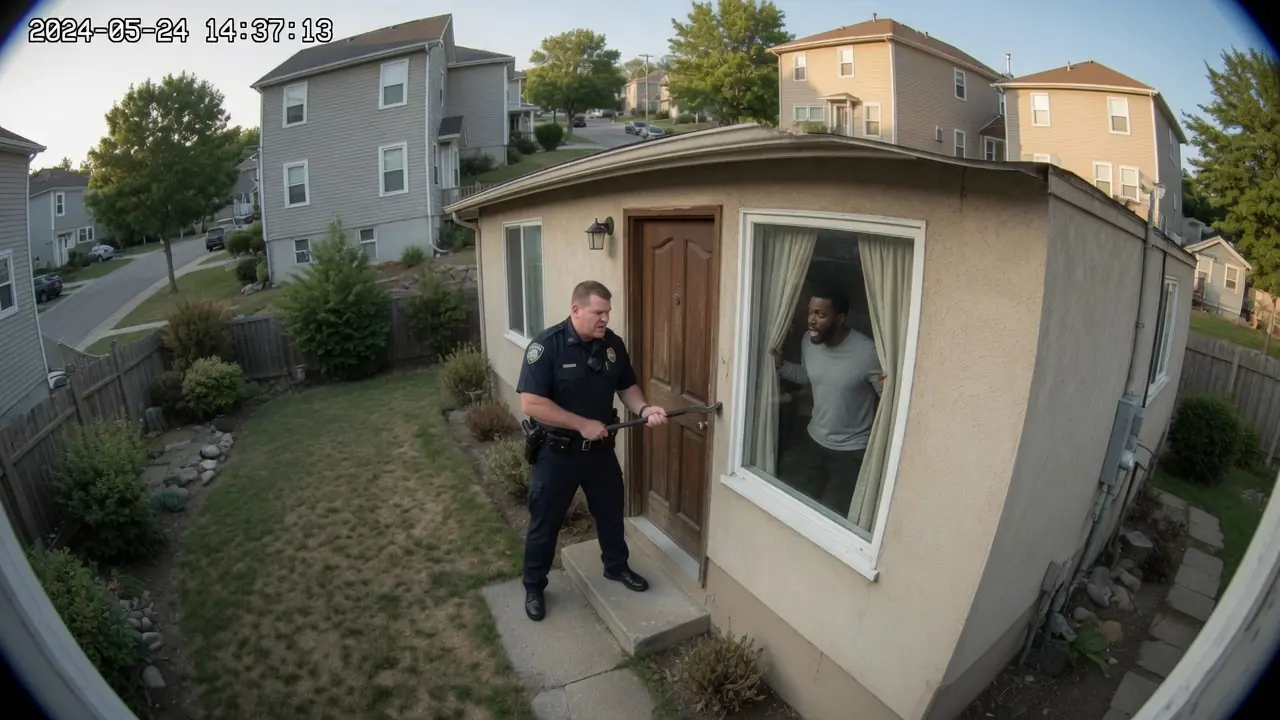
Marcus approached the door and struck the frame with his fist.
“Police. Open up.”
Nathan did not immediately comply.
Protocol required identification and verification before opening an active safe house to unexpected law enforcement.
He checked the exterior monitor.
Only one officer.
No emergency vehicles.
No visible injured person.
No evidence of a pursuit.
Nathan moved near the door with his federal credentials.
Marcus knocked again.
“Sir, open this door. I’m responding to a disturbance complaint.”
Nathan stood two feet from the entrance.
“Officer, I hear you.”
Marcus stopped knocking.
“I need you to listen carefully,” Nathan continued. “This property is under federal protection. I am a federal officer. I will cooperate, but before I open the door, I need you to contact dispatch and request a jurisdiction check on this address.”
The silence outside lasted two seconds.
“Open the door.”
“Do you have a warrant?”
“I don’t need one for a disturbance in progress.”
“There is no disturbance in progress.”
“I’ll decide that.”
Nathan recognized the tone.
Some officers regarded questions as information.
Others heard them as resistance.
Nathan kept his voice even.
“The federal designation number is on the plaque beside the entrance. Read it to dispatch. They will provide instructions.”
Marcus glanced at the brass plaque.
He saw several lines of small writing and dismissed them as property-management information.
“You have ten seconds to open this door.”
Nathan pressed his credential against the narrow pane of glass beside the frame.
The federal seal, his photograph, and identification number were visible.
“I am displaying my credentials.”
Marcus looked toward the card.
For one brief moment, Nathan believed he might stop.
Then Marcus said, “That could be fake.”
“Call it in.”
“You don’t give me orders.”
“I am giving you a way to verify the situation before either of us creates a larger problem.”
Marcus reached toward the metal bar stored in his patrol vehicle’s emergency kit.
Nathan saw him step away from the porch.
Inside the basement, Aaron watched the news with the volume low.
He had not yet heard the conversation.
Nathan touched the communication panel on the wall but did not activate the breach alert.
Not yet.
He wanted to avoid unnecessary escalation.
Marcus returned carrying the pry tool.
“Last chance.”
Nathan spoke through the door.
“Officer Hale, do not force entry.”
Hearing his name made Marcus feel exposed rather than reassured.
“You’ve been watching me.”
“Yes.”
“Why?”
“Because protecting this property is my job.”
“What’s inside?”
“Information you are not cleared to receive.”
Marcus’s suspicion became certainty.
A man hiding behind a locked door.
Special equipment visible through the window.
A property owned by a holding company.
Refusal to explain who or what was inside.
Each detail appeared to confirm his belief that criminal activity was occurring.
He did not consider that real criminals rarely announced federal jurisdiction and invite an officer to verify it.
“Open the door.”
Nathan extended the credential again.
“Read the identification number to your dispatcher.”
Marcus wedged the tool between the frame and the lock.
Nathan exhaled.
He had spent years in rooms where men made dangerous decisions under pressure.
The most difficult situations were not always created by cruelty.
Sometimes they were created by people who believed changing course would make them look weak.
Marcus pulled the pry bar.
The wood cracked.
Nathan stepped backward and pressed the silent alert.
No alarm sounded.
No light flashed.
The message traveled through a dedicated line to a federal operations center forty miles away.
SAFE HOUSE BREACH CONFIRMED.
The door burst inward.
Marcus entered with one hand on his holster.
Nathan stood four feet away, credentials raised.
“Don’t move.”
“My hands are visible.”
“Get on the floor.”
“No.”
Marcus stared at him.
Nathan’s refusal was calm, not aggressive.
That irritated Marcus more than panic would have.
“I am a federal officer,” Nathan said. “I am not a threat to you. But you need to understand that this property contains a protected witness.”
A crash came from below.
Aaron had heard the door breaking.
Years of fear compressed into that single sound.
He knocked over a chair while retreating toward the reinforced room.
Marcus looked toward the floor.
“Who else is here?”
“A protected individual.”
“Bring him up.”
“No.”
“Now.”
“You do not have authorization.”
Marcus moved farther inside.
Communication equipment lined one wall.
Federal inventory labels marked several cases.
A secure relay panel displayed lights he did not understand.
For the first time, doubt entered his expression.
Nathan saw it.
“This is the moment to stop,” he said.
Marcus looked at him.
“Read the credentials. Call your supervisor. Do not make the next decision before checking the first one.”
The words might have reached another officer.
Marcus heard judgment.
He unsnapped his holster.
Nathan remained still.
“That is a serious mistake.”
“Get down.”
“Not because I intend to resist.”
Nathan nodded toward the window.
“Because people are already responding, and they will see a local officer reaching for a weapon inside a classified protective site.”
Marcus’s breathing quickened.
“You’re threatening me.”
“No.”
Nathan’s voice remained steady.
“I’m explaining what happens next.”
Forty miles away, duty officer Adrianna Vega received the breach alert.
The property code appeared on her monitor alongside the operation name.
HAVEN GLASS.
She opened the active file.
Safe house.
One protection officer.
One high-risk witness.
Extraction scheduled in seventy-two hours.
No local law-enforcement activity authorized.
Adrianna called the standby tactical coordinator.
“Confirmed breach at Pembroke Lane.”
“Known threat?”
“Local patrol officer forced entry. Status of protection officer unknown.”
The coordinator did not ask why.
“Moving.”
Three unmarked vehicles left a staging facility twelve minutes from the house.
Adrianna followed in a fourth.
No sirens.
No marked federal units.
The tactical team had reviewed the property before the assignment became active. They knew the floor plan, neighborhood, access points, and location of the protected room.
Their response was designed around speed without spectacle.
The first vehicle stopped at the northern intersection.
Another entered from the south.
Team members moved behind homes and fences to secure the rear.
Others covered the front windows.
Within minutes, Pembroke Lane ceased functioning as an ordinary public street.
Inside, Marcus continued trying to regain control.
Nathan held his identification at arm’s length.
“Look at it.”
“I’ve seen fake federal badges.”
“Have you seen this seal?”
Marcus barely glanced.
“Read the designation number.”
“I’m conducting an investigation.”
“This is not your investigation.”
The sentence struck him hard.
Marcus’s career had been shaped by the belief that other people prevented him from receiving the authority he deserved.
Supervisors.
Promotion boards.
Complainants.
Now the man in front of him spoke as though Marcus’s authority did not apply at all.
“You don’t decide where my jurisdiction ends.”
“No.”
Nathan looked toward the brass plaque outside the broken door.
“The law already decided.”
Marcus’s hand moved closer to the pistol.
Nathan saw the black vehicles arrive through the blinds.
He heard nothing.
That was how he knew the response team had taken the block.
Marcus noticed the change in the street seconds later.
A figure crossed between two neighboring houses.
Another knelt behind a parked SUV.
His radio remained silent.
No supervisor warned him.
No dispatcher announced incoming units.
The response had formed around him without involving his department.
“What is this?” he asked.
Nathan moved toward the left edge of the window.
“This is what happens when someone breaches a protected federal property.”
Marcus looked toward the equipment again.
Then the broken door.
Then Nathan’s credentials.
He finally began seeing the room rather than the story he had created before entering it.
“I responded to a call.”
“I know.”
“There was suspicious activity.”
“There was a man looking through his own window.”
“He refused entry.”
“He requested verification.”
Marcus’s radio crackled.
“Unit Twelve, supervisor requesting immediate status.”
He ignored it.
“This is a setup,” he said.
Nathan’s expression did not change.
“Who set you up?”
“The caller.”
“Possibly.”
“My department.”
“Unlikely.”
“You.”
Nathan shook his head.
“You arrived here without anyone inviting you. I gave you three ways to verify the property.”
Marcus’s face tightened.
“Stop trying to build a defense while the event is still happening.”
“You don’t know me.”
“I know you had choices.”
Marcus stepped forward.
His hand began to rise.
The front window filled with red light.
Four laser points appeared on his chest.
That was where the story had begun for him.
The moment his body finally understood what his pride had refused to accept.
He raised his hands.
Special Agent Adrianna Vega entered.
After securing Marcus, she checked Nathan first.
“You injured?”
“No.”
“Witness?”
“Alive. Panicked.”
“Compromise exposure?”
“Address transmitted through local dispatch. Exterior entry visible from the street.”
Adrianna nodded.
“Move him tonight.”
Nathan looked toward the basement.
“He was not prepared for immediate extraction.”
“He no longer has the option.”
The tactical team escorted Marcus away from his weapon but did not handcuff him immediately.
He stood near the wall as Adrianna explained the situation.
The property had been federally designated fourteen months earlier.
The designation appeared in restricted law-enforcement databases.
Any officer entering the address should have received an instruction to contact the task-force duty line.
The brass plaque contained the reference code.
Nathan’s credentials were valid.
The protected individual was a central witness in a federal criminal prosecution.
Because Marcus forced entry, the location could no longer be treated as secure.
The witness had to be moved.
Vehicles, routes, and personnel planned for a later extraction now had to change within hours.
Marcus listened.
His face became paler with each detail.
“I had probable cause,” he said when Adrianna finished.
“For what specific offense?”
“Possible domestic disturbance.”
“Did you hear fighting?”
“No.”
“See an injured person?”
“No.”
“Receive a report of a weapon?”
“No.”
“Receive a named complainant?”
“No.”
“He was watching me.”
Adrianna looked toward Nathan.
“From inside the residence he was assigned to protect.”
Marcus’s jaw tightened.
“The house looked suspicious.”
“That is not a crime.”
“He refused to open the door.”
“He identified himself, displayed credentials, cited the property designation, and requested supervisor verification.”
Adrianna took a step closer.
“You did not misunderstand one unclear fact, Officer Hale.”
“You were given correct information repeatedly.”
Marcus looked toward Nathan.
“He could have opened the door.”
Nathan answered without anger.
“And exposed the witness to an unverified person wearing a local police uniform.”
“I am a legitimate officer.”
“The organization pursuing Aaron Voss has used police information before.”
The statement changed the room.
Nathan continued.
“His location was protected from local systems for a reason.”
Marcus understood the implication.
The protocols were not designed to insult him.
They existed because a badge alone was not proof that opening the door was safe.
Adrianna’s radio transmitted a short update.
“Asset secure. Preparing movement.”
Marcus lowered his eyes.
“What happens now?”
“That depends partly on the United States Attorney’s Office.”
“I mean to me.”
Adrianna studied him.
“That question should have occurred to you before the door broke.”
Police Chief Lawrence Bennett arrived twenty-five minutes later.
He came alone in an unmarked sedan.
Marcus watched him cross the lawn and step over the shattered frame.
Chief Bennett was sixty, lean, and rarely raised his voice. He had led the department for eight years and was known for treating anger as a condition that impaired judgment rather than evidence of strength.
He looked toward Adrianna.
Then Nathan.
Finally, Marcus.
His expression carried no surprise.
Only disappointment.
“Chief,” Marcus began.
Bennett lifted one hand.
“Not yet.”
Adrianna summarized the incident.
She described the anonymous call, property designation, displayed credentials, forced entry, threatened weapon access, and federal response.
Bennett listened without interrupting.
When she finished, he stood before Marcus.
“Your badge.”
Marcus stared.
“Chief, I need to explain.”
“Your badge and weapon.”
“I responded based on the information I had.”
“You were given more information at the door.”
“He could have been lying.”
“That is why databases and supervisors exist.”
Marcus’s face hardened.
“You weren’t here.”
“No.”
Bennett looked toward the broken frame.
“But you were.”
The words silenced him.
Marcus unclipped his badge.
He had carried it for fifteen years.
The metal had worn smooth along one edge from repeated handling.
For a second, he held it between both hands.
Then placed it in the chief’s palm.
The pistol came next.
He removed it carefully, cleared the chamber, and handed it over grip first.
Bennett accepted both.
“You had options at every stage tonight,” he said.
“The vague call was an opportunity to observe.”
“The plaque was an opportunity to verify.”
“The credentials were an opportunity to slow down.”
“The request for a supervisor was an opportunity to step back.”
Bennett’s expression remained controlled.
“You treated every exit as a challenge to your authority.”
Marcus said nothing.
Two federal officers positioned themselves beside him.
“Am I under arrest?” he asked.
Adrianna answered.
“You are being detained while federal prosecutors review the breach.”
Marcus looked toward Chief Bennett.
The chief did not intervene.
For the first time in his career, Marcus understood that the badge had never made him the most powerful person in a room.
It had only made his decisions more consequential.
He walked through the broken doorway without looking at Nathan.
Outside, neighbors watched from porches and windows.
The same people Marcus had believed might be in danger now saw him escorted toward an unmarked vehicle.
No sirens sounded.
No cameras waited.
There was no dramatic public humiliation.
Only a quiet transfer of control.
Aaron Voss left the basement twenty minutes later.
He wore a plain jacket and baseball cap. His face looked gray from fear.
Nathan met him near the concealed stairwell.
“They found us,” Aaron whispered.
“One officer found the house.”
“Then they know.”
“We don’t know that.”
“He transmitted the address.”
“The destination changes tonight.”
Aaron looked toward the shattered entrance.
“How can you be sure the next place is safe?”
Nathan considered lying.
Protection work often required confidence even when certainty was impossible.
Instead, he answered honestly.
“I cannot guarantee that nothing will happen.”
Aaron’s eyes widened.
Nathan continued.
“I can guarantee that we plan for what happens after it does.”
The response team placed Aaron inside a vehicle that differed from every car named in the original extraction plan.
The convoy divided three times after leaving the neighborhood.
One vehicle drove north.
Another west.
Aaron’s vehicle entered an underground facility downtown, transferred him to a second transport, and departed through another exit.
Before dawn, he occupied a secure location Marcus would never know.
Nathan remained on Pembroke Lane while technicians removed equipment.
The safe house had to be decommissioned immediately.
Hard drives were cleared.
Communication systems disconnected.
Interior records destroyed or removed.
By morning, the house once again looked ordinary except for the broken door.
The organization Aaron had served learned nothing useful from the incident.
His testimony proceeded two months later.
It led to indictments against eleven defendants, including three senior leaders previously believed untouchable.
Marcus Hale’s career ended more quietly.
Federal prosecutors ultimately charged him with unlawful entry into protected federal property and interference with an active witness-security operation.
His attorney argued that he acted in good faith while responding to a legitimate call.
The prosecution acknowledged the call.
Then played the audio from Nathan’s interior security system.
The jury heard Nathan identify himself.
Request a jurisdiction check.
Display credentials.
Direct Marcus toward the federal plaque.
Ask for a supervisor.
Warn him not to breach.
Each recording removed another part of the misunderstanding defense.
The trial was not about whether Marcus knew everything inside the house.
He was not supposed to know.
It was about what a reasonable officer should do when confronted with information requiring verification.
Marcus testified that he feared evidence might be destroyed or someone inside might be harmed.
The prosecutor asked what evidence of either possibility existed.
He had no clear answer.
The department’s internal review reopened his earlier complaints.
Investigators discovered the same pattern.
Marcus frequently interpreted questions as defiance.
He often escalated after people requested explanations.
His reports emphasized movements and tones while minimizing his own commands.
Supervisors had warned him repeatedly.
The promotion boards had not denied him advancement because he lacked courage.
They had refused because his judgment under challenge was unreliable.
That truth damaged him more than the conviction.
For years, he believed the department failed to recognize his strength.
In reality, it had recognized his danger.
Marcus lost his certification.
He received a reduced federal sentence after accepting responsibility and agreeing to complete additional evaluations.
Chief Bennett visited once before sentencing.
Marcus sat across from him in a small conference room.
“You came to say you were right?” Marcus asked.
“No.”
“Then why?”
Bennett folded his hands.
“Because I want you to understand something before you build the rest of your life around blaming that house.”
Marcus looked away.
“The house did not end your career.”
“I made a mistake.”
“You made a sequence.”
Bennett leaned forward.
“Mistakes happen quickly. You were offered corrections repeatedly.”
Marcus’s expression tightened.
“So what am I supposed to do? Spend the rest of my life admitting I’m some kind of monster?”
“No.”
Bennett stood.
“You begin by admitting you were wrong without adding the word but.”
Nathan received no commendation for the incident.
His report described the breach, response, and extraction in restrained language.
He did not mention Marcus’s anger beyond what operationally mattered.
When Adrianna reviewed the report, she looked toward him.
“You could have made him look worse.”
“He did enough himself.”
“He almost drew on you.”
“He did not.”
“Because four rifles stopped him.”
Nathan closed the file.
“Then the system worked.”
Adrianna studied him.
“Do you ever get angry?”
“Yes.”
“You hide it well.”
“No.”
Nathan looked toward the rain outside the federal building.
“I decide whether it is useful.”
Three weeks later, he drove past Pembroke Lane.
The damaged door had been replaced.
A family had moved into the house through a government property contractor.
Children’s bicycles rested on the porch.
A flowerpot stood near the entrance.
The brass plaque was gone.
To the neighbors, the strange night became an uncertain story.
Some believed police had raided a criminal house.
Others said federal agents arrested a corrupt officer.
A few claimed the property hid a spy.
No official explanation was released.
The street returned to normal.
Nathan knew better than to trust normal.
Still, he slowed briefly near the house.
A little girl drew circles on the driveway with blue chalk.
Her father carried grocery bags toward the door.
Nothing about the scene required protection.
Nothing appeared hidden.
Nathan continued driving.
Years later, new federal protection officers studied the Pembroke Lane breach during training.
The lesson was not presented as a story about one foolish patrol officer.
It was used to demonstrate how quickly authority could turn uncertainty into danger.
The instructors paused the recording after Nathan displayed his credentials.
“What should the local officer do now?”
Call dispatch.
Request a supervisor.
Secure the exterior.
Do not enter.
Verify jurisdiction.
The correct response required less courage than forcing the door.
It required more discipline.
Another instructor asked why Nathan did not immediately open the entrance after identifying himself.
A trainee answered:
“Because the uniform outside was not the person he was assigned to protect.”
The lesson ended with Marcus’s hand moving toward his weapon.
The frame froze before the red dots appeared.
The instructor looked around the classroom.
“Power is not the ability to force the next step.”
He pointed toward Nathan standing calmly in the image.
“Sometimes power is understanding which step you are not authorized to take.”
The first mistake Marcus Hale made was believing the house was ordinary.
But ordinary appearances were not what destroyed him.
The second mistake was not merely forcing the door.
His career ended because he had been given warning after warning and treated every one as an insult.
A plaque.
A credential.
A designation number.
A request for dispatch.
A request for a supervisor.
A final explanation.
At every point, he could have stopped.
He entered Pembroke Lane believing authority meant other people had to answer him immediately.
He left understanding that his own actions would now require answers.
Nathan never struck him.
Never drew a weapon.
Never raised his voice.
He did not need to.
Real discipline rarely announces itself.
It waits.
It verifies.
It prepares.
And when the four red dots appeared across Marcus Hale’s chest, they did not create the consequence.
They simply made visible the line he had already crossed.