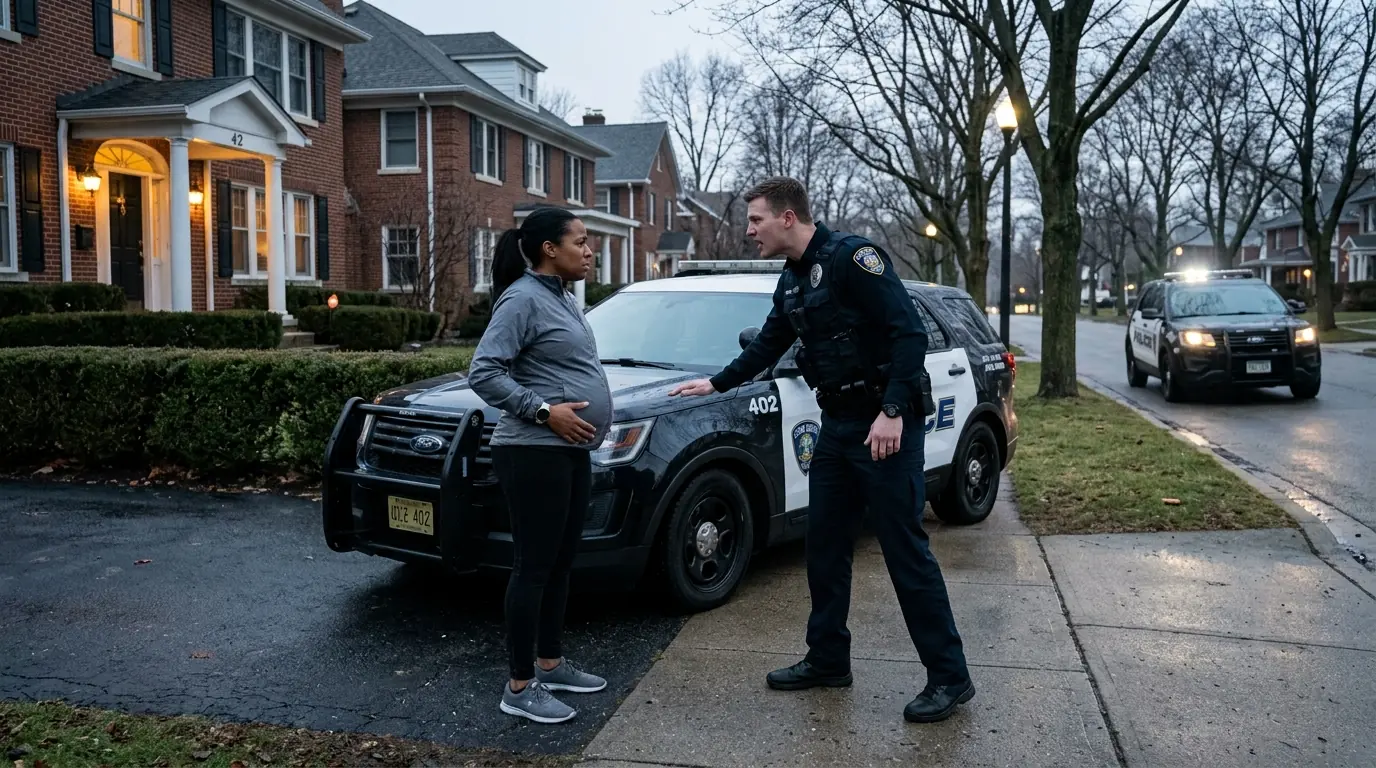
Officer Nathan Cole’s body camera had been recording for eleven minutes when he ordered the pregnant woman to place her hands on the hood of his patrol car.
She did not move.
Cold February air passed between them, carrying the smell of damp pavement and wood smoke from the houses lining Briarwood Avenue.
The woman wore black running leggings, a dark blue jacket, and gray shoes marked by road salt. One hand rested beneath the curve of her stomach.
She was visibly pregnant.
Nathan had noticed that immediately.
It had not made him less suspicious.
“Turn around,” he repeated.
The woman studied his face.
“Explain why you intend to search me.”
“I said it’s a safety check.”
“For what weapon?”
“You’re refusing a lawful instruction.”
“I’m asking whether the instruction is lawful.”
Nathan moved one step closer.
“I don’t need you teaching me procedure.”
“No,” she said quietly. “But someone should.”
The answer struck him harder than if she had shouted.
A curtain shifted inside the house across the street. Nathan knew the caller was watching.
A second patrol officer stood ten feet away, uncertain whether to intervene.
Nathan could feel the entire encounter slipping beyond his control.
That was exactly why he refused to end it.
He reached toward the woman’s elbow.
She stepped back.
“Do not touch me.”
“Stop resisting.”
“You have not arrested me.”
“I ordered you to turn around.”
“And I asked what crime you reasonably suspect me of committing.”
Nathan’s face reddened.
The woman inhaled sharply.
Her hand moved from beneath her stomach to the right side of her abdomen.
For the first time, Nathan’s certainty wavered.
“What’s wrong?”
“My back is tightening.”
“Do you need an ambulance?”
“No. I need you to stop prolonging this.”
“You are prolonging it.”
A black police SUV turned onto Briarwood Avenue.
It approached much faster than the residential speed limit allowed.
The vehicle stopped behind Nathan’s patrol car.
Deputy Chief Raymond Lawson stepped out before the engine had fully settled.
Nathan straightened.
He expected Lawson to take control of the scene, confirm the detention, and tell the woman that arguing with an officer only made matters worse.
Instead, the deputy chief walked past him.
He stopped in front of the woman.
“Commander Grant,” he said, breathing hard. “Are you hurt?”
Nathan felt the blood leave his face.
The woman looked toward Lawson.
“I’m cold. My lower back hurts. Otherwise, I’m fine.”
Lawson turned slowly.
“Nathan, this is Commander Vivian Grant.”
Nathan stared at her.
The running clothes remained the same.
So did the tired face, damp hair, and visibly swollen stomach.
But he suddenly saw everything differently.
Lawson continued.
“She assumes command of the East Borough Precinct at eight o’clock this morning.”
The entire street became silent.
Nathan’s mouth opened.
Nothing came out.
Vivian looked at him.
“Officer Cole, am I free to leave?”
“Yes, ma’am.”
“Was I detained?”
Nathan swallowed.
“Yes, Commander.”
“For suspicion of what crime?”
His eyes moved toward the notebook in his hand.
“Possible burglary activity.”
“What specific conduct indicated a burglary?”
“You were stopping in front of houses.”
“I moved into number eighteen last night. I was checking the addresses so I could find my way back.”
“You had no identification.”
“I was jogging.”
“The resident said you looked suspicious.”
“Did she report seeing me enter private property?”
“No.”
“Did she see me touch a window, vehicle, door, or mailbox?”
“No.”
“Did you observe any of those things?”
“No, Commander.”
Vivian’s voice remained controlled.
“Then what transformed a woman checking house numbers into a burglary suspect?”
Nathan glanced toward the home across the street.
The curtain had closed.
He had no answer.
Twenty minutes earlier, he had possessed nothing but answers.
Vivian Grant had arrived in Brookhaven, Virginia, shortly before midnight.
Most of her belongings remained sealed inside boxes.
The kitchen table was still disassembled. The refrigerator contained bottled water, yogurt, and a carton of milk purchased at a gas station.
A framed photograph of her husband remained wrapped in a moving blanket beside the fireplace.
Vivian had carried it inside herself.
Then she had left it there because deciding where to place it felt like admitting that Michael would never walk into this new home.
Detective Michael Grant had died nine months earlier.
He had been driving home after a late shift when he saw a masked man enter a pharmacy carrying a shotgun.
Michael was off duty.
He still stopped.
By the time uniformed officers arrived, he had moved three customers into a storeroom and attempted to draw the gunman away from them.
The first shot struck his shoulder.
The second entered below his vest.
Vivian had been presenting a case review when he called.
She did not answer because her phone was silenced.
She missed the second call too.
At the hospital, a nurse gave her his phone.
Two unanswered calls appeared above a voice message Vivian could not bring herself to open for almost a month.
She had been thirteen weeks pregnant.
Michael knew about the baby.
He had already purchased a small baseball glove and hidden it inside their bedroom closet.
Three days after the funeral, Vivian felt their son move for the first time.
Grief and life had existed inside her body together ever since.
The transfer to Brookhaven offered a promotion and a chance to leave the apartment where every room reminded her of the future she had lost.
At forty years old, Vivian had served eighteen years in law enforcement.
She began in patrol.
Worked narcotics.
Led a violent-crime unit.
Spent three years overseeing internal investigations.
She was not naive about police work.
Calls arrived incomplete.
Witnesses lied.
People concealed weapons in unlikely places.
Officers sometimes had seconds to make decisions that would later be judged through hours of video review.
Vivian understood all of that.
What she did not accept was using uncertainty as permission to ignore judgment.
She had gone running before dawn because pregnancy made sleep difficult.
Her doctor encouraged light exercise, and the steady movement eased the pressure in her lower back.
She had travelled less than a mile when a patrol car crossed the sidewalk and stopped directly in front of her.
Nathan Cole stepped from behind the wheel.
“Ma’am, stop there.”
Vivian stopped.
Nathan was twenty-nine, tall, fit, and carefully groomed. His uniform looked new despite three years of service.
His right hand remained near his holster.
“What’s the problem?” she asked.
“We received a report of suspicious activity.”
Vivian looked at the quiet street.
“And you believe that is me?”
“I’m asking the questions.”
The answer came immediately.
Not because she posed danger.
Because Nathan needed to establish the order of the encounter.
Vivian read his nameplate.
COLE.
She recognized it.
Officer Nathan Cole.
Three commendations.
Excellent firearm scores.
High numbers of field interviews and misdemeanor arrests.
Five civilian complaints in thirty-six months.
All closed without sustained findings.
Vivian had reviewed the summaries but not the complete recordings.
She intended to study them after formally assuming command.
Now one of the files stood before her.
“What was reported?” she asked.
“A woman walking slowly, looking at houses, and checking numbers.”
“I moved into number eighteen last night. I was checking street addresses.”
Nathan glanced toward the houses.
“You live here?”
“Yes.”
“Since when?”
“I answered that.”
“Do you have identification?”
“No.”
“You went outside without ID?”
“I have medical identification on my watch.”
“That isn’t government identification.”
“No.”
“What’s your name?”
“Vivian Grant.”
“Date of birth?”
She provided it.
“What do you do?”
“I work for the city.”
“Which department?”
“The police department.”
Nathan’s eyes narrowed.
“Doing what?”
Vivian could have ended the stop.
One sentence would have changed his voice.
She could have told him she was the incoming precinct commander.
He would straighten, apologize, and begin explaining that the caller had sounded concerned and that he was only being thorough.
But Vivian wanted to know how he treated a person without rank.
A pregnant resident.
A woman wearing inexpensive running clothes.
Someone whose discomfort could be ignored without career consequences.
“Administrative work,” she said.
It was not false.
Command was administration with consequences.
Nathan laughed once.
“You expect me to believe that?”
“I expect you to verify my information.”
He contacted dispatch.
Vivian gave her previous Richmond address because her driver’s license had not yet been updated.
The records check returned valid.
No warrants.
No criminal history.
Registered vehicle at the old address.
Nathan appeared pleased by the discrepancy.
“You said you live here.”
“I moved yesterday.”
“And your license still shows Richmond.”
“Yes.”
“That’s convenient.”
“It has been less than twelve hours.”
The stop should have ended there.
Nathan had a verified identity.
No report of a crime.
No observed illegal conduct.
A reasonable explanation consistent with what he saw.
Yet ending the encounter required him to admit the original suspicion had not developed into anything.
Instead, he began asking more questions.
Who owned the house?
Where was her lease?
Why was she outside so early?
Why would a heavily pregnant woman run alone?
Where was her husband?
Vivian answered until the last question.
“My husband is dead.”
Nathan’s face changed briefly.
“I’m sorry, but I still need to verify where you belong.”
The wording stayed with her.
Where you belong.
Not whether she had committed a crime.
Whether Nathan accepted her presence.
Vivian asked whether she was detained.
He asked why an innocent person would care.
She requested a supervisor.
He warned that waiting would take longer.
When her back began tightening, she asked to sit on a low stone wall.
Nathan told her to use the curb.
“I’m thirty-two weeks pregnant,” she said. “Getting down to the pavement is difficult.”
“You were able to run.”
“Running does not require lowering my body to a six-inch curb.”
He allowed her to remain standing.
Then he decided to conduct a pat-down.
That was when Officer Priya Shah arrived.
Priya had been with the Brookhaven Police Department for seven years.
She heard Nathan request a supervisor over the radio and recognized the irritation in his voice.
When she reached Briarwood Avenue, Vivian stood in the cold while Nathan positioned himself between her and the stone wall.
“What do we have?” Priya asked.
Nathan answered first.
“Suspicious-person report. She claims she moved into number eighteen, but she doesn’t have proof. Address isn’t updated. She’s refusing a safety search.”
Priya looked at Vivian.
The woman’s fitted clothing concealed almost nothing larger than a phone, which she did not appear to possess.
“What did the caller observe?”
“Checking houses.”
“Entering yards?”
“No.”
“Trying doors?”
“No.”
“Looking inside cars?”
Nathan’s jaw tightened.
“We’ve had burglaries.”
“Not in this neighborhood.”
“I’m handling it.”
“You requested a supervisor.”
“I requested Lawson.”
Priya turned toward Vivian.
“Are you experiencing a medical emergency?”
“No. My back is uncomfortable.”
“Would you like to sit?”
“On the wall, please.”
Priya nodded.
Nathan stepped forward.
“She needs to stay where I can see her hands.”
“You can see her hands from here.”
Vivian sat carefully.
Relief crossed her face.
Priya asked for her name.
“Vivian Grant.”
Priya’s expression changed.
An internal department email two days earlier had announced the appointment of Commander Vivian Grant, former head of Richmond’s Major Crimes Bureau.
There was no photograph attached.
The name was enough.
Priya looked toward Nathan.
Vivian gave the smallest shake of her head.
Not yet.
Priya understood.
A resident emerged from the house across the street.
She was an older woman wearing a wool robe and holding a coffee mug.
“Officer,” she called. “I’m the person who called.”
Nathan walked toward her.
“You saw this woman looking at houses?”
“Yes.”
“Did she enter any property?”
“No.”
“Touch anything?”
“No.”
“Look inside vehicles?”
“I couldn’t see clearly.”
“What specifically made you believe a crime might be happening?”
The woman hesitated.
“She looked out of place.”
Nathan wrote the phrase in his notebook without questioning it.
Priya did.
“What does out of place mean?”
The caller became defensive.
“This is a quiet neighborhood. We watch out for one another.”
“Was it her clothing?”
“No.”
“Her behavior?”
“She kept stopping.”
“To read numbers?”
“I didn’t know that.”
Priya looked toward Nathan.
The report contained discomfort.
Not criminal conduct.
Nathan returned to the patrol car and checked the property database.
The listed owner was a company connected to a relocation service, not Vivian.
He treated that as contradiction.
Vivian explained she was renting through the city’s executive-transfer program.
Nathan asked for the landlord’s phone number.
It was inside her house.
He accused her of expecting police to believe every answer without evidence.
Vivian asked him to identify the suspected offense.
Nathan replied that her legal vocabulary was “too rehearsed.”
Then he ordered her against the patrol car.
That was the moment Deputy Chief Lawson arrived.
After Vivian walked toward her house, Nathan remained beside the patrol car.
His body camera continued recording.
Deputy Chief Lawson looked at him for several seconds.
“Turn off your emergency equipment and report directly to headquarters.”
“Yes, sir.”
“You are relieved from patrol pending review.”
Nathan glanced toward the house Vivian had entered.
“I didn’t know who she was.”
Lawson’s expression hardened.
“That sentence is the problem.”
“I followed a call.”
“You followed it where?”
Nathan said nothing.
Lawson turned toward Priya.
“Preserve both body cameras. Contact dispatch and flag the call recording.”
“Yes, Chief.”
“Write your report before discussing the incident with anyone.”
“Yes, sir.”
The caller remained on her porch.
Lawson walked toward her.
“Ma’am, did Commander Grant threaten you?”
“No.”
“Enter your property?”
“No.”
“Damage anything?”
“No.”
“What outcome did you expect when you called us?”
“I expected an officer to check.”
“That occurred.”
The woman looked toward Nathan.
“I didn’t tell him to do all that.”
“No.”
Lawson’s voice remained calm.
“But calls based only on who looks like they belong can create consequences the caller never sees.”
She lowered her eyes.
“I was trying to help.”
“Then next time, describe behavior. Not belonging.”
At eight twenty-three, Vivian entered the East Borough Precinct wearing her dark uniform.
Gold commander’s insignia rested at her collar.
Her hair was pulled tightly back.
No sign remained of the woman who had stood shivering beside a patrol car, except for the way she lowered herself carefully into a chair before briefing.
Nearly seventy officers filled the room.
They stood when she entered.
Vivian placed her prepared speech on the lectern.
She had written it the previous week.
Community partnership.
Officer safety.
Investigative standards.
Accountability.
The honor of public service.
She closed the folder without reading it.
“At 5:38 this morning, I was detained while jogging near my new home.”
The officers looked toward one another.
“The officer did not know my position.”
Vivian paused.
“That fact is almost irrelevant.”
Deputy Chief Lawson stood near the wall.
Priya occupied the front row.
Nathan was absent.
“The officer was correct to respond to a citizen call. Police work frequently begins with incomplete or inaccurate information.”
Several officers relaxed slightly.
“He was also correct to ask initial questions.”
Vivian looked around the room.
“The problem began when every answer inconsistent with his assumption became evidence that I was deceptive.”
No one moved.
“He verified my identity. Found no warrants. Observed no criminal act. Received no report of a criminal act. Yet the encounter escalated because ending it would have required him to reconsider his first conclusion.”
Her palm rested on the lectern.
“He treated knowledge of constitutional limits as hostility.”
She looked toward the officers.
“He treated pregnancy as an inconvenience until he learned rank made my discomfort important.”
A young officer near the rear lowered his eyes.
“Character in this profession is not revealed by how respectfully you treat a commander.”
Vivian’s voice softened.
“It is revealed by how you treat the person you believe cannot affect your career.”
She dismissed patrol teams to duty.
Then she asked Lawson to remain.
Inside the commander’s office, Lawson closed the door.
“I apologize.”
Vivian lowered herself into the desk chair.
“For what?”
“The conduct of an officer under my supervision.”
“You read Nathan Cole’s complaint summaries?”
“Yes.”
“You signed two closure memoranda.”
“Yes.”
“Did you review the body-camera recordings?”
Lawson hesitated.
“Not all of them.”
“How many?”
“One.”
“Out of five?”
“Yes.”
“Why?”
“Internal Affairs reviewed the footage. The investigator found no policy violation.”
“You read the investigator’s conclusions.”
“Yes.”
“You did not examine the evidence.”
Lawson looked toward the window.
“We receive hundreds of complaints.”
“And Officer Cole produced high arrest and field-contact numbers.”
“He was considered proactive.”
“That made the summaries easier to accept.”
Lawson did not answer.
Vivian opened Cole’s first complaint file.
“A nurse walking home after a hospital shift was stopped because she carried a dark bag.”
“She generally matched a description.”
“The description was a male in a dark jacket carrying a backpack.”
Lawson rubbed one hand across his jaw.
“She consented to the bag search.”
“The footage shows her asking whether she could leave.”
“She eventually said, ‘Fine, look.’”
“After Cole told her refusing would prolong the stop.”
Lawson sat down.
Vivian opened another file.
“A college student waited outside his grandmother’s townhouse. Cole detained him until the grandmother came outside.”
“He could not provide the exact unit number.”
“He had never visited before.”
Another file.
“A delivery driver was placed in handcuffs after entering the wrong apartment complex.”
“He kept reaching inside the truck.”
“For his delivery manifest.”
Lawson closed his eyes briefly.
“I trusted the reviews.”
“You trusted conclusions that asked nothing of you.”
The words settled between them.
“I thought I was a fair supervisor,” Lawson said.
“Being personally fair does not make your supervision fair.”
“I failed.”
“Yes.”
The direct answer surprised him.
Vivian continued.
“What happens next determines whether failure becomes information or identity.”
The review of Nathan Cole’s conduct expanded beyond the morning stop.
Vivian assigned the investigation to an outside municipal oversight unit rather than managing the case herself.
She had been the subject of the encounter.
She could establish policy changes, but she would not personally determine guilt.
The independent investigators examined body cameras, dispatch calls, written reports, and complaint histories.
A pattern emerged.
Nathan did not fabricate evidence.
He did not use excessive physical force.
He did something subtler and more frequent.
He approached civilians expecting deception.
Any delay in answering became suspicious.
Any request for explanation became resistance.
Any attempt to preserve dignity became a challenge.
His reports described nearly every questioned civilian as nervous, evasive, confrontational, or uncooperative.
The videos often showed people who were confused, frightened, tired, disabled, or simply unwilling to accept unnecessary humiliation.
Nathan’s performance reports praised his productivity.
The precinct displayed monthly numbers inside the briefing room.
Stops.
Citations.
Arrests.
Warrants served.
No formal quota existed.
It did not need to.
Officers understood what drew praise.
Priya had lower stop numbers than Nathan.
Her supervisors described her as cautious.
Yet her calls produced fewer complaints, fewer injuries, and more cases resolved without arrest.
Those results had never appeared on the board.
Vivian removed it.
In its place, she created a broader review.
Successful de-escalations.
Legally sound stops.
Complaints and resolutions.
Repeat calls.
Community feedback.
Cases where officers identified danger without manufacturing confrontation.
Some officers objected.
Sergeant Paul Dwyer requested a meeting.
“You’re discouraging proactive policing,” he said.
“No.”
Vivian sat behind her desk with one hand against her stomach.
“I’m discouraging unsupported detention.”
“Officers will become afraid to stop anyone.”
“Do you believe reasonable suspicion is impossible to articulate?”
“No.”
“Then articulate it.”
“Real situations aren’t clean.”
“Legal standards were not designed only for clean situations.”
Dwyer crossed his arms.
“Criminals exploit hesitation.”
“So does ego.”
He stared at her.
Vivian continued.
“An officer who fears ending an unsupported stop is not being proactive. He is protecting his pride with government authority.”
Dwyer left unconvinced.
Vivian expected resistance.
A policy could change in one day.
A culture changed only when the behavior receiving admiration changed with it.
Nathan’s administrative hearing occurred three weeks later.
His union attorney sat beside him.
So did an independent investigator.
Lawson attended as the previous supervisor responsible for the complaint reviews.
Vivian appeared as a witness rather than the deciding official.
Nathan looked exhausted.
“Why did you continue the stop?” the investigator asked.
“The address could not be verified.”
“Why did you believe Commander Grant had committed or was preparing to commit a crime?”
Nathan stared at the table.
“The caller reported suspicious behavior.”
“Describe that behavior.”
“She looked at homes and checked numbers.”
“Did you observe additional conduct?”
“No.”
“Why did you order a pat-down?”
“Officer safety.”
“What specific fact suggested she possessed a weapon?”
Nathan glanced toward his attorney.
The attorney said nothing.
“She challenged everything I said.”
“That is not evidence of a weapon.”
“No.”
“Did you understand that at the time?”
Nathan took a long breath.
“I felt like she was testing me.”
Vivian watched him.
The investigator leaned forward.
“Why would that justify continuing the detention?”
“Because the caller was watching. Then Officer Shah arrived.”
His voice became quieter.
“She kept asking questions I should have known how to answer.”
“You were embarrassed.”
“Yes.”
“And you escalated because ending the stop would have made you appear wrong.”
Nathan nodded.
“Yes.”
The honesty changed the room.
The investigator placed the previous complaints before him.
“Have you done that before?”
Nathan looked at the files.
“Yes.”
His union attorney shifted.
“You are not required to speculate.”
“I’m not speculating.”
Nathan looked toward Vivian.
“My father was a police officer.”
She waited.
“He was killed during a home-invasion call when I was fifteen.”
No one spoke.
“A woman met him outside and said the suspect had already left. The man was hiding in a bedroom.”
Nathan’s hands tightened together.
“My father believed her. He entered without waiting for backup.”
The investigator’s expression softened but did not change course.
“What did you learn from that?”
“That people lie and officers die.”
Vivian spoke for the first time.
“That explains your fear.”
Nathan looked toward her.
“It does not justify transferring punishment to every person you meet.”
“I know.”
“You know consequences have reached you.”
He lowered his eyes.
“Understanding will take longer.”
Nathan received a ninety-day suspension without pay.
He was removed from independent patrol duties for at least six additional months.
Before any return, he was required to complete psychological evaluation, constitutional-policing retraining, report-writing instruction, and supervised community engagement.
Some members of the public demanded termination.
Several officers claimed the discipline was excessive.
The review board concluded termination was legally possible but chose a structured last-chance agreement because Nathan had admitted the misconduct, possessed no sustained force violations, and agreed to intensive monitoring.
One more similar incident would end his employment.
Vivian did not celebrate the outcome.
Discipline was not revenge.
It was a boundary.
Whether Nathan changed would be determined after the embarrassment faded.
His community assignment began at Brookhaven Rehabilitation Hospital.
The facility treated injured firefighters, veterans, police officers, and civilians recovering from strokes, spinal injuries, and traumatic accidents.
Nathan expected clerical work.
Instead, he was assigned to patient transport and supervised assistance.
On the first morning, a therapist introduced him to seventy-eight-year-old Harold Simmons.
Harold had suffered a stroke.
Speech came slowly.
His left hand remained curled against his chest.
The therapist asked Nathan to help guide him toward a raised walking platform.
Nathan approached from behind.
“Sir, move over here.”
Harold became agitated.
His right hand tightened around the walker.
“I need you to follow me,” Nathan said.
Harold shook his head.
The therapist stopped him.
“Ask.”
“I did.”
“No. You issued an instruction.”
Nathan looked at Harold.
The old man’s breathing had quickened.
Nathan crouched where Harold could see him.
“Mr. Simmons, would you like to use the walking platform?”
Harold struggled for several seconds.
“No.”
Nathan almost corrected him.
Instead, he waited.
Harold pointed toward the polished floor beside the platform.
“Light.”
Sunlight reflected from the surface.
The glare made it difficult for his damaged vision to judge depth.
The therapist closed the blinds.
Harold agreed to continue.
Nathan understood something he should have learned years earlier.
People did not always resist because they opposed authority.
Sometimes they possessed information the person giving orders had not bothered to request.
Over the next several months, Nathan worked beside patients who needed time.
A woman with a brain injury repeated questions.
A veteran with post-traumatic stress could not tolerate people approaching from behind.
A retired teacher appeared uncooperative because hearing loss prevented him from understanding instructions.
Nathan learned to leave silence empty.
Not fill it with accusation.
He learned to ask before touching.
He learned that explaining an instruction often produced faster cooperation than repeating it more loudly.
One afternoon, he met Michael Grant’s former partner.
Detective Samuel Ortiz was receiving therapy for a shoulder injury.
He recognized Nathan’s name.
“You stopped Vivian.”
Nathan braced himself.
“Yes.”
Samuel attached a resistance band to the wall.
“She’s had a brutal year.”
“I know.”
“No. You know the public version.”
Samuel looked at him.
“You don’t know what it cost her to accept that command after Michael died.”
Nathan lowered his eyes.
“I asked where her husband was.”
Samuel’s expression tightened.
“Yes.”
“I didn’t know.”
“That sentence follows a lot of damage.”
Nathan nodded.
“I’m trying to learn what should happen before it.”
Samuel studied him for several seconds.
Then he handed him the resistance band.
“Hold this steady.”
Vivian went into labor during a neighborhood meeting five months after the stop.
She was answering a resident’s question about traffic enforcement when a contraction forced her to grip the edge of the table.
Priya noticed first.
“How far apart?”
“I’m not sure.”
Another contraction arrived four minutes later.
Lawson drove her to the hospital.
Priya collected the overnight bag from Vivian’s house.
Her son was born shortly after midnight.
She named him Michael James Grant.
Two days later, a package arrived at the nurses’ station.
Inside was a pair of tiny running shoes.
There was no expensive gift.
Only a handwritten note.
Commander Grant,
When I met you, I believed authority meant forcing people to prove they deserved my trust.
You showed me that authority means proving people are safe in my presence.
I have not earned that yet. I am working on it.
—Nathan Cole
Vivian read the note twice.
She placed it inside Michael’s baby book.
She did not send a reply.
Change demonstrated through words remained only a claim.
Nathan returned to limited patrol under Priya’s direct supervision.
During their second week, dispatch reported an elderly man wandering through backyards near Briarwood Avenue.
The caller described him as suspicious and possibly looking inside homes.
Nathan and Priya found the man standing beside a fence.
He wore bedroom slippers and a thin robe despite freezing temperatures.
Mud covered his knees.
The previous Nathan would have approached with commands.
Hands visible.
Step away from the fence.
Identify yourself.
Instead, he stopped several yards away.
“My name is Nathan. Are you cold?”
The man looked toward him.
“My wife is waiting.”
“What is her name?”
“June.”
Priya checked missing-person reports.
A family nearby had reported an eighty-one-year-old man with dementia missing from home.
His wife, June, had died ten years earlier.
Nathan removed his jacket.
“Let’s find somewhere warm while we look for her.”
The man allowed him to come closer.
No handcuffs.
No shouting.
No forced compliance.
When the family arrived, the man’s daughter began crying.
She hugged Nathan.
He stood awkwardly beneath the embrace.
Priya said nothing until they returned to the vehicle.
“You handled that well.”
Nathan looked toward the house where the family had disappeared.
“A year ago, I would have put him against the fence.”
“I know.”
“He would have been terrified.”
“Yes.”
Nathan started the engine.
“I keep thinking about how many people I made afraid when there wasn’t any danger.”
Priya fastened her seat belt.
“You should think about it.”
He looked toward her.
She continued.
“Just don’t use guilt as another excuse to focus only on yourself.”
Nathan nodded.
The lesson was never finished.
One year after the stop, Lawson retired.
Officers and their families gathered in the precinct briefing room.
Vivian stood near the front holding her infant son.
Michael kept trying to pull the gold insignia from her collar.
Lawson approached the lectern.
“I spent most of my career believing that because I was not cruel, I was a good supervisor.”
The room became quiet.
“I was wrong.”
He looked toward the officers.
“Supervisors are responsible not only for the misconduct they order. We are responsible for the patterns we choose not to examine.”
His eyes found Vivian.
“She made me examine mine.”
After the ceremony, Nathan approached with Priya.
He stopped several feet away.
“Commander.”
“Cole.”
He looked toward Michael.
“He’s grown.”
“That is what babies generally do.”
Priya smiled.
Nathan’s expression became serious.
“I wanted to thank you.”
“For the suspension?”
“For not pretending the stop didn’t matter.”
Vivian adjusted her son.
“I did not protect you from consequences.”
“No.”
“And I did not promise you redemption.”
“No.”
“You built whatever progress you’ve made one call at a time.”
Nathan nodded.
“I also wanted to thank you for not deciding my worst fifteen minutes were the only thing I could ever be.”
Vivian looked at him.
“You will carry those minutes.”
“I do.”
“That is different from living inside them forever.”
Michael reached toward Nathan’s badge.
Nathan waited for permission.
Vivian stepped closer.
The baby touched the silver shield.
Then he immediately lost interest and grabbed Nathan’s pen.
“The pen is apparently more impressive,” Vivian said.
Nathan looked down at the badge.
“It probably should be.”
The encounter on Briarwood Avenue became part of the department’s training curriculum.
New recruits always focused on the final revelation.
Deputy Chief Lawson arriving.
Nathan learning that the pregnant jogger was his incoming commander.
His expression changing on the body-camera footage.
Vivian stopped the video before that moment.
She showed recruits the first eleven minutes without revealing her identity.
They watched Nathan question, dismiss, and escalate.
Then the screen went black.
“What should happen next?” Vivian asked.
Someone in every class eventually answered:
“Verify who she is.”
Vivian shook her head.
“No.”
Another said:
“Call a supervisor.”
“That may be appropriate, but it is not the central answer.”
She stood before them wearing the same insignia Nathan had failed to recognize.
“The correct response is to recognize that the legal basis for the detention has ended.”
She looked across the room.
“If I had been a nurse, teacher, unemployed mother, visitor, cashier, or woman walking home from work, every standard would have been exactly the same.”
The lesson was not to identify important people faster.
It was to stop treating dignity as a privilege unlocked by status.
Vivian played Nathan’s statement from the disciplinary hearing.
People were watching. I didn’t want to look weak.
She paused the recording.
“This profession will regularly place you in situations where ending an encounter feels personally embarrassing.”
She let the silence remain.
“End it anyway.”
The recruits wrote that down.
Years later, Nathan became a field-training officer.
He never hid the footage.
On the first day with each new recruit, he showed them the encounter himself.
He told them how quickly concern had become suspicion.
How suspicion became pride.
How pride borrowed the authority of a badge.
One recruit once asked why he would preserve the most humiliating moment of his career.
Nathan looked toward the frozen image of Vivian standing beside his patrol car.
“Because embarrassment made me dangerous when I believed hiding it was more important than correcting it.”
He never received another complaint for an unsupported detention.
That did not erase the people he had previously frightened.
Growth was not a refund.
It was a responsibility carried forward.
Vivian remained commander of East Borough for six years.
Under her leadership, arrests decreased slightly.
Violent-crime clearance increased.
Civilian complaints fell by nearly half.
Officers used less force.
None of those results came from making police timid.
They came from teaching officers that authority became more effective when it no longer needed constant performance.
On certain mornings, Vivian still ran through Briarwood.
After Michael learned to walk, she pushed him in a jogging stroller.
She sometimes passed the house belonging to the woman who had made the original call.
The woman eventually approached her.
Her name was Barbara Ellis.
She stood beside the sidewalk holding an envelope.
“I wrote you an apology.”
Vivian did not take it immediately.
“Why did you call?”
Barbara looked toward the homes.
“I saw someone unfamiliar.”
“That isn’t what I asked.”
The woman’s face reddened.
“I decided unfamiliar meant dangerous.”
Vivian waited.
Barbara continued.
“I told myself I was protecting the neighborhood.”
“Were you?”
“No.”
She held out the envelope again.
“I was protecting my belief that I could identify who belonged here by looking.”
Vivian accepted the letter.
“I appreciate you answering honestly.”
“Do you forgive me?”
Vivian looked toward her son sleeping in the stroller.
“Forgiveness is not the first thing you need from me.”
Barbara’s eyes lowered.
“What is?”
“Change what you do next time.”
The following winter, Barbara saw a teenager walking slowly along the street and looking toward driveways.
She did not call police immediately.
She stepped onto the porch.
“Are you looking for an address?”
The boy held up a delivery bag.
“Number twenty-six.”
“You passed it. Two houses back.”
“Thank you.”
The interaction lasted ten seconds.
No patrol car came.
No one was ordered against a hood.
No body camera recorded it.
That was what progress often looked like.
A harmful event that never happened.
Nathan Cole’s mistake had never been failing to recognize the woman who would soon control his precinct.
His mistake was believing respect could wait until recognition.
Vivian Grant’s first act as commander was not revealing her rank.
It was asking a department to confront the question beneath every badge:
How do you treat a person when you believe she has no power over you?
The answer, she told every officer, revealed far more than any medal, arrest statistic, or gold insignia ever could.