“Sir, I need to see some identification right now.”
The body camera began recording before Officer Nolan Briggs reached the porch.
The first few seconds were tilted and unsteady, showing a strip of green lawn, the corner of a patrol car, and the officer’s hand brushing past the radio clipped to his uniform. Then the image stabilized as he stepped onto the wooden porch of a two-story house on Hawthorne Lane.
The timestamp in the upper-right corner read 7:42 p.m.
There were no emergency lights flashing in the street.
No broken windows.
No damaged locks.
No shouting from inside the house.
A man stood near the front door with a paper grocery bag resting beside his feet. His keys were in his right hand, and a carton of milk could be seen near the top of the bag. His phone lay face down on the porch railing.
He was not trying to run.
He was not hiding anything.
He was simply attempting to enter his own home.
Officer Briggs stopped six feet behind him.
“What are you doing on this property?”
The man turned slowly.
He was in his early forties, with closely cut hair, a dark blue jacket, and the tired expression of someone who had just finished a long day at work. His eyebrows drew together, not in anger, but in confusion.
“This is my house,” he said. “I live here.”
Officer Briggs did not move back.
“I still need to confirm that. Go ahead and show me some identification.”
The man looked at the officer, then at the patrol car parked along the curb.
He seemed to be deciding whether the situation was real.
“My identification?”
“That’s what I said.”
The man glanced at the body camera on Briggs’s chest.
Then he placed his keys on the railing beside his phone.
“My name is Daniel Mercer,” he said carefully. “I have lived at this address for six years.”
Officer Briggs’s posture remained rigid.
“I need to see proof of that.”
Daniel looked through the front window of his home. A lamp was glowing in the living room. A framed photograph sat on a table near the window, showing Daniel with his wife and their daughter during a summer trip to Lake Michigan.
Everything about the house reflected his life.
The tree he had planted when his daughter was born stood in the front yard.
The loose porch board he kept forgetting to repair creaked beneath the officer’s boot.
The brass house numbers beside the door had been installed by Daniel himself.
Yet, standing only inches from his own keyhole, Daniel was being treated as though none of it belonged to him.
“Was there a reported crime?” he asked.
Officer Briggs paused.
“We received a call about a suspicious person.”
“Doing what?”
“Trying to enter this residence.”
Daniel looked down at the keys on the railing.
“I am unlocking my front door.”
“That is what I’m trying to verify.”
Daniel’s face remained calm, but his breathing changed slightly.
The body camera captured it.
What the camera could not capture was the calculation taking place behind his eyes.
Daniel Mercer had spent seventeen years in federal law enforcement. He had interviewed violent offenders, walked into armed standoffs, and testified in courtrooms where every word had been challenged by experienced defense attorneys.
He knew the importance of keeping his hands visible.
He knew how quickly fear could be used to justify force.
Most importantly, he knew exactly which questions to ask.
“Officer, am I being detained?”
Briggs shifted his weight.
“Right now, I’m trying to determine what you’re doing here.”
“I already told you. I live here.”
“And I’m asking you to prove that.”
“That doesn’t answer my question. Am I being detained, or am I free to enter my home?”
For the first time, Officer Briggs looked uncertain.
The uncertainty lasted less than a second.
Then his jaw tightened.
“If you cooperate, this will go a lot faster.”
Daniel had heard those words many times.
Sometimes they were spoken to frightened witnesses.
Sometimes to confused drivers.
Sometimes to people who had no idea what rights they were surrendering.
“I am cooperating,” Daniel said. “I gave you my name and explained why I am here. I am asking whether you suspect me of committing a crime.”
“You match the description we received.”
“What description?”
“A man attempting to enter the home.”
Daniel waited.
“What else?”
Officer Briggs did not answer.
There was no other description.
At 7:35 that evening, the police department had received a call from a woman who lived two houses away. She told the dispatcher that an unfamiliar man was standing on a neighbor’s porch and that he did not appear to belong there.
The caller did not report a weapon.
She did not say he had damaged the door.
She did not say he had threatened anyone.
She had watched Daniel remove groceries from a registered vehicle, walk up his own driveway, and place a key into his own lock.
But none of those details had made him seem less suspicious to her.
The dispatcher had categorized the call as a possible trespass in progress.
Officer Briggs had been three blocks away.
Before arriving, he had not checked the registered owner of the vehicle in the driveway. He had not searched the property database. He had not asked the dispatcher whether any actual crime had occurred.
He arrived already believing the person on the porch needed to explain himself.
That assumption followed him up the walkway.
Now it stood between Daniel and his front door.
Daniel nodded toward the bag near his feet.
“My groceries are sitting on the porch. My vehicle is in the driveway. The registration is in my name, and the address on it is this house. You can confirm that through dispatch without me reaching into my clothing.”
Briggs glanced at the vehicle.
For a moment, Daniel thought the officer might radio the license plate.
Instead, Briggs stepped slightly closer.
“Sir, failure to provide identification can escalate this situation.”
Daniel’s expression changed.
It was subtle.
His eyes narrowed, not with aggression, but with professional recognition.
He had spent years listening to people make confident statements that were not supported by law. He had watched interviews collapse because investigators moved too quickly or allowed assumptions to replace evidence.
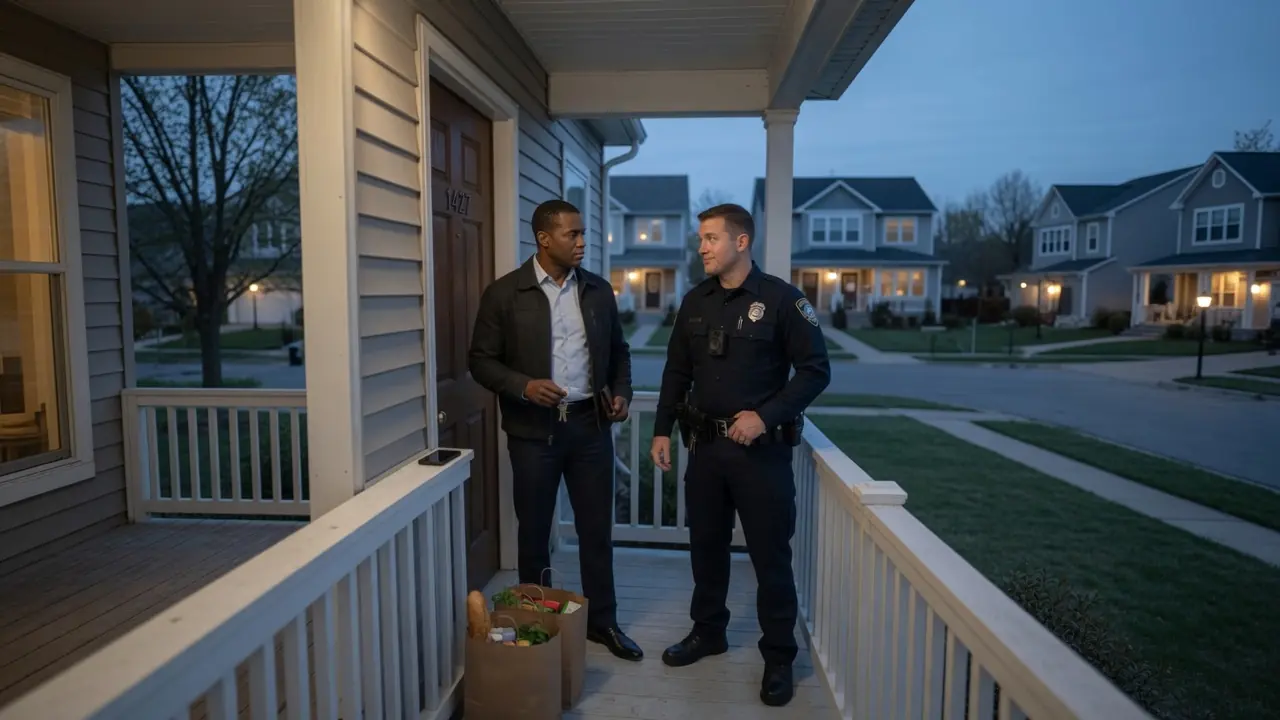
Now he was watching the same mistake happen in front of him.
“Escalate it how?” Daniel asked.
“Don’t make this difficult.”
“I am standing on my property with my hands visible. I have told you who I am and why I am here. You have not identified a crime. I am asking what legal authority you are using to demand identification.”
Officer Briggs’s hand moved closer to his belt.
It was not touching his weapon.
Not yet.
But Daniel noticed the movement.
So did the body camera.
Daniel slowly spread his fingers.
“I am not reaching for anything.”
“Then keep your hands where I can see them.”
“They are where you can see them.”
The porch seemed to grow smaller.
A lawnmower stopped somewhere down the street. A dog barked behind a neighboring fence. From inside Daniel’s house came the faint hum of the air-conditioning system.
Ordinary sounds continued while the encounter became increasingly dangerous.
A curtain moved in the house across the street.
Someone was watching.
Then another front door opened.
Daniel recognized his neighbor, Linda Carver, standing near her mailbox. She had lived on Hawthorne Lane for eleven years and had attended Daniel’s daughter’s birthday party only two months earlier.
Linda stared at the officer and Daniel but said nothing.
Daniel looked toward her.
“Linda, would you please tell the officer that I live here?”
Officer Briggs immediately raised one hand.
“Sir, don’t involve anyone else.”
“She knows me.”
“I said stay focused on me.”
Linda took one uncertain step toward the street.
“That’s Daniel’s house,” she called. “He’s lived there for years.”
Briggs turned his head slightly.
“Ma’am, please remain where you are.”
“But he does live there.”
“Please go back inside.”
Linda stopped.
Daniel watched her face change.
She looked embarrassed, as if she had somehow interrupted something official and dangerous. Slowly, she backed toward her home.
The officer turned to Daniel again.
“I’m giving you one more opportunity to show me identification.”
Daniel stared at him.
A witness had just confirmed his story.
The registered vehicle was in the driveway.
The keys were beside him.
The grocery receipt was still in his jacket pocket.
Yet the officer’s suspicion had not weakened.
It had become more determined.
Daniel understood why.
The encounter was no longer about discovering the truth.
It was about preserving the officer’s authority.
If Briggs accepted Daniel’s explanation now, he would have to admit that the questioning had been unnecessary. He would have to step back without obtaining the proof he had demanded.
For some officers, retreat felt too much like losing.
Daniel lowered his voice.
“I do not consent to a search. I have not committed a crime. I will not make any sudden movements. If you want me to retrieve identification, I need you to clearly acknowledge that I am reaching into my inside jacket pocket.”
Briggs looked at the jacket.
“Use your left hand. Slowly.”
Daniel did not move.
“Before I do that, I want you to confirm that your body camera is recording.”
“It’s always recording.”
“That was not my question.”
Briggs’s nostrils flared.
“Yes. It’s recording.”
“Good.”
Daniel slowly raised his left hand.
Two fingers moved toward the opening of his jacket.
Officer Briggs widened his stance.
Daniel stopped.
“Are you comfortable with me continuing?”
“Just get the ID.”
Daniel reached into the inner pocket and removed a dark leather credential case.
He held it by the edge.
Briggs extended his hand.
Daniel did not give it to him.
Instead, he opened it himself.
The gold badge caught the porch light.
Beneath it was a federal identification card bearing Daniel’s photograph, name, and title.
Special Agent.
Federal Bureau of Investigation.
The porch went silent.
Officer Briggs stared at the credential.
His hand moved away from his belt.
Daniel’s voice remained steady.
“I’m a special agent with the FBI.”
Briggs blinked.
Once.
Then twice.
The camera captured the exact moment his confidence fractured.
Daniel held the credentials open.
“You may call it in.”
Briggs looked from the badge to Daniel’s face.
“Why didn’t you tell me that before?”
Daniel’s expression hardened.
“Because I should not need a federal badge to be believed when I say I live in my own house.”
Briggs opened his mouth, but no words came.
Across the street, Linda Carver was still watching.
Another neighbor had stepped onto the sidewalk.
Briggs pressed the radio button on his shoulder.
“Dispatch, Unit Twelve.”
The answer came through the speaker.
“Go ahead, Twelve.”
“I need credential verification on a federal agent.”
There was a pause.
“Repeat?”
Briggs lowered his voice.
“I have an individual identifying himself as an FBI special agent. Stand by for information.”
Daniel recited his credential number.
Briggs repeated it over the radio.
As they waited, he looked toward the patrol car, the driveway, and the growing number of neighbors outside their homes.
His face had become pale.
Daniel closed the credential case but kept it in his hand.
“Am I still being detained?”
Briggs avoided his eyes.
“Just wait until we confirm everything.”
“So yes?”
“I said we’re confirming your credentials.”
“That is not an answer.”
Officer Briggs pressed the radio again, although dispatch had not called back.
“Can I get a supervisor to my location?”
This time, the response was immediate.
“Copy. Supervisor en route.”
Daniel looked at his locked door.
The milk in the grocery bag was beginning to warm. A thin line of moisture had formed along the carton and was soaking through the brown paper.
He had planned to cook dinner before his wife and daughter returned from an evening music lesson.
Instead, he was standing outside his home waiting for strangers to decide whether he belonged there.
Three minutes later, a second patrol vehicle turned onto Hawthorne Lane.
Sergeant Ellen Price stepped out.
She was a twenty-two-year veteran of the department, known for speaking slowly when other officers became emotional. Before reaching the porch, she looked at the vehicle in the driveway and read the license plate into her radio.
The response came within seconds.
The vehicle was registered to Daniel Mercer at the exact address where they were standing.
Price’s eyes moved to Briggs.
“You didn’t run the plate?”
Briggs did not answer.
She climbed the porch steps.
“Good evening, sir. I’m Sergeant Price.”
Daniel held up his credential case.
“Special Agent Daniel Mercer. This is my residence.”
Price examined the identification without taking it from him.
Dispatch spoke through Briggs’s radio.
“Unit Twelve, federal credentials confirmed. Daniel Mercer is listed as an active special agent.”
No one moved.
The confirmation seemed louder than it actually was.
Price looked at Briggs again.
“What was the reported offense?”
“Possible trespass.”
“What evidence did you observe?”
“He was at the door.”
“With keys?”
Briggs glanced at the railing.
“Yes.”
“With groceries from the vehicle registered to this address?”
“I hadn’t confirmed the registration yet.”
Price turned back to Daniel.
“Agent Mercer, I apologize for the inconvenience.”
Daniel’s gaze did not soften.
“Inconvenience?”
Price seemed to realize the weakness of the word as soon as she said it.
“Sir, I understand this situation should have been handled differently.”
“My neighbor confirmed I lived here.”
Price nodded.
“I heard that.”
“He was told there was no forced entry and no crime. He threatened escalation when I asked whether I was detained.”
Briggs interrupted.
“I did not threaten him.”
Daniel looked directly at the camera on Briggs’s chest.
“It’s recorded.”
Price raised one hand toward Briggs.
“Do not argue.”
Briggs fell silent.
Daniel placed the credential case back inside his jacket.
The motion no longer made anyone reach toward a weapon.
That difference was not lost on him.
Price took a small notebook from her pocket.
“Agent Mercer, I will document this encounter and provide you with the incident number.”
“I want the name of the watch commander, your internal affairs contact, and confirmation that both body-camera files will be preserved.”
Price looked at him carefully.
“Of course.”
“I also want the dispatch audio preserved, including the original call.”
“Yes, sir.”
“And I want the preservation request documented before either officer leaves.”
Briggs stared toward the street.
The balance of authority had shifted, but Daniel took no satisfaction from it.
He was not thinking about revenge.
He was thinking about what would have happened if the leather case inside his jacket had contained only an ordinary driver’s license.
Would Briggs have believed that?
Would he have taken the license and then asked to enter the house?
Would he have placed Daniel in handcuffs while verifying the address?
Would he have described Daniel’s refusal to surrender identification as resistance?
The badge had not made Daniel more truthful.
It had only made his truth harder to ignore.
Sergeant Price wrote down the requested information.
Officer Briggs stepped off the porch for the first time since the encounter began.
Daniel noticed the movement.
It was small, almost meaningless.
Yet for the previous ten minutes, Briggs had occupied the narrow space between Daniel and his front door. Now he stood on the walkway with his shoulders lowered.
Daniel picked up his keys.
“Am I free to enter my house?”
Price nodded.
“Yes, Agent Mercer.”
Daniel inserted the key into the lock.
Before opening the door, he looked at Officer Briggs.
“You knew I had a key. You had a witness. You had a vehicle you could have checked in seconds. What exactly were you waiting to discover?”
Briggs did not answer.
Daniel opened the door and carried the groceries inside.
His hands began shaking only after the deadbolt clicked behind him.
He set the bag on the kitchen counter.
The carton of milk tipped sideways and rolled against a loaf of bread. Daniel caught it before it fell, then remained standing with both palms pressed against the counter.
Through the window, he could see the officers talking beneath the porch light.
Briggs was gesturing toward the house.
Sergeant Price was listening with her arms folded.
Daniel could not hear what they were saying, but he knew how the conversation would probably sound.
The officer had been responding to a call.
The circumstances were unclear.
The resident had been uncooperative.
The scene had evolved rapidly.
No force had been used.
No arrest had occurred.
The language of official reports had a way of draining human moments of their fear.
His wife, Rachel, arrived twenty minutes later with their twelve-year-old daughter, Sophie.
Rachel saw the patrol vehicles before she saw Daniel.
She rushed through the front door.
“What happened?”
Daniel tried to answer casually.
“There was a misunderstanding.”
Rachel looked at his face.
She had been married to him for fourteen years. She knew when he was choosing words instead of telling the truth.
“What happened?” she repeated.
Sophie stood behind her, clutching a violin case.
Daniel looked at his daughter.
He did not want her to hear how quickly an ordinary evening could become dangerous.
He did not want her to imagine her father being handcuffed outside the home where she slept.
But he also refused to lie.
“An officer stopped me on the porch,” Daniel said. “He didn’t believe I lived here.”
Sophie frowned.
“But you had your keys.”
“I know.”
“And Miss Carver knows us.”
“I know.”
Rachel put her hand over her mouth.
“Did he draw his weapon?”
“No.”
“Did he touch you?”
“No.”
“Then why do you look like that?”
Daniel glanced toward the window.
“Because there were several moments when I didn’t know what he was going to do.”
Sophie placed the violin case on the floor.
“Did you show him your FBI badge?”
“Eventually.”
“Then he knew you were telling the truth.”
Daniel looked at his daughter.
“He should have listened before he knew where I worked.”
That night, Daniel did not sleep.
He reviewed the encounter repeatedly in his mind.
The first demand for identification.
The shift of the officer’s hand.
The warning that the situation could escalate.
Daniel had been trained to remember details, but memory was unreliable under stress. By morning, he had written a complete account while every word remained fresh.
At 8:14 a.m., he emailed a formal preservation notice to the police department.
He requested all body-camera recordings, patrol-car video, dispatch audio, call notes, vehicle database searches, radio transmissions, internal messages, and supervisory reports.
At 9:03, the department’s legal office acknowledged receipt.
By noon, Daniel had contacted civil rights attorney Miriam Cole.
Miriam had spent two decades handling cases involving unlawful detention and excessive force. She listened without interrupting as Daniel described the encounter.
When he finished, she asked one question.
“Why do you think he didn’t believe you?”
Daniel looked across her office.
A framed copy of the Constitution hung on the wall behind her desk.
“Because he had decided who I was before I spoke.”
Miriam nodded.
“And when you gave him facts?”
“He treated them as obstacles.”
“That’s the important part.”
Daniel leaned back.
“He never searched me. He never arrested me.”
“He didn’t have to,” Miriam said. “A constitutional violation does not become acceptable simply because it stopped before handcuffs.”
The department released a short public statement two days later.
It said an officer had responded to a report of suspicious activity and made contact with an individual at a residence. After the individual’s identity was confirmed, the encounter ended without further incident.
Daniel read the statement twice.
Without further incident.
The phrase made the encounter sound harmless.
It erased the officer’s threat.
It erased the refusal to answer whether Daniel was detained.
It erased the hand moving toward the belt as Daniel reached for identification.
Most of all, it erased the reason the situation ended.
It ended because Daniel possessed a badge that carried more authority than the officer’s suspicion.
Miriam filed a formal complaint.
The body-camera footage was reviewed by internal affairs. Investigators examined the encounter frame by frame, noting the time of every question, every movement, and every radio transmission.
Officer Briggs said he had acted out of concern for the homeowner.
When asked why he did not believe Daniel was the homeowner, Briggs said Daniel appeared nervous.
The video showed Daniel speaking calmly.
Briggs then said Daniel’s calmness seemed rehearsed.
When asked why he did not run the vehicle’s license plate before demanding identification, Briggs said he wanted to secure the scene first.
There had been no unsecured scene.
When asked why he dismissed the neighbor’s confirmation, Briggs said he could not rely on an unidentified third party.
He had been willing to rely on an unidentified caller.
Each explanation created another contradiction.
The original dispatch call was eventually released to Daniel’s attorney.
The caller’s voice was uncertain.
“There’s a man on the porch across the street,” she had said.
“Is he trying to break in?” the dispatcher asked.
“I don’t know.”
“Do you see a weapon?”
“No.”
“Is he damaging the door?”
“No. He has something in his hand.”
“What does it look like?”
“Maybe keys.”
There was a pause.
“Do you know who lives there?”
“Not really. I just don’t think he belongs.”
That single sentence had brought an armed officer to Daniel’s home.
During the internal investigation, Sergeant Price admitted that Briggs should have verified the vehicle registration before initiating a detention. She also acknowledged that the department had no policy requiring residents to carry identification while standing on private property.
The department nevertheless avoided the word unlawful.
Its final report described the incident as a failure of communication and judgment.
Officer Briggs received a written reprimand and three days of additional training.
He remained on patrol.
Daniel read the conclusion at his kitchen table.
Rachel sat across from him.
“That’s it?” she asked.
Daniel placed the report down.
“They say he misunderstood the scope of his authority.”
“He told you the situation would escalate.”
“They call that an attempt to gain voluntary compliance.”
Rachel shook her head.
“There was nothing voluntary about it.”
“No.”
The civil claim continued for months.
Depositions were taken.
Lawyers argued over qualified immunity, reasonable suspicion, and whether a person in Daniel’s position would have felt free to leave.
The city insisted the encounter had been brief.
Miriam responded that fear was not measured only in minutes.
A person did not need to be injured for his dignity to be violated.
A door did not need to be broken for a home to be denied.
Eventually, the city agreed to settle.
The amount remained confidential.
There was no admission of wrongdoing.
The police chief announced updated training on investigative detentions, identification requests, and responses to suspicious-person calls. Officers were instructed to verify available information before making demands and to clearly explain whether a person was being detained.
The department called the changes proactive.
Daniel called them overdue.
Months after the settlement, he stood on the same porch replacing the loose board that had creaked beneath Briggs’s boot.
Sophie sat on the steps, handing him screws from a small cardboard box.
“Do you still think about that night?” she asked.
Daniel tightened a screw.
“Sometimes.”
“Are you still angry?”
He considered the question.
“Yes.”
Sophie looked surprised by his honesty.
Daniel sat beside her.
“But anger isn’t always the same as hatred,” he said. “Sometimes anger is the part of you that knows something was wrong.”
“Do you hate Officer Briggs?”
“No.”
“Why not?”
“Because hating him would make the story too simple.”
Sophie waited.
Daniel looked across the quiet street.
“The problem wasn’t only one officer. It was the caller who thought a person needed to look a certain way to belong. It was the dispatcher who treated uncertainty like danger. It was the officer who valued suspicion more than evidence. And it was a system that tried to describe everything as a misunderstanding afterward.”
Sophie looked at the repaired porch board.
“Would it have happened if you weren’t an FBI agent?”
“Yes.”
“I mean, would they have let you go?”
Daniel did not answer immediately.
“That’s the question I still think about.”
A car passed at the end of the street.
Somewhere nearby, children were playing basketball in a driveway. A delivery driver left a package on a porch and returned to his van without anyone questioning why he was there.
Ordinary life continued.
Daniel picked up the screwdriver again.
His home looked exactly as it had before the encounter. The same brass numbers were beside the door. The same tree moved in the evening breeze. The same family photographs could be seen through the front window.
But something had changed.
Daniel now understood how fragile belonging could become when another person was given the power to question it.
He had survived the encounter without injury because he knew the law.
Because he remained calm.
Because a camera was recording.
Because a neighbor spoke up.
And because, inside his jacket, he carried proof of authority that the officer was trained to respect.
Most people standing on their own porches had none of those protections.
They had only their words.
Their keys.
Their addresses.
Their truth.
And sometimes, the truth was not enough until someone with greater authority confirmed it.
Daniel drove to work the following Monday.
Before leaving, he stopped at the edge of the porch and looked back at the front door.
For years, it had represented privacy, safety, and the ordinary promise that a person could return home without explaining why he belonged there.
Now it represented something else as well.
A boundary.
Not only between public and private property, but between assumption and evidence.
Between service and control.
Between a question asked for safety and a demand made to establish power.
Daniel locked the door and slipped the keys into his pocket.
He no longer carried his badge simply because his job required it.
He carried it because he had learned how quickly some people refused to recognize a man until they recognized his institution.
Then he walked toward his car, leaving the porch empty beneath the morning light.
The repaired board no longer creaked.
But Daniel knew he would never again step across it without remembering the officer who had stood between him and his own front door—and the ten minutes in which the truth had been treated like a claim that needed permission to become real.