Officer Caleb Vance decided the car did not belong to the woman driving it before he ever activated his lights.
The vehicle was a pearl-white Bentley Continental, polished so cleanly that the morning sun moved across its body like water. It traveled through Ashford Heights, one of the wealthiest neighborhoods outside Atlanta, at thirty miles per hour.
The posted limit was thirty-five.
The driver used her turn signal.
She stopped fully at an intersection.
She allowed a cyclist to cross before continuing.
Nothing about the car’s movement violated the law.
Caleb followed anyway.
Beside him, Officer Marcus Hill looked up from the report he had been reviewing on the patrol computer.
“What did she do?”
Caleb kept his eyes on the Bentley.
“She slowed when she saw us.”
“She’s going thirty in a thirty-five.”
“Exactly.”
Marcus stared at him.
“That is not a violation.”
“People slow down when they’re hiding something.”
“People also slow down because there’s a patrol car behind them.”
Caleb smiled.
“Let’s find out which one she is.”
Before Marcus could respond, Caleb activated the emergency lights.
The Bentley pulled onto the shoulder immediately.
No sudden braking.
No hesitation.
The driver lowered her window, placed both hands on the steering wheel, and waited.
Her name was Judge Vanessa Monroe.
She was fifty years old and had served on the Fulton County Superior Court for eleven years. Before that, she spent nearly two decades as a prosecutor, defense attorney, and civil-rights litigator.
She had presided over murder trials, public-corruption cases, and hearings involving officers who believed a confident report could replace evidence.
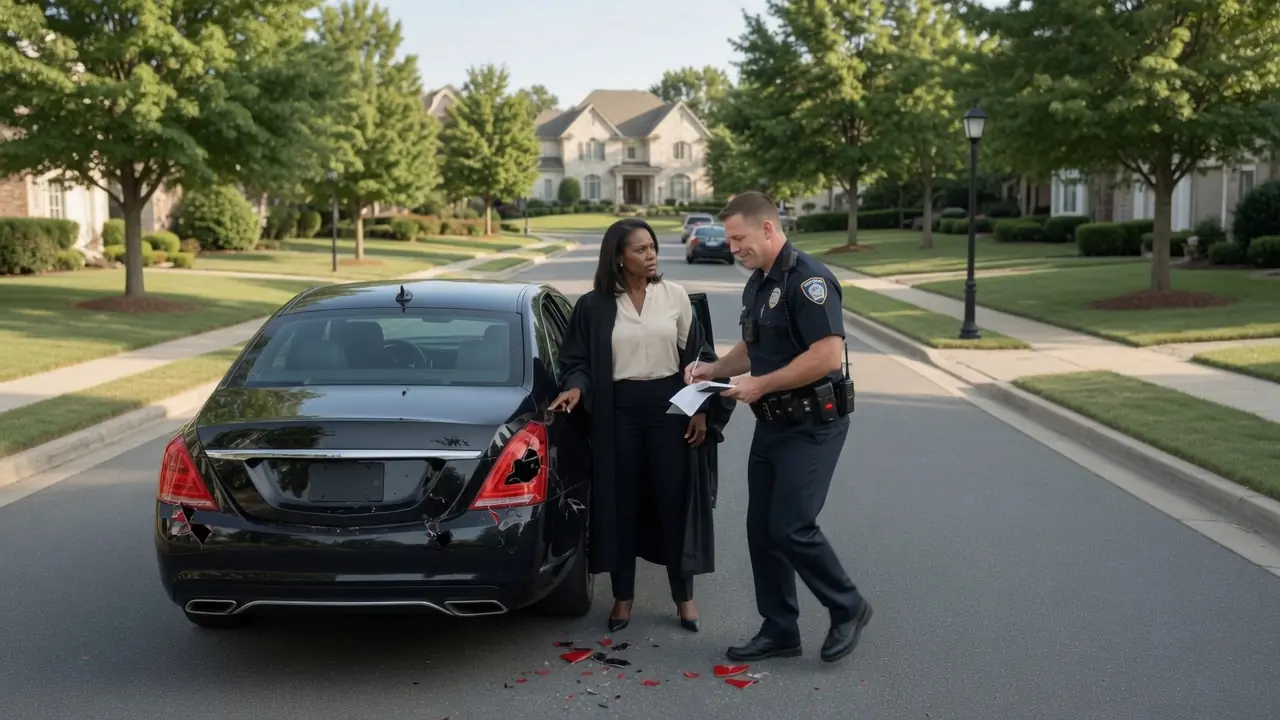
That morning, she wore a cream blouse beneath a charcoal jacket. Her black judicial robe hung from a hook behind the passenger seat.
She was on her way to court.
Her first hearing began in forty minutes.
Vanessa watched the officers approach through her mirror.
The younger one walked toward her window with his shoulders set wide and one hand resting near his holster.
The older officer remained several steps behind.
“Good morning,” Vanessa said.
Caleb looked through the open window at the cream leather seats, the navigation screen, and the gold watch on her wrist.
“Nice car.”
“Thank you.”
“Yours?”
Vanessa looked at him.
“Yes.”
Caleb laughed softly.
Marcus heard it from behind him.
Vanessa did too.
“In 2026,” she said, “women are still permitted to own automobiles.”
Caleb’s smile disappeared.
“What are you doing in this neighborhood?”
“Driving.”
“You live around here?”
“No.”
“Then why are you here?”
Vanessa studied his nameplate.
“Officer Vance, have I committed a traffic violation?”
“I’m asking you a question.”
“And I am asking why you stopped me.”
Caleb leaned closer to the window.
“Your behavior was suspicious.”
“What behavior?”
“You were driving slowly.”
“The speed limit is thirty-five. I was traveling at thirty.”
“You slowed when you noticed my cruiser.”
“I approached an intersection.”
“You looked nervous.”
Vanessa’s hands remained on the wheel.
“What did I do that appeared nervous?”
Caleb glanced toward the center console.
“Are there any firearms, narcotics, illegal substances, or other contraband in the vehicle that I need to know about?”
“No.”
The answer came after less than a second.
Caleb lifted his eyebrows.
“You hesitated.”
“I did not.”
“You sure about that?”
“Yes.”
“What is it about this car,” Vanessa asked, “or about me, that caused you to begin with questions about drugs and weapons?”
Marcus shifted behind Caleb.
The younger officer straightened.
“You were driving suspiciously.”
“Five miles under the limit?”
“I already explained it.”
“No. You repeated a conclusion.”
Caleb held out his hand.
“License and registration.”
Vanessa reached slowly toward her purse.
“My license is in the front pocket.”
“Keep your movements where I can see them.”
“I am narrating them for that reason.”
She removed the license.
Then she opened the glove compartment and handed him the registration and insurance card.
Every document carried the same name.
VANESSA ELAINE MONROE
The Bentley was registered to her.
The insurance was current.
Her license was valid.
Caleb examined the documents twice.
Marcus looked toward the license.
The name was familiar.
He had heard it in roll call and during mandatory courtroom testimony training.
Judge Vanessa Monroe had presided over several cases involving their department.
Marcus glanced through the rear window.
A black judicial robe hung behind the passenger seat.
Caleb either did not notice or chose not to understand it.
“This vehicle is registered to you?” he asked.
Vanessa looked at the documents in his hand.
“That is what the registration says.”
“I asked you a question.”
“And I answered by providing the state-issued document.”
Caleb’s jaw tightened.
“You people always want to argue.”
Marcus looked sharply toward him.
Vanessa’s expression remained controlled.
“You people?”
“You know what I mean.”
“No. Explain it.”
Caleb stepped away from the window.
“Stay here.”
“I had no intention of leaving.”
He returned to the patrol car.
Marcus followed.
“What are you doing?” Marcus asked quietly.
“Writing her.”
“For what?”
“Reckless operation.”
“She was going thirty.”
“Unreasonably slow driving can create a hazard.”
“There was no traffic behind her except us.”
Caleb opened the citation program.
“She was impeding.”
“No one was impeded.”
“She made me brake.”
“You were following too closely.”
Caleb turned.
“Whose side are you on?”
“The law’s.”
“Do not start that righteous nonsense.”
Marcus lowered his voice.
“Her documents are clean. The car is hers. There is no violation.”
Caleb typed.
“I decide what I observed.”
“That is not the same as deciding what happened.”
Caleb looked toward the Bentley.
Vanessa remained seated with both hands visible.
A small dashboard camera near her rearview mirror faced forward.
Caleb did not see the secondary lens built into the rear window.
The Bentley’s factory security system recorded the exterior whenever someone stood close to the vehicle.
He finished the citation.
Then he removed a compact metal flashlight from the patrol door.
“What are you doing with that?” Marcus asked.
“Checking the plate.”
“The plate is readable.”
Caleb ignored him.
He walked behind the Bentley.
Vanessa watched through the mirror.
Caleb bent near the left taillight.
His body blocked Marcus’s view for one second.
Then came a sharp crack.
The sound was faint but distinct.
Vanessa turned slightly in her seat.
Caleb stood.
A triangular section of red plastic had broken away from the taillight and fallen onto the pavement.
Marcus stared.
“What happened?”
Caleb bent and picked up the plastic.
“Broken taillight.”
“That was not broken before.”
“You inspect it?”
“I saw it when we walked up.”
Caleb dropped the fragment beside the curb.
“Maybe vibration loosened it.”
Marcus’s face hardened.
“You hit it.”
“Careful.”
“I saw your arm move.”
“You saw nothing.”
Caleb returned to the driver’s window carrying the citation.
Vanessa looked toward the mirror.
“What did you do behind my car?”
“Ma’am, here is your license, registration, and citation.”
She accepted the papers.
“What is the citation for?”
“Reckless driving and creating a hazard.”
“By traveling thirty miles per hour in a thirty-five zone?”
“You were impeding traffic.”
“What traffic?”
Caleb pointed at the document.
“You can contest it in court.”
Vanessa read the citation.
The hearing location was Division Seven of Fulton County Traffic Court.
Her own courthouse.
She looked up.
“Is the stop concluded?”
“Not yet.”
Caleb stepped toward the rear of the Bentley again.
“You also have a broken taillight.”
Vanessa turned enough to see the damaged lens in her mirror.
“That light was intact when you approached.”
“No, it wasn’t.”
“Yes, it was.”
“You calling me a liar?”
“I am stating that my vehicle had no broken light before you stood behind it with a metal object.”
Caleb moved closer to the window.
“Intentional property damage is a misdemeanor.”
Vanessa stared at him.
“Are you suggesting I damaged my own taillight while seated inside the car?”
“You could have damaged it earlier.”
“Then why did you not mention it when you first approached?”
Caleb’s face flushed.
“You want another citation?”
“For asking a question?”
“For being argumentative.”
Marcus stood several feet away.
His body camera recorded the exchange.
Vanessa noticed the red activation light.
She looked at him.
“Officer Hill, was my taillight broken when you first approached?”
Marcus felt Caleb’s eyes on him.
For several seconds, he did not answer.
Vanessa waited.
Caleb stepped between them.
“He is not part of this conversation.”
“He arrived with you.”
“I conducted the stop.”
“And he witnessed it.”
Caleb lowered his voice.
“You think you have power because you drive an expensive car?”
“No.”
Vanessa folded the citation once.
“I believe power is demonstrated by what a person does when he thinks no one can challenge him.”
Caleb smiled without humor.
“That sounds like something from a television courtroom.”
Vanessa glanced toward the judicial robe hanging behind her seat.
Caleb followed her gaze.
He saw the black fabric.
“Why are you dressed like that?” he asked.
“I am not.”
“What is that in the back?”
“A robe.”
“For what?”
“Work.”
Caleb looked at her suit again.
“What are you supposed to be, some kind of attorney?”
Vanessa met his eyes.
“I am a judge.”
He laughed.
Marcus did not.
Caleb waited for her to smile.
She did not.
“You’re a judge.”
“Yes.”
“What court?”
“Fulton County Superior Court.”
Caleb looked toward the citation.
Then back at her.
“You don’t look like a judge.”
Vanessa’s expression changed slightly.
“What does a judge look like?”
“Not you.”
Marcus closed his eyes briefly.
Vanessa asked again.
“What does one look like?”
Caleb gestured vaguely.
“Older. More professional.”
“I am fifty years old and wearing a business suit.”
“That doesn’t prove anything.”
Vanessa reached toward the interior pocket of her jacket.
Caleb’s hand moved toward his holster again.
“Do not reach.”
“My judicial credential is in this pocket.”
“You should have led with that.”
“I led with a valid license and registration.”
“If you had just told me who you were, this could have gone differently.”
Vanessa became very still.
“That is the problem.”
Caleb frowned.
“What is?”
“It should not matter who I am.”
Marcus looked toward her.
Vanessa continued.
“You did not have the right to invent a traffic offense, damage my vehicle, or threaten me with another charge when I asked you to explain your actions.”
“I did not damage anything.”
“The vehicle recorded you.”
Caleb’s confidence shifted.
“What?”
“This car has exterior security cameras.”
For the first time, he looked directly at the small lens near the rear window.
His face changed.
Vanessa lifted her phone from the center console.
“The footage is already uploading.”
Caleb reached toward his radio.
Before he could speak, dispatch called.
“Unit Nineteen, supervisor requesting your status.”
Caleb pressed the microphone.
“Routine traffic stop. Almost clear.”
“Unit Nineteen, hold position. Lieutenant Sanders is responding.”
Caleb glanced toward Marcus.
“Why is a lieutenant coming?”
Marcus said nothing.
He had pressed the silent supervisory alert on his body camera when Caleb struck the taillight.
Caleb stepped closer.
“You called a supervisor?”
“Yes.”
“You went around me?”
“I followed policy.”
“You made this into something.”
Marcus looked at the broken light.
“You did that.”
Caleb’s voice dropped.
“You need to think carefully about what you claim you saw.”
Marcus had heard similar warnings before.
Not always from Caleb.
Sometimes from senior officers after questionable searches.
Sometimes after someone was injured.
The words were never direct enough to become an official threat.
Their meaning was still understood.
Protect the officer.
Protect the unit.
Protect yourself.
Marcus looked toward Vanessa.
She had watched him remain silent when asked about the taillight.
She had seen the choice arrive and pass unanswered.
He felt ashamed.
“I saw you strike the lens with your flashlight,” he said.
Caleb stared at him.
“You lying piece of—”
“Step away from him,” Vanessa said.
Caleb turned toward her.
“You do not give orders here.”
“No.”
Her voice remained calm.
“But I recognize escalation when I see it.”
A second patrol cruiser arrived behind them.
Lieutenant Rebecca Sanders stepped out.
She was forty-seven and had supervised the traffic division for three years.
She approached with her body camera active.
“What happened?”
Caleb answered immediately.
“Driver was operating recklessly, became argumentative, and is now accusing me of damaging her vehicle because she disagrees with a citation.”
Rebecca looked toward Marcus.
“Officer Hill?”
Marcus inhaled.
“The vehicle was traveling thirty in a thirty-five. The plate and documents were valid. Officer Vance issued a reckless-driving citation. While standing behind the vehicle, he struck the left taillight with his flashlight.”
Caleb’s face reddened.
“That is false.”
Rebecca looked toward the Bentley.
“Is there video?”
Vanessa held up her phone.
“Yes.”
“May I see it?”
“You may.”
The clip had already uploaded to secure storage.
Vanessa played it from the beginning.
The rear camera showed both officers approaching.
The taillight was intact.
It showed Caleb return with the citation.
It showed him remove the flashlight.
Then strike the lens deliberately before lifting the broken fragment from the ground.
No one spoke when the video ended.
Rebecca looked at Caleb.
“Hand me your badge and duty weapon.”
His face emptied.
“What?”
“You are being placed on administrative suspension pending investigation.”
“Over a taillight?”
“Over falsifying a violation, damaging private property, and lying to a supervisor.”
Caleb pointed toward Vanessa.
“She provoked this.”
Rebecca’s expression hardened.
“She remained seated inside her vehicle.”
“She was disrespectful.”
“Disrespect is not a crime.”
“She kept challenging me.”
“Questions are not force.”
Caleb looked toward Marcus.
“You are ending my career because she says she’s a judge.”
Vanessa opened her credential wallet and held it where Rebecca could see.
The lieutenant’s eyes widened.
“Judge Monroe.”
“Lieutenant.”
Rebecca removed her hat.
“I apologize.”
Vanessa shook her head.
“Do not apologize because of my title.”
Rebecca stopped.
“Apologize if your department failed to train an officer to distinguish lawful authority from personal pride.”
The lieutenant absorbed the words.
“Yes, Your Honor.”
“And preserve every recording.”
“Yes.”
“His body camera?”
Caleb looked away.
Rebecca checked it.
The device had not been activated.
She turned toward Marcus.
“Yours?”
“Recorded from the beginning.”
“Upload complete?”
“Yes.”
Rebecca radioed for another unit.
Caleb stood on the shoulder without his weapon or badge.
The confidence that had shaped every sentence was gone.
He looked smaller.
Not because Vanessa had become more powerful.
Because the uniform was no longer carrying the weight of his version.
Rebecca voided the citations at the scene.
She photographed the broken taillight and arranged for the department to cover immediate repairs.
Vanessa checked the time.
Her hearing had begun twelve minutes earlier.
Her clerk had delayed the docket after receiving a message from courthouse security that police had stopped her vehicle.
Before leaving, Vanessa looked toward Marcus.
“You told the truth eventually.”
He lowered his eyes.
“Not immediately.”
“No.”
“I should have stopped him before he damaged the car.”
“Yes.”
Marcus expected anger.
Vanessa gave him something more difficult.
“Remember how long those seconds felt.”
He nodded.
“I will.”
She looked toward Caleb.
He did not meet her eyes.
Vanessa entered the courthouse thirty minutes late.
When the bailiff announced her arrival, everyone stood.
Caleb had said she did not look like a judge.
Inside the courtroom, the black robe changed nothing essential about her.
It only made authority visible to people trained to recognize symbols.
Vanessa took her seat.
Before calling the first case, she looked toward the gallery.
“I apologize for the delay.”
The prosecutor stood.
“Is everything all right, Judge?”
Vanessa considered the question.
“No.”
The courtroom became quiet.
“But we will proceed.”
She handled the docket without mentioning the traffic stop.
That afternoon, she formally recused herself from every matter involving Caleb Vance, Marcus Hill, and their department’s internal investigation.
She also sent preservation requests for dash-camera footage, body-camera recordings, dispatch calls, vehicle-location data, prior complaints, and Caleb’s citation history.
Not as the judge controlling the investigation.
As the complainant ensuring the evidence existed before other officials took over.
The department initially described the encounter as a disagreement during a traffic stop.
That description lasted one day.
The video was too clear.
Caleb had broken the taillight.
His citation claimed Vanessa had driven fifteen miles below the limit and caused multiple vehicles to brake suddenly.
Traffic-camera footage showed no other vehicles behind her except the cruiser.
His report said Vanessa admitted she had been distracted and lost.
She had said neither.
He claimed he noticed the broken taillight before initiating the stop.
The patrol car’s front camera showed it functioning normally.
Internal Affairs opened a broader review.
Investigators examined Caleb’s previous citations for reckless driving, obstruction, and equipment violations.
Patterns emerged.
He disproportionately stopped Black drivers in affluent neighborhoods.
He frequently claimed drivers became nervous after seeing police.
He described legal questions as argumentative behavior.
In twelve cases, he issued equipment citations shortly after walking behind vehicles beyond the view of the primary camera.
Three drivers had previously accused him of damaging lights or license-plate covers.
Their complaints were dismissed for lack of proof.
One man, a delivery driver named Raymond Cole, had reported that Caleb broke a mirror after he refused consent to a search.
The department found the allegation unsubstantiated.
No investigator requested footage from a nearby bank.
A woman named Denise Palmer had been arrested for obstruction after asking why Caleb wanted her to open her trunk.
Her charge was dismissed, but the arrest remained on her record.
Another driver had accepted a plea on reckless driving because he could not afford repeated court appearances.
Caleb’s reports used the same language.
Observed nervous behavior.
Unusually slow speed.
Possible attempt to avoid detection.
Became argumentative when questioned.
Officer detected signs of deception.
What appeared to be instinct was often a conclusion searching for support.
Marcus cooperated fully.
He admitted that Caleb had joked about “luxury-car fishing.”
“What did that mean?” the investigator asked.
“You see someone you think doesn’t match the car or neighborhood,” Marcus said. “Then you stop them and look for a reason afterward.”
“Did you object?”
“Sometimes.”
“Did you report him?”
“No.”
“Why?”
Marcus looked at the table.
“Because he was popular. He had good arrest numbers. Supervisors called him proactive.”
“And because?”
Marcus took a long breath.
“Because I did not want other officers to stop trusting me.”
His honesty did not remove responsibility.
He received a suspension for failing to intervene sooner and for remaining silent during previous questionable stops.
He accepted it.
Caleb resigned before the disciplinary hearing.
Resignation did not end the investigation.
The district attorney charged him with criminal damage to property, false statements, and violation of oath by a public officer.
His attorney argued that the taillight broke accidentally when Caleb inspected it.
The rear camera showed the flashlight rising and striking the lens.
The defense argued Vanessa’s identity had turned a minor roadside dispute into a political prosecution.
Vanessa testified once.
She wore a dark suit.
No robe.
The prosecutor asked whether Caleb knew she was a judge when he initiated the stop.
“No.”
“Did your office make the stop unlawful?”
“No.”
“Did revealing your title make his conduct worse?”
Vanessa looked toward the jury.
“It revealed what he believed would make his conduct matter.”
The defense attorney rose.
“You were offended when Officer Vance questioned whether the vehicle belonged to you.”
“Yes.”
“You became argumentative.”
“I asked him to identify a violation.”
“You suggested he was racially profiling you.”
“I asked what about me or the vehicle suggested drugs and weapons.”
“You did not simply answer.”
“I did answer.”
The attorney approached.
“Had you immediately told him you were a judge, none of this would have happened.”
Vanessa looked directly at him.
“That is not a defense.”
“I didn’t say it was.”
“It is the argument you are making.”
The lawyer paused.
Vanessa continued.
“A citizen should not need to present a prestigious occupation before an officer chooses not to manufacture evidence.”
The jury convicted Caleb on the most serious counts.
He did not receive decades in prison.
The property damage was minor.
The abuse of authority was not.
He received a custodial sentence, probation after release, and a permanent prohibition from serving as a law-enforcement officer in the state.
Several of his old cases were reopened.
Denise Palmer’s arrest record was cleared.
Raymond Cole received a formal apology and compensation for the damaged mirror and lost work.
Twenty-three traffic convictions based primarily on Caleb’s unsupported testimony were vacated or dismissed.
The police department adopted new review procedures.
Equipment violations discovered after officers approached a vehicle had to be documented by continuous video.
Stops based on unusually slow driving required proof that traffic was actually obstructed.
Repeated complaints against one officer could no longer be examined in isolation.
Supervisors had to review demographic patterns in discretionary traffic stops.
Officers were reminded that refusing consent, asking the basis of a stop, and requesting a supervisor were not evidence of criminal behavior.
The reforms sounded obvious.
That did not make them unnecessary.
Marcus returned to duty after his suspension.
For months, other officers avoided him.
Some called him disloyal.
One left a toy rat inside his locker.
Marcus reported each incident.
Not because the insults endangered him.
Because silence had already taught him what it could become.
A year later, he supervised a young officer during a stop involving an elderly man driving slowly through a wealthy subdivision.
The younger officer activated the lights.
After approaching, he said the driver looked nervous.
Marcus asked what law had been violated.
“He was going twenty-eight in a thirty-five.”
“Was he obstructing traffic?”
“No.”
“Any equipment violation?”
“No.”
“Any report matching the vehicle?”
“No.”
Marcus looked toward the old man waiting behind the wheel.
“Then explain the warning and let him leave.”
The younger officer frowned.
“That’s it?”
“That is all the law allows.”
Marcus remembered the seconds beside Vanessa’s Bentley.
The question about the taillight.
His own silence.
This time, the correction came before harm.
Judge Vanessa Monroe continued driving the Bentley.
She replaced the damaged taillight but kept the broken piece.
It remained inside a clear evidence bag in her office drawer beside the voided citation.
Visitors occasionally asked why a judge preserved a piece of red plastic.
“It reminds me how quickly facts can be manufactured,” she said.
Two years after the stop, she spoke at a police-academy graduation.
She did not tell recruits that officers should be careful because the person they stopped might be a judge.
She told them the opposite.
“The most revealing moment of your authority,” Vanessa said, “will come when you believe the person before you has none.”
The recruits listened.
“You may stop a physician, a janitor, a teacher, a person without housing, a convicted felon, a frightened teenager, or another police officer.”
She looked across the room.
“The law does not become more important when you recognize the person’s title.”
Behind her, a screen displayed the first minute of Caleb’s body-camera footage.
Vanessa sitting calmly.
Hands visible.
Documents valid.
No violation.
“The officer who stopped me believed my profession should have been the first thing I announced.”
She paused.
“He was wrong.”
A badge, she explained, carried lawful authority.
It did not carry the right to punish irritation.
It did not transform assumptions into evidence.
It did not make questions illegal.
And it did not allow an officer to create the violation he failed to find.
After the speech, one recruit approached.
“Judge Monroe, did you feel powerful when you told him who you were?”
Vanessa considered the question.
“No.”
The recruit appeared surprised.
“I felt disappointed that he believed it should matter.”
On the morning of the stop, Caleb Vance saw a Black woman driving an expensive car through a wealthy neighborhood.
He believed the image did not add up.
Every fact that followed was forced to support that belief.
Driving five miles under the limit became suspicious.
Calm questions became argument.
A valid registration became attitude.
A refusal to accept an invented explanation became defiance.
When no equipment violation existed, he created one.
Then he saw the black robe.
For one second, Caleb understood that the woman he had chosen to intimidate possessed a title powerful enough to make his conduct dangerous to him.
But Vanessa Monroe had been entitled to lawful treatment before he saw the robe.
Before he read her credential.
Before a supervisor arrived.
Before the video uploaded.
Her position did not transform the stop.
It exposed it.
The broken taillight became the smallest piece of damage that morning.
The larger damage came from an officer who believed respect should be reserved for people important enough to punish him for withholding it.
Caleb had asked why Vanessa did not tell him immediately that she was a judge.
Her answer followed him through the investigation, the trial, and every reopened case.
Because she should not have needed to.
No citizen should.