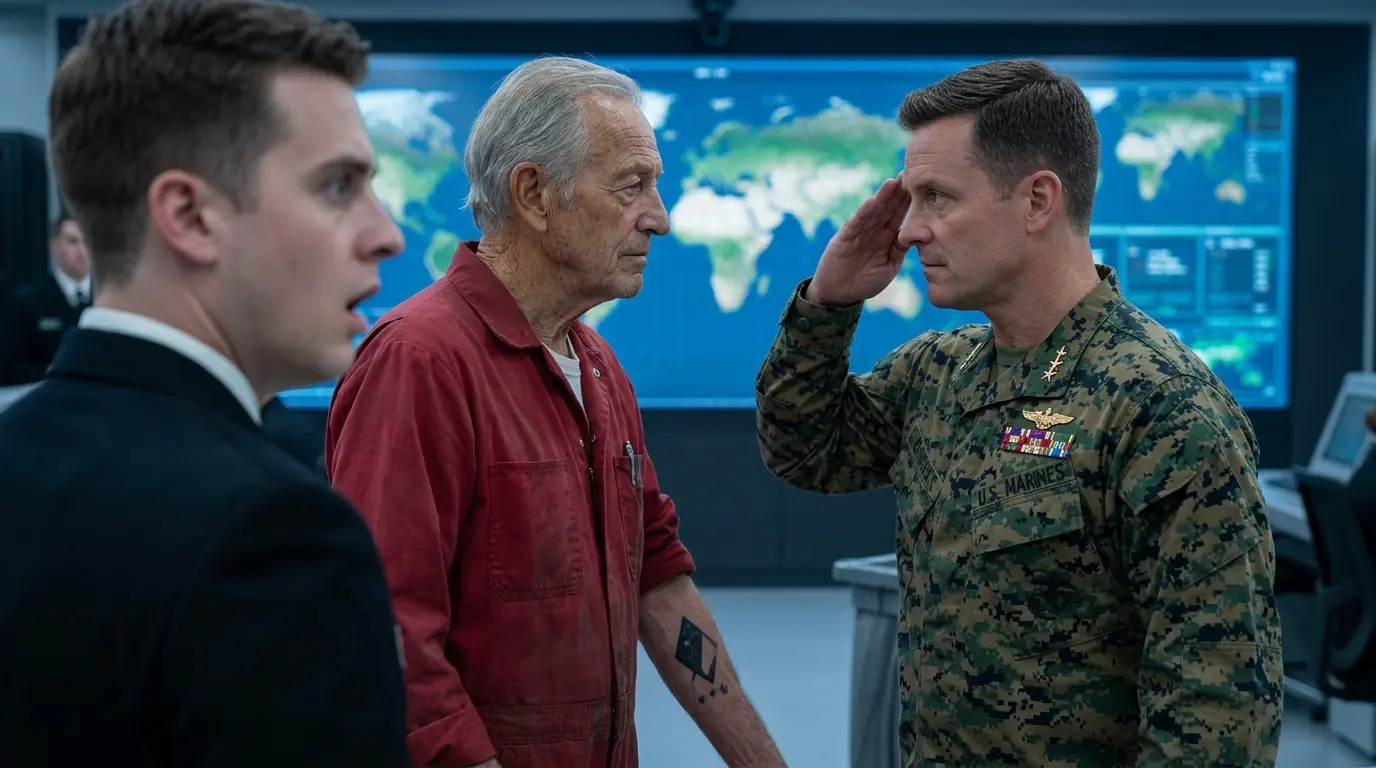
Captain Daniel Mercer stopped three feet in front of the elderly janitor and raised his right hand.
The salute was perfect.
His shoulders squared. His fingers aligned against the brim of his cover. His eyes remained fixed on the old man standing beside an industrial floor buffer.
Nobody inside the Naval Command and Control Center moved.
Banks of blue monitors covered the walls. Digital maps displayed fleet positions across the Pacific. Server fans produced a constant mechanical hum beneath the fluorescent lights.
Lieutenant Commander Preston Ward stood near the center console with his mouth slightly open.
Less than ten minutes earlier, he had called the faded tattoo on the janitor’s arm prison garbage.
Now a decorated Marine captain was saluting it.
The old man looked at Daniel for several seconds.
His red maintenance coveralls hung loosely from his narrow shoulders. A plastic identification card rested against his chest, and one hand remained wrapped around the handle of the floor buffer.
At eighty-two, Elias Grant had the stooped posture of someone whose bones remembered every year they had carried him.
But when he returned the salute, something changed.
His back straightened.
His chin lifted.
For one brief moment, the janitor disappeared.
In his place stood the man he had been more than half a century earlier.
A reconnaissance team leader in a valley where twelve Marines entered and only four walked out.
“At ease, Captain,” Elias said.
His voice was rough with age, yet the command inside it needed no volume.
Daniel lowered his hand.
“It is an honor to meet you, sir.”
Preston finally found his voice.
“Captain Mercer, I think there’s been some misunderstanding.”
Daniel did not look at him.
His attention remained on the tattoo running along Elias’s inner forearm.
The design was crude.
A dark diamond.
A crooked lightning bolt.
Three uneven dots beneath it.
The ink had spread across wrinkled skin until the edges blurred together. Small white scars crossed the pattern, making it look even more damaged.
To Preston, it had resembled something created in a prison cell.
To Daniel, it was the symbol his father had drawn on restaurant napkins, grocery receipts, and the backs of birthday cards for as long as he could remember.
It was the last thing Corporal Thomas Mercer had asked to see before he died.
Daniel turned toward the silent technicians and officers.
“Does anyone in this room know what this mark means?”
No one answered.
Preston’s face had become pale.
Daniel gently gestured toward Elias’s arm.
“With your permission, sir.”
Elias nodded.
Daniel turned the forearm enough for everyone to see the faded design.
“This was not created in a tattoo shop.”
His voice traveled across the command center.
“It was cut into the skin with a sewing needle, ash, and gunpowder during the summer of 1968.”
A few heads lifted.
“The diamond represented pressure from every direction. The lightning bolt represented the strike they were sent to guide.”
Daniel touched none of the three dots.
“And these represented the men they had already lost when the tattoo was made.”
Elias looked down at the floor.
Daniel continued.
“The men who wore this mark belonged to a deep-reconnaissance element operating near the A Shau Valley.”
A young ensign near the communications station whispered the name before she could stop herself.
“The Ghost Walkers.”
Daniel looked toward her.
“Yes.”
The room seemed to grow colder.
Very few details about the Ghost Walkers appeared in ordinary military history books.
The unit had been assembled for missions too dangerous and politically sensitive for conventional forces. Its members moved deep beyond friendly positions, located hidden artillery sites, monitored enemy supply routes, and remained invisible for days at a time.
Their radio reports saved bases that never learned their names.
When the men were compromised, help rarely arrived quickly.
Sometimes it did not arrive at all.
Daniel faced Preston.
“You called this gang tagging.”
Preston swallowed.
“Sir, I didn’t have access to that information.”
“You had access to basic decency.”
The words were quiet.
That made them worse.
“You did not need to know what the tattoo meant before deciding not to humiliate an elderly man in front of your staff.”
Preston looked toward Elias.
“I was enforcing security standards.”
Elias said nothing.
Daniel’s eyes moved toward the floor buffer.
“By mocking him?”
“I was questioning an unauthorized marking inside a secured command environment.”
“His badge has granted him access to this room for fifteen years.”
“I wanted it verified.”
“After you had already accused him of belonging to a gang.”
Preston’s jaw tightened.
“I was doing my duty.”
Elias finally looked up.
“No, son.”
The word son did not sound affectionate.
“You were enjoying yourself.”
The command center became silent again.
The confrontation had begun twenty-seven minutes earlier with a cup of coffee and a joke Preston Ward expected everyone to forget.
Elias arrived at the Command and Control Center every Tuesday before noon.
He had cleaned the room for fifteen years.
The job required more than pushing a mop around electronic equipment. Every contractor entering the secured wing underwent background checks, identity verification, and periodic clearance reviews.
Elias understood the rules.
He respected them.
He never touched a workstation, never moved classified papers, and never asked questions about the maps glowing above him.
He knew more about operational security than most of the young officers watching him work.
They did not know that.
To them, he was Mr. Grant.
The quiet maintenance worker who arrived with a cart, emptied waste bins, wiped dust from approved surfaces, and polished the floor until the commanding admiral could see the lights reflected beneath his shoes.
Most people treated Elias politely.
Some barely noticed him.
He preferred the second group.
Being invisible had once kept him alive.
That Tuesday, the service elevator was broken.
Elias had hauled the heavy floor buffer up a maintenance ramp with help from another custodian. By the time he entered the command center, his shirt clung to his back beneath the red coveralls.
The room remained cold to protect the equipment.
The work kept him warm.
He rolled his sleeves above the elbows, checked that the loose fabric could not catch in the rotating machinery, and began polishing the western quadrant.
Lieutenant Commander Preston Ward arrived twenty minutes later.
At thirty-four, Preston was considered unusually young for his position.
He was intelligent, disciplined, and ambitious.
He had graduated near the top of his class, performed well during simulations, and possessed a talent for turning complicated data into confident recommendations.
He had never served in ground combat.
There was no shame in that.
Wars required planners, analysts, technicians, and officers capable of coordinating people they might never meet.
The problem was not where Preston had served.
It was what he believed his clean uniform revealed about men whose uniforms had once been covered in mud.
He entered the room carrying coffee and speaking to two junior officers.
His eyes landed on Elias’s exposed arm.
He stared at the tattoo.
Then smiled.
“Is that supposed to be a snake?”
Several officers looked up.
Elias continued guiding the floor buffer.
Preston stepped closer.
“Or did a toddler find a marker while you were passed out?”
One junior officer laughed.
The other, Ensign Olivia Reed, did not.
Elias kept working.
The machine moved in a slow arc.
Preston appeared dissatisfied by the lack of reaction.
“Hey, I’m talking to you.”
Elias switched off the buffer.
The motor wound down, leaving the room suddenly quieter.
He straightened slowly.
“Yes, sir?”
Preston pointed toward the tattoo.
“What is that supposed to be?”
“Just an old mark.”
“A mark from where?”
“A long time ago.”
Preston looked toward the other officers.
“That clears everything up.”
A few nervous smiles appeared.
Elias wrapped both hands around the buffer handle.
“I need to finish this area before the afternoon watch change.”
Preston stepped into his path.
“I asked you a question.”
Elias studied him.
The young officer wanted more than information.
He wanted submission performed publicly.
“It is a reminder,” Elias said.
“Of what? Bad decisions?”
“Of people.”
Preston sipped his coffee.
“What kind of people get tattoos like that?”
“The kind I knew.”
“Looks like prison work.”
“I have never been in prison.”
“Gang?”
“No.”
“Then what?”
Elias looked at the three dots.
“Work.”
Preston laughed.
“Right. Janitorial special operations.”
The junior officer beside him chuckled again.
Olivia looked down at her station.
A civilian network technician named Rachel Kim heard the exchange from a nearby terminal. She removed one side of her headset and watched.
Elias restarted the buffer.
Preston reached across and turned the machine off.
“I am not finished speaking.”
Elias’s grip tightened.
“You asked about the mark. I answered.”
“You avoided the question.”
“It is personal.”
“You are standing inside a naval command center. Nothing visible on this deck becomes personal when I believe it creates a security concern.”
The language changed everything.
Preston had moved from mockery into authority.
He knew it.
Elias knew it too.
“Your badge,” Preston said.
Elias looked toward him.
“Sir?”
“Give Ensign Reed your access badge.”
Olivia turned in her chair.
“Commander, Mr. Grant is on the approved contractor list. He has cleaned this room for years.”
Preston’s eyes narrowed.
“Did I ask for your assessment?”
“No, sir.”
“Then verify the badge.”
Olivia approached Elias.
“I’m sorry,” she whispered.
He removed the card and handed it to her.
“You’re doing your job.”
She entered the identification number.
The computer returned the expected result.
ELIAS GRANT
FACILITIES CONTRACTOR
SECURED OPERATIONS ACCESS: ACTIVE
BACKGROUND REVIEW: CURRENT
Olivia turned.
“He is authorized, sir.”
Preston looked dissatisfied.
“Run the name against the watch list.”
“That requires a documented security basis.”
“The tattoo is the basis.”
Olivia hesitated.
Preston stepped closer.
“Is there a problem with following a direct order?”
“No, sir.”
Elias stared toward a blinking server light.
For a moment, the room disappeared.
He smelled rain.
Mud.
Gunpowder.
Something dead beneath wet leaves.
The year was 1968.
Elias was twenty-four years old and everybody called him Eli because the men who knew him best did not waste time on extra syllables.
Twelve Marines had entered the valley.
By the sixth night, three were dead.
The remaining men sheltered inside a shallow depression beneath tangled roots while enemy patrols moved through the jungle less than fifty yards away.
Corporal Danny “Needles” Price held Elias’s arm beneath the weak beam of a covered flashlight.
“Don’t move.”
Needles dipped a sewing needle into a mixture of ash, alcohol, and powder scraped from an opened cartridge.
Mortars landed somewhere beyond the ridge.
The ground trembled.
“That lightning bolt is crooked,” Elias whispered.
“You want art, go to Paris.”
“I want you to stop shaking.”
“I’m not shaking.”
Another explosion rolled through the valley.
Needles looked at him.
“That was the ground.”
Elias nearly smiled.
Beside them sat Corporal Thomas Mercer, the radio operator.
Jimmy to everyone in the platoon.
His headset rested around his neck while he guarded the small radio as though it were the most valuable object on earth.
It might have been.
Without it, they were twelve men who had become nine, trapped beyond friendly lines with enemy artillery positions still unreported.
With it, they still had a chance to complete the mission.
Needles finished the diamond.
Then the lightning bolt.
Elias looked toward three ponchos covering shapes the jungle rain could not make smaller.
“Three dots,” he said.
Needles stopped.
“For Carter, Boone, and Ramirez?”
“Yes.”
Jimmy leaned closer.
“Then we all get them.”
“If we return.”
“When,” Jimmy corrected.
Needles pressed the needle into Elias’s skin again.
“If we die in this hole, the Reaper should know who gets the bill.”
The memory vanished when Olivia’s computer produced another clear result.
“No watch-list match,” she said.
Preston should have ended the matter.
Instead, the verification embarrassed him.
His suspicion had been disproven in front of the people he supervised.
An experienced leader would have accepted the result, apologized, and moved on.
Preston believed backing down would weaken his authority.
“Roll down your sleeves,” he ordered.
Elias glanced at the machinery.
“Safety guidelines require loose fabric to remain secured while the buffer is operating.”
“Are you quoting regulations to me?”
“I am explaining why my sleeves are raised.”
“I know what you are doing.”
Elias waited.
“You are testing how far you can push.”
“I am cleaning the floor.”
Rachel Kim left her terminal and approached.
“Commander, the machine can catch fabric. He’s right.”
Preston turned.
“This is not a technical-support matter.”
“It becomes one if someone is injured beside equipment connected to our network floor.”
“You should return to your station.”
Rachel folded her arms.
“Or you could let him work.”
Preston’s face darkened.
“Mr. Grant, leave the command center.”
Elias looked toward the buffer.
“The service elevator is down. I cannot move this machine alone, and the storage closet is here.”
“That is not my problem.”
“I need to finish the quadrant and secure it.”
“You need to follow an order.”
Preston gestured toward the doors.
“Now.”
Elias did not move.
The machine weighed more than he did.
Leaving it unattended near secured equipment violated the same safety requirements Preston claimed to defend.
“Call maintenance transport,” Elias said. “When they arrive, I’ll leave.”
Preston stepped close enough that the coffee and cologne overwhelmed the smell of floor polish.
“I decide when people leave my deck.”
Elias looked into his eyes.
“This is not your deck.”
The sentence was technically true.
The command center belonged to the Navy.
Operational authority rotated through designated watch officers.
Preston did not hear technical accuracy.
He heard defiance.
His hand closed around Elias’s shoulder.
“Move.”
The reaction came from a part of Elias that had not aged.
He shifted his weight.
Dropped his center.
Rotated the shoulder slightly.
Preston’s grip slid away.
The officer stumbled forward.
Elias remained beside the buffer.
“Do not touch me, son.”
The room froze.
The sir had disappeared.
So had the gentle rasp in Elias’s voice.
Preston turned with his face red.
“Did you assault me?”
“I stood still.”
“You used some kind of maneuver.”
“You lost your grip.”
Preston reached for his radio.
“Master-at-Arms to Command and Control. I have a hostile contractor refusing removal.”
Olivia stood.
“Sir, he is not hostile.”
Preston ignored her.
“Possible intoxication. Immediate response required.”
Rachel quietly removed her phone.
Because she was a civilian contractor, Preston could not prevent her from contacting the base security liaison.
She typed a message.
Trouble in C&C. Commander Ward is trying to detain Mr. Grant over an old tattoo. Diamond, lightning bolt, three dots.
Major Aaron Lewis received it at headquarters.
He did not recognize the symbol.
But he knew someone who might.
Captain Daniel Mercer was already in the building for a scheduled briefing.
Aaron forwarded the message.
Daniel stopped walking when he read it.
A Navy captain and two Marine gunnery sergeants accompanying him also stopped.
The description pulled him backward through time.
His father sitting at the kitchen table.
A pencil moving across a napkin.
Diamond.
Lightning bolt.
Three dots.
Daniel had been seven the first time he asked what the symbol meant.
Thomas Mercer rolled down his sleeve.
“Men I owe my life to.”
“Were you all heroes?”
His father laughed softly.
“No. We were cold, hungry boys who wanted to go home.”
“Did you?”
“Some of us.”
The older Daniel became, the more his father revealed.
The Ghost Walkers.
The artillery positions.
The compromised extraction site.
The climb toward Hill 927.
The radio damaged by shrapnel.
Thomas’s ankle shattered during the ambush.
And Elias Grant, the team leader called Wraith, refusing to abandon him.
Thomas said Elias carried him for four miles.
Sometimes over his shoulders.
Sometimes dragged on a poncho.
Sometimes supported beneath one arm while firing with the other.
Whenever Thomas begged to be left behind, Elias gave the same answer.
“Keep the radio dry.”
Thomas did.
He called the aircraft that saved the survivors.
Six years earlier, cancer reduced Thomas Mercer to a thin man in a hospital bed.
Daniel sat beside him.
His father drew the symbol one final time on a paper napkin.
“If you ever see this on an old man’s arm, you stand up.”
“Why?”
“Because there are only four of us left.”
Thomas looked toward the hospital window.
“And one of them carried me home.”
Daniel read Rachel’s message again.
“Diamond. Lightning bolt. Three dots.”
The Navy captain beside him asked, “You recognize it?”
Daniel began moving.
“We need to reach the command center.”
“Why?”
“Because someone is about to learn the difference between looking important and being worthy of respect.”
Inside the command center, Preston paced while waiting for security personnel.
Elias leaned against the wall.
The tattoo remained uncovered.
“You will be banned from this base,” Preston said.
Elias looked tired rather than frightened.
“I have been asked to leave worse places.”
“You think this is funny?”
“No.”
“You deliberately undermined a senior officer.”
“I corrected a mistake.”
“Your mistake was believing you could speak to me as an equal.”
Elias studied the young man’s polished shoes.
“I never said we were equal.”
Preston moved toward him.
The command-center doors opened.
“Attention on deck!”
A gunnery sergeant’s voice struck the room like an explosion.
Every uniformed person straightened.
Preston stopped with one hand raised.
Captain Daniel Mercer entered.
The Navy captain followed.
Preston saluted immediately.
“Sir. We have a security matter involving a noncompliant contractor.”
Daniel walked past him.
He crossed the room and stopped in front of Elias.
Then he saluted.
After Daniel revealed the history of the tattoo, the command center no longer seemed to belong to Preston.
It belonged to memory.
Elias looked toward Daniel.
“Your father was Jimmy?”
“Yes, sir.”
“Tommy Mercer?”
“He said everybody called him Jimmy in the valley.”
Elias’s face softened.
“Because he hated it.”
Daniel laughed once, unexpectedly.
“He never mentioned that.”
“He threatened to break my nose if I called him Jimmy after we got home.”
“Did he?”
“No. He had a bad ankle.”
A few people smiled.
Elias did not.
The memories had begun moving too quickly.
Daniel lowered his voice.
“He told me what you did for him.”
“We all carried one another.”
“He said you carried him four miles.”
“He carried the radio.”
“He said you refused evacuation until every living man was on the helicopter.”
Elias looked toward the three dots.
“Not every man.”
Daniel’s expression changed.
“No, sir.”
The room honored the silence that followed.
Captain Rebecca Sloan, the senior Navy officer accompanying Daniel, approached Preston.
“Lieutenant Commander Ward, explain why base security was called.”
Preston struggled to regain his professional tone.
“The contractor refused a lawful order to leave and used physical force when I attempted to escort him.”
Olivia spoke from her station.
“Captain, Mr. Grant did not strike or grab him.”
Preston turned.
“Ensign Reed—”
Rebecca raised one hand.
“You will remain silent until I ask you another question.”
Preston’s mouth closed.
Rachel added, “Commander Ward grabbed Mr. Grant’s shoulder. Mr. Grant shifted, and the commander lost his grip.”
“Was Mr. Grant threatening anyone?”
“No, ma’am.”
“Was his access valid?”
“Yes, ma’am,” Olivia said. “I verified it twice.”
“Did he violate dress or safety regulations?”
“No. Rolled sleeves were permitted for the machinery.”
Rebecca looked toward Preston.
“You ordered an authorized contractor from a secured room because you disliked a tattoo?”
“I suspected a gang affiliation.”
“After his background check came back clear?”
Preston said nothing.
Daniel faced him.
“My father told me Elias Grant could move through enemy patrols without disturbing a branch.”
He took one step closer.
“He could survive for days with no food, guide aircraft onto hidden artillery positions, and carry a wounded Marine through terrain where young men in full strength struggled to walk alone.”
Preston looked toward Elias.
Daniel continued.
“But none of that is why your behavior was wrong.”
The officers waited.
“You were wrong before you knew who he was.”
Preston’s eyes lowered.
“A janitor should not need a Navy Cross before you treat him like a human being.”
The sentence traveled through the room more powerfully than any description of combat.
Daniel looked toward Elias.
“Sir, we are about to brief asymmetrical operations in restricted terrain.”
Elias glanced at the main display.
“I noticed.”
“I would be grateful if you joined us.”
“I clean floors now.”
“You spent weeks surviving inside the kind of terrain our analysts are discussing through satellite images.”
Elias rested one hand on the floor buffer.
“The machine needs to be put away.”
Olivia stepped forward.
“I’ll finish.”
He looked at her.
“You have a watch station.”
“My relief arrives in five minutes.”
Rebecca nodded.
“Permission granted.”
Olivia took the handle.
“It would be an honor, Mr. Grant.”
Elias hesitated.
For fifteen years, officers had stepped over sections he was polishing without seeing him.
Now an ensign held the same machine as though it were a ceremonial object.
“Keep the cord behind you,” Elias said. “It pulls left when you turn.”
“Yes, sir.”
Preston flinched at the sir.
Elias walked toward him.
The lieutenant commander stood rigidly.
Everyone expected an accusation.
Perhaps a demand for discipline.
Elias stopped a foot away.
“You have good boots.”
Preston looked down at them.
“They are inspection polished.”
“I can see that.”
Elias’s voice remained quiet.
“Keep them clean. But remember the work is done in the mud.”
Preston’s throat moved.
“Yes, sir.”
“The people doing it will not always look like the recruiting posters.”
Elias touched two fingers against his own chest.
“They may look tired. Old. Unimportant.”
His eyes went to the tattoo.
“Sometimes they carry things you cannot read.”
Preston could not meet his gaze.
“I apologize.”
Elias waited.
Preston forced himself to look up.
“I mocked you in front of the room. I questioned your clearance after it was verified. I put my hands on you and made a false report because I was embarrassed.”
The room remained silent.
“I was cruel.”
It was the first completely honest sentence he had spoken since the incident began.
Elias nodded once.
“Now you know what needs fixing.”
Rebecca instructed Preston to surrender his watch authority pending a formal review.
He removed the access device from his belt and handed it to the next qualified officer.
There was no shouting.
No public stripping of rank.
Accountability did not require theater.
It required documentation, witnesses, and consequences that continued after the dramatic moment ended.
Preston sat alone at a side station while the others left for the briefing.
Before following Daniel, Elias looked toward the floor buffer.
Olivia guided it carefully across the linoleum.
The motor hummed.
Its sound pulled Elias back to the valley again.
Rain striking leaves.
Needles pressing the improvised needle into his skin.
Jimmy protecting the radio beneath his jacket.
Three bodies beneath ponchos.
Twelve men entering.
Four coming home.
After the tattoo was finished, the remaining men placed their forearms together beneath the covered light.
The designs were all uneven.
Needles had grown weaker with each one.
Jimmy’s lightning bolt leaned almost horizontally.
“You ruined mine,” Jimmy whispered.
“Looks appropriate,” Elias said. “You always leaned when you walked.”
“That is because one leg is shorter.”
“No, it isn’t.”
“It will be if you keep talking.”
They had laughed silently in the mud while enemy soldiers searched the slopes around them.
The memory seemed impossible inside the sterile hallway.
Daniel walked beside Elias.
“You look like him,” Elias said.
“My father?”
“Same chin. Same habit of listening before you speak.”
Daniel smiled.
“He told me I talked too much.”
“He was right about many things.”
They entered a secure briefing room.
Officers and analysts surrounded a long table.
When Elias appeared, conversations stopped.
Daniel did not introduce him by listing medals.
He gave only his name.
“Mr. Elias Grant has agreed to advise us on terrain, concealment, and small-team survival.”
Elias took the empty seat near the wall.
The first briefing slide showed a satellite image of a mountainous region covered in dense forest.
An analyst explained likely movement corridors.
Elias watched for less than a minute.
“That route is wrong.”
The analyst stopped.
“Sir?”
“You selected the shallow valley because the elevation change is easier.”
“Yes.”
“So will the people hunting you.”
Elias pointed toward a narrow ridgeline.
“Move here.”
“There is no visible water source.”
“There is water.”
“How can you tell?”
“The trees bend inward at the lower saddle. The ground beneath them stays wet.”
The analyst zoomed in.
A seasonal stream appeared beneath the vegetation model.
Nobody in the room laughed.
For the next hour, Elias spoke only when necessary.
He explained how tired men chose routes differently from rested planners.
How rain changed sound.
How fear made teams gather too close together.
How equipment that looked essential became dangerous weight after several days.
The officers took notes.
Daniel watched him.
The elderly janitor had spent fifteen years polishing floors beneath maps created by people who never asked what he saw when he looked at them.
After the briefing, Daniel accompanied Elias toward the maintenance area.
“Would you allow me to take you to dinner?”
Elias shook his head.
“I have soup at home.”
“My mother would like to meet you.”
That stopped him.
“Your mother is alive?”
“Yes.”
“How is she?”
“Still angry that my father left his tools disorganized.”
Elias smiled.
“He told her I did that.”
“Did you?”
“No. Jimmy could lose equipment while holding it.”
Daniel laughed.
Elias looked toward him.
“I would like to see her.”
They arranged dinner for Sunday.
Before leaving the base that evening, Elias returned to the command center.
The floor was clean.
The buffer had been stored correctly.
Olivia stood when he entered.
“You finished the cord properly,” he said.
“I followed your instructions.”
“Rare skill around here.”
She smiled.
Preston remained at the side terminal.
He had spent the previous hours reading Elias’s personnel file after receiving temporary permission from Captain Sloan.
The publicly accessible portion listed the Navy Cross, three Purple Hearts, a Bronze Star with valor device, and several citations with large sections redacted.
One report described Elias refusing medical evacuation despite shrapnel injuries.
Another described him directing air support while carrying a wounded radio operator.
Preston’s eyes were red.
Elias approached.
“You read enough?”
“No, sir.”
“You read too much.”
Preston stood.
“I don’t know what to say.”
“You already apologized.”
“That doesn’t seem sufficient.”
“It isn’t.”
Elias looked toward the blue monitors.
“An apology changes nothing by itself.”
Preston nodded.
“What should I do?”
“Next time someone with less rank corrects you, listen before protecting your pride.”
Elias glanced toward Olivia.
“And when a person cleans your floor, remember he can still see how you treat everyone standing above it.”
Preston looked toward the faded tattoo.
“Why did you never tell anyone?”
“About the unit?”
“Yes.”
Elias considered the question.
“The men who needed to know were there.”
“And the medals?”
“They are in a drawer.”
“Why work here?”
“I needed work after my wife died.”
The answer was ordinary.
That made it heavier.
“My pension covered the house, but not enough of the days.”
Preston looked confused.
Elias explained.
“My wife was named Margaret. We were married forty-six years. When she died, mornings became too long.”
He looked toward the buffer closet.
“This gave me somewhere to be.”
Preston lowered his eyes.
For the first time, he understood that the old man had not been hiding greatness beneath the coveralls.
He had been carrying grief.
The job did not diminish him.
It helped keep him alive.
A formal review of the incident lasted three weeks.
Preston lost his watch-officer position and received an official reprimand for harassment, misuse of security authority, physical misconduct, and filing an inaccurate threat report.
He was ordered into leadership remediation and transferred away from the command center.
Some officers believed the discipline was too mild.
Others believed his career had ended.
Elias asked for neither destruction nor protection.
He gave one statement and returned to work.
Months later, Preston requested a meeting.
They sat inside the base cafeteria.
Preston wore the same uniform, but the easy arrogance had disappeared.
“I have been volunteering with facilities crews on Saturdays,” he said.
Elias stirred his coffee.
“That punishment?”
“No.”
“Then why?”
“I wanted to understand the work.”
“And?”
“My back hurts.”
Elias almost smiled.
Preston continued.
“I used to think respect moved downward from rank.”
“It can.”
“I mean I thought the person above decided who deserved it.”
Elias looked at him.
“And now?”
“Now I think rank only reveals whether you know how to give it.”
They drank coffee in silence.
Preston eventually returned to operational duties, though never to the same command center.
Years later, people who served under him described a demanding officer who listened carefully when junior personnel raised concerns.
He kept a photograph inside his office.
It showed an industrial floor buffer beside a blue server wall.
No people were visible.
Beneath it, he had written:
THE FLOOR IS PART OF THE DECK.
SO IS THE MAN CLEANING IT.
Elias continued working until he was eighty-five.
On his final Tuesday, command-center personnel gathered near the western quadrant.
They presented him with no elaborate plaque.
He had requested none.
Instead, Olivia—now a lieutenant—gave him a framed copy of the old Ghost Walker symbol recreated from his tattoo.
The diamond was uneven.
The lightning bolt crooked.
Three dots rested beneath it.
“We could have made it cleaner,” she said.
Elias studied the image.
“Then it would have been wrong.”
Daniel attended the retirement gathering with his mother.
When Mrs. Mercer saw Elias, she crossed the room and placed both arms around him.
“You brought him home.”
Elias closed his eyes.
“He brought us home too.”
She touched the faded tattoo.
“Tom drew this until his hands stopped working.”
“He always drew the lightning bolt wrong.”
“So did Needles.”
Elias laughed.
The sound surprised everyone who had known him only as the quiet janitor.
After the gathering, Daniel and Elias walked through the command center one final time.
The monitors displayed storms, ships, aircraft, and movements unfolding thousands of miles away.
Young officers worked beneath cold lights.
Nobody mocked the tattoo.
Most understood its history now.
Elias stopped beside the place where Preston had grabbed his shoulder years earlier.
“The floor looks good,” Daniel said.
“It could use another coat.”
“You are retired.”
“That does not make the floor less dull.”
Daniel smiled.
At the doors, he stepped aside.
“After you, sir.”
Elias paused.
“I was never an officer.”
“I know.”
“Then stop calling me sir.”
Daniel looked at him.
“My father would disagree.”
Elias walked through the doors first.
Daniel followed one step behind.
Not because of rank.
Because some forms of respect did not fit neatly inside regulations.
The command-center floor shone beneath the lights after Elias was gone.
Years later, new officers still heard the story.
They were told about the faded tattoo.
The young commander who mistook age for insignificance.
The Marine captain who recognized a symbol from his father’s past.
Most people remembered the salute.
But Olivia remembered the moment before it.
An eighty-two-year-old man standing beside a floor buffer while a superior officer mocked something he did not understand.
Elias Grant had possessed the same history before Captain Mercer entered the room.
He had carried the same wounded men.
Earned the same medals.
Buried the same friends.
The salute did not make him worthy of respect.
It merely forced everyone else to see the worth that had been standing in front of them all along.
The tattoo remained ugly.
The diamond was uneven.
The lightning bolt leaned.
The dots were different sizes.
But it had never been intended as decoration.
It was a map.
A promise made in mud.
A record of men who had walked into darkness together and carried one another toward home.
And after that day, nobody inside the Naval Command and Control Center ever called it a scribble again.