Ronan Vance came down from Black Hollow Pass twice a year, and never because he wanted company. He came because salt ran out, flour ran low, lamp oil emptied, and even a man who could live through mountain winters still needed powder, caps, and coffee when the price did not insult him too badly. Red Mercy sat below the pass like a stain in the valley, all muddy streets, smoky chimneys, mining men, and the sour smell of too many lives pressed close together. Ronan had spent eleven years above the tree line, and every time he returned to town, he remembered why he had left people behind.
He tied his horse outside Henley’s General Store in late October, checked the knot twice, and stood for a moment before going in. The wind that moved through town was almost soft compared to the air on Black Hollow, but Ronan still pulled his collar higher. He was thirty-eight years old, broad through the shoulders, with shoulder-length brown hair beneath a worn fur hat and gray-blue eyes that looked colder than the mountain wind. People in Red Mercy knew him by sight, but most were wise enough not to pretend they knew him.
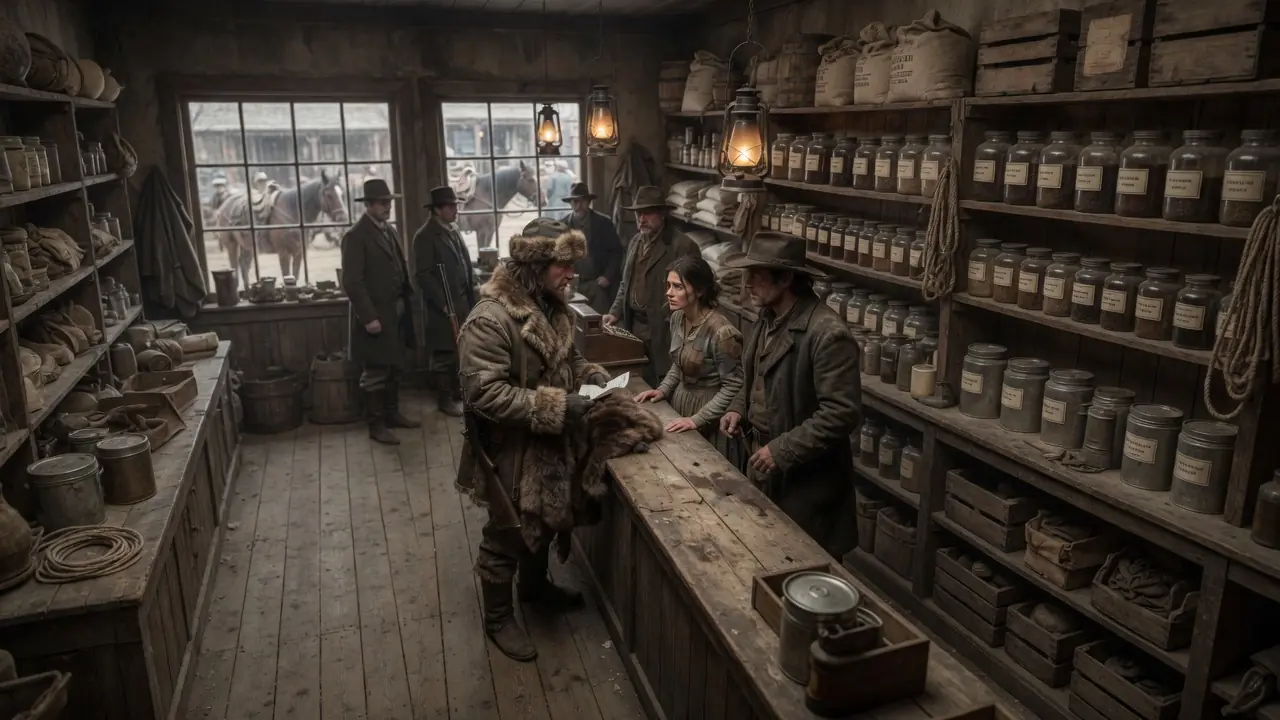
Inside Henley’s, the air smelled of tobacco, old potatoes, damp floorboards, and lamp oil. Flour sacks leaned against one wall, salt barrels stood near the front, and tin cups hung from hooks above the counter. Three men played cards around a barrel in the back, a woman kept her two children close beside the dry goods shelf, and old Henley stood behind the counter pretending to read. No one was speaking, though the room was far from empty.
Ronan saw the reason before he took three steps. A man in a grimy coat stood too close to a young widow near the counter, crowding her without touching her, smiling in the cruel way of men who enjoyed having witnesses. His hat was pushed back, his coat had once been expensive, and his hand kept drifting near the handle at his belt as if he wanted everyone to notice it. In front of him stood Evelyn Cross, both hands braced against the counter behind her, her dark brown hair coming loose from a knot and her patched dress worn thin at the elbows. She was not crying, not pleading, not shrinking, and that was what made Ronan stop.
The debt collector’s voice was almost pleasant. “Thomas Cross owed money, Mrs. Cross. Death doesn’t settle accounts just because it makes people sad.” Evelyn’s face did not change. “Thomas has been gone four months, Silas. I told you I have nothing left to give.” Silas Grady smiled wider. “Then maybe you and I need to discuss other arrangements.”
The woman near the dry goods made a small sound and pulled her children closer. The card players looked at their hands as if they had suddenly become fascinating. Henley kept his eyes on the paper in front of him, though he had not turned a page since Ronan entered. Red Mercy had learned the art of looking away.
Evelyn turned her head then, not toward the people who had failed her, but toward Ronan. Her eyes were dark brown, steady, and assessing, as if she had known he was there from the moment the door opened. She did not look at him like a helpless woman begging for rescue. She looked at him like a person measuring whether he was another danger or something else entirely.
Ronan stood still for four seconds. He counted them because counting gave shape to choices he did not want to make. He had come for salt, flour, lamp oil, caps, and coffee, not for a stranger’s trouble. Then Silas shifted closer to Evelyn, and Ronan crossed the store.
“What’s the debt?” he asked.
Silas turned slowly, irritated at the interruption. “This is between me and the widow, mountain man. Best you keep walking.”
“I asked what the debt is.”
Silas’s eyes narrowed, his arrogance adjusting itself around something unexpected. “Forty-two dollars, plus interest from her dead husband’s loans.”
Ronan reached inside his coat and pulled out a wrapped bundle of beaver pelts. Three months of careful trapping lay in his hands, work gathered in cold, wind, and solitude. He set the pelts on Henley’s counter. “That’s worth sixty at current prices. Take the forty-two from it and leave the rest with Henley.”
The store went so quiet the hanging lamp sounded loud. Silas looked from the pelts to Ronan’s face, then to Evelyn, who had not moved at all. “You don’t even know her.”
“No.”
“Then why pay?”
“Because forty-two dollars is forty-two dollars,” Ronan said. “And because I don’t like the way this conversation was going.”
Silas’s smile disappeared. For a moment, the room held its breath around the shape of his pride. Men like Silas needed rooms to fear them, and Ronan had just shown the room another option. Still, the pelts were real, the money was certain, and even cruel men knew when a profit could be taken without further risk.
Silas took the bundle from the counter. “This doesn’t end anything,” he said. He looked at Evelyn, then at Ronan. “Not one thing.” Then he walked out, and the bell over the door shook behind him.
“I didn’t ask for that,” she said.
“No.”
“I wasn’t going to let him take me.”
“I know.”
Something flickered across her face then, not softness exactly, but surprise that he had understood. She looked at the counter where the pelts had been. “What do you want for it?”
“Nothing.”
“Men don’t spend sixty dollars on nothing.”
“Forty-two,” he said. “And I told you what I want.”
Henley weighed flour with hands less steady than usual. Ronan gathered salt, lamp oil, caps, and coffee, even though the coffee was over a dollar and he bought it anyway. Evelyn stayed where she was, not hovering, not pleading, simply remaining in the room as if her mind was arranging new information around old danger. Finally, she asked, “Where are you going?”
“Back to the mountain.”
“Black Hollow?”
“Yes.”
She looked toward the window, where the street had begun filling with evening smoke. “He’ll come after me.”
“Probably.”
“I have six dollars in a tin under my floorboard, a house Thomas’s brother is trying to take, and no one in this town who will stand between Silas Grady and anything he wants.” Her voice was flat, factual, without pity. That made it harder to ignore. “So if you know what he is, you know this isn’t over.”
Ronan stood with one hand on the bag of coffee. He looked at Evelyn Cross, at the patched dress, the still hands, the eyes that had not learned helplessness even when the room had offered it as the safer choice. He thought about his cabin on the ridge, cold, narrow, lonely, and built for one man who had decided one was safer than two. Then he heard himself speak before the thought had finished hardening.
“I live alone,” he said. “Cabin up near the ridge. It’s cold, small, and a long way from anything.”
Evelyn did not answer.
“The horse leaves at first light,” Ronan continued. “Stable on the south end. If you’re there, you’re there. If you’re not, you’re not.”
He paid Henley, took his supplies, and left without looking back. That night, he slept in the stable beside his horse and told himself he had done enough. He had paid a debt that was not his and made an offer that would probably be refused. People did not ride into Black Hollow with strangers unless their last option had already burned behind them.
At first light, she was waiting outside the stable. She sat on a fence rail with a canvas bag at her feet and an old Winchester across her knees. Her hair had been braided and tucked beneath a hat, and she wore a man’s coat too large for her shoulders. When Ronan stopped in front of her, she looked up calmly.
“Is that loaded?” he asked.
“It wouldn’t be much use if it wasn’t.”
“Can you ride?”
“Not well,” Evelyn said. “I can stay on.”
“That may be enough.”
They left Red Mercy before the town fully woke. The trail to Black Hollow was barely a trail, more a line of decisions made by rock, scrub, and weather. Ronan rode ahead, letting his horse choose safe footing, and Evelyn followed with her jaw set and both hands steady on the reins. She did not pretend to be comfortable, and she did not complain.
By midday, they were above the tree line. The air thinned, the temperature dropped, and the land lost every courtesy it had offered below. Gray stone rose around them, snow sat in the higher cuts, and the wind moved like something with intention. Evelyn’s breathing changed, but she kept riding.
“If your hands go numb, say so,” Ronan said without turning.
“I can still feel them.”
“That can change fast up here.”
“Then I’ll tell you when it does.”
He did not know if he believed her, but he respected the answer. On the narrow ledge above a steep drop, her horse shied at loose stone. Evelyn stiffened, fear flashing clearly across her face, but she did not panic. “Tell me what to do,” she said.
Ronan told her. She listened. The horse found the trail again, and they kept going.
They reached the cabin at dusk. Evelyn stopped in front of it and stared long enough that Ronan saw the place through a stranger’s eyes for the first time in years. It was small, built into the mountain’s side, with a moss-dark roof, one north-facing window covered with oiled paper, a lean-to for wood, and a door that only fit properly because Ronan had spent an entire autumn making it fit. It looked less like a home than a shelter that had won every argument with the weather by refusing to fall apart.
“You live here?” Evelyn asked.
“Yes.”
She looked at the cabin again, then nodded. “All right.”
That was all. No horror, no regret, no accusation that he had undersold the discomfort. Just all right, as if the cabin were the next fact in a long list of difficult facts. Ronan opened the door and let her inside.
The cabin was one room: stove, worktable, sleeping platform, supply shelves, chest, tools, pelts, and the permanent smell of pine smoke and dried meat. Evelyn stood in the center and looked around with the same methodical assessment she had used in the store. “Where do I sleep?”
“You can take the platform.”
“No.”
“I can manage the floor.”
“I know,” she said. “But I won’t take your bed.”
“There is no bed.”
“Then I’ll make something.”
She built a low frame from spare boards and folded blankets before supper. Ronan sat at the table repairing a leather strap and tried not to watch her move around his space. It had been eleven years since another person had belonged to the sounds of his cabin. Every step she took seemed both impossible and ordinary.
Snow began the first night. It fell without warning, quiet against the roof, and by morning the world outside the door was white. By the second day, eight inches covered the ground, and the trail down had disappeared beneath drifts. Evelyn sat near the stove with a blanket around her shoulders and watched the oiled-paper window turn blue with snowlight.
“How long does it usually last?” she asked.
“Could clear tonight,” Ronan said. “Could stay a week.”
“This one?”
“This one wants to stay.”
She accepted that, as she accepted most things, by immediately adjusting herself to what it changed. On the second day, she hauled firewood from the lean-to without being asked. On the third, she found torn grain sacks and stitched them closed with waxed thread. On the fourth, she mended two of Ronan’s shirts, neatly and without comment, as if the cabin had given her work and she had agreed to it.
Ronan noticed everything. He noticed that she made coffee too strong at first, then adjusted it by the end of the week. He noticed that she never asked personal questions only to fill silence. He noticed that when she was afraid, she became more precise, not less.
The snow lasted four days. When the sky finally opened to a band of cold orange light, Ronan went out to cut more wood. Evelyn came with him, coat buttoned tight, hat low, one of the small hatchets in her hand. He looked at it, then at her.
“You know how to use that?”
“Point it at the wood. Hit the wood. That’s the principle, isn’t it?”
“More or less.”
Her first strikes were poor. Too much wrist, not enough shoulder, and the blade bounced more than it bit. Ronan corrected her once, then twice, and she listened without taking offense. By the end of the hour, she had a small pile cut, not pretty, but useful.
“Your wrist is breaking,” he told her. “Lock it.”
She tried again. The blade landed better.
“Again?” she asked.
That word became familiar. Again. Not with shame, not with performance, just the refusal to stop before the work changed. It was the same word she seemed to carry inside every part of herself.
As winter deepened, the cabin developed a rhythm. Ronan checked trap lines and hunted when weather allowed. Evelyn hauled water, stacked wood, cooked better beans than he had ever managed, and learned the slopes around the cabin one careful distance at a time. They lived in shared silence, which Ronan discovered was different from solitude.
The first time he stayed out too long in a storm, Evelyn saved him from his own calculation. He had gone to check the upper creek and misread the speed of the weather. By the time he reached the cabin clearing, snow had built high around his knees and the cold had moved past discomfort into danger. His legs failed him twenty yards from the door.
The cabin door opened. Evelyn came out without a coat, which he would later tell her was foolish, and crossed the yard fast enough to make the snow fly around her boots. She got her shoulder under his arm and said, “Up. Come on, Ronan. We’re close.”
“I’m up.”
“No, you’re arguing. Up.”
He got up because her voice left no space for refusal. Inside, she sat him on the platform, warmed water, and put his hands in it before he could insist he knew how to manage cold. When he tried to pull back, she held his wrists firmly. “Leave them.”
“It’s fine.”
“I can see the scars,” she said. “Leave them.”
He left them. Feeling returned in burning stages, and she did not release him until his fingers moved properly. Later, wrapped in a blanket near the stove, he said, “I misread the storm.”
“Yes.”
“I should have turned back sooner.”
“Yes.”
“You don’t have to agree so quickly.”
“I’m not here to protect your pride.”
That almost made him smile. Almost. Instead, he watched her feed the stove and understood that the cabin had already divided his life into before and after. Before was a man alone by choice and habit. After was a woman coming through snow without a coat because she had decided he was not staying out there.
In January, the supplies began to worry him. He had stocked for one person, not two. The math did not bend because he wanted it to, so he ate less, trapped harder, and said nothing. Evelyn was already doing the same.
“You are counting flour,” she said one evening.
“You’re watching too much.”
“You looked at the sack like it insulted you.”
“We’re fine.”
“We’re rationing.”
“Yes.”
She nodded and took the information as a working fact, not an accusation. The next morning, she went with him to the lower trap line and asked questions about tracks, sets, and why he placed traps where animals already traveled instead of where he wanted them to go. When he explained, she listened with full attention. Then she said, “That works for men too.”
Ronan glanced at her.
“Grady,” she said. “He found the path Thomas already walked. Saloon. Cards. Debt. He did not create the weakness. He waited in its road.”
“No,” Ronan said. “But waiting there still makes him what he is.”
They did not speak of Silas often, but he lived in the future like a shape under snow. When spring opened the lower trail, Ronan knew the conversation interrupted in Henley’s store might resume. Evelyn knew it too. She began practicing with the revolver in late January.
She had used a rifle before, but the revolver was different. He taught her stance, wrist, breath, distance, and what to do if fear arrived before thought. The first shot went wide. Evelyn looked at the target, then at the gun, then at him.
“Again,” she said.
By March, she could place shots close enough to matter. She was never reckless, never theatrical, never proud. She practiced because she believed preparation was another form of refusing to be owned by fear. Ronan watched her become steadier and tried not to think too much about how much that mattered to him.
The nightmares came in February. His first, then hers, though in a one-room cabin, such things became shared whether either person wanted them to or not. One night he woke to find her sitting up on her sleeping frame, arms around her knees, eyes fixed on the stove’s red glow. He waited before speaking.
“You don’t have to pretend you slept.”
She turned toward him. “Does it go away?”
He thought of eleven years of Cal’s face in snow, of one mistake that had followed him up the mountain and stayed. “It changes.”
“That is not the same thing.”
“No.”
She was quiet a long time. Then she said, “The night Thomas died, I felt relieved.” The words came flat, but Ronan heard the weight under them. “Not happy. Not glad. Relieved. Then I spent four months hating myself for it.”
“You shouldn’t.”
“I know,” she said. “Most days.”
Ronan looked toward the ceiling. “I had a partner once. Cal. Before the mountain. He died because of a bad choice I made, or because of weather, or because the world turns cruel without asking permission. Depends on the dream.”
Evelyn looked at him fully. “Knowing a thing and believing it all the way down are not the same.”
“No,” Ronan said. “They are not.”
After that night, the cabin felt different again. Not easier, exactly, but less sealed. Some things, once spoken, no longer had to press so hard against the inside of a person’s chest. They were still there, but outside too, where another human being could see them and not run.
Spring arrived in pieces. The creek woke first, loud beneath thinning ice. Then the lower trail showed itself, a dark line through mud and rock. Ronan noticed Evelyn notice it one morning while she carried water, and neither of them said what they both knew.
Silas Grady came ten days later.
Ronan heard the horses before he saw them. He set down the axe, went inside, and reached for the rifle. Evelyn stood from the table and picked up the revolver from the shelf, checking it exactly as he had taught her. Her face was pale but still.
“How many?” she asked.
“At least two.”
“Do we stay inside?”
“I go out,” Ronan said. “You stay back unless the situation changes.”
Her eyes held his. “Do not make me come after you.”
He almost told her not to. Then he remembered the storm, the snow, her shoulder under his arm. “I will try not to.”
Silas rode into the clearing with two men behind him. He looked smaller on the mountain than he had in the store, though no less dangerous. The cabin, woodpile, and cleared yard were all behind Ronan, and Black Hollow rose above them like an indifferent witness. Silas smiled as if the months between October and April had only sharpened his appetite for humiliation.
“Vance,” he called.
“Grady.”
“You had a comfortable winter with something that belongs to me.”
“No person belongs to you.”
Silas’s smile thinned. “The widow and I still have unfinished business.”
“Not here.”
One of the men behind Silas shifted in the saddle, trying to look larger than he was. The other stayed too still, watching angles and distance. Ronan saw him as the real problem. Silas had brought muscle and calculation.
“You’re one man,” Silas said. “I count three of us.”
“You should count again,” Evelyn said from the cabin door.
Silas turned. Evelyn stood in the doorway with the revolver held low but ready, both hands steady, her dark eyes fixed on him. She had not come out running. She had come out decided. Ronan did not look away from the men, but he felt the shift in the clearing like weather changing.
Silas’s arrogance cracked for the first time. “Evelyn, put that down.”
“No.”
“This mountain man has filled your head with foolish courage.”
“No,” she said. “He reminded me I already had it.”
The still man behind Silas moved first, not toward Evelyn, but toward Ronan’s side. Ronan raised the rifle and fired into the dirt near the horse’s front hooves, not close enough to harm, but close enough to make the animal rear back hard. The rider lost control, cursing as he fought for balance. Silas reached for his own weapon, and Evelyn lifted the revolver fully.
“Don’t,” she said.
The word was not loud. It did not need to be. Something in her voice stopped even the wind from seeming to move.
Silas looked from Ronan to Evelyn, then to the second man, whose horse still danced beneath him. The calculation that had saved him in Henley’s store returned, but this time the numbers were uglier. The mountain gave him no crowd to frighten, no cowardly town to hide inside, and no cornered widow alone against him.
Ronan stepped forward. “Ride down. Leave Red Mercy. Find another town to poison.”
Silas’s jaw worked. “This is not over.”
“It is here,” Evelyn said.
For one long moment, Silas looked as if pride might drag him into a choice he could not survive. Then he spat into the mud, jerked his horse around, and rode back toward the trail. His men followed, one with anger, one with relief. Ronan and Evelyn stood in the yard until the sound of hooves faded below the ridge.
Only then did Evelyn’s hands begin to shake. She stared at them as if surprised by the body’s honesty after the mind had held so firm. Ronan crossed to her and gently took the revolver from her grip. He set it aside, then touched the side of her face briefly, just enough to tell her she was real and standing.
She closed her eyes for two seconds.
Then she opened them. “The horses left deep tracks in the mud. If he comes back, we will hear him sooner.”
Ronan lowered his hand. “Yes.”
“And your cheek is scratched from the splinter near the woodpile.”
“I’m fine.”
“I know. Let me look anyway.”
He let her. She picked the tiny splinter from his cheek with careful fingers while the mountain stood above them, enormous and silent. Ronan realized then that he had spent eleven years believing survival meant needing no one. Evelyn Cross had arrived and proved that survival could also mean letting someone stand beside you.
By May, Red Mercy felt less like a place and more like a fever that had passed. Evelyn did not ask to go back. Ronan did not ask her to leave. The cabin began adjusting itself around two people the way mountain trails adjust around repeated steps.
They planned a supply trip to a trading post two days east, not because they feared Red Mercy, but because they had no reason to return to a town that had looked away. Ronan spoke of flour, salt, lamp oil, and traps. Evelyn spoke of needles, coffee, dried apples, and maybe glass for the window if the pelts brought enough. Ronan pretended not to notice that she said “we” easily now.
One evening in late spring, they sat outside the cabin on the bench built against the east wall. The snowfields above them glowed under the last light, and the creek below ran loud with meltwater. Evelyn held coffee in both hands, looking at the sky rather than him. “I’m glad you didn’t walk out of that store,” she said.
Ronan took a long time answering. “So am I.”
“I still don’t know why you didn’t.”
“I think I saw someone worth knowing.”
She turned then, and the guarded look that had once lived in her face had softened into something quieter. Not weakness. Never that. Something more dangerous to a lonely man: trust.
“And was I?” she asked.
Ronan looked at the cabin, the smoke rising from the chimney, the stacked wood, the patched window, the second sleeping frame that no longer felt temporary, and the woman beside him who had brought sound, work, warmth, and witness into the hollow place where he had once kept only survival. “Yes,” he said. “You were.”
The mountain did not care. It did not bless them, judge them, or rearrange itself because two damaged people had found a way to remain. It stood as it had always stood, vast and cold and ancient. But inside the little cabin built into its side, the stove burned, coffee cooled, two chairs sat close enough for shoulders to nearly touch, and silence no longer meant being alone.
Ronan Vance had come down from Black Hollow for supplies.
He had ridden home with Evelyn Cross.
And somewhere between the store, the storm, the cabin, and the long thaw of spring, the woman he rescued had become the person who rescued him back.