The wagon should never have made it that far.
One rear wheel had split near the hub and dragged crooked through loose mountain gravel.
The mule in front stumbled every few steps.
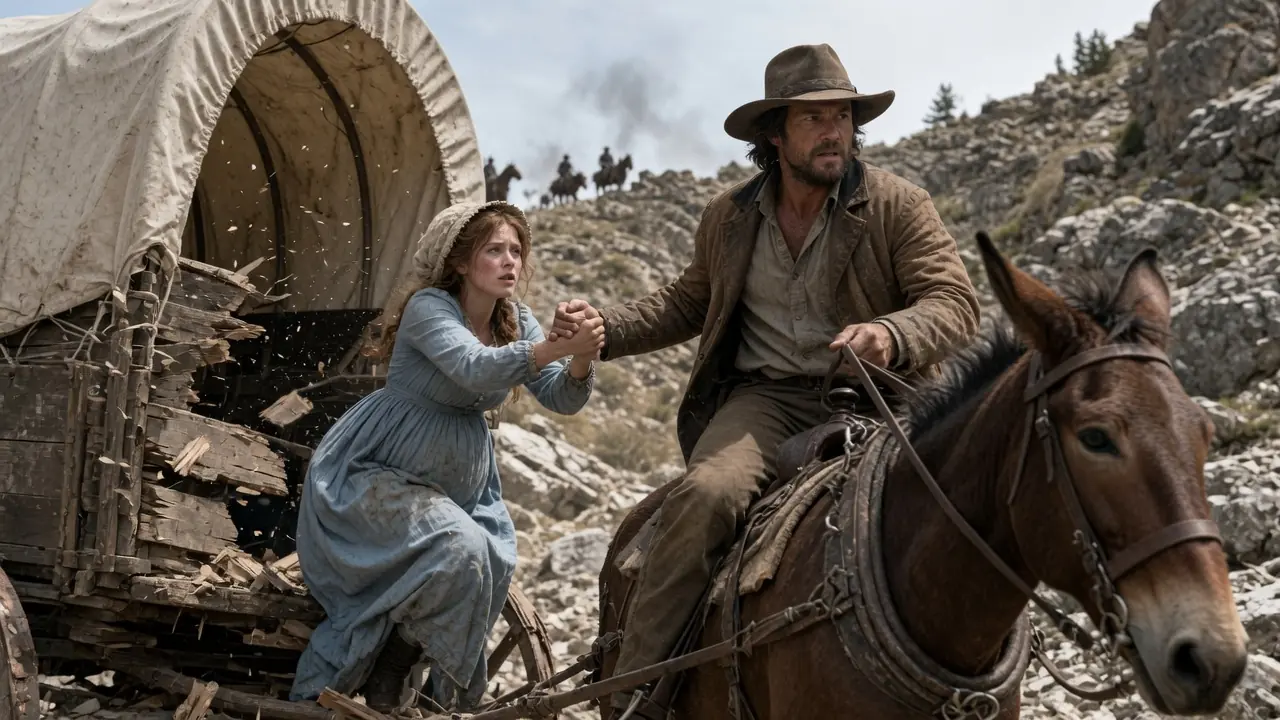
And beside the wagon walked a young woman who looked as though the next mile might be the one that finally put her on the ground.
Her dress had once been blue.
Now it was the color of dust.
Her bonnet hung down her back by its strings.
Strands of auburn hair stuck to her face.
One hand rested against the side of the wagon.
The other pressed instinctively against the child beneath her dress.
The sun stood high over the northern Rockies.
No shade.
No settlement.
No water visible anywhere except a thin silver line far below the pass.
And above her, hidden among broken granite shelves, three men watched through narrow openings between the rocks.
The woman did not see them.
The man approaching from the east did.
Silas McCord had spent enough years in the mountains to notice when a trail became too quiet.
Thirty-eight years old.
Broad shoulders.
Dark hair showing gray at the temples.
A weathered face marked more by wind than age.
He drove a freight wagon loaded with flour, lamp oil, nails, coffee, and medicine bound for a ranching settlement two valleys west.
His sorrel gelding, Buck, followed tied behind the wagon.
Silas had been on the trail six days.
He wanted a hot meal.
A bed.
And one night when he did not wake every two hours listening for wolves, thieves, or weather.
Then he saw the broken wagon.
He slowed.
The woman lifted one hand.
Not waving.
Warning.
“Don’t come too close.”
Silas stopped twenty yards away.
“All right.”
She looked exhausted enough to collapse and frightened enough to fight him anyway.
That combination made him careful.
“My name’s Silas McCord.”
She said nothing.
“I haul freight through here.”
Still nothing.
He looked at the damaged wheel.
“That wagon won’t make another half mile.”
“I know.”
“Where are you headed?”
“Red Pine Crossing.”
Silas glanced toward the ridge above them.
One glint disappeared behind stone.
Metal.
Rifle barrel.
His expression changed.
The woman noticed.
“What?”
Silas climbed down.
“Ma’am, I need you to listen very carefully.”
She stiffened.
“There are men above us.”
Her eyes went toward the ridge.
“Don’t look.”
She stopped.
Silas walked to her wagon as though inspecting the wheel.
“How many?”
“I saw three.”
“Could be more.”
Her breathing changed.
“What do they want?”
“Whatever you have.”
She looked toward the canvas covering her belongings.
“It isn’t much.”
Silas met her eyes.
“That has never stopped a thief.”
Her name was Caroline Mercer.
Twenty-seven years old.
Widowed seven months.
Her husband, Nathan, had died during a winter fever outbreak near Council Bluffs.
He had been a carpenter.
Not wealthy.
Not famous.
Just a man who believed land farther west might give them a life neither had been able to afford in town.
Before he died, Nathan filed a claim and paid a deposit on acreage near Red Pine Crossing.
Caroline had the documents wrapped in oilcloth beneath the wagon seat.
She also had forty-three dollars.
Two quilts.
A sewing machine.
Three cooking pots.
A trunk of clothing.
Nathan’s tools.
And a child due before winter.
She had sold everything else.
The wagon had begun failing two days earlier.
First a cracked spoke.
Then the brake.
Then the wheel.
She had ignored every warning because stopping alone in the mountains frightened her more than moving badly.
Now Silas stood beside the wheel and quietly said:
“We are not repairing this here.”
Caroline stared.
“You just said it won’t move.”
“It won’t.”
“My wagon can.”
He pointed toward his freight load.
“We transfer what matters.”
“What about the rest?”
“We leave it.”
“No.”
Silas looked toward the ridge.
“Mrs. Mercer.”
“That is everything I own.”
“If those men come down, they may decide it’s everything you owned.”
The words were harsh.
He meant them to be.
She looked at the wagon.
Then at him.
Her jaw trembled.
Silas softened.
“Take Nathan’s tools.”
“How do you know—”
“You keep looking at that chest like it matters.”
Her eyes filled.
She nodded.
They worked quickly.
Tool chest.
Clothing trunk.
Food sack.
Documents.
Sewing machine.
Two quilts.
Silas secured the mule behind his wagon.
Then helped Caroline onto the bench.
She hesitated before taking his hand.
Finally did.
The second she sat, Silas climbed beside her.
“Hold on.”
“What about my wagon?”
“Not ours anymore.”
He snapped the reins.
The first rifle shot came less than a minute later.
It struck the abandoned wagon.
Wood splintered.
Caroline gasped.
A second shot cracked above them.
Silas drove harder.
His team lunged forward.
Behind them, riders appeared from the rocks.
Four.
Then five.
Men on fast horses.
One wore a long black coat despite the heat.
Silas recognized him.
Rufus Cade.
There were handbills carrying his face from Helena to Cheyenne.
Stage robber.
Cattle thief.
Two murder warrants.
Rumored to travel with a loose gang that changed every season.
Caroline looked back.
“They’re coming.”
“I know.”
“Can we outrun them?”
“No.”
That answer frightened her more than a lie would have.
Silas turned toward a narrow break in the trees.
The main trail continued southwest.
He took the wagon north.
Caroline grabbed the side.
“Red Pine is the other direction.”
“I know.”
“Then where are we going?”
“Somewhere a wagon can fit.”
She looked behind them.
“And horses?”
“Not all at once.”
Silas had found the side trail three years earlier after spring runoff washed part of the mountain open.
It cut between two steep shoulders of rock before dropping toward an old logging route.
Narrow.
Rutted.
Dangerous for a freight wagon.
Worse for five riders trying to pass one another.
Silas drove into it.
Branches struck the wagon.
Boxes bounced.
A sack of flour tore loose and disappeared over the side.
Caroline screamed as the left wheels lifted briefly over a rock.
Silas hauled the team back.
“Stay low.”
Behind them, Cade’s men entered the cut.
One tried to ride around another.
His horse slipped.
The rider went down.
No one stopped for him.
Silas reached a section where an old pine had fallen partly across the trail.
He had to slow.
Caroline looked at him.
“They’ll catch us.”
Silas handed her the reins.
Her eyes widened.
“What?”
“Keep them straight.”
“I’ve never driven four horses.”
“You’re about to.”
He climbed onto the wagon bed.
Caroline stared at the reins in her hands.
“Silas.”
“Straight.”
The freight wagon passed the fallen pine.
Silas jumped down behind it.
He pulled a small axe from the side rack.
One of Cade’s riders appeared around the bend.
Silas struck the remaining support branch holding the dead trunk above the slope.
Once.
Twice.
The old wood cracked.
He jumped back onto the wagon.
The dead pine rolled.
Not an avalanche.
Not the mountain collapsing.
Just one enormous trunk sliding sideways across the trail.
The first pursuing horse stopped hard.
The second nearly struck it.
The narrow cut became blocked.
Silas grabbed the reins from Caroline.
Behind them, Cade shouted:
“McCord!”
Silas looked back once.
Rufus Cade stood beside the fallen trunk.
He had recognized him too.
That was not good.
They reached Red Pine Crossing near sunset.
It was not much of a town.
One muddy main street.
General store.
Blacksmith.
Small hotel.
Church.
Livery stable.
Saloon.
A dozen houses scattered toward the river.
The sheriff’s office occupied a narrow building beside the feed store.
Silas stopped there first.
Sheriff Amos Reddin came outside.
Fifty-three.
Heavy mustache.
Bad left knee.
A man who rarely hurried because his body had made hurrying expensive.
He looked at Silas.
Then Caroline.
Then the mule tied behind the freight wagon.
“What happened?”
“Cade.”
That single word changed him.
“How many?”
“Five I saw.”
“Where?”
“North pass.”
“Anybody hurt?”
“Not yet.”
Amos looked at Caroline.
“Ma’am?”
“Caroline Mercer.”
Silas added:
“She’s headed for the Mercer claim south of town.”
Amos’s face softened.
“Nathan Mercer?”
Caroline looked up.
“You knew him?”
“Met him last fall.”
“He filed the boundary through my office.”
“He talked about you.”
That nearly broke her.
Caroline turned her face away.
Amos did not push.
He looked toward Silas.
“Cade’s been bold lately.”
“How bold?”
“Three freight robberies.”
“One ranch burned after the owner refused to pay him.”
“Two witnesses disappeared before trial.”
“How many deputies?”
“Three.”
Silas stared.
Amos shrugged.
“It’s a small town.”
Caroline intended to continue to her claim the next morning.
The doctor stopped that plan.
Dr. Evelyn Porter examined her at the hotel.
When she finished, she sat beside the bed.
“You’ve been walking how far?”
Caroline looked embarrassed.
“Too far.”
“That was not a number.”
“Several miles yesterday.”
“On mountain roads?”
“Yes.”
Evelyn sighed.
“You need rest.”
“How long?”
“At least two weeks before I want you in another wagon.”
“I can’t afford two weeks.”
“That does not change the pregnancy.”
Caroline looked toward the wall.
“I have land waiting.”
“You have a baby coming.”
“The land may not wait.”
Evelyn’s expression softened.
“It has waited through winter.”
“It can wait fourteen more days.”
Caroline closed her eyes.
After the doctor left, Silas stood awkwardly beside the door.
“I’ll find you somewhere cheaper than the hotel.”
Caroline looked at him.
“You don’t have to do that.”
“I know.”
“You’ve already done enough.”
Silas stared at the floor.
“No.”
“I stopped a wagon.”
“That doesn’t make me responsible for the rest of your life.”
“Good.”
She almost smiled.
“Because I wouldn’t let you be.”
Silas found a small cabin near the river.
One room.
Cookstove.
Narrow bed.
Leaking window.
Owned by a widow named Martha Bell.
Martha charged almost nothing after hearing Caroline’s story.
Silas paid one week anyway.
Caroline objected.
He ignored her.
She tried to give him money from the purse she kept hidden beneath her dress.
“No.”
“Silas.”
“No.”
“I am not helpless.”
“I know.”
“Then stop treating me like I am.”
He looked at her.
“That isn’t what I’m doing.”
“What are you doing?”
Silas had no answer.
So he left.
That irritated Caroline more than if he had argued.
Silas planned to remain in Red Pine one night.
He stayed six weeks.
At first because Sheriff Reddin asked for help escorting freight through the north pass.
Then because Cade was still nearby.
Then because Caroline needed repairs made to Nathan’s claim cabin before she could safely move there.
He told himself each reason was practical.
Caroline knew better before he did.
Their friendship developed in small things.
Silas brought lumber.
Caroline repaired the torn sleeve of his coat.
He found a secondhand cradle.
She baked biscuits so hard he politely soaked them in coffee.
He showed her how to fire a small revolver safely.
She told him she hated guns.
He said:
“So do I.”
She looked surprised.
“You carry one.”
“I carry a rain coat too.”
“I don’t enjoy storms.”
Caroline smiled.
That became the first time Silas realized how much he liked seeing her do it.
He disliked that realization immediately.
Red Pine lived under pressure.
Cade’s gang did not attack every week.
That would have been easier.
Instead, they appeared unpredictably.
A rancher found cattle missing.
A freight team vanished.
A storekeeper received a note demanding “road protection.”
Someone shot through the sheriff’s window at midnight.
Fear became routine.
That was worse.
People adapted.
Children were called indoors earlier.
Men traveled armed.
Women watched roads from kitchen windows.
Nobody wanted to be the reason Cade returned angry.
Then came the warning.
Not from some mystical stranger.
From two ranch hands north of town.
They had seen Cade meeting with rustlers near an abandoned mining camp.
Possibly twelve men.
Maybe fifteen.
No one knew exactly.
But enough horses had been gathered to suggest something larger than a road robbery.
Sheriff Reddin sent word to the territorial marshal.
Help would take days.
Maybe longer.
Silas studied the map.
“What does Cade want here?”
Amos said:
“Horses.”
“Food.”
“Ammunition.”
“Maybe the bank box.”
Silas shook his head.
“He wants winter.”
Amos looked at him.
“What?”
“He needs supplies before snow.”
“Red Pine has everything in one place.”
That changed the discussion.
They did not need to defeat an army.
They needed to make the town too difficult to rob.
For the first time, Red Pine organized together.
Not as soldiers.
As townspeople.
Wagons positioned to narrow access roads.
Lookouts on the ridge.
Ranchers agreeing to move valuable horses away from the main livery.
A bell signal from the church.
Women and older men assigned to the church basement as a protected aid station.
Buckets filled.
Water barrels moved.
Extra ammunition distributed only to people who knew how to use it.
Dr. Porter organized medical supplies.
Caroline helped.
Silas objected.
“You’re supposed to rest.”
“I am sitting.”
“You’ve been standing for twenty minutes.”
“I am about to sit.”
“You said that ten minutes ago.”
Caroline looked at him.
“Silas.”
“Yes?”
“Go bother an outlaw.”
He smiled despite himself.
Cade came three days later.
Not thirty riders.
Thirteen.
Enough.
They entered from the east just after noon, expecting the town to panic.
Instead, the main street was partly blocked by freight wagons.
The best horses were gone.
Store shutters closed.
The bank empty of cash beyond what could not be moved.
Sheriff Reddin stood behind a barricade with his deputies.
Silas beside him.
Amos called:
“Cade!”
The riders stopped beyond rifle range.
Rufus Cade moved forward alone.
His black coat was open.
“What is this?”
Amos answered:
“A town.”
Cade smiled.
“Looks scared.”
“Scared people can still say no.”
Cade looked toward Silas.
“You again.”
Silas said nothing.
Cade’s smile disappeared.
“You cost me a horse up there.”
Silas shrugged.
“Mountain did that.”
Cade raised his voice.
“We need supplies.”
Amos answered:
“Buy them.”
Several townspeople laughed nervously.
Cade did not.
“Move the wagons.”
“No.”
“Last chance.”
Amos rested both hands on his rifle.
“Same answer.”
For a long moment, nothing happened.
Then one of Cade’s men fired.
The shot struck a wagon wheel.
Everything broke open.
The fight lasted less than fifteen minutes.
It felt much longer.
Cade’s riders tried the main street first.
The barricades forced them into narrow approaches.
Two horses went down after riders pushed them too hard on muddy ground.
One outlaw was wounded.
Another abandoned his horse and fled behind the feed store.
Ranchers fired from protected positions.
Sheriff Reddin kept shouting:
“Don’t chase.”
“Hold the street.”
“Stay behind cover.”
That discipline mattered.
This was not a heroic charge.
It was frightened people refusing to leave prepared ground.
Cade quickly realized the town was harder than expected.
He turned toward the river road.
That was where the aid cabin stood.
Silas saw him.
So did Caroline.
Cade rode fast.
Not because he knew who Caroline was.
Because the river road offered the only open path around the barricade.
Caroline stood inside the cabin beside Dr. Porter.
“Get down.”
Evelyn pulled her behind a table.
Cade reached the well.
Silas intercepted him on Buck.
The two horses nearly collided.
Cade fired.
Missed.
Silas fired once toward the ground beside Cade’s horse.
The animal reared.
Cade went down.
He rolled.
Came up with a revolver.
Silas dismounted behind the well.
“Drop it.”
Cade laughed.
“You always were a preacher.”
“I’ve never preached.”
“You should.”
Cade raised the revolver.
A second voice came from behind him.
“Rufus.”
Sheriff Reddin stood near the corner of the store.
Cade turned.
For half a second, everyone froze.
Then Cade made the wrong choice.
He shifted the gun toward Amos.
Amos fired.
The bullet struck Cade high in the shoulder.
His revolver fell.
Silas reached him first.
Kicked the weapon away.
Two deputies came running.
Within seconds, Rufus Cade was on his back in the mud, cursing while Dr. Porter shouted that if anyone wanted him alive for trial, they should stop standing on his injured arm.
The remaining riders broke.
Some fled.
Three surrendered.
Two were captured later by ranchers.
The others disappeared into the mountains.
Red Pine did not cheer immediately.
People counted.
Checked doors.
Called names.
Looked for wounded.
One deputy had been hit in the leg.
A rancher had a bullet crease across his ribs.
Another man broke his wrist when a horse knocked him down.
No townspeople were killed.
That felt miraculous enough.
Cade went east under guard to face trial.
Not execution in the street.
Not frontier revenge.
Court.
Witnesses.
Charges.
The territorial system was imperfect.
Slow.
But Sheriff Reddin believed law only meant something if people used it when revenge would have been easier.
Silas agreed.
Caroline did too.
Months later, a jury convicted Cade on robbery, attempted murder, and several other charges tied to previous attacks.
He disappeared into a territorial prison.
Red Pine gradually stopped expecting his return.
Caroline moved to the Mercer claim in early autumn.
Nathan’s land sat in a valley south of town.
Not spectacular.
But good.
Creek water.
Grass.
Enough timber for repairs.
A small cabin Nathan had paid two men to begin building before winter stopped the work.
Silas finished the roof.
Then fence.
Then barn wall.
Caroline watched him one afternoon.
“You know you don’t live here.”
“I know.”
“You spend a great deal of time repairing property you don’t own.”
“I’ve noticed.”
“What happens when you run out of things to fix?”
Silas hammered one nail.
Then another.
“Fence is bad on the west side.”
“That is not an answer.”
He looked at her.
“I don’t have one yet.”
Caroline smiled.
“Good.”
“Why?”
“Means you’re learning.”
Her daughter was born in November.
The first snow had fallen during the night.
Dr. Porter arrived before sunrise.
Martha Bell came too.
Silas waited outside the cabin.
For six hours.
In the cold.
Sheriff Reddin rode by once.
“You know there’s a stove inside town.”
Silas stared at him.
“Go away.”
Amos smiled.
At noon, the cabin door opened.
Martha looked at Silas.
“You can come in.”
He removed his hat.
Caroline looked exhausted.
Pale.
Happy.
In her arms was a little girl wrapped in one of the quilts from the broken wagon.
Silas approached carefully.
Caroline said:
“Her name is Clara.”
Silas looked at the baby.
“Hello, Clara.”
The child opened her eyes.
Then immediately began crying.
Silas stepped back.
Caroline laughed.
“She likes you.”
“Terrible way to show it.”
Caroline watched him.
Then said:
“Nathan wanted a daughter.”
Silas became quiet.
“I’m glad she has his name.”
Clara Nathaniel Mercer.
Caroline had chosen the middle name before Silas ever knew her.
He respected that.
He never tried to become the man who had died.
That was one reason Caroline eventually allowed him to become something else.
They married the following spring.
No grand ceremony.
Church.
Twenty-three people.
Caroline wore a simple cream dress Martha altered for her.
Silas stood uncomfortable in a clean shirt.
Sheriff Reddin served as witness.
Dr. Porter cried.
Silas did not.
Until Caroline reached him.
Then he did.
Only once.
Briefly.
He denied it afterward.
Nobody believed him.
The Mercer claim never became the richest ranch in the territory.
That story came later.
People improved stories with time.
The real farm struggled.
One winter killed six cattle.
A spring flood took part of the lower fence.
Grasshoppers ruined one field.
Silas spent two summers hauling freight on the side because crops alone did not cover expenses.
Caroline sewed clothes for half the valley.
They built slowly.
Year by year.
Fence by fence.
Animal by animal.
Clara grew.
Then came another child.
A boy.
Then another daughter.
Travelers began stopping at the ranch because Silas knew the pass better than anyone.
He gave directions.
Water.
Repairs.
Food if someone needed it.
Caroline never charged a stranded family for supper.
When Silas complained mildly about supplies, she reminded him:
“You once abandoned a freight schedule for a woman with a broken wagon.”
He always lost that argument.
Years later, the old north trail was replaced by a better road.
Then stage service improved.
Eventually surveyors marked a route for rail through the lower valley.
Red Pine changed.
The saloon became a hotel.
The blacksmith shop expanded.
Sheriff Reddin retired.
Dr. Porter trained an assistant.
Children who had hidden in the church basement during Cade’s attack grew old enough to tell the story badly.
According to them, Silas McCord fought fifty outlaws alone.
Caroline corrected them every time.
“There were thirteen.”
A boy once asked:
“How many did Mr. McCord shoot?”
Caroline looked toward Silas.
He was sitting on the porch repairing tack.
“Ask him.”
The boy did.
Silas said:
“Not many.”
“How many?”
“Enough.”
“Did you kill Rufus Cade?”
“No.”
“Sheriff Reddin shot him.”
“Then you captured him?”
“With help.”
The boy looked disappointed.
“That’s not how my father tells it.”
Silas smiled.
“Your father likes exciting stories.”
“Wasn’t it exciting?”
Silas thought.
“Yes.”
“That’s why people keep adding things it doesn’t need.”
When Silas was sixty-seven, Clara asked him a different question.
They stood near the old mountain pass.
She had children of her own by then.
The abandoned wagon was long gone.
Only a rusted wheel rim remained half buried near the trail.
Clara asked:
“Did you know my mother would become your wife when you stopped?”
Silas laughed.
“No.”
“Did you even like her?”
“At first?”
“Yes.”
“She threatened me.”
Clara smiled.
“That sounds like her.”
“She thought I might rob her.”
“Did that offend you?”
“No.”
“She was traveling alone.”
“She was supposed to be suspicious.”
Clara looked toward the ridge.
“Then why stop?”
Silas became quiet.
The answer seemed obvious to him.
Yet people kept turning it into destiny.
Love.
Fate.
Legend.
He finally said:
“Because her wheel was broken.”
Clara looked at him.
“That’s it?”
“That was enough.”
That became the part of the story she later told her children.
Not that Silas was secretly a famous scout.
He was not.
Not that Caroline’s land contained gold.
It did not.
Not that one cowboy defeated an outlaw army.
He did not.
The truth was smaller.
And stronger.
One man came around a bend in the trail.
Saw a woman in trouble.
Also saw danger.
He could have continued.
His freight was valuable.
His schedule mattered.
Nobody would have blamed him for deciding the risk was too high.
Instead, he stopped.
That choice did not guarantee anything.
He could not know they would survive Cade.
Could not know Caroline would remain in Red Pine.
Could not know they would become friends.
Or marry.
Or build a family.
Or spend thirty years together on a piece of ground another man had dreamed about before dying.
He only knew what existed in front of him.
A broken wheel.
A frightened woman.
Men with rifles above the pass.
And a moment when continuing forward would have been easier than helping.
That was all.
History often became grand after enough years.
People added heroes.
Villains.
Perfect courage.
Perfect endings.
But the people who actually lived through difficult days rarely experienced them that way.
They were tired.
Afraid.
Unsure.
They made decisions with incomplete information.
Then lived with what followed.
Silas McCord never thought of himself as brave.
Caroline Mercer never thought of herself as helpless.
Red Pine never believed it had defeated evil forever.
They simply reached one point where enough ordinary people decided fear could no longer make every decision for them.
And sometimes that was all courage was.
Not charging toward danger.
Not winning a gunfight.
Not becoming a legend.
Just refusing to ride past someone who needed you when the easier road was still open.