The federal prosecutor had been speaking for less than ten minutes when the defense attorney made the worst decision of his career.
He turned toward the witness stand, adjusted his expensive gray suit, and smiled at the eighty-year-old woman seated beneath the courthouse lights.
“Mrs. Whitmore,” he said, “isn’t it possible that age, grief, and isolation caused you to misunderstand what you believed you saw?”
Eleanor Whitmore folded her hands in her lap.
She wore a dark-blue dress, a pearl brooch that had belonged to her mother, and the calm expression of a woman listening to a child explain something he had not properly studied.
“No,” she said.
The attorney glanced toward the jury.
“You were watching from more than a hundred yards away.”
“One hundred twelve yards from my attic window to the warehouse loading entrance.”
“You expect this jury to believe you could identify criminal activity from that distance?”
“I identified vehicles, arrival patterns, chemical containers, armed guards, and waste discharge.”
He lifted a photograph.
“This image is blurred.”
“That photograph was taken during heavy rain at 2:43 in the morning.”
“And yet you included it in your report.”
“Yes.”
“Why?”
“Because the same van appeared on six other nights, always on Tuesdays or Thursdays, always between two and four in the morning, and always remained inside for approximately nineteen minutes.”
The attorney paused.
Eleanor continued before he could recover.
“The vehicle was rented in Portland under a false identity. The rental agreement was later connected to your client’s accountant through a prepaid telephone recovered during the federal search.”
A few jurors looked toward the defense table.
Victor Rourke sat there in a dark suit that failed to disguise his size. The spiderweb tattoo rising above his collar appeared faded beneath the courtroom lights.
Six months earlier, people in Cedar Ridge had crossed the street to avoid looking at him.
Now he could not look at Eleanor.
The defense attorney tried again.
“You have no law-enforcement training.”
“I was a trauma nurse for thirty-eight years.”
“That is not surveillance training.”
“No.”
Eleanor tilted her head.
“It is training in noticing what frightened people miss.”
The judge lowered his face, hiding the beginning of a smile.
The prosecutor had warned the defense not to underestimate her.
They had done it anyway.
Everyone did.
That was how the Iron Vultures had lost an empire.
Cedar Ridge had once been the kind of Pacific Northwest town where people left gardening tools outside overnight and trusted that they would still be there in the morning.
Retired teachers lived beside hardware-store owners. Families gathered on porches after dinner. Children rode bicycles through the streets until porch lights came on.
Eleanor Whitmore had lived at the end of Alder Lane for forty-two years.
She was five feet two inches tall and walked with a slight limp following a hip replacement. Her silver hair was always pinned neatly, even when she worked in the greenhouse behind her home.
To most people, she appeared harmless.
That impression had protected her better than any locked door.
Her late husband, Colonel James Whitmore, had served in military intelligence before retiring to Cedar Ridge. He rarely discussed his assignments, but he had spent thirty-five years teaching Eleanor how to observe the world without appearing interested in it.
“People hide from suspicion,” he once told her. “They perform for indifference.”
James died eight years before the Iron Vultures arrived.
Eleanor missed him without allowing grief to become the only story her life told.
She cultivated hydrangeas.
Baked sourdough for the parish food pantry.
Volunteered at a rural clinic twice each month.
Read medical journals over breakfast because she disliked the assumption that retirement required intellectual surrender.
Her home stood beside an abandoned lumber warehouse separated from her property by an old drainage ravine and several acres of brush.
For years, the warehouse had been nothing more than rusted siding, broken windows, and nesting birds.
Then the motorcycles came.
The first convoy arrived in late July.
Engines shook glasses inside kitchen cabinets. More than thirty motorcycles moved down Alder Lane in a staggered formation, followed by black sport-utility vehicles and two cargo trucks.
They entered the warehouse property.
Within two days, contractors erected an eight-foot fence topped with razor wire.
Security cameras appeared at the gates.
Floodlights turned night into a hard white glare.
The Iron Vultures had chosen Cedar Ridge as their new regional headquarters.
Their president was Victor “Iron” Rourke.
He stood six feet four, weighed nearly two hundred seventy pounds, and possessed the confidence of a man who had escaped consequences often enough to believe they were optional.
A federal racketeering case against him had recently collapsed after mishandled evidence was excluded.
He arrived in Cedar Ridge feeling untouchable.
The town’s police department employed fourteen officers.
Its tactical equipment was outdated. Its annual budget barely covered patrol vehicles, training, and overtime.
Rourke understood the imbalance immediately.
The warehouse was officially registered as a private motorcycle association.
Its permits were technically valid.
Its lawyers answered every complaint.
Its members learned where the law ended and intimidation could begin without easily crossing into a provable felony.
Engines roared at three in the morning.
Dogs patrolled the fence.
Beer bottles landed in neighboring yards.
People who complained found tires punctured or windows broken.
Harold Benton, the seventy-four-year-old owner of the local hardware store, asked one rider to move a motorcycle from his loading area.
That evening, Harold was found behind the store with a broken jaw and three cracked ribs.
He could not identify his attackers.
No witness admitted seeing anything.
Detective Nathan Cole visited Eleanor two days later.
He was fifty-one, experienced, and exhausted by the knowledge that his department was responsible for a town it lacked the resources to defend.
They sat in Eleanor’s kitchen while motorcycle engines shook the lace curtains.
“Our hands are tied,” Nathan said.
Eleanor poured iced tea.
“People use that phrase when they want helplessness to sound procedural.”
Nathan sighed.
“I need evidence that survives court. Complaints about noise and threats are not enough for a warrant against a fortified property.”
“They attacked Harold.”
“He did not see who hit him.”
“He knows.”
“Knowing and proving are different things.”
Eleanor looked through the window toward the fence.
“My husband and I bought this house after his second deployment.”
Nathan followed her gaze.
“I understand what this place means to you.”
“No, Detective. You understand the sentence. That is not the same thing.”
He lowered his eyes.
Eleanor continued.
“James spent his life believing certain places were worth defending because decent people lived there.”
“I am asking you not to provoke them.”
She took a slow drink.
“I am asking you to stop treating fear like a permanent zoning regulation.”
Nathan leaned forward.
“Rourke is dangerous.”
“So am I.”
The answer was soft.
Nathan did not laugh.
The event that changed everything occurred one week later.
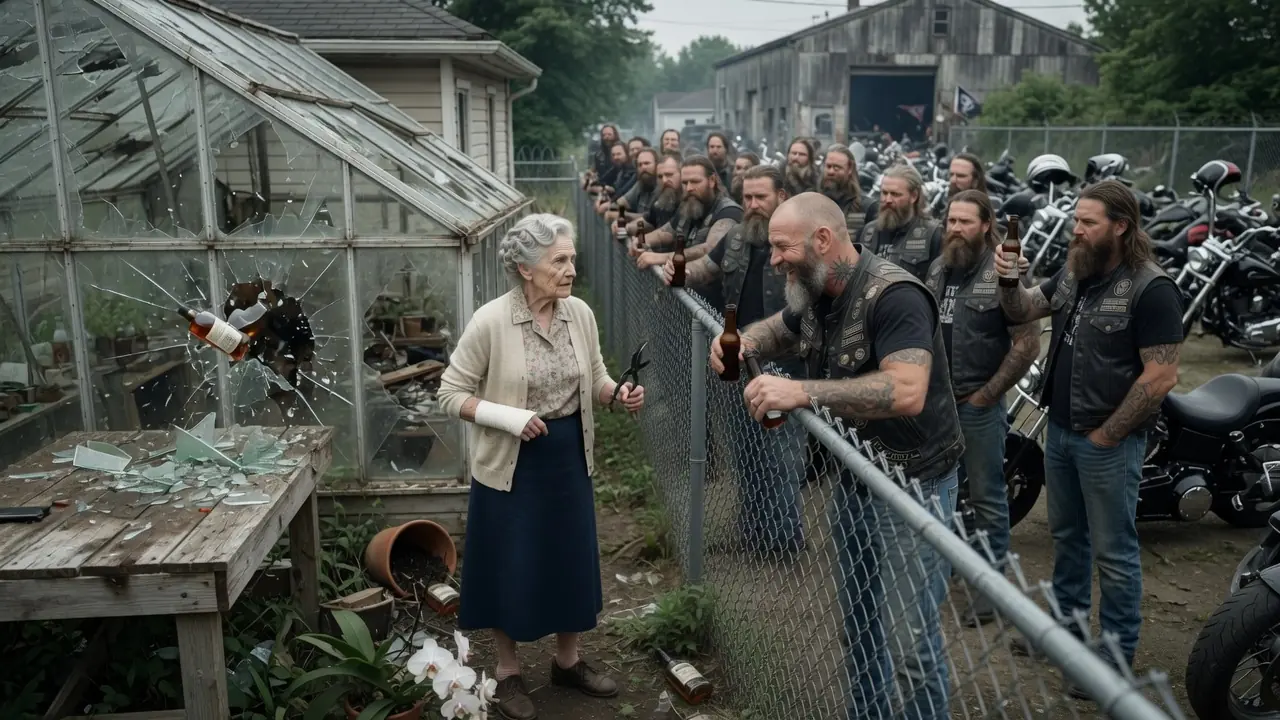
Eleanor was inside her greenhouse pruning an orchid when a party erupted behind the warehouse fence.
Music shook the glass.
Men shouted.
Bottles broke against the ground.
Eleanor ignored them until a whiskey bottle sailed over the fence.
It struck the greenhouse roof.
Glass exploded downward.
A shard cut across Eleanor’s forearm, opening a wound nearly three inches long.
Blood fell onto the orchid soil.
She did not scream.
Years in trauma rooms had taught her that panic spent energy while solving nothing.
Eleanor entered the house, cleaned the wound, closed it with supplies from her medical kit, and wrapped the arm in white gauze.
Then she returned to the greenhouse.
Victor Rourke and three members stood beyond the chain-link fence laughing.
One was Warren Hayes, the club’s enforcer. People called him Dutch.
Another was a broad, heavy man named Caleb Rollins.
Rourke raised a cigar.
“Bad luck, Grandma.”
Eleanor picked up the broken neck of the bottle.
“You damaged my greenhouse.”
Rourke exhaled smoke through the fence.
“Call the police.”
The men laughed.
Eleanor stepped closer.
“You have made a serious miscalculation.”
Dutch slapped one hand against the fence.
“You threatening us?”
“No.”
Eleanor looked directly toward Rourke.
“I am informing you.”
The laughter faded slightly.
Rourke recovered first.
“Go inside before you get hurt.”
Eleanor placed the bottle fragment in a metal bucket.
Then she turned her back on them.
She did not call Nathan Cole.
She entered the basement and opened the steel footlocker James had left behind.
Inside were old binoculars, maps, notebooks, cameras, recording devices, and carefully labeled tools.
Nothing was illegal.
Nothing was extraordinary by itself.
The value came from knowing what information to collect.
For the next three weeks, Eleanor appeared to retreat.
Her curtains remained closed.
She stopped reading on the porch.
She visited the grocery store only during quiet hours.
The bikers believed they had frightened her.
From the attic, Eleanor began watching.
She was not interested in parties or motorcycle noise.
She searched for structure.
Every organization had rhythms.
Deliveries.
Guard changes.
Money movement.
Waste.
Rourke’s men behaved like criminals but operated like a business.
Cargo vans arrived twice each week between two and four in the morning.
They stayed for similar lengths of time.
Certain men appeared only during deliveries.
Others were never permitted near the basement entrance.
Eleanor recorded license plates, vehicle descriptions, dates, and times.
She did not guess.
When details were uncertain, she marked them uncertain.
When rain obscured a plate, she waited for the vehicle to return.
Patterns formed.
One van came from an out-of-state rental company.
Another was registered to a plumbing contractor that had closed three years earlier.
A black pickup regularly left the warehouse twenty minutes after deliveries arrived and returned shortly before dawn.
Eleanor mapped every movement.
Then she noticed the drainage pipe.
The warehouse’s visible security system covered its gate, parking area, and road-facing walls.
The cameras ignored the wooded ravine behind the properties.
Rourke assumed the brush and steep ground made the area inaccessible.
He had not spent forty-two years living beside it.
Eleanor knew where the soil remained firm after rain.
She knew the deer paths.
She knew where James had once placed stepping stones to reach the creek.
Wearing dark garden clothes and carrying a small flashlight covered with red fabric, she entered the ravine on two nights.
She did not crawl beneath the fence or enter the compound.
She remained on public land and her own property.
Near the drainage outlet, she smelled something that did not belong in ordinary wastewater.
Solvents.
Ammonia.
Chemical waste.
Her nursing experience told her the mixture was dangerous.
Her gardening experience told her the damaged vegetation was evidence.
Leaves had yellowed along a narrow path beneath the pipe.
Moss had died.
The water carried an unnatural sheen.
Eleanor collected soil and water samples from her side of the boundary, sealed them, labeled them, and sent them to a private environmental laboratory.
The results confirmed contamination associated with illegal synthetic-drug production.
The warehouse was not merely a clubhouse.
Rourke’s organization was operating a high-output narcotics laboratory.
Eleanor prepared two identical binders.
Every photograph was dated.
Every observation distinguished fact from inference.
License plates were cross-referenced with public registration information.
Laboratory reports were included with chain-of-custody documentation.
Maps showed the ravine, pipe, vehicle routes, and observable activity.
One binder remained hidden inside her home.
The second went to Special Agent Michael Grant at the federal narcotics office in Seattle.
James had known Michael’s father.
Eleanor enclosed no dramatic letter.
Only one sentence.
I believe the enclosed material documents an active manufacturing and distribution operation in Cedar Ridge. Please verify independently.
Federal agents began verification without informing local police.
Michael understood the risk of a leak, even an accidental one.
The evidence was strong.
But the investigation still required time.
Eleanor knew time was dangerous.
Rourke’s men were becoming more careless.
Chemical waste increased.
Deliveries grew larger.
Harold Benton refused to reopen his store.
Families began discussing moving.
Eleanor decided the bikers needed to reveal themselves publicly.
She also understood Rourke’s weakness.
Not intelligence.
Ego.
Men like him could tolerate being disliked.
They could not tolerate being laughed at or outmaneuvered by someone they considered powerless.
Eleanor began leaving small signs that she knew more than she should.
At the grocery store, she spoke loudly enough for Dutch Hayes to hear.
“My nephew in Seattle received the photographs,” she told the cashier while purchasing apples. “He said the vans were especially interesting.”
The cashier had no idea what she meant.
Dutch did.
Eleanor did not look at him.
She paid and walked away.
That evening, activity inside the compound changed.
Two vehicles left unexpectedly.
Three men inspected the rear fence.
Rourke increased guards.
Eleanor documented everything.
The following morning, she sat on her porch for the first time in weeks.
When Rourke appeared behind the fence, she raised her coffee cup.
He stared at her.
She smiled.
The bait worked.
On a stormy Tuesday night, the power to Eleanor’s house went out at 1:15.
The neighboring houses remained lit.
She sat inside her bedroom with a charged telephone, a portable emergency light, and James’s old revolver secured beside her.
She had already called federal Agent Grant when the warehouse activity changed.
He instructed her to lock herself inside and wait.
Local police were notified only after the break-in began.
Eleanor heard the rear fence being cut.
Then footsteps entered her yard.
Three men.
The back door shattered.
Flashlight beams moved through the kitchen.
“Find the computer,” Rourke whispered.
Eleanor activated the emergency call on her telephone.
The dispatcher answered silently, following protocol.
From the hallway, Rourke spoke again.
“Find the files. Make it look like an accident.”
Those words would later support the attempted-murder charges.
Dutch and Rollins moved toward the basement.
Eleanor had left an old laptop visible at the bottom of the stairs, displaying a fabricated transfer screen.
No federal system was connected to it.
It was only a message designed to confirm the paranoia already inside their minds.
When Dutch reached the basement, an ordinary reinforced security door closed behind him and Rollins.
The lock had been installed years earlier by James to protect emergency supplies.
Eleanor secured it remotely from inside her bedroom.
The men began pounding on the door.
The laptop screen changed.
FILES RECEIVED. FEDERAL RESPONSE ACTIVE.
Dutch panicked.
Upstairs, Rourke hurried toward the hallway.
Eleanor activated the home’s emergency alarm and high-intensity security lights.
Rourke dropped his flashlight and stumbled.
Eleanor remained behind the locked bedroom door.
She did not confront him.
She did not fire the revolver.
She spoke clearly into the emergency line.
“Three armed men have entered my home. Two are contained in the basement. One is in the hallway. They stated they intend to make my death appear accidental.”
Detective Nathan Cole arrived five minutes later with Officer James Park and two additional units.
They entered through the broken rear door.
Rourke was disoriented in the hallway, one hand covering his face.
His pistol lay on the floor several feet away.
Nathan kicked it out of reach.
“Hands behind your head!”
Rourke obeyed after seeing four weapons trained on him.
The alarm stopped.
Eleanor opened her bedroom door.
She wore a navy cardigan over her nightgown. Her hair remained pinned, though several strands had come loose.
The revolver stayed pointed toward the floor.
Nathan stared at her.
“Are you injured?”
“No.”
“What did you do?”
“Delayed them.”
A muffled voice came through the basement door.
“Local police?”
Nathan looked toward Eleanor.
“That is Dutch Hayes,” she said.
From below, Dutch shouted again.
“We surrender! Keep the federal team out!”
Officer Park looked confused.
“What federal team?”
“The one he believes received the warehouse files.”
Nathan slowly turned toward Eleanor.
“You sent files?”
“Yes.”
She placed the revolver on a side table and handed him the remaining binder.
Nathan opened it.
His expression changed before he reached the fifth page.
Photographs.
License plates.
Timelines.
Environmental laboratory results.
Maps.
Organizational charts.
Vehicle links.
Detailed observations written with the unemotional precision of a medical record.
“Eleanor,” he whispered.
His radio interrupted.
Dispatch advised that federal arrest and search warrants had been approved. State police and federal tactical units were approaching Cedar Ridge.
Nathan closed the binder.
“You built the case.”
“No.”
Eleanor looked toward the warehouse.
“I gave people who had authority enough information to use it.”
By dawn, Alder Lane resembled a military staging area.
Federal agents, state troopers, hazardous-material crews, and emergency medical units surrounded the warehouse.
Rourke’s remaining members surrendered after tactical teams breached the compound.
Inside, investigators found a large narcotics laboratory, illegal firearms, cash, stolen motorcycles, chemical precursors, and records connecting the Cedar Ridge operation to distribution sites across three states.
Special Agent Michael Grant entered Eleanor’s kitchen shortly after sunrise.
He was fifty-eight, serious, and carried twenty years of federal investigative experience in the lines around his eyes.
Eleanor served him black coffee and sourdough toast.
Michael placed one hand on the evidence binder.
“I have never received a civilian submission this disciplined.”
“My husband disliked incomplete reports.”
“You documented an entire organization from your attic.”
“They were loud.”
Michael almost smiled.
“We suspected Rourke was rebuilding his network, but nobody could approach the warehouse.”
“They guarded against police, rivals, and informants.”
Eleanor buttered her toast.
“They did not guard against an elderly neighbor tending hydrangeas.”
“You put yourself at extraordinary risk.”
“They were already poisoning the ravine.”
“That is not what I meant.”
“I know.”
Michael looked toward her bandaged arm.
“Why didn’t you leave?”
Eleanor’s eyes settled on James’s photograph.
“Because bullies depend on decent people surrendering one house at a time.”
The arrests expanded over the following week.
Dutch Hayes began cooperating almost immediately.
The fabricated transfer screen convinced him federal agents already possessed every financial record.
He provided locations of two storage sites and a distribution garage.
Rollins followed.
Fifty-one people were eventually indicted on charges involving narcotics manufacturing, racketeering, weapons offenses, environmental crimes, assault, and attempted murder.
The Iron Vultures did not collapse because of the raid alone.
They collapsed because Rourke’s authority depended on the belief that he could not be humiliated.
Being captured inside the home of an eighty-year-old widow shattered that belief.
Members who feared him began talking.
Associates disappeared.
Partners protected themselves.
An empire built on intimidation discovered that fear flowed in more than one direction.
At trial, Rourke’s attorneys attempted to discredit Eleanor.
They described her as obsessive.
Confused.
Vindictive after the greenhouse damage.
The prosecutor allowed them to continue.
Every aggressive question gave Eleanor another opportunity to explain her methods.
She distinguished what she personally observed from what investigators later confirmed.
She identified the limitations of each photograph.
She explained why repeated patterns mattered more than isolated events.
When the attorney suggested the laboratory findings could have come from household gardening chemicals, Eleanor corrected his chemistry.
When he claimed the ravine samples were unreliable, she explained the collection dates, sealed containers, independent laboratory procedures, and duplicate controls.
The judge asked whether she had scientific training.
“I spent thirty-eight years evaluating evidence inside human bodies,” Eleanor answered.
The courtroom became silent.
“People arrived unconscious and bleeding. They did not always tell us what happened. We observed, tested, compared, and refused to confuse assumptions with facts.”
She looked toward Rourke.
“That is what I did here.”
The jury deliberated for less than six hours.
Victor Rourke received forty-three years in federal prison.
Dutch Hayes received twenty-two after cooperation.
Rollins received eighteen.
The warehouse and surrounding property were seized.
Environmental crews demolished the contaminated structures and removed damaged soil.
The town later converted the land into a public garden and small community clinic.
A stone path connected the clinic to Eleanor’s greenhouse.
Harold Benton reopened the hardware store.
Nathan Cole became police chief after the previous chief retired.
He refused to accept sole credit for the investigation.
At his first town meeting, he stood beside Eleanor.
“We were not defeated by a lack of courage,” he said. “We were defeated by accepting too narrow a definition of our options.”
He looked toward her.
“Mrs. Whitmore reminded us that observation is action, documentation is action, and asking for larger help is not failure.”
Eleanor disliked the speech.
She disliked the applause more.
When a national television crew parked outside her property and requested an exclusive interview with “America’s Tactical Grandmother,” she turned on the sprinklers.
The satellite equipment survived.
The producer’s suit did not.
Eleanor returned to ordinary life.
She repaired the greenhouse with help from local volunteers.
She baked bread.
Worked at the clinic.
Replanted orchids in the soil where her blood had fallen.
Police cruisers passed slowly along Alder Lane each morning.
Officers sometimes raised a hand in greeting.
Eleanor usually ignored them if she was busy.
Teenagers treated her property with exaggerated caution.
She found this amusing but did not correct it.
One afternoon, Nathan visited while she pruned hydrangeas.
“You know people are afraid of you now.”
“That seems inefficient.”
“Rourke was afraid of you.”
“No.”
Eleanor clipped a dead blossom.
“He was afraid of losing control over how other people saw him.”
“Is there a difference?”
“A large one.”
She handed Nathan the shears.
“Cut that branch.”
He obeyed.
“Not there.”
“You said that branch.”
“I did not say destroy the plant.”
Nathan adjusted.
Eleanor watched his hands.
“Power is usually impatient,” she said. “It wants immediate obedience.”
“And real strength?”
“Real strength can wait long enough to understand what it is touching.”
Years passed.
The public garden beside Eleanor’s home became Cedar Ridge’s most visited space.
A memorial stone honored residents harmed during the Iron Vultures’ occupation.
Harold Benton’s name appeared there.
So did several families who had been threatened into leaving.
Eleanor refused to have her own name included.
“I still live next door,” she explained. “That would be excessive.”
After her death at eighty-seven, the town named the clinic’s trauma room for her.
Nathan attended the dedication.
Michael Grant came from Seattle.
James Whitmore’s photograph stood beside a display of Eleanor’s nursing pins, gardening gloves, and the first evidence notebook.
Her revolver was not included.
Neither was the fake laptop.
Eleanor had understood something the public often missed.
The weapon had not defeated Rourke.
The trap had not defeated him.
Even the federal raid had only delivered the final result.
He was defeated the moment he assumed Eleanor was too old, too small, and too ordinary to matter.
That assumption allowed her to watch without being noticed.
It encouraged his men to become careless.
It convinced him that intimidation had succeeded when her curtains closed.
It led him into her home because he believed an elderly widow could possess only fear, never strategy.
Victor Rourke built fences, installed cameras, recruited armed men, and ruled Cedar Ridge through noise.
Eleanor Whitmore sat quietly beside him with a notebook.
Power does not always announce itself.
Sometimes it wears a wool cardigan.
Sometimes it remembers every license plate.
Sometimes it waits behind lace curtains while arrogant men create the evidence that will bury them.
And sometimes, after months of being treated as harmless, it takes the witness stand, folds its hands, and calmly corrects the attorney who made the final mistake of underestimating it.