The wind across the Montana Territory did not howl that winter. It came down from the mountains like something physical, flattening grass beneath the snow and driving ice against anything foolish enough to remain standing in the open. In January of 1886, mistakes did not stay small for long. Cold had a way of turning every bad decision into a final one.
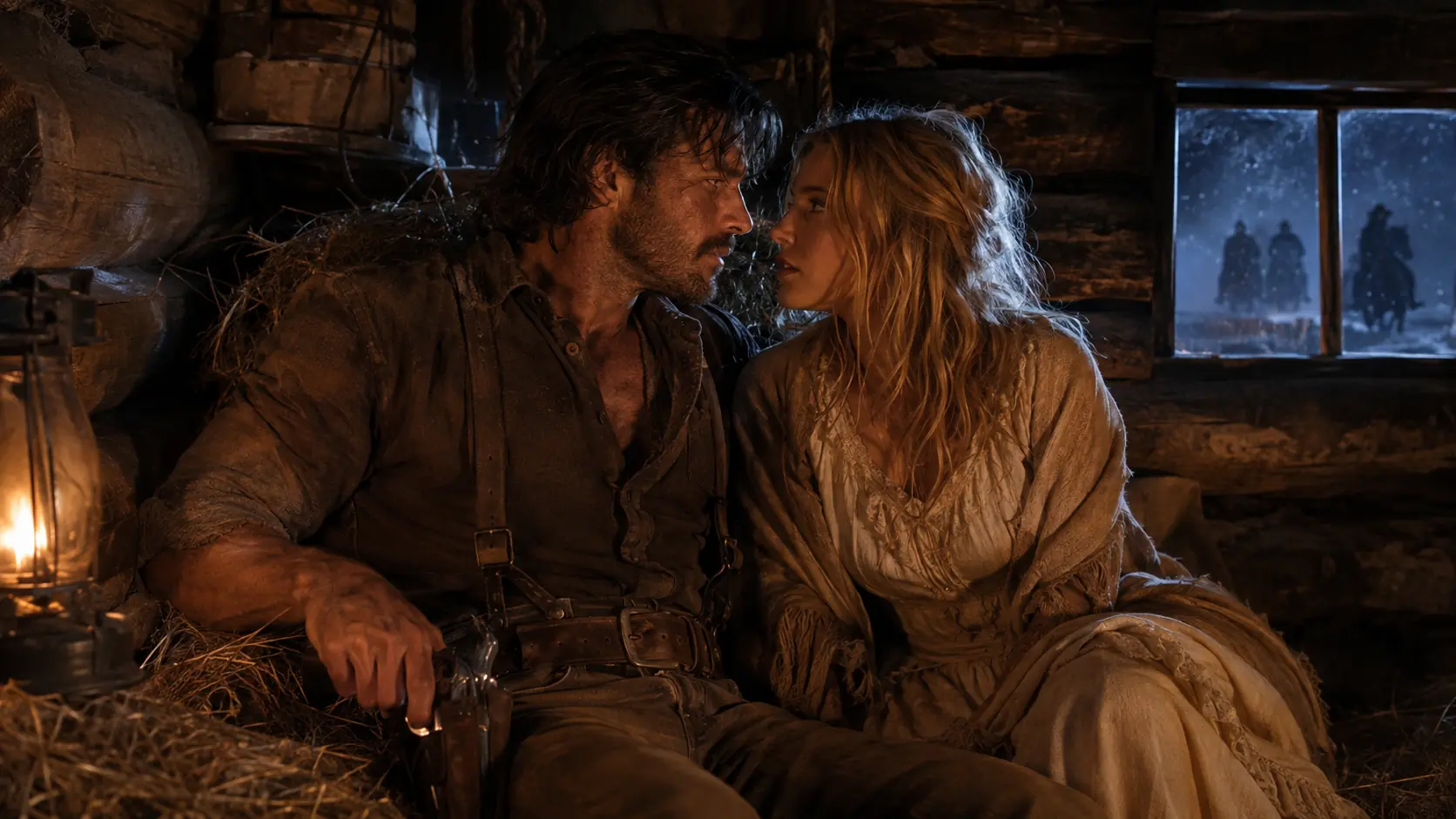
Colter Ames walked directly into that weather with his head down and one gloved hand wrapped around the lead rope of his horse. Behind the animal, a small sled carried two dressed elk that would help keep him alive until spring. Snow had frozen into his dark beard, and a cut above his eyebrow from an earlier fall had dried into a black line against his skin. He noticed none of it because his cabin was less than a mile away and staying alive required paying attention only to what mattered next.
Colter had lived alone for almost six years. His cabin stood beneath thick lodgepole pine where the slope protected it from the worst northern wind, far enough from town that nobody arrived without meaning to. That distance suited him because he had once owned land closer to people and had learned what people sometimes did when they wanted what another man possessed. Solitude was quieter than revenge, and Colter had chosen quiet deliberately.
He almost missed the wagon. It sat crooked beyond a low drift, one wheel split through the hub and the canvas top torn loose enough to crack in the wind. There were no horses attached, and whatever tracks had led away were already disappearing beneath fresh snow. Colter would have continued past if he had not seen the hand beneath the axle.
It was small, bare, and motionless. He tied his horse to the wagon frame and dropped to one knee, clearing snow until he found a woman curled against the frozen ground. Her dress was torn at one shoulder, one side of her face was bruised, and her lips had gone dangerously pale. When Colter pressed two fingers beneath her jaw, he found a pulse so faint he checked twice.
A sensible man alone in a storm might have ridden for help. A crueler man could have convinced himself the weather had already made the decision. Colter did neither. He wrapped the woman in his spare buffalo robe, secured her to the sled so she would not slide during the climb, and headed toward the cabin.
He warmed her slowly because he knew enough about severe cold not to throw someone half-frozen directly against intense heat. He removed only the clothing that was wet or dangerously cold, wrapped her in dry wool, and kept the cabin warm while he heated broth and water. Bruises covered her ribs and arms, some yellow with age and others fresh enough that anger rose in him before he understood what he was seeing. Then he found the mark on her shoulder.
It was a brand. Not a birthmark, not an accidental burn, but a deliberate symbol made with hot iron and shaped like a crooked letter B inside a circle. Colter had marked cattle and horses when he was younger, and he knew exactly what kind of scar a branding iron left. He stood beside the bed for several seconds staring at that mark before pulling the wool blanket back over her.
She woke before dawn with a sound closer to panic than breath. Her eyes opened wide, and she tried to scramble away until her back struck the cabin wall. “Where am I?” she whispered, gripping Colter’s oversized wool shirt against her chest. Colter stayed beside the fire and kept both hands visible.
“My cabin,” he said. “I found you beneath a wagon.”
“Don’t touch me.”
“I won’t.”
She watched him like a trapped animal. Colter poured broth into a tin cup, set it on the floor halfway between them, and moved back until his shoulders touched the opposite wall. “Drink when you can,” he said, then turned his attention to the fire as though her decision about the cup belonged entirely to her.
That confused her more than force would have. She remained still for nearly a minute before crawling toward the cup, keeping her eyes on him the entire time. Her hands shook so badly that broth spilled across the floorboards. Colter looked away until she finished.
She slept through most of the next two days. Colter changed dressings only after asking permission each time, left food within reach, and slept in the chair beside the hearth so the bed remained hers. When she woke frightened, he told her where she was again. When she asked what he wanted, he gave the same answer.
“Nothing.”
On the fourth day, she could stand without holding the wall. She studied the cabin then as though finally noticing its dimensions: one bed, one table, two rough shelves, a stone fireplace, and one enormous man whose head nearly brushed the roof beams. Colter’s size frightened her less than his restraint because she understood violence and had no framework for a man capable of it who kept choosing not to use it.
“Why did you bring me here?” she asked one evening. Colter was carving a scrap of pine into something vaguely shaped like a bird. “You would have died,” he answered, and she frowned because she seemed convinced there must be another reason hidden behind the simple one. “Men don’t do things for nothing,” she said.
“Some do.”
“I’ve never met them.”
Colter set the knife aside. “Then maybe the men you met were the problem.”
Her real name came three evenings later. She sat near the fire with her knees pulled close and said, “Maeve Larkin,” so softly he almost missed it. Colter nodded once and told her his own name, nothing more. He did not ask why someone had branded Maeve or how she came to be abandoned beneath a wagon because whatever answer existed seemed to live behind a door she was not ready to open.
The first sign that danger was closer than either of them hoped came after a snowfall. Colter returned from checking snares and stood too long beside the doorway before removing his coat. Maeve noticed immediately. “What did you see?”
“One horse.”
“Where?”
“Ridge above the creek.”
Her face drained of color. “He found me.”
Colter looked at her. “You don’t know that.”
“You think it.”
“I think somebody rode close enough to look at the cabin and left.”
Maeve wrapped both arms around herself. “That is how his men search.”
That night she told him part of the truth. A man named Cyrus Baines operated a freight company, saloon, boarding house, and gambling room in a settlement called Cottonwood Crossing. He loaned money to desperate ranch families, then rewrote the debts through fees, food charges, lodging, penalties, and labor contracts until repayment became mathematically impossible. Maeve’s father had borrowed after a bad cattle winter, and when he could not pay, Cyrus demanded labor from the family.
Maeve had been seventeen. Her father signed something after two of Cyrus’s men beat him outside their house, and Maeve was taken to work at one of Baines’s establishments. The documents called it service toward debt; Maeve called it what it had felt like. “I belonged to him because everyone around him agreed I did.”
Colter’s eyes moved toward the scar beneath her shirt. “The brand?”
Maeve nodded. “I tried to leave the first year.”
He did not ask how it happened.
He did not need to.
“I got away three weeks ago,” she continued. “A freight driver helped me hide inside an empty wagon heading north. When he learned Baines had riders searching the road, he left me farther west and told me to keep moving.” Her voice grew quieter. “The wagon broke in the storm, the driver’s horses got loose, and he went after them.”
“You remember his name?”
“Samuel Finch.”
Colter filed it away. A living witness was worth more than ten angry men with guns. He was beginning to understand that if Cyrus Baines used paper to make violence look respectable, then paper and witnesses might matter as much as rifles.
Maeve expected Colter to tell her she had to leave. Instead, he built a second sleeping place against the far wall, a proper cot separated from his own space by a hanging wool blanket. When she saw it, her expression hardened. “You want me gone?”
“No.”
“Then why are you building that?”
“Because you should have a place that is yours while you decide what comes next.”
Maeve looked at the unfinished cot. She had spent years living in rooms where every inch belonged to somebody else and where doors closed only when men allowed them to. Colter had somehow understood the value of a separate bed without requiring an explanation. “I don’t know what comes next,” she admitted.
“You don’t have to today.”
By the following week, Maeve began helping because doing nothing made her feel helpless. Colter showed her how to split small firewood, repair leather tack, and recognize which snowdrifts could conceal unstable ground. He never laughed when she missed with the axe, and when her third strike split a log cleanly, he merely said, “Again,” while pretending not to notice the smile that appeared across her face. It was the first time she had looked proud since waking in the cabin.
The peace between them grew in ordinary ways. Maeve thickened Colter’s terrible stew with onions and beans, repaired a torn shirt he had intended to keep wearing indefinitely, and swept corners he had apparently accepted as permanent dust territory. Colter complained that the cabin had survived six years without interference. Maeve answered, “Surviving and living are not the same thing,” then seemed startled by her own words.
Something else grew too, slower and more dangerous. Maeve began watching Colter when he thought she was not looking, especially when he worked with his hands or stood beside the doorway scanning the ridge. Colter noticed but refused to mistake gratitude for affection. A person pulled from freezing ground deserved time to discover whether closeness was desire or merely relief.
One night Maeve moved nearer to him by the fire. She rested one hand briefly against his chest and said, “I want to know what it feels like to choose.” Colter went very still. “Then choose something small first,” he said.
She frowned. “I’m choosing you.”
“You are also still waking from nightmares about another man controlling your life.”
Anger flashed across her face. “You think I don’t know what I want?”
“I think you deserve enough time that nobody can confuse rescue with obligation.”
The words wounded her because they sounded like rejection. She slept facing the wall that night, while Colter remained in the chair staring at the fire and hating himself for hurting her even though he believed he had done the right thing. By morning, the distance between them felt colder than the weather outside.
Maeve found him working on the separate cot. She watched him measure the frame, then said, “You really don’t understand me.”
“Probably not.”
“I’m not staying because I have nowhere else.”
Colter set down the saw. “Then why are you staying?”
Maeve struggled for the answer. “Because nobody has ever asked me to decide what I want without already deciding the acceptable answer.”
Colter looked at her for a long time. “Then keep deciding.”
The sound of hooves ended the conversation.
Three riders emerged between the trees twenty minutes later. Maeve recognized Cyrus Baines before she could see his face because she knew the way he sat a horse. He wore a black winter coat, expensive gloves, and the calm smile of a man accustomed to arriving with documents after violence had already cleared the path.
Colter stepped onto the porch without raising his rifle. Maeve stood inside near the doorway where she could see everything. Cyrus dismounted and said, “You’ve got something belonging to me.”
Colter’s expression did not change. “No.”
Cyrus smiled. “Woman called Clara Bell. Blonde. Brand on the shoulder.”
Maeve flinched at the false name.
“She says her name is Maeve Larkin,” Colter replied.
“She can call herself the Queen of England if she wants. I hold her contract.”
Colter looked at the two men behind Cyrus. “Court judgment?”
Cyrus’s smile weakened slightly. “Private labor agreement.”
“Signed voluntarily?”
“Signed.”
“That wasn’t my question.”
Maeve stepped onto the porch.
Cyrus looked at her and the pleasantness disappeared from his face.
“Clara.”
“My name is Maeve.”
“You’ve had your little adventure.”
“I’m not going back.”
Cyrus looked at Colter. “You understand you’re interfering with lawful property?”
“She is a person.”
“Person with a debt.”
“Then take the debt to a court.”
That sentence changed the temperature more than the wind did.
Cyrus had expected a gunfight or frightened negotiation. He had not expected someone to ask for a judge. “You mountain men think the law doesn’t reach this far?”
Colter answered, “I’m counting on it reaching farther than you’d like.”
One of Cyrus’s riders moved his hand toward his coat. Colter finally lifted the rifle enough to make the choice obvious without pointing the barrel directly at anyone. Cyrus raised one hand and stopped his man.
“This isn’t finished,” he said.
Maeve stepped fully beside Colter. “It is for me.”
Cyrus stared at her for several seconds. Then he mounted and rode away.
Colter lowered the rifle only after the riders disappeared. Maeve’s knees began shaking immediately, all the strength that had held her upright draining away now that she no longer needed it. Colter caught her by the elbows.
“I stood there,” she whispered.
“You did.”
“I thought I’d hide.”
“You didn’t.”
For the first time, Maeve leaned into him without wondering whether needing support meant surrendering anything.
The next morning Colter rode to Cottonwood Crossing alone. He did not go to threaten Cyrus, burn a saloon, or challenge anyone in the street because those actions would have given Cyrus exactly the kind of story he needed. Instead, he went to Sheriff Warren Hale and told him everything Maeve had said, including Samuel Finch’s name, the brand, the alleged contract, and Cyrus’s visit to the cabin.
Sheriff Hale was sixty, cautious, and irritatingly resistant to dramatic conclusions. Colter liked him immediately. He listened, then said, “Baines has papers.”
“Are they lawful?”
“That’s the question.”
“Maeve says her father signed after being beaten.”
“Can she testify to that?”
“Yes.”
“Can her father?”
“Don’t know if he’s alive.”
Hale leaned back in his chair. “Then we find out.”
The sheriff explained something Colter already suspected. Private labor agreements existed, debts existed, and courts sometimes enforced financial obligations, but no document lawfully converted a woman into personal property. A contract signed under coercion could be challenged, and branding somebody was not transformed into legitimate discipline because Cyrus preferred that word. The problem was proving what had happened.
Hale agreed to come to the cabin, not to arrest Cyrus immediately but to take Maeve’s statement formally. Maeve nearly refused when she saw the sheriff ride up because uniforms had always appeared beside Cyrus in her memories, never against him. Hale remained outside until she invited him in.
He listened for nearly two hours. Maeve described her father’s debt, the threats, the false name Cyrus gave her, the changing balances, the punishments, and the night she was branded after attempting to escape. Hale asked difficult questions without accusing her of lying. When she finished, he closed the notebook and said, “I believe enough of this to investigate, but believing and proving aren’t the same job.”
Maeve swallowed. “What do you need?”
“Records.”
“Witnesses.”
“And eventually you may have to say this before a judge.”
Fear moved across her face.
Colter said, “You don’t have to decide today.”
Hale nodded. “He’s right.”
Maeve looked between them. Two men with the physical ability to make decisions for her, both refusing to do it. “I’ll testify,” she said.
Hale did not congratulate her. “Think overnight.”
“I’ve been thinking for three years.”
The investigation took six weeks.
Samuel Finch was found alive in a mining settlement east of Helena after Hale sent inquiries through territorial lawmen and stage stations. He confirmed helping Maeve escape and testified that she had begged him not to return her to Cottonwood Crossing. More importantly, he had once worked freight for Cyrus and knew where duplicate account ledgers were kept.
The sheriff obtained a warrant through the county judge rather than simply walking into Cyrus’s office because doing things properly mattered if they intended to survive a real challenge. The records revealed debts that increased even after workers completed contracted labor, payments entered incompletely, arbitrary charges for food and lodging, and different balances depending on which copy of the ledger was examined. Several names appeared beside notations indicating workers had been “transferred” between Cyrus’s establishments.
Maeve’s father was found too.
Patrick Larkin was living outside Fort Benton with one damaged hand and enough shame to have stayed silent after believing his daughter lost forever. When Sheriff Hale brought him to testify, Maeve stood across the courthouse hallway unable to move. Her father looked older by twenty years.
“I tried to come for you,” he whispered.
Maeve stared at him.
“They told me you died.”
Patrick covered his face.
Maeve did not immediately forgive him because life was not improved by pretending complicated wounds closed on command. She let him sit beside her before the hearing. That was enough for one day.
The territorial judge, Samuel Beckett, held a preliminary hearing in Cottonwood Crossing. Cyrus arrived with an attorney, clean clothes, and the confidence of a man who had spent years watching poor people retreat when legal costs appeared. He placed Maeve’s contract on the table as though the paper itself settled everything.
Judge Beckett read it.
Then he asked, “Where is the independent witness to the execution?”
Cyrus’s attorney hesitated.
“Mr. Larkin signed.”
“Mr. Larkin was the debtor, not an independent witness.”
The judge turned another page.
“Where is the schedule showing how this balance was calculated?”
Cyrus’s attorney produced a ledger.
Sheriff Hale produced the second ledger.
The hearing changed after that.
Patrick testified that two men working for Cyrus beat him before the agreement was signed. Samuel Finch testified about transporting laborers and hearing Cyrus refer to several women as assets rather than employees. A former bookkeeper named Evelyn Price testified that Cyrus regularly added penalties after workers were close to paying balances because keeping experienced labor was more profitable than collecting repayment.
Then Maeve stood.
Her hands shook so badly that she held the rail.
Cyrus watched her with the same expression he had used in the cabin clearing, confident that fear would eventually pull her back into the role he had written for her. Maeve looked at him once, then turned toward Judge Beckett.
“My name is Maeve Larkin.”
The judge nodded. “Proceed.”
She described being taken at seventeen.
She described the false name.
She described being told the debt belonged to her because her father could not pay.
Then she pulled the shoulder of her dress aside enough for the judge and witnesses to see the brand.
A murmur moved through the courtroom.
Cyrus’s attorney stood. “Your Honor, we object to theatrics.”
Judge Beckett looked at him. “A permanent injury directly connected to the alleged coercion is not theatrical merely because your client dislikes looking at it.”
Maeve continued.
“You told me nobody would believe me,” she said, looking at Cyrus now. “For years I believed you.”
Cyrus’s jaw tightened.
“I don’t anymore.”
The preliminary hearing did not end with Judge Beckett tearing the contract in half. Courts did not become more just because a judge performed dramatically with paper. Instead, he issued findings that the claimed labor agreement could not presently support any right to seize, restrain, or compel Maeve, referred the evidence for criminal prosecution, and prohibited Cyrus or his agents from contacting her while the matter continued.
For Maeve, those careful words felt louder than thunder.
She walked outside afterward and began shaking so hard Colter thought she might fall. He opened his arms but waited. Maeve stepped into them herself.
That mattered.
Cyrus Baines was arrested two days later after prosecutors filed charges supported by the ledgers, witness statements, and evidence involving multiple workers. The case expanded because Maeve had not been the only person trapped through manipulated debt. Several former employees came forward once they learned somebody had finally survived long enough to challenge him publicly.
The trial came months later.
Cyrus was convicted on several counts involving assault, unlawful restraint, fraud, and coercive labor practices, though not on every allegation prosecutors brought. His businesses were placed into receivership while creditors, workers, and courts fought over legitimate assets and illegitimate debts. No single verdict restored what Maeve lost.
She understood that better than anyone.
Winter softened gradually.
Maeve remained at Colter’s cabin because she wanted to, but she began earning money sewing for a trading post and assisting a widow near Cottonwood Crossing with bookkeeping. The first money she received went into a tin box beneath her own bed. Nobody could touch it without her permission.
Colter noticed the box and said nothing.
Their relationship changed again once the case no longer controlled every conversation. Maeve still woke from nightmares, but fewer of them ended with her reaching for the door. Colter still slept badly during storms because memories of his brother’s death returned whenever wind struck the cabin hard enough.
One evening Maeve sat beside him after supper. “You said I should choose small things first.”
Colter looked at her. “I remember.”
“I chose where to sleep.”
“Yes.”
“I chose to testify.”
“Yes.”
“I chose to stay.”
“Yes.”
She moved closer.
“And I’m choosing you.”
Colter’s breathing changed.
Maeve smiled faintly. “You are allowed to ask whether I’m sure.”
“Are you?”
“Yes.”
This time when she kissed him, Colter did not pull away.
Nothing happened quickly. He held her carefully at first until Maeve laughed softly and told him she was not made of glass. The rest of that night belonged to them, not to Cyrus, not to debt, and not to anyone who believed rescue created ownership.
By spring, grass pushed through the last crusts of snow around the cabin. Maeve planted beans, onions, and flowers beside the south wall, while Colter repaired fencing along the lower meadow. She began riding into Cottonwood Crossing alone on a chestnut mare and discovered the first trip frightened her more than the hearing had.
She went anyway.
People looked.
Some knew who she was.
A few whispered.
Maeve learned that being free did not mean never being afraid again.
It meant fear no longer made every choice.
Her father came to visit in June.
Patrick stood awkwardly at the edge of the garden while Maeve continued pulling weeds for almost a minute before acknowledging him. They spoke for an hour beneath the porch roof. At the end, she hugged him briefly.
Colter asked nothing afterward.
Maeve eventually said, “I don’t forgive everything.”
“You don’t have to.”
“But I believe he was afraid.”
“That can be true too.”
She looked at him. “You always make things annoyingly complicated.”
“Most true things are.”
Their marriage came two years later, not because law required a wife for Colter to keep his land and not because Maeve needed a husband to become respectable. She had already filed her own homestead claim on adjacent acreage with help from the county land office, and the two properties remained legally distinct for years afterward. They married because after two winters of waking beneath the same roof, both had become tired of pretending there was a better word for what they had built.
Sheriff Hale attended.
So did Maeve’s father, Samuel Finch, the widow she worked for, and three former laborers who had testified against Cyrus. Judge Beckett performed the ceremony because Maeve said anyone capable of reading fifty pages of terrible contracts deserved the easier assignment.
Colter held Maeve’s hands.
“You are not something I saved,” he told her quietly before the vows.
Maeve looked up at him. “Good, because you are not something I owe.”
He smiled.
They married beside the creek.
Years passed.
The cabin gained another room, then a barn, then a second chimney that leaned even more than the first because Colter insisted it was straight while Maeve insisted his eyes were defective. Children eventually ran across the meadow, though for a long time Maeve had believed motherhood was another life stolen from her.
The brand remained.
She could have tried to hide it forever beneath high collars.
Sometimes she did.
Other times she wore whatever she wanted and let people see it.
Once her young daughter touched the scar and asked, “What happened?”
Maeve thought carefully before answering.
“A bad man tried to convince me I belonged to him.”
The child frowned. “But you didn’t.”
“No.”
“How’d you know?”
Maeve looked across the yard where Colter was repairing a gate.
“It took me a while.”
She never told the story as though Colter had ridden into town and defeated Cyrus with a rifle.
He had not.
He had given her shelter.
He had refused to collect payment for kindness.
He had gone to the sheriff instead of starting a private war.
Then he had stood nearby while Maeve did the hardest parts herself.
That was enough.
Colter’s own wounds took longer.
He eventually rode south to the ranch where his brother had died, not to reclaim it or find the remaining men responsible. He stood beside the burned foundation, placed a stone where the barn entrance had once been, and returned north.
Maeve waited at the cabin.
“You all right?” she asked.
“No.”
She nodded. “Good answer.”
Colter sat beside her.
He had once left that ranch because he feared revenge would turn him into the men he hated. Years later he understood that leaving had saved him, but hiding forever had not been the same as healing. Maeve had taught him that without ever trying.
One autumn evening, long after the Cyrus Baines case had become a story other people told more dramatically than it happened, Maeve sat beside Colter on the porch. The mountains were already white at their highest edges, and wind moved across the grass without yet carrying winter’s cruelty. She rested her head against his shoulder.
“You were right about one thing,” she said.
Colter looked down. “Only one?”
“You were too big.”
He frowned.
Maeve smiled.
“For the life I had before.”
Colter wrapped one arm around her.
The old Maeve would have expected that arm to close like a restraint.
The woman she had become felt only warmth.
Below them, the meadow moved beneath the wind.
Behind them stood a cabin that had once contained one chair, one bed, and a man who believed solitude was the safest thing he could offer the world. Now there were boots beside the door, children’s coats on pegs, jars in the pantry, flowers drying above the stove, and a second rocking chair that Maeve insisted Colter had built crooked.
Nothing about their life was perfect.
Some winters were hard.
Some memories returned.
Some wounds did not disappear simply because justice eventually arrived.
But they had stopped mistaking scars for chains.
And they had stopped believing survival was the same as living.
Years earlier, Colter Ames had found a bare hand beneath a broken wagon and made one decision: he would not leave a stranger to die because helping might become complicated. Maeve Larkin had spent the years afterward making decisions of her own.
She chose her name.
She chose to speak.
She chose where to live.
She chose whom to trust.
And eventually, when nobody was holding a contract over her, nobody was demanding payment, and nobody was telling her what her freedom ought to look like, she chose a home.
That was the part of the story Colter always considered most important.
Not that he found her.
That she stayed because she wanted to.