The summer of 1874 came dry and merciless to the Missouri plains.
Corn stalks rose from the ground but never formed ears. Wells sank lower each week. Dust crept through window cracks, settled inside cooking pots, and coated the pews of the little white church where Reverend Jonathan Whitaker had preached for twenty-two years.
By spring, he was burying more neighbors than he baptized.
Cholera took some.
Hunger weakened others until fever finished what the drought had begun.
When Reverend Whitaker fell ill in June, there was no doctor close enough to help and no money left to send for one.
He died in the bedroom where his daughter had been born.
Eliza Whitaker sat beside him until his breathing stopped, one hand holding his and the other resting on the worn Bible he had carried to every service since before she could remember.
At nineteen, Eliza inherited three things.
Her father’s Bible.
A cracked china teacup that had belonged to her mother.
And debts larger than the value of the house.
The bank gave her thirty days.
Her aunt Ruth arrived from St. Louis before the second week had passed. Ruth was practical in the manner of people who considered tenderness an unnecessary delay.
“A young woman alone cannot keep this place,” she said, fanning herself with an old church bulletin. “Not without brothers, land, or money.”
“I know.”
“You could come back to St. Louis.”
“And do what?”
“There are factories.”
“I can sew.”
“Then you might survive.”
Eliza looked through the kitchen window at the dead garden.
Survival no longer sounded like a promise.
It sounded like a sentence.
Aunt Ruth placed a newspaper on the table.
The folded page contained advertisements from men in western territories seeking wives.
Ranchers.
Farmers.
Merchants.
Widowers with children.
Men who described themselves as sober, God-fearing, industrious, and honest, as though printing the words made them true.
One notice had been circled.
Rancher and licensed trader, thirty-one years of age, seeks educated woman of strong character willing to build a life in Arizona Territory. Applicant must tolerate isolation and hardship. Travel expenses provided. Correspondence requested. Samuel Crow, care of San Roca Trading Office.
“Crow,” Eliza said.
“A common enough name.”
“He says nothing about his church.”
“Ask him.”
“He says nothing about family.”
“Ask that too.”
“And if he lies?”
Aunt Ruth folded her fan.
“Men in Missouri lie without paying train fare.”
Eliza should have thrown the newspaper into the stove.
Instead, she wrote a letter.
She told Samuel Crow that she was the daughter of a minister, that she could read, keep accounts, cook, sew, and manage a household.
She told him that she possessed no dowry.
She did not tell him how frightened she was.
His reply arrived twelve days later.
The handwriting was firm and careful.
He wrote that he raised horses and managed trade between settlements and several communities beyond San Roca. He warned that the country was beautiful but unforgiving.
He said that the woman who came west would be expected to make her own judgments, not merely obey his.
He wrote that he had no interest in acquiring a servant.
He wanted a companion.
That word stayed with Eliza.
Companion.
Not possession.
Not charity.
They exchanged four letters.
In the final one, Samuel sent a train ticket, a modest silver ring, and enough money for food during the journey.
He included one sentence beneath his signature.
Do not come because Missouri has left you no choice. Come only if you believe the West may offer one.
On the morning she departed, Eliza stood beside the railway with a carpetbag, her father’s Bible, and the cracked teacup wrapped inside a shawl.
The train whistle cut through the humid air.
Aunt Ruth embraced her awkwardly.
“You may still change your mind.”
Eliza looked toward the house she would lose whether she stayed or left.
“No,” she said. “I think I changed it when I wrote the first letter.”
The journey lasted six days.
Missouri’s green fields became dry grassland.
Dry grassland became red earth.
Mountains rose from the horizon.
The farther west she traveled, the larger the world appeared and the smaller she felt inside it.
At night, she studied the photograph Samuel had sent.
It was faint and badly exposed.
A broad-shouldered man stood beside a horse, his face shaded by a wide hat. A dark mustache covered his upper lip. The picture revealed little beyond his height and the steadiness of his posture.
Eliza imagined the rest.
Fair skin darkened by the sun.
A quiet voice.
A respectable ranch house.
Perhaps a whitewashed church within riding distance.
Perhaps children someday.
Perhaps a place where every room did not remind her of someone who had died.
When the train stopped at San Roca, heat entered the carriage like breath from an oven.
Eliza stepped onto the platform in a pale blue traveling dress.
The station was smaller than she expected. A general store faced the tracks. Beyond it stood a saloon, blacksmith shop, feed yard, and sheriff’s office.
No man approached her.
She waited while passengers collected their trunks.
The platform emptied.
Finally, Sheriff Amos Bell came toward her.
He removed his hat.
“Miss Whitaker?”
“Yes.”
“You are expected.”
“Where is Mr. Crow?”
The sheriff glanced toward the edge of town.
“There is something you should know before you meet him.”
Eliza tightened her grip on the carpetbag.
“Is he married?”
“No.”
“Is he a criminal?”
“Not by any law I recognize.”
“Then what is it?”
Bell looked uncomfortable.
“Samuel Crow is the name he uses for business. His mother’s people live in the Red Mesa settlement beyond the eastern ridge.”
Eliza waited.
The sheriff continued.
“He is Apache.”
For a moment, the sounds of the station disappeared.
The buzzing insects.
The horses.
The wind turning the sign above the general store.
Everything receded beneath the rushing inside her ears.
“No.”
“I am afraid so.”
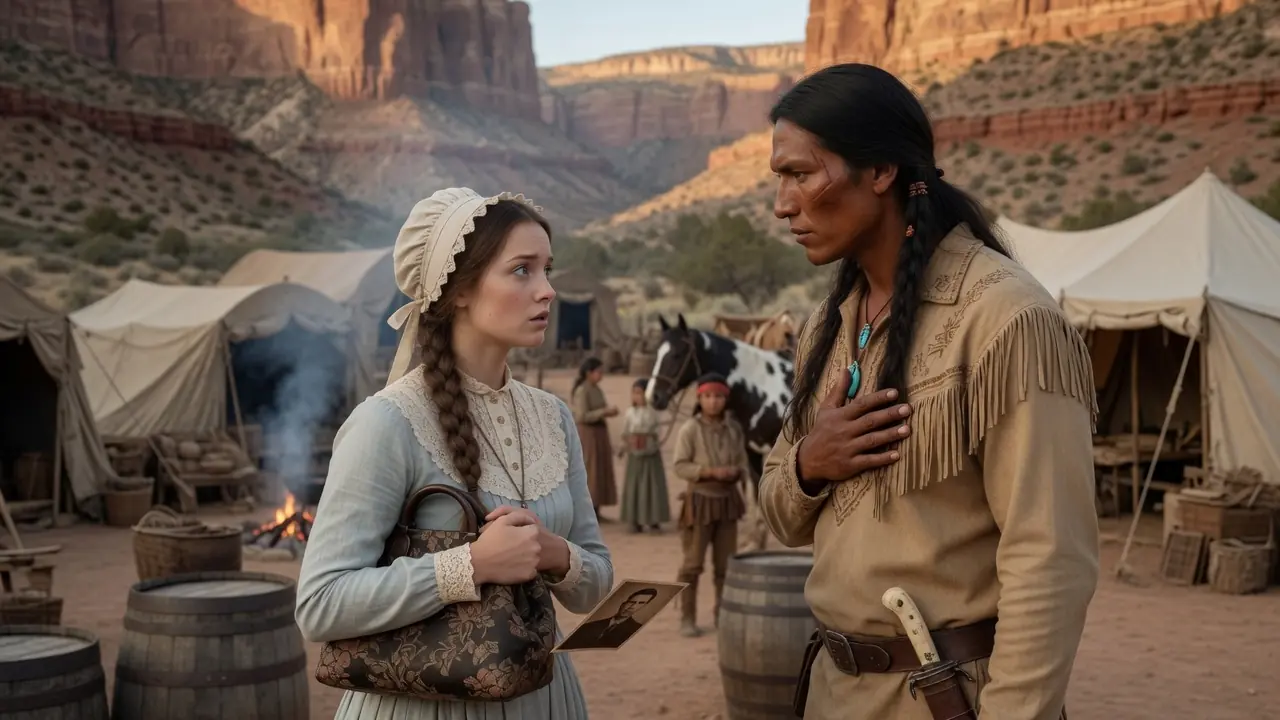
Eliza pulled the photograph from her pocket.
The shadowed face beneath the hat changed before her eyes.
“You knew.”
“I knew a woman was coming. I did not know what the advertisement said.”
“He deceived me.”
“Possibly.”
“Possibly?”
“The matrimonial office in St. Louis is run by a man named Harlan Voss. Crow claims Voss altered part of his notice.”
“And you believe him?”
“I believe Voss has been accused of dishonest arrangements before.”
Eliza looked toward the stationmaster.
“When is the next eastbound train?”
“Four days.”
“I will wait here.”
“There is no respectable boardinghouse with an empty room.”
“I do not care.”
“You may when night comes.”
A wagon stood beyond the feed yard.
A young man waited beside it, holding the reins of two lean horses. His dark hair was tied at his neck, and he wore a plain cotton shirt, trousers, and boots.
Sheriff Bell gestured toward him.
“That is Daniel, Crow’s cousin. He can take you to Red Mesa. You may hear Crow’s explanation yourself, then decide what to do.”
Eliza stared toward the wagon.
“You expect me to travel into the desert with strangers after learning that the man I came to marry lied about who he was?”
“No.”
Bell placed his hat back on his head.
“I expect you to decide whether remaining alone in San Roca is safer.”
The ride took three hours.
Daniel spoke little, though his English was fluent.
When Eliza asked how far they were traveling, he answered.
When she asked whether Samuel Crow had a ranch, Daniel said yes.
When she demanded to know why no one had told her he lived among Apache families, Daniel’s jaw tightened.
“He wrote it.”
“I never received those words.”
“Then Voss removed them.”
“How convenient.”
Daniel looked at her.
“You think my cousin waited months for a woman who would hate him on sight?”
“I do not know what your cousin thinks.”
“That is true.”
The wagon passed through a narrow canyon and entered a broad valley.
Several adobe houses and brush shelters stood near a stream lined with cottonwoods. Horses grazed beyond a fenced meadow. Smoke rose from outdoor cooking fires. Women carried baskets between buildings while children chased one another through the dust.
This was not the war camp Eliza’s imagination had created.
It was a settlement.
A working community filled with ordinary movement.
People stopped when the wagon arrived.
Some watched openly.
Others turned away.
Then a tall man approached from the largest house.
He wore dark trousers, a linen shirt, and a leather vest. His long black hair was tied behind his shoulders. A thin scar crossed the left side of his face.
He resembled the man in the photograph.
But there was no mustache.
And no hat to cast him into reassuring shadow.
He stopped several feet away.
“Miss Whitaker.”
His voice was calm.
Eliza stepped down without accepting Daniel’s hand.
“You are Samuel Crow.”
“In San Roca.”
“What are you called here?”
“Jonah is the name my mother used when speaking English. My family has another name for me, but I do not give it to strangers.”
The honesty of the answer made her angrier.
“You had no difficulty giving me a false impression.”
His expression tightened.
“I wrote that I lived with my mother’s people.”
“That line never appeared.”
“I wrote that my business connected the Apache settlements with San Roca.”
“That did not appear either.”
“I wrote that some settlers would object to the marriage.”
Eliza pulled the letters from her bag.
“Show me where.”
Jonah read them.
By the third page, anger replaced caution in his face.
“These were changed.”
“Or you are lying now.”
“I kept copies.”
He looked toward Daniel.
“Bring the ledger.”
Within minutes, Daniel returned carrying a leather book.
Inside were handwritten copies of every letter Jonah had sent.
The words missing from Eliza’s versions were present.
She compared the pages.
The handwriting matched.
The omitted passages described his mother’s people, his mixed position between the settlement and town, and his concern that a white woman might arrive with expectations he could not meet.
Someone had carefully removed every warning.
Jonah closed the ledger.
“Harlan Voss said complete honesty would prevent any answer.”
“And you continued using him.”
“I told him honesty was the condition.”
“But you never confirmed what reached me.”
“No.”
He accepted the accusation without defense.
“That was my failure.”
Eliza looked around the settlement.
“What happens now?”
“You choose.”
“The train leaves in four days.”
“I will pay for your room in town until then.”
“And until a room is available?”
“You may stay in my house. I will stay with Daniel.”
Her eyes narrowed.
“You expect me to believe that?”
“No.”
He gestured toward an older woman approaching from one of the adobe buildings.
“This is Marta Reyes. She has lived here longer than I have. You may stay with her, and no man will enter without her permission.”
Marta was small, silver-haired, and unimpressed by everyone.
She looked Eliza over.
“You are thin.”
Eliza blinked.
“I beg your pardon?”
“The train did not feed you enough.”
Marta took the carpetbag.
“Come. You may be angry after supper.”
Eliza remained in Red Mesa because anger required strength and she had eaten nothing since dawn.
Marta gave her beans, roasted squash, and bread cooked on a flat iron.
Jonah did not join them.
That night, Eliza lay on a woven mat beneath a cotton blanket, listening to unfamiliar voices outside.
She expected chanting and drums because those were the images eastern newspapers printed whenever they wrote about Apache people.
Instead, she heard a baby crying.
A woman laughing.
Two men arguing about a lame horse.
A child being told to go back to bed.
The sounds were so ordinary that they unsettled her more than anything exotic could have.
On the following morning, Jonah brought her a wooden box.
It was small, carved from mesquite, with a simple brass lock.
“I had this made before you arrived.”
Eliza did not take it.
“What is inside?”
“Something that belongs to you.”
“You have nothing that belongs to me.”
“Not yet.”
He placed it near the doorway.
“The key is tied beneath the box. Open it when you decide what you want.”
“That sounds like another test.”
“No.”
He met her eyes.
“It is protection against one.”
He left before she could ask more.
During the four days before the train, Eliza avoided him whenever possible.
She helped Marta prepare meals because sitting still made her feel trapped.
She learned that Jonah’s father had been a Mexican horse trader who died when Jonah was twelve. His mother had been Apache and had taught him to negotiate in three languages before teaching him to saddle a horse.
He owned grazing land under a federal claim recognized by San Roca County, though several neighboring ranchers disputed the boundaries whenever it benefited them.
He was a licensed trader.
He kept records.
He employed men from Red Mesa and town.
He was not the simple settler Eliza had imagined.
He was something more complicated.
On the third day, Sheriff Bell arrived with news.
The eastbound train had been delayed by a bridge collapse.
It might be two weeks before service resumed.
“I can remain in San Roca,” Eliza said.
Bell shook his head.
“The hotel owner has refused you a room.”
“Why?”
The sheriff looked toward Jonah.
“Because word reached town that you came to marry him.”
Eliza understood.
She was no longer respectable enough for the white hotel, yet not willing to admit she belonged in Red Mesa.
The choice was not freedom.
But it was still hers to make.
“I will stay with Marta until the train comes.”
Jonah nodded.
“No marriage.”
“No expectation.”
“No claim on me.”
“None.”
“And you will confront Harlan Voss.”
“I already sent the telegram.”
Two weeks became a month.
The bridge repairs took longer than expected.
Then a fever spread through San Roca, and the station closed temporarily.
Eliza told herself she remained because leaving was impossible.
But each day made that explanation less complete.
She began teaching several children to read English using her father’s Bible and old business invoices Jonah provided.
In return, Marta and the children taught her words from their own language, though they laughed kindly at her pronunciation.
She helped keep the settlement’s supply accounts.
She discovered that one merchant had been charging Red Mesa twice the rate he charged white ranchers.
Jonah took the corrected ledger to San Roca and returned with the difference paid in silver.
“You forced him to repay it?” Eliza asked.
“I showed him the numbers.”
“And if he refused?”
“I showed them to the sheriff.”
She began to understand Jonah’s power.
He rarely raised his voice because he preferred evidence.
He did not demand respect.
He made disrespect expensive.
Yet he was gentler than she expected.
When a colt broke its leg, he stayed beside the animal until the end.
When a widow in the settlement lost her food supply in a flash flood, he quietly transferred grain from his own storehouse and entered nothing in the ledger.
When Eliza’s grief caught her unexpectedly one evening, he did not tell her that Missouri was behind her.
He sat on the opposite side of the fire and listened while she spoke about her father.
“He believed suffering always contained a lesson,” she said.
“Do you?”
“I think people say that because suffering without meaning frightens them.”
Jonah looked toward the flames.
“My mother said pain teaches only that something hurts. What we do afterward is where meaning begins.”
Eliza studied him.
“That sounds more honest.”
“She was an honest woman.”
He taught Eliza to ride through rocky country.
She taught him hymns, though he claimed most were too long.
He showed her how to identify clouds that carried rain and clouds that only promised it.
She learned that the scar on his cheek came from a drunken rancher in San Roca who objected to being corrected in Spanish.
Their conversations became easier.
Then dangerous.
One afternoon, Eliza walked toward the stream carrying an empty water jar.
A rattlesnake sounded from beneath a flat rock.
She froze.
Jonah was ten feet away repairing a fence.
“Do not move,” he said.
He approached slowly, using a long branch to guide the snake away from the path.
He did not kill it.
When it disappeared into the brush, Eliza exhaled.
“You spared it.”
“It was where snakes live.”
“It could have bitten me.”
“You were where snakes live too.”
She almost laughed.
Then her legs weakened.
Jonah caught her elbow.
His hand remained only long enough to steady her.
“You are safe.”
The words affected her more than the danger had.
A week later, the train service resumed.
Sheriff Bell arrived to tell her personally.
“Eastbound leaves Friday.”
Eliza spent Thursday packing.
Her carpetbag seemed smaller than she remembered.
Marta watched from the doorway.
“You are leaving?”
“That was always the plan.”
“Plans made before knowledge are only guesses.”
Eliza folded her blue dress.
“What would I stay for?”
Marta gave her a look suggesting the answer was too obvious to deserve words.
On Friday morning, Jonah harnessed the wagon.
He did not ask Eliza to remain.
That hurt more than she expected.
They traveled in silence until San Roca appeared in the distance.
At the station, Jonah unloaded her bag.
“I am sorry,” he said.
“For what?”
“For allowing Voss to become part of your life. I should have verified every letter.”
“Yes.”
“I have returned his fee to you.”
He handed her an envelope.
It contained more money than she had spent on the journey.
“I cannot take this.”
“It is yours.”
“You did not alter the letters.”
“My carelessness made it possible.”
The train whistle sounded far down the line.
Jonah stepped back.
“You are free, Eliza.”
She looked toward the approaching smoke.
Missouri waited behind her.
No home.
No father.
No land.
Only Aunt Ruth and factory work.
Red Mesa waited in the opposite direction.
A community that had not asked her to become someone else.
Children waiting for reading lessons.
Marta’s sharp voice.
Jonah’s quiet patience.
The train came closer.
Eliza picked up the carpetbag.
Then she placed it back on the platform.
Jonah’s expression did not change, but his breath stopped.
“I am not staying to marry you,” she said.
“I understand.”
“I am staying because I have work here.”
“Yes.”
“And because I have not finished deciding.”
He nodded.
“Take as long as you need.”
Eliza returned to Red Mesa.
Three months later, she asked Jonah to walk with her beyond the cottonwoods.
The desert evening was cool. Red light spread across the cliffs.
“I have been waiting for you to mention marriage again,” she said.
“You told me not to.”
“I did.”
“I listen occasionally.”
She smiled.
“That is one of your more irritating qualities.”
“I have others.”
“So I have noticed.”
Eliza stopped near the stream.
“I came west expecting a husband to save me from poverty.”
Jonah’s face became serious.
“I do not want to be saved.”
“No.”
“I want a partner.”
He waited.
“And I believe you may be one.”
“Is that a proposal?”
“It is an invitation for you to make one.”
A slow smile crossed his face.
“Eliza Whitaker, will you marry me with every witness knowing you were free to refuse?”
“Yes.”
Their wedding was held twice.
First before Sheriff Bell, who recorded the marriage in the county register.
Then at Red Mesa, where both families and communities shared food around a long fire.
No one renamed Eliza.
No one declared that she belonged to Jonah’s people simply because she married him.
Marta placed a red woven sash around Eliza’s shoulders.
“This was his mother’s,” she said.
Eliza looked toward Jonah.
“You kept another secret.”
“I was told not to interfere.”
After the meal, Jonah brought the wooden box.
“You may open it now.”
Eliza untied the key.
Inside lay a deed transferring a small parcel of land near the stream into her name.
There was also enough money for a train east and several months of living expenses.
Beneath it rested a letter.
Eliza,
If you open this because you wish to leave, the money and land are yours. Sell the land or keep it. No one here will stop you.
If you open it because you have chosen to stay, the same remains true. Marriage should not make your survival dependent upon my favor.
I asked for a wife. I did not ask for a captive.
Jonah
Eliza read it twice.
“You prepared this before I arrived.”
“Yes.”
“Before you knew whether you would even like me.”
“I knew what distance and poverty might do. I wanted you to possess a road away from me.”
She closed the box.
“And now?”
“Now I hope you never need it.”
Autumn brought trouble.
Cattle vanished from three ranches north of San Roca.
Tracks led toward the hills near Red Mesa.
The ranchers blamed Apache raiders before the sheriff completed his first inspection.
Jonah believed the thefts were organized.
“These animals are being driven toward the Mexican border,” he said. “Not taken for food.”
“Who profits if Red Mesa is blamed?” Eliza asked.
“Men who want our grazing land. Men who sell rifles. Men who believe another war would erase debts.”
Jonah rode to San Roca for a council.
Eliza went with him.
The crowd gathered outside the sheriff’s office was already angry.
A rancher named Silas Kane pointed at Jonah.
“We found tracks.”
“From shod horses,” Jonah replied. “Most riders from Red Mesa do not shoe their horses.”
“You expect us to believe that proves anything?”
“It proves you have not looked carefully.”
The crowd shifted.
Eliza stepped forward.
“Then let the sheriff examine the tracks.”
Kane looked at her.
“You are not one of us anymore.”
“I am still capable of seeing horseshoes.”
Several men laughed.
Kane did not.
“You married him.”
“Yes.”
“That makes you blind.”
“No.”
Eliza’s voice carried across the street.
“It made me close enough to learn when you are lying.”
Sheriff Bell prevented violence that day.
But the hatred had already been prepared.
Three nights later, armed riders attacked Red Mesa.
They wore scarves over their faces and fired into the air while setting fire to two storage buildings.
The attackers were not trying to win a battle.
They wanted panic.
Jonah organized the defense long enough for families to reach the rocky ravine beyond the settlement.
During the confusion, three men struck him from behind and dragged him onto a horse.
Eliza saw only a glimpse.
Jonah’s bound hands.
Blood near his temple.
A rider wearing a silver spur engraved with the letter K.
Silas Kane.
Marta pulled Eliza behind a stone wall.
“You cannot follow alone.”
“I cannot leave him.”
“You will not help him by dying.”
The truth of it was unbearable.
At dawn, Sheriff Bell arrived with four deputies.
Eliza showed him the tracks.
Shod horses.
One print from a damaged shoe missing a nail on the outer edge.
She described the silver spur.
Bell’s face hardened.
“Kane owns a cattle yard near the western canyon.”
Jonah’s cousin Daniel gathered six riders.
Eliza insisted on joining them.
“No,” Daniel said.
“I saw the spur.”
“You have no experience in a fight.”
“I can identify Kane, read his records, and speak to the sheriff. I am coming.”
They found the stolen cattle hidden in a narrow valley.
Kane’s men had altered brands and prepared the animals for sale across the border.
Jonah was tied near a supply wagon.
Eliza did not charge into gunfire.
She stayed with Sheriff Bell behind the ridge and helped devise the diversion.
Daniel’s riders released the stolen horses from the upper side of the valley.
The frightened animals thundered through the camp.
While Kane’s men scrambled to control them, the deputies moved in from the east.
Eliza crossed the lower rocks with Bell beside her.
She reached Jonah while the others exchanged fire beyond the wagons.
His face was bruised.
One eye was swollen.
But he was conscious.
“You took your time,” he whispered.
She cut the rope around his wrists.
“I considered returning to Missouri.”
“I would not blame you.”
“That was a joke.”
“I have been struck in the head.”
A shadow moved behind her.
Silas Kane raised a revolver.
Jonah pulled Eliza down as Sheriff Bell fired.
Kane’s weapon fell from his hand.
He collapsed beside the stolen-branding irons and ledgers that would later prove the entire scheme.
The attack had never been about stolen cattle.
Kane and three partners had diverted animals for months, blamed Apache riders, then pushed frightened ranchers toward violence.
War would have emptied Red Mesa.
Empty land could be claimed.
The evidence changed more than Eliza’s testimony ever could.
The county arrested eight men.
Two merchants were charged with buying stolen cattle.
Harlan Voss, the matchmaker who had altered Jonah’s letters, appeared in the ledgers as one of Kane’s financial partners. He had identified vulnerable eastern women, collected fees from western men, and sold private information to anyone willing to pay.
Jonah had not been the only person deceived.
The discovery did not end prejudice.
No single rescue could.
Some ranchers apologized.
Others simply became quieter.
But Red Mesa received formal recognition of its grazing boundaries, and Sheriff Bell established a joint brand registry so theft accusations would require evidence rather than rumor.
When Jonah recovered, he found Eliza sitting beside their home with the wooden box in her lap.
“You opened it again,” he said.
“I considered using the money.”
His face remained calm.
“To go east?”
“To build a schoolroom.”
Jonah sat beside her.
“That is less expensive than a train.”
“Not the way I intend to build it.”
The school became a trading office, classroom, and meeting hall.
Children learned English, Spanish, arithmetic, and the language of their own families.
Ranchers used the neutral ledger room to record brands and sales.
Eliza managed the accounts.
Jonah negotiated disputes.
Marta criticized everyone equally.
Years later, when travelers asked Eliza whether she regretted becoming a mail-order bride, she corrected them.
“I arrived as one,” she said. “I did not remain one.”
She had traveled west because grief and debt made every road feel like escape.
She stayed because she discovered that choice did not always arrive as an open door.
Sometimes it came as a locked wooden box with the key tied beneath it.
Sometimes it came as a man who stepped back instead of closing his hand.
Sometimes it came after fear, disappointment, and enough time to separate gratitude from love.
On the tenth anniversary of their marriage, Jonah repaired the brass lock on the box.
Eliza watched him work.
“You know,” she said, “the lock has never been useful.”
“It protected the papers.”
“It also made the box mysterious.”
“You distrust mystery.”
“I distrust men who use mystery to appear wise.”
He smiled.
“That is reasonable.”
Their daughter played near the stream while several students practiced reading inside the schoolroom.
Beyond the cottonwoods, horses moved across land that remained legally Eliza’s.
She had never needed the deed to leave.
Its importance lay in what it proved.
Jonah had loved her before he knew whether she would choose him.
And because he loved her, he had protected the choice that might take her away.
Eliza rested her head against his shoulder.
“Do you remember the station?” she asked.
“Yes.”
“I hated you.”
“I noticed.”
“I thought you had brought me west to trap me.”
“I feared you would believe that.”
“You could have asked me to stay.”
“I wanted the answer to belong to you.”
The desert stretched before them, red and gold beneath the setting sun.
It was still dangerous.
Still divided.
Still capable of taking everything without warning.
But it was no longer the empty wilderness Eliza had seen from the train.
It contained graves and gardens.
Conflict and reconciliation.
People who had harmed one another and people still attempting to build something better.
It contained the life she had chosen.
Not destiny.
Not rescue.
Not a treaty purchased with a woman’s body.
A partnership.
A home.
And a love strong enough to leave the door open.