Morning fog lay low over the Colorado foothills, silver between the pines and pale above the rocky ground.
Twenty-three-year-old Abigail Hart knelt behind her family’s cabin with both hands buried in cold soil.
There was not much of a garden left.
A few onions.
Late cabbage.
Carrots no thicker than her fingers.
She pulled weeds anyway.
Waste nothing.
That had become the rule of the Hart household.
Inside the cabin, her father coughed.
The sound came through the logs so clearly that Abigail stopped working.
One cough.
Then another.
Then the terrible deep one that seemed to tear its way upward from somewhere below his ribs.
She closed her eyes.
Waited.
Eventually the coughing stopped.
Only then did she return to the garden.
Her father, Amos Hart, had come west chasing gold fifteen years earlier.
Like thousands of men, he believed one rich vein might change everything.
Instead, mining changed him.
Dust damaged his lungs.
A cave-in damaged his hip.
Bad claims consumed money.
Good claims produced just enough to convince him to keep trying.
Now he was fifty-three and looked seventy.
The family owed money in Denver.
A merchant held notes against their mule and equipment.
A lender held a lien on the small mining claim.
Winter was approaching.
And Abigail knew exactly how many sacks of flour remained in the pantry.
Three.
Her younger brother Ben was twelve.
Her sister Lucy was nine.
Neither understood how close the family stood to losing everything.
Abigail intended to keep it that way as long as possible.
That evening, wind pushed against the shutters.
Abigail sat near the stove repairing Ben’s shirt.
Amos watched the fire.
For a long time, neither spoke.
Finally he said:
“Abby.”
Her needle stopped.
“Yes?”
“I can’t work the claim through another winter.”
She looked down.
“I know.”
“The Denver note comes due in three weeks.”
“I know.”
“I talked to Harlan at the trading post.”
Her stomach tightened.
“About what?”
“A husband.”
The needle slipped.
It pricked her finger.
A bright bead of blood appeared.
Abigail stared at it.
Then at her father.
“No.”
Amos closed his eyes.
“Listen.”
“I will work.”
“You already do.”
“I’ll take laundry.”
“You already do.”
“I’ll work at the hotel in Pine Ridge.”
“And leave Lucy and Ben here with me?”
His voice broke into another cough.
Abigail looked away.
When it passed, Amos continued.
“There are men with land.”
“Men who need wives.”
“Men who could take you and maybe help us.”
Abigail stood.
“So that’s it?”
“No.”
“You borrowed until there was nothing left, and now I become the last thing you sell?”
Amos’s face collapsed.
The anger vanished from her almost immediately.
That was worse.
He looked small.
Ashamed.
“I deserve that.”
“Pa—”
“I do.”
His hands trembled.
“I kept telling myself one more season.”
“One more shaft.”
“One more assay.”
“I told your mother the same thing until the fever took her.”
His eyes filled.
“I have failed you three in almost every way a father can fail.”
Abigail’s throat tightened.
He continued.
“But I will not watch strangers separate you after I’m gone.”
She froze.
Amos looked toward the loft where Ben and Lucy slept.
“If the claim is seized and I cannot work, we have nothing.”
“You’re not dying.”
His expression told her he would not insult her with a lie.
Abigail sat again.
For the next several minutes, the only sound was the fire.
Then someone knocked.
Three firm strikes.
Not hesitant.
Not friendly.
Purposeful.
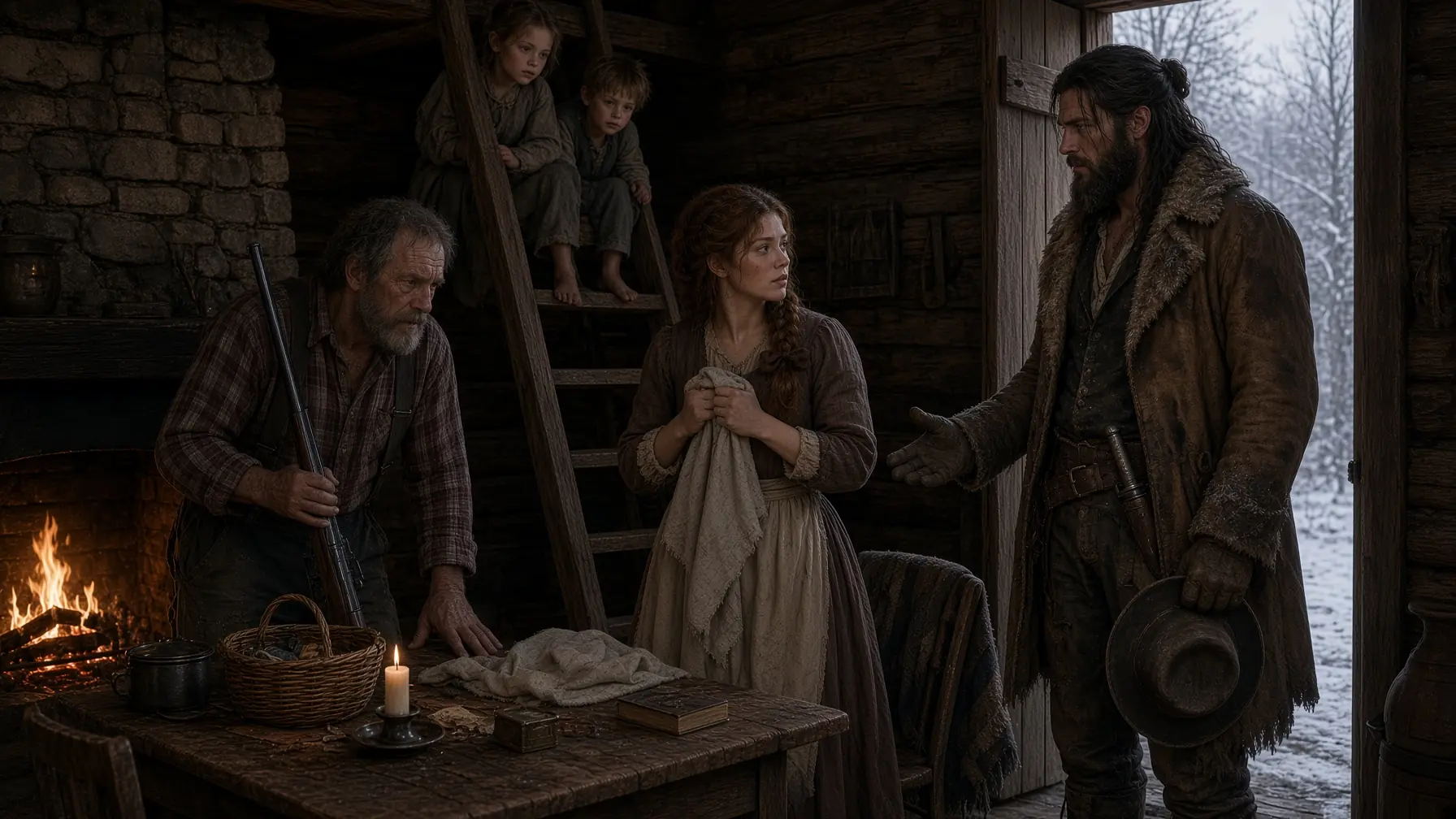
Amos reached for the old rifle.
Abigail stood behind him.
He opened the door.
A tall man filled the frame.
Dark beard.
Broad shoulders.
Heavy coat worn pale at the seams.
Snow dusting his hat.
His eyes were a clear gray-blue.
Not soft.
Not hard either.
Watchful.
“Amos Hart?”
“Yes.”
“My name is Nathan Kincaid.”
Abigail knew the name.
Not well.
People in Pine Ridge called him Kincaid from the high country.
He came down three or four times a year.
Bought salt.
Coffee.
Tools.
Sometimes hired men.
Nobody seemed to know exactly where he lived.
Amos lowered the rifle slightly.
“What do you want?”
Nathan removed his hat.
“I heard about your situation.”
Amos’s face hardened.
“Town talks too much.”
“Yes.”
Nathan stepped only after Amos moved aside.
He looked at Abigail once.
Then Ben and Lucy watching from the loft ladder.
Then back to Amos.
“I’ll speak plainly.”
“Please do.”
“I need a wife.”
Abigail nearly laughed.
Not because it was funny.
Because the day had apparently decided subtlety was unnecessary.
Nathan continued.
“I have a homestead in the mountains.”
“Livestock.”
“Timber work.”
“More work than one man can manage.”
“I need someone capable.”
“Someone who can keep accounts.”
“Run a household.”
“Make decisions when I’m away.”
He looked at Abigail.
“I believe your daughter can.”
Amos stared.
“You know her?”
“I’ve seen her in town.”
Abigail crossed her arms.
“That sounds comforting.”
Nathan accepted the criticism.
“I’ve seen you argue with merchants who tried to cheat your father on weight.”
“I’ve seen you unload flour while men twice your size watched.”
“I’ve seen you bring books home from Reverend Collins every Thursday.”
“You pay attention.”
Abigail asked:
“And what exactly are you offering?”
“If you choose to marry me, I settle the secured debts against this cabin and claim.”
Her breath stopped.
“I arrange provisions for your father, brother, and sister through winter.”
“Enough wood too.”
Amos stared at him.
“With what money?”
Nathan answered:
“Mine.”
Abigail looked at his worn coat.
His boots were well cared for, but ordinary.
His gloves patched.
Nothing about him suggested wealth.
“You’re offering to buy me.”
“No.”
His answer came immediately.
“I’m offering an agreement.”
“That sounds prettier.”
“It should sound exactly as ugly as it is if you don’t want it.”
That surprised her.
Nathan continued.
“If you say no, I leave.”
“No debt collection.”
“No gossip.”
“No punishment.”
“I will not speak badly of you.”
He put his hat back on.
“Think about it.”
Amos said:
“What do you expect from her as a wife?”
Nathan looked at Abigail, not Amos.
“Partnership.”
“Work.”
“Honesty.”
Then:
“Nothing she does not freely agree to.”
He turned toward the door.
Abigail called after him.
“Why me?”
Nathan stopped.
For the first time, something vulnerable crossed his face.
“Because I don’t need someone who looks impressive in a parlor.”
“I need someone who doesn’t collapse when life stops being polite.”
Then he stepped into the night.
Pine Ridge knew about the proposal before noon the next day.
Women whispered outside church.
Men at the trading post laughed that Kincaid had finally spent too many winters alone.
One woman told Abigail:
“Men don’t offer to pay another man’s debts out of kindness.”
Abigail answered:
“I didn’t assume kindness.”
The woman lowered her voice.
“They say he killed a man.”
“They say half the men in Colorado killed a man.”
“His was in Denver.”
“So?”
The woman looked disappointed that Abigail refused to be properly frightened.
In truth, Abigail was frightened.
She simply had larger fears.
Two days later, representatives from Denver arrived.
They carried ledgers.
Contracts.
Clean gloves.
The senior man sat at Amos’s table and explained exactly what would happen if payment was not received.
The mule would be taken.
Then equipment.
Then the claim.
Depending on the remaining balance, action could follow against the cabin.
Amos asked for another month.
No.
Two weeks.
No.
Abigail stood behind her father while the men spoke.
She memorized every number.
When they left, Amos remained sitting at the table.
He did not move for almost a minute.
Then he whispered:
“I am sorry.”
Abigail came beside him.
He would not look at her.
“I was supposed to give you choices.”
“Instead you get mine.”
That night Abigail stood before the cracked mirror in the loft.
A tired young woman stared back.
Auburn hair braided.
Hands rough.
Face thinner than the previous winter.
She had imagined marriage many times as a girl.
A man she loved.
A small house.
Children perhaps.
Laughter.
She had never imagined choosing a husband because a creditor had a date written in a ledger.
But waiting for life to become fair would not save Ben.
Or Lucy.
Or Amos.
At dawn, Abigail walked outside.
Nathan Kincaid was already there.
A wagon waited behind him.
Food sacks.
Tools.
Blankets.
Two strong horses.
He did not look triumphant.
That mattered.
Abigail stopped in front of him.
“If I agree, my father keeps the cabin.”
“Yes.”
“The debt is settled directly with the lender.”
“Yes.”
“My brother and sister remain with him.”
“If that’s what all of you want.”
“And you put the terms in writing.”
Nathan raised an eyebrow.
“You want a contract?”
“Yes.”
A small smile appeared.
“Good.”
“Why good?”
“Because you’re about to marry a man you barely know.”
“You should demand paper.”
By noon, Reverend Collins had witnessed a simple marriage agreement and the wedding itself.
There were no flowers.
No feast.
No music.
Only signatures.
A prayer.
Amos crying quietly.
Lucy clinging to Abigail’s waist.
Ben pretending not to.
Then Abigail climbed into Nathan’s wagon.
Her family stood in the road as the horses pulled away.
She did not turn around again after the cabin disappeared.
If she had, she might not have been able to keep going.
The trail climbed for two days.
Nathan spoke little.
But silence around him did not feel punishing.
He checked the horses carefully.
Cooked competently.
Never complained when Abigail asked questions.
“How far?”
“Tomorrow afternoon.”
“How high?”
“About eighty-five hundred feet.”
“Nearest town?”
“Depends which direction you want trouble from.”
That made her smile despite herself.
The higher they traveled, the more Abigail noticed things that did not fit her assumption about him.
His equipment was worn but excellent.
His horses were unusually good.
He knew every switchback.
Once, they passed two men hauling timber.
Both tipped their hats.
“Morning, Mr. Kincaid.”
Not Nathan.
Not friend.
Mr. Kincaid.
Another time, Nathan stopped beside a bridge and examined fresh repairs.
“Who maintains this?”
Abigail asked.
“I do.”
“You built it?”
“No.”
“My crews did.”
She looked at him.
“Crews?”
He urged the horses forward.
“Men who work up here.”
That was all she got.
On the third afternoon, they reached a narrow pass.
Nathan stopped the wagon.
Beyond the ridge, the trail disappeared.
Abigail looked at him.
“What is it?”
“The next part.”
“What about it?”
He stared forward.
“You may be angry.”
“That is a troubling thing to say before driving a woman deeper into the mountains.”
Nathan almost smiled.
“I owe you an explanation.”
“About?”
“Everything.”
He clicked the reins.
The wagon moved through the pass.
Then the mountains opened.
Abigail forgot to breathe.
A broad valley stretched below them.
River flashing through grass.
Fenced pasture.
Barns.
Workshops.
Timber stacks.
Several worker cottages.
Farther uphill stood a lodge built of stone and enormous logs.
Not a cabin.
Not even close.
Three chimneys.
Wide porches.
Glass windows tall enough to reflect the opposite mountain.
Smoke rose from the roof.
Men moved around a stable yard.
Abigail gripped the seat.
“Whose place is that?”
Nathan looked at her.
“Mine.”
She thought she misheard him.
“What?”
“The valley is called North Fork.”
“The lodge is Kincaid House.”
“It belongs to me.”
Abigail stared at his patched coat.
Nathan continued:
“My father built a timber company.”
“Two mills.”
“Freight contracts.”
“Land holdings.”
“I inherited controlling interest six years ago.”
The wagon continued downward.
Abigail could barely hear the wheels.
“You told me you were a mountain man.”
“I live in the mountains.”
“You said you had steady work.”
“I do.”
“You let me believe you were poor.”
“Yes.”
Her face went hot.
“That was deliberate.”
“Yes.”
Nathan stopped the wagon before the final descent.
Then turned fully toward her.
“I was wrong to do that.”
Abigail had not expected an admission.
Nathan continued.
“I wanted to know whether you would agree to a life with me without knowing what I owned.”
“So this was a test?”
“Yes.”
“That makes me feel much better.”
“It shouldn’t.”
His voice was quiet.
“It was unfair.”
Abigail stared at the valley.
“How rich are you?”
Nathan sighed.
“Rich enough that people behave differently when they know.”
“And you decided to see whether I would behave correctly before you told me.”
“Yes.”
She turned on him.
“You watched my family face ruin.”
“I settled the debt yesterday morning.”
Her anger stopped.
“What?”
“Before we left.”
“Regardless of whether you remained with me.”
He took an envelope from inside his coat.
Receipt.
Paid.
Cabin lien released.
Claim debt satisfied.
Provision account opened at the Pine Ridge mercantile.
Abigail read everything.
Her hands began shaking.
Nathan said:
“If you want to leave after learning the truth, I’ll take you back.”
“The agreement with your family remains.”
“Why?”
“Because I promised.”
She looked at him.
“What are you afraid of?”
The question struck him.
Nathan looked toward the lodge.
“Being wanted for everything except myself.”
Abigail folded the papers carefully.
“You should have trusted me enough to let me decide with the truth.”
“Yes.”
“You say yes very easily when admitting terrible decisions.”
“I’ve had two days to realize it.”
She almost laughed.
Almost.
Then:
“I’m staying.”
Nathan looked surprised.
“For now.”
She added.
“Do not mistake that for forgiveness.”
“I won’t.”
“And there will be no more tests.”
“No.”
“Secrets?”
He hesitated.
Abigail narrowed her eyes.
“One.”
She sighed.
“Of course.”
“My name is Nathaniel Kincaid.”
She stared.
“That is your secret?”
“People call me Nathan.”
Abigail covered her face.
For the first time since leaving home, she laughed.
Kincaid House overwhelmed her.
Servants.
Polished floors.
A library larger than the Pine Ridge church.
Porcelain.
Hot water carried through pipes to an upstairs bathing room.
Abigail spent her first meal terrified of using the wrong fork.
Nathan noticed.
“Use whichever one works.”
“That cannot possibly be the rule.”
“It is in my house.”
The staff watched her with curiosity.
Some welcomed her.
Others clearly wondered what their employer had dragged home from the foothills.
Abigail understood them.
She wondered too.
But within days, she began asking questions.
How many families lived in the worker cabins?
Where did they get water?
Who handled injuries?
What happened when a lumberman was hurt badly enough to miss work?
Who kept the company store accounts?
Why were food prices higher at the upper camp?
Nathan answered when he knew.
When he did not, he found someone who did.
That impressed her more than the house.
A foolish man pretended expertise.
Nathan was willing to say:
“I don’t know.”
For nearly two weeks, Abigail believed their largest problem would be learning how to live together.
Then Charlotte Kincaid arrived from Denver.
Nathan’s aunt.
She stepped out of a private carriage wearing dark blue wool and an expression suggesting the entire mountain had inconvenienced her personally.
Two men accompanied her.
One was company counsel.
The other represented a group of investors interested in expanding Kincaid Timber’s rail contracts.
Charlotte entered the lodge.
Looked at Abigail.
And understood everything immediately.
“So it’s true.”
Nathan’s jaw tightened.
“Aunt Charlotte.”
“You married.”
“Yes.”
“Without telling the board.”
“My marriage does not require a board vote.”
“No.”
Charlotte removed her gloves.
“But certain trust provisions regarding voting shares require notice if a marriage creates a material conflict in company governance.”
Abigail looked at Nathan.
He closed his eyes briefly.
“That is the other secret.”
She whispered:
“You are developing an impressive collection.”
Charlotte almost smiled.
The issue was not whether Abigail’s marriage was legal.
It was.
No judge could simply erase it because investors disliked her.
The real problem involved Nathan’s father’s estate plan.
Nathan controlled the company.
But a portion of his voting shares remained inside a family trust until his thirty-fifth birthday, less than two years away.
Three trustees could temporarily restrict certain major transactions if they believed Nathan was acting under coercion or allowing an outside party to compromise the company.
Charlotte was one trustee.
The Denver banker was another.
A retired judge was the third.
Nathan had avoided telling Abigail because he considered the provision insulting and nearly obsolete.
Charlotte intended to use it.
Not to annul the marriage.
To weaken Nathan’s control.
If the trustees declared a conflict, they could delay major contracts and pressure him into accepting an expansion plan he opposed.
The plan involved aggressive timber cutting across steep sections of North Fork.
New rail spurs.
More mills.
Faster profits.
Nathan believed it would damage the watershed and create erosion problems.
Charlotte believed he was sentimental.
Now she intended to argue that his sudden marriage to an unknown miner’s daughter proved his judgment had become unstable.
Abigail listened.
Then asked:
“So I’m not threatening the company.”
Charlotte smiled.
“You threaten confidence.”
“Whose?”
“Men whose money matters.”
Abigail nodded.
“Then perhaps their confidence is fragile.”
Nathan looked away to hide a smile.
Charlotte did not.
At dinner, Charlotte finally said what everyone had been avoiding.
“Denver is holding a directors’ reception next week.”
Nathan said:
“We know.”
“You should attend.”
“I intended to.”
“With Abigail.”
The table went quiet.
Nathan looked at his aunt.
“What are you doing?”
“Giving your wife the opportunity to demonstrate that she is not a liability.”
Abigail asked:
“To whom?”
“Directors.”
“Lenders.”
“Railroad men.”
“Government officials.”
“People whose opinion affects whether this company has access to capital.”
Nathan said:
“She is not appearing for inspection.”
Charlotte looked at Abigail.
“Then everyone will make judgments without seeing her.”
That sentence landed differently.
Abigail hated Charlotte.
But she understood the logic.
After dinner, Nathan told Abigail:
“You’re not going.”
“Yes, I am.”
“No.”
“Interesting.”
“What?”
“You offered me choice until my choice became inconvenient.”
Nathan winced.
“That was deserved.”
“Yes.”
He sat.
“Those people can be cruel.”
“So can hunger.”
“That is different.”
“No.”
Abigail looked toward the window.
“I have spent my life being judged by people with cleaner clothes.”
“I don’t need protection from being looked at.”
Nathan said nothing.
“I need information.”
“What kind?”
“Everything.”
She turned toward him.
“If they are going to argue I weaken your company, I want to understand the company.”
For the first time, Nathan looked uncertain.
Then proud.
“Come to the office.”
The next five days changed their marriage more than the wedding had.
Nathan opened ledgers.
Timber maps.
Payroll.
Rail contracts.
Land surveys.
Debt schedules.
Board minutes.
Abigail read.
Asked questions.
Sometimes basic ones.
Sometimes questions Nathan could not answer immediately.
“Why does Camp Three pay seventeen percent more for flour?”
“Freight.”
“Then why is Camp Four farther away and only eight percent higher?”
Nathan stopped.
They checked.
The Camp Three store manager had been adding unauthorized markup.
Abigail found another discrepancy.
Then another.
Not fraud everywhere.
Just weak oversight.
She visited worker cabins.
Talked to wives.
Learned which slopes flooded after heavy snowmelt.
A sawyer showed her where careless cutting had already caused runoff to fill a creek with mud.
Nathan watched her absorb the company not as numbers, but as a living system.
Land.
Workers.
Families.
Water.
Money.
She did not become an expert in five days.
But she understood consequences.
That mattered.
The Denver reception was held at the Windsor Hotel.
Abigail wore a dark green dress.
Simple.
Well fitted.
Nothing designed to disguise where she came from.
When her name was announced beside Nathan’s, the room shifted.
People knew the story already.
Mountain owner marries penniless miner’s daughter.
Some smiled.
Some stared.
One woman whispered too loudly:
“She’s prettier than I expected.”
Abigail turned.
“Thank you.”
The woman nearly dropped her glass.
Nathan coughed into his hand.
Charlotte appeared soon after.
“Mrs. Kincaid.”
“Aunt Charlotte.”
Charlotte’s eyebrow lifted.
Abigail smiled.
“If we’re family, we might as well suffer properly.”
Nathan actually laughed.
The confrontation came not from Charlotte but from Franklin Graves, one of the eastern investors.
He approached with several directors.
Graves praised rail growth.
Denver expansion.
New demand.
Then casually asked Abigail:
“Have you formed an opinion on industrial forestry in your first two weeks of marriage?”
The men smiled.
They expected embarrassment.
Abigail answered:
“No.”
Graves seemed pleased.
Then she continued:
“But I have formed opinions about slope stability.”
The smile faded.
She described what she had seen near Camp Four.
Cut slopes.
Spring runoff.
Muddy creek.
The cost of repairing washed roads.
She did not preach about saving every tree.
She spoke about losing money because land had been treated like an inventory sheet.
Graves said:
“Timber grows back.”
“Yes.”
“Roads cost money.”
“Yes.”
“So does slowing production.”
Abigail nodded.
“So does rebuilding a bridge after a slide.”
A director asked:
“Are you suggesting the expansion plan creates unacceptable risk?”
“I am saying nobody showed me where that risk appears in the projections.”
Now they looked at one another.
Abigail continued:
“You include labor.”
“Rail freight.”
“Equipment.”
“Expected timber yield.”
“But I saw no contingency for slope failure, contaminated water supplies, emergency road work, or camp relocation if the upper watershed is cut too aggressively.”
Nathan stared at her.
He had argued against the expansion on principle.
Abigail had translated his instinct into cost.
That was something boards understood.
The next morning, Nathan’s board met.
Abigail was not a director.
She did not pretend to be.
She attended the opening only because Nathan formally requested that she present what she had observed.
No governor saved her.
No judge invented a convenient loophole.
No magical appointment changed her status.
She had fifteen minutes.
She used twelve.
She discussed Camp Three pricing.
Worker housing.
Road maintenance.
Watershed exposure.
The financial vulnerability of cutting too fast.
Then she left the room.
Nathan remained.
The directors debated for three hours.
By afternoon, they voted to postpone the aggressive expansion plan pending independent engineering and forestry review.
Charlotte lost the vote.
Barely.
Four to three.
That was all.
No humiliation.
No destruction.
Just a decision.
When Nathan came outside, Abigail was sitting in the hotel lobby reading a book.
“Well?”
“Four to three.”
“Which way?”
He smiled.
“Against expansion.”
Abigail closed the book.
“And the trust?”
“Nothing changes.”
“Charlotte?”
“Still furious.”
“Good.”
Nathan sat beside her.
“Abigail.”
“Yes?”
“I thought I was bringing you into my world.”
She looked at him.
“You did.”
“No.”
He shook his head.
“I brought you into a room full of people I’ve argued with for six years.”
“You asked one question about their numbers, and suddenly they had to defend themselves instead of attacking me.”
Abigail smiled.
“Maybe you talk too much.”
“That is possible.”
They returned to North Fork.
Life did not become perfect.
That would have been suspicious.
Abigail struggled with servants.
Nathan sometimes reverted to making decisions alone.
She reminded him:
“No more tests.”
He learned.
Slowly.
They fought over whether her father should move to North Fork.
Amos refused.
Pride.
Eventually they compromised.
Nathan arranged regular freight deliveries and paid a doctor to visit Pine Ridge monthly.
Ben later came to North Fork as an apprentice carpenter.
Lucy attended school there.
Amos lived long enough to see both children grown.
He never stopped apologizing for Abigail’s marriage.
She finally told him:
“You gave me a terrible choice.”
He looked down.
“Yes.”
“But I made it.”
“That matters.”
He cried after that.
So did she.
At North Fork, Abigail never became a decorative mistress of the lodge.
She learned accounts.
Then payroll.
Then purchasing.
She organized a workers’ relief fund funded jointly by the company and voluntary employee contributions.
She pushed Nathan to hire a full-time camp medic after a winter accident nearly killed a sawyer before help arrived.
She argued for a school.
He built one.
She insisted the company store post prices publicly.
Nathan laughed.
“Still fighting merchants?”
“Until death.”
The independent forestry survey later confirmed much of Nathan’s concern.
Some areas could support increased cutting.
Others could not without major erosion controls.
The company expanded more slowly.
Profits grew less dramatically than Graves promised.
But they remained stable.
Road repair costs dropped.
Timber regeneration improved.
And when a recession hit several years later, Kincaid Timber survived partly because it had not borrowed heavily for reckless expansion.
Charlotte never apologized.
Abigail never required one.
Eventually even Charlotte began asking for Abigail’s opinion during meetings.
The first time it happened, Nathan nearly fell out of his chair.
Abigail kicked him under the table.
Their marriage changed too.
Duty became familiarity.
Familiarity became affection.
Affection became something deeper.
Not because Nathan owned a hidden valley.
If anything, the wealth had almost destroyed trust before love had time to begin.
What saved them was ordinary work.
Arguments.
Apologies.
Shared decisions.
Mornings.
Illness.
Long rides.
Bad seasons.
Nathan learned that honesty offered late was more expensive than honesty offered early.
Abigail learned that receiving help did not make her owned by the person who gave it.
Years after their wedding, Nathan asked:
“If I had told you everything that first night, would you still have married me?”
Abigail considered.
“Yes.”
He looked relieved.
Then she added:
“Probably.”
“Probably?”
“You did arrive after dark looking like a murderer.”
Nathan laughed.
“The beard?”
“The whole presentation.”
Twenty years later, a young employee’s daughter once asked Abigail how she had become mistress of Kincaid House.
The girl expected romance.
Abigail told her:
“I married badly.”
The girl’s eyes widened.
Nathan, sitting nearby, said:
“Thank you.”
Abigail continued:
“Then he improved.”
Nathan nodded.
“Fair.”
She told the girl the truth.
She had not married a mysterious rich man because destiny recognized her hidden worth.
She married under pressure.
Nathan concealed important facts.
Both entered the arrangement carrying fear.
They were lucky enough—and stubborn enough—to turn that beginning into something better.
That distinction mattered.
Abigail never wanted young women hearing her story and believing desperation was romantic.
It wasn’t.
What mattered was that once she reached North Fork and learned the truth, Nathan gave her the freedom to leave.
And when she stayed, they stopped treating the marriage as a bargain already completed.
They built it again.
This time with both people knowing what they were choosing.
Near the end of Abigail’s father’s life, she returned to the small cabin in the foothills.
The garden was still there.
Better now.
Ben had repaired the porch.
Lucy had planted roses beside the wall.
Amos sat outside beneath a blanket.
His breathing was weaker.
Abigail joined him.
For a while, they watched the mountains.
Finally Amos said:
“You remember the night Kincaid came?”
“Yes.”
“I hated him.”
Abigail smiled.
“You barely knew him.”
“He had come to take my daughter.”
“No.”
She looked toward the peaks.
“He came to offer me a road.”
Amos frowned.
“That sounds like something rich people say.”
She laughed.
“Maybe.”
Then she grew serious.
“You didn’t sell me, Pa.”
“I nearly did.”
“No.”
“You were desperate.”
“So was I.”
“I chose.”
Amos looked toward her.
“Was it worth it?”
Abigail thought of North Fork.
Nathan.
Workers’ children running from the schoolhouse.
Her brother learning a trade.
Lucy teaching younger students.
The company surviving hard years.
The first terrible argument after she learned Nathan’s identity.
The first time he admitted:
I was wrong.
The first winter morning she realized she loved him.
“Yes.”
She said.
“But not because he was rich.”
Amos smiled faintly.
“I know.”
“What gave it away?”
“You would’ve spent his money faster if that was why.”
Abigail laughed so hard she had to wipe her eyes.
Years later, after Amos was gone, Abigail stood on the porch at North Fork while evening settled over the valley.
The timberline had changed.
Some sections harvested.
Some regrown.
Streams protected.
Roads improved.
The lodge remained large enough that she occasionally wondered why anybody needed so many rooms.
Nathan came beside her.
Gray now.
Still broad.
Still wearing work clothes despite owning enough suits to satisfy Denver society for a month.
“You cold?”
“No.”
He handed her a shawl anyway.
Below them, men were returning from the mill.
Children ran along the road.
Smoke rose from worker cabins.
The school bell rang once before someone remembered to secure it for the night.
Abigail listened.
“This place was very quiet when you lived here alone, wasn’t it?”
Nathan nodded.
“Too quiet.”
“Is that why you married me?”
“Partly.”
“Seven hundred acres and you couldn’t find noise?”
“I found the correct kind.”
She leaned against him.
For a while they watched the valley.
Then Nathan said:
“You know what everyone gets wrong about us?”
“Only one thing?”
“They think I rescued you.”
Abigail smiled.
“You did settle the debt.”
“Yes.”
“That was useful.”
“But you weren’t rescued.”
“No.”
She looked at the lodge.
“You gave me a place to stand.”
“And?”
“I decided what to do from there.”
Nathan nodded.
“That sounds right.”
Abigail thought about the woman she had been at twenty-three.
Thin garden.
Dying father.
Letters from Denver.
A borrowed book open beneath a candle.
She had believed the world contained only two choices.
Stay and lose everything.
Leave and surrender herself.
She had been wrong.
Life rarely offered clean choices.
Sometimes the first decision only carried you far enough to discover the next one.
She chose the wagon.
Then she chose to stay.
Then she chose to challenge Nathan.
Then to learn his business.
Then to stand in Denver.
Then to build something different in North Fork.
None of those choices erased the fear of the one before it.
They simply became a life.
People later liked to say Abigail Hart had married a poor mountain man and discovered he was secretly wealthy.
That was the version told at dinners because it sounded romantic.
Abigail always thought the better revelation came afterward.
Nathan Kincaid owned forests.
Mills.
Freight contracts.
A great lodge.
A hidden valley.
But none of those things made him worth staying for.
What mattered was what happened when the truth came out.
He gave her the freedom to choose again.
And this time, with no creditor behind her and no starving family forcing her forward, Abigail looked at the man, the mountains, the difficult work ahead—
and chose him anyway.