Arthur Bennett was sitting at the head of a glass conference table when Conrad Mercer entered the room.
For several seconds, neither man spoke.
Outside the windows, morning fog moved between the towers of downtown San Francisco. The bay was barely visible beyond the rooftops, and traffic below appeared as thin lines of silver beneath the pale sky.
Arthur wore a charcoal suit that had been altered carefully around his narrow shoulders. His silver hair was combed back, and a small gold pin shaped like a vine leaf rested on his lapel.
A leather folder lay open before him.
Inside were two versions of the same development contract—one in English, one in Mandarin.
Six executives sat along the table.
Three represented Pacific Horizon Development in Shanghai. Two were attorneys from an international law firm. The final seat belonged to the cultural adviser responsible for ensuring that neither side misunderstood what the other truly intended.
That adviser was Arthur.
Conrad stopped near the door.
Five years earlier, he had thrown a twenty-dollar bill at Arthur’s feet and ordered him to leave an expensive restaurant table.
Now Arthur was the man everyone in the room had been waiting for.
Jian Zhou, chairman of Pacific Horizon, rose to greet Conrad.
“Mr. Mercer.”
Conrad forced a professional smile.
“Mr. Zhou.”
He looked again at Arthur.
“I wasn’t told he would be here.”
Jian’s expression remained polite.
“Mr. Bennett is leading today’s review.”
Conrad placed his briefcase on the table.
“I assumed the attorneys were leading it.”
“They understand the law,” Jian replied. “Arthur understands what each party is trying not to say.”
One of the attorneys lowered his eyes, hiding a smile.
Arthur closed the folder.
“Good morning, Mr. Mercer.”
Conrad pulled out the chair across from him.
“Arthur.”
There was no apology in the greeting.
No acknowledgment of the past.
Yet Conrad could not avoid looking at the gold vine pin.
He remembered the first night Arthur wore it.
He remembered the applause.
Most of all, he remembered the check.
Arthur began the meeting without mentioning any of it.
“Section seventeen still creates conflicting obligations between the parent company and its California subsidiary,” he said. “The English draft describes consultation as optional. The Mandarin draft presents it as a formal condition.”
Conrad opened his copy.
“Our legal team approved the language.”
Jian looked toward Arthur.
Arthur translated Conrad’s sentence into Mandarin, preserving the confidence in his voice without softening its dismissive edge.
Jian answered.
Arthur listened and then returned to English.
“Mr. Zhou says that your legal team approved the same kind of ambiguity five years ago. He does not intend to repeat that experience.”
Silence settled around the table.
Conrad’s jaw tightened.
Five years ago.
The first waterfront deal.
The dinner at Laurent & Vine.
The elderly waiter Conrad had mistaken for a man with nothing to contribute.
Arthur turned a page.
“Shall we continue?”
Conrad stared at him.
Then he nodded.
The meeting lasted two hours.
By the time it ended, every major disagreement had been identified and rewritten. The attorneys would need another week to prepare the final drafts, but the negotiation had survived.
Jian shook Arthur’s hand with both of his.
“Excellent work.”
“Thank you.”
After the others left, Conrad remained beside the window.
Arthur gathered the papers slowly.
“You enjoy this,” Conrad said.
“The work?”
“Making me depend on you.”
Arthur placed the documents inside his folder.
“You do not depend on me. You hired a company that values my judgment.”
“You could have refused the assignment.”
“Yes.”
“But you did not.”
Arthur looked toward the fog beyond the glass.
“I stopped arranging my life around your comfort a long time ago.”
Conrad said nothing.
Arthur walked toward the door.
“Do you still have it?” Conrad asked.
Arthur stopped.
“The twenty-dollar bill.”
Arthur turned.
Conrad’s face held something Arthur had rarely seen there.
Not humility.
But perhaps the beginning of it.
“No,” Arthur said.
“What did you do with it?”
“I gave it to a young dishwasher who needed bus fare.”
Then he left Conrad standing alone in the conference room.
Five years earlier, Conrad Mercer had entered Laurent & Vine believing the restaurant existed to impress men like him.
It stood near the San Francisco waterfront, inside a restored building of stone, glass, and dark walnut. Reservations were often made months ahead. The wine list contained bottles costing more than many employees earned in a month.
That evening, every detail had been arranged around Conrad’s ambitions.
He was fifty-two and controlled one of the most powerful real-estate firms on the West Coast. Mercer Urban Holdings had transformed old warehouses and neglected industrial districts into luxury apartments, office towers, private clubs, and waterfront hotels.
Conrad called it renewal.
Former tenants sometimes used another word.
Displacement.
Business magazines placed his fortune above three hundred million dollars. He appeared on magazine covers discussing vision, courage, and the ability to recognize value before other people could see it.
That was how Conrad liked to describe himself.
A man who recognized hidden value.
The claim would become deeply ironic before dinner ended.
His guests that night represented Pacific Horizon Development.
Jian Zhou controlled projects across China, Singapore, and the United States. He was considering a ninety-million-dollar investment in Conrad’s newest waterfront complex.
The project required international financing, complicated environmental approvals, and patience Conrad did not possess.
He wanted the agreement completed quickly.
Jian wanted to understand every risk.
Conrad believed an extravagant dinner would close the distance between those positions.
A private table had been prepared near the windows.
Rare wine waited inside a temperature-controlled cabinet.
The chef designed twelve courses.
A pianist played near the bar.
Conrad’s business partner, William Price, sat to his right. His wife, Eleanor, sat beside Mrs. Zhou. Two Chinese legal advisers completed the table.
At seven thirteen, Arthur Bennett approached with the wine list.
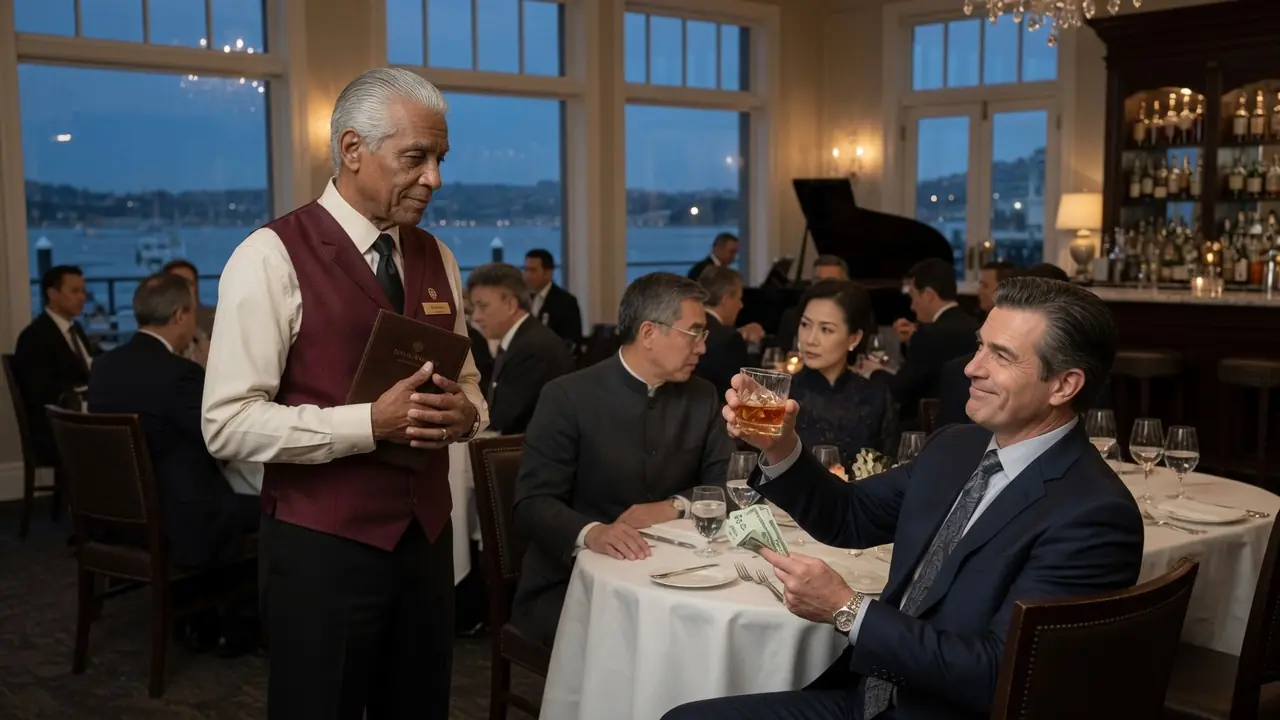
Arthur was sixty-eight years old.
He had silver hair, a lined face, and hands shaped by five decades of physical work. His knees hurt on stairs, but he never allowed discomfort to change the care with which he carried a tray.
He had worked at Laurent & Vine for two years.
Before that, he had stocked groceries, unloaded ships, driven delivery trucks, cleaned hotel kitchens, managed warehouse inventory, and served meals in restaurants across San Francisco.
He wore a white shirt beneath a black vest.
His name was stitched neatly above one pocket.
Conrad barely looked at it.
“I requested a Mandarin-speaking server.”
Arthur stopped beside his chair.
“I’ve been assigned to your table, sir.”
Conrad looked him over.
“Did the manager misunderstand me?”
“I don’t believe so.”
“I asked for someone capable of communicating with my guests.”
“I can assist you.”
Conrad laughed.
The sound was louder than necessary.
“You?”
Several nearby diners turned.
Arthur held the wine list against his chest.
“Yes, sir.”
Conrad glanced toward Jian, inviting him to share the joke.
Jian did not.
Conrad looked back at Arthur.
“I need someone who speaks Chinese. Not an old waiter who can barely hold the menu steady.”
The manager, Peter Lawson, stood near the kitchen entrance.
He took one step forward, then stopped.
Conrad saw him hesitate.
Power often revealed itself in small moments.
A person looking away.
A manager deciding a wealthy customer mattered more than an employee.
Conrad enjoyed those moments because they confirmed his place in the room.
He removed a twenty-dollar bill from his wallet.
“Here.”
He flicked it toward Arthur.
The bill struck the edge of Arthur’s shoe and landed on the polished floor.
“Pick it up and find someone useful.”
The pianist continued playing for three more notes.
Then stopped.
Conversation faded around the restaurant.
Arthur looked down at the money.
He had experienced humiliation in many forms.
Customers who snapped their fingers.
Guests who called him “boy” when he was older than their fathers.
Young executives who discussed him as if he were furniture.
He had learned to survive such moments without allowing strangers to define him.
But Conrad had made the cruelty public.
That changed its purpose.
This was not impatience.
It was a performance.
Arthur raised his eyes.
“I speak four languages, Mr. Mercer.”
Conrad leaned back in his chair.
“You speak four languages?”
“Yes.”
“Where did you study? Between washing dishes and carrying boxes?”
William shifted uncomfortably.
“Conrad, that’s enough.”
Conrad ignored him.
“You should be grateful a restaurant like this allows someone your age near the dining room.”
Arthur’s fingers tightened around the wine list.
“You may comment on my age,” he said. “But you do not decide what I am capable of.”
Conrad picked up his whiskey.
“You are not important enough to tell me what I decide.”
The surrounding tables had gone silent.
Arthur looked toward the kitchen.
He could leave.
He could remove the vest, collect his wages, and catch the final bus home.
Walking away would not mean Conrad had won.
Sometimes dignity meant refusing to remain available for another person’s cruelty.
Arthur took one step.
Behind him, Jian spoke softly to his wife in Mandarin.
“This man has talked about honor for an hour,” he said. “But he treats workers like objects placed here for his convenience.”
Mrs. Zhou responded.
“He believes money protects him from being observed.”
The legal advisers exchanged a look.
Conrad smiled because he understood none of it.
Arthur understood every word.
He stopped.
Then slowly turned back toward the table.
Conrad smirked.
“Forget where the kitchen is?”
Arthur did not look at him.
He faced Jian.
Then he spoke in Mandarin.
“Mr. Zhou, please accept my apology for the interruption. The chef has prepared tea-smoked duck as the fourth course. A Burgundy listed on page three would complement it well, although I believe the oolong pairing may be more appropriate if you prefer something traditional.”
Jian’s eyebrows rose.
Arthur’s Mandarin was fluent.
Not a memorized greeting.
Not the careful pronunciation of someone who had studied a phrase for tourists.
The tones were precise. The rhythm was natural. His speech carried traces of older teachers from Beijing and the softened expressions used by immigrant families who had lived in California for decades.
Jian replied in Mandarin.
“Where did you study?”
“I did not attend university.”
“Then who taught you?”
“Grocers, cooks, dockworkers, grandparents, delivery drivers, and anyone patient enough to correct me.”
Mrs. Zhou smiled.
“You speak like my grandfather.”
“That is a great compliment.”
For the first time that evening, Jian laughed without politeness.
Conrad’s smile vanished.
“What did he say?”
Arthur turned toward him.
“Mr. Zhou asked where I learned Mandarin.”
“That was more than one question.”
“Yes.”
Conrad narrowed his eyes.
“You could have memorized that conversation.”
Jian’s legal adviser spoke rapidly in Mandarin, asking Arthur to explain a complicated concern about shoreline permits, soil contamination, and construction delays.
Arthur listened.
Then answered at length.
He explained that the California environmental review process differed from the procedure used in several Chinese provinces. He clarified that preliminary municipal approval did not guarantee a final construction permit. He also noted that Conrad’s proposed timeline left little space for appeals by neighborhood groups.
Jian leaned forward.
Conrad stared at them.
“What are you discussing?”
Arthur returned to English.
“Your guests have three concerns.”
He counted them calmly.
“The environmental permits may take longer than you represented. Mrs. Zhou believes your construction schedule is unrealistic. Mr. Chen is concerned that the liability provisions do not clearly separate the parent firms from their subsidiaries.”
The room changed.
Conrad lowered his whiskey glass.
William stopped moving.
Eleanor looked at her husband with an expression Arthur could not immediately understand.
Perhaps she had watched Conrad underestimate people before.
Perhaps she had spent years seeing the consequences arrive after he had already dismissed every warning.
Jian confirmed the translation in English.
“Mr. Bennett is correct.”
Conrad looked toward Arthur’s name tag for the first time.
“Bennett.”
“Yes.”
“How much of our conversation did you understand?”
“All of it.”
A murmur traveled through the nearby tables.
The twenty-dollar bill remained on the floor.
Conrad pulled out his phone.
“Speaking a language socially is different from understanding business.”
He opened the preliminary development agreement and pushed the screen toward Arthur.
“Read this.”
Arthur picked up the phone.
The document was written in dense legal Mandarin.
Conrad leaned back.
“Translate it.”
Peter Lawson finally approached from the kitchen.
“Mr. Mercer, Arthur does not need to participate in this.”
Arthur raised one hand.
“It’s all right.”
He read silently for several seconds.
Then began translating.
“Section one establishes the ownership structure following the initial investment.”
He explained voting rights, dilution, and the conditions under which additional capital could be required.
“Section two addresses indemnification.”
Arthur paused.
“The Chinese version is broader than the English wording. It may expose individual directors to obligations that your draft limits to corporate entities.”
Jian’s attorneys leaned closer.
Conrad’s expression tightened.
Arthur continued.
When he reached the noncompetition section, he stopped.
Conrad smiled.
“Problem?”
“Yes.”
Arthur placed one finger on the screen.
“The clause is ambiguous.”
“Convenient.”
“In standard mainland commercial usage, it probably applies only to subsidiaries. Under another reasonable interpretation, it could restrict individual officers and directors from participating in unrelated projects.”
Jian nodded.
“We raised that concern last week.”
Conrad looked toward William.
“Our attorneys rejected it.”
“They were wrong,” Jian said.
Arthur continued through the document.
He translated words, but he also explained intention.
Some phrases were technically accurate yet carried expectations not visible in direct English translation. A sentence described as consultation actually implied that approval was expected. A reference to good-faith cooperation suggested obligations beyond the written contract.
By the time Arthur reached the final page, Jian’s advisers were taking notes from him.
Conrad was not.
He was staring at the man he had ordered away.
“You understand this better than the lawyers who drafted it,” Jian said.
Conrad pushed his chair back.
“Anyone can learn terminology.”
No one answered.
He walked toward the bar.
The restaurant’s owner, Nathan Laurent, stood behind it.
Nathan was sixty-one and had spent twenty-three years serving guests wealthy enough to confuse spending with ownership.
Conrad stopped in front of him.
“Your waiter embarrassed me.”
Nathan placed a polished wineglass on the counter.
“He translated the agreement you brought.”
“I spend nearly two hundred thousand dollars a year in this restaurant.”
“We appreciate your business.”
“I want him fired.”
Nathan met his eyes.
“I have never removed a guest from Laurent & Vine.”
Conrad waited.
“Do not become the first.”
For several seconds, neither moved.
Conrad eventually returned to the table.
Arthur stepped into the kitchen.
Marcus Lee, the head server, stood near the service station.
“You never told me,” Marcus said.
“No one asked.”
“I’ve worked beside you for two years.”
“Yes.”
Marcus lowered his eyes.
“That is embarrassing.”
“It is common.”
Marcus glanced toward the dining room.
“He may try to ruin your job.”
“I know.”
“Was it worth answering him?”
Arthur retied his apron.
“He made a public wager against my dignity before he knew my name.”
“What wager?”
Arthur looked toward the table.
“He has not made it yet.”
As though responding to the sentence, Conrad’s voice rose from the dining room.
“One hundred thousand dollars.”
Everyone turned.
Conrad stood beside the table.
“I will pay one hundred thousand dollars if that waiter can prove he possesses professional-level Mandarin.”
William closed his eyes.
“Conrad.”
“No. He wants an audience.”
Arthur returned from the kitchen.
“I did not ask for one.”
“You claimed expertise.”
“I said I spoke the language.”
Conrad held up his phone.
“I have contacted Dr. Vivian Park, a federally certified interpreter with twenty years of experience. She will administer three tests.”
Arthur looked at the screen.
A woman in her fifties appeared from an office lined with books.
She looked irritated.
Conrad continued.
“Legal translation. Medical interpretation. Classical literature.”
“And if I pass?”
“I will write the check tonight.”
“If I fail?”
“You admit this evening was a performance, apologize, and leave the restaurant permanently.”
Nathan stepped forward.
“You do not decide who works here.”
Arthur looked at him.
“Let him finish.”
“Arthur, you owe him nothing.”
“I know.”
Arthur faced Conrad.
“I accept.”
The legal test came first.
Dr. Park read a paragraph involving fiduciary duties, subordinate financing, and joint liability.
Arthur listened without taking notes.
Then translated the passage into English, preserving the technical meaning and formal tone.
Dr. Park asked two questions.
Arthur answered both.
“Accurate,” she said. “Professional register.”
The restaurant remained silent.
The medical passage concerned liver disease, medication interactions, and a complex diagnosis.
Arthur translated each term carefully.
Near the end, Dr. Park included an uncommon phrase.
Arthur paused.
Conrad leaned forward.
Then Arthur broke the phrase into its component characters and provided the correct English meaning.
Dr. Park removed her glasses.
“That is right.”
She studied him through the screen.
“Many trained medical interpreters would need to research that expression.”
Conrad’s face had begun losing color.
The final test involved classical Chinese prose.
Dr. Park warned that literal translation would not be sufficient.
The passage described an aging minister watching a river after the fall of an arrogant ruler. It contained historical references, restrained grief, and a warning that power disappeared faster than memory.
Arthur closed his eyes as she read.
When she finished, he began translating.
He did not chase every individual word.
He carried the meaning across.
The river continuing after palaces vanished.
The difference between being feared and being respected.
The quiet dignity of those whose labor outlived the names of the men who commanded them.
When Arthur finished, Dr. Park remained silent.
So did the restaurant.
Finally, she spoke.
“Mr. Bennett, where did you learn to understand literature this way?”
Arthur thought about the grocery store on Stockton Street.
His aunt cleaning offices in Chinatown.
Discarded newspapers.
The old shopkeeper who corrected his characters after closing.
Hospital forms he translated for frightened families.
Dockworkers who taught him Spanish.
Tourists who gave him French phrasebooks.
“I listened,” he said.
Dr. Park nodded.
“That is a rare answer.”
She turned toward Conrad.
“He has passed every assessment.”
Conrad opened his checkbook.
The sound of his pen carried through the room.
He wrote the amount slowly.
One hundred thousand dollars.
Then he placed the check on the table.
Someone had picked up the twenty-dollar bill and set it beside his plate.
Arthur looked at both.
The amount meant more to him than anyone in the room understood.
His sister’s apartment still carried a mortgage.
Several young employees at the restaurant had abandoned college because rent came first.
A hundred thousand dollars could change lives.
Arthur folded the check once.
Then picked up the twenty.
He held it toward Conrad.
“Keep this.”
Conrad stared at him.
“You may need it more than I do.”
Jian stood.
He began applauding.
Mrs. Zhou rose beside him.
Then the advisers.
William.
Eleanor.
Nathan Laurent.
Marcus and the kitchen staff.
The pianist left his bench.
Table by table, nearly sixty diners stood.
The applause grew until Arthur could feel it through the floor.
He remained beside the table in a waiter’s vest, holding a folded check with hands that had unloaded ships, cleaned kitchens, carried boxes, and raised children.
Those same hands were trembling now.
Not from age.
From being seen.
When the room quieted, Jian approached with a business card held respectfully in both hands.
“My company employs hundreds of bilingual professionals,” he said. “Few possess your instinct.”
Arthur accepted the card.
“I would like you to join us as a senior cultural adviser.”
Conrad stared.
“You are recruiting my waiter during my dinner?”
Jian turned.
“He is not your waiter.”
The words landed harder than any insult Conrad had delivered.
“He is a professional serving a table where you happened to be sitting.”
Arthur looked down at the card.
“I am sixty-eight.”
Jian smiled.
“That means you have sixty-eight years my younger advisers cannot imitate.”
Nathan removed the gold vine pin from his own lapel.
It was awarded only to those who had made a permanent contribution to Laurent & Vine.
He attached it above Arthur’s name.
“I failed to understand the person working beside me,” Nathan said. “That failure is mine.”
Arthur touched the pin.
Nathan continued.
“Whatever you decide about Mr. Zhou’s offer, you will always have a place here.”
Eleanor approached Arthur later, near the service station.
“I need to apologize.”
“You did not throw the money.”
“No.”
She looked toward Conrad.
“But I stayed seated.”
Arthur waited.
“I have spent years telling myself silence prevents conflict.”
Her eyes filled.
“Tonight I understood that silence can also protect cruelty.”
Arthur took her hand briefly.
“You still have time to decide what your silence means tomorrow.”
Eleanor nodded.
Conrad left without apologizing.
He walked through the applauding restaurant, past the twenty-dollar bill still resting beside his plate, and disappeared into the fog outside.
Arthur used part of the wager to pay off his sister Evelyn’s home.
With the remainder, he created a scholarship for working adults who had never been able to study what they loved.
Nathan matched the amount.
Jian did too.
The Second Beginning Fund awarded its first grants the following year.
A hotel cleaner began nursing school at forty-six.
A former dockworker studied accounting.
A sixty-three-year-old grandmother entered an interpretation program after translating informally for her neighborhood for decades.
Arthur accepted Jian’s offer.
He worked three days a week reviewing international agreements and preparing younger consultants for negotiations.
He still served one evening each week at Laurent & Vine.
He did not consider restaurant work beneath his new position.
He wanted younger employees to understand that advancing did not require being ashamed of where they began.
Three years later, a nervous young server recognized Arthur beneath the framed photograph hanging behind the bar.
“Mr. Bennett?”
“Yes?”
“My father received one of your scholarships.”
Arthur straightened.
“What did he study?”
“Electrical engineering.”
“How old was he when he began?”
“Fifty-seven.”
The server smiled.
“He graduated last month.”
Arthur removed a business card.
“Ask him to call me.”
“Why?”
“Pacific Horizon needs engineers who understand more than textbooks.”
The young man accepted the card with both hands.
Arthur watched him return to work.
Evelyn sat across from him wearing her best blue dress.
“You keep collecting people,” she said.
“They were already there.”
“You know what I mean.”
Arthur smiled.
Years passed.
The scholarship grew.
Arthur advised companies, universities, hospitals, and legal organizations. He spoke occasionally about language, age, and the invisible knowledge carried by working people.
He never built his speeches around Conrad.
Conrad had been a doorway.
He was not the destination.
Yet their paths continued crossing through business.
That was why Arthur eventually found himself at the head of the conference table five years later, reviewing another agreement while Conrad sat across from him.
After Arthur left that morning, Conrad remained alone for several minutes.
On the table lay the corrected contract and a handwritten note Arthur had prepared for the attorneys.
Near the bottom, Arthur had written:
Respect is not decoration around an agreement. Without it, every promise eventually becomes unstable.
Conrad read the sentence twice.
That afternoon, he visited Laurent & Vine for the first time since the wager.
The staff recognized him immediately.
Nathan met him near the entrance.
“I’m not here for dinner.”
“I assumed not.”
Conrad looked toward Arthur’s photograph behind the bar.
“Does he still work here?”
“One evening a week.”
“When?”
“Thursday.”
It was Tuesday.
Conrad placed an envelope on the counter.
“Give this to him.”
Nathan did not touch it.
“What is it?”
“A donation to the scholarship.”
“How much?”
Conrad hesitated.
“One hundred thousand.”
Nathan studied him.
“Anonymous?”
“No.”
“Why not?”
“Because anonymity would let me pretend generosity costs nothing.”
Nathan finally picked up the envelope.
“Is there an apology inside?”
“Yes.”
“Is it a good one?”
“I don’t know.”
“Then Arthur will decide.”
Two days later, Arthur opened the envelope in the staff room.
The check came first.
Then the letter.
Arthur,
Five years ago, I thought humiliating you would make me appear powerful in front of people I wanted to impress.
Instead, I revealed that I could not recognize value unless it arrived with status I already respected.
I have spent my career claiming I see what other people miss.
That night, everyone in the room saw you before I did.
I am sorry.
The donation does not purchase forgiveness.
It is simply overdue payment toward a lesson that cost others more than it cost me.
Conrad Mercer
Arthur read the letter again.
He did not call Conrad.
He deposited the check into the scholarship fund.
A month later, Conrad received a small card.
No long message.
Only one sentence in Arthur’s handwriting.
A person becomes different through what he does after finally seeing himself clearly.
Conrad placed the card inside his desk.
Arthur never learned whether it remained there.
He did not need to.
At seventy-five, Arthur returned to Laurent & Vine for the scholarship fund’s annual dinner.
The restaurant was filled with graduates, donors, servers, translators, nurses, engineers, and working adults beginning new careers long after others told them their useful years had ended.
The young server’s father attended as an engineer for Pacific Horizon.
The hotel housekeeper had become a nurse.
The grandmother now interpreted in a public hospital.
Arthur stood beneath his photograph while Evelyn adjusted the gold vine pin on his jacket.
“You’re crooked,” she said.
“The pin?”
“You.”
She straightened his tie.
Jian raised a glass.
“Years ago, this room witnessed a wager,” he said. “A powerful man believed an employee’s uniform defined his ability.”
He looked toward Arthur.
“The wager was settled that night. The lesson has continued paying interest ever since.”
People laughed softly.
Arthur approached the microphone.
He looked across the dining room.
At the servers moving between tables.
At the cooks visible through the kitchen doorway.
At guests who held titles and those who did not.
“People often say I proved it is never too late,” he began.
“I do not believe that is exactly what happened.”
The room quieted.
“I was already capable before anyone applauded.”
He touched the vine pin.
“The opportunities arrived late. My value did not.”
Several former scholarship recipients lowered their eyes.
Arthur continued.
“There are people all around us carrying knowledge they were never given permission to name. The woman cleaning an office may understand three languages. The warehouse worker may have designed a better system in his head. The grandfather delivering groceries may have abandoned a degree to raise children.”
He paused.
“Do not wait for a public spectacle before becoming curious about the people beside you.”
The applause came slowly.
Not like the first night.
That applause had been surprise.
This was recognition.
After dinner, Arthur stepped outside with Evelyn.
Fog had rolled across the waterfront.
The city lights blurred softly in the distance.
“Do you remember the twenty dollars?” Evelyn asked.
“Yes.”
“Do you regret giving it away?”
“No.”
“You could have framed it.”
Arthur smiled.
“Then it would still belong to Conrad’s story.”
They began walking.
Behind them, Laurent & Vine continued its evening service.
Coffee was poured.
Wine bottles opened.
Important people discussed important agreements.
Servers moved quietly between them.
Some guests looked only at the uniforms.
Others had learned to look closer.
Arthur no longer needed every stranger to understand what he carried inside him.
He had spent most of his life being underestimated and had survived without applause.
But the night Conrad Mercer threw money at his feet revealed something larger than one elderly waiter’s hidden talent.
A person’s knowledge did not begin when a wealthy man recognized it.
Dignity did not depend on occupation.
Experience did not expire because hair turned silver or hands began to shake.
Arthur had been valuable while unloading ships.
While translating hospital letters for frightened families.
While carrying boxes.
While pouring wine.
While standing silently beside tables occupied by people who never asked his name.
The restaurant did not create his worth that night.
The investors did not grant it.
The check did not measure it.
They simply discovered what had been standing in front of them all along.
Talent in a black vest.
Wisdom behind tired eyes.
And a lifetime of knowledge that had never needed anyone’s permission to matter.