Reeve Callaway had seen drought break men faster than bullets ever could. He had seen proud ranchers sell their last herd for half its worth, widows sign deeds with trembling hands, and whole families ride east with nothing tied behind their wagons but bedding and silence. Across Cimarron County, men spoke his name with a certain weight, because he owned more cattle than some towns had people and more land than most men could cross before sundown. But Reeve had never mistaken wealth for strength, and that was why the run-down ranch below the trail stopped him cold that October morning.
He was riding back from Cedar Falls alone, checking water the way he always did. Cattle could be counted by foremen, fences could be inspected by hands, but water was something Reeve trusted only to his own eyes. The sky hung low and gray, and his stallion moved steadily along the ridge where the wind cut clean across the grass. He almost passed the ranch entirely before a strange neatness below the trail caught his attention.
The house should have looked abandoned. The porch rail sagged, the barn wall had missing boards, and the south fence leaned in places where winter would surely finish it if no one got there first. Yet the yard had been swept clean, not roughly, not halfway, but with the stubborn care of someone who had risen before sunrise and worked while no one watched. Near the eastern wall, a narrow garden had been cut into hard ground, the rows straight and deliberate against all reason.
Reeve drew rein and sat there longer than he meant to. He told himself he was looking at the well boundary, though he knew that was not the truth. The place was poor, failing, almost beaten, but not surrendered. A ranch could be ruined by weather, banks, or men with papers, but a swept yard in a dying season meant the owner had not yet agreed to lose.
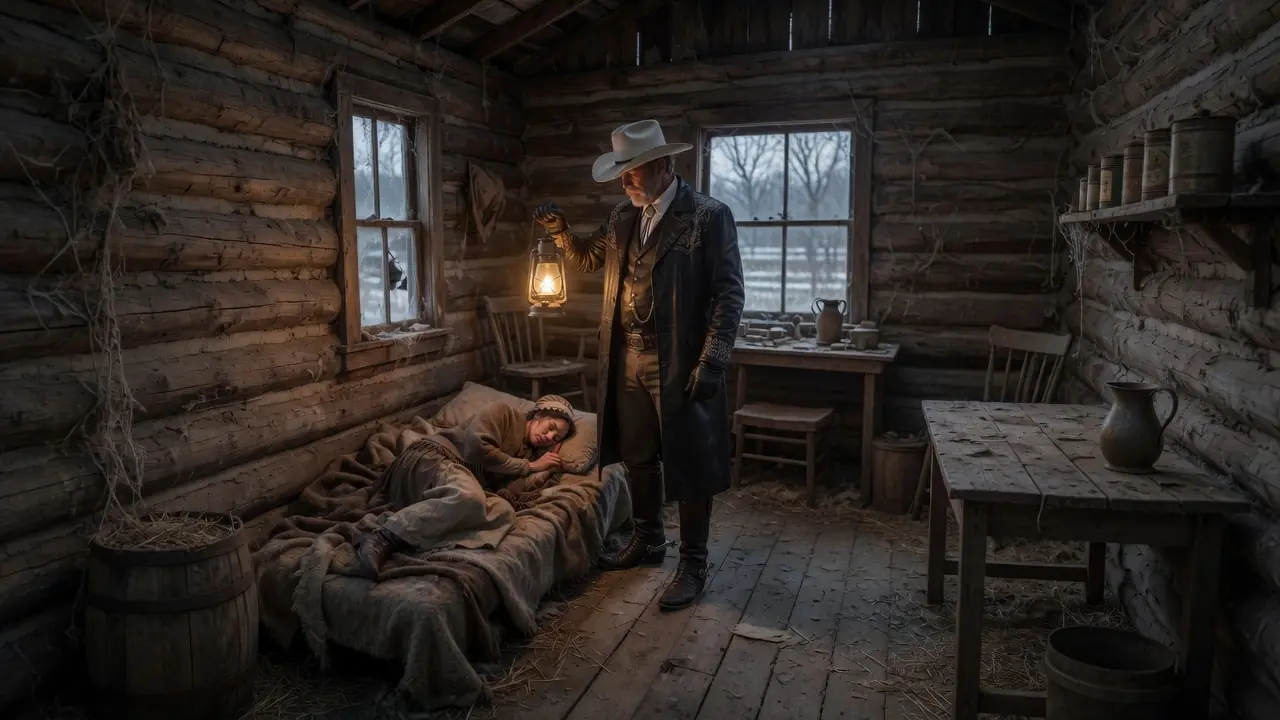
He dismounted and walked toward the house. The front door stood partly open, moving a little in the wind. Inside, a woman slept upright in a chair beside a cold hearth, boots still on, sleeves rolled to the elbow, a worn ledger open across her knee. She looked less like someone resting and more like someone whose body had simply refused to continue without permission.
Reeve stopped at the threshold and did not step farther in. The room was plain, clean where it could be cleaned, and stripped down to necessity. A cracked frame hung above the hearth with a faded deed inside, its lettering still legible enough to read. Vance Homestead, registered 1869, Cimarron County, Kansas Territory.
The woman woke before he finished reading. Her eyes opened without panic and fixed on him with the flat precision of someone who had trained herself to come awake ready. She did not scream, scramble, or shrink back into the chair. She closed the ledger in one smooth motion and said, “You have one breath to tell me why you are standing inside my house.”
Reeve kept both hands visible and stayed where the doorway ended. “Door was open, ma’am,” he said. “I came to check the well line, not frighten you.” She stood slowly, tall in spirit though not in height, her dark hair pinned carelessly, her face drawn with exhaustion and pride. “Men who mean no harm usually knock before crossing a widow’s threshold,” she said.
Her expression changed only slightly, but he saw recognition move through it. Everyone in the county knew the Callaway name, and most people decided what it meant before the man had time to speak. “Nora Vance,” she said. Names were fair exchange, and after that the room was quieter.
Reeve glanced again at the deed above the hearth. “You running stock?” he asked. Nora’s mouth tightened. “Sold the herd to keep the land,” she answered. “Last two seasons were dry.” There was no apology in it, no invitation for pity, only the arithmetic of survival stated plainly.
He respected her more for that than he expected to. Many people decorated hardship when they spoke of it, hoping to be admired for enduring it. Nora Vance did not decorate anything. She stood in a cold house with an unpaid winter coming and spoke as if every loss was simply a number in the ledger, painful but exact.
“How long alone?” Reeve asked, then regretted the shape of the question before she answered. “Maintaining it,” she corrected. “Running takes resources. Maintaining takes will.” He looked at the swept yard through the open door and knew she had more will than half the men he did business with. Still, will did not repair a fence before snow, and it did not keep a land broker from smelling weakness.
He stepped outside to examine the south fence. Three sections were gone, two more failing, and the original work had been good enough that neglect was not the culprit. Time had done what time does, and drought had made every problem sharper. In that country, a broken fence invited drifting herds, boundary arguments, and men who arrived smiling with surveyors behind them.
When Reeve returned, Nora was in the garden with a hoe. She worked between the rows with economical movements, saving strength without surrendering rhythm. Her hands were raw across the knuckles, not from a single hard day, but from weeks of refusing to stop. He stood near the fence and said, “Three sections gone.”
“I know,” she said, not looking up. “Any stock you bring in come spring drifts onto Cooper’s pasture inside a week,” he added. “I know,” she said again. The answer was not rude, only tired of being told what she had already measured. After a moment, she stopped and leaned both hands on the hoe handle.
“What would it take?” she asked. “To fix it?” Reeve looked toward the south line. “Six days with two good men, maybe forty dollars in materials if the ground holds.” Nora said nothing, and the silence told him forty dollars might as well have been four hundred. He did not offer sympathy, because sympathy would have insulted her before it helped her.
“I am not offering to pay for it,” he said. That made her look at him. “I am offering to send a crew.” Her eyes narrowed, sharp and immediate. “In exchange for something.” Reeve almost smiled, not because the matter was light, but because she heard the world accurately.
They sat on the porch because Nora would not discuss terms inside where he had entered uninvited. Reeve laid it out cleanly: a winter lease on East Creek water rights, eight weeks of cattle movement each season for three years, fair market rate, plus fence repair and barn roof work before the hard freeze. Nora listened without blinking, her hands folded in her lap, her ledger beside her. When he finished, she asked the question most people were too afraid to ask him.
“Why not buy the parcel?” she said. “That is what men with your name do.” Reeve looked through the open doorway at the deed above the hearth. “Because it is not for sale.” Nora held his gaze. “How do you know I do not want to sell?”
“Because you hung the title where you could see it every morning,” he said. That answer landed harder than either of them expected. Something shifted in her face, not trust, not warmth, but recognition. Being read clearly can feel like comfort or danger, and Nora had not yet decided which one Reeve Callaway was.
“In writing,” she said. “With a termination clause if your cattle damage the creek bank.” Reeve pulled a notebook from his coat and wrote the clause on his knee right there on the porch. She read it twice, then a third time, and only then nodded. He left with her agreement in his pocket and the strange feeling that he had not helped a poor widow so much as negotiated with the strongest person on that dying piece of land.
The fence crew arrived at first light two days later. Nora was outside before they finished unloading, her shawl pinned tight and her work gloves already on. She took a post hole digger from the wagon without asking and carried it toward the south line. Aldous, Reeve’s foreman, looked once at her hands and once at her face, then nodded the quiet respect working people give one another when no speech is needed.
She worked beside them all morning. When a section required one more post than expected, she dragged the extra post herself. When one of the younger hands tried to take the tool from her, she looked at him until he remembered another task. By noon, every man on that crew understood they had not been sent to repair Nora Vance’s ranch for her.
They had been sent to repair it with her. Reeve arrived the next afternoon with the lease in two copies, signed and notarized. Nora read it standing beside a newly set post, one boot braced on the packed soil. “You added a drainage clause,” she said. Reeve nodded.
“Cattle traffic on a creek crossing ruins a bank faster than most men admit,” he said. “This protects you.” She looked down at the page again, and he saw her turn the words over carefully. Most people thanked him too quickly, grateful for the powerful man’s favor. Nora Vance studied the favor to make certain it did not hide a hook.
That evening, Aldous told her what Reeve had said before the crew left his ranch. “She will know more about what that place needs than you do,” he had told them. “Listen when she speaks.” Nora received that information without expression, but she carried it with her all the way into the barn that night. Respect, she had learned, was more valuable than help, because help often expected surrender in return.
November arrived hard and sharp. The first freeze locked the ground overnight, and Nora was banking the garden rows with straw when a silver-trimmed roan entered her yard. The man who dismounted wore a fine coat, polished boots, and the smile of someone who considered pressure a profession. He introduced himself as Gerald Pell from land acquisition in Wichita.
Nora had heard of him. Pell bought land from exhausted people at the exact moment they were too tired to understand what they signed. He did not need to forge documents or threaten loudly; he knew how to place a legal sentence where a desperate person would trip over it. In two years, he had swallowed eleven parcels in Cimarron County.
“I have been authorized to make you a serious offer,” Pell said. Nora leaned her straw fork against the fence. “The property is under lease,” she answered. “Water rights and pasture access through 1880. Leaseholder is Reeve Callaway.”
Pell’s smile changed shape. It did not disappear; it cooled. “Leases are paper, Miss Vance,” he said. He looked toward the repaired fence, then back at her. “Paper is fragile in a dry winter, and this county is a long ride from the nearest law office.”
He rode away after telling her he would return Friday. Nora watched until the roan disappeared, then went inside and opened her ledger. She wrote his name, the date, the words threat made explicit, and Friday beneath them. Then she sent a rider to Callaway before fear had time to argue with good sense.
Reeve arrived Thursday evening with three men and no unnecessary noise. He found Nora at the kitchen table with her father’s old Colt Navy revolver lying on the wood beside the ledger. He looked at the weapon, then at her. “You know how to use it,” he said, not as a question.
“My husband taught me before he died,” Nora replied. “I am not hiding in the house while Pell burns my fence.” Reeve sat across from her and leaned his forearms on the table. “Nobody is asking you to hide.”
For the first time, something in Nora’s guarded face flickered. It was not relief exactly, but the small, weary shock of not being ordered around for her own good. Reeve saw it and felt anger rise in him, not hot, but deep. Too many people had mistaken Nora’s loneliness for weakness. Too many had assumed a widow defending land alone could be managed, cornered, or bought.
Friday came clear and cold. Pell arrived mid-morning with two riders behind him, men too clean for working country and too still for honest business. Reeve stood near the south fence with Aldous and two hands behind him. Nora stood six feet to his left, her father’s revolver at her hip, her eyes level, her spine straight.
Pell took in the scene without expression. “Callaway,” he said. “Did not expect you personally.” Reeve adjusted his glove. “I inspect my water rights personally.” His voice was calm enough to make Pell’s men nervous.
Pell turned toward Nora. “Miss Vance has until Sunday. The offer stands.” Nora’s answer carried across the field without effort. “The offer was declined Monday. It was declined when you threatened me. It is declined now, and the next time you ride onto this land, I will have the county sheriff here to meet you.”
The silence afterward was long enough to become its own witness. Pell looked at Reeve, at the repaired fence, at the men behind him, and at Nora, who had not stepped behind anyone. He found nothing to work with. At last, he touched the brim of his hat, turned his horse, and rode away without papers signed.
No one spoke until the hoofbeats faded. Then Aldous said quietly, “First time I have seen Pell leave without paperwork.” Nora was already walking back toward the house. Reeve watched her go, not with pity and not with triumph, but with the growing certainty that some forms of courage were so plain they could almost be missed. He had built an empire, but Nora Vance had held a homestead together with her bare hands.
Word traveled fast after that. Ranchers rode by to ask what had happened at the south fence line, pretending they only wanted to inspect the crossing or borrow news. The county land recorder, Samuel Darrington, stopped Reeve outside his office in Cedar Falls and said, “Most men in your position would have bought the parcel.” Reeve answered, “She did not want to sell.”
Samuel studied him over his spectacles. “A rich man who takes no for an answer from a woman with nothing,” he said. “That may be the rarest transaction I record all year.” Reeve rode back to Nora’s ranch that afternoon and told her what Samuel had said. She listened with the ledger open across her knees and said, “He is right. That is unbelievable.”
Then she looked up. “Thank you, Reeve.” It was the first time she used his given name. He did not make anything of it, because she would have retreated if he had. But he noticed, and he carried the sound of it home like a letter folded close to the heart.
December settled over the county. The creek froze inward from its edges, and Reeve’s cattle crossed twice a week according to the lease. Nora monitored the banks, the ice, the water level, and the ground compression with a seriousness that impressed every hand who rode through. She sent weekly reports to Cedar Falls, and Reeve replied with short notes that began as business and slowly became something else.
He arrived in person one Thursday to inspect the crossing before the heaviest cattle movement. Nora was crouched near the bank, studying the soil beneath a cottonwood root. “Needs a branch and rock deflector here,” she said without looking up. “Three yards upstream would slow the approach.” Reeve crouched beside her and saw that she was right.
They stood close enough for their sleeves to brush. Neither moved away quickly. The wind came down cold and clean, stirring the loose hair near Nora’s cheek. Reeve looked at her ledger, then at the creek, then at the woman who had made knowledge survive on paper where most ranchers carried it only in their heads.
“These reports,” he said, “will tell whoever works this land ten years from now exactly how this crossing behaves.” Nora glanced at him. “You have been thinking about who works this land in ten years.” Reeve held her gaze. “I have.”
The words stood between them more plainly than any proposal could have. Nora looked away first, not because she was weak, but because what rose in her face was too unguarded for the open field. Reeve did not reach for her. He had learned by then that Nora Vance gave nothing under pressure, and anything worth having from her had to be freely placed in his hands.
“Miss Vance,” he said, slower than business required, “I would like to discuss whether the arrangement between us might take a different form. Something permanent.” Nora’s fingers tightened around the ledger. “You are talking about more than the lease.” Reeve nodded once. “I am.”
She did not answer that day. He had not expected her to. Nora gave serious questions the respect of serious thought, and Reeve admired that even while it made the ride home longer than any ride he could remember. Three days later, on a frosted Tuesday morning, she came to his ranch.
Reeve was working near the north pasture water tank when he saw her ride in. She tied her horse at the gate and crossed the yard with her shawl drawn tight, her face steady and unreadable. He wiped his hands and waited. She stopped before him and said, “I have conditions.”
Something moved through him, quiet and bright. “Name them,” he said. “The Vance deed remains separate,” she said. “The three hundred twenty acres are mine, my name, my title.” Reeve answered immediately. “Agreed.”
“I manage the east range records,” she continued. “The ledger system stays intact.” “I would expect nothing less,” he said. Nora lifted her chin. “And I do not become an ornament. If I am part of this operation, I am part of it.”
Reeve looked at her with the full force of what he had known since October. “I told my fence crew you would know more about that ranch than they did,” he said. “I have known what I was looking at from the first morning.” The silence that followed held more tenderness than either of them knew how to speak. Then Nora extended her hand.
Reeve took it. At first, it was a business gesture, firm and clean, like the first agreement on the porch. Then his thumb moved gently over the back of her raw knuckles, and the small tenderness changed the shape of the moment. Nora did not pull away.
Her eyes lowered to their joined hands. “I am not good at needing anyone,” she said. Reeve stepped closer, slowly enough that she could stop him without a word. “Then do not need me,” he answered. “Choose me.”
That broke through something she had held too tightly for too long. Nora’s mouth trembled, and for a moment she looked not like the widow who had faced Pell at the fence, but like a woman who had been lonely and strong until both had become the same thing. Reeve removed one glove and lifted his bare hand to her cheek. He touched her lightly, giving her every chance to turn away.
She leaned into his palm. It was a small movement, almost nothing, yet it shook him more than any victory in business ever had. He brushed a strand of hair away from her eyes with his thumb. “Nora,” he said, and her name sounded less like a word than a vow.
She closed her eyes for one breath. When she opened them, she placed her hand over his and held it against her cheek. “If I say yes,” she whispered, “I keep my name, my deed, and my work.” Reeve bent his head until his forehead nearly touched hers. “Then keep all of it,” he said, “and let me love the woman who refused to lose any part of herself.”
He kissed her brow gently. Nora’s hand tightened around his wrist, not to push him away, but to keep him there. For the first time since her husband’s death, she allowed herself to be touched without bracing for loss. Reeve held her as if she were not fragile, but precious, and she stood in his arms like someone learning that tenderness did not have to be a trap.
Spring came slowly, testing what winter had left standing. The garlic pushed through straw first, the fence line held, and the barn roof shed snowmelt without a leak. At the creek crossing, the new deflectors worked exactly as Nora had predicted, and Reeve made certain every ranch hand knew who had designed them. On the first page of the new ledger, the heading read Callaway Vance Ranch, Cimarron County, Spring 1878.
The deed did not erase Nora’s name. It did not swallow her land into Reeve’s empire or turn her into a woman seated politely beside someone else’s power. It became what she had demanded from the beginning: an agreement built on respect, written carefully, and lived even more carefully. Reeve never once asked her to be smaller so his name could appear larger.
One morning, Nora was turning the first garden row when she heard his horse in the yard. She looked up and smiled before she remembered to hide it. Reeve saw, and the expression on his face made her blush like a girl, though she was long past girlhood and had earned every line of strength she carried. He walked to the garden edge and asked, “Beans this year?”
“Beans and squash,” she said. “Rotating off the rye ground.” He nodded. “Sound decision.” They stood in the clean morning light, two people who had built something carefully, clause by clause, repair by repair, until trust had become as visible as the fence line.
Reeve reached for her hand, and this time Nora gave it without hesitation. His fingers closed around hers, warm and steady, and she let herself step nearer. He kissed her forehead again, the way he had at the water tank, and she rested her free hand against his chest. The ranch stretched around them, repaired but not tamed, scarred but still standing.
There was a kind of wealth that did not announce itself with silver tack, bank ledgers, or acres counted by the thousand. It lived in a swept yard before sunrise, in a garden planted against the season, in a man powerful enough to honor a woman’s refusal, and in a woman brave enough to accept love without surrendering herself. Nora Vance had not been rescued from her ranch. She had been seen there, exactly where she stood, and loved for the strength it had taken to remain.
Years later, people in Cimarron County still told the story of the morning Reeve Callaway found a widow sleeping in a chair beside a cold hearth. Some told it as the tale of a millionaire cowboy who saved a failing homestead. Others told it as the tale of a woman too stubborn to sell and a man wise enough not to ask twice. But those who knew them best understood the truth was quieter and better than either version.
Reeve did the unexpected because Nora herself was unexpected. He did not buy her land, bury her name, or mistake her need for permission to rule her life. He repaired the fence, honored the lease, faced the threat beside her, and offered permanence only after proving he knew the difference between possession and partnership. And when Nora finally took his hand, she did not lose the Vance Homestead; she gained a future strong enough to stand beside it.