“Get out of my sight.”
The words cut across the dining room of Bellamy & Vine with enough force to slow every nearby conversation.
The restaurant was one of San Francisco’s most exclusive establishments, a place where reservations were made months in advance and where a bottle of wine could cost more than an ordinary family’s rent.
Crystal lights glowed above linen-covered tables. A pianist played softly near the bar. Beyond the tall windows, the city’s waterfront shimmered beneath the evening fog.
At the largest table in the room sat Harrison Langley.
At fifty-two, Harrison was one of the most powerful real-estate developers on the West Coast. His company had transformed miles of industrial waterfront into luxury towers, private clubs and expensive office buildings.
Business magazines estimated his net worth at more than three hundred million dollars.
That evening, he was entertaining four investors from China.
Their leader, Jian Zhou, controlled an international development firm considering a ninety-million-dollar investment in Harrison’s newest waterfront project.
Everything about the dinner had been designed to impress him.
The private table.
The twelve-course tasting menu.
The rare wine.
The view of the bay.
Everything except the elderly waiter Harrison had just insulted.
His name was Walter Brooks.
He was sixty-eight years old, with silver hair combed neatly back, a weathered face and hands marked by decades of work. He wore a black vest over a white shirt and moved with the measured care of a man whose knees had begun reminding him of every staircase he had ever climbed.
Walter had worked at Bellamy & Vine for two years.
Before that, he had spent most of his life working inside grocery stores, hotels, restaurants and shipping warehouses across San Francisco.
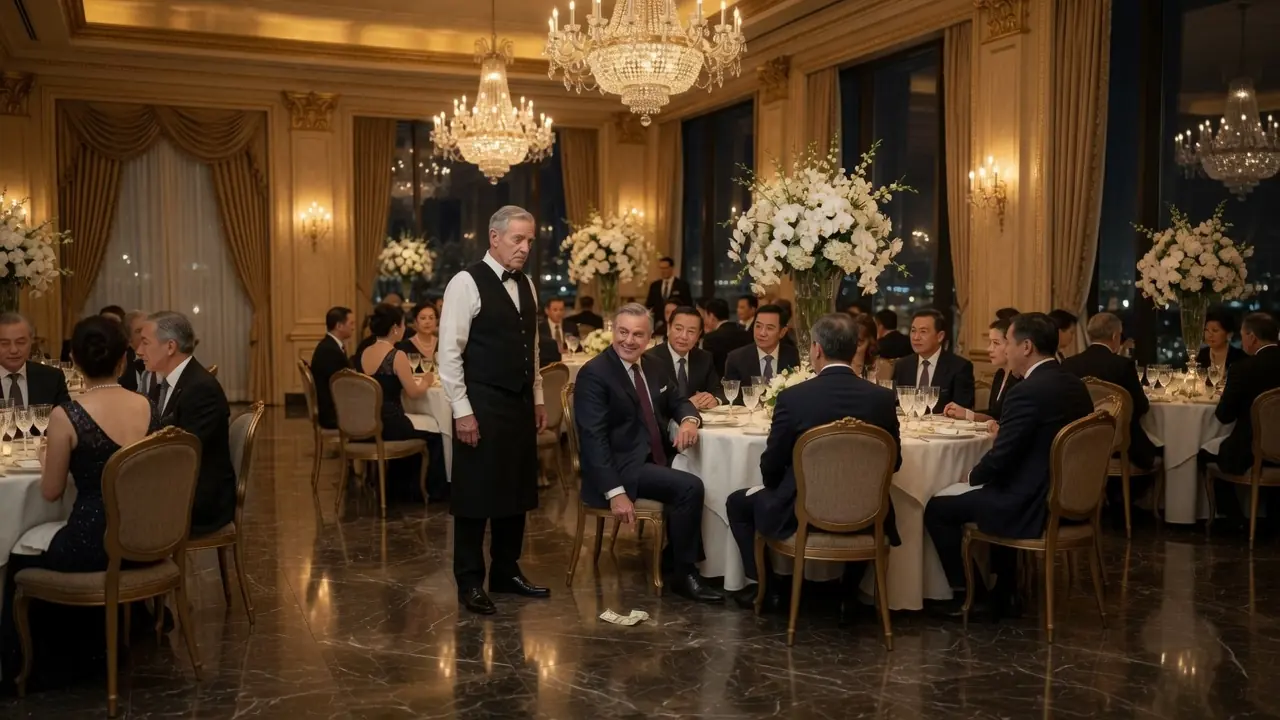
He stood beside Harrison’s chair holding a wine list.
His expression remained calm.
“I’ve been assigned to your table this evening, sir.”
“I asked for someone who speaks Chinese,” Harrison said. “Not some worn-out old waiter who can barely keep his hands steady.”
Several diners turned their heads.
Walter’s manager, standing near the kitchen, took one cautious step forward but stopped when Harrison looked in his direction.
Harrison noticed.
He enjoyed noticing when people were afraid of him.
He pulled a twenty-dollar bill from his wallet and flicked it onto the floor beside Walter’s polished shoes.
“Pick that up and find someone useful.”
Walter looked down at the money.
Then he looked back at Harrison.
“I speak four languages, Mr. Langley.”
Harrison laughed.
The sound carried through the entire dining room.
“Four languages?”
He glanced at the investors as though inviting them to enjoy the joke.
“You probably spent your whole life carrying boxes and washing dishes, and now you expect us to believe you’re some kind of scholar?”
Walter’s fingers tightened around the wine list.
He had endured rude customers before.
Men who snapped their fingers at him.
Women who spoke about him while he stood directly beside them.
Young executives who called him “old man” instead of learning his name.
He had learned not to answer every insult.
But Harrison was not finished.
“You should be grateful anyone still lets you work at your age,” he said. “Men like you belong in the back room, not near serious people.”
The pianist stopped playing.
The insult did more than silence the surrounding tables.
It changed the temperature of the room.
Walter stepped closer.
“You may say what you like about my age,” he said. “But you will not decide what I am capable of.”
Harrison leaned back.
“You’re not important enough to tell me what I can decide.”
“I’m still responsible for serving this table.”
“Not anymore.”
Harrison reached for his whiskey.
Then an idea appeared on his face.
“One hundred thousand dollars.”
Walter did not move.
Harrison smiled.
“I’ll bet you one hundred thousand dollars that you cannot say one complete sentence in Mandarin.”
“Harrison, leave the man alone.”
“No. He claims he speaks four languages.”
Harrison looked around the room.
“Say it loudly enough for everyone to hear, old man.”
Nearly sixty people were dining at Bellamy & Vine that evening.
By the end of the night, every one of them would be standing.
But not for Harrison Langley.
Walter turned toward the kitchen.
He could leave.
He could remove his vest, clock out and take the bus back to the small apartment he shared with his seventy-four-year-old sister.
He did not need this humiliation.
He had spent fifty years surviving work that younger men believed was beneath them.
Walking away would not make him weak.
Then Jian Zhou leaned toward his wife and spoke quietly in Mandarin.
“This man talks constantly about honor,” he said, “yet he treats the people around him like furniture.”
His wife gave a small nod.
The two associates beside them exchanged a glance.
Harrison continued smiling because he understood none of it.
Walter understood every word.
He stopped walking.
His back straightened.
Then he turned around.
He returned to the table slowly, each step measured and deliberate.
Harrison watched him approach.
“What happened?” he asked. “Forget where the kitchen was?”
Walter did not look at him.
He looked directly at Jian Zhou.
Then he spoke in fluent Mandarin.
“Mr. Zhou, I apologize for the interruption. I would be honored to explain tonight’s tasting menu. The chef has prepared tea-smoked duck, and I believe the wine listed on page three would complement it beautifully.”
Jian’s eyebrows rose before Walter completed the first sentence.
His Mandarin was fluid, tonal and precise.
Not memorized.
Not the careful speech of a tourist repeating phrases from a guidebook.
He spoke with the ease of someone who had carried the language inside him for decades.
Jian responded in Mandarin.
“Your pronunciation is remarkable. Where did you study?”
Walter answered in the same language.
“I never had the opportunity to attend a university. I learned in grocery stores, community halls and kitchens from people patient enough to include me in their lives.”
Jian’s wife smiled.
“He speaks like one of the old teachers from Beijing,” she said.
For the first time that evening, Jian laughed genuinely.
Harrison’s smile disappeared.
He looked from one face to another.
“Very entertaining,” he said in English. “But repeating a few practiced sentences doesn’t make a man qualified to participate in business.”
Walter turned toward him.
“Would you like me to translate what your guests have been discussing for the past ten minutes?”
Harrison said nothing.
“They have raised three concerns about your proposal,” Walter continued. “Mr. Zhou is worried about the environmental permits. Mrs. Zhou believes your schedule is unrealistic. And one of the advisers thinks the liability provisions in the preliminary agreement are unclear.”
Silence fell across the table.
Not ordinary restaurant silence.
A complete absence of movement.
Harrison’s hand froze around his whiskey glass.
Thomas slowly lowered his fork.
Harrison’s wife, Margaret, stared at Walter with an expression that looked less like surprise than recognition.
Perhaps she had spent years watching her husband underestimate people.
Perhaps she knew exactly how dangerous his confidence could become.
Jian leaned back in his chair.
He looked at Harrison.
Then at Walter.
Then back at Harrison.
He did not need to confirm the translation.
His expression did it for him.
The twenty-dollar bill remained on the floor.
No one looked at it.
Every eye in the restaurant was now on Walter Brooks.
Walter had not learned Mandarin in a classroom.
He had learned it the way many working people learned the most important things in their lives—by listening, helping and remaining present.
His mother died when he was twelve.
His father disappeared not long afterward.
Walter was raised by his older aunt, Evelyn Brooks, who worked as a cleaner in San Francisco’s Chinatown.
After school, Walter sat behind the counter of a grocery store on Stockton Street while Evelyn finished her shifts.
The shopkeeper’s wife helped him with arithmetic.
The women at the fish counter argued in Cantonese close enough for him to hear every word.
Mandarin news programs played over the radio.
Delivery drivers spoke Spanish behind the store.
Tourists arrived speaking French, searching for addresses Walter eventually learned to explain.
At first, he listened because he had nowhere else to go.
Then listening became understanding.
By sixteen, Walter translated for elderly customers who needed help reading official letters.
By twenty, he helped immigrant families complete rental applications and hospital forms.
He learned written Chinese from newspapers discarded outside the grocery store. The shopkeeper gave him an old dictionary and corrected his characters after closing.
Walter dreamed of studying languages.
But dreams did not pay rent.
He left school early, worked on the docks and later drove delivery trucks. He married, raised two sons and supported his family through a series of jobs that never asked what he knew beyond the task placed in front of him.
After his wife died and his children moved out of state, Walter returned to restaurant work.
Bellamy & Vine hired him because he was dependable, calm and unusually good at understanding guests.
No one asked why.
No one asked what languages he spoke.
No one asked what knowledge might be hidden behind the black vest and silver hair.
Until Harrison Langley decided to bet against him.
Harrison pulled out his phone.
“Let’s see how far this little performance goes.”
He opened a document and pushed the screen across the table.
“Read it.”
Walter picked up the phone.
The document contained dense Chinese legal language.
It was the preliminary term sheet for Harrison’s waterfront development agreement.
Harrison sat back.
“Conversation is one thing. Written business Chinese is another.”
He gestured toward the screen.
“Translate it. Right now.”
Walter’s eyes moved down the document.
He did not hurry.
He simply read.
Then he began translating aloud.
“Section one defines the ownership structure following the initial investment.”
He explained the proposed equity percentages, voting rights and dilution conditions.
“Section two limits liability between the parent companies and their subsidiaries.”
He paused briefly.
“The English version does not fully reflect the indemnity language used here. The closest equivalent would be ‘hold harmless,’ but the Chinese text is broader.”
Jian’s advisers leaned forward.
Walter continued.
When he reached the third section, he stopped.
Harrison smiled.
“Problem?”
“Yes.”
His smile widened.
Walter looked up.
“The noncompetition clause is ambiguous.”
He placed one finger against the screen.
“In standard mainland legal usage, this language might apply only to corporate subsidiaries. But under certain regional conventions, it may also include individual officers and directors.”
He turned toward Jian.
“If the parties disagree later, the exclusivity provision could be challenged.”
Jian slowly nodded.
“He is correct,” he said in English.
The entire table turned toward him.
“We raised this concern with Mr. Langley’s attorneys last week. They dismissed it.”
Harrison’s face lost its color.
His own lawyers had missed—or ignored—a weakness the elderly waiter had identified in minutes.
Walter returned the phone.
“Would you like me to continue?”
Harrison did not answer.
Jian did.
“Yes, Mr. Brooks. Please continue.”
For the next several minutes, Walter translated the document section by section.
He explained not only the words but the cultural expectations behind them.
When a phrase emphasized obligations beyond the written agreement, he explained its significance.
When the Chinese version implied a longer negotiation period than Harrison’s English draft, Walter pointed it out.
He did not deliberately humiliate Harrison.
He simply revealed how unprepared the millionaire had been.
When Walter finished, Jian folded his hands.
“You understand this agreement better than the legal advisers who prepared it.”
Harrison’s jaw tightened.
“Anyone can memorize legal expressions.”
No one agreed with him.
The silence around the table became its own answer.
Harrison pushed his chair back and walked toward the bar.
The restaurant’s owner, Arthur Bellamy, stood behind it polishing a glass.
Arthur had run Bellamy & Vine for twenty-three years. He was sixty-one, silver-haired and rarely impressed by wealth.
Harrison approached him.
“Your waiter embarrassed me in front of an important client.”
Arthur continued polishing.
“He corrected your agreement.”
“I spend nearly two hundred thousand dollars a year here.”
“That is generous.”
“I want him fired tonight.”
Arthur placed the glass on the counter.
Then he looked directly at Harrison.
“I have never asked a guest to leave this restaurant.”
Harrison waited.
“Do not make tonight the first time.”
For several seconds, the men stared at each other.
Then Harrison returned to the table.
In the kitchen, Walter retied his apron.
The head server, Marcus Lee, stood beside the dish station.
“You know he can cause trouble for you,” Marcus said.
“I know.”
“He knows everyone in this city.”
“I know.”
“Are you certain this is worth it?”
Walter pulled the apron knot tight.
“He wagered one hundred thousand dollars that I could not speak Mandarin.”
Marcus raised an eyebrow.
“He did not wager that I would remain silent.”
Marcus studied him.
Then he smiled.
“I’ve worked beside you for two years. How did I never know?”
“You never asked.”
“That is fair.”
Word of what had happened traveled through the kitchen.
The cooks heard.
Then the dishwashers.
Then the sommelier.
Staff members began finding reasons to stand near the dining-room doorway.
They wanted to see what happened next.
Jian called Arthur to the table.
“Mr. Bellamy, I have an unusual request.”
Arthur nodded.
“I would like Mr. Brooks to remain with us for the rest of dinner, not as a waiter but as an interpreter and cultural adviser.”
Jian looked toward Harrison.
“He understands our concerns better than anyone else at this table.”
Arthur turned toward Walter.
“Would you be comfortable doing that?”
Walter considered the request.
“Yes.”
“Then please do.”
Walter returned to the table.
But the balance of power had changed.
He was no longer standing behind Harrison’s chair waiting for instructions.
Jian asked him to sit between the two groups so he could interpret equally for both sides.
Harrison was forced to speak through the man he had tried to dismiss.
The irony was visible to everyone.
During the next half hour, Walter did more than translate sentences.
He translated intention.
When Harrison used a joke that sounded aggressive in Mandarin, Walter softened the phrasing without changing its purpose.
When Mrs. Zhou asked a formal question about environmental risk, Walter preserved the seriousness of her tone so Harrison could not dismiss it.
When an adviser mentioned a zoning requirement with no direct English equivalent, Walter explained the concept clearly.
The negotiations began moving.
Jian’s posture relaxed.
His associates opened notebooks.
Questions that had remained hidden for months finally surfaced.
Harrison’s business partner leaned toward him.
“He is saving this deal,” Thomas whispered.
Harrison drank his whiskey and said nothing.
The twenty-dollar bill still lay beside the table.
It now seemed smaller than ever.
After the main course, Arthur approached the group.
“Mr. Zhou, there is something I should say about Mr. Brooks.”
Walter looked at him.
“He has worked here for two years. He is among the most reliable and thoughtful people on my staff.”
Arthur paused.
“And it is obvious that I failed to understand the full extent of his abilities.”
He did not pretend he had always known.
That honesty mattered.
“Walter deserved to be recognized before tonight.”
Jian pushed back his chair and stood.
He removed a business card from his jacket.
Then he held it with both hands and offered it to Walter.
“Mr. Brooks, my company employs more than two hundred bilingual consultants in Shanghai, Beijing and San Francisco.”
He waited until Walter met his eyes.
“Very few translate with your instinct.”
Walter’s composure weakened slightly.
“I would like to offer you a position as a senior cultural adviser.”
Harrison stared.
“You are offering employment to my waiter during my dinner?”
Jian turned toward him.
“He is not your waiter.”
His voice remained quiet.
The words landed harder than a shout.
“He is a professional whose ability you failed to recognize.”
Walter accepted the card with both hands.
“Mr. Zhou, I am honored.”
His voice was steady, but his fingers trembled.
“However, I am sixty-eight years old.”
Jian smiled.
“That means you possess sixty-eight years of experience my younger consultants do not.”
A quiet laugh moved through the room.
“Take time to consider it,” Jian continued. “The work can be done partly from San Francisco. I am not asking you to abandon your life.”
Walter looked down at the card.
“For most of my life, people assumed my useful years were behind me.”
“Then perhaps it is time to prove them wrong.”
Margaret Langley followed Walter toward the service station.
“Mr. Brooks.”
Walter turned.
Her eyes were wet.
“I owe you an apology.”
“You did not insult me.”
“No.”
She glanced toward her husband.
“But I sat beside him while he did.”
She took a breath.
“I have spent years convincing myself that remaining silent prevents conflict. Tonight, I realized silence can also protect cruelty.”
Walter set down the water pitcher in his hand.
“You are not responsible for everything your husband says.”
“I know.”
Margaret held his gaze.
“But I am responsible for what I allow myself to become.”
She squeezed his hand gently and walked away.
Walter entered the staff hallway and took out his phone.
He called his sister, Evelyn.
She answered on the fourth ring.
“Walter? Is everything all right?”
“I’m fine.”
He leaned against the wall.
“Someone offered me a job tonight because I speak Mandarin.”
The line went quiet.
Then Evelyn laughed softly.
“I always told you all that listening would become useful one day.”
“I’m sixty-eight.”
“And?”
“I thought that part of my life was over.”
“Which part?”
“The part where something new could happen.”
Evelyn’s voice softened.
“Walter, you spent your whole life helping everyone else begin again. Perhaps this one belongs to you.”
Walter closed his eyes.
“I wish Mother could see it.”
“She can.”
The hallway smelled of espresso, lemon polish and bread.
Through the door, Walter heard the muffled sound of the dining room.
“Go back in there,” Evelyn said. “Do not leave those rich people alone with important paperwork.”
Walter laughed.
“I’ll call you tomorrow.”
“You had better.”
When Walter returned, Harrison had regained the appearance of control.
He stood beside the table holding his phone.
“All right,” he announced. “The old man speaks Mandarin.”
Thomas lowered his voice.
“Harrison, stop.”
Harrison ignored him.
“But I made a wager.”
He looked at Walter.
“One hundred thousand dollars.”
Several diners exchanged glances.
“I am prepared to honor it if he demonstrates professional ability.”
Arthur stepped closer.
“This has gone far enough.”
Walter raised one hand.
“No.”
He looked toward Harrison.
“Let him finish.”
Harrison smiled.
“I have contacted Dr. Elaine Parker, a federally certified Mandarin interpreter with twenty years of experience.”
A woman’s face appeared on the phone screen. She sat before a wall of books and looked deeply unimpressed by the explanation Harrison gave her.
“She will administer three professional translation tests,” Harrison said. “Legal, medical and cultural.”
He looked at Walter.
“If he passes all three, I’ll write the check tonight.”
“And if I fail?” Walter asked.
“You admit this was a performance, apologize to my guests and leave this restaurant permanently.”
Arthur’s expression hardened.
“You do not decide who works here.”
Walter looked at him.
“It’s all right.”
“Walter—”
“I accept.”
Dr. Parker adjusted her glasses.
“Mr. Brooks, these exercises are difficult even for professionally trained interpreters.”
“I understand.”
“Are you ready?”
Walter placed both hands calmly on the back of a chair.
“Yes, ma’am.”
The diners nearest the table stood so they could see.
Others moved closer.
The pianist left his bench.
The kitchen staff gathered in the doorway.
The legal test came first.
Dr. Parker read a paragraph from a joint-venture agreement involving fiduciary duties, liability structures and subordinate financing.
Walter listened.
Then he translated it accurately, preserving both its technical meaning and formal tone.
Dr. Parker asked two follow-up questions.
Walter answered without hesitation.
“Accurate,” she said. “Professional register.”
Harrison’s expression did not change.
The medical test followed.
Dr. Parker read from a hospital intake report containing specialized terminology.
Walter translated the symptoms, previous diagnoses and medication warnings.
Then she reached a rare hepatology phrase.
Walter paused.
Harrison leaned forward.
For two seconds, the old waiter said nothing.
Then he broke down the Chinese characters, considered the context and gave the English equivalent.
“Hepatic portal hypertension secondary to biliary atresia.”
Dr. Parker stared at him.
“That is correct.”
She removed her glasses.
“That is a term many trained interpreters would need to research.”
Harrison slowly leaned back.
The final test involved classical Chinese writing.
Dr. Parker warned that it exceeded ordinary certification standards.
She read a short historical passage filled with metaphors and references that could not be translated word for word.
Walter closed his eyes and listened.
When the passage ended, he began.
He did not translate every character literally.
He recreated the meaning.
The restrained sorrow.
The warning against pride.
The image of a river continuing to flow after kings, armies and palaces had vanished.
When Walter finished, the room remained completely still.
Dr. Parker looked directly through the screen.
“In twenty years of professional interpretation, I have rarely encountered someone without a formal language degree who possesses this level of fluency.”
She paused.
“Mr. Brooks, wherever you learned Mandarin, you learned it deeply.”
Harrison reached into his jacket.
No one spoke as he removed a checkbook.
He wrote slowly.
The scratching of his pen was audible across the room.
One hundred thousand dollars.
He tore out the check and placed it on the table.
It landed near the twenty-dollar bill he had thrown earlier. Someone had picked it up from the floor and placed it beside his plate.
Twenty dollars.
One hundred thousand dollars.
Walter looked at both amounts.
He picked up the check and folded it once.
Then he lifted the twenty-dollar bill.
He held it toward Harrison.
“Keep this.”
Harrison stared at him.
“You may need it more than I do.”
Jian Zhou stood.
He began applauding.
Slowly.
Deliberately.
His wife stood beside him.
Then his associates.
The couple at the next table rose.
A woman near the window stood so quickly her napkin fell to the floor.
The pianist stood.
The sommelier.
The bartender.
The servers.
The dishwashers and cooks crowded inside the kitchen doorway.
Within seconds, all sixty people inside Bellamy & Vine were standing.
The applause was not loud at first.
It was steady.
Heavy.
The sound of recognition rather than entertainment.
Walter stood in the center of the dining room wearing a black vest, holding a folded check and trying to understand how his entire life had changed during one dinner shift.
Marcus stood in the kitchen doorway.
He was applauding, but his eyes remained on Walter.
He gave one slow nod.
Arthur waited until the applause softened.
Then he removed a small gold pin from his lapel.
It was shaped like a vine leaf.
Only a handful of people had ever worn the Bellamy & Vine founding pin.
Arthur attached it above Walter’s name tag.
“You have worked here for two years,” he said. “But I never took the time to learn your full story.”
Arthur’s voice caught slightly.
“That failure belongs to me.”
Walter looked down at the pin.
Arthur continued.
“You were always more than an employee. Tonight, you reminded all of us to look closely enough to see it.”
Jian stepped forward and offered his card again with both hands.
“My offer stands.”
Thomas Reed placed his business card on the table.
“I have worked with graduates from the finest universities in the world,” he said. “I have never seen anyone perform under pressure the way you did.”
Others approached.
The director of a nonprofit language program.
The owner of a translation agency.
A professor from a nearby university.
A woman who managed an immigrant legal-aid organization.
By the time the room settled, eleven business cards lay on the table.
Eleven opportunities that had not existed two hours earlier.
Harrison stood.
He buttoned his jacket.
The room became quiet.
He looked at Walter for a long moment.
His expression held anger, embarrassment and something close to reluctant understanding.
“I underestimated you.”
“Yes,” Walter said.
“That may be the most expensive mistake I’ve made in years.”
Walter shook his head.
“The expensive mistake was believing a person’s position tells you the limits of his value.”
Harrison had no answer.
He walked toward the exit.
Margaret remained behind for several seconds.
She squeezed Walter’s hand once before following her husband into the night.
Walter looked at the check.
Then he turned toward Arthur, Marcus and the employees gathered near the kitchen.
“I’ve spent most of my life watching talented people abandon their education because their families needed money.”
Arthur listened.
“I’m going to use part of this to pay off my sister’s home.”
Walter lifted the check.
“And I want the rest to create a scholarship fund for working adults who never had the opportunity to study what they loved.”
Arthur did not hesitate.
“I’ll match it.”
Jian spoke from beside the table.
“So will I.”
Walter’s eyes filled.
He did not hide it.
The Walter Brooks Second Beginning Fund awarded its first scholarships the following year.
The recipients ranged in age from thirty-four to seventy-one.
One was a hotel housekeeper who wanted to become a nurse.
Another was a former dockworker studying accounting.
A sixty-three-year-old grandmother enrolled in a translation-certification program after spending decades interpreting informally for her neighborhood.
Walter accepted Jian’s offer.
He worked three days a week as a senior cultural adviser, reviewing documents and preparing younger consultants for international negotiations.
He continued serving at Bellamy & Vine one evening each week.
Not because he needed the money.
Because he liked the staff, the guests and the rhythm of the dining room.
He also wanted young employees to see that moving forward did not require becoming ashamed of where they had begun.
Harrison Langley closed his waterfront deal three months late, under less favorable terms.
He never returned to Bellamy & Vine.
Margaret made an anonymous donation to the scholarship fund six months later.
Walter recognized the initials on the accompanying note.
He never revealed them.
Arthur hung a framed photograph behind the restaurant bar.
It showed Walter standing in the dining room wearing his black vest and the gold vine pin.
Beneath it, a brass plate carried five words:
EXPERIENCE DOES NOT HAVE AN EXPIRATION DATE.
Years later, Walter returned to the same table for dinner with Evelyn.
She wore her best blue dress and spent several minutes pretending not to be impressed by the restaurant.
Arthur greeted them personally.
Walter’s photograph still hung behind the bar.
“You look younger in that picture,” Evelyn said.
“It was only four years ago.”
“You had fewer responsibilities.”
Their server approached.
He was a nervous young man who appeared to be working his first week.
He looked at the photograph, then at Walter.
“Are you Mr. Brooks?”
“I am.”
The young server smiled.
“My father received one of your scholarships.”
Walter sat straighter.
“What did he study?”
“Electrical engineering. He graduated last month.”
The young man’s eyes glistened.
“He was fifty-seven when he started. Everyone told him it was too late.”
Walter reached into his jacket and removed a business card.
“Tell your father to call me.”
“Why?”
“Jian Zhou’s company is looking for engineers who understand both technical work and real life.”
The server stared at the card.
“I will.”
After dinner, Walter and Evelyn walked outside.
Fog rolled across the street, softening the city lights.
“Did that millionaire ever apologize?” Evelyn asked.
“No.”
“That is unfortunate.”
Walter buttoned his coat.
“I stopped needing him to.”
They continued along the sidewalk.
Inside Bellamy & Vine, another dinner service began.
Servers moved between tables.
Wine was poured.
Contracts were discussed.
Important people made important claims.
But the staff remembered the night when a powerful man tried to reduce an elderly waiter’s worth to twenty dollars.
They remembered the wager.
The contract.
The check.
And the moment every person in the dining room rose from their chair.
Harrison Langley had believed age, clothing and occupation told him everything he needed to know about Walter Brooks.
He had been wrong.
The knowledge he mocked had taken Walter a lifetime to build.
It had survived poverty.
Loss.
Hard work.
Missed opportunities.
And fifty years of being overlooked.
Talent had been standing beside Harrison’s table all evening.
It simply had silver hair, tired knees and a waiter’s vest.
And it had never needed his permission to matter.