The first time Staff Sergeant Brock Tanner slammed his fist against Mara Quinn’s table, every fork in the mess hall seemed to stop at once.
Metal trays rattled.
Coffee jumped inside paper cups.
Conversation died beneath the fluorescent lights as nearly eighty soldiers turned toward the far corner of the room.
Mara remained seated.
At five feet two inches tall, she looked almost misplaced inside the oversized combat uniform. Her sleeves were rolled neatly above narrow wrists, her dark hair was secured beneath a patrol cap, and her boots barely touched the floor beneath the bench.
Across from her, Private Eli Bennett froze with a spoon halfway to his mouth.
Tanner stood over them.
He was six feet four, broad through the shoulders, and built like the heavy machine guns he liked to talk about carrying. His sleeves stretched around thick arms, and a permanent half-smile sat across his face whenever someone smaller looked uncomfortable.
That smile was wider now.
“You’re sitting at my table,” he said.
Mara looked at the empty seats surrounding them.
“There are six tables.”
“This one is mine.”
Eli shifted as though preparing to stand.
Mara placed two fingers against his tray.
He stopped.
Tanner noticed.
“You giving orders now, Quinn?”
“No.”
Her voice was quiet.
“I’m eating lunch.”
Several soldiers near the drink station exchanged glances.
Everyone in Bravo Company knew Tanner.
He had been with the unit longer than most of the younger enlisted soldiers and had learned exactly how far he could push without giving leadership an obvious reason to punish him.
He did not strike people in front of officers.
He humiliated them.
He hid equipment before inspections, assigned impossible tasks, mocked weak scores, and forced younger soldiers to repeat exercises after everyone else finished.
Then he called it discipline.
Most people avoided him.
Mara had not.
She arrived at Fort Ashford three weeks earlier with transfer orders that revealed almost nothing interesting. Her personnel file listed communications support, advanced medical training, and several years at installations no one in Bravo Company recognized.
She was thirty-one.
She wore no combat badge.
She never spoke about deployments.
And she had finished first in every endurance evaluation since her arrival.
That last detail bothered Tanner.
The week before, Mara carried a wounded-soldier dummy through a smoke course faster than two infantry specialists. During land navigation, she reached every point without using the full time allowance.
When instructors praised her, she reacted with the same expression she wore while cleaning a rifle.
Nothing.
Tanner mistook that calmness for arrogance.
“You think the rules don’t apply to you?” he asked.
Mara lifted a cup of water.
“I think the dining hall has open seating.”
A few soldiers lowered their faces to hide smiles.
Tanner heard them.
His fist landed on the table again.
Eli’s tray jumped.
Mara’s cup remained steady in her hand.
“You find something funny?”
“No,” she said.
“Then why are people laughing?”
“You would need to ask them.”
Tanner leaned closer.
His shadow covered her tray.
“I’m asking you.”
Mara looked up at him for the first time.
Her eyes were gray and unreadable.
“You are asking the wrong person.”
The room became quieter.
Tanner had expected fear, anger, or embarrassment.
Instead, Mara looked at him as though he were a mechanical problem she had not yet decided was worth repairing.
That expression made his smile disappear.
“You want to prove something?”
“No.”
“Because the way you carry yourself tells me you do.”
Mara placed her cup down.
“I’m carrying myself to lunch.”
Someone near the kitchen coughed to hide a laugh.
Tanner turned sharply.
No one claimed responsibility.
Then his attention returned to Mara.
“Training mat. Eighteen hundred.”
Eli looked between them.
Mara picked up her fork.
“What happens at eighteen hundred?”
“You and me.”
“Why?”
“Because you need to learn what happens when confidence meets weight.”
Mara took another bite.
“You’re angry because I sat at a table.”
“I’m offering instruction.”
“No.”
The single word traveled farther than a shout.
Tanner stared at her.
“No?”
“I have scheduled communications training at eighteen hundred.”
“Cancel it.”
“I don’t take orders from you.”
The muscles in Tanner’s jaw tightened.
Technically, Mara was correct.
Although Tanner outranked her, he was not in her operational chain of command. He could not alter her assignment simply because he wanted a public fight.
But technical correctness had never stopped him before.
He bent lower.
“You scared?”
Mara looked at the small scar crossing the knuckle of his right hand.
Then she looked at his left knee.
Tanner did not realize she had already watched him favor it during morning formation.
“No,” she said.
“Then show up.”
Mara returned to her food.
The dismissal was complete.
Tanner straightened.
For a moment, everyone expected him to overturn the tray.
Instead, he pointed at her.
“Eighteen hundred.”
Then he walked away.
Conversation returned only after the mess-hall doors closed behind him.
Eli released a breath.
“You should report him.”
“To whom?”
“First Sergeant Cole.”
Mara looked toward the front of the room, where senior noncommissioned officers normally sat.
First Sergeant David Cole was absent at a battalion meeting.
That was likely why Tanner had chosen the moment.
“What would I report?” Mara asked.
“He threatened you.”
“He invited me to train.”
“That isn’t what he meant.”
“I know.”
Eli leaned closer.
“Tanner hurt Specialist Nolan last month.”
Mara’s eyes shifted.
“How?”
“Called it combatives practice. Nolan’s shoulder dislocated. Tanner said he refused to tap.”
“Was there an instructor?”
“Tanner is assistant combatives instructor.”
“That was not my question.”
Eli looked down.
“No.”
Mara placed her fork on the tray.
“Who else?”
“What?”
“Who else has he hurt?”
Eli hesitated.
“Three that I know of.”
“Reported?”
“One tried.”
“What happened?”
“They said there were no witnesses willing to contradict Tanner.”
Mara looked around the mess hall.
Almost everyone had resumed eating.
Few looked in her direction now.
There had been dozens of witnesses to Tanner’s behavior.
Yet silence had returned as naturally as conversation.
Mara understood that kind of silence.
She had lived inside it before.
At seventeen forty-five, the combatives room began filling.
No official training had been scheduled.
No announcement had been made.
Still, more than forty soldiers found reasons to enter the building.
Some carried water bottles.
Others claimed they needed to clean equipment stored along the wall.
Most simply stood near the blue mat and waited.
Rumor moved faster than command channels.
Tanner arrived first.
He wore a gray training shirt and combat trousers. He removed his boots, stretched his shoulders, and demonstrated several throws for the soldiers nearest him.
He wanted them watching.
Mara entered at seventeen fifty-eight.
She still wore her duty uniform.
A wooden cane clicked against the floor beside her.
The room grew confused.
The cane belonged to an elderly civilian walking at her side.
He was thin, white-haired, and dressed in a brown coat that looked older than most of the soldiers present.
Behind him came Major Lena Hart, the battalion legal officer.
Tanner’s expression changed.
“What is this?”
Mara helped the old man sit on a bench.
“My scheduled communications training.”
The elderly man removed his coat.
Beneath it, he wore a faded black T-shirt bearing the emblem of the United States Army Combatives School.
Tanner looked toward Major Hart.
“Ma’am, I was told this room was available.”
“It is,” Hart said.
Her voice carried the crisp calm of an officer who rarely repeated herself.
“Mr. Samuel Quinn has authorization to conduct a historical after-action interview with Specialist Quinn.”
Tanner stared at Mara.
“Your father?”
“Uncle.”
Samuel Quinn adjusted his cane against the bench.
He had once been Command Sergeant Major Samuel Quinn, senior instructor at the Army’s advanced combatives program and an adviser to several special operations units.
Most people in the room did not recognize him.
Tanner did.
His face tightened.
“You didn’t mention your uncle was visiting.”
Mara removed her patrol cap.
“You didn’t ask.”
Samuel studied Tanner from the bench.
“You the one who invited my niece to train?”
Tanner glanced at the soldiers around the room.
Retreating now would make him look weak.
“Yes, Sergeant Major.”
“Retired.”
Samuel nodded toward the mat.
“What rules?”
“Standard submission. Controlled strikes. No weapons.”
“Referee?”
Tanner looked toward Sergeant First Class Aaron Mills, the unit’s primary combatives instructor, who had entered moments earlier after hearing about the gathering.
Mills folded his arms.
“This wasn’t authorized.”
Tanner’s confidence flickered.
“It’s voluntary.”
“Voluntary still requires supervision.”
Major Hart stepped closer.
“And written acknowledgment when participants are outside a scheduled training event.”
Tanner looked toward Mara.
“You brought lawyers and family to a sparring session?”
“I brought witnesses.”
A murmur moved through the room.
Tanner’s eyes hardened.
“You planning to accuse me of something?”
“Not if nothing happens.”
Samuel Quinn tapped his cane once against the floor.
“Use grappling rules. No closed-fist strikes. Three-minute round. Mills referees.”
Tanner looked at Mara.
“She asked for one shot in the mess hall.”
Mara’s eyebrows rose.
“I asked for lunch.”
Several soldiers laughed.
Tanner stepped onto the mat.
“Fine. Grappling.”
Major Hart looked toward Mara.
“You are not required to do this.”
“I know.”
“Do you consent?”
“Yes.”
Mara removed her boots and outer uniform blouse.
Underneath, she wore a fitted olive training shirt. A pale scar curved from beneath her right shoulder toward the center of her back.
Samuel saw it.
He looked away.
Mara stepped onto the mat.
Tanner smiled again.
“Try not to break.”
Mills moved between them.
“This is controlled training. You stop immediately on command. You tap, the engagement ends. Understood?”
Mara nodded.
Tanner did the same.
They touched hands.
The timer began.
Tanner advanced immediately.
He did not test distance or posture. He charged with the confidence of a man who believed mass could solve every problem before technique became relevant.
Mara moved backward.
Tanner drove her toward the edge of the mat.
His hand closed around her shoulder.
“There it is,” he whispered. “Nowhere to go.”
Mara lowered her center of gravity.
The room watched.
Tanner’s heavy smirk suggested the outcome had already been decided.
Mara did not flinch.
She shifted her weight and locked both bare hands around his leading wrist.
“You’re about to fall like the rest,” Tanner said.
Sweat struck the blue canvas.
Heavy feet scuffed against the synthetic grain.
His shadow covered her completely, broad and imposing, designed to consume all the space around her.
Mara lowered her chin.
She tracked the subtle twitch in his shoulders rather than meeting his eyes.
The timer flashed past thirty seconds.
Tanner lunged.
His right arm swung wide, not as a legal strike but as an aggressive attempt to wrap her neck and force an immediate takedown.
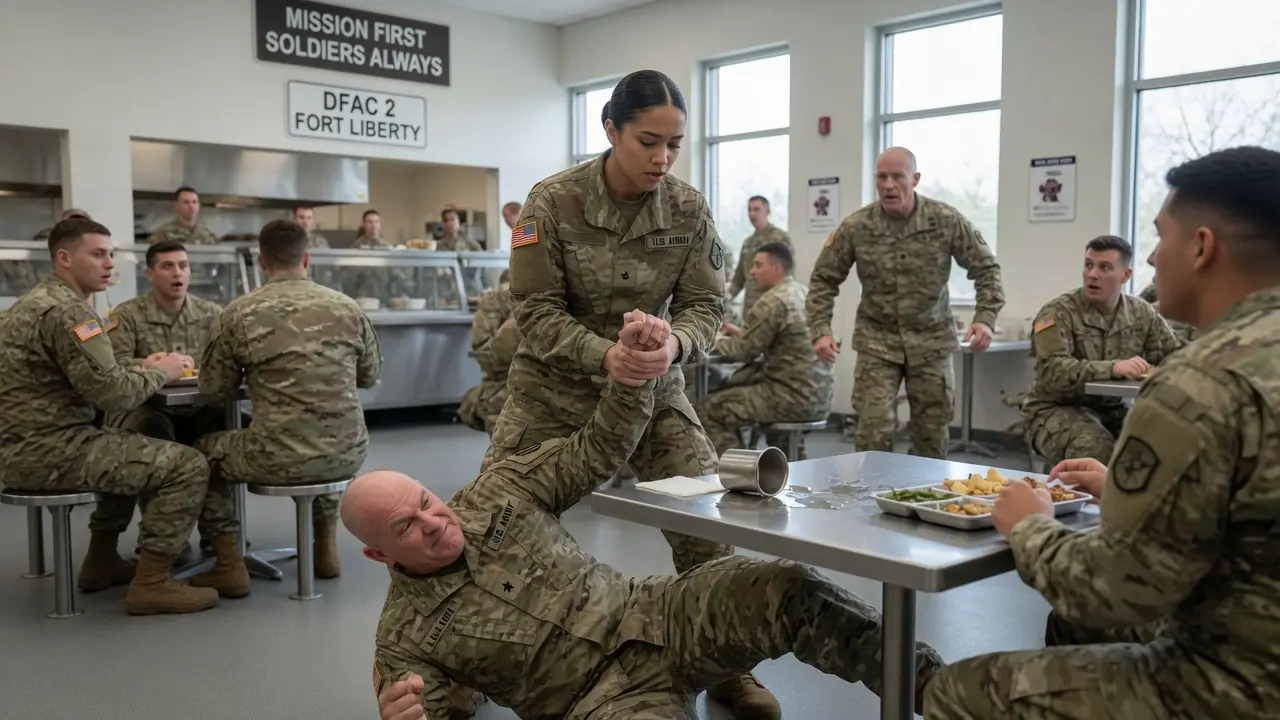
Mara stepped inside the arc.
Displaced air moved the collar of her shirt.
She pivoted.
Her hip settled beneath his center of gravity.
Her grip locked.
For one instant, all the momentum belonged to Tanner.
Then Mara redirected it.
The massive sergeant left the floor.
Surprise replaced anger in his face while gravity seized him.
His back struck the mat with a deep, flat impact that silenced the room.
Mara followed him down, controlled his arm, and placed one knee near his shoulder without pressing her full weight.
“Never underestimate a soldier,” she said.
Tanner roared and twisted.
Mills moved closer.
“Control yourself.”
Mara released the arm and stepped back.
The engagement should have ended there.
Tanner made sure it did not.
He rolled to one knee and drove forward before Mills could reset them.
His fist came toward Mara’s face.
Closed.
Fast.
Illegal.
Mara leaned back just enough for the punch to pass.
Then her body changed.
The calm restraint disappeared.
Her left foot planted.
Her right leg moved in a short, explosive arc.
The heel of her foot struck Tanner high across the chest, below the shoulder and away from the throat.
The impact stopped his advance and sent him backward.
He struck the mat again.
This time, his head missed the floor because Mills caught part of his weight.
Mara followed.
She stood over Tanner with her right leg drawn back.
Her posture was balanced.
Her eyes were no longer merely calm.
They were somewhere else.
The room vanished for her.
The blue mat became broken concrete.
The fluorescent lights became desert sun.
Tanner’s gray shirt became the dark clothing of a man who had pinned her beneath collapsing beams while another soldier screamed behind her.
Her breath shortened.
Her foot lifted.
Samuel Quinn stood from the bench.
He did not shout her rank.
He did not call her name.
He said one word.
“Northstar.”
Mara froze.
Her raised foot remained suspended for half a second.
Then it lowered.
She stepped backward.
The room returned.
Mills moved between them.
“Engagement over!”
Tanner lay on the mat coughing, one hand pressed to his chest.
He was conscious.
Humiliated.
And suddenly frightened.
Mara stared at him.
Then at her own hands.
Major Hart approached slowly.
“Specialist Quinn, step off the mat.”
Mara did.
Samuel retrieved her uniform blouse and placed it around her shoulders.
No one spoke.
Tanner struggled to sit.
“She kicked me.”
Mills looked at him.
“You threw an illegal punch after the reset.”
“She could have killed me.”
Samuel’s expression became cold.
“No. She could have done considerably worse.”
Mara looked toward him.
“Uncle.”
He stopped.
Major Hart ordered the room cleared except for witnesses directly involved.
The soldiers left quietly.
No laughter followed them.
Private Bennett remained near the doorway until Mara nodded that he should go.
Tanner was examined by a medic.
The kick had bruised his chest but broken no bones.
He demanded that Mara be arrested.
Major Hart recorded the request without comment.
Inside a small briefing room, Mara sat across from First Sergeant David Cole, Major Hart, Samuel Quinn, and Sergeant First Class Mills.
Cole had returned from the battalion meeting after receiving three calls about the incident.
He looked exhausted and angry.
“Start at the beginning.”
Mara described the mess-hall confrontation.
She omitted emotion.
She reported words, times, positions, and witnesses.
Mills described the unauthorized punch.
Major Hart confirmed that Tanner initiated the escalation.
Then Cole looked at Samuel.
“What was ‘Northstar’?”
Samuel glanced at Mara.
She answered.
“A grounding command.”
“For what?”
Silence settled over the room.
Mara placed both hands flat on the table.
“Post-traumatic response.”
First Sergeant Cole’s anger shifted.
“Is that documented?”
“Yes.”
“Why wasn’t I informed?”
“You were informed that I had a medical accommodation related to advanced combatives exposure. You were not authorized to receive the full operational record.”
Cole leaned back.
“Operational?”
Samuel folded his hands over the cane.
“Mara was assigned to a joint personnel-recovery unit.”
Mills stared at her.
Her transfer file said communications support.
Samuel continued.
“Her official specialty was communications. Her actual role included field extraction, close protection, emergency medicine, and resistance training.”
Cole’s eyes moved toward the scar on Mara’s back.
“What happened?”
Mara answered before Samuel could.
“Three years ago, our team entered a damaged compound to recover two captured aid workers. The building collapsed during contact.”
Her voice remained even.
“We lost four people.”
“Were you injured?”
“Yes.”
“Did you complete treatment?”
“I completed the required program.”
Samuel’s jaw tightened.
“Required is not the same as complete.”
Mara looked at him.
“This is not the place.”
Cole noticed the tension.
“Why transfer here?”
Mara took a breath.
“Because I requested ordinary duty.”
Mills looked confused.
“You went from personnel recovery to a conventional communications unit?”
“I wanted to train soldiers without being sent back into classified operations.”
“And no one knows?”
“Very few.”
Major Hart opened Mara’s restricted personnel supplement.
A commendation summary appeared on the first page.
Two Silver Stars.
A Soldier’s Medal.
A Purple Heart.
Several lines remained redacted.
Cole read silently.
Then he closed the file.
“The kick was controlled?”
Mills nodded.
“She redirected the strike into the upper chest. It was forceful but not targeted at the head, neck, or knee.”
“And the second movement?”
Mills hesitated.
“She prepared another strike after Tanner was down.”
Mara looked at the table.
“I lost situational awareness for approximately two seconds.”
Samuel spoke.
“And responded to the stop command.”
Cole studied her.
“Would you have stopped without it?”
Mara’s eyes remained lowered.
“I don’t know.”
The honesty changed the room.
Major Hart asked the next question.
“Why did you accept Tanner’s challenge if you knew there was a risk?”
Mara looked toward the wall.
“Because he hurt other soldiers.”
“That does not make you responsible for confronting him physically.”
“No.”
“Then why?”
Mara’s fingers curled once.
“Because reporting systems failed them.”
Cole’s face tightened.
“How many complaints?”
Mills answered.
“Informal concerns have come up.”
“Informal?”
“Soldiers said Tanner trained too aggressively.”
“Were incident reports filed?”
“One after Nolan’s shoulder injury.”
“What happened?”
Mills looked uncomfortable.
“Tanner stated Nolan refused to tap. Two witnesses supported Tanner.”
Mara looked at him.
“Did they support him willingly?”
No one answered.
Cole opened a second file on his tablet.
Tanner had three documented training injuries associated with unsupervised sessions.
Each had been treated separately.
No one had reviewed them as a pattern.
The problem did not begin when Mara kicked him.
It had been growing beneath the unit’s routine for months.
Tanner understood how to create fear without leaving evidence senior leaders could easily use.
Mara had understood something else.
Bullies became powerful when everyone treated each incident as isolated.
The formal investigation began the following morning.
Forty-three soldiers were interviewed.
At first, most claimed they had seen little.
Then Private Bennett provided a video.
He had started recording after Tanner struck the mess-hall table the second time.
The footage captured the challenge, the insults, and Tanner’s attempt to turn the dining room into an audience.
Other soldiers followed.
One provided messages in which Tanner ordered him to attend late-night “corrective training.”
Another described being choked unconscious after tapping.
Specialist Nolan admitted that Tanner threatened to ruin his evaluation if he reported the shoulder injury honestly.
The two witnesses who had supported Tanner changed their statements.
“He told us everyone would think we were weak,” one said.
The investigation expanded to leadership.
Why had no one acted?
Why were unscheduled combatives sessions allowed?
Why had injury patterns not been reviewed?
The answer was not a single corrupt officer.
It was convenience.
Tanner produced high physical-fitness scores.
He volunteered for difficult tasks.
He spoke confidently during briefings and knew when senior leaders were watching.
His victims were usually young, uncertain, and afraid of appearing weak.
Supervisors saw pieces.
No one assembled them.
Tanner was suspended from training duties.
He received a formal no-contact order involving Mara and several other soldiers.
His attorney argued that the mat incident proved Mara was the true danger.
The video weakened that claim.
It showed Mara releasing him after the legal takedown.
It showed Tanner rising and throwing the illegal punch.
It also showed her raised leg after he fell.
That part could not be ignored.
Mara faced a separate medical and command review.
She was not punished for defending herself.
She was temporarily removed from live combatives training because of the dissociative response.
Mara accepted the decision without argument.
Samuel did not.
He found her alone behind the communications building two days later.
She sat on a low concrete wall, watching soldiers cross the parade field.
“You knew they would remove me,” she said.
“I knew they would protect you.”
“From training?”
“From pretending nothing happened.”
Mara looked at him.
“You should not have told them about the unit.”
“They had clearance.”
“That was my history.”
“It became relevant when you nearly continued.”
Her jaw tightened.
“I stopped.”
“When I used Northstar.”
“I would have stopped.”
“You said you didn’t know.”
Mara stood.
The movement brought pain across her back.
Samuel noticed.
“You still favor the left side when you’re angry.”
“I’m not angry.”
“You always were a terrible liar.”
She turned away.
Samuel tapped the cane against the pavement.
The cane was not age alone.
A bullet had destroyed part of his right knee during a rescue mission in 1989. Mara had grown up watching him adapt without apologizing for the limp.
He had taught her to fight.
He had also taught her when not to.
“I failed you,” he said.
Mara turned.
“What?”
“After the compound.”
“You visited every week.”
“I talked about recovery as though it were another mission. Complete the therapy. Pass the evaluation. Return to duty.”
Samuel looked toward the field.
“I taught you that control meant never needing help.”
“You taught me to survive.”
“Survival is the first task.”
He met her eyes.
“It is not the whole life.”
Mara sat again.
For the first time since the incident, her composure cracked.
“I saw him.”
“Tanner?”
“No.”
Her voice became smaller.
“Rafiq.”
Samuel knew the name.
The man inside the compound.
The one who attacked Mara while the roof collapsed around them.
“He was on the mat,” she continued. “For two seconds, I knew exactly where I was, but I also knew I was there.”
Samuel sat beside her.
“Both places.”
“Yes.”
“That is what memory can do after trauma.”
“I could have hurt Tanner.”
“You did hurt him.”
“I could have done worse.”
“Yes.”
She looked at her hands.
“I don’t want to be that person.”
Samuel’s voice softened.
“You are not the worst thing your body prepared to do.”
Mara said nothing.
“You are the choice you made when you heard the command.”
“What happens when nobody is there to say it?”
“Then we teach you how to say it to yourself.”
Mara returned to treatment voluntarily.
This time, she did not approach it as an obstacle to clear.
She worked with a military psychologist who specialized in operational trauma. They rebuilt grounding techniques around sound, position, and breath.
Northstar remained the emergency word.
But it stopped belonging only to Samuel.
Mara learned to recognize the narrowing of her vision before the past replaced the present.
She also began speaking with the soldiers Tanner had targeted.
Not as an investigator.
As someone who understood the shame of losing control over a situation and blaming yourself afterward.
Specialist Nolan met her in the rehabilitation gym.
His shoulder had healed physically.
He still avoided combatives training.
“You embarrassed him,” Nolan said.
“That was not the goal.”
“It felt good.”
“It shouldn’t.”
He frowned.
“Why not?”
“Because humiliation is the weapon he used.”
Mara adjusted the resistance band attached to his arm.
“If we enjoy becoming him, he still teaches the lesson.”
Nolan considered that.
“You could train us.”
“I’m currently restricted.”
“When you’re not.”
“Perhaps.”
The command eventually court-martialed Tanner for assault, maltreatment of subordinates, making threats, and false statements.
He did not receive a dramatic public punishment in front of the unit.
Military justice moved through documents, testimony, and hearings.
Some soldiers found that disappointing.
They wanted to see a bully broken as publicly as he had tried to break others.
Mara did not.
She testified.
She described the mess-hall confrontation and the mat incident without exaggeration.
Tanner’s attorney asked whether her hidden background gave her an unfair advantage.
Mara answered calmly.
“Training is always an advantage.”
“Did Staff Sergeant Tanner know your qualifications?”
“No.”
“So he believed he was sparring with an ordinary communications specialist?”
“There is no such thing as an ordinary soldier on a controlled training mat.”
The attorney shifted.
“Did you enjoy proving him wrong?”
“No.”
“You expect this panel to believe you felt no satisfaction?”
Mara looked toward Tanner.
“I felt relief when he stopped.”
“And when you stood over him?”
“I was not seeing him.”
The room became quiet.
She explained the trauma response.
She did not hide it to make herself appear invulnerable.
That honesty mattered.
The panel found Tanner guilty on most charges.
He was reduced in rank, confined, and discharged from the Army under conditions that ended his military career.
The investigation also resulted in disciplinary action for supervisors who ignored warning signs.
New policy required formal oversight for all combatives sessions.
Injury reports would be reviewed collectively rather than one at a time.
Anonymous reporting channels were strengthened.
No policy could guarantee courage.
But the unit would no longer make silence the easiest option.
Three months later, Mara returned to the combatives room.
She did not come to fight.
She came to teach.
Sergeant First Class Mills stood beside her while twenty soldiers formed a semicircle around the mat.
Private Bennett was among them.
So was Nolan.
Mara wore training clothes and no medals.
Most still did not know the full details of her former assignment.
That was intentional.
She began with a simple wrist release.
Then a controlled fall.
Then the proper way to stop when a partner tapped.
“Strength matters,” she told them. “So does speed. But neither is permission.”
She selected Bennett as her training partner.
He looked terrified.
“You’ll be fine,” she said.
“That is what people say before something painful.”
“Then listen carefully.”
She showed him how to maintain balance.
How to redirect pressure without injuring a joint.
How to recognize when technique turned into punishment.
At the end of the session, Nolan raised his hand.
“What should you do when someone stronger corners you?”
Mara looked at the blue mat.
The same edge where Tanner once stood over her.
“First, decide whether you need to fight.”
“And if you do?”
“Create space. Protect your head. Use the minimum force needed to escape.”
Nolan smiled faintly.
“That isn’t what you did to Tanner.”
“No.”
The room became still.
“I allowed anger and history into the decision.”
She looked at each soldier.
“My first throw was controlled. My response to his punch was effective. The next strike would not have been necessary.”
Many instructors would have hidden that admission.
Mara used it.
“Skill does not excuse losing control. It creates a greater responsibility to maintain it.”
After training, Captain Elena Ruiz, the company commander, approached her.
“I received a request from the advanced combatives school.”
Mara packed her gloves.
“For what?”
“They want you to help develop a course on trauma-aware training and instructor misconduct.”
“No.”
Ruiz smiled.
“That was quick.”
“I just returned to duty.”
“They are not asking you to leave permanently.”
“I don’t want to become a case study.”
“They want you as an instructor.”
Mara stopped packing.
Captain Ruiz handed her the request.
At the bottom was Samuel Quinn’s handwritten note.
Teach them the part I forgot.
Mara read it twice.
Then she folded the page.
“I’ll consider it.”
“That is almost enthusiastic.”
“Do not become accustomed to it.”
A year later, the course became mandatory for senior combatives instructors across several training installations.
It did not teach soldiers to become less aggressive when lives depended on action.
It taught instructors to distinguish aggression from abuse.
It taught them that tapping ended an engagement.
That humiliation was not leadership.
That physical dominance could not be used to replace competence.
Mara opened every course with footage from an unnamed training room.
The video showed a large soldier throwing an illegal punch.
It showed a smaller soldier countering.
Then it froze on the moment she stood above him with her leg drawn back.
She never identified herself.
“What do you see?” she asked.
Students gave different answers.
Superior technique.
Loss of control.
Trauma.
Self-defense.
Excessive force.
Mara allowed the debate.
Then she played the final second.
Samuel’s voice said, “Northstar.”
The soldier lowered her foot.
Mara faced the class.
“The most important movement in this video is not the throw.”
She advanced one frame.
“It is not the kick.”
Another frame.
“It is this.”
The raised foot touched the mat.
“The decision to stop.”
Years passed.
Stories about the confrontation grew throughout Fort Ashford.
New soldiers claimed Mara knocked Tanner unconscious with one kick.
Others said she had been an assassin.
Some insisted she was secretly a colonel.
Bennett corrected them whenever he heard the exaggerations.
“She was a communications specialist.”
Nobody believed him.
He would shrug.
“That was the point.”
Mara eventually became a warrant officer and helped redesign training programs across the Army.
She remained small.
She still wore the same unreadable expression when people underestimated her.
But she no longer treated vulnerability as classified information.
When younger soldiers asked about the scar across her back, she did not always change the subject.
Sometimes she told them survival could leave the body prepared for battles that had already ended.
Sometimes she told them asking for help was part of discipline.
And sometimes she simply said it was an old injury and returned to work.
Not every truth belonged to every audience.
Samuel attended her promotion ceremony with the wooden cane resting beside his chair.
Afterward, they stood near the edge of the parade field.
“You taught them well,” he said.
“I had a difficult instructor.”
“I meant yourself.”
Mara looked toward the young soldiers leaving formation.
“You think I’ve recovered?”
Samuel considered the question.
“No.”
She looked at him.
“I think recovery is something people practice.”
Mara nodded slowly.
“Like control?”
“Exactly.”
She touched the new insignia on her uniform.
“Do you still carry the Northstar word for me?”
“Always.”
“What happens when you’re gone?”
Samuel looked toward her.
“You carry it for yourself.”
The answer stayed with her.
The truth about Mara Quinn was not that a tiny woman possessed a secret ability to destroy larger men.
Size could be overcome by timing, leverage, and training. There was nothing supernatural about that.
Her chilling secret was more human.
She had survived a place where hesitation killed people.
Her body remembered that lesson even when the danger in front of her did not require it.
Staff Sergeant Brock Tanner believed her silence meant weakness.
He believed the cane beside the mat represented age.
He believed laughter meant loyalty.
And he believed power belonged to whoever occupied the most space.
Mara proved him wrong with one throw.
But the lesson that changed the unit came after the kick.
She stood above a fallen man while anger, memory, and training demanded one more strike.
Then a single word reached her.
She lowered her foot.
Because the strongest soldier in the room was not the person capable of doing the most damage.
It was the one who could stop when the threat was over.